
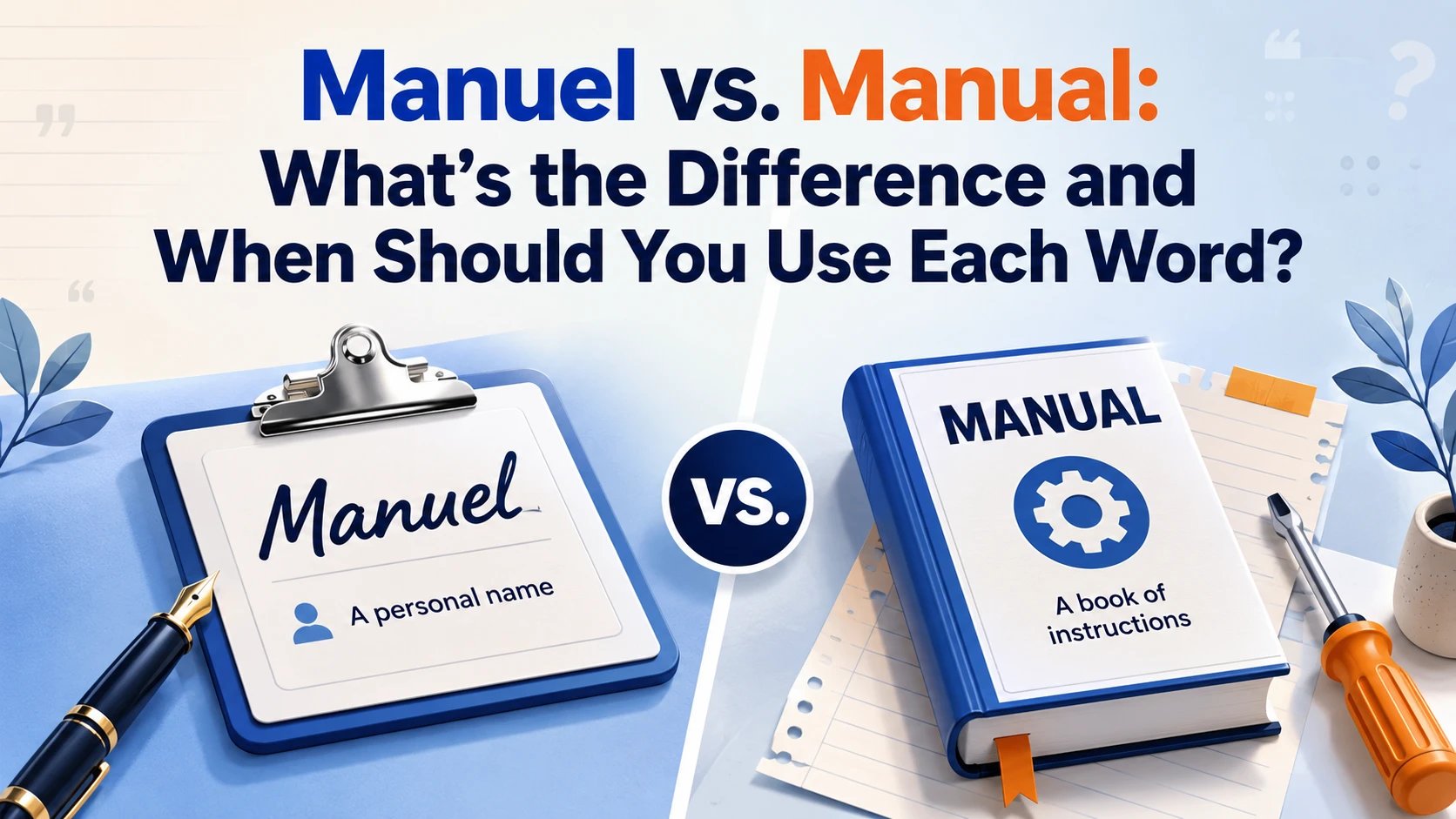
Manuel and manual look similar, but they have different meanings and uses. This small spelling difference can cause confusion in emails, academic assignments, business documents, SEO content, and everyday writing. Because the words share many of the same letters and may sound similar to some learners, writers sometimes use one when they mean the other. Understanding the difference helps you choose the correct word and communicate your meaning clearly.
In most cases, manual is a common English word. It can refer to an instruction book, a guide, or something operated or completed by hand. For example, you might read a car manual, follow a user manual, or perform manual work. Manuel, however, is usually a proper noun and a masculine given name, especially in Spanish-speaking cultures. Since it refers to a person, it normally begins with a capital M.
The easiest way to remember the difference is to check the context. If the sentence discusses instructions, a handbook, a machine, or work done by hand, manual is probably the correct choice. If it identifies a person, Manuel is the appropriate spelling. This guide explains their meanings, capitalization, grammar roles, sentence usage, and common mistakes through clear examples, comparisons, and practical tips.
Quick Answer: Manuel vs Manual
Here’s the simplest explanation possible:
- Manuel is a male first name.
- Manual refers to instructions, guidebooks, or something done by hand.
Example
| Correct Usage | Meaning |
| Manuel sent the report yesterday. | Refers to a person |
| Please read the user manual carefully. | Refers to an instruction guide |
One word identifies a human being.
The other describes instructions or hand-operated work.
That’s the entire difference in plain English.
Why People Confuse Manuel and Manual
The confusion usually comes from three things:
- The words look nearly identical
- Fast typing causes accidental swaps
- Spellcheck often misses the error
Your brain processes familiar word shapes quickly. When you type in a hurry, fingers sometimes outrun logic. Unfortunately, autocorrect doesn’t always save the day.
Common Mistake
| Incorrect | Correct |
| Employee Manuel | Employee manual |
| Manuel transmission | Manual transmission |
Because both words exist in English usage, grammar software may not flag the mistake immediately.
That’s why context matters.
What Does Manual Mean?
The word manual works as both:
- A noun
- An adjective
Most people encounter the noun version daily without realizing it.
Manual as a Noun
As a noun, manual means:
A book, document, or guide containing instructions.
You’ll see manuals everywhere:
- Cars
- Smartphones
- Software
- Appliances
- Workplace training systems
Without manuals, modern technology would confuse people instantly. Imagine buying a drone with zero instructions. Within ten minutes, it would probably decorate a nearby tree branch permanently.
Examples of Manual as a Noun
- Read the instruction manual before installation.
- The employee manual explains company policies.
- I downloaded the repair manual online.
Common Types of Manuals
Different industries use different manuals depending on their needs.
| Type of Manual | Purpose |
| User Manual | Explains product usage |
| Employee Manual | Defines workplace rules |
| Safety Manual | Covers hazard prevention |
| Training Manual | Teaches procedures |
| Technical Manual | Provides operational details |
Manual as an Adjective
As an adjective, manual describes something done by hand rather than automatically.
Examples
- Manual labor
- Manual transmission
- Manual controls
- Manual data entry
In simple terms:
A human performs the task directly.
What Does Manuel Mean?
Unlike manual, Manuel is usually a proper noun.
It’s a male first name commonly used in:
- Spain
- Portugal
- Mexico
- Latin America
- The Philippines
The name comes from “Emmanuel,” which means:
“God is with us.”
How Manuel Is Used in Sentences
Because Manuel is a person’s name, it should always begin with a capital letter.
Correct Examples
- Manuel joined the meeting late.
- I spoke with Manuel yesterday.
- Manuel submitted the project proposal.
Famous People Named Manuel
Several well-known public figures carry the name Manuel.
| Name | Known For |
| Manuel Neuer | German soccer goalkeeper |
| Manuel Pellegrini | Chilean football manager |
| Manuel Noriega | Former Panamanian ruler |
| Manuel Garcia-Rulfo | Mexican actor |
These examples help reinforce that Manuel refers to a person, not an instruction booklet.
Manuel vs Manual: The Main Difference Explained
Here’s the easiest way to remember the distinction:
| Word | Meaning | Word Type |
| Manuel | A person’s name | Proper noun |
| Manual | Instructions or hand-operated work | Noun/adjective |
One refers to a human.
The other refers to instructions or physical operation.
That’s it.
Yet this tiny spelling difference creates thousands of writing mistakes every year.
How to Use Manual Correctly in Writing
Using a manual properly becomes easy once you understand its two roles.
Using Manual as a Noun
When manual means “instruction guide,” use it as a noun.
Examples
- The software manual helped solve the issue.
- Always read the safety manual first.
- The repair manual included detailed diagrams.
Using Manual as an Adjective
When a manual describes physical operation, it functions as an adjective.
Examples
- She drives a manual car.
- Manual labor requires physical effort.
- The office still uses manual filing systems.
How to Use Manuel Correctly in Writing
Manuel functions only as a proper name.
You cannot use it:
- As a verb
- As an adjective
- As a common noun
Correct Examples
- Manuel works in accounting.
- I had lunch with Manuel.
- Manuel called customer support.
Incorrect Example
- Please Manuel the process.
That sentence falls apart immediately because Manuel cannot function as an action word.
Common Manuel vs Manual Mistakes
People often confuse these words in professional writing.
Workplace Errors
| Incorrect Sentence | Correct Sentence |
| Please read the employee Manuel. | Please read the employee manual. |
| Manual emailed the report. | Manuel emailed the report. |
Automotive Errors
Car discussions often produce this typo:
| Incorrect | Correct |
| Manuel transmission | Manual transmission |
Unless a mechanic named Manuel personally operates your gearbox, you probably need “manual.”
Why Spellcheck Misses Manuel vs Manual Errors
Spellcheck struggles because:
- Both words are real
- Both are spelled correctly
- Context determines correctness
For example:
“The employee Manuel is important.”
No spelling issue exists technically. However, the sentence still sounds strange to human readers.
That’s why proofreading matters even in the age of AI tools and grammar software.
Manual vs Automated: Important Difference
The adjective “manual” appears constantly in business and technology discussions.
Manual Process
A human performs the task directly.
Examples
- Manual bookkeeping
- Manual scheduling
- Manual inspections
Automated Process
Software or machines handle tasks automatically.
Examples
- Automated payroll
- Automated testing
- AI customer support
Manual vs Automated Comparison
| Feature | Manual | Automated |
| Human Involvement | High | Low |
| Speed | Slower | Faster |
| Flexibility | Higher | Lower |
| Error Risk | Human error possible | System error possible |
Easy Memory Tricks for Manuel vs Manual
Simple memory tricks help eliminate confusion permanently.
Trick One: Manuel Is a Name
Think about similar names:
- Samuel
- Daniel
- Miguel
- Manuel
That pattern helps your brain recognize Manuel as a person.
Trick Two: Manual Contains “AL”
Think:
InstructionAL
Both words share “AL,” which helps connect manual with instructions.
Why Correct Word Choice Matters
Small spelling mistakes affect:
- Credibility
- Professionalism
- Readability
- User trust
In business writing, tiny errors often create surprisingly large impressions.
Imagine a software company publishing:
“Download the installation Manuel.”
Readers notice immediately.
Good writing feels smooth and invisible. Mistakes pull readers out of the experience like potholes on a highway.
Conclusion
Understanding the difference between Manuel and Manual is important for clear and accurate English writing. Even though both words have similar spelling and close pronunciation, their meanings are completely different. Manuel is usually a Spanish name and a proper noun, while manual is an English word connected to instruction books, instruction manuals, handbooks, manual jobs, and hand-operated devices. Using the wrong word in professional communication, academic writing, SEO content, or an important email can create word confusion, reduce professional credibility, and affect overall communication clarity. From my experience in professional writing and instructional writing, the easiest way to avoid mistakes is to focus on contextual meaning, proper capitalization, and sentence placement. A strong understanding of English grammar, grammar learning, vocabulary learning, and contextual interpretation helps learners improve writing accuracy, avoid spelling confusion, and use the correct word naturally.
FAQs
Q1. What Is the Main Difference Between Manuel and Manual?
Manuel is usually a Spanish name used for a male person, while manual is an English word used for instruction books, instruction guides, handbooks, or work done by hand. The difference mainly depends on contextual meaning and capitalization.
Q2. Is Manuel a Wrong Spelling of Manual?
No, Manuel is not a spelling mistake when referring to a real person named Manuel. However, in general usage, manual is the correct term for instruction manuals, manual devices, or manual jobs in standard English.
Q3. Why Do People Confuse Manual and Manuel?
People often get confused because the words have similar spelling, close pronunciation, and almost the same visual structure in English writing. This creates spelling confusion, especially for students, writers, learners, and content creators.
Q4. How Can I Remember the Correct Usage of Manual and Manuel?
A simple trick is to remember that Manual usually explains something, such as an instruction manual or guide, while Manuel usually identifies a real person. This practical method improves writing confidence and communication skills.
Q5. Why Is Correct Capitalization Important in Manual vs Manuel?
Correct capitalization rules help readers understand the intended meaning immediately. Manual with lowercase letters is a common noun, while Manuel with an uppercase letter is a proper noun. Using the correct form improves sentence accuracy, writing clarity, and professional communication.
