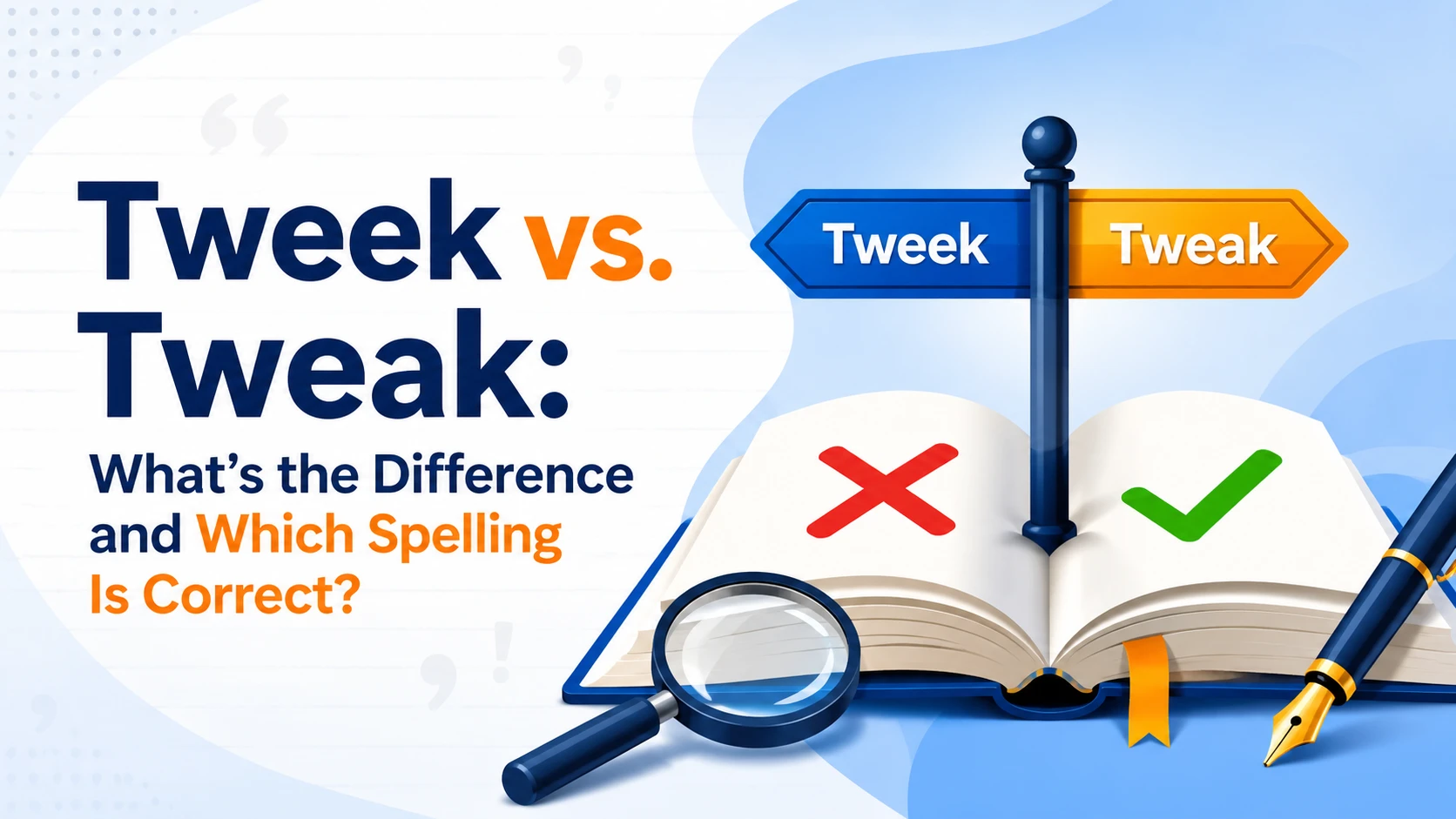
Tweek vs. Tweak can look confusing because the words have similar spelling patterns and are often pronounced in a similar way. This confusion commonly appears when people write emails, essays, reports, software documentation, social media posts, or professional content. You may type “tweek the settings” and then wonder whether the spelling is correct. In standard English, tweak is the accepted spelling when you mean to make a small adjustment, improvement, or correction. Tweek is generally treated as a misspelling in this context.
The word tweak can function as both a verb and a noun. As a verb, it means to make a small change to improve how something works, looks, or performs. For example, you might tweak a software setting, tweak a sentence for clarity, or tweak a design before publishing it. As a noun, a tweak refers to the small adjustment itself. Although Tweek may appear as a name, character, or informal reference in certain contexts, it is not the standard spelling for describing a minor change or refinement.
The easiest way to remember the difference is to focus on meaning. If you are talking about adjusting, refining, fixing, or improving something, tweak is the correct word. Learning this distinction can help you avoid spelling mistakes and write with greater accuracy and confidence. In this guide, you’ll learn the meaning of tweak, understand why tweek causes confusion, explore clear examples, and discover simple tips for choosing the correct spelling in everyday and professional writing.
Quick Answer: Tweek vs Tweak
Here’s the simple version:
| Word | Correct in Standard English? | Meaning |
| Tweak | Yes | Small adjustment or improvement |
| Tweek | Usually no | Common misspelling or name |
Correct Example
- We need to tweak the website layout.
Incorrect Example
- We need to tweek the website layout.
In professional writing, tweak is the correct spelling.
What Does Tweak Mean?
The word tweak means:
To make a small change, adjustment, or improvement.
People use it constantly in:
- Technology
- Business
- Writing
- Design
- Gaming
- Marketing
- Everyday conversation
A tweak usually improves something slightly rather than changing it completely.
Think about adjusting a crooked picture frame. You don’t tear down the wall. You simply nudge things into place.
That’s a tweak.
Tweak Meaning in Everyday Language
People use “tweak” naturally because it sounds flexible and conversational.
Common Examples of Tweak
- Tweak a recipe
- Tweak website settings
- Tweak a blog headline
- Tweak a workout plan
- Tweak a business strategy
- Tweak lighting in a photo
The word suggests:
- Precision
- Small refinements
- Smart improvements
Not giant dramatic changes.
How to Use Tweak in a Sentence
“Tweak” works as both:
- A verb
- A noun
That flexibility makes it extremely common in modern English.
Tweak as a Verb
When used as a verb, tweak describes the action of adjusting something.
Examples
- I tweaked the presentation before the meeting.
- She tweaked the recipe with extra garlic.
- The developer tweaked the app settings.
- We need to tweak the landing page for better conversions.
Tweak as a Noun
As a noun, tweak refers to:
The small adjustment itself.
Examples
- That tweak improved page speed.
- A small tweak fixed the issue.
- The latest tweak increased engagement.
What Does Tweek Mean?
Here’s where confusion begins.
In most situations, tweek is simply a misspelling of “tweak.”
However, there are rare exceptions.
“Tweek” may appear as:
- A fictional character name
- A username
- A surname
- Internet slang
- A brand name
Still, if you mean:
“Make a small adjustment”
then tweak the correct spelling.
Why People Spell Tweak as Tweek
English spelling causes this mistake constantly.
Why?
Because the long “E” sound often uses:
- ee
- ea
For example:
- Week
- Seek
- Green
- Speak
- Freak
So naturally, many people assume:
tweak = tweek
Your brain searches for familiar spelling patterns automatically. Unfortunately, English spelling rules sometimes behave like a GPS that confidently tells you to drive into a lake.
Tweek vs Tweak: Side-by-Side Comparison
| Feature | Tweak | Tweek |
| Real dictionary word | Yes | Usually no |
| Correct standard spelling | Yes | No |
| Common use | Adjustments and improvements | Misspelling or name |
| Professional writing acceptable | Yes | No |
| Part of speech | Noun and verb | Usually proper noun |
Which Is Correct: Tweek or Tweak?
The correct spelling is:
Tweak
You should use it in:
- Emails
- Articles
- Technical writing
- Academic papers
- Social media posts
- Business communication
Correct Usage
- Let’s tweak the design slightly.
Incorrect Usage
- Let’s tweek the design slightly.
That single vowel changes polished writing into a visible typo.
Tweek in Pop Culture
Many people recognize “Tweek” because of:
South Park
The show includes:
Tweek Tweak
That exposure helped spread the unusual spelling online.
However, fictional character names do not change standard English spelling rules.
Using “tweek” in professional writing still looks incorrect.
The Origin of the Word Tweak
The word “tweak” originally referred to:
A sharp pull, pinch, or twist.
Over time, the meaning evolved into:
- Fine-tuning
- Refining
- Small improvements
- Minor adjustments
Language changes constantly. Words stretch and adapt over generations like old sweaters that somehow survive every winter.
Why Tweak Became So Popular
Modern life revolves around tweaking things.
Businesses tweak strategies.
Designers tweak layouts.
Developers tweak code.
Content creators tweak headlines.
Gamers tweak settings.
Tiny improvements often create huge results. That’s why the word exploded in popularity during the digital era.
Tweak in Technology
Technology professionals use “tweak” constantly because software almost never launches perfectly on day one.
Developers tweak:
- Performance
- User interfaces
- Security settings
- Databases
- Mobile responsiveness
- Loading speeds
Common Tech Tweaks
| Area | Example |
| Web Design | Adjusting spacing |
| SEO | Refining keywords |
| Apps | Improving responsiveness |
| Gaming | Modifying graphics settings |
| Cybersecurity | Tweaking firewall rules |
In tech culture, tweaking means:
Improving precision gradually.
Tweaking in SEO and Marketing
SEO experts practically live inside a world of tiny tweaks.
Even small adjustments can improve:
- Rankings
- Click-through rates
- Conversions
- Engagement
Common SEO Tweaks
- Updating page titles
- Improving meta descriptions
- Refining keyword placement
- Compressing images
- Adjusting headings
- Improving internal linking
Digital marketing often feels like tuning a race car. One tiny adjustment can noticeably improve performance.
Real Case Study: One Tiny Tweak That Increased Conversions
A software company changed a CTA button from:
- “Submit”
to:
- “Get My Free Trial”
That tiny tweak increased conversions by more than 20%.
Why?
Because the second phrase felt:
- More personal
- More valuable
- More action-oriented
Small wording tweaks can dramatically influence behavior.
Tweak in Writing and Editing
Writers tweak content constantly.
Rarely does strong writing appear perfectly on the first attempt.
Professional writers often tweak:
- Headlines
- Sentence flow
- Tone
- Formatting
- Word choice
- Readability
Editing usually involves layers of refinement rather than massive rewrites.
Like sculpting marble, good writing emerges by shaving away rough edges carefully.
Common Tweek vs Tweak Mistakes
People make the same errors repeatedly.
Incorrect vs Correct Usage
| Incorrect | Correct |
| Tweek the article | Tweak the article |
| Tweeking the design | Tweaking the design |
| Tweeked the settings | Tweaked the settings |
| Small tweek | Small tweak |
Why Spellcheck Sometimes Misses Tweek
Spellcheck tools fail occasionally because:
- Names confuse dictionaries
- User-added words interfere
- Context detection isn’t perfect
That’s why proofreading still matters.
Even advanced grammar tools occasionally stumble through language like a puppy sprinting across slippery kitchen tiles.
Pronunciation of Tweak
Most English speakers pronounce tweak like:
“Tweek”
Ironically, the incorrect spelling sounds exactly like the correct word.
That phonetic similarity causes most of the confusion.
Tweak vs Adjust vs Modify
These words overlap but carry different shades of meaning.
| Word | Meaning | Tone |
| Tweak | Small precise improvement | Conversational |
| Adjust | General correction | Neutral |
| Modify | Partial alteration | Formal |
| Optimize | Improve efficiency | Technical |
“Tweak” usually sounds:
- Smaller
- Smarter
- More flexible
Why Correct Spelling Matters
Spelling mistakes affect:
- Credibility
- Professionalism
- Readability
- Reader trust
Imagine visiting a marketing agency website that says:
“We tweek websites for businesses.”
That typo weakens trust immediately.
Good writing works like clean glass. Readers focus on the message instead of the smudges.
Easy Memory Tricks for Tweak
Simple tricks make the spelling easier to remember.
Think of Similar Words
“Tweak” shares the “ea” pattern with:
- Speak
- Freak
- Weak
That visual pattern helps reinforce correct spelling.
Remember What Tweaks Do
Tweaks improve details carefully.
That careful refinement matches the cleaner-looking “ea” spelling naturally.
Conclusion
Understanding Tweek vs Tweak becomes much easier once you focus on contextual meaning, correct spelling, and proper language usage. In standard English writing, Tweak is the accepted word used for fine tuning, adjusting settings, improving software, or making small corrections in a sentence, design, or system. Meanwhile, Tweek is mostly treated as a misspelling, informal variation, or pop culture reference in certain contexts. From professional writing and technical writing to social media writing and business writing, using the correct term improves writing accuracy, communication clarity, professional credibility, and overall spelling confidence. Strong grammar learning, vocabulary learning, proofreading skills, and contextual analysis help writers avoid common spelling mistakes, usage confusion, and embarrassing language mistakes. Whether you are drafting an important email, editing software documentation, or creating online content, understanding the real difference, meaning, and usage of these words improves your sentence accuracy, writing confidence, and communication effectiveness in every context.
FAQs
Q1. Is “Tweek” a Correct Word in Standard English?
No, Tweek is generally not accepted in standard English for formal or professional use. The correct spelling is usually Tweak, especially in professional communication, technical writing, essay writing, and business writing. However, Tweek may appear in slang terminology, informal language, or pop culture references.
Q2. What Does “Tweak” Mean in Writing and Communication?
The word Tweak usually means making a small adjustment, improvement, or correction. In English writing, it often refers to fine tuning, editing content, adjusting settings, improving software, or refining a sentence. It can function as both a verb and a noun depending on the sentence structure.
Q3. Why Do People Confuse Tweek and Tweak?
People confuse Tweek and Tweak because they have similar pronunciation, nearly identical spelling, and close visual appearance in text. This creates spelling confusion, usage confusion, and word identity confusion, especially during fast typing, online writing, and content editing.
Q4. How Can I Remember the Correct Spelling of Tweak?
A simple trick is to connect Tweak with improving or fixing something. If the sentence discusses adjusting settings, improving software, refining a sentence, or correcting a document, the correct word is almost always Tweak. This method improves writing confidence, spelling accuracy, and communication clarity.
Q5. Where Is the Word “Tweak” Commonly Used?
The word Tweak is commonly used in software documentation, professional writing, technical writing, digital communication, social media writing, and everyday English conversations. It appears frequently when discussing editing, fixing problems, improving performance, or making small changes in a system, sentence, design, or application.
