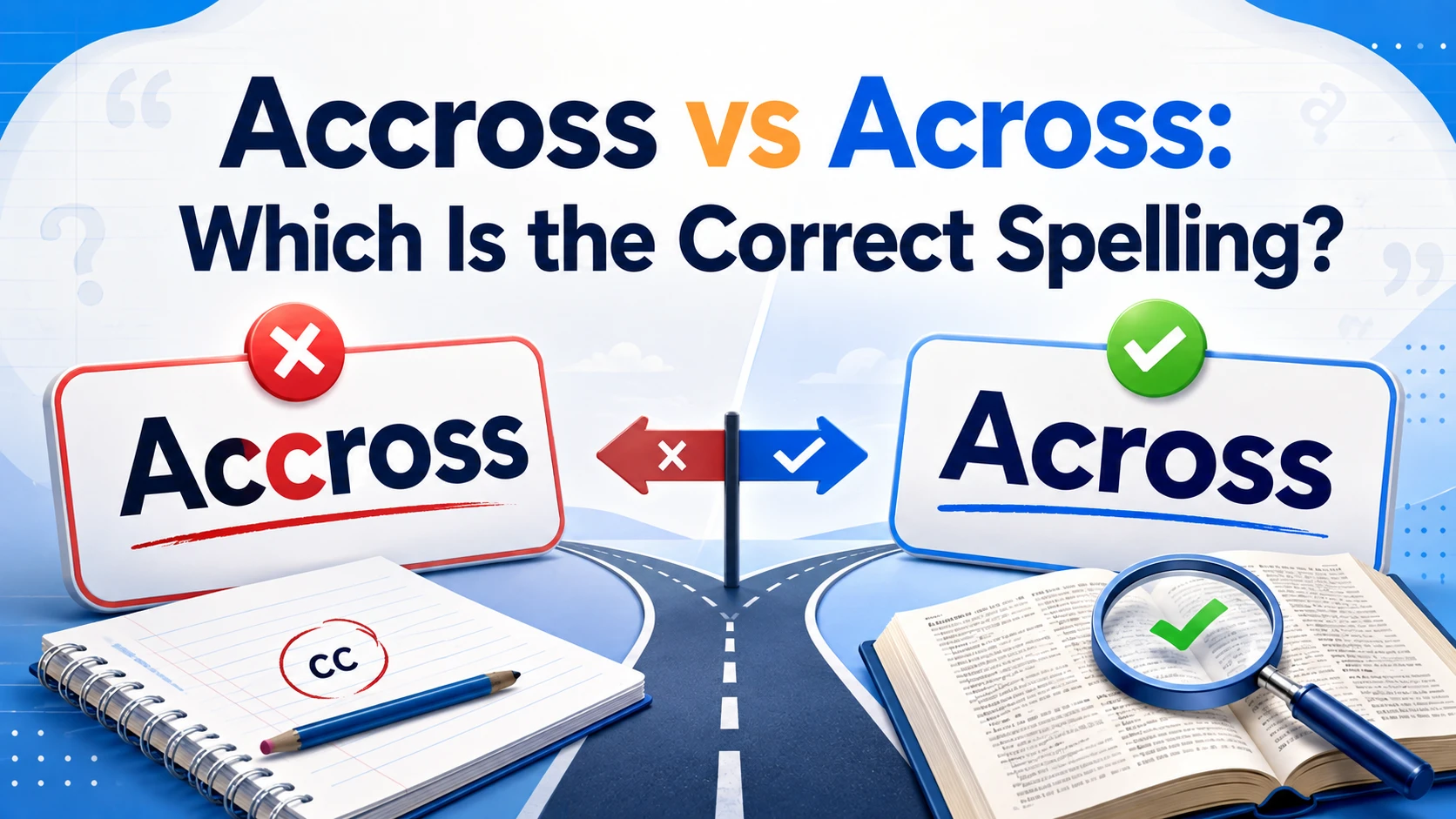
Across is the correct spelling, while accross is a common misspelling that appears in emails, school assignments, social media posts, and even professional documents. At first glance, the extra “c” seems harmless, but a small spelling error can affect readability, credibility, and even how others perceive your writing. If you’ve ever hesitated before typing this word, you’re not alone. Many fluent English speakers make the same mistake because the pronunciation doesn’t clearly reveal the correct spelling.
English spelling can be surprisingly inconsistent, which is why certain words cause confusion long after we’ve learned the basics. Across belongs to a group of frequently used words that people type automatically, making them especially prone to spelling mistakes. Understanding why the error happens is often more useful than simply memorizing the correct form. In this guide, you’ll learn the meaning of across, discover why accross is incorrect, compare it with similar words, and pick up practical techniques that help you remember the correct spelling every time.
Whether you’re a student, teacher, professional writer, job seeker, or someone who simply wants to write more confidently, this article is designed to answer every important question about accross vs across. You’ll find real-world examples, grammar explanations, comparison tables, usage tips, and expert recommendations that go beyond what most online guides offer. By the end, you’ll not only know which spelling is correct but also understand how to use across naturally and accurately in everyday English.
Quick Answer: Is It “Accross” or “Across”?
The short answer is simple:
| Word | Correct? | Meaning |
| Across | ✅ Yes | The correct English spelling used to describe movement, position, or something extending from one side to another. |
| Accross | ❌ No | A misspelling. It is not recognized as a standard English word. |
If you’re writing in American English, British English, Canadian English, or Australian English, the spelling remains the same:
✅ Across
There is no English dialect in which accross is accepted as the standard spelling.
Key takeaway: Whenever you’re unsure, remember that across contains only one “c” and two “s” letters.
The Correct Spelling at a Glance
The correct spelling is:
Across
Pronunciation:
/əˈkrɔːs/ (British English)
/əˈkrɔːs/ or /əˈkrɑːs/ (American English)
Although the pronunciation includes a strong “cross” sound, it does not justify adding another c. English spelling follows historical word development rather than pronunciation alone.
Why This Spelling Mistake Is So Common
Many spelling mistakes occur because writers rely on sound instead of spelling rules. The confusion between accross and across is a classic example.
Several factors contribute to this error:
- The double “ss” at the end encourages some people to double the preceding consonant.
- Many English words legitimately contain double c, such as:
- account
- accommodate
- occasion
- accessory
- Fast typing often leads people to insert an extra letter without noticing.
- Some learners mistakenly assume every stressed consonant should be doubled.
Professional editors often spot this error immediately because accross is among the most common spelling mistakes in everyday writing.
Expert Tip
If your writing software underlines accross with a red line, don’t simply accept the correction without understanding why. Learning the rule makes you less dependent on spellcheck and improves your long-term writing accuracy.
What Does “Across” Mean?
Understanding the meaning of across is just as important as spelling it correctly. Although it’s a short word, it has several related meanings depending on the context.
In most situations, across expresses the idea of moving, extending, or being positioned from one side of something to the other.
For example:
- She walked across the bridge.
- The bookstore is across the street.
- News spread across the country.
Each sentence uses the same word, but the relationship it describes is slightly different.
Definition in Modern English
Across generally means:
- from one side to another
- on the opposite side
- over the surface or width of something
- throughout an area, group, or period
It often functions as a preposition and sometimes as an adverb, depending on the sentence structure.
For example:
As a preposition
- The cat ran across the yard.
- We drove across the desert.
As an adverb
- Come across.
- The children ran across.
The meaning remains connected to movement or position.
Different Meanings Depending on Context
English speakers use across in several common ways.
Movement from One Side to Another
This is the most familiar use.
Examples:
- They swam across the river.
- She hurried across the parking lot.
- We cycled across town before sunset.
Here, the emphasis is on traveling from one side to another.
Position on the Opposite Side
Sometimes there is no movement at all.
Instead, across simply indicates location.
Examples:
- Our office is across the hall.
- The café sits across the road.
- His apartment is across from the library.
In these examples, across describes where something is located.
Extending Over an Area
The word can also describe something stretching from one side to another.
Examples:
- A large crack ran across the wall.
- A rainbow appeared across the sky.
- The banner stretched across the entrance.
The object isn’t moving. Instead, it occupies space from one side to the other.
Reaching or Affecting Many People or Places
Modern English frequently uses across figuratively.
Examples:
- The campaign gained support across Europe.
- The company operates across five continents.
- New policies apply across all departments.
Here, across means throughout or covering multiple places, groups, or regions rather than physical movement.
Did You Know?
Many business reports, news articles, and academic papers use across figuratively because it efficiently expresses broad coverage or widespread impact. Understanding this usage helps you read professional writing more confidently.
Is “Accross” Ever a Correct Word?
One of the most common questions people ask is whether accross was once an accepted spelling or whether it belongs to a regional variety of English.
The answer is straightforward:
No.
Accross is not a standard English word. It does not appear as a correct spelling in modern dictionaries, style guides, or educational references.
Whether you’re writing in:
- American English
- British English
- Canadian English
- Australian English
- New Zealand English
the accepted spelling is always:
Across
Why “Accross” Is Considered a Misspelling
English dictionaries are based on established usage rather than personal preference. Reputable references consistently recognize across as the only correct spelling.
The error usually happens because writers unconsciously apply spelling patterns from other English words that legitimately contain doubled consonants.
For instance:
| Correct Word | Why It Doesn’t Change “Across” |
| Account | The double c is part of the word’s historical spelling. |
| Access | The double c belongs to a different word origin. |
| Accommodate | Its spelling follows separate linguistic rules. |
| Across | Developed with a single c, so adding another is incorrect. |
This illustrates an important point:
English spelling isn’t governed by one universal doubling rule. Every word has its own spelling history, which is why memorizing common exceptions is often necessary.
When You Might Still Encounter “Accross”
Although incorrect, accross still appears in many places.
You may notice it in:
- first drafts
- handwritten notes
- student essays
- online forums
- informal text messages
- social media comments
- unedited blog posts
Seeing accross repeatedly online does not make it correct. Spelling mistakes spread easily because digital content isn’t always professionally edited.
Writing Tip
If you’re proofreading an important document, search specifically for “accross” before submitting your work. Catching this small mistake can instantly make your writing appear more polished and professional.
Accross vs Across: Side-by-Side Comparison
Although the difference between accross and across is only one letter, that extra “c” completely changes the word’s correctness. One is accepted by every major English dictionary, while the other is simply a spelling mistake.
The table below highlights the key differences.
| Feature | Across | Accross |
| Correct spelling | ✅ Yes | ❌ No |
| Recognized in dictionaries | ✅ Yes | ❌ No |
| Accepted in academic writing | ✅ Yes | ❌ No |
| Accepted in business writing | ✅ Yes | ❌ No |
| Used in published books | ✅ Yes | ❌ No (except as a typo) |
| Appropriate in exams | ✅ Yes | ❌ No |
| Used in all English varieties | ✅ Yes | ❌ No |
The rule is easy to remember:
If you are referring to movement, location, or something extending from one side to another, always write “across.”
Differences in Spelling
The only visual difference is one extra “c”, but that single letter determines whether the word is correct.
| Incorrect | Correct |
| accross | across |
Many people accidentally type the extra “c” because English contains numerous words with double consonants. However, across isn’t one of them.
Differences in Meaning
This comparison is surprisingly simple.
- Across has several accepted meanings related to movement, position, distance, or coverage.
- Accross has no meaning because it is not an English word.
For example:
✅ The children ran across the playground.
❌ The children ran accross the playground.
Only the first sentence is grammatically correct.
Differences in Usage
Because across is a common English word, you’ll find it in nearly every type of writing.
It appears in:
- novels
- newspapers
- academic journals
- legal documents
- business reports
- websites
- emails
- advertisements
- everyday conversations
By contrast, accross appears only as a typing or spelling error. Professional editors, teachers, and grammar checkers will immediately identify it as incorrect.
Correct vs Incorrect Examples
Seeing both spellings side by side makes the distinction easier to remember.
| ❌ Incorrect | ✅ Correct |
| We drove accross the state. | We drove across the state. |
| She looked accross the room. | She looked across the room. |
| A bridge goes accross the river. | A bridge goes across the river. |
| News spread accross the city. | News spread across the city. |
| They walked accross the street. | They walked across the street. |
Notice that every corrected sentence follows exactly the same grammar. Only the spelling changes.
Expert Recommendation
If you proofread your writing manually, pay special attention to short, frequently used words like across. They are often typed automatically, making them surprisingly easy to miss during editing.
Why Do People Misspell “Across” as “Accross”?
Most spelling mistakes happen for predictable reasons. Understanding those reasons helps you avoid repeating them.
The misspelling accross isn’t caused by poor grammar. Instead, it usually results from how our brains process familiar spelling patterns while typing or writing quickly.
Let’s examine the most common causes.
Double-Consonant Confusion
English includes countless words with doubled consonants.
Examples include:
- account
- access
- accommodate
- accompany
- occurrence
- success
Because writers see these words regularly, they sometimes assume across follows the same pattern.
It doesn’t.
The correct spelling has:
- one c
- two s letters
This is simply a spelling rule that must be learned through repeated exposure.
Pronunciation and Typing Habits
Another reason is pronunciation.
When spoken naturally, across contains a strong consonant sound near the middle of the word. Some people mistakenly interpret that sound as requiring an additional “c.”
Fast typing creates another problem.
Instead of consciously spelling the word, many writers rely on muscle memory. If that memory is inaccurate, the same mistake appears repeatedly.
This is why experienced writers still make occasional spelling errors in first drafts.
Influence of Similar English Words
English contains many words beginning with ac-, including:
- accept
- accident
- accompany
- access
- accomplish
- account
Several of these include double consonants.
After seeing those spellings repeatedly, the brain sometimes applies the same pattern where it doesn’t belong.
This is called pattern overgeneralization, a common phenomenon in language learning.
Autocorrect and Proofreading Mistakes
Modern writing tools catch many spelling errors, but they aren’t perfect.
Problems occur when:
- spellcheck is turned off
- typing happens on mobile devices
- software doesn’t review text in real time
- writers ignore suggested corrections
- documents are published without proofreading
Professional editors rarely rely on software alone.
Instead, they combine spellcheck with careful proofreading because even advanced writing tools occasionally miss contextual errors.
Pro Tip
Read important documents aloud before submitting them. While reading won’t reveal every spelling mistake, it naturally slows you down, making visual errors like accross much easier to spot.
How to Use “Across” Correctly in Sentences
Knowing the correct spelling is only part of the equation. You should also understand how across functions in everyday English.
In most cases, across introduces a relationship involving movement, location, distance, or broad coverage.
The following examples demonstrate its most common uses.
Everyday Conversation Examples
These are the kinds of sentences native English speakers use every day.
- The grocery store is across the street.
- We walked across the bridge after dinner.
- Please throw the ball across the yard.
- I could hear music coming from across the hall.
- They traveled across the country during the summer.
Notice how naturally across connects two locations.
Academic and Professional Writing Examples
Formal writing often uses across in a broader, more figurative sense.
Examples include:
- The survey collected responses across multiple regions.
- New safety guidelines apply across all departments.
- Researchers compared data across different age groups.
- The organization operates across several international markets.
- Customer satisfaction improved across every product category.
Here, across means throughout, covering, or including many groups or places rather than physical movement.
Formal vs Informal Usage
One advantage of across is its versatility.
It works equally well in both casual and formal communication.
| Informal | Formal |
| I ran across the park. | Participants traveled across the research sites. |
| She’s across the street. | Operations expanded across multiple countries. |
| We drove across town. | Policies were implemented across the organization. |
This flexibility makes across one of the most useful location words in English.
Common Sentence Patterns with “Across”
Learning common patterns helps you write more naturally.
1: Across + noun
- across the road
- across the river
- across the field
- across the city
2: Verb + across + noun
- walk across the bridge
- swim across the lake
- drive across the country
- look across the valley
3: Across + multiple groups
- across departments
- across generations
- across industries
- across cultures
4: Across from
This phrase indicates something on the opposite side.
Examples:
- My office is across from the elevator.
- The pharmacy is across from the hospital.
- Their house sits across from the park.
Common Beginner Mistake
Some learners write “cross the street” and “across the street” interchangeably. While both can be correct, they serve different grammatical roles. Cross is usually a verb, whereas across is most often a preposition or adverb. Choosing the right one depends on the sentence structure, a distinction we’ll explore later when comparing across with similar words.
Common Phrases and Expressions with “Across”
Learning individual words is useful, but learning common word combinations helps you sound more natural. Native English speakers frequently use across in fixed expressions and phrasal verbs, each with its own meaning. Understanding these patterns will improve both your writing and your spoken English.
Across the Street
This phrase refers to something located on the opposite side of a street.
Examples:
- The bakery is across the street from the library.
- We parked across the street because the main parking lot was full.
- She waved to her friend across the street.
Tip: Don’t confuse across the street with down the street. The first means on the opposite side, while the second means farther along the same street.
Across the Country
This expression describes something happening throughout an entire nation.
Examples:
- Schools across the country celebrated the event.
- The company opened new offices across the country.
- Weather conditions varied across the country.
This usage is common in news reports, government publications, and business writing.
Across the World
This phrase refers to something happening in many countries or worldwide.
Examples:
- Fans across the world watched the championship.
- Scientists across the world collaborated on the project.
- The product is sold across the world.
It emphasizes global reach rather than physical movement.
Across From
Across from indicates that something is directly opposite another place.
Examples:
- The hotel is across from the train station.
- My classroom is across from the science lab.
- The coffee shop sits across from the bank.
This is one of the most frequently used location expressions in English.
Across the Board
Across the board is an idiom meaning equally affecting everyone or everything.
Examples:
- Prices increased across the board.
- Employee benefits improved across the board.
- The company reduced expenses across the board.
Because this phrase is idiomatic, avoid interpreting it literally.
Come Across
Come across is a phrasal verb with several meanings depending on context.
Meaning 1: Find something unexpectedly
- I came across an old photo album yesterday.
- She came across an interesting article online.
Meaning 2: Create an impression
- He comes across as very confident.
- The speaker came across as knowledgeable and approachable.
The surrounding sentence determines which meaning applies.
Get Across
Get across means to communicate an idea successfully.
Examples:
- The teacher explained the concept clearly and got the message across.
- It can be difficult to get your point across during a debate.
- The advertisement successfully got its message across.
This phrase is especially common in education, business, and public speaking.
Run Across
Run across means to find or meet something by chance.
Examples:
- I ran across an old classmate at the airport.
- She ran across a useful website while researching.
- We ran across several rare birds during the hike.
In American English, run across and come across are often interchangeable in this meaning.
Expert Tip
Learn expressions as complete phrases instead of memorizing individual words. Doing so improves fluency and helps you recognize how native speakers naturally use across in different situations.
Across vs Similar Words
One of the biggest challenges for English learners is choosing between across and other prepositions that describe movement or position. Although these words sometimes appear similar, they are not interchangeable.
The following comparisons explain when each word should—and should not—be used.
Across vs Through
Both words describe movement, but the direction differs.
| Across | Through |
| Movement from one side to another over a surface or open space | Movement into, inside, and out of something enclosed or surrounded |
| We walked across the bridge. | We walked through the tunnel. |
| The dog ran across the field. | The dog ran through the forest. |
Rule of thumb:
- Use across for surfaces or open areas.
- Use through for spaces with an interior.
Across vs Over
These words overlap in some situations but emphasize different ideas.
| Across | Over |
| Highlights movement from one side to another | Highlights movement above or covering something |
| Walk across the road. | Fly over the city. |
| Swim across the river. | Jump over the fence. |
Sometimes either word works, but one usually sounds more natural depending on what you want to emphasize.
Compare:
- We walked across the bridge. ✅
- We walked over the bridge. ✅
The first emphasizes travel from one side to the other, while the second emphasizes being on top of the bridge during the movement.
Across vs Along
These words describe different directions.
| Across | Along |
| Movement from side to side | Movement following a line or path |
| Walk across the field. | Walk along the river. |
| Drive across town. | Drive along the coast. |
Think of it this way:
- Across cuts from one side to another.
- Along follows the same direction as the object.
Across vs Cross
This pair causes confusion because the words are closely related.
| Across | Cross |
| Usually a preposition or adverb | Usually a verb (though it can also be a noun or adjective) |
| She walked across the road. | She crossed the road. |
| The school is across the park. | Please cross carefully. |
Notice the grammatical difference.
Incorrect:
❌ She acrossed the street.
Correct:
✅ She crossed the street.
Correct:
✅ She walked across the street.
A simple trick is to ask yourself whether you need an action or a location/direction.
- Need a verb? → Cross
- Need a preposition? → Across
Across vs Throughout
These words sometimes describe broad coverage, but their meanings aren’t identical.
| Across | Throughout |
| Often emphasizes distribution over multiple places or groups | Emphasizes every part of an entire area or time period |
| Sales increased across Europe. | It rained throughout the day. |
| Offices operate across Asia. | Trees grow throughout the forest. |
Professional writers choose between these words based on the level of coverage they want to express.
Grammar Tips for Using “Across”
Using the correct spelling is only the first step. Good writing also requires understanding how the word functions grammatically.
Fortunately, the grammar of across is straightforward once you know its role in a sentence.
Is “Across” a Preposition or an Adverb?
Most of the time, across is a preposition because it introduces a noun or noun phrase.
Examples:
- We walked across the bridge.
- A path runs across the field.
- She looked across the room.
Here, across connects the action to a location.
However, across can also function as an adverb when no object follows it.
Examples:
- Come across.
- The children ran across.
- She leaned across.
In these sentences, the word modifies the verb without introducing a noun.
Can “Across” Start a Sentence?
Yes. There is no grammar rule preventing across from appearing at the beginning of a sentence.
Examples:
- Across the valley stood an ancient castle.
- Across the room, everyone applauded the announcement.
- Across the nation, communities celebrated the holiday.
Beginning a sentence this way often creates a more vivid description.
Should “Across” Be Followed by a Noun?
When used as a preposition, the answer is yes.
Correct:
- across the street
- across the ocean
- across the city
- across the table
Incorrect:
- across quickly ❌
- across beautiful ❌
The noun completes the prepositional phrase and clarifies what is being crossed or located.
Punctuation and Capitalization Tips
The spelling of across never changes because of punctuation or capitalization.
Examples:
- Across the road stood a church.
- We walked across the road.
- “Across the river,” she whispered.
- Across? Yes, that’s the shortest route.
Whether it appears at the beginning, middle, or end of a sentence, the spelling remains exactly the same.
Writing Tip
Don’t capitalize across unless it begins a sentence or forms part of a title. The spelling also remains unchanged whether the word appears in formal reports, emails, novels, or casual text messages.
Common Mistakes to Avoid
Even experienced writers occasionally make spelling mistakes, especially with frequently used words like across. The good news is that most errors are easy to avoid once you recognize the common patterns.
Writing “Accross” Instead of “Across”
This is by far the most common mistake.
❌ We drove accross the state.
✅ We drove across the state.
If you notice yourself making this mistake repeatedly, add accross to your word processor’s autocorrect list so it automatically changes to across.
Confusing “Across” with “Cross”
Although these words are related, they have different grammatical roles.
| Incorrect | Correct |
| We acrossed the bridge. | We crossed the bridge. |
| Please cross across carefully. | Please cross carefully. |
| She walked cross the road. | She walked across the road. |
Remember:
- Cross is usually a verb.
- Across is usually a preposition or adverb.
Using the Wrong Preposition
Choosing the wrong directional word can change the meaning of a sentence.
Examples:
❌ We walked through the bridge.
✅ We walked across the bridge.
❌ The airplane flew across the mountain.
✅ The airplane flew over the mountain.
Selecting the appropriate preposition makes your writing more precise and natural.
Misusing Idiomatic Expressions
Idioms should be learned as complete expressions.
Examples:
- ✅ Across the board
- ✅ Come across
- ✅ Get across
❌ Across from the board (when you actually mean across the board)
When in doubt, consult a reliable dictionary instead of guessing an idiom’s wording.
Editing Checklist
Before submitting important writing, ask yourself:
- Is the spelling across, not accross?
- Did I choose the correct preposition?
- Am I using cross and across correctly?
- Does the sentence sound natural when read aloud?
Is the Spelling Different in British and American English?
Unlike words such as colour/color or centre/center, across has exactly the same spelling in all major varieties of English.
Whether you’re writing in:
- American English
- British English
- Canadian English
- Australian English
- New Zealand English
the spelling is always:
Across
There are no regional spelling variations and no officially accepted alternatives.
This consistency makes across one of the easier English words to remember once you’ve learned its correct spelling.
Synonyms and Alternatives to “Across”
Sometimes another word fits your sentence better than across. Choosing the right alternative depends on context rather than simply replacing one word with another.
Synonyms Based on Movement
Use these when describing travel or motion.
- over
- from one side to the other
- crosswise
- side to side
Example:
We walked across the field.
Possible alternative:
We walked from one side of the field to the other.
Synonyms Based on Location
When referring to position, you may use:
- opposite
- facing
- on the other side of
- beyond (in some contexts)
Example:
The pharmacy is across from the hospital.
Alternative:
The pharmacy is opposite the hospital.
Synonyms for Figurative Meanings
When across means throughout or covering many places, suitable alternatives include:
- throughout
- throughout the organization
- nationwide
- worldwide
- among
- spanning
- covering
Example:
Sales increased across Europe.
Alternative:
Sales increased throughout Europe.
When Not to Replace “Across”
Not every synonym works in every sentence.
For example:
✅ We swam across the river.
❌ We swam throughout the river.
Similarly:
✅ The library is across from the museum.
❌ The library is throughout from the museum.
Always consider the intended meaning before replacing across with another word.
Easy Memory Trick to Remember the Correct Spelling
Simple memory techniques often work better than memorizing spelling rules.
A Simple Mnemonic
Think of this sentence:
Across has one road to cross, so it needs only one “c.”
The word already contains the double “ss”, so there’s no need to add another “c.”
Visual Spelling Technique
Break the word into smaller parts:
A + CROSS
Notice that cross already begins with one c.
Adding another c creates:
❌ A + CCROSS
which is not a real English spelling.
Many learners find this visualization easier to remember than a grammar rule.
Memory Tip
Every time you write across, pause for a second and picture the word cross inside it. Since cross starts with one c, across does too.
Practice Your Understanding
Choose the Correct Spelling
Select the correct answer.
- We walked ______ the bridge.
- A. accross
- B. across
- The hotel is ______ from the train station.
- A. across
- B. accross
- News spread ______ the country.
- A. accross
- B. across
Answers:
- B
- A
- B
Fill in the Blanks
Complete each sentence with across.
- She looked ______ the room.
- They drove ______ the state in two days.
- A rainbow stretched ______ the sky.
- The message spread ______ social media.
Answers:
- across
- across
- across
- across
Correct the Spelling Mistakes
Rewrite each sentence correctly.
- We walked accross the park.
- The restaurant is accross from the cinema.
- Birds flew accross the lake.
Corrected Sentences
- We walked across the park.
- The restaurant is across from the cinema.
- Birds flew across the lake.
Conclusion
A single extra letter may seem insignificant, but spelling across correctly helps your writing appear more accurate, polished, and professional. Remember that across is the only accepted spelling in every major variety of English, while accross is always a misspelling. Understanding how across functions as a preposition and adverb, recognizing common expressions, and distinguishing it from related words such as cross, through, and over will make your writing more natural and precise. One final actionable tip: add accross to your personal proofreading checklist or autocorrect settings so you catch the error instantly. A common mistake to avoid is assuming that pronunciation determines spelling. In English, correct spelling often depends on established usage rather than sound alone.
Frequently Asked Questions
Q1. Is accross a real English word?
No. Accross is a misspelling, not a recognized English word. Standard dictionaries and style guides accept only across. If you use accross in academic, professional, or published writing, it will generally be treated as a spelling error.
Q2. Why is across spelled with only one “c”?
English spelling often reflects a word’s historical development rather than its pronunciation. Across has always been standardized with one “c” and two “s” letters. Although many English words contain double consonants, this word simply isn’t one of them.
Q3. Can spellcheck always detect accross?
Most modern spellcheck tools will flag accross, but they’re not foolproof. If automatic correction is disabled or the software has limited proofreading features, the mistake may remain. A final manual proofread is still one of the best ways to catch spelling errors.
Q4. Is across a preposition or an adverb?
It can be both. Across functions as a preposition when followed by an object, such as across the road, and as an adverb when it stands alone, as in Come across. The sentence structure determines its grammatical role.
Q5. What’s the easiest way to remember the correct spelling?
A practical trick is to think of A + CROSS. Since cross begins with one “c”, across does too. This visual reminder is simple, memorable, and effective for avoiding the common accross mistake.
