
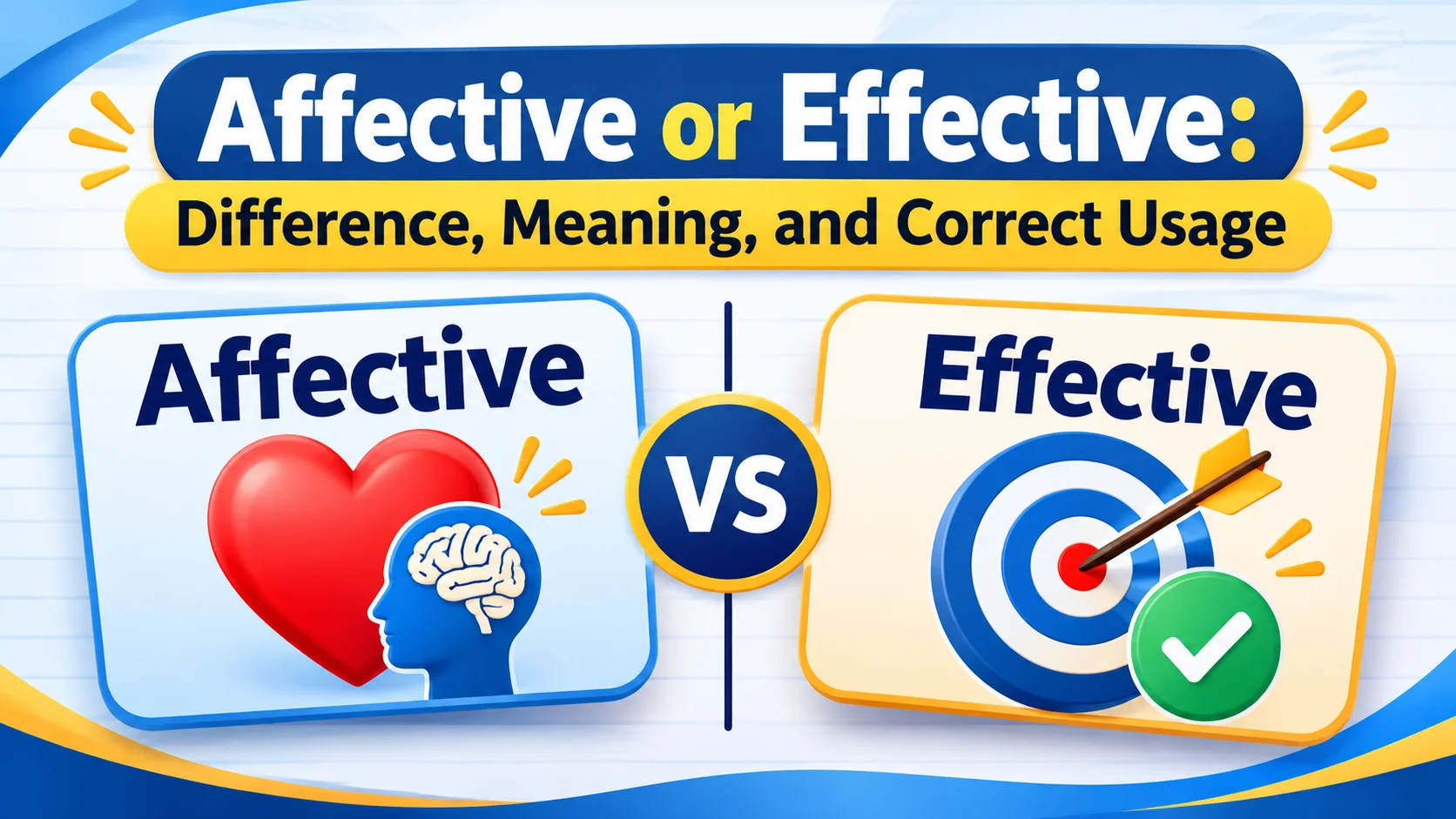
Have you ever paused while writing because you could not decide between affective or effective? The two adjectives look almost identical, but they describe very different things. One relates to emotions, feelings, and psychological experiences; the other describes something that works successfully or produces an intended result. Choosing the wrong one can change the meaning of an entire sentence, particularly in academic, professional, and educational writing. The good news is that the distinction becomes straightforward once you understand what each word describes and how it functions in context.
The confusion often appears because both words are connected to the familiar terms affect and effect. Those words have their own grammatical roles, which makes the distinction slightly more complicated than simply remembering two definitions. For example, an affective response describes an emotional reaction, whereas an effective response is one that successfully addresses a situation. Both expressions are grammatically correct, but they communicate different ideas. Understanding this difference helps you write more precisely, especially when discussing psychology, learning, healthcare, workplace performance, or research findings.
In this guide, you will learn the meaning of affective and effective, how to pronounce them, and how to use each adjective naturally in sentences. You will also explore their meanings in specialized fields, discover why effective is not always interchangeable with efficient, and understand how the four related words—affect, effect, affective, and effective—fit together. Practical examples, comparison tables, common mistakes, and a short quiz will help you choose the right word confidently rather than relying on guesswork.
Affective vs. Effective: The Quick Answer
The main difference is simple:
- Affective means relating to feelings, emotions, moods, or emotional responses.
- Effective means successful in producing a desired result or achieving a particular purpose.
Consider these two sentences:
- The school introduced activities to support students’ affective development.
- The school introduced an effective teaching strategy to improve examination results.
In the first sentence, affective refers to students’ emotional and personal development. In the second, effective describes a teaching strategy that produces a useful educational outcome.
The words are not synonyms, and neither is a misspelling of the other. Both are correct English adjectives, but their meanings determine where they belong.
Affective vs. Effective at a Glance
| Feature | Affective | Effective |
| Part of speech | Adjective | Adjective |
| Main meaning | Related to feelings and emotions | Producing a desired result |
| Central idea | Emotional experience | Successful outcome |
| Common fields | Psychology, education, mental health | Business, healthcare, education, everyday English |
| Common expressions | Affective response, affective state | Effective method, effective treatment |
| Example | The study examined affective reactions. | The study tested an effective method. |
Quick memory tip: If the sentence is about feelings, consider affective. If it is about whether something works, consider effective.
What Does Affective Mean?
Affective is an adjective that describes something connected with emotions, feelings, moods, attitudes, or emotional responses. It is particularly common in psychology, education, and healthcare, where professionals need precise language to discuss the emotional side of human experience.
For instance:
- The researcher measured participants’ affective responses to different images.
- Teachers should consider students’ affective needs as well as their academic progress.
- The therapist asked about changes in the patient’s affective state.
In each example, the word relates to emotions rather than success or performance.
In everyday conversation, people often use emotional instead of affective. Both can be appropriate, but affective is more specialized. It is useful when discussing emotions as a defined area of study rather than simply describing someone as emotional.
Affective Meaning in Psychology
In psychology, affective refers to the emotional dimension of human experience. It can describe how people feel, how they respond emotionally to situations, and how emotional experiences influence their thoughts and behavior.
Psychologists may examine affect when studying subjects such as:
- Emotional reactions to stressful situations.
- Changes in mood over time.
- Emotional regulation and self-control.
- Feelings associated with memories.
- Emotional responses to rewards or disappointment.
- The relationship between mood and decision-making.
For example:
The experiment examined the affective responses of participants after they watched a series of emotional videos.
This means the researchers were interested in how participants felt or reacted emotionally, not whether the videos were successful.
A useful distinction in psychological writing is that affect, mood, and emotion are related but not always interchangeable. In some professional contexts, affect refers particularly to the observable expression of emotion, while mood often describes a more sustained emotional state. The exact distinction depends on the theoretical or clinical framework being used.
Affective Meaning in Education
Education is another important field where affective has a specific meaning. Learning is not limited to remembering facts or developing practical skills. Students also develop interests, attitudes, values, motivation, and feelings about what they learn.
These emotional and attitudinal aspects are commonly discussed through the affective domain.
A familiar educational framework distinguishes three broad learning domains:
| Learning domain | Main focus | Example |
| Cognitive | Knowledge and intellectual skills | Understanding a mathematical formula |
| Affective | Attitudes, interests, feelings, and values | Developing an interest in science |
| Psychomotor | Physical and practical skills | Performing a laboratory procedure |
Suppose a teacher introduces a group project about environmental protection. Students may learn scientific facts, develop practical research skills, and become more concerned about environmental responsibility.
The knowledge belongs to the cognitive dimension. The practical activity involves the psychomotor dimension. Their developing attitudes and values relate to the affective dimension.
An example sentence:
The school designed an affective learning program to encourage empathy, cooperation, and responsibility.
This does not mean the program is necessarily successful. It means its focus includes emotional and attitudinal development.
Affective Meaning in Healthcare and Mental Health
In healthcare, affective appears in discussions of emotions, mood, and psychological symptoms. It is especially relevant when professionals describe a patient’s emotional experiences or presentation.
You may encounter expressions such as:
- Affective symptoms: Symptoms involving emotional or mood-related experiences.
- Affective presentation: The way emotional expression is observed or described.
- Affective disturbance: A disruption involving emotional functioning or mood.
- Affective disorder: A clinical expression historically used for disorders involving significant mood disturbances.
For example:
The assessment considered the patient’s cognitive functioning and affective symptoms.
Here, the word identifies the emotional aspect of the assessment.
It is important not to treat every use of affective as a diagnosis. The adjective itself simply describes an emotional connection. A clinical diagnosis requires a much more specific assessment and appropriate diagnostic criteria.
Common Expressions That Use Affective
Understanding common word combinations makes it easier to recognize the adjective in professional writing.
| Expression | Meaning | Example |
| Affective response | An emotional reaction | The music produced a strong affective response. |
| Affective state | A person’s emotional condition | The interview explored his affective state. |
| Affective development | Development of feelings, values, and attitudes | The program supports children’s affective development. |
| Affective behavior | Behavior associated with emotional experience or expression | The study recorded changes in affective behavior. |
| Affective learning | Learning involving attitudes and values | Group activities can encourage affective learning. |
| Affective regulation | Managing or influencing emotional responses | Children gradually develop affective regulation skills. |
Writing advice: Use affective when you need to identify an emotional dimension precisely. If your audience is unfamiliar with technical terminology, emotions may communicate the idea more clearly.
What Does Effective Mean?
Effective is an adjective describing something that works well, achieves its purpose, or produces the intended result.
It is widely used in everyday English as well as business, medicine, education, technology, and academic writing.
Examples include:
- The new study method is effective.
- The company introduced an effective customer-service system.
- Regular exercise can be an effective part of a healthy lifestyle.
- The treatment was effective in reducing the symptoms being studied.
In each case, the word describes performance or results.
However, effectiveness does not automatically mean that something is inexpensive, fast, easy, or suitable for everyone. It means that it achieves the relevant purpose. Those other qualities must be evaluated separately.
Effective Meaning in Everyday English
In ordinary conversation, effective is used to describe actions, methods, tools, and decisions that successfully accomplish something.
Consider these examples:
- An effective study routine helps a student understand difficult subjects.
- An effective password-management system helps users manage their login details securely.
- An effective cleaning product removes the particular type of dirt it is designed to handle.
- An effective conversation resolves a misunderstanding between two people.
The important question is always: Does it achieve the purpose for which it was intended?
For example, a student might spend four hours reading a textbook without understanding the material. Another student may use a structured practice method and understand the same material in one hour. If the method helps the student learn successfully, it can be described as effective.
Effective in Business and the Workplace
In professional settings, effectiveness is closely connected with objectives, performance, and results.
You might see the word used in expressions such as:
- Effective leadership.
- Effective communication.
- Effective management.
- Effective planning.
- Effective teamwork.
- Effective decision-making.
An effective manager does more than remain busy. They help a team understand its priorities, solve problems, and achieve agreed objectives.
For example:
The manager introduced an effective communication system that reduced confusion between departments.
The system is described as effective because it addresses a specific workplace problem.
One useful distinction is that effectiveness can be measured against different goals. A communication strategy may be effective at increasing customer engagement but less effective at reducing support costs. Always consider the outcome being discussed.
Effective in Healthcare and Medicine
In medical writing, effective describes a treatment, medicine, intervention, or procedure that produces a desired health-related outcome.
For example:
The treatment was effective in reducing the severity of the symptoms among the patients studied.
However, medical effectiveness needs careful interpretation. A treatment may work for some patients but not others. Its results can depend on the condition, patient characteristics, treatment schedule, and other clinical factors.
Also, an effective treatment is not automatically:
- Safe for every patient.
- Free from side effects.
- Appropriate for every condition.
- The most affordable option.
- The most convenient treatment.
Healthcare professionals consider effectiveness alongside safety, suitability, evidence, and individual circumstances. Avoid using effective as if it means universally successful.
Effective in Education and Learning
In education, effective describes teaching approaches, learning resources, and assessment methods that achieve useful educational outcomes.
Examples include:
- An effective teaching method improves students’ understanding.
- Effective feedback helps learners identify areas for improvement.
- An effective revision plan supports examination preparation.
- Effective classroom management creates conditions that support learning.
A method should be judged by the outcome it is intended to achieve. A strategy that helps beginners understand basic grammar may not be equally effective for advanced academic writing.
This is why good teachers adapt their methods to the students, subject, and learning objectives.
Effective Can Also Mean “In Force” or “Operational”
There is another important meaning of effective that readers sometimes overlook.
In official, legal, and administrative writing, the word can describe the date or moment when a policy, agreement, decision, or rule begins to apply.
For example:
- The new policy becomes effective on January 1.
- The revised agreement is effective immediately.
- The updated regulations will be effective from next month.
- The appointment is effective from the date stated in the letter.
In these sentences, effective does not mean successful. It means officially operative or in force.
Compare the two meanings:
| Sentence | Meaning of effective |
| The new strategy is effective. | The strategy produces good results. |
| The new policy becomes effective tomorrow. | The policy starts applying tomorrow. |
| The treatment proved effective. | The treatment achieved the intended outcome. |
| The contract is effective immediately. | The contract begins to apply immediately. |
This distinction is especially useful when reading contracts, employment documents, policy notices, and official announcements.
Common Expressions That Use Effective
| Expression | Meaning | Example |
| Effective method | A method that works | Practice is an effective method of improving pronunciation. |
| Effective strategy | A successful plan | The business adopted an effective strategy. |
| Effective solution | A solution that addresses a problem | We need an effective solution to the scheduling issue. |
| Effective communication | Communication that achieves its purpose | Clear instructions support effective communication. |
| Effective treatment | A treatment that produces the intended benefit | The study evaluated an effective treatment. |
| Effective immediately | Starting at once | The new rule applies effective immediately. |
| Effective from | Starting on a specified date | The agreement is effective from Monday. |
| Effective in reducing | Successful at lowering something | The program was effective in reducing waste. |
Affective or Effective: What Is the Core Difference?
The easiest way to distinguish these adjectives is to look at what they describe.
Affective describes the emotional side of an experience. Effective describes how successfully something works.
Imagine a school introduces a new reading program. Researchers might examine two separate questions:
- Are students becoming more interested, confident, and enthusiastic about reading?
- Is the program improving their reading comprehension?
The first question concerns students’ emotional and attitudinal development, so affective is relevant. The second concerns the program’s results, so effective is appropriate.
The distinction becomes even clearer when the same subject appears in both sentences.
Affective Describes Emotional Experience
- The counselor examined the student’s affective response to criticism.
- The course aims to support affective development.
- Researchers measured affective changes during the experiment.
- The teacher considered students’ affective needs.
Each example focuses on feelings, attitudes, or emotional experiences.
Effective Describes Successful Results
- The counselor recommended an effective communication technique.
- The course uses effective teaching strategies.
- Researchers developed an effective measurement method.
- The teacher introduced an effective classroom routine.
These examples focus on whether a method, action, or approach achieves its purpose.
Can Something Be Both Affective and Effective?
Yes. The adjectives describe different qualities, so they can both accurately describe the same activity, program, or intervention.
For example:
The school introduced an effective program that supports students’ affective development.
Here:
- Effective describes the program’s success.
- Affective describes the emotional and attitudinal development the program supports.
Another example:
The workshop used effective activities to improve participants’ affective understanding of teamwork.
The activities are successful, while their subject involves emotional awareness and interpersonal attitudes.
This is a useful distinction in professional writing because it allows you to describe both what something achieves and which area of human experience it addresses.
Affective or Effective in Different Contexts
The correct choice sometimes becomes easier when you recognize the subject being discussed. However, the field alone does not determine the answer. Psychology can use effective when discussing successful treatment, just as business writing can use affective when discussing employee emotions.
In Psychology
Use affective when discussing emotional responses, mood, or emotional expression.
- The researcher examined affective responses to stressful situations.
- The patient reported changes in mood and affective experience.
Use effective when describing an approach that successfully achieves a psychological or therapeutic goal.
- The intervention was effective in helping participants manage stress.
In Education
Use affective for students’ attitudes, values, interests, and emotional engagement.
- The teacher encouraged affective development through collaborative activities.
Use effective for teaching approaches that produce learning outcomes.
- The teacher used an effective strategy to explain complex grammar rules.
A single educational program may have both affective and academic objectives.
In Healthcare
Use affective when referring to mood, emotional symptoms, or emotional experiences.
- The clinical assessment included affective symptoms.
Use effective when evaluating whether a treatment or intervention achieves its intended clinical outcome.
- The treatment was effective in managing the symptoms in the group studied.
Do not confuse the emotional condition being assessed with the success of the treatment.
In Business
Use affective when the subject concerns employees’ emotional responses, attitudes, or workplace feelings.
- The survey explored employees’ affective reactions to organizational change.
Use effective when describing successful business processes or decisions.
- The company introduced an effective approach to managing customer complaints.
In Academic and Research Writing
Both words can be important in academic work, but they perform different jobs.
A researcher might write:
The study investigated the relationship between affective responses and the effectiveness of a new learning intervention.
This sentence uses affective for emotional responses and effectiveness for the degree to which the intervention achieves its goal.
When writing research papers, choose the word that matches the variable or concept being measured. Do not use effective simply because a result is positive, or affective merely because a study involves people.
In Everyday Conversation
Effective is common in everyday speech:
- This method is effective.
- That was an effective way to explain the problem.
- The new routine is more effective than the old one.
Affective is less common outside specialist or academic contexts. In ordinary conversation, people generally prefer emotional.
For example:
- More natural in everyday English: She had an emotional reaction.
- More technical: She displayed an affective response.
Both may be appropriate, depending on the intended meaning and audience.
Affective or Effective in a Sentence: Practical Examples
The following examples show how each word works in different sentence structures.
Examples of Affective in Sentences
- The research team studied the affective responses of children to different learning environments.
- Music can influence a person’s affective state.
- The school introduced activities designed to support affective development.
- The therapist discussed the patient’s affective symptoms during the assessment.
- The lesson encouraged affective engagement through discussion and reflection.
- Researchers examined the affective effects of social isolation.
- The assessment considered students’ cognitive and affective abilities.
- Her affective reaction suggested that the subject was personally important to her.
- The program aims to develop positive attitudes through affective learning.
- Emotional regulation is an important part of affective development.
Examples of Effective in Sentences
- The new study technique is effective for improving vocabulary retention.
- The company developed an effective plan to attract new customers.
- Clear instructions are essential for effective communication.
- The medicine proved effective in the clinical study.
- Regular revision is an effective way to prepare for examinations.
- The manager introduced an effective solution to the scheduling problem.
- The new security system provides an effective way to protect sensitive information.
- The policy will become effective at the beginning of next month.
- The team found an effective way to reduce unnecessary expenses.
- The training program was effective in improving employees’ technical skills.
Side-by-Side Sentences: Affective vs. Effective
| Affective | Effective |
| The study examined affective responses to music. | The study tested an effective method of teaching music. |
| The teacher supported students’ affective development. | The teacher used an effective classroom strategy. |
| The assessment considered affective symptoms. | The treatment was effective in managing the symptoms. |
| The research explored affective attitudes toward technology. | The research identified an effective use of technology. |
| The workshop encouraged affective awareness. | The workshop used effective communication techniques. |
Notice that the nouns following the adjectives provide useful clues. Responses, development, symptoms, and attitudes often appear with affective. Method, strategy, treatment, and technique frequently appear with effective.
These are common patterns, not strict grammatical rules. Always check the intended meaning rather than relying on a memorized list.
Affective vs. Effective vs. Affect vs. Effect
The confusion between affective and effective is closely related to another common English problem: choosing between affect and effect.
These four words belong to related word families, but they do not perform the same grammatical function.
Affect: Usually a Verb Meaning to Influence
In its most common use, affect is a verb meaning to influence or produce a change in something.
Examples:
- Lack of sleep can affect concentration.
- Weather conditions may affect travel plans.
- Stress can affect a person’s mood.
In each sentence, something influences another thing.
Effect: Usually a Noun Meaning a Result
Effect is most commonly used as a noun meaning a result, consequence, or change produced by an action.
Examples:
- The new policy had a positive effect.
- The medicine produced an unexpected effect.
- Regular exercise can have beneficial effects.
Here, effect identifies what happened as a result of something.
Affective: An Adjective Related to Feelings
Affective is used to describe emotional experiences, moods, feelings, and related psychological processes.
Example:
The researchers recorded participants’ affective responses.
Effective: An Adjective Describing Successful Results
Effective describes something that produces the intended outcome or achieves its purpose.
Example:
The researchers developed an effective testing method.
Comparison Table: All Four Words
| Word | Usual grammatical role | Meaning | Example |
| Affect | Verb | To influence | Stress can affect sleep. |
| Effect | Noun | A result | Stress has an effect on sleep. |
| Affective | Adjective | Related to emotions | The study measured affective responses. |
| Effective | Adjective | Producing a desired result | The treatment was effective. |
There are exceptions to the usual affect/effect distinction. Effect can also be a verb meaning to bring about or make something happen.
For example:
The new director hopes to effect meaningful changes.
Similarly, affect has a specialized noun use in psychology, referring to observable emotional expression. These exceptions are useful to know, but the common verb-and-noun distinction is sufficient for most everyday writing.
Affective vs. Effective vs. Efficient: What Is the Difference?
Another word worth distinguishing is efficient. It is often used alongside effective, particularly in business, education, and project management.
Although the words are related, they describe different qualities.
- Affective: Connected with emotions and feelings.
- Effective: Successful in achieving a desired result.
- Efficient: Achieving a result while making good use of time, effort, money, or other resources.
Consider a company that wants to process customer requests.
One system may successfully resolve every request but require a large team and several hours. It is effective because it achieves the goal, but it may not be efficient.
Another system may process requests quickly while leaving many customer problems unresolved. It may be efficient in terms of speed, but it is not effective at solving the actual problem.
| Word | Main question | Example |
| Affective | Does it involve feelings or emotions? | The training addressed affective development. |
| Effective | Does it achieve the intended result? | The training improved employee performance. |
| Efficient | Does it use resources wisely? | The training delivered results with less time and cost. |
A useful professional habit is to evaluate effectiveness and efficiency separately. A process should ideally achieve its goal without wasting resources, but those are two different standards.
Common Mistakes When Using Affective and Effective
Even experienced writers can confuse these words, especially when writing quickly or editing technical material. The following mistakes are easy to correct once you understand the meaning behind each adjective.
1. Using Affective When You Mean Successful
Incorrect: The new marketing strategy was affective.
Correct: The new marketing strategy was effective.
Why? The sentence evaluates whether the strategy achieved its business objective. It does not describe an emotional response.
2. Using Effective When You Mean Emotional
Incorrect: The researchers studied effective responses to music.
Correct: The researchers studied affective responses to music.
Why? The researchers are examining emotional reactions. Effective would suggest that the responses themselves successfully achieved a purpose.
3. Treating Affective as a General Synonym for Emotional
Affective and emotional overlap, but they are not always equally natural.
For example:
- Everyday wording: The film created an emotional reaction.
- Academic wording: The researchers examined the film’s affective impact.
The technical adjective is useful when discussing emotional processes in a specialized framework. In a general audience article, emotional may be clearer.
4. Confusing Effective With Efficient
Incorrect: The process is efficient because it produces the correct result.
Better: The process is effective because it produces the correct result.
If it also achieves that result with minimal waste, you can describe it as efficient.
5. Assuming Every Word Beginning With Affect Has the Same Meaning
Words in the same family can have related but distinct meanings. For example, affect is usually a verb meaning to influence, while affective is an adjective associated with emotions.
Do not select a word solely because it resembles another word. Check its grammatical role and meaning in the sentence.
6. Using Technical Vocabulary When Simpler English Would Be Clearer
A sentence can be grammatically correct but unnecessarily difficult to understand.
For example:
- Technical: The activity encouraged affective engagement.
- Simpler: The activity encouraged students to become emotionally involved.
Choose the technical expression when it adds precision. Otherwise, prefer wording your readers will understand immediately.
Easy Ways to Remember Affective vs. Effective
You do not need to memorize long definitions every time you write. A few simple associations can help you choose correctly.
Affective = Affect = Feelings
Connect affective with the emotional meaning of affect used in psychology.
Remember:
- Affective response = emotional response.
- Affective state = emotional state.
- Affective development = development of feelings, attitudes, and values.
Effective = Effect = Result
Connect effective with effect, which commonly means a result or consequence.
Remember:
- Effective method = a method that works.
- Effective solution = a solution that achieves its purpose.
- Effective strategy = a strategy that produces the intended outcome.
Use the Feelings-or-Results Test
When you are uncertain, ask yourself one question:
Am I describing emotions, or am I describing success?
If the answer is emotions, affective is likely correct. If the answer is success or results, effective is likely correct.
| What your sentence describes | Correct choice |
| A person’s emotional reaction | Affective |
| A student’s attitudes and values | Affective |
| A psychological mood-related experience | Affective |
| A successful teaching method | Effective |
| A solution that works | Effective |
| A policy’s starting date | Effective |
One final check: if the sentence concerns a date when a rule or agreement begins to apply, effective may be correct even though no idea of success is involved.
Affective and Effective: Pronunciation and Word Forms
Knowing how to pronounce and recognize the related forms of these words can help you use them confidently in speech and writing.
How to Pronounce Affective
Affective is commonly pronounced:
uh-FEK-tiv
IPA: /əˈfɛktɪv/
It has three syllables:
- uh
- FEK
- tiv
The main stress falls on the second syllable.
How to Pronounce Effective
Effective is commonly pronounced:
ih-FEK-tiv
IPA: /ɪˈfɛktɪv/
It also has three syllables, with the main stress on the second syllable.
The two words sound very similar. Their first vowel sound differs, but pronunciation alone is not always a reliable way to distinguish them. Understanding the meaning is more useful.
Word Forms Related to Affective
| Word | Part of speech | Meaning |
| Affect | Usually a verb | To influence |
| Affect | Specialized noun | Observable emotional expression |
| Affective | Adjective | Related to emotions |
| Affectively | Adverb | In an emotional or affect-related manner |
Example: The researcher examined how participants responded affectively to the experience.
Word Forms Related to Effective
| Word | Part of speech | Meaning |
| Effect | Usually a noun | A result or consequence |
| Effect | Less commonly a verb | To bring something about |
| Effective | Adjective | Producing a desired result |
| Effectively | Adverb | In a successful or practical way |
| Effectiveness | Noun | The degree to which something achieves its purpose |
Examples:
- The strategy was effective.
- The team implemented the strategy effectively.
- The study measured the strategy’s effectiveness.
These forms are not interchangeable. Use the adjective to describe a noun, the adverb to modify an action or description, and the noun to discuss the quality of achieving a result.
Synonyms and Related Words
Synonyms can help make writing more natural, but a replacement should preserve the intended meaning. Neither affective nor effective has a single perfect substitute for every context.
Synonyms for Affective
Depending on the sentence, possible alternatives include:
- Emotional: Connected with feelings or emotions.
- Feeling-related: Associated with subjective feelings.
- Mood-related: Connected with a person’s mood.
- Sentimental: Involving tender or strong feelings, often associated with memories or affection.
Examples:
- Affective response → emotional response.
- Affective experience → emotional experience.
- Affective state → mood or emotional state.
In academic psychology, replacing affective with emotional may sometimes remove a technical distinction. Keep the original term if it is part of a specific research framework.
Synonyms for Effective
Possible alternatives include:
- Successful: Achieving the desired outcome.
- Productive: Producing useful results.
- Useful: Helping to accomplish a purpose.
- Powerful: Having a strong impact or influence.
- Efficacious: Producing the intended effect, especially in formal or technical contexts.
For example:
- An effective strategy may also be a successful strategy.
- An effective meeting may be a productive meeting.
- An effective treatment may be described as efficacious in appropriate clinical or technical writing.
Be careful with efficient. It is related to effectiveness, but it specifically emphasizes the use of resources.
Affective or Effective: Practice Quiz
Test your understanding by choosing the correct word in each sentence. Consider what the sentence describes rather than relying only on the surrounding nouns.
- The psychologist examined the ______ responses of participants to stressful situations.
- The new teaching method proved ______ in improving reading comprehension.
- The school aims to support students’ ______ development.
- The company introduced an ______ system for handling customer complaints.
- The research focused on the ______ effects of music on mood.
- Regular practice is an ______ way to improve pronunciation.
- The treatment was ______ in reducing the symptoms in the study.
- The teacher considered students’ emotional needs and ______ learning.
- The new policy becomes ______ next Monday.
- The team developed an ______ process that achieved its goals while reducing unnecessary work.
Answers and Explanations
- Affective — The sentence concerns emotional responses to stressful situations.
- Effective — The teaching method achieved the intended learning outcome.
- Affective — The focus is on students’ emotional and attitudinal development.
- Effective — The system successfully handles customer complaints.
- Affective — The research concerns emotions and mood.
- Effective — The practice method produces a useful result.
- Effective — The treatment achieved the intended clinical outcome in the study.
- Affective — The sentence refers to the emotional dimension of learning.
- Effective — Here, the word means officially in force or operational.
- Effective and efficient — The process achieved its goals and reduced wasted resources. Both qualities are being described.
Conclusion
Choosing between affective or effective becomes much easier when you focus on the idea behind the sentence. Use affective when discussing emotions, feelings, moods, attitudes, or the emotional dimension of learning and psychological experience. Choose effective when describing a successful method, treatment, strategy, or action—or when identifying when an official rule begins to apply. One final actionable tip: Before publishing or submitting your writing, check whether the adjective describes an emotional experience or an intended result. A common mistake to avoid is assuming that effective and efficient mean exactly the same thing. Precise word choice does more than prevent spelling confusion; it helps readers understand exactly what you mean.
Frequently Asked Questions
Q1. What is the main difference between affective and effective?
Affective means related to emotions, feelings, moods, or attitudes. Effective means successful in achieving a desired result. For example, an affective response is an emotional reaction, while an effective response successfully addresses a problem.
Q2. Is affective the same as emotional?
They are closely related, but not always interchangeable. Emotional is a familiar general-purpose adjective, whereas affective is often used in technical fields such as psychology and education to describe the emotional dimension of an experience or process.
Q3. Can a person be described as effective or affective?
Yes, but the meanings differ. An effective person performs tasks successfully or achieves particular goals. Affective is more commonly used to describe someone’s emotional responses, expression, or characteristics rather than their overall personality or performance.
Q4. What does effective mean in a contract or official document?
In official writing, effective can mean legally or officially in force. An effective date identifies when an agreement, policy, or decision begins to apply. It does not necessarily mean the document or policy has already produced successful results.
Q5. What is the difference between affective, effective, and efficient?
Affective relates to emotions, effective describes achieving an intended outcome, and efficient describes achieving that outcome while using resources wisely. A process can be effective without being efficient if it succeeds but wastes considerable time or money.
