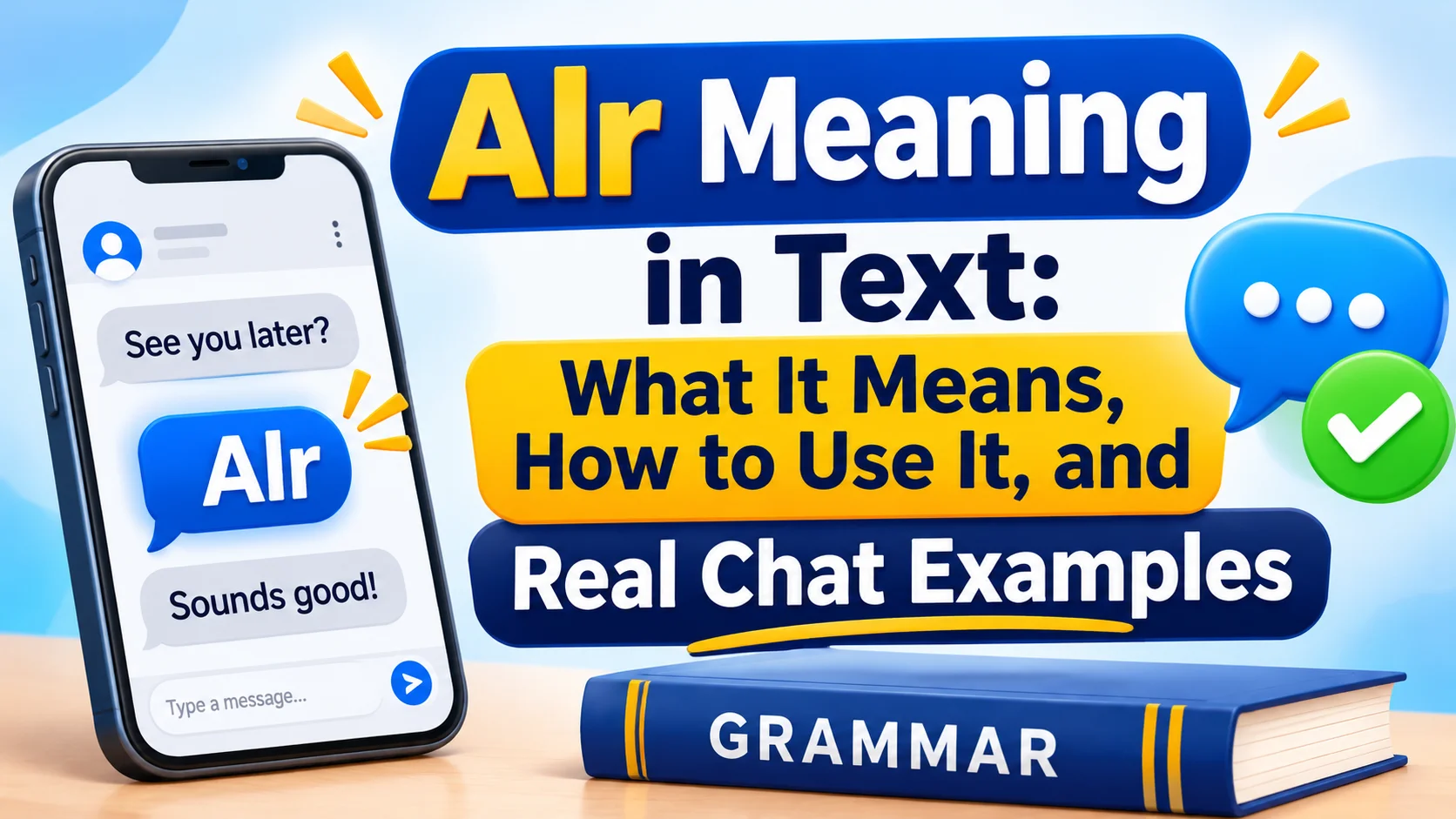
If you have received a message containing “alr” and wondered what the sender meant, you are not alone. The most common alr meaning in text is “alright.” People use this short form in everyday conversations to agree with someone, confirm plans, acknowledge information, or show that something is acceptable. It is especially common in casual digital communication, where quick replies are often preferred over complete sentences. Although it looks simple, the meaning can change slightly depending on the conversation, the sender’s tone, and the words surrounding it.
You might see alr in a Snapchat message, an Instagram DM, a WhatsApp conversation, a gaming chat, or a comment on TikTok. In most of these situations, it communicates the same basic idea as “okay” or “sounds good.” However, a short response does not always reveal how someone feels. One person might use it warmly to confirm a plan, while another might send it simply because they have nothing more to add. Understanding the context helps you avoid reading too much into a brief message.
This guide explains what ALR stands for, why people use it instead of writing “alright,” and how to recognize its intended meaning in different situations. You will also find realistic chat examples, comparisons with expressions such as OK, K, Aight, and Bet, and practical suggestions for replying. If you are unsure whether someone is agreeing, sounding annoyed, or simply acknowledging your message, the examples ahead will help you interpret the response more accurately.
What Does ALR Mean in Text Messages?
ALR usually means “alright” in texting. It is an informal shortened spelling that people use when they want to respond quickly without typing the complete word.
Depending on the conversation, it can communicate several related messages:
- Agreement: “Alr, let’s do that.”
- Confirmation: “Alr, I’ll meet you at 5.”
- Acknowledgment: “Alr, I understand.”
- Acceptance: “Alr, that’s fine.”
- Conversation ending: “Alr, talk to you later.”
For example:
Person A: “Can you send me the notes tonight?”
Person B: “Alr.”
The second person is most likely saying, “Alright, I will.” The reply is brief, but it communicates acceptance of the request.
The important point is that ALR is not a separate word with a completely different meaning from alright. It is simply a casual way of writing it. Most people understand it through the surrounding conversation rather than by analyzing the individual letters.
What Does ALR Stand For?
In ordinary texting, ALR is generally a shortened form of alright, not an acronym made from several separate words.
This distinction matters because some texting expressions are initialisms:
- IDK: I Don’t Know
- LOL: Laughing Out Loud
- BRB: Be Right Back
- TBH: To Be Honest
ALR works differently. It is a compact spelling of an existing expression rather than a phrase whose individual words begin with A, L, and R.
You may see it written in several ways:
- alr
- Alr
- ALR
These variations generally communicate the same thing. Lowercase is common in casual messages, while capital letters may simply reflect someone’s typing preference.
Why Do People Write ALR Instead of Alright?
The main reason is convenience. In fast conversations, people often shorten familiar words because the intended meaning is already obvious.
There are several practical reasons for using ALR:
- Faster typing: It takes fewer characters to write.
- Casual tone: It fits the relaxed style of texting friends.
- Quick acknowledgment: It allows someone to respond without interrupting what they are doing.
- Personal writing habits: Some people naturally shorten everyday expressions.
- Informal online communication: Shortened spellings are common in chats, comments, and gaming conversations.
However, shorter is not always better. Writing “alright” or “all right” can make a message clearer when the conversation is serious or professional.
Does ALR Mean Alright or Already?
This is one of the most important distinctions to understand.
In everyday texting, alright is the usual interpretation of ALR. Some people may also use similar-looking shorthand to mean “already,” but that interpretation depends heavily on the sentence and is not the default meaning.
Consider these examples:
| Text message | Likely interpretation | Explanation |
| “Alr, see you tomorrow.” | Alright | Accepting a plan |
| “Alr, I’ll send it.” | Alright | Agreeing to do something |
| “I finished it alr.” | Possibly already | Referring to something completed |
| “Alr, thanks for telling me.” | Alright | Acknowledging information |
| “Are you coming? Alr?” | Unclear | More context is needed |
How to Tell Which Meaning Someone Intended
Rather than guessing, examine how the word functions in the sentence.
1. Check whether it is a standalone reply.
If someone sends “alr” after you suggest a meeting, ask a question, or make a request, they almost certainly mean “alright.”
2. Look at the surrounding words.
If the message discusses whether an action has happened, a reference to “already” may be possible.
3. Consider the previous message.
The same abbreviation can be interpreted differently depending on what the other person is responding to.
4. Ask if the meaning affects your next step.
If you genuinely cannot tell whether someone has completed a task or simply agreed to complete it, ask: “Do you mean you’ve already done it?”
This is more reliable than treating every occurrence of ALR as having one fixed interpretation.
How People Use ALR in Everyday Texting
People rarely send ALR just to use slang. They generally use it because they want to communicate a simple response without writing a longer sentence.
Here are its most common conversational purposes.
1. To Agree With Someone
ALR can show that a person accepts an idea or suggestion.
Example:
Friend 1: “Let’s watch a movie after dinner.”
Friend 2: “Alr, sounds good.”
Here, ALR communicates agreement. The additional phrase “sounds good” makes the response more enthusiastic, but it is not necessary.
When to use it: When someone suggests an activity, shares an idea, or proposes something you are happy to do.
2. To Confirm Plans
Another common use is confirming an arrangement.
Example:
Person A: “I’ll pick you up at 7:30.”
Person B: “Alr, I’ll be ready.”
The reply indicates that the person has received the information and accepts the proposed time.
This is particularly useful in quick conversations where both people already understand the details.
3. To Acknowledge Information
Sometimes a person does not need to agree with an opinion or accept a request. They simply need to show that they have understood a message.
Example:
Person A: “The class has been moved to Room 12.”
Person B: “Alr, thanks.”
In this situation, ALR works like “Got it” or “Understood.”
One useful distinction: acknowledging information does not always mean agreeing with it. Someone can understand a decision without necessarily supporting it.
4. To Accept a Request
ALR can be a quick way to accept a favor or small responsibility.
Example:
Friend 1: “Can you bring my book tomorrow?”
Friend 2: “Alr.”
The response suggests willingness to help. If the request involves something important, however, a more detailed answer is safer.
For instance, “Alright, I’ll bring it tomorrow morning” makes the commitment clearer.
5. To Accept a Change in Plans
Plans sometimes change at the last minute. ALR can indicate that the change is acceptable.
Example:
Person A: “Can we meet at 6 instead of 5?”
Person B: “Alr, that’s fine.”
The message communicates flexibility without requiring a long explanation.
6. To Move a Conversation Along
People also use ALR when a discussion has reached a natural stopping point.
Example:
Person A: “I need to finish my assignment now.”
Person B: “Alr, talk later.”
It acknowledges the other person’s situation and allows the conversation to end comfortably.
7. To Show Reluctant Agreement
ALR does not always express excitement. Sometimes it indicates that someone accepts a decision even though it was not their first choice.
Example:
Friend 1: “We have to cancel the trip.”
Friend 2: “Alr, I guess.”
The words “I guess” suggest disappointment or hesitation. The meaning comes from the entire message, not from ALR alone.
What Does ALR Mean on Snapchat, TikTok, Instagram, and WhatsApp?
The basic meaning of ALR generally stays the same across social platforms. It usually means alright, rather than having a completely different definition on every app.
What changes is the kind of conversation in which people use it.
ALR Meaning on Snapchat
On Snapchat, ALR may appear in private messages, replies to snaps, or conversations about meeting up.
Example:
Friend: “I’ll send you the picture when I get home.”
You: “Alr 😂”
The response acknowledges the message in a casual, friendly way.
ALR Meaning on TikTok
People may use ALR in TikTok direct messages or comments when reacting to suggestions, videos, or conversations.
Example:
Person A: “You should try this challenge.”
Person B: “Alr, I’ll give it a try.”
Here, it communicates acceptance of the suggestion.
ALR Meaning on Instagram
On Instagram, the abbreviation can appear in DMs, story replies, and conversations between followers.
Example:
Person A: “I’ll tag you in the post.”
Person B: “Alr, thank you!”
It is simply a short acknowledgment.
ALR Meaning on WhatsApp
WhatsApp conversations often involve practical arrangements, reminders, and group discussions. ALR can make these exchanges quicker.
Example:
Person A: “We’re leaving at 8 tomorrow morning.”
Person B: “Alr, I’ll be there.”
The reply confirms the arrangement.
Does ALR Have a Different Meaning on Each Platform?
Not usually. The platform does not automatically change the definition.
| Platform | Common situation | Example |
| Snapchat | Replying to a friend | “Alr 😂” |
| TikTok | Responding to a suggestion | “Alr, I’ll try it.” |
| Acknowledging a DM | “Alr, thanks!” | |
| Confirming arrangements | “Alr, see you then.” | |
| Gaming chat | Confirming readiness | “Alr, let’s start.” |
Practical takeaway: Interpret ALR by looking at the message and the conversation, not by assuming that Snapchat, TikTok, Instagram, or WhatsApp gives it a special meaning.
What Tone Does ALR Convey? Friendly, Neutral, or Rude?
A short message can be difficult to interpret because it provides very little emotional information. ALR is a good example: the same response can sound perfectly normal in one conversation and dismissive in another.
When ALR Sounds Friendly
It often feels friendly when it appears in a relaxed conversation between people who know each other.
Example:
“Alr 😂 see you soon!”
The emoji and surrounding words create a lighthearted tone.
When ALR Sounds Neutral
A simple confirmation does not need to express excitement.
Example:
“Alr, noted.”
This is a straightforward acknowledgment. There is no clear indication of anger or enthusiasm.
When ALR Sounds Dry or Dismissive
A one-word response may feel cold when someone has shared something important and receives very little acknowledgment in return.
Example:
Person A: “I’ve had a really difficult day, and I just wanted to talk.”
Person B: “Alr.”
The reply may feel emotionally distant because it does not respond to the seriousness of the first message.
However, it would be unfair to assume the sender is deliberately being rude. They might be distracted, unsure what to say, or simply not comfortable discussing the subject.
Does Capitalization or Punctuation Change the Tone?
Small writing choices can influence how a message is interpreted.
| Version | Possible impression |
| “alr” | Relaxed and casual |
| “Alr” | Neutral acknowledgment |
| “ALR” | Emphasis or ordinary capitalization |
| “Alr!” | Energetic or enthusiastic |
| “alr…” | Possibly hesitant or disappointed |
| “alr 😂” | Playful or humorous |
| “alr 🙄” | Potentially sarcastic or annoyed |
These are possible impressions, not fixed rules. For example, some people capitalize every message automatically. Others use periods without intending to sound unfriendly.
Expert tip: Do not judge someone’s feelings from one abbreviation. Look at their usual communication style and the conversation as a whole.
Is ALR Rude or Disrespectful?
No. ALR is not inherently rude. It is a normal informal acknowledgment, and many people use it without intending any negative emotion.
Whether it feels disrespectful depends on the situation.
When ALR Is Completely Appropriate
It generally works well for:
- Confirming casual plans with friends.
- Responding to everyday reminders.
- Acknowledging a simple instruction.
- Agreeing to an ordinary suggestion.
- Quick exchanges in group chats.
- Gaming conversations where speed matters.
For example:
Friend: “I’ll meet you near the entrance.”
You: “Alr.”
There is no obvious problem with this response.
When ALR Might Feel Impolite
It may be less suitable when the other person expects a thoughtful response.
Consider these situations:
- Someone shares upsetting personal news.
- A colleague explains an important problem.
- A friend asks for emotional support.
- A person sends a detailed message requiring a clear decision.
- Someone needs confirmation of an important responsibility.
In these situations, a short response can leave the other person uncertain about whether you understood or cared about what they said.
How to Make ALR Sound More Polite
You do not necessarily need to stop using the abbreviation. You can simply add a few words.
Instead of:
“Alr.”
Try:
- “Alr, thank you for letting me know.”
- “Alright, I understand.”
- “Alr, I appreciate it.”
- “That works for me, thanks.”
- “Sure, I’ll take care of it.”
The best response depends on what you are acknowledging. A friendly thank-you, a clear confirmation, or a complete sentence often communicates more than a short abbreviation.
ALR vs. Alright, Aight, OK, K, and Bet
Several texting expressions can communicate agreement or acknowledgment. Although their meanings overlap, they are not always interchangeable.
ALR vs. Alright
ALR is an informal shortened spelling of alright. The two usually communicate the same basic message.
- ALR: “Alr, I’ll see you there.”
- Alright: “Alright, I’ll see you there.”
The difference is mainly writing style. Alright is more suitable when clarity or a slightly more complete tone is preferred.
ALR vs. All Right
“All right” is the established two-word spelling, while “alright” is also widely used as a single word.
In formal or carefully edited writing, all right is often the safer choice. In casual texting, ALR is a convenient shorthand.
ALR vs. Aight
Aight is an informal representation of “all right.” It has a more distinctly conversational or slang-like appearance.
Examples:
- “Alr, let’s go.”
- “Aight, let’s go.”
Both can express agreement. The choice often comes down to personal style and the tone of the conversation.
ALR vs. OK
OK is a widely recognized way to express acceptance or acknowledgment.
Examples:
- “OK, I’ll call you later.”
- “Alr, I’ll call you later.”
OK is generally more versatile and can be used in a wider range of everyday situations. ALR has a more informal texting style.
ALR vs. K
K is an extremely short form of “OK.” It can sound abrupt because it offers very little conversational detail.
Compare:
- “Alr, thanks!”
- “K.”
The first response can feel more conversational, while the second may appear distant in certain contexts. Neither interpretation is guaranteed.
ALR vs. Bet
Bet is casual slang that can express agreement, confidence, or acceptance of a suggestion.
For example:
Person A: “I’ll pick you up at 7.”
Person B: “Bet.”
This communicates something like “Sounds good” or “You can count on it.” ALR is usually a more straightforward acknowledgment.
| Expression | Main meaning | Typical tone | Common use |
| ALR | Alright | Casual | Agreement and acknowledgment |
| Alright | All right | Neutral | Everyday conversation |
| Aight | All right | Very casual | Informal chats |
| OK | Okay | Neutral | General acknowledgment |
| K | Okay | Very brief | Quick replies |
| Bet | Agreement or acceptance | Casual, confident | Friends and social chats |
| Sure | Agreement or willingness | Neutral to friendly | Everyday requests |
The important distinction is not simply how many letters each expression contains. It is how much information and emotional tone the reply communicates.
Real Chat Examples of ALR in Different Situations
The following conversations show how ALR works in situations you might encounter in everyday messaging.
Example 1: Making Plans With a Friend
Alex: “Want to get something to eat tonight?”
Sam: “Alr, where?”
Meaning: Sam agrees to the idea and asks for more information.
Example 2: Confirming a Meeting
Mia: “Let’s meet outside the station at 6.”
Lena: “Alr, see you there.”
Meaning: Lena confirms the meeting arrangement.
Example 3: Accepting a Favor
Chris: “Can you bring my notebook tomorrow?”
Jordan: “Alr, no problem.”
Meaning: Jordan agrees to bring the notebook.
Example 4: Acknowledging a Reminder
Dad: “Don’t forget to lock the door before leaving.”
You: “Alr, I won’t.”
Meaning: You have received and understood the reminder.
Example 5: School or College Group Chat
Student 1: “The teacher said we need to submit the assignment by Friday.”
Student 2: “Alr, thanks for the update.”
Meaning: The second student acknowledges the information.
Example 6: Gaming With Friends
Player 1: “Everyone ready? Starting in two minutes.”
Player 2: “Alr, ready.”
Meaning: The player confirms readiness.
Example 7: Instagram Direct Message
Person A: “I’ll send you the details in a bit.”
Person B: “Alr!”
Meaning: The person acknowledges the message and expects the information later.
Example 8: Ending a Casual Conversation
Friend 1: “I need to sleep now. Talk tomorrow.”
Friend 2: “Alr, goodnight.”
Meaning: The second person acknowledges the conversation is ending.
Example 9: Reluctant Agreement
Friend 1: “We might have to take the earlier bus.”
Friend 2: “Alr, if we have to.”
Meaning: The second person accepts the change but does not sound especially enthusiastic.
Example 10: Understanding a Possible “Already” Meaning
Person A: “Did you finish the presentation?”
Person B: “I finished it alr.”
Meaning: The sender may intend “I finished it already.” This is a context-dependent shorthand use, not the usual interpretation of ALR as a standalone reply.
These examples demonstrate why the surrounding sentence matters. The same three letters can communicate different shades of agreement, acknowledgment, or acceptance.
How Should You Reply When Someone Texts ALR?
In most cases, you do not need a special response. Choose your reply according to what the person is agreeing to or acknowledging.
Casual Replies
Use these when chatting with friends or acquaintances:
- “Cool!”
- “Sounds good.”
- “Okay!”
- “Nice.”
- “See you then.”
Friendly Replies
If you want to keep the conversation warm, add a little more detail:
- “Perfect, thanks!”
- “Awesome, talk soon.”
- “Great, see you there!”
- “Thanks, I appreciate it.”
Short Replies
When the conversation only needs a quick acknowledgment:
- “Bet.”
- “Got it.”
- “Nice.”
- “Sure.”
Playful Replies
Among friends, a lighthearted response may fit:
- “Alrr 😂”
- “Say less!”
- “You got it!”
- “Let’s go!”
What If You Cannot Tell Whether They Actually Agree?
Sometimes ALR is too brief to confirm an important detail.
For example:
You: “Should I book the tickets for 7 PM?”
Them: “Alr.”
If the decision involves money, timing, or arrangements, it is sensible to confirm:
“Just checking, 7 PM works for you, right?”
This avoids misunderstandings. A short reply can be enough for casual conversation, but important decisions deserve clear confirmation.
Is ALR Formal or Informal? When Should You Use It?
ALR is an informal texting expression. It is suitable for relaxed digital conversations but is not a good choice for formal documents or professional writing.
Where ALR Is Appropriate
You can comfortably use it in:
- Messages with friends.
- Casual family conversations.
- Social media DMs.
- Gaming chats.
- Informal group messages.
- Everyday conversations with people who understand texting shorthand.
Where You Should Avoid ALR
Choose a more complete expression in:
- Professional emails.
- Job applications.
- Academic assignments.
- Business proposals.
- Formal customer communication.
- Important workplace discussions.
For example, if a manager asks whether you can attend a meeting, replying “ALR” may look too casual.
A better response would be:
“Certainly. I’ll attend the meeting at 10 AM.”
Better Alternatives for Professional Messages
| Instead of ALR | Consider writing | When it works |
| ALR | Understood. | Acknowledging instructions |
| ALR | Certainly. | Accepting a request |
| ALR | That works for me. | Confirming arrangements |
| ALR | Thank you for letting me know. | Acknowledging information |
| ALR | I agree. | Expressing agreement |
| ALR | I’ll take care of it. | Confirming responsibility |
The goal is not to make every message sound formal. It is to match your language to the relationship, setting, and importance of the conversation.
Common Misunderstandings About ALR
Even though ALR is simple, people sometimes interpret it incorrectly. These are the misunderstandings worth avoiding.
Mistake 1: Assuming ALR Is Always an Acronym
ALR is generally a shortened spelling of “alright.” It is not normally an initialism in which each letter represents a separate word.
Mistake 2: Thinking It Always Means Already
The usual texting interpretation is “alright.” The possibility of “already” depends on sentence structure and context.
Mistake 3: Believing It Is Automatically Rude
A short response is not necessarily disrespectful. Many people use ALR as a routine acknowledgment without intending any negative emotion.
Mistake 4: Assuming It Signals Romantic Interest
ALR does not have a standard romantic or flirtatious meaning. Someone using it in a conversation is not automatically expressing attraction.
If you are trying to understand someone’s interest, look at their broader communication and behavior rather than relying on one abbreviation.
Mistake 5: Treating Every ALR Message as Enthusiastic Agreement
Someone may accept a suggestion without being excited about it. A message such as “Alr, I guess” can communicate hesitation rather than enthusiasm.
Does ALR Have Other Meanings Outside Texting?
Yes, capitalized ALR may appear as an abbreviation in specialized settings, including technical, organizational, or professional documents.
However, those meanings depend on the subject. An abbreviation used in a technical report may have nothing to do with the texting expression.
For example, if ALR appears in a message about a casual meeting, “alright” is a reasonable interpretation. If it appears in a technical document, the surrounding terminology and the document’s subject should guide your interpretation.
Do not assume that every capitalized ALR has one universal expansion. Abbreviations often have different meanings in different industries, and there is no reason to apply an unrelated technical definition to an ordinary chat.
Conclusion
The most common ALR meaning in text is “alright.” People use it to agree with suggestions, confirm plans, acknowledge information, and keep everyday conversations moving. It is a convenient informal expression that works across messaging apps and social platforms. However, its tone is not fixed: depending on the situation, it can sound friendly, neutral, hesitant, or occasionally dismissive. One final actionable tip: pay attention to the message that comes before ALR instead of interpreting the abbreviation on its own. A common mistake to avoid is assuming that a short reply reveals someone’s feelings. When clarity matters, ask a simple follow-up question. Good communication depends less on the number of words and more on whether both people understand the message.
Frequently Asked Questions
Q1. What does ALR mean when someone texts you?
ALR usually means “alright.” It is a casual way to agree, acknowledge information, or accept a suggestion. If someone sends it after you propose a plan, they are generally saying that the arrangement works for them.
Q2. Does ALR mean alright or already?
In everyday texting, alright is the usual meaning. Some people may use ALR to represent “already” in a sentence, but that interpretation depends on context. A standalone “alr” is generally understood as an acknowledgment.
Q3. What does ALR mean from a girl or a guy?
The abbreviation has no gender-specific meaning. Whether a girl or guy sends ALR, it usually means “alright.” It does not automatically indicate romantic interest, annoyance, or disinterest. The relationship and surrounding conversation provide more useful clues.
Q4. Is ALR a dry or rude response?
Not necessarily. ALR can be a perfectly normal acknowledgment between friends. However, it may feel dry when someone expects a thoughtful response to an important message. Consider the sender’s usual texting habits before interpreting it negatively.
Q5. What is the difference between ALR and Aight?
Both are informal expressions related to “all right.” ALR is commonly used as a shortened spelling of “alright,” while Aight is a slang-style spelling of the spoken expression. Both can communicate agreement or acknowledgment in casual conversations.
