
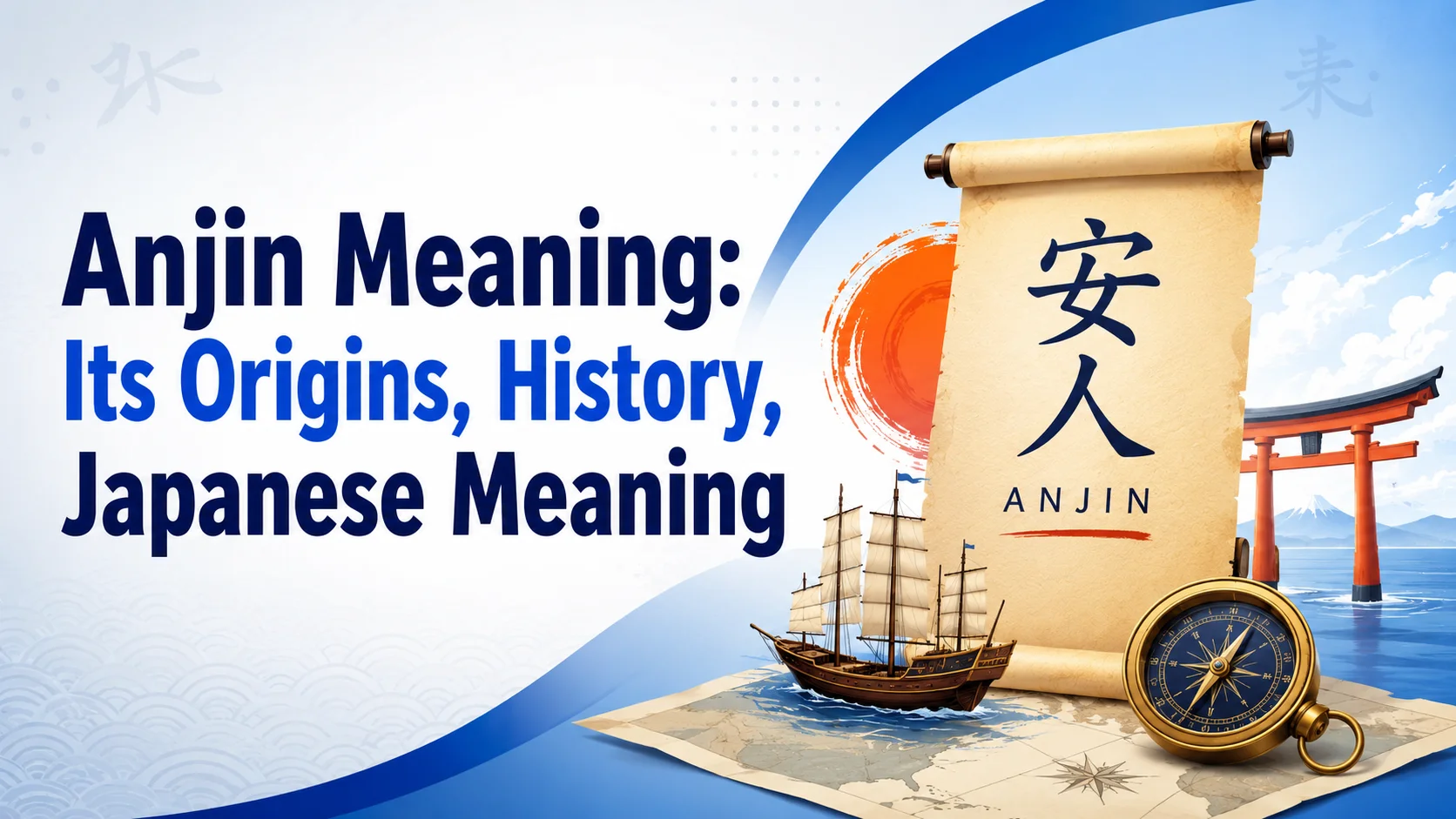
Anjin is a Japanese word with more than one possible meaning, and its interpretation depends heavily on context and kanji. Most English-language readers encounter it through Miura Anjin, the historical name given to English navigator William Adams, or through John Blackthorne in James Clavell’s Shōgun. In that historical setting, anjin refers to a pilot or navigator rather than simply meaning “foreigner” or “samurai.” The word can also appear in Japanese Buddhist and philosophical contexts with a different meaning connected to a settled or assured state of mind. Understanding these distinctions makes the word much easier to interpret accurately.
The confusion comes partly from Japanese romanization. When Japanese words are written in Latin letters, different kanji can sometimes appear identical in romanized form. That means seeing anjin by itself does not always tell you which meaning is intended. In historical sources, the word is closely tied to maritime expertise, William Adams, and the early Tokugawa period. In other contexts, related Japanese forms can describe inner reassurance or spiritual peace. The spelling alone is therefore not enough; the original Japanese characters and surrounding context matter.
This guide examines Anjin meaning, its Japanese origins, historical development, pronunciation, connection to William Adams, and use in Shōgun. It also separates the historical maritime term from the distinct philosophical meaning that readers may encounter in Japanese religious writing. By the end, you will know why Adams became Miura Anjin, what Anjin-san means, why Blackthorne receives the title in Shōgun, and why translating every occurrence of anjin in exactly the same way can lead to mistakes.
What Does Anjin Mean?
There is no single English definition that safely covers every occurrence of anjin. The meaning depends on the Japanese word being represented and the context in which it appears.
The historical term associated with Miura Anjin is generally understood in connection with a ship’s pilot or navigator. William Adams’s maritime knowledge made the title particularly appropriate to him after his arrival in Japan in the early seventeenth century.
A different Japanese term represented by the same or closely related romanization can occur in Buddhist or philosophical contexts, where the sense concerns a mind or heart that has become settled, secure, or spiritually assured.
Anjin Meaning at a Glance
| Context | What “Anjin” refers to | Key point |
| William Adams | A historical maritime title | Associated with a pilot/navigator |
| Miura Anjin | Adams’s Japanese name/title | Connected with his role and residence in Miura |
| Shōgun | Blackthorne’s title | Fictional character inspired by Adams |
| Buddhist/philosophical writing | A settled or assured state of mind | A different contextual meaning |
| Modern references | Often historical or literary | Meaning depends on the source |
Important: Do not assume that every Japanese occurrence of anjin means “navigator.” Romanization hides kanji, and kanji can carry the information needed to identify the intended meaning.
Anjin in Japanese: Meaning Depends on the Kanji
Japanese does not work like English when it comes to identifying words from romanization alone. A romanized spelling represents pronunciation, but it may not preserve the written distinction between different words.
This matters particularly with anjin, because readers may encounter the romanized form while researching Japanese history, Buddhism, or Shōgun.
What Does Anjin Mean in Japanese?
In the historical maritime context, anjin is associated with the Japanese term written 按針, traditionally understood as referring to a pilot or navigator.
The characters themselves help explain why the term has a specialized historical meaning. Rather than treating anjin as an ordinary Japanese personal name with a simple dictionary-style definition, it is more accurate to consider how the title functioned within its historical setting.
By contrast, 安心 is a different written form that can be romanized as anshin and, in some historical or Buddhist readings, anjin. It relates to peace of mind, reassurance, or spiritual assurance.
That distinction is crucial.
Why the Same Romanized Form Can Cause Confusion
When Japanese is converted into Latin letters, information contained in the writing system can disappear.
For example:
- 按針 → anjin in the historical maritime context
- 安心 → commonly anshin in modern Japanese, but anjin can occur in particular historical or Buddhist readings
Therefore, two texts can contain something that looks like anjin in English while referring to substantially different concepts.
The safest approach is simple: look at the original Japanese characters whenever the meaning matters.
Anjin and the Idea of a “Settled Heart”
The Buddhist/philosophical use deserves separate treatment because it is easy to confuse with the historical maritime title.
In this context, 安心 can express a condition of inner assurance, peace, or spiritual settlement. In Buddhist traditions, the concept can carry deeper doctrinal implications than the everyday English phrase “peace of mind” suggests.
It should not, however, be merged with 按針, the maritime term associated with William Adams.
That is one of the most important distinctions in understanding anjin accurately.
Anjin Origins and Linguistic Background
The history of anjin is particularly interesting because its best-known English-language use is tied to a period when Japan was encountering European maritime knowledge.
The word became famous internationally through William Adams, but its historical significance is larger than the story of one foreign sailor.
Where Does the Historical Word Anjin Come From?
The historical maritime term is written 按針 and is associated with the occupation or role of a ship’s pilot.
A pilot was not necessarily the captain of a vessel. The distinction matters because historical maritime roles were specialized.
A person responsible for piloting a ship needed practical knowledge of:
- Coastal waters
- Navigation
- Routes and harbors
- Winds and currents
- Ship handling
- Local maritime conditions
That expertise explains why describing anjin simply as “captain” can be misleading.
The Maritime Meaning Behind Anjin
The historical sense is commonly translated into English with terms such as pilot or navigator, depending on context.
Neither English word should be treated as a perfect one-to-one replacement.
A modern reader may imagine a navigator as someone primarily responsible for plotting a route, while a maritime pilot may be understood as someone with specialized knowledge of particular waters. Historical terminology does not always line up perfectly with modern occupational categories.
Context is therefore more reliable than a single English gloss.
Why Maritime Vocabulary Matters
William Adams did not become important in Japan merely because he was European. His technical and maritime knowledge was a major part of his historical significance.
This is also why the title Anjin tells readers something useful about how Adams was perceived: his practical expertise became part of his identity in Japan.
Miura Anjin: The Historical Figure Behind the Famous Name
When people search for Anjin meaning, they are often actually looking for the story of William Adams.
Who Was Miura Anjin?
William Adams was an English navigator who reached Japan in 1600 as part of a Dutch fleet.
His arrival occurred during a major turning point in Japanese history. Tokugawa Ieyasu was consolidating political power, and Adams’s maritime and technical knowledge attracted Ieyasu’s attention.
Adams eventually became closely associated with Japan and was known as Miura Anjin.
Why Was William Adams Called Miura Anjin?
The name is usually understood as combining Miura, associated with his residence or domain in the Miura area, with Anjin, his maritime title.
In other words, Anjin was not simply an invented Japanese version of “William.”
It reflected his professional role.
This distinction helps explain why historical references may use Miura Anjin even though the man’s birth name was William Adams.
How William Adams Became Associated With Japan
Adams’s story developed through several stages:
- He arrived in Japan in 1600.
- He came to the attention of Tokugawa Ieyasu.
- His knowledge of navigation and shipbuilding proved useful.
- He became an adviser and intermediary in matters involving Western maritime knowledge.
- He received privileges and status that were unusual for a foreigner in Japan at the time.
- He became known historically as Miura Anjin.
His life is therefore an important example of cross-cultural contact mediated through technical expertise.
What Did Miura Anjin Actually Do?
Adams’s skills extended beyond simply steering ships.
Historical accounts associate him with navigation, shipbuilding, maritime technology, and communication involving European powers.
His expertise had practical value because Japan’s leaders had strategic reasons to understand foreign ships, navigation, and overseas trade.
That makes the historical title Anjin more meaningful than a simple translation such as “sailor.”
Anjin During the Tokugawa Period
The historical significance of Anjin becomes clearer when placed against the background of the early Tokugawa period.
Anjin and Tokugawa Ieyasu
Tokugawa Ieyasu became the dominant political figure in Japan following the Battle of Sekigahara in 1600 and was appointed shogun in 1603.
Adams’s arrival around this period placed him in an unusually important historical moment.
Ieyasu recognized practical value in Adams’s knowledge. Rather than being treated solely as a foreign captive or curiosity, Adams became a source of information about European navigation, ships, and international affairs.
Anjin’s Role in Japanese Maritime History
The story illustrates how technical knowledge can cross cultural boundaries.
Adams’s maritime experience gave Japanese authorities access to information about:
- European ship construction
- Navigation
- Overseas routes
- Maritime trade
- Western political and commercial activity
This does not mean Adams single-handedly transformed Japanese maritime history. His importance should be understood within a much broader network of Japanese sailors, shipbuilders, officials, merchants, and foreign visitors.
Why the Anjin Title Became Historically Significant
Many occupational titles disappear into historical records. Anjin became unusually memorable because it became inseparable from one remarkable foreign individual.
That connection eventually made Miura Anjin a recognizable historical name, even though modern readers may first encounter it through fiction.
Anjin in Shōgun: Why Is Blackthorne Called Anjin?
The word gained renewed attention through James Clavell’s novel Shōgun and its screen adaptations.
What Does Anjin Mean in Shōgun?
In Shōgun, John Blackthorne is given the title Anjin because he is a foreign pilot whose maritime expertise resembles that of the historical William Adams.
The title therefore has a functional meaning within the story.
It is not Blackthorne’s surname.
Why Is Blackthorne Called “Anjin”?
Blackthorne arrives in Japan as an English pilot with valuable knowledge of navigation and European maritime affairs.
Japanese characters use Anjin as a way of identifying him through his occupation and role.
That mirrors the historical association between William Adams and Miura Anjin.
Historical William Adams vs. Fictional John Blackthorne
| William Adams | John Blackthorne |
| Historical person | Fictional character |
| English navigator | English pilot in the novel |
| Arrived in Japan in 1600 | Created for Clavell’s historical fiction |
| Known as Miura Anjin | Given the title Anjin |
| Became associated with Tokugawa Ieyasu | Becomes involved with fictionalized political events |
| Basis for the character | Literary adaptation |
The resemblance is deliberate, but Blackthorne is not simply William Adams with his name changed.
Clavell used historical material as the foundation for a fictional narrative.
How Accurate Is the Use of Anjin in Shōgun?
The use of Anjin is rooted in genuine history because William Adams really was known as Miura Anjin.
However, the novel and television adaptations reshape historical events for storytelling.
A useful rule is:
Treat Anjin’s historical connection to Adams as factual, but do not automatically treat every event involving Blackthorne as a historical event involving Adams.
That distinction prevents one of the most common misunderstandings surrounding the word.
What Does Anjin-San Mean?
Readers of Shōgun may also encounter Anjin-san.
The expression becomes easier to understand once the two parts are separated.
What Does “-san” Mean in Japanese?
-san is a widely used Japanese honorific.
It is placed after a person’s name or certain forms of address and conveys ordinary politeness or respect.
Therefore:
Anjin + san = Anjin-san
The suffix does not create an entirely new dictionary meaning for anjin.
Is “Anjin-san” a Name, Title, or Respectful Address?
In a historical or fictional setting, Anjin identifies the person through his title or role, while -san adds respectful address.
So Anjin-san can be understood roughly as “Mr. Anjin” or “Anjin” with a respectful Japanese form of address, although English translations do not always reproduce the nuance exactly.
Why “Anjin-san” Is Not a Separate Meaning
A common beginner mistake is to memorize Anjin-san as one indivisible Japanese vocabulary item.
Instead, break it apart:
- Anjin = the relevant title/name
- -san = honorific
That small distinction makes Japanese dialogue much easier to interpret.
How to Pronounce Anjin
The Japanese pronunciation is relatively short, but English speakers sometimes alter it because they instinctively apply English spelling rules.
Anjin Pronunciation in Japanese
The word has a compact Japanese rhythm, with the j sound corresponding to the Japanese consonant in the second syllable.
Anjin (anjin)
When practicing it, focus on keeping the syllables even rather than heavily stressing one syllable as English often does.
Common Pronunciation Mistakes
English speakers may:
- Overemphasize the first syllable
- Turn the vowels into strongly English-style vowel sounds
- Treat the word as though it were an English surname
- Add an unnecessary final sound
For Japanese words, rhythm and vowel clarity generally matter more than trying to force the word into an English stress pattern.
Is Anjin a Japanese Name?
Calling Anjin simply a Japanese first name can create the wrong impression.
Anjin as a Historical Title
In the William Adams story, Anjin functions as a title associated with his occupation, not as his original personal name.
This is why Miura Anjin should not be interpreted in the same way as a modern Japanese person’s ordinary given name.
Is Anjin Used as a Modern Personal Name?
Readers should be cautious about treating the historical title as evidence that Anjin is a common contemporary Japanese given name.
Historical, literary, religious, and modern naming contexts are different.
If you encounter Anjin presented as a person’s name today, check the original kanji and source before assuming that it has the same meaning as Adams’s title.
Why Context Matters More Than Romanization
Romanization answers one question:
How is this written in Latin letters?
It does not necessarily answer:
Which Japanese word is this?
That second question may require the original kanji.
Anjin vs. Similar Japanese Terms
The easiest way to avoid confusion is to compare anjin with words that look or sound similar.
Anjin vs. Anshin
| Feature | Historical Anjin | Anshin |
| Kanji | 按針 | 安心 |
| Main context | Maritime history | Everyday and philosophical/religious contexts |
| Common modern sense | Historical pilot/navigator title | Peace of mind, reassurance |
| Famous association | William Adams | Broader Japanese usage |
| Main danger | Translating it as “foreigner” | Confusing it with the historical title |
The two forms can sound similar enough to confuse learners, but their meanings are not interchangeable.
Anjin vs. Senchō
船長 (senchō) means ship captain.
That is not automatically equivalent to anjin.
A captain has command responsibility for a vessel, while a pilot or navigator can have a different specialized role.
This distinction is especially useful when reading historical translations.
Anjin vs. Other Maritime Roles
Historical maritime terminology does not always map neatly onto modern job titles.
A useful approach is to ask:
- Is the person commanding the vessel?
- Is the person responsible for navigation?
- Is the person an expert on particular waters?
- Is the term being used as a title rather than a modern occupation?
Those questions produce a better translation than choosing the first English synonym found in a dictionary.
Common Misunderstandings About Anjin
Anjin Does Not Simply Mean “Foreigner”
Blackthorne is foreign, but Anjin is not a Japanese synonym for foreigner.
The connection exists because a foreign pilot occupies the historical and fictional role associated with the term.
Anjin Does Not Mean “Samurai”
William Adams’s unusual status in Japan sometimes leads modern readers to associate Anjin with samurai.
That is incorrect.
His relationship with the Tokugawa authorities and the privileges he received are separate from the meaning of the maritime title.
Anjin Was Not William Adams’s Birth Name
His birth name was William Adams.
Miura Anjin was the Japanese name/title by which he became historically known in Japan.
Anjin Does Not Always Have One Fixed English Translation
“Pilot” and “navigator” can both be useful translations in the historical context, but neither should be treated as an automatic translation for every appearance of anjin.
Anjin-San Is Not One Undivided Word
The respectful form contains the honorific -san.
Understanding this helps readers recognize the same pattern with other Japanese names and titles.
Shōgun Is Not a Biography of William Adams
The historical relationship is real, but the story of John Blackthorne belongs to historical fiction.
Readers interested in Adams’s actual life should consult historical biographies and primary or scholarly sources rather than relying exclusively on the television drama.
Anjin and Cross-Cultural History
The story of Anjin is more interesting when viewed beyond vocabulary.
William Adams represents an unusual example of technical knowledge becoming a bridge between cultures.
His expertise gave Japanese authorities information about a world that was geographically distant but increasingly connected through maritime trade.
Language, Occupation, and Social Status
Historical societies often used occupational titles to identify people.
In Adams’s case, his professional expertise became sufficiently important that his Japanese identity became closely linked to his maritime role.
That is one reason Miura Anjin survived as a historical designation.
Anjin and Japan’s Contact With the Western World
The early seventeenth century was a period of significant contact between Japan and European powers.
English and Dutch maritime activity brought new information about:
- Ships
- Navigation
- Trade
- Geography
- International politics
- European commercial interests
Adams’s story sits inside this much larger historical development.
Why William Adams’s Story Made Anjin Memorable
Most technical titles do not become globally recognizable.
Anjin did because it became connected to a dramatic historical biography and, centuries later, a major work of popular fiction.
That combination explains why the word still attracts attention today.
Anjin Meaning in Modern Culture
The word now has a life beyond historical documents.
Anjin Beyond the Historical Record
Modern audiences may encounter Anjin through:
- Historical books
- Japanese history
- James Clavell’s Shōgun
- Television adaptations
- Discussions of William Adams
- Japanese cultural and historical commentary
The source matters because a literary use may deliberately echo historical terminology without reproducing its original context exactly.
Why Shōgun Renewed Interest in Anjin
For many English-speaking readers and viewers, Blackthorne is the first person associated with the word.
That creates an interesting reversal: a historical Japanese title became familiar internationally through a fictional character inspired by the person who historically carried it.
Anjin as a Symbol of Cross-Cultural Exchange
It is reasonable to interpret the story of Miura Anjin as an example of cultural exchange, particularly because Adams’s technical knowledge became valuable across linguistic and national boundaries.
That is an interpretive lesson from the historical story, however, rather than the literal dictionary meaning of anjin.
How to Understand Anjin When You See It in Context
If you encounter the word while reading or watching something, use the surrounding information to identify its meaning.
| Where you see “Anjin” | Most useful interpretation | What to check |
| “Miura Anjin” | William Adams’s historical title/name | Historical context |
| Shōgun | Blackthorne’s title | Fictional context |
| “Anjin-san” | Anjin + respectful honorific | Role of -san |
| Japanese Buddhist writing | Potentially a different meaning | Original kanji |
| Modern Japanese text | Context-dependent | Kanji and sentence |
If You See “Anjin” in Shōgun
Think pilot/maritime title and then consider the historical connection to William Adams.
If You See Anjin in a Japanese Religious Context
Do not automatically translate it as “navigator.”
Check the kanji, because the philosophical use belongs to a different semantic field.
If You See “Miura Anjin”
The reference is almost certainly connected with William Adams, the English navigator who became an important historical figure in early Tokugawa Japan.
If You See “Anjin-san”
Separate the two components mentally. The first identifies the relevant title/name; -san supplies respectful address.
Conclusion
The most useful way to understand Anjin meaning is to stop treating the romanized spelling as a complete definition. In the history of Miura Anjin, Anjin refers to a maritime role associated with William Adams, the English navigator who became closely connected with Tokugawa Ieyasu. In Shōgun, that historical connection is transformed into the fictional title given to John Blackthorne. Meanwhile, a different Japanese written form can carry a philosophical meaning related to inner assurance or a settled mind. One final actionable tip: whenever you encounter anjin in Japanese, check the kanji and context before translating it. A common mistake to avoid is assuming that every appearance means “navigator,” “foreigner,” or the character from Shōgun. The spelling may look identical in English, but the Japanese word behind it can tell a very different story.
Frequently Asked Questions
Q1. What does Anjin mean in Japanese?
Anjin most famously refers to the historical Japanese maritime title 按針, associated with a pilot or navigator. However, romanization alone can be ambiguous. A related form involving 安心 has a different meaning connected with reassurance or spiritual assurance, so the original kanji matters.
Q2. Why is William Adams called Anjin?
William Adams became known in Japan as Miura Anjin, with Anjin referring to his maritime role. His expertise in navigation and shipbuilding made him valuable to Tokugawa Ieyasu. The title subsequently became strongly associated with Adams in Japanese history.
Q3. Does Anjin mean “foreigner” in Japanese?
No. Anjin does not literally mean “foreigner.” The confusion comes partly from its association with William Adams and John Blackthorne, both foreign characters in historical or fictional narratives. Its famous historical usage concerns a maritime role, not nationality.
Q4. Is Anjin a samurai rank?
No. Anjin is not a samurai rank. In the historical story of William Adams, it was a maritime title associated with his expertise. Adams later received considerable status in Japan, but that historical status should not be confused with the literal meaning of anjin.
Q5. What is the difference between Anjin and Anshin?
Anjin in the historical context is associated with 按針, a maritime pilot/navigator title. Anshin (安心) commonly means peace of mind, reassurance, or security. Some Buddhist contexts use a reading of 安心 that may appear as anjin, which is why the distinction requires attention to kanji.
