
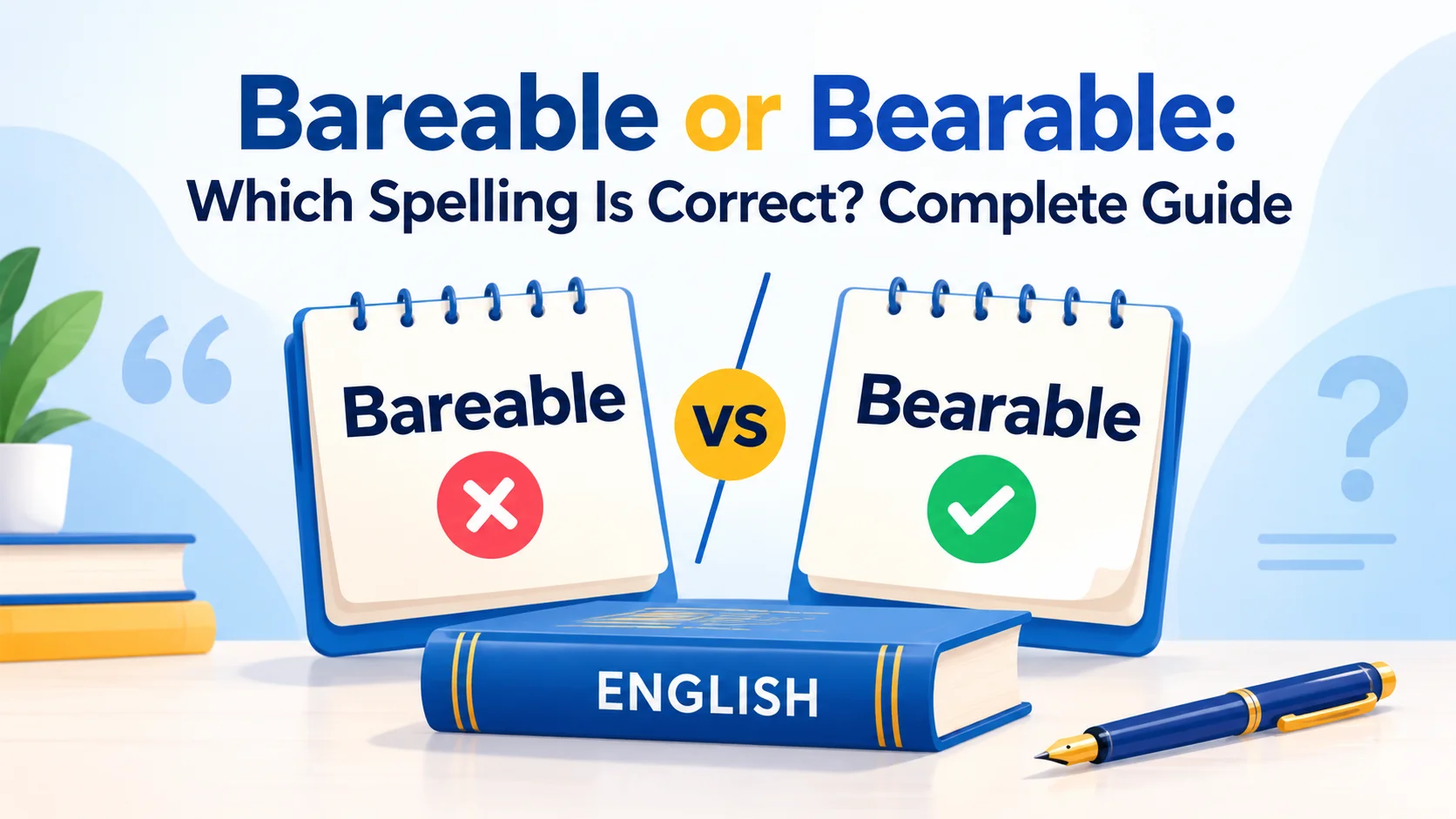
Bareable or bearable—which spelling should you use when you want to say that something can be endured or tolerated? The correct spelling is bearable. It comes from the verb bear, which can mean to endure, tolerate, or withstand something, combined with the suffix -able, meaning “capable of being.” So, if a difficult situation is bearable, it is difficult but still possible to tolerate. Bareable is a common spelling mistake caused largely by the fact that bear and bare sound alike in many varieties of English.
The confusion becomes easier to understand when you look at the two root words. Bear can mean to carry, support, produce, or endure, while bare means uncovered, exposed, or lacking something. These meanings are unrelated in the expression bearable pain, bearable heat, or bearable workload. Understanding that connection is much more useful than simply memorizing a spelling. It gives you a reliable way to choose the correct form whenever you encounter the word.
In this guide, you will learn why bearable is correct, whether bareable is ever acceptable, how the word developed, and how it differs from related terms such as barely bearable, unbearable, tolerable, and manageable. You will also see practical examples from everyday, professional, emotional, and physical situations. By the end, the simple “Can I bear it?” test will make this spelling choice almost automatic.
Bareable or Bearable: The Correct Spelling at a Glance
The standard spelling is bearable.
Use bearable when you mean that something can be endured, tolerated, or withstood, even if it is unpleasant or difficult.
Bareable is generally a misspelling when used with this meaning.
| Word | Standard spelling? | Meaning | Example |
| Bearable | Yes | Able to be endured or tolerated | The pain was bearable. |
| Bareable | No, for this meaning | Usually a misspelling of bearable | Avoid this spelling in standard writing. |
| Bare | Yes | Uncovered, exposed, or empty | The walls were bare. |
| Barely | Yes | Only just; by a small margin | The pain was barely bearable. |
A useful shortcut is:
If you can bear something, it is bearable.
For example:
- I can bear the noise → The noise is bearable.
- I cannot bear the pain → The pain is unbearable.
- I can only just bear the heat → The heat is barely bearable.
That connection explains the spelling far better than memorizing bearable as an isolated word.
What Does Bearable Mean?
Bearable is an adjective describing something that can be endured or tolerated.
It does not necessarily mean that something is pleasant, comfortable, or desirable. Instead, it suggests that a person can put up with it without reaching the point where it becomes impossible to tolerate.
Consider these examples:
- The headache was bearable.
- The waiting time was bearable.
- The heat became more bearable in the evening.
- Her workload was difficult but bearable.
- The noise was annoying but still bearable.
In each sentence, something creates discomfort or difficulty, but the speaker believes it can still be endured.
Bearable as an Adjective
Grammatically, bearable is an adjective because it describes a noun or subject.
Compare:
- The pain is bearable.
- The weather is bearable.
- The situation became bearable.
- The workload seems bearable.
It can also appear after adverbs that modify its degree:
- barely bearable
- quite bearable
- reasonably bearable
- more bearable
- less bearable
- completely bearable
This makes bearable useful for describing degrees of difficulty rather than simply labeling something good or bad.
Bearable Does Not Mean Pleasant
This distinction matters.
If you say:
The temperature is bearable.
you are not saying the temperature is comfortable. You are saying it is possible to tolerate.
Likewise:
The workload is bearable.
does not necessarily mean the workload is easy. It means the workload has not become impossible to handle.
That subtle difference makes bearable especially useful when discussing difficult circumstances.
Is “Bareable” a Correct English Word?
When people write bareable, they usually intend to write bearable.
The mistake is understandable because bare is a real English word and bare + -able looks like a logical construction. Someone who knows words such as readable, washable, or breakable may instinctively assume that bareable should work in the same way.
But the intended word comes from bear, not bare.
Why Bareable Looks Like It Should Be Correct
English spelling often encourages people to build words from familiar pieces.
For example:
- read + able → readable
- wash + able → washable
- accept + able → acceptable
So it is easy to look at bare and assume:
bare + able = bareable
The problem is semantic, not simply visual. Bearable is connected to the verb bear in the sense of endure.
The meaning is essentially:
able to be borne or endured
It is not:
able to be bare
Is Bareable Ever Seen in Writing?
You may encounter bareable online, in informal writing, user-generated content, or as an apparent word formation. Seeing it somewhere, however, does not make it the appropriate standard spelling for the meaning “able to be endured.”
For normal English writing, especially schoolwork, professional communication, journalism, business writing, and edited content, use bearable.
Bearable vs Bareable: What Is the Difference?
The most important distinction is the root word.
Bearable comes from bear, meaning to endure or tolerate.
Bare relates to being uncovered or exposed.
| Form | Root | Core idea | Example |
| Bearable | bear | Able to be endured | The discomfort was bearable. |
| Bare | bare | Uncovered or exposed | He walked with bare feet. |
| Barely | bare + -ly | Only just | She could barely hear him. |
| Unbearable | bear + -able + un- | Impossible or extremely difficult to endure | The noise was unbearable. |
The difference becomes obvious once the meanings are placed side by side.
Bearable = Able to Be Endured
In:
The pain is bearable.
bear carries the idea of enduring pain.
The word can therefore be understood as:
bear + able → bearable
Bare = Uncovered or Exposed
The word bare has an entirely different semantic field.
Examples include:
- bare feet
- bare skin
- bare walls
- bare ground
- bare hands
- the bare minimum
None of these meanings involves enduring or tolerating something.
That is why replacing bearable with bareable changes the word’s underlying logic.
Why Is Bearable Spelled With “Bear”?
The spelling makes sense once you recognize one particular meaning of bear.
Many learners first associate bear with the animal. Others know it as a verb meaning “to carry.” But bear also has a long-established verbal meaning: to endure, tolerate, or withstand.
For example:
I cannot bear this noise.
Here, bear obviously does not mean carry an object. It means tolerate or endure.
Now change the structure:
This noise is bearable.
The adjective means that the noise can be endured.
The Connection Between Bear and Bearable
Think of these pairs:
- bear the pain → bearable pain
- bear the heat → bearable heat
- bear the pressure → bearable pressure
- bear the workload → bearable workload
- bear the situation → bearable situation
This relationship is the strongest spelling clue.
How the Suffix “-able” Helps
The suffix -able commonly creates adjectives expressing possibility or capability.
Examples include:
- avoid → avoidable
- understand → understandable
- accept → acceptable
- predict → predictable
- tolerate → tolerable
With bearable, the basic idea is:
something that can be borne or endured
You do not need to analyze the historical development of every letter to spell it correctly. The practical connection to bear = endure is enough.
Bear vs Bare: The Root of the Spelling Confusion
The confusion between bear and bare is especially persistent because the two words are homophones in many varieties of English.
That means they are pronounced alike or very similarly even though their meanings and spellings differ.
Bear as a Verb
Depending on context, bear can mean:
- carry
- support
- endure
- tolerate
- withstand
- produce
For bearable, the relevant meaning is endure or tolerate.
Example:
She could not bear the pain.
Bare as an Adjective
Bare can mean:
- uncovered
- exposed
- without clothing
- empty
- lacking decoration
- minimal
Examples:
He walked across the floor with bare feet.
The room had bare walls.
They had only the bare essentials.
A Simple Meaning Test
When you are unsure whether the word should contain bear or bare, ask what the sentence actually means.
If the idea is:
Can this be endured?
choose bearable.
If the idea is:
Is something uncovered or exposed?
you are dealing with bare, not bearable.
This meaning-first approach is much more dependable than trying to remember which spelling “looks right.”
How Bearable Is Used in Real Sentences
The word appears in many situations because people constantly need to describe things that are difficult without being impossible.
Physical Pain and Discomfort
The pain was bearable after a few minutes.
The soreness was uncomfortable but bearable.
Here, bearable describes a physical sensation that can still be tolerated.
Weather and Temperature
The afternoon heat was almost unbearable.
With some shade, the temperature became bearable.
Weather is a common context because temperatures can move along a scale from comfortable to unpleasant to unbearable.
Emotional Situations
Talking to someone made the situation more bearable.
The first few weeks were difficult, but eventually life became more bearable.
In emotional contexts, bearable often suggests that support, time, or changing circumstances has reduced the difficulty.
Work and School
The workload is bearable if we divide the assignments between the team.
The exam schedule was demanding but bearable.
The word does not mean the workload is ideal. It means it remains within a person’s capacity to tolerate.
Noise and Environmental Conditions
The construction noise was bearable during the afternoon.
The smell became more bearable after the windows were opened.
This illustrates an important feature of the word: bearable is highly dependent on circumstances.
Something may be bearable for one person and unbearable for another.
Common Phrases and Collocations With Bearable
Certain combinations occur naturally because they describe degrees or changes in tolerance.
More Bearable
Used when something becomes easier to tolerate.
The cooler weather made the long journey more bearable.
Barely Bearable
This means only just bearable.
The noise was barely bearable.
The word barely is important. It tells the reader that the situation is very close to becoming unbearable.
Make Something Bearable
This pattern describes an action or condition that reduces difficulty.
A short break made the workload more bearable.
Become Bearable
Used when a situation changes from difficult to tolerable.
Once the crowd became smaller, the waiting room became more bearable.
Keep Something Bearable
This can describe deliberately maintaining a tolerable level.
We opened the windows to keep the temperature bearable.
Bearable vs Barely Bearable: A Small Difference With a Big Meaning
Bearable and barely bearable are not interchangeable.
Compare:
The pain is bearable.
This means the pain can be tolerated.
The pain is barely bearable.
This means the pain can only just be tolerated.
The pain is unbearable.
This means the pain cannot reasonably be tolerated.
Think of them as points on a scale:
comfortable → unpleasant → bearable → barely bearable → unbearable
The exact boundary is subjective, but the language communicates increasing difficulty.
Why “Barely” Is Correct Here
A common learner may see barely bearable and assume that barely is somehow connected to the spelling of bearable. It is not.
Barely means:
only just; scarcely; by a very small amount
Bearable means:
capable of being endured
So:
barely + bearable
means:
only just capable of being endured.
This is one of the most useful examples for understanding why bareable and bearable are different.
Bearable vs Unbearable
Unbearable is the negative form of bearable.
The prefix un- reverses the meaning.
| Word | Meaning | Example |
| Bearable | Can be endured | The discomfort is bearable. |
| Barely bearable | Can only just be endured | The discomfort is barely bearable. |
| Unbearable | Cannot reasonably be endured | The discomfort is unbearable. |
Consider temperature:
The room is bearable.
The temperature is tolerable.
The room is barely bearable.
The temperature is very difficult to tolerate.
The room is unbearable.
The temperature has crossed the speaker’s tolerance limit.
This distinction is particularly useful in descriptive writing because it lets you communicate degree, rather than simply saying that something is good or bad.
Bearable vs Tolerable, Endurable, Manageable, and Acceptable
These words overlap, but they are not identical.
Bearable vs Tolerable
Tolerable is perhaps the closest everyday synonym.
The noise is bearable.
The noise is tolerable.
Both indicate that the noise can be endured.
However, tolerable can sometimes sound more formal or objective, while bearable often feels more personal and experiential.
Bearable vs Endurable
Endurable also means capable of being endured, but it is less common in ordinary conversation.
The hardship was endurable.
is grammatically possible, but:
The hardship was bearable.
usually sounds more natural.
Bearable vs Manageable
Manageable is not necessarily about suffering.
A task can be manageable because it is within someone’s ability to organize or control.
The workload is manageable.
This may mean the person can successfully handle it.
By contrast:
The workload is bearable.
focuses more on whether the workload can be tolerated.
Bearable vs Acceptable
Acceptable often relates to standards, rules, approval, or expectations.
The quality is acceptable.
This means the quality meets a certain standard.
The quality is bearable.
This sounds unusual unless the quality itself is causing discomfort, inconvenience, or difficulty.
The words overlap in some situations, but they emphasize different judgments.
Common Mistakes Involving Bearable
Writing “Bareable” Instead of “Bearable”
This is the central spelling error.
Incorrect:
The pain was bareable.
Correct:
The pain was bearable.
The easiest fix is to connect the adjective to bear = endure.
Confusing Bearable With Barely
These words can appear together:
The situation was barely bearable.
But they have different functions.
- barely = only just
- bearable = capable of being endured
Removing barely leaves a complete sentence:
The situation was bearable.
Confusing Bearable With Bailable
Bailable is a different word associated with bail, particularly in legal contexts.
For example:
The offense was bailable.
This has nothing to do with whether something can be endured.
The similar spelling can cause occasional typing mistakes, especially when writing quickly.
Confusing Bearable With Borne or Born
The forms borne and born belong to the verb bear, but they have different uses.
For example:
The cost was borne by the company.
Here, borne relates to carrying or accepting a burden.
Born is primarily used in connection with birth:
She was born in June.
These words are related to bear, but they should not be substituted for bearable.
Using Bearable When Unbearable Is Intended
The prefix matters.
The noise was bearable.
means the noise could be tolerated.
The noise was unbearable.
means the noise could not be tolerated.
A single prefix changes the meaning substantially, so proofreading should pay attention to un-.
Bearable in American and British English
There is no standard American-versus-British spelling difference here.
Bearable is the normal spelling in both American English and British English.
This is different from pairs such as:
- color / colour
- organize / organise
- center / centre
You should not change bearable to bareable because you are writing for a British audience.
Is “Bareable” a British Spelling?
No. Bareable should not be treated as the British version of bearable.
For standard English in either variety, write:
bearable
The same rule applies in professional writing, educational material, edited publications, and general communication.
How to Remember the Correct Spelling of Bearable
A good memory trick should explain the word rather than simply attach an arbitrary image to it.
Use the “Bear the Pain” Trick
Think:
Can I bear the pain?
If yes:
The pain is bearable.
The two words share the same important root:
bear → bearable
Think “Can I Bear It?”
Whenever you hesitate, ask:
Can I bear it?
If the answer relates to enduring or tolerating something, use bearable.
Examples:
- Can I bear the heat? → The heat is bearable.
- Can I bear the noise? → The noise is bearable.
- Can I bear the workload? → The workload is bearable.
Connect Bearable With Unbearable
Another useful memory aid is to remember the familiar word unbearable.
If something can be endured, it is:
bearable
If it cannot be endured, it is:
unbearable
Both clearly contain bear.
Avoid the “Bare + -able” Trap
Do not build the word mechanically from bare.
The question is not:
“Can I make an adjective from bare?”
Instead ask:
“What does this sentence mean?”
If the answer is able to be endured, the spelling is bearable.
Quick Editing Checklist: Should It Be Bearable?
Before publishing a sentence containing this word, run through this short checklist:
- Does the word mean able to be endured?
- Could you replace it with tolerable?
- Is the situation something a person can bear?
- Are you accidentally thinking about bare, meaning uncovered?
- Are you describing a degree of discomfort rather than physical exposure?
- If the answer is yes, use bearable.
This takes only a few seconds and is more reliable than depending on visual familiarity.
Bearable Examples: Correct vs Incorrect
| Incorrect | Correct | Reason |
| The pain was bareable. | The pain was bearable. | Bear means endure. |
| The heat became bareable. | The heat became bearable. | The heat can be tolerated. |
| The workload is bareable. | The workload is bearable. | The workload can be endured. |
| The noise was barely bearable. | The noise was barely bearable. | Both words are correctly spelled and have separate meanings. |
| The conditions were unbareable. | The conditions were unbearable. | Unbearable comes from bear. |
Casual Examples
The traffic was annoying but bearable.
The movie was long, but the wait was bearable.
After a cup of coffee, the early morning became more bearable.
Professional Examples
The revised schedule makes the workload more bearable for the team.
The temporary disruption should remain bearable for most customers.
The increased processing time is bearable during peak demand.
Academic and Formal Examples
The experimental conditions remained bearable throughout the observation period.
Participants described the discomfort as bearable rather than severe.
The exact wording should always reflect the context. In highly formal technical writing, more precise terms such as tolerable, within acceptable limits, or a measurable description may sometimes be preferable.
Why “Bareable” Is Such a Common Spelling Mistake
The mistake is not random. Several features of English make it predictable.
English Has Many Homophones
Bear and bare sound alike in many accents.
That means a listener cannot necessarily determine which spelling is intended from pronunciation alone.
For example, if someone says:
“The pain is bearable.”
you cannot rely on the sound of bearable to distinguish it from a hypothetical bareable. You need to understand the meaning.
“Bare” Is a Familiar Word
Most English learners know bare from an early stage:
- bare feet
- bare hands
- bare walls
- bare skin
- bare minimum
Because it is familiar, the spelling bareable can look convincing at first glance.
Fast Typing Encourages Sound-Based Spelling
When people write quickly, they often retrieve words from memory by pronunciation rather than by consciously reconstructing their roots.
That becomes especially risky with homophones.
Repeated Online Errors Can Look Legitimate
A misspelling that appears repeatedly can start to look normal.
This is an important lesson beyond bearable: frequency on the internet does not automatically determine standard spelling.
When accuracy matters, meaning, established usage, and reliable dictionaries are stronger guides than the number of times a form appears in informal online text.
A Practical Way to Choose the Right Word
If you regularly confuse bearable and bareable, do not memorize a complicated spelling rule.
Use this three-step method:
Step 1: Identify the Meaning
Ask:
Does this mean “able to be endured”?
If yes, continue.
Step 2: Find the Root Verb
Ask:
What verb expresses this idea?
The answer is bear.
Step 3: Add the Adjective Form
bear + able = bearable
For example:
I can bear the discomfort.
becomes:
The discomfort is bearable.
This method works because it connects spelling, grammar, and meaning at the same time.
Conclusion
When you mean “able to be endured or tolerated,” the correct spelling is bearable, not bareable. The key is understanding the root: bear can mean to endure, and adding -able creates the adjective bearable. The word has nothing to do with bare, which describes something uncovered, exposed, or lacking. One final actionable tip: whenever you hesitate, replace the word with tolerable. If the sentence still makes sense, bearable is probably the word you need. You can also ask yourself, “Can I bear it?” That simple question connects the meaning directly to the correct spelling. A common mistake to avoid is choosing bareable simply because bare is a familiar word. English spelling often depends on a word’s meaning and origin, not just how naturally its letters seem to fit. Remember bear → endure → bearable, and this particular spelling problem becomes much easier to avoid.
Frequently Asked Questions
Q1. Is “bareable” ever acceptable in standard English?
For the intended meaning “able to be endured,” bareable is not the standard spelling. Use bearable. Although nonstandard formations can appear in informal or user-generated writing, they should not be treated as an alternative spelling in careful English.
Q2. Why do bearable and bareable sound so similar?
The confusion comes from bear and bare, which are homophones in many English accents. Their pronunciation can be identical or nearly identical even though their meanings differ. Spelling therefore has to be learned from meaning and word relationships, not pronunciation alone.
Q3. Is bearable a synonym for tolerable?
Yes, bearable and tolerable are often interchangeable when describing something that can be endured. However, bearable can sound more personal or experiential, while tolerable may sound slightly more neutral or formal depending on the context.
Q4. What is the opposite of bearable?
The direct opposite is unbearable. It describes something that cannot reasonably be endured or tolerated. Between the two is barely bearable, meaning something can technically be endured but only by a very small margin.
Q5. What is the easiest way to remember bearable?
Connect it to the verb bear, meaning “endure.” Ask yourself, “Can I bear it?” If the answer is yes, the adjective is bearable. This memory technique also helps distinguish it from bare, which means uncovered or exposed.
