
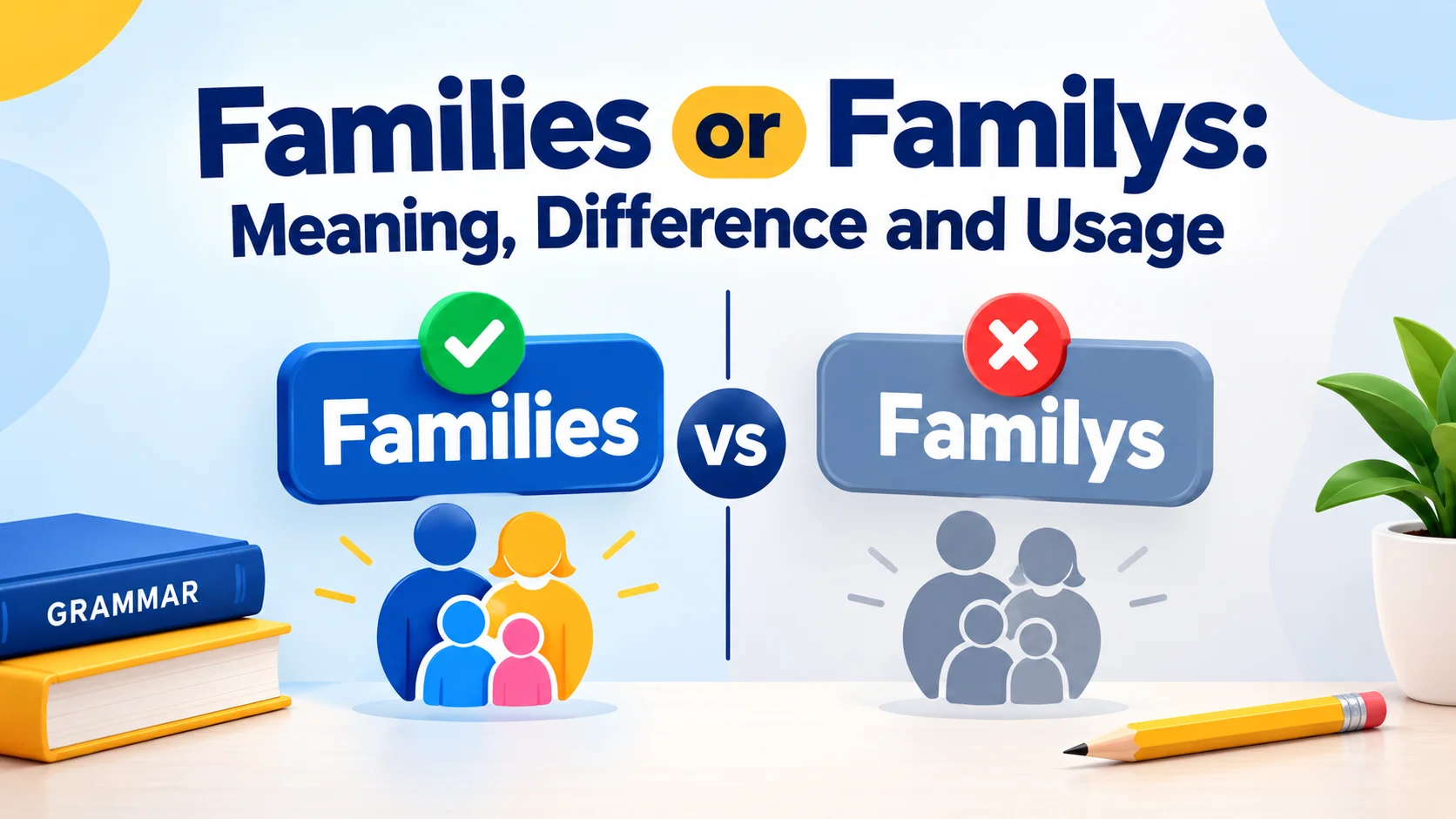
The correct spelling in “families or familys” is families. Although familys may look reasonable at first glance, it does not follow the standard English rule for forming the plural of a noun that ends in a consonant followed by y. This small spelling difference matters when writing emails, school assignments, reports, invitations, and other everyday documents. Fortunately, the rule is straightforward once you understand why family changes to families instead of simply adding an s.
The confusion does not stop at spelling. Writers also need to distinguish families, family’s, and families’. These forms look similar, but they perform different jobs in a sentence. Families refers to more than one family, family’s usually indicates something belonging to one family, and families’ shows possession involving multiple families. Choosing the wrong form can change the meaning of an otherwise clear sentence.
In this guide, you will learn the correct plural spelling, understand the grammar behind the consonant-plus-y rule, and see how the four forms work in real situations. You will also find practical examples, comparison tables, common errors, and a simple method for checking your writing. Whether you are learning English or polishing professional documents, understanding these distinctions will help you communicate more precisely without relying on guesswork or spell-check alone.
Families or Familys: Which Spelling Is Correct?
Families is the correct plural spelling of family. The spelling familys is incorrect in standard English when you mean more than one family.
The reason is a common English spelling rule: when a noun ends in a consonant followed by y, the y usually changes to i before adding -es to form the plural.
- One family → two families
- One baby → two babies
- One city → two cities
- One country → two countries
The same pattern explains why familys is incorrect. You do not simply add s to family; you change the ending first.
| Form | Correct? | Meaning or use |
| Family | Yes | One family |
| Families | Yes | More than one family |
| Family’s | Yes | Possession or association involving one family |
| Families’ | Yes | Possession or association involving multiple families |
| Familys | No, in standard plural usage | Incorrect spelling of families |
Quick rule: Use families when counting family groups. Use an apostrophe only when you need to show possession or another relationship expressed by a possessive form.
What Does “Families” Mean?
Families is the plural form of the noun family. It refers to two or more family groups.
A family commonly consists of people related by birth, marriage, adoption, or other recognized relationships. The word can also refer to people who form a household or a close family unit, depending on the context.
For example:
- Several families attended the school meeting.
- The charity provides food to low-income families.
- Three families live in the same apartment building.
- The park was crowded with families during the holiday.
- Local families were invited to the community event.
In every example, families refers to multiple groups rather than one group.
How “Families” Is Used in Everyday English
The word appears in many settings, including education, healthcare, community services, business communication, and news reporting.
Consider the sentence:
“Families are encouraged to register before Friday.”
This means that multiple family groups are being encouraged to register. The sentence does not identify a particular family or indicate ownership.
Now compare it with:
“The family is encouraged to register before Friday.”
Here, the family refers to one family group.
The distinction is useful when writing announcements, instructions, or reports in which the number of groups matters.
Does “Families” Always Mean Parents and Children?
No. The word family does not always refer exclusively to a mother, father, and their children.
Depending on the situation, it may include extended relatives, adoptive relationships, single-parent households, blended families, or other family arrangements. In some contexts, people also use family more broadly to describe a close-knit group.
For example, “The organization supports families affected by displacement” does not specify a particular family structure.
Use the term according to the intended meaning rather than assuming every family has the same composition.
Why “Familys” Is Incorrect
The spelling familys fails to follow the usual plural-forming rule for nouns ending in a consonant plus y.
The noun family ends with l + y. Because l is a consonant, the standard plural form changes the y to i and adds -es:
family → families
Writing familys applies a different pattern—simply adding s—that does not work for this noun.
Why the Rule Matters
English plural formation depends partly on the letters at the end of a word. Compare these examples:
| Singular noun | Correct plural | Rule |
| Family | Families | Consonant + y changes to i + es |
| Baby | Babies | Consonant + y changes to i + es |
| City | Cities | Consonant + y changes to i + es |
| Toy | Toys | Vowel + y takes s |
| Key | Keys | Vowel + y takes s |
| Day | Days | Vowel + y takes s |
The difference between family and toy is particularly useful. Both end in y, but the letter before the y determines the usual plural pattern.
Can “Familys” Ever Be Used?
You may encounter Familys as a business name, username, fictional label, or deliberate stylistic choice. Proper names and branding do not always follow standard spelling conventions.
That exception does not make familys correct as the ordinary plural of family. In schoolwork, professional writing, and standard edited English, use families.
Family, Families, Family’s, and Families’: What Is the Difference?
These four forms are related, but each has a distinct grammatical purpose. The best way to choose between them is to ask two questions:
- Are you referring to one family or multiple families?
- Are you showing possession or association?
Family: The Singular Form
Use family when referring to one family group.
Examples:
- My family lives in Lahore.
- The family visited the museum.
- Her family supports her decision.
- Our family enjoys weekend picnics.
The word is singular in meaning, although family is also a collective noun. That means it names a group of people as one unit.
Families: The Plural Form
Use families when referring to two or more family groups.
Examples:
- Several families attended the ceremony.
- The school invited local families.
- Many families need affordable housing.
- The program helps families access educational resources.
No apostrophe is needed because the word is simply plural.
Family’s: The Singular Possessive Form
Use family’s when showing that something belongs to, concerns, or is associated with one family.
Examples:
- The family’s house is near the river.
- We respected the family’s decision.
- The family’s history spans several generations.
- The family’s application was approved.
The apostrophe and s indicate possession or association. They do not make the word plural.
A useful test is to ask whether you could replace the phrase with “belonging to one family” or “associated with one family.”
For instance, “the family’s decision” means the decision made by or associated with that family.
Families’: The Plural Possessive Form
Use families’ when showing possession or association involving multiple families.
Examples:
- The families’ homes were inspected.
- The school considered the families’ concerns.
- The families’ applications arrived together.
- The community center hosted a meeting for the families’ representatives.
Because families is already plural and ends in s, the possessive apostrophe usually comes after the final s.
Comparison Table: All Four Forms
| Word | Number | Possessive? | Example |
| Family | Singular | No | The family lives nearby. |
| Families | Plural | No | The families live nearby. |
| Family’s | Singular | Yes | The family’s garden is large. |
| Families’ | Plural | Yes | The families’ gardens are large. |
Notice how the meaning changes:
- The family’s garden refers to the garden associated with one family.
- The families’ gardens refers to gardens associated with multiple families.
The apostrophe is not decorative punctuation. Its position helps communicate the relationship between the noun and the thing being discussed.
How to Form the Plural of “Family” Correctly
The spelling of families follows a broader pattern used for many English nouns. Learning that pattern helps you spell other words correctly, too.
The Consonant + Y Rule
When a noun ends in a consonant followed by y, change the y to i and add -es to form its plural.
Examples include:
- Family → families
- Baby → babies
- Country → countries
- Library → libraries
- Party → parties
- Story → stories
The same rule applies to family because the letter before the final y is l, a consonant.
When You Keep the Y and Add S
When a noun ends in a vowel followed by y, the usual plural form is made by adding s without changing the y.
Examples:
- Boy → boys
- Day → days
- Key → keys
- Toy → toys
- Journey → journeys
This is why families and boys follow different spelling patterns even though both singular words end in y.
Does the Rule Apply to Every Word Ending in Y?
No spelling rule should be applied without considering the word’s structure and usage.
The consonant-plus-y pattern is a reliable general rule for regular plural nouns, but English also contains irregular plurals and special forms. For example, child becomes children, not childs, and person commonly becomes people when referring to multiple individuals.
For ordinary plural formation, however, family → families is straightforward and regular.
Families vs. Family’s vs. Families’: Real-World Examples
The difference becomes easier to understand when you compare the forms in complete sentences.
In School and Education
- Correct: The school invited several families to the event.
- Correct: The family’s permission was required.
- Correct: The families’ feedback helped improve the program.
The first sentence refers to multiple groups. The second refers to one family’s permission. The third refers to feedback associated with several families.
In Business and Community Communication
- Correct: We provide support to local families.
- Correct: The family’s request has been reviewed.
- Correct: The families’ requests have been reviewed.
- In a formal announcement, choosing the right form helps readers understand whether a statement concerns one group or many.
In Everyday Conversation
- Correct: Our family is visiting tomorrow.
- Correct: Two families are visiting tomorrow.
- Correct: My family’s car is outside.
- Correct: The families’ cars are outside.
The final two sentences show how number and possession work together. The apostrophe changes position because the noun’s grammatical form changes.
Common Mistakes With “Families” and “Familys”
Most errors occur because writers focus on the sound of a word instead of its spelling or grammatical function.
Mistake 1: Adding Only S to “Family”
Incorrect: The familys are waiting outside.
Correct: The families are waiting outside.
Why: Family ends in a consonant followed by y, so the standard plural is formed by changing y to i and adding -es.
Mistake 2: Using “Family’s” for More Than One Family
Incorrect: The family’s attended the meeting.
Correct: The families attended the meeting.
Why: The sentence needs a plural noun, not a possessive form. If you are not showing possession, you do not need the apostrophe.
Mistake 3: Forgetting the Apostrophe in a Possessive Phrase
Incorrect: The families homes were renovated.
Correct: The families’ homes were renovated.
Why: The sentence refers to homes associated with multiple families. The plural possessive form requires an apostrophe after the final s.
Mistake 4: Confusing the Plural With the Singular Possessive
Compare:
- The families gathered outside. — Multiple groups gathered.
- The family’s belongings were packed. — Belongings associated with one family.
- The families’ belongings were packed. — Belongings associated with multiple families.
Reading the sentence for meaning is often enough to identify the correct form.
Mistake 5: Assuming Every Word Ending in Y Takes -IES
Incorrect: The childs played outside.
Correct: The children played outside.
The y rule does not explain every English plural. Child has an irregular plural, children, so the correct form must be learned separately.
Subject-Verb Agreement: Family vs. Families
The choice between family and families can also affect the verb.
Families is plural, so it normally takes a plural verb:
- The families are arriving.
- The families have submitted their forms.
- The families were invited.
Family is singular in form, but it is a collective noun. Whether it takes a singular or plural verb can depend on the variety of English and whether the group is being considered as one unit or as individual members.
In American English, a family considered as one unit commonly takes a singular verb:
– The family is travelling tomorrow.
In British English, a plural verb is also common when the sentence emphasizes individual members:
– The family are travelling at different times.
The important distinction is that families is grammatically plural, whereas family is a collective noun whose agreement may vary by context and dialect.
British English vs. American English: Is the Spelling Different?
No. The standard plural spelling families are the same in both British and American English.
Some English words have regional spelling differences, such as colour and color. However, family follows the same plural spelling rule in both varieties.
| Form | British English | American English |
| Singular | Family | Family |
| Plural | Families | Families |
| Singular possessive | Family’s | Family’s |
| Plural possessive | Families’ | Families’ |
| Incorrect standard plural | Familys | Familys |
You do not need to change the spelling of families based on your audience’s location.
Verb agreement with collective nouns may vary, but that is a separate issue from the spelling of the plural noun.
How to Choose the Correct Form Every Time
When you are unsure, identify the meaning before deciding how to spell the word.
| What you want to say | Correct form | Example |
| One family group | Family | The family is here. |
| More than one family group | Families | The families are here. |
| Something associated with one family | Family’s | The family’s car is here. |
| Something associated with multiple families | Families’ | The families’ cars are here. |
Use this quick checklist before submitting your writing:
- Count the groups: Are you referring to one family or more than one?
- Check for possession: Does the sentence show ownership or association?
- Place the apostrophe correctly: Use family’s for one family and families’ for multiple families.
- Check the plural spelling: Use families, not familys.
- Read the sentence in context: Make sure the chosen form communicates the intended meaning.
This method works well for emails, essays, applications, notices, and other practical writing.
Conclusion
Choosing between families or familys is simple once you understand how English forms regular plurals. Families is the correct spelling because nouns ending in a consonant followed by y generally change the y to i and add -es. The more important skill is recognizing when the sentence needs family, families, family’s, or families’. Each form communicates a different combination of number and possession, so a small punctuation change can affect meaning. One final actionable tip: before finishing a sentence, ask whether you mean one family, several families, or something associated with them. A common mistake to avoid is adding an apostrophe simply because a word ends in s. Use punctuation to show the relationship you intend, and your writing will be clearer and more accurate.
Frequently Asked Questions
Q1. Is “familys” ever correct in English?
Familys is not the standard plural of family. You may see it in a brand name, username, or deliberately stylized text, where conventional spelling may not be followed. In ordinary writing, formal documents, and school assignments, use families.
Q2. What is the plural of “family”?
The plural of family is families. Because the word ends in a consonant followed by y, the usual spelling rule changes y to i and adds -es. For example, “One family lives here” becomes “Three families live here.”
Q3. What is the difference between “families” and “family’s”?
Families is the plural form of family, referring to multiple family groups. Family’s is the singular possessive form, showing that something belongs to or is associated with one family. Compare “The families arrived” with “The family’s house is nearby.”
Q4. What is the difference between “families” and “families’”?
Families is a plural noun without possession, while families’ is its plural possessive form. For example, “The families attended” simply refers to several groups. “The families’ concerns were addressed” refers to concerns associated with those groups.
Q5. Should I write “the family is” or “the family are”?
Both forms can be correct, depending on the variety of English and the intended meaning. American English commonly uses “the family is” when treating the family as one unit. British English also commonly uses “the family are” when emphasizing individual members.
