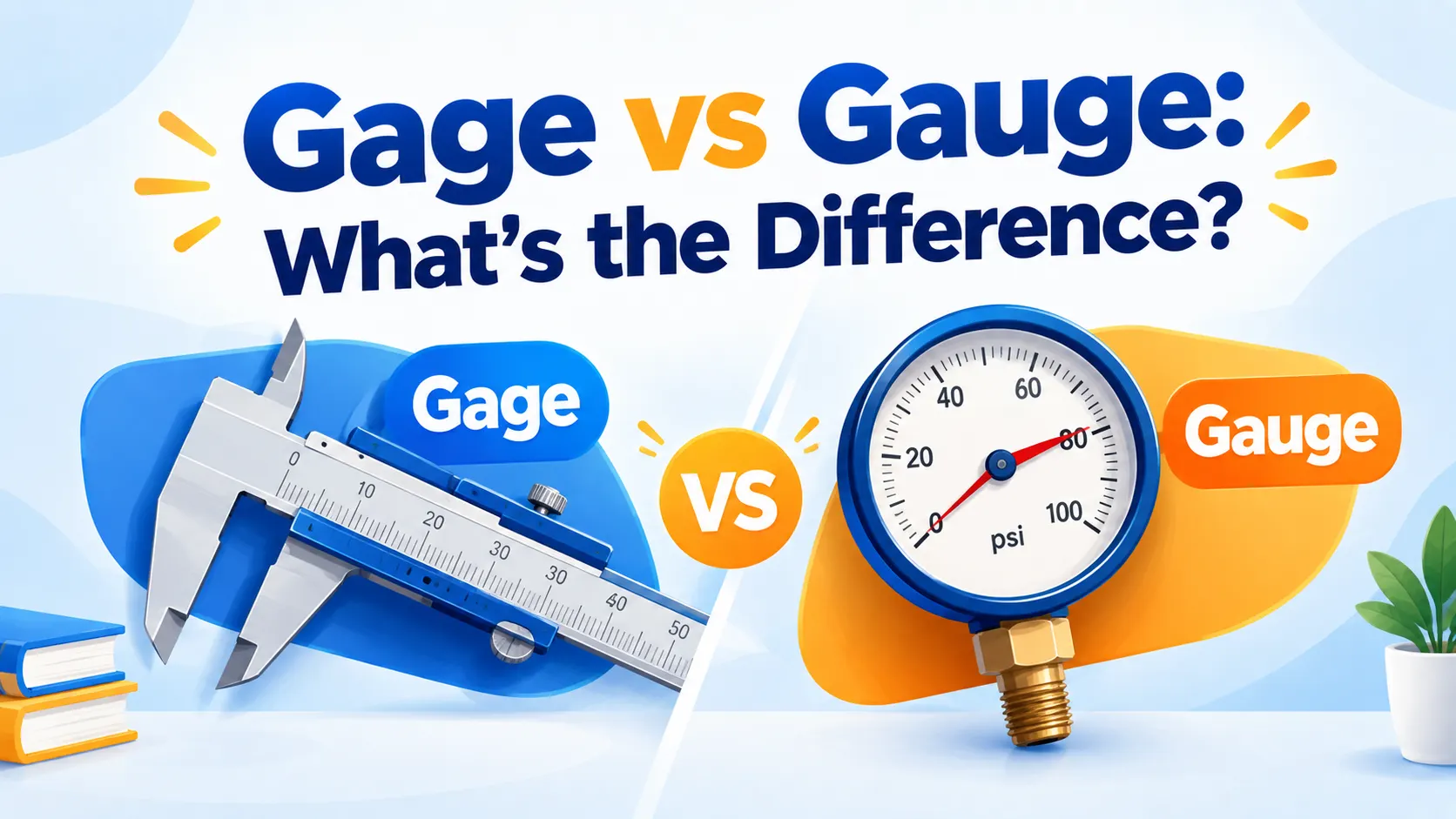
Gage and gauge look almost identical, and both spellings can be legitimate. The important distinction is that gauge is the standard spelling in general English, while gage is usually a variant or a specialized form. Both can refer to measurement, but they do not have the same frequency or range of use. The difference becomes especially important when writing about measuring instruments, wire or material thickness, pressure, or the act of estimating something. There are also situations where Gage is a proper name, so automatically “correcting” it would be a mistake.
For most everyday writing, the choice is straightforward: use gauge unless you have a specific reason to use gauge. The word gauge works as both a noun and a verb. You can use a gauge to measure pressure, for example, or gauge someone’s reaction. Gage can appear in technical terminology and other specialized contexts, but it is much less likely to be the expected spelling in ordinary prose. Understanding that difference is more useful than simply memorizing that one spelling is “right” and the other is “wrong.”
This guide explains gage vs. gauge from several angles: meaning, grammar, technical usage, common phrases, spelling patterns, examples, and regional conventions. You will also see when gage is genuinely acceptable, why professionals sometimes use it, and how to choose the spelling when you’re unsure. By the end, you should be able to make the right decision quickly without relying on guesswork.
Gage vs. Gauge: The Quick Answer
The simplest rule is:
Use gauge as your default spelling in general English. Use gage when it is an established variant, specialized technical term, or part of a proper name.
Both words can relate to measurement, but gauge has a broader role in contemporary standard English.
| Word | Main role | Typical context | General recommendation |
| gauge | Measure, assess, measuring device, standard | Everyday, academic, professional, technical | Preferred default |
| gage | Variant of gauge; specialized usage; proper name | Certain technical contexts and names | Use when context calls for it |
For example:
- Correct and standard: We need to gauge customer interest.
- Correct and standard: Check the pressure gauge before starting the machine.
- Possible specialized usage: The specification refers to a pressure gage.
- Proper name: Gage is the name of the technician.
The key point is that gage is not automatically a spelling mistake. At the same time, seeing gauge in one technical document does not mean you should start replacing gauge with it everywhere.
What Is the Difference Between Gage and Gauge?
The difference is primarily one of standard usage, context, and convention, rather than a simple difference in meaning.
Gauge is the standard spelling in modern English
Gauge is the spelling most readers expect when the word means:
- a device that measures or indicates something
- a measurement standard
- the thickness or size of a material
- an act of estimating or assessing something
- the verb to measure, estimate, or assess
Consider these examples:
- The mechanic checked the tire pressure gauge.
- The instrument measures the thickness of the sheet.
- It’s difficult to gauge how people will respond.
- The survey helps us gauge demand.
In all four cases, gauge is the natural choice for general writing.
Gage is a legitimate variant, not simply a misspelling
Gage has a long history as a spelling variant of gauge. It can therefore be encountered in legitimate writing.
The important question is why the writer used it.
If an engineering company, manufacturer, technical standard, or established terminology consistently uses gage, changing it to gauge may make the terminology inconsistent with that source.
On the other hand, if you are writing a general-interest article and mean “assess” or “measure,” gauge is normally the better choice.
Why do both spellings exist?
English spelling has developed through centuries of borrowing, regional variation, printing practices, and competing forms. Some variants disappear; others survive in particular industries or contexts.
That is what makes gage vs. gauge slightly more complicated than a simple right-versus-wrong spelling question. The forms overlap, but gauge became the dominant spelling in standard general English.
What Does Gauge Mean?
Gauge has several related meanings. Its central idea is connected to measurement or assessment, but the exact meaning depends on how it is used.
Gauge as a noun
As a noun, gauge can refer to a device used to measure or indicate a quantity.
Examples include:
- pressure gauge
- fuel gauge
- temperature gauge
- tire gauge
- depth gauge
For example:
The pressure gauge showed that the system was operating normally.
A gauge can also refer to a standard used for determining dimensions or capacity.
For example:
The manufacturer specifies the required wire gauge.
Gauge as a verb
As a verb, gauge means to measure, estimate, judge, or assess something.
It can describe literal measurement:
The engineer gauged the depth of the opening.
It can also describe judgment or estimation:
The manager tried to gauge the team’s reaction.
That figurative meaning is extremely common in modern English.
Gauge can be literal or figurative
This distinction helps explain why gauge appears so frequently.
Literal:
The device gauges the pressure inside the tank.
Figurative:
She watched the audience carefully to gauge their response.
The first concerns physical measurement. The second concerns assessment or interpretation.
What Does Gage Mean?
Gage as a variant spelling of gauge
Gage can represent a variant spelling of gauge, particularly in contexts involving measurement.
That does not mean the two forms are interchangeable in every sentence without considering convention.
For ordinary readers, gauge will usually look more familiar and natural:
We need to gauge the situation.
Writing:
We need to gauge the situation.
may be understood, but it is not the normal general-English choice.
Gage in technical and specialized contexts
One reason you may encounter gage is technical terminology.
Engineering, manufacturing, automotive, machining, and other technical fields sometimes use gage in specific terms or documentation. A company may also maintain a terminology system in which gage is preferred.
This creates an important professional-writing rule:
Follow the terminology of the governing standard, manufacturer, organization, or technical document when a specialized convention is established.
In other words, don’t “correct” a technical term simply because another spelling is more common in everyday English.
Gage as a proper name
Gage is also used as a personal name.
If someone’s name is Gage, it should obviously remain Gage.
For example:
Gage submitted the report on Monday.
Changing the name to Gauge would not be a spelling correction; it would change the person’s name.
The same principle applies to established business names, product names, titles, or other proper nouns.
Gage vs. Gauge: Side-by-Side Comparison
| Question | Gage | Gauge |
| Is it a legitimate English form? | Yes, as a variant and in certain uses | Yes |
| Is it the usual general-English spelling? | No | Yes |
| Can it refer to a measuring device? | Yes, in variant usage | Yes |
| Can it mean “assess” or “estimate”? | Possible as a variant, but uncommon | Yes |
| Used in technical contexts? | Yes, in some conventions | Yes |
| Used as a personal name? | Yes | Less relevant |
| Best choice for ordinary prose? | Usually not | Yes |
| Should you change established technical terminology? | No | No |
The table reveals the practical distinction: gauge is the broad default; gage is context-dependent.
When Should You Use Gauges?
Use gauge when you mean “measure”
Choose a gauge when something is being physically measured or evaluated.
Examples:
- The instrument gauges the temperature.
- The technician used a gauge to check the pressure.
- We need to gauge the thickness of the material.
Use gauge when you mean “estimate” or “assess”
This is one of the most important uses to remember.
Examples:
- It’s difficult to gauge her reaction.
- The company conducted a survey to gauge demand.
- He tried to gauge whether the audience understood the explanation.
In these sentences, gauge does not mean that someone is necessarily using a physical instrument. It means assess or estimate.
Use gauge in formal and everyday writing
If you’re writing:
- an essay
- a report
- an email
- a website article
- a school assignment
- a business document
- a general technical explanation
gauge is normally the safest spelling unless your subject requires a specialized convention.
When Should You Use Gage?
Use gage when it is established terminology
If a technical specification, industry document, manufacturer, or organization deliberately uses gage, retain that spelling when reproducing or discussing the terminology.
Consistency matters in technical communication. A reader working from a specification may need terminology to match the original document exactly.
Use Gage when it is a proper name
If a person, company, product, or organization is officially named Gage, use that spelling.
Names don’t need to conform to the spelling convention of ordinary vocabulary.
Don’t use gage merely because it looks shorter
A common beginner mistake is to think that gage is simply a more efficient version of gauge.
That’s not how standard English works.
The missing u does not make the word automatically more correct, modern, or American. In ordinary prose, gauge remains the conventional choice.
Common Uses of Gauge You Should Know
Measuring instruments
You will frequently see gauge in names of instruments:
- pressure gauge
- fuel gauge
- temperature gauge
- tire gauge
- depth gauge
- vacuum gauge
These devices can measure or indicate different physical quantities.
For example:
The fuel gauge showed that the tank was nearly empty.
Material and wire measurements
Gauge can also refer to a measurement system or dimension, especially for materials such as wire or sheet metal.
Examples include:
- wire gauge
- sheet-metal gauge
- needle gauge
The exact relationship between gauge numbers and physical dimensions depends on the particular measurement system or industry. That is why technical writers should avoid assuming that every “gauge” scale works in exactly the same way.
Figurative uses
The figurative verb is equally important:
- gauge interest
- gauge demand
- gauge public opinion
- gauge someone’s reaction
- gauge effectiveness
- gauge the seriousness of a problem
Here, the underlying idea is assessment.
Gage vs. Gauge Examples in Sentences
Examples with gauge as a noun
- The pressure gauge needs to be replaced.
- Check the fuel gauge before leaving.
- The technician inspected the temperature gauge.
- The wire gauge must match the project’s specifications.
- A depth gauge can help determine the exact measurement.
Examples with gauge as a verb
- We need to gauge customer interest before launching the product.
- She tried to gauge his reaction to the proposal.
- The device can gauge the pressure inside the chamber.
- The survey was designed to gauge public opinion.
- It’s difficult to gauge how serious the problem is from a single report.
Examples with gage
The following illustrate contexts where gage may legitimately occur:
- The engineering document specifies a particular gage for the component.
- The manufacturer’s technical terminology uses “gage” throughout its documentation.
- Gage reviewed the measurements before the equipment was installed.
The first two are context-dependent technical usage, while the third uses Gage as a name.
Gauge or Gage in Common Phrases
| Phrase | General-English choice | Why |
| pressure gauge | Gauge | Standard noun |
| fuel gauge | Gauge | Standard noun |
| wire gauge | Gauge | Standard measurement term |
| gauge pressure | Gauge | Standard technical/general form |
| gauge interest | Gauge | Common figurative verb |
| gauge the situation | Gauge | Standard verb |
| gauge a reaction | Gauge | Standard figurative use |
| gage pressure | Context-dependent | May occur in specialized terminology |
The important lesson is not to treat every occurrence of gage as an error. Technical vocabulary can preserve variants that general prose does not normally use.
Is “Gage” a Misspelling of Gauge?
Not necessarily.
Calling every instance of gage a misspelling is too broad. The form has legitimate historical and specialized uses.
However, if you’re writing ordinary English and want to say:
We need to assess the customer’s response.
then:
We need to gauge the customer’s response.
is the conventional choice.
Using gage simply because you know it exists does not improve the sentence.
A useful three-question test is:
- Is it a proper name?
If yes, preserve the established spelling. - Is it specialized terminology?
If yes, check the relevant technical convention or source. - Is it ordinary English?
If yes, gauge is normally the right choice.
This approach is more reliable than memorizing an absolute rule.
Common Mistakes With Gage and Gauge
Mistake 1: Assuming gage is always wrong
This ignores legitimate variants and technical usage.
Better approach: Look at the context before correcting it.
Mistake 2: Using gage in ordinary figurative expressions
Writing gage interest or gage someone’s reaction may confuse readers because gauge is overwhelmingly more familiar in these expressions.
Better approach: Use gauge for standard general-English phrases.
Mistake 3: Changing a proper name
If someone is named Gage, don’t “correct” the name to Gauge.
Better approach: Treat proper names as fixed forms.
Mistake 4: Ignoring industry terminology
Technical documents often have established vocabulary.
Better approach: If you’re editing engineering or manufacturing content, check the terminology used by the relevant standard or organization before making spelling changes.
How to Remember Gage vs. Gauge
A simple memory rule is enough:
Gauge is your default. Gage is your context-specific exception.
Think of gauge whenever you mean:
- measure
- measuring device
- estimate
- assess
- evaluate
For example:
Gauge the reaction.
Check the pressure gauge.
If you encounter gage, ask why it is being used. It may be:
- a technical variant
- established industry terminology
- a person’s name
- another proper name
This is a better strategy than trying to memorize every possible exception.
Is there a difference between British vs. American English?
Not in the simple way that pairs such as colour/color differ.
It is tempting to assume that gauge must be an American spelling and gauge a British spelling, but that explanation is too simplistic. The two spellings have overlapping historical and technical usage, and gauge is widely recognized as the standard spelling in both major varieties of English.
Regional dictionaries and individual industries can have their own preferences, but the practical rule remains the same: don’t treat gauge as a straightforward American-English equivalent of British gauge.
Related Forms: Gauged and Gauging
Once you know the gauge, another spelling question often appears: what happens when the word takes an ending?
Gauged
The standard past-tense form is:
gauged
Example:
The technician gauged the pressure before adjusting the valve.
Gauging
The standard form is:
gauging
Example:
The researchers are gauging public interest in the proposal.
Writers sometimes wonder whether the spelling should become gaging. In ordinary English, gauging is the familiar standard form.
The unusual appearance of gauging comes from retaining the recognizable spelling of gauge while adding -ing.
A Quick Decision Guide: Gage or Gauge?
| If you’re… | Choose |
| Writing for a general audience | Gauge |
| Using the verb meaning “assess” | Gauge |
| Referring to a measuring instrument | Gauge |
| Writing “gauge interest” | Gauge |
| Writing “gauge a reaction” | Gauge |
| Following established specialized terminology | Whichever the terminology specifies |
| Writing someone’s name, such as Gage | Gage |
| Unsure in ordinary prose | Gauge |
The professional editing rule
When editing general content, don’t waste time debating the two forms every time you see gage. Instead, identify the function and context first.
- If it is ordinary English, standardize the gauge.
- If it belongs to a specialized terminology system, verify the convention.
- If it is a proper name, leave it alone.
That gives you a consistent editorial process without oversimplifying the language.
Conclusion
The distinction between gauge vs. gauge is easier once you stop treating it as a simple spelling error. Gauge is the standard choice for general English, whether you are talking about a measuring instrument, a measurement, or the act of assessing something. Gage remains a legitimate variant in certain technical contexts, and it can also be a proper name, so it should not automatically be “corrected.” One final actionable tip: when writing ordinary content, choose gauge unless a reliable technical source or established name requires gauge. A common mistake to avoid is assuming that every occurrence of gage is wrong—or, in the opposite direction, using gage simply because it is shorter. Context determines the appropriate form. When no special context is present, gauge is the clear, reader-friendly default.
Frequently Asked Questions
Q1. Is “gage” a correct spelling?
Yes. Gage is a legitimate spelling variant, and it can appear in specialized technical usage or as a proper name. However, it is not normally the preferred spelling in everyday English. For general writing, gauge is the safer and more familiar choice.
Q2. Which is correct: gauge or gauge?
Both can be correct, depending on context. Gauge is the standard general-English spelling for the noun and verb associated with measurement or assessment. Gage is appropriate when an established technical convention or proper name specifically calls for it.
Q3. Is gauge an American spelling of gauge?
Not exactly. Although gage occurs in American usage, it should not be treated as a simple American-versus-British spelling pair. Gauge is standard in general English, while gage survives in particular historical, technical, and naming contexts.
Q4. Should I write “pressure gauge” or “pressure gauge”?
For ordinary writing, a pressure gauge is the best choice. However, a technical manufacturer, specification, or industry document may use pressure gage as part of its established terminology. When reproducing technical terminology, follow the relevant source or standard.
Q5. Is “gauging” or “gaging” correct?
Gauging is the standard form used in ordinary English. It is the present participle or gerund of gauge. Gaging may appear in specialized contexts, but writers should not substitute it for the standard form without a specific terminology-based reason.
