
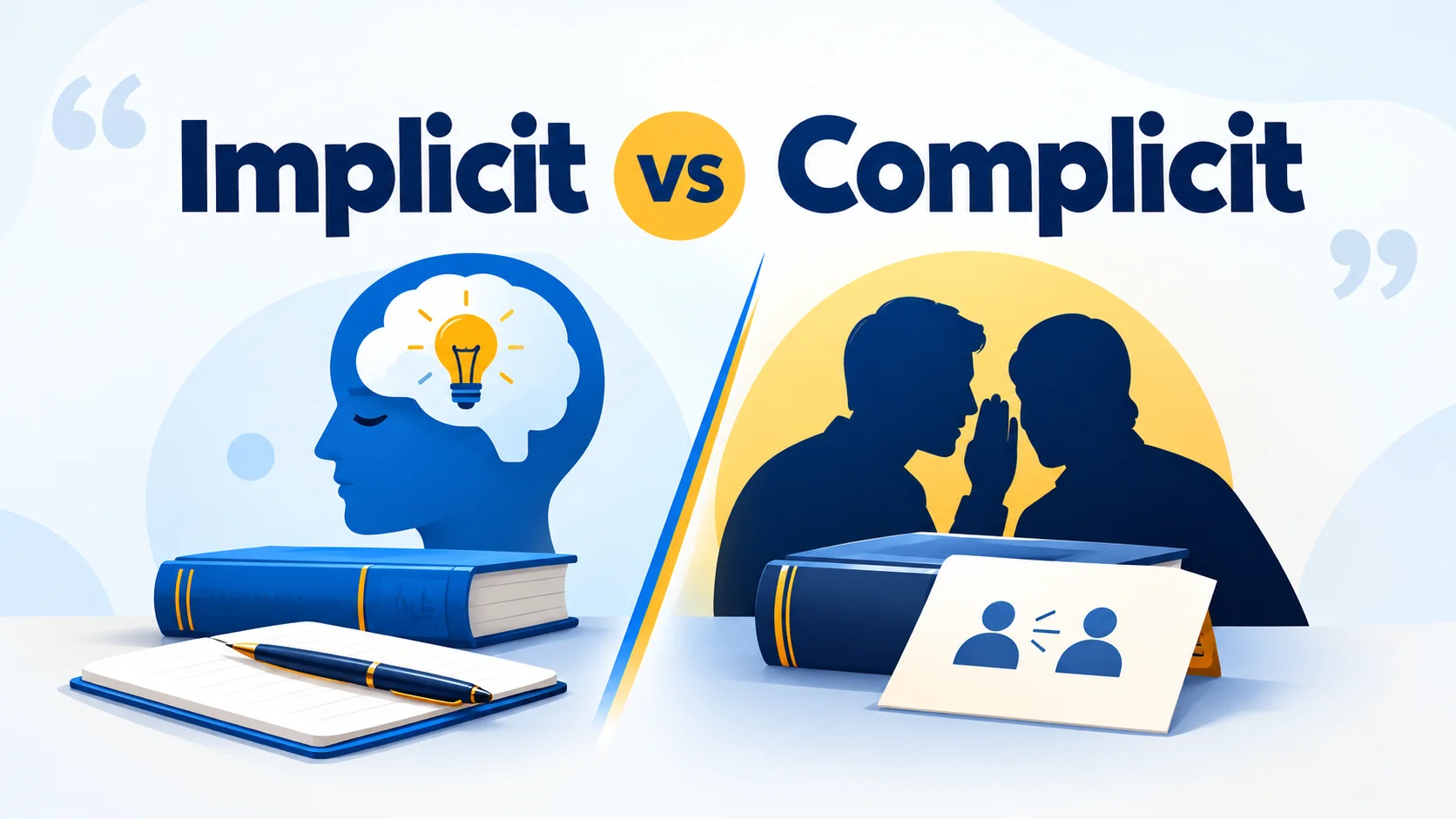
Implicit vs complicit is a confusing pair because the words look and sound similar, but they describe completely different ideas. Implicit refers to something that is suggested, understood, or present without being directly stated. Complicit, on the other hand, describes a person or group that is involved in wrongdoing, usually by knowingly helping, supporting, or enabling it. One word is mainly about meaning and communication; the other is about participation and responsibility. Once you recognize that distinction, choosing between them becomes much easier. This guide explains both words with clear definitions, realistic examples, sentence patterns, common mistakes, and a practical way to remember the difference.
The confusion becomes especially noticeable because both words often appear in formal writing, workplace discussions, academic texts, ethical debates, and news reporting. A reader might encounter an “implicit assumption” in one sentence and someone being “complicit in misconduct” in the next. Despite their similar appearance, there is no useful sense in which the two terms are interchangeable. Implicit describes what is not directly expressed, while complicit describes a person’s involvement in something improper. Understanding that difference helps you write more precisely, particularly when discussing responsibility, intention, communication, or wrongdoing.
There is also an important nuance that simple dictionary-style explanations can miss. Something can be implicit without being secret, and someone can know about wrongdoing without necessarily being complicit. Context matters, especially when describing a person’s conduct. You will learn how implicit differs from explicit, how complicit relates to complicity and accomplice, which grammatical patterns sound natural, and why silence alone does not automatically establish complicity. By the end, you should be able to look at a sentence and quickly determine whether it calls for implicit, explicit, complicit, or none of these words.
Implicit vs Complicit: The Quick Difference
The easiest way to separate these words is to focus on what they describe.
| Word | Basic meaning | Usually describes | Example |
| Implicit | Suggested or understood without being directly stated | Meaning, ideas, assumptions, messages, expectations | “There was an implicit warning in her response.” |
| Complicit | Involved in or helping with wrongdoing | A person, group, or organization | “The manager was complicit in the scheme.” |
| Explicit | Stated directly and clearly | Information, instructions, statements, meaning | “The instructions were explicit.” |
A useful shortcut is:
Implicit = implied.
Complicit = involved.
If you are talking about an unstated idea, choose implicit. If you are talking about someone’s knowing involvement in wrongdoing, choose complicit.
Implicit in One Sentence
Implicit means something is communicated indirectly rather than stated openly.
“Her answer contained an implicit criticism of the proposal.”
The criticism was not necessarily spoken directly. The listener inferred it from the answer.
Complicit in One Sentence
Complicit means involved in wrongdoing, particularly by knowingly participating in, assisting, or enabling it.
“The employee was found to be complicit in the fraudulent activity.”
Here, the word describes the employee’s role in the wrongdoing, not an unstated message.
The One-Word Memory Trick
Remember the first letters conceptually:
- Implicit → Implied
- Complicit → Cooperation/involvement
That distinction is enough to solve most everyday usage questions.
What Does “Implicit” Mean?
Implicit Definition and Core Meaning
Implicit is an adjective used for something that is suggested, understood, or contained without being directly stated or expressed.
For example:
“The email contained an implicit warning.”
The email may never literally say, “You are being warned.” Instead, the wording or circumstances make the warning understandable.
The important idea is inference. The information exists in the situation, but the speaker or writer does not necessarily express it in direct words.
How Implicit Meaning Works
Implicit meaning often depends on context.
Imagine someone asks:
“Are you coming to the meeting tomorrow?”
You reply:
“I have three deadlines tomorrow morning.”
You have not explicitly said, “No.” Yet the listener may reasonably understand that you probably cannot attend. Your response carries an implicit message.
Implicit meaning can arise through:
- Choice of words
- Tone
- Circumstances
- Behavior
- Shared knowledge
- Cultural expectations
- What a speaker deliberately leaves unsaid
This is why implicit meaning is common in everyday communication. People do not always state every thought directly.
Common Meanings and Uses of Implicit
You will frequently encounter implicit in combinations such as:
- Implicit meaning — a meaning that is suggested rather than directly stated
- Implicit message — an indirectly communicated message
- Implicit assumption — an assumption taken for granted without being stated
- Implicit agreement — agreement understood from circumstances or conduct
- Implicit criticism — criticism communicated indirectly
- Implicit trust — trust that is understood rather than formally declared
- Implicit bias — attitudes or associations that may operate without conscious awareness
The noun following implicit helps reveal exactly what is being implied.
Examples of “Implicit” in Everyday English
Example 1:
“There was an implicit understanding that everyone would arrive on time.”
Nobody necessarily announced the rule. The expectation was simply understood.
Example 2:
“His silence carried an implicit message.”
The silence itself communicated something that was not verbally stated.
Example 3:
“The advertisement makes an implicit promise about quality.”
The promise may be suggested by the presentation rather than directly guaranteed in words.
Example 4:
“Her question contained an implicit criticism of the decision.”
She criticized the decision indirectly rather than openly saying that it was wrong.
What Does “Complicit” Mean?
Complicit Definition and Core Meaning
Complicit is an adjective describing someone who is involved in wrongdoing, especially when they knowingly assist, support, facilitate, or participate in another person’s improper actions.
For example:
“The accountant was complicit in the fraud.”
The accountant is not merely aware that fraud occurred. The sentence indicates involvement in it.
This makes complicit much more serious than words such as aware, present, or informed.
Does Complicit Always Mean You Committed the Wrongdoing?
Not necessarily.
A person can be involved in wrongdoing without being the primary person who carries it out.
Consider a fictional workplace example:
An employee secretly changes financial records. Another employee knows what is happening and deliberately provides access to the accounting system so the changes can continue.
The second employee may be described as complicit in the misconduct because their actions helped facilitate it.
By contrast, suppose a third employee learns about the misconduct after it has already happened but had no role in it. Simply knowing about an event does not automatically make that person complicit.
Complicity involves more than mere awareness. Context, knowledge, conduct, and the nature of the situation all matter.
Common Contexts for “Complicit”
The word commonly appears when discussing:
- Fraud
- Theft
- Corruption
- Misconduct
- Deception
- Cover-ups
- Abuse of authority
- Unethical business practices
- Criminal activity
- Deliberate assistance or enabling behavior
It can also appear in broader ethical discussions where someone is accused of helping sustain harmful conduct.
Examples of “Complicit” in Realistic Sentences
“The driver was accused of being complicit in the robbery.”
The driver allegedly played a role in the wrongdoing.
“Several employees were considered complicit in the cover-up.”
Their conduct allegedly contributed to concealing the misconduct.
“The official denied being complicit in the scheme.”
The person rejected the claim that they knowingly participated.
Notice the common structure: complicit in + wrongdoing/activity.
Implicit vs Complicit: What Is the Actual Difference?
The most important distinction is grammatical as well as semantic.
Implicit generally describes the status of information or meaning.
Complicit describes the status or conduct of a person or group in relation to wrongdoing.
Implicit Describes Something Unstated or Inferred
Use implicit when the central question is:
“What is being suggested without being directly said?”
For example:
“The policy contains an implicit assumption that employees already understand the procedure.”
The focus is on an assumption, not on someone’s participation in misconduct.
Complicit Describes Involvement in Wrongdoing
Use complicit when the central question is:
“Who is knowingly involved in this improper action?”
For example:
“The supervisor was complicit in falsifying the records.”
The focus is the supervisor’s involvement.
They Belong to Different Meaning Categories
A useful way to think about the difference is:
- Implicit → communication and interpretation
- Explicit → direct communication
- Complicit → involvement and wrongdoing
That is why replacing one with another can completely change a sentence’s meaning.
Side-by-Side Comparison
| Feature | Implicit | Complicit |
| Part of speech | Adjective | Adjective |
| Main idea | Suggested or understood indirectly | Involved in wrongdoing |
| Usually describes | Meaning, message, assumption, agreement, expectation | Person, group, institution, or role |
| Requires wrongdoing? | No | Generally yes |
| Related concept | Implication | Complicity |
| Common pattern | Implicit meaning | Complicit in misconduct |
| Opposite/contrast | Explicit | Not simply “explicit” |
| Example | “An implicit expectation existed.” | “She was complicit in the scheme.” |
Implicit vs Complicit Examples That Make the Difference Clear
Example 1 — An Unspoken Message
“When Mark said he had ‘better things to do,’ there was an implicit criticism of the meeting.”
The criticism is inferred. Nothing about the sentence says Mark participated in wrongdoing.
Example 2 — Workplace Conduct
“The company’s dress expectations were implicit rather than written in the employee handbook.”
This concerns an unstated expectation.
Compare:
“The manager was complicit in falsifying employee records.”
Now the subject is a person’s involvement in wrongdoing.
Example 3 — A Conversation
“Her response contained an implicit refusal.”
She did not directly say no, but the listener could understand her intention.
Example 4 — Wrongdoing
“The assistant was complicit in concealing the missing funds.”
The assistant’s alleged role involves the improper act.
Example 5 — Silence and Knowledge
Suppose an employee witnesses a colleague breaking a company rule but does nothing.
It would be too simplistic to say:
“The employee was automatically complicit.”
Whether complicit is appropriate depends on the circumstances. Silence, knowledge, intent, and participation are not identical concepts.
Example 6 — A Social Situation
“There was an implicit agreement between the friends that they would not discuss the argument publicly.”
The agreement is understood rather than formally announced.
This has nothing to do with complicity.
Implicit vs Explicit vs Complicit
Adding explicit to the comparison makes the distinction even clearer.
Implicit vs Explicit
These two words form the most natural contrast.
- Implicit = indirectly suggested or understood
- Explicit = directly stated or clearly expressed
Compare:
“The manager gave an implicit warning.”
The warning was indirect.
“The manager gave an explicit warning.”
The warning was direct and unmistakable.
Explicit vs Complicit
These words are not opposites.
Explicit concerns how clearly something is expressed.
Complicit concerns someone’s involvement in wrongdoing.
A person could therefore be explicitly told about misconduct and still not be complicit. Likewise, a person’s involvement might be described as complicit even when the surrounding communication was not explicit.
A Three-Way Example
Consider this fictional situation:
A supervisor tells an employee, “Do not alter these numbers.” The employee understands that the supervisor suspects something is wrong, even though the supervisor does not directly accuse anyone. Later, another employee knowingly changes the numbers to hide the problem.
Here:
- The supervisor’s suspicion may be implicit.
- A direct instruction such as “Do not alter the numbers” is explicit.
- The person knowingly helping falsify the records may be complicit.
The three words describe three different dimensions of the situation.
Three-Word Comparison
| Word | Question it answers | Example |
| Implicit | What is suggested but not directly stated? | “The message contained an implicit warning.” |
| Explicit | What is directly stated? | “The warning was explicit.” |
| Complicit | Who is involved in wrongdoing? | “He was complicit in the misconduct.” |
Why Do People Confuse Implicit and Complicit?
The confusion is understandable, but it is mainly a form-and-sound problem, not a meaning problem.
Their Similar-Looking Spellings
Both words begin with im-/com- and contain the familiar -plicit sequence. When writing quickly, especially from memory, that visual similarity can cause substitutions.
Similar Pronunciation Patterns
The words have a somewhat similar rhythm, which can make them harder to distinguish when heard rather than read.
That is particularly relevant for learners who encounter one word in writing and another primarily through conversation.
Both Appear in Abstract Discussions
There is another reason they sometimes appear close together.
Formal writing frequently discusses:
- Responsibility
- Behavior
- Communication
- Assumptions
- Ethics
- Social expectations
- Institutional conduct
Both words can occur in these broader discussions, even though they perform different jobs within a sentence.
Context Usually Reveals the Correct Word
Ask yourself one question:
Am I describing an unstated meaning, or someone’s involvement in wrongdoing?
If it is the first, implicit is probably the word you need.
If it is the second, complicit may be appropriate.
How to Use “Implicit” Correctly in a Sentence
Common Sentence Patterns With Implicit
Some natural combinations include:
- implicit meaning
- implicit message
- implicit assumption
- implicit agreement
- implicit expectation
- implicit criticism
- implicit understanding
- implicit bias
- implicit trust
These combinations work because the noun identifies what is being suggested or understood.
Correct Examples With Explanations
“The contract contained an implicit expectation that the work would be completed on time.”
The expectation was understood rather than necessarily stated in those exact words.
“His comment was an implicit criticism of the proposal.”
The criticism was indirect.
“The students had an implicit understanding of the classroom rules.”
The rules were understood even if every detail had not been formally explained.
Implicit Does Not Mean “Unclear”
This is an important distinction.
Something can be implicit but perfectly understandable.
For instance:
“She looked at the clock repeatedly.”
The implicit message might be that she wants the conversation to end.
The message is indirect, but the context may make it quite clear.
So avoid treating implicit as a synonym for confusing, uncertain, or poorly expressed.
How to Use “Complicit” Correctly in a Sentence
Common Sentence Patterns With Complicit
The most useful construction is:
complicit in + wrongdoing/action
Examples include:
- complicit in fraud
- complicit in corruption
- complicit in misconduct
- complicit in a cover-up
- complicit in the scheme
- complicit in illegal activity
For example:
“The executive was complicit in the cover-up.”
Why “Complicit in” Is So Common
The preposition in connects the person to the activity in which they are allegedly involved.
Compare:
“She was complicit in the scheme.”
with the less natural:
“She was complicit with the scheme.”
When describing participation in an activity, complicit in is the standard pattern to reach for.
Correct Examples With Explanations
“The employees were accused of being complicit in the misconduct.”
Their alleged role involved the misconduct.
“He denied being complicit in the fraud.”
He rejected the claim of involvement.
“The organization was criticized for being complicit in the practice.”
The criticism concerns the organization’s role in allowing or supporting the practice.
Complicit vs Responsible vs Guilty
These words should not be treated as interchangeable.
Complicit describes involvement in wrongdoing.
Responsible is broader and can describe accountability, duty, causation, or blame.
Guilty can have a specific legal meaning when used in relation to a criminal proceeding, while it can also be used more generally outside legal contexts.
Therefore, calling someone complicit is not simply another way of saying that person was the main offender or has been legally found guilty.
Common Mistakes With Implicit and Complicit
Mistake 1 — Using “Complicit” to Mean “Implied”
Incorrect:
“The email contained a complicit warning.”
If the intended meaning is that the warning was indirect, use implicit.
Correct:
“The email contained an implicit warning.”
Mistake 2 — Using “Implicit” for Participation in Wrongdoing
Incorrect:
“The accountant was implicit in the fraud.”
If the intended meaning is that the accountant knowingly participated in the fraud, complicit is the appropriate adjective.
Correct:
“The accountant was complicit in the fraud.”
Mistake 3 — Assuming Awareness Automatically Means Complicity
Knowing that something happened is not necessarily the same as helping it happen.
Compare:
“She was aware of the misconduct.”
and:
“She was complicit in the misconduct.”
The second statement makes a much stronger claim about her involvement.
Mistake 4 — Assuming Silence Always Makes Someone Complicit
Silence can have many explanations. A person might not know enough to act, might be unable to intervene, or might simply be a witness.
Whether silence contributes to wrongdoing depends on context and circumstances.
Mistake 5 — Treating “Implicit” as a Synonym for “Secret”
Something implicit is not directly stated. That does not mean someone deliberately hid it.
An unstated assumption can be widely understood by everyone involved.
Mistake 6 — Confusing “Complicit” With “Accomplice”
These words are related but have different grammatical roles.
- Complicit is an adjective: “He was complicit in the crime.”
- Accomplice is a noun: “He was an accomplice.”
The distinction becomes particularly useful when constructing sentences accurately.
Implicit vs Complicit in Different Contexts
In Everyday Conversation
Implicit is common when people communicate indirectly:
“There was an implicit understanding that we would leave early.”
Complicit is more serious and normally enters the conversation when wrongdoing or unethical conduct is involved.
In Academic and Formal Writing
Academic writing often uses implicit to discuss:
- Assumptions
- Premises
- Meanings
- Messages
- Relationships between ideas
For example:
“The argument rests on an implicit assumption.”
That wording tells readers that an assumption exists even though the author has not stated it as a formal premise.
In Business and the Workplace
A workplace can contain implicit expectations about punctuality, communication, hierarchy, or professional behavior.
Complicity enters a completely different category:
“The supervisor was complicit in concealing the violation.”
The word now raises a question about participation and responsibility.
In Legal and Ethical Discussions
This is where precision becomes especially important.
Complicit can describe alleged involvement in wrongdoing, but everyday use of the word should not automatically be treated as a legal conclusion.
A careful writer should distinguish between:
- Being accused of complicity
- Being described as complicit
- Being investigated for involvement
- Being legally found responsible or guilty
Those are not necessarily identical claims.
In Media and Social Commentary
Both terms can appear in discussions about institutional behavior.
For example:
“The report identified an implicit assumption in the policy.”
versus:
“Critics argued that the organization was complicit in the practice.”
The first concerns interpretation; the second concerns alleged involvement.
Related Words You Should Know
Imply vs Implicit
Imply is a verb.
“Her comment implied that she disagreed.”
Implicit is an adjective.
“Her comment contained an implicit disagreement.”
The two are closely connected but serve different grammatical functions.
Implication vs Implicit
An implication can be an idea or consequence suggested by something.
“The implication of his response was clear.”
Implicit describes the nature of the information:
“His response contained an implicit criticism.”
Explicit vs Implicit
These are the strongest direct comparison:
- Implicit → indirectly understood
- Explicit → directly expressed
Complicity vs Complicit
Complicity is the noun.
“The investigation examined his complicity in the scheme.”
Complicit is the adjective.
“He was complicit in the scheme.”
Accomplice vs Complicit
An accomplice is a person involved in wrongdoing.
“The police identified an alleged accomplice.”
Complicit describes someone’s involvement.
“The employee was allegedly complicit in the scheme.”
Implicit and Complicit Word Families
Understanding related forms can make these words easier to use correctly.
The Implicit Word Family
- Imply — to suggest something indirectly
- Implied — suggested rather than directly stated
- Implication — an idea or consequence suggested by something
- Implicit — understood without direct expression
- Implicitly — in an implicit manner
Example:
“The speaker implicitly implied that the plan would fail.”
This sentence is grammatically possible but stylistically repetitive. A cleaner version would usually be:
“The speaker implicitly suggested that the plan would fail.”
The Complicit Word Family
- Complicit — involved in wrongdoing
- Complicity — involvement in wrongdoing
- Accomplice — a person who participates in wrongdoing
These forms are related, but they cannot simply replace one another.
How to Remember the Difference Between Implicit and Complicit
The “Implied” Trick
Connect the first word to:
Implicit → implied
If something is implied rather than directly stated, implicit is probably correct.
“The message was implicit.”
The “Involved” Trick
Connect the second word to:
Complicit → involved
If a person is involved in wrongdoing, complicit may be the correct word.
“She was complicit in the misconduct.”
A Fast Context Test
Before choosing a word, ask:
- Is the idea unstated but understood?
→ Implicit - Is the information directly stated?
→ Explicit - Is a person or organization involved in wrongdoing?
→ Complicit
This three-question test is more reliable than trying to remember the spellings in isolation.
Implicit vs Complicit: Correct and Incorrect Examples
| Situation | Correct Word | Example | Why |
| An idea is suggested without being stated | Implicit | “The criticism was implicit.” | The criticism is indirect. |
| An expectation is understood | Implicit | “There was an implicit expectation of punctuality.” | The expectation is not directly expressed. |
| Something is clearly and directly stated | Explicit | “The instructions were explicit.” | Nothing needs to be inferred. |
| Someone knowingly helps wrongdoing | Complicit | “He was complicit in the fraud.” | The person is involved in wrongdoing. |
| Someone merely knows about wrongdoing | Not automatically complicit | “She knew about the misconduct.” | Awareness alone does not necessarily establish involvement. |
| Someone is a participant in wrongdoing | Complicit | “They were complicit in the cover-up.” | Their involvement is the focus. |
| Something is indirect but not necessarily secret | Implicit | “The message was implicit.” | Indirect does not mean deliberately hidden. |
The most important lesson from this table is that context determines whether the word describes communication or conduct.
A Simple Decision Guide: Which Word Should You Use?
Choose “Implicit” When…
Use implicit when:
- Something is suggested rather than directly stated.
- A reader must infer a meaning.
- An expectation exists without being formally expressed.
- A message is indirect.
- An assumption is taken for granted.
- The topic has nothing inherently to do with wrongdoing.
Choose “Complicit” When…
Use complicit when:
- You are describing a person or group.
- The situation involves wrongdoing, misconduct, or another improper act.
- The person knowingly participates, assists, facilitates, or enables the conduct.
- You need to describe involvement rather than an unstated meaning.
Choose “Explicit” When…
Use explicit when:
- Something is stated directly.
- Instructions are clear and specific.
- There is little or nothing left for the reader to infer.
The 5-Second Test
- Unstated meaning? → Implicit
- Directly stated? → Explicit
- Involved in wrongdoing? → Complicit
If you can answer that question, you can usually choose the correct word immediately.
Conclusion
Understanding implicit vs complicit becomes much easier once you stop focusing on their similar appearance and ask what the sentence is actually describing. Implicit belongs to the world of indirect communication: meanings, assumptions, expectations, and messages that are understood without being directly stated. Complicit, by contrast, describes involvement in wrongdoing, particularly when someone knowingly assists, supports, or enables improper conduct. One final actionable tip is to replace implicit mentally with “implied” and complicit with “involved” before choosing between them. A common mistake to avoid is treating awareness or silence as automatic proof of complicity; context matters. When precision matters, choose the word that describes the exact relationship your sentence intends to express.
Frequently Asked Question
Q1. Is “implicit” the same as “complicit”?
No. Implicit means something is suggested or understood without being directly stated, while complicit describes involvement in wrongdoing. An implicit message concerns communication or meaning; a complicit person concerns participation or assistance in an improper act.
Q2. Does “complicit” always mean someone committed a crime?
Not necessarily. Complicit generally describes involvement in wrongdoing, which can include misconduct or unethical behavior as well as criminal activity. In legal contexts, however, the word should not automatically be treated as proof of a particular legal finding or criminal guilt.
Q3. Does implicit mean something is hidden?
No. Implicit means something is not directly expressed, but it does not necessarily mean it is deliberately concealed. An implicit expectation, for example, may be obvious to everyone in a particular workplace even though nobody has formally written it down.
Q4. Can someone be both implicit and complicit?
Yes, but the words would describe different aspects of a situation. For example, a person’s communication could contain an implicit message while that same person could separately be described as complicit in wrongdoing. Neither word replaces the other.
Q5. What is the easiest way to remember implicit vs complicit?
Use the simplest associations: implicit = implied and complicit = involved. If you are describing something that must be inferred, think implicit. If you are describing someone’s knowing involvement in wrongdoing, think complicit.
