
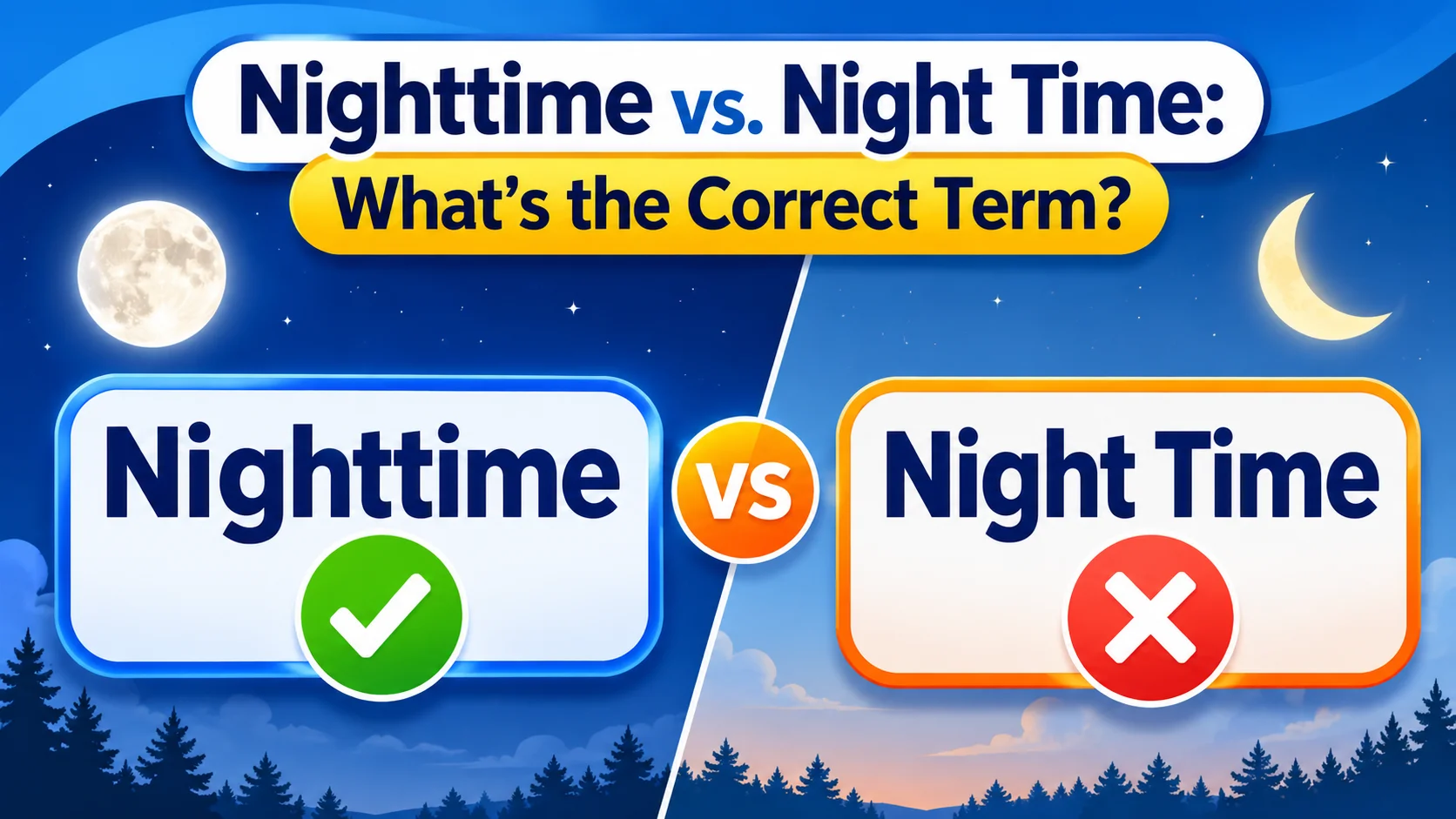
Nighttime vs. night time is a common spelling question, especially when writing articles, emails, school assignments, or professional documents. Both forms appear in English, but they are not equally conventional. If you are referring to the general period between evening and morning, nighttime is the standard modern spelling and the safest choice in most situations. The confusion arises because English compound words do not always follow predictable spelling patterns. Some remain separate, others join together, and a few retain hyphens. Understanding this distinction makes the correct choice much easier.
The interesting part is that nighttime and night time are closely connected in meaning, yet their written forms serve slightly different purposes. The one-word spelling functions as an established compound noun, while the two-word version can describe a time associated with night when the sentence genuinely treats the words separately. You may also encounter night-time, particularly in certain editorial traditions. Knowing why these variations exist helps you avoid unnecessary corrections and recognize when a particular spelling is appropriate rather than assuming that every alternative is automatically incorrect.
In this guide, you will learn the meaning of nighttime, the grammatical rule behind its spelling, and the practical differences between nighttime, night time, and night-time. We will also examine how these forms work as nouns and modifiers, whether American and British English treat them differently, and how to use them naturally in everyday and formal writing. Most importantly, you will find real sentence examples, comparison tables, common mistakes, and straightforward recommendations so you can choose the right expression confidently without memorizing complicated grammar rules.
Nighttime or Night Time: Which Spelling Is Correct?
The standard spelling is nighttime, written as one word. It is an established compound noun referring to the period of darkness or the part of the day associated with night.
For example:
- The park looks beautiful during nighttime.
- Some animals become active at nighttime.
- Nighttime temperatures are expected to drop.
Although night time also appears in written English, it is less conventional when used as the general name for the period of night. In ordinary writing, there is rarely a reason to choose the two-word version instead of the established compound.
The important distinction is between a word’s conventional spelling and the grammatical possibility of using the same words separately. English allows both constructions, but that does not make them equally suitable in every context.
Quick Answer: Should You Write Nighttime or Night Time?
Use nighttime when referring to the general period between evening and morning.
| Situation | Recommended form |
| Describing the period of night | Nighttime |
| Discussing animal activity after dark | Nighttime |
| Describing temperatures during the night | Nighttime temperatures |
| Writing a general article about night activities | Nighttime activities |
| Deliberately referring to a particular time associated with night | Night time, if the sentence requires separate words |
Simple rule: If you mean the general period of night, write nighttime.
Is Night Time Grammatically Incorrect?
Not necessarily. The expression night time can be understood as two separate words, particularly when time is being discussed as a specific period or when the wording emphasizes the time associated with night.
However, when it functions as the ordinary compound noun meaning the nighttime period, nighttime is the conventional spelling.
Consider the difference:
- Nighttime is my favorite part of the day. — Uses the established compound noun.
- The night time was divided into three observation periods. — A possible separate-word construction, although time during the night or nighttime would often be clearer.
The second sentence illustrates why context matters. Separate spelling should not be used simply because the writer thinks two familiar words must remain separate.
Which Spelling Should You Use in Modern Writing?
For most purposes, choose nighttime. It is concise, recognizable, and appropriate for:
- Blog posts and website content
- School and university assignments
- Business documents
- Emails and reports
- Books and general publications
- Everyday communication
If you are following a publication’s house style, check its preferred spelling. Consistency is particularly important in edited and professional content.
What Does Nighttime Mean?
Nighttime refers to the part of the day associated with night, generally extending from evening after sunset until morning around sunrise.
It is the opposite of daytime, although the exact boundaries between the two are not always fixed. Sunset, sunrise, local customs, and the context of a conversation can all influence how people understand the term.
For example, a person might describe 8 p.m. as nighttime in winter but still consider it early evening during summer.
The word is useful because it identifies a broad period without requiring an exact clock time.
Nighttime Definition and Meaning
In everyday English, nighttime means the period when it is dark outside or when night conditions generally prevail.
Examples:
- The streets are quieter during nighttime.
- Nighttime is ideal for observing certain stars.
- The animals search for food at nighttime.
The word does not necessarily mean the entire period when people are asleep. Many people work, study, travel, exercise, or socialize during nighttime.
Nighttime as a Noun
The most common grammatical role of nighttime is a noun.
A noun names a person, place, thing, or concept. Here, the word identifies a period of time.
Examples:
- Nighttime brings cooler weather to the region.
- We prefer nighttime because the city is less crowded.
- The researchers monitored nighttime activity.
- Nighttime can be challenging for inexperienced drivers.
In these sentences, nighttime identifies the period being discussed.
When Does Nighttime Begin and End?
There is no universal clock-based definition of nighttime.
Its beginning and ending depend on the situation:
- Astronomical context: Night is associated with the period when the Sun is sufficiently below the horizon.
- Everyday conversation: People often use nighttime to mean the hours after sunset and before sunrise.
- Work schedules: A nighttime shift may begin in the evening and continue past midnight.
- Social context: Someone might consider nighttime to begin around 8 or 9 p.m.
This distinction matters in scientific writing, weather reporting, transportation, and workplace scheduling. When precision is necessary, use exact times rather than relying on the broad word nighttime.
Nighttime vs. Evening vs. Midnight
These expressions are related, but they do not identify exactly the same period.
- Evening generally refers to the later part of the day, often around sunset and the hours following it.
- Nighttime refers to the broader period associated with night.
- Midnight refers to 12:00 a.m., the point halfway between one noon and the next.
For example, 7 p.m. might be described as evening, 10 p.m. as nighttime, and 12 a.m. as midnight.
What Does Night Time Mean?
Night time is the same pair of words written separately. It can communicate the idea of a time associated with night, but it is not the preferred conventional spelling when referring to the general nighttime period.
The distinction is important because English contains both established compound nouns and ordinary combinations of separate words.
For example, bed time may appear as two words in some contexts, while bedtime is the established compound spelling. Similarly, nighttime has become the conventional closed form.
Is Night Time a Real English Expression?
Yes. The two-word sequence is understandable and can occur in English writing.
However, its acceptability depends on how it functions in the sentence.
Compare:
- Nighttime is usually quieter here.
- The night time was divided into separate observation periods.
The first uses a conventional compound noun. The second treats night and time more independently, although a clearer alternative may be preferable depending on the intended meaning.
Do not confuse the existence of a two-word construction with a recommendation to use it as the standard spelling.
Why Do Some Writers Spell Night Time as Two Words?
There are several reasons:
- Word familiarity: Writers may naturally see night and time as two independent words.
- Older writing habits: Historical texts may preserve spelling conventions that differ from modern usage.
- Editorial preferences: Some publications retain particular open or hyphenated compounds.
- Meaning and emphasis: A writer may deliberately refer to a specific time associated with nighttime rather than use the general compound noun.
- Inconsistent proofreading: Some writers simply alternate between spellings without recognizing that one is more conventional.
A useful editorial approach is to determine whether the writer means the established concept or a genuinely separate combination of words.
Does Night Time Have a Different Meaning from Nighttime?
In most ordinary contexts, readers understand both forms as referring to the same general period.
The difference is primarily one of word structure and conventional spelling, not a completely different definition.
For example:
- I enjoy nighttime walks.
- I enjoy walks at night.
Both communicate a preference for walking after dark. The second sentence is often more natural than forcing the less conventional expression night time walks.
When Can the Two-Word Form Make Sense?
The separate construction may be appropriate when the sentence genuinely emphasizes a time or period associated with night.
For example:
– The night time was divided into three scheduled observation sessions.
Even here, the writer should consider whether the nighttime period or the hours of the night communicates the idea more naturally.
Expert recommendation: Do not choose night time merely to create variety. Use the conventional compound unless the sentence has a specific grammatical or stylistic reason for separating the words.
Nighttime vs. Night Time: Key Differences Explained
The easiest way to understand the distinction is to examine how each form behaves in a sentence. Nighttime is an established compound noun with a conventional one-word spelling. Night time is a separate-word construction whose suitability depends on the intended meaning.
For most readers, the practical difference is straightforward: the closed compound is the normal choice for general writing.
Meaning: Do Both Forms Mean the Same Thing?
Generally, yes. Both can communicate the idea of a period associated with night.
However, the one-word form has a more established role as the name of that period. The two-word construction can place greater emphasis on the individual ideas of night and time.
Spelling: One Word vs. Two Words
The spelling difference is visible:
- Nighttime: One uninterrupted word.
- Night time: Two separate words with a space.
- Night-time: Two word elements connected by a hyphen.
These are three different written forms, but they are closely related in meaning.
Grammar: Compound Noun vs. Separate Words
A compound noun combines two or more words to create a single established concept.
In nighttime, the elements night and time work together as one lexical unit. Its spelling reflects that established combination.
In a separate construction, the words retain their individual identities. Whether that construction is appropriate depends on the sentence rather than on a general preference for spaces.
Usage: Which Form Sounds More Natural?
Consider these examples:
| Sentence | Assessment |
| I enjoy nighttime walks. | Natural and standard |
| Nighttime temperatures are falling. | Natural and standard |
| I prefer studying at night. | Natural and standard |
| I enjoy night time walks. | Less conventional |
| The night-time temperature dropped. | Alternative editorial spelling |
Notice that at night is also a perfectly natural alternative. Writers do not have to use nighttime in every sentence.
Formal Writing: Which Spelling Is Preferred?
In formal writing, use nighttime unless a particular style guide or publication specifies otherwise.
This applies to:
- Academic essays
- Research reports
- Business correspondence
- News articles
- Educational materials
- Professional website content
For scientific or technical documents, specify the actual hours when a precise time period matters. For example, observations conducted between 10 p.m. and 4 a.m. is more precise than nighttime observations.
The Grammar Rule Behind Nighttime
Understanding compound nouns explains why nighttime is written as one word.
English frequently combines words to create new vocabulary. Over time, some combinations become so established that dictionaries recognize them as single words.
The spelling of these combinations is not governed by one universal rule. Usage, history, pronunciation, and editorial convention all influence whether a compound is written as one word, two words, or with a hyphen.
What Is a Compound Noun?
A compound noun consists of two or more words that work together as a single noun.
Examples include:
- Bedroom
- Toothbrush
- Sunlight
- Football
- Moonlight
- Nighttime
Each compound identifies a particular object, concept, or category.
For example, a toothbrush is not simply a random combination of tooth and brush. It has an established meaning as a single object used for cleaning teeth.
Similarly, nighttime identifies a recognized period of the day.
How Closed Compound Words Work
A closed compound is written as one word without a space or hyphen.
Examples:
| Compound | Individual elements |
| Bedroom | Bed + room |
| Daytime | Day + time |
| Moonlight | Moon + light |
| Sunrise | Sun + rise |
| Notebook | Note + book |
| Nighttime | Night + time |
The important point is that a compound’s spelling becomes conventional through established usage. Writers should not assume that every combination of two familiar words must follow the same pattern.
Why Nighttime Is Written as One Word
The one-word spelling is established in modern English dictionaries and general writing.
It is also consistent with the spelling of daytime, a closely related compound.
For example:
- Daytime activities are popular in the summer.
- Nighttime activities often require additional lighting.
Both words identify periods of the day and are conventionally written as closed compounds.
Closed Compounds vs. Open Compounds
Not every compound noun is written as one word.
English uses three common compound spelling patterns:
- Closed compounds: The elements are joined together.
- Open compounds: The elements remain separate.
- Hyphenated compounds: The elements are connected by a hyphen.
Examples:
| Compound type | Examples |
| Closed | Nighttime, bedroom, sunrise |
| Open | Ice cream, post office, swimming pool |
| Hyphenated | Mother-in-law, check-in, well-being |
The spelling of a compound must be learned from conventional usage rather than invented by applying a mechanical rule.
Why English Compound Spellings Sometimes Change
Compound words can develop different spellings over time.
A combination may begin as two separate words, become hyphenated in certain writing traditions, and eventually become a closed compound. However, this development is not automatic or identical for every word.
For this reason, older publications and modern publications may display different forms.
The practical lesson is simple: use the spelling recognized in contemporary reference sources, especially when preparing content for a modern audience.
How to Use Nighttime Correctly in Sentences
Knowing the correct spelling is only part of the task. You also need to understand how the word fits into sentence structure.
The following examples demonstrate common grammatical patterns.
Nighttime as the Subject of a Sentence
When nighttime appears as the subject, it identifies the period being discussed.
Examples:
- Nighttime brings cooler temperatures to the desert.
- Nighttime is particularly beautiful in the countryside.
- Nighttime provides opportunities for astronomical observation.
- Nighttime can be difficult for people who work early shifts.
In each sentence, the word performs the grammatical role of a noun.
Nighttime as the Object of a Sentence
The word can also appear as the object of a verb.
Examples:
- Many photographers enjoy nighttime.
- The researchers studied nighttime activity.
- Some animals prefer nighttime to daytime.
- We appreciate nighttime during the warmer months.
Here, the sentences focus on the period as the object of an action or preference.
Using Nighttime in Descriptive Sentences
Nighttime can also provide context or description.
Examples:
- The nighttime sky looked unusually clear.
- Nighttime temperatures remained below freezing.
- The city has introduced nighttime security measures.
- The nighttime landscape attracted several photographers.
These examples also demonstrate how the compound can modify another noun.
Nighttime in Questions and Negative Sentences
There is no special spelling change when nighttime appears in a question or negative sentence.
Examples:
- Do you prefer nighttime or daytime?
- Why do some animals become active at nighttime?
- I do not enjoy driving during nighttime.
- Isn’t nighttime a better opportunity for stargazing?
The word retains its normal spelling regardless of the sentence type.
Nighttime as an Adjective: Is It Correct?
Yes. Nighttime can function attributively, meaning it can appear before another noun to describe or classify it.
This use is particularly common in professional writing, technical descriptions, and everyday communication.
For example:
- Nighttime photography requires suitable equipment.
- Nighttime temperatures can affect plant growth.
- The hospital introduced new nighttime procedures.
In these examples, nighttime tells the reader what kind of photography, temperatures, or procedures are being discussed.
What Is a Compound Modifier?
A compound modifier is a word or group of words that describes another word.
Consider:
- Nighttime activities
- Daytime television
- Evening classes
- Overnight delivery
The first element identifies the time or period associated with the activity, service, or object.
A useful distinction is that not every compound modifier requires a hyphen. Established closed compounds such as nighttime normally retain their standard spelling when placed before another noun.
Common Nighttime Adjective Combinations
| Expression | Meaning | Example |
| Nighttime activities | Activities performed at night | Nighttime activities attract many tourists. |
| Nighttime photography | Photography conducted at night | Nighttime photography requires careful exposure settings. |
| Nighttime driving | Driving during the night | Nighttime driving requires extra attention. |
| Nighttime temperatures | Temperatures recorded at night | Nighttime temperatures can fall rapidly. |
| Nighttime wildlife | Wildlife observed during the night | The guide studies nighttime wildlife. |
| Nighttime routine | A routine followed at night | Reading is part of my nighttime routine. |
Should Nighttime Be Hyphenated Before a Noun?
Generally, no.
When the established compound nighttime modifies another noun, keep it as one word.
Correct:
- Nighttime activities
- Nighttime photography
- Nighttime temperatures
Usually unnecessary:
- Night-time activities
- Night-time photography
- Night-time temperatures
The hyphenated forms may appear in publications that follow a particular spelling convention, but they are not required simply because the word modifies another noun.
Nighttime vs. Night-Time in Compound Modifiers
The distinction is primarily editorial rather than grammatical.
If a publication uses night-time consistently, its editors may retain that spelling throughout its content. Another publication may use nighttime.
For independent writers, the one-word form is the straightforward choice. Avoid switching between the two versions in the same document.
Is Night-Time With a Hyphen Ever Correct?
Yes. Night-time is an alternative spelling found in English publications and dictionaries.
A hyphen connects two elements while keeping them visually separate. Some compound words retain this structure because of historical convention, regional usage, or editorial preference.
However, seeing night-time in a published article does not mean you must use it.
What Does Night-Time Mean?
Night-time generally refers to the same period as nighttime: the part of the day associated with darkness.
For example:
- Night-time temperatures are expected to fall.
- Some birds are active during the night-time hours.
- The area becomes quieter at night-time.
The meaning remains broadly the same. The difference lies in the spelling convention.
Nighttime vs. Night-Time vs. Night Time
| Form | Structure | General recommendation |
| Nighttime | Closed compound | Preferred for general modern writing |
| Night-time | Hyphenated compound | Acceptable in publications that prefer it |
| Night time | Open construction | Use when the sentence genuinely requires separate words |
Is Night-Time an Outdated or Alternative Spelling?
It is better described as an alternative spelling rather than automatically labeling it outdated.
Hyphenated compounds remain common in English, and different dictionaries or publishing traditions may record different preferences.
If you encounter night-time in a British publication or older book, there is no need to assume the writer has made a grammatical error.
Should You Use Night-Time in Formal Writing?
Use the spelling required by your organization, academic institution, or publication.
If no house style is specified, nighttime is a practical default.
For example, an editor preparing a publication should choose one form and apply it consistently across:
- Headlines
- Article body text
- Captions
- Subheadings
- Tables
- Image descriptions
Consistency makes a document look professionally edited.
Nighttime vs. Night Time in American and British English
One area where writers need to be careful is regional spelling. American and British English sometimes prefer different forms of the same compound, and nighttime is a useful example of why dictionary evidence matters.
The American form of nighttime is widely established. British English also uses nighttime, but night-time is a recognized alternative in British reference works.
Interestingly, dictionaries do not always make identical editorial choices. Cambridge lists nighttime in both its UK and US entries, whereas Oxford’s Advanced Learner’s Dictionary lists night-time in its British entry and nighttime in its American entry.
English meaning – Cambridge Dictionary+2
Is Nighttime More Common in American English?
Yes. The closed spelling nighttime is firmly established in American English.
For example:
- Nighttime temperatures are expected to rise.
- The city has introduced nighttime parking restrictions.
- Nighttime photography requires a steady camera.
American dictionaries such as Merriam-Webster list nighttime as a noun meaning the period from dusk to dawn.
Merriam-Webster+1
How Is Nighttime Written in British English?
British English accepts both the closed and hyphenated forms, although individual dictionaries and publications may favor one.
Oxford’s Advanced Learner’s Dictionary uses night-time, while Cambridge includes nighttime as its UK headword.
This difference illustrates an important editorial principle: a dictionary’s preferred spelling is a reference for its own editorial tradition, not proof that every alternative is incorrect.
If you are writing for a British publication, follow its house style rather than automatically replacing every occurrence with the American spelling.
Do Australian and Canadian English Follow the Same Pattern?
English-speaking countries share many spelling conventions, but regional publications can maintain their own preferences.
For Australian and Canadian English, it is sensible to consult a local dictionary or the style guide used by the intended publication rather than assuming that every spelling follows either the American or British model.
For internationally targeted content, nighttime is a recognizable choice, while night-time may be appropriate when following a British-oriented editorial standard.
Does Regional English Change the Meaning?
No. The regional spelling preference does not normally change the meaning.
| English variety or reference | Commonly encountered form |
| American English | Nighttime |
| British English | Nighttime / night-time |
| Canadian English | Nighttime is readily understood; follow local house style |
| Australian English | Nighttime / night-time; follow publication style |
The difference is mainly editorial. Readers should understand the same general concept regardless of which established spelling they encounter.
Nighttime in Dictionaries and Established Writing Standards
Dictionaries are especially useful when two spellings compete because they show which forms have become established in published English.
However, there is a difference between a dictionary recording a word and a publication recommending one spelling over another.
A dictionary documents vocabulary and usage. A style guide helps writers maintain consistency within a particular publication or organization.
How Dictionaries Define Nighttime
Major English-language dictionaries recognize nighttime as a noun.
For example:
- Cambridge Dictionary: Defines nighttime as the period in each 24-hour cycle when it is dark.
English meaning – Cambridge Dictionary - Merriam-Webster: Defines it as the time from dusk to dawn and notes that it is often used attributively.
Merriam-Webster - Oxford Advanced Learner’s Dictionary: Records night-time in its British entry and nighttime in its American entry.
Oxford Learner’s Dictionaries+1
These entries establish that the compound is recognized across major English reference traditions, even though its preferred presentation differs.
What Dictionary Entries Tell Us About Night Time
A useful lesson from dictionary research is that spelling variation does not automatically indicate a difference in meaning.
When comparing entries, examine:
- The headword: Which spelling does the dictionary use as its main entry?
- The part of speech: Is it identified as a noun or another grammatical category?
- The definition: Does the meaning differ between entries?
- Regional labels: Does the dictionary identify a British or American preference?
- Usage examples: How is the word used naturally in sentences?
This approach is more reliable than deciding that a spelling is wrong simply because a particular website uses another version.
Why Dictionary and Style Guide Preferences Matter
Professional editors need consistent spelling throughout a document. If one article uses nighttime, night-time, and night time interchangeably, readers may assume that the variations represent different concepts.
Usually, they do not.
A publication’s style guide helps settle questions that dictionaries may treat differently.
For example, an editor might establish these rules:
- Use nighttime in American English articles.
- Use night-time when a British publication’s house style requires it.
- Avoid night time when referring to the general period of darkness.
- Apply the selected spelling consistently in headings, captions, and body text.
How to Choose a Consistent Spelling for Published Content
Use this decision process:
| Your writing situation | Best approach |
| General international blog | Use nighttime |
| American English publication | Use nighttime |
| British publication following Oxford conventions | Use night-time |
| Publication with its own style guide | Follow its specified form |
| Academic paper | Follow the institution or journal’s style |
| Personal communication | Use the familiar standard form, nighttime |
The objective is not to force one spelling on every English-speaking audience. It is to make a defensible editorial choice and apply it consistently.
Nighttime vs. Night Time: Real-World Examples
Examples become more useful when they reflect the situations in which people actually write. The following sentences demonstrate how nighttime works across different contexts.
Everyday Conversation
- I enjoy walking around the neighborhood during nighttime.
- The streets become quieter at nighttime.
- My children prefer playing indoors during nighttime.
- We usually have our family conversations at night.
The last example also demonstrates that at night is often a more natural alternative than at nighttime.
Academic and Scientific Writing
In research, nighttime is useful when discussing observations, environmental conditions, or animal behavior.
Examples:
- The researchers examined nighttime activity among urban birds.
- Nighttime temperatures were recorded at regular intervals.
- The experiment compared daytime and nighttime behavior.
- The team documented changes in nighttime insect activity.
For scientific precision, researchers should specify the observation period when it matters. A study conducted from 9 p.m. to 2 a.m. should report those hours rather than relying only on the broad label nighttime.
Professional and Business Writing
The word is also common in workplace documents.
Examples:
- Nighttime security procedures must be followed by all employees.
- The company provides nighttime transportation services.
- Nighttime maintenance will begin after business hours.
- Employees must report any nighttime safety concerns.
One practical consideration is that workplace policies may define nighttime using specific clock hours. In such cases, the policy should state those hours clearly.
Literature and Creative Writing
Writers can use nighttime to establish atmosphere, setting, and timing.
Examples:
- Nighttime transformed the quiet village into a landscape of shadows.
- The nighttime sky shimmered above the distant mountains.
- A soft breeze moved through the trees during nighttime.
- The nighttime silence made every distant sound seem louder.
Creative writers may also prefer expressions such as after dark, under the moonlight, or in the dead of night when those phrases better match the intended mood.
Headlines, Titles, and Digital Content
For online content, concise and recognizable wording is especially useful.
Examples:
- Nighttime Photography: A Beginner’s Guide
- The Best Nighttime Activities for Families
- How to Stay Safe While Driving at Night
- Nighttime Wildlife: Animals That Become Active After Dark
When preparing headlines, use the same spelling throughout the article, page title, image text, and supporting content.
Common Mistakes Writers Make With Nighttime
Even though this spelling question is relatively simple, a few recurring mistakes can make writing less consistent or less natural.
Switching Between Nighttime and Night Time Without a Reason
One of the most noticeable editorial mistakes is alternating between the forms in the same article.
For example:
- Incorrectly inconsistent: Nighttime activities are popular. Night time photography is also enjoyable.
- More consistent: Nighttime activities are popular. Nighttime photography is also enjoyable.
Choose the appropriate form and use it consistently.
Assuming Night-Time Is Always the Correct Middle Ground
Some writers believe a hyphen makes compound spelling safer.
That is not a reliable rule.
A hyphen is not a universal solution for uncertain compound spelling. Established closed compounds should retain their conventional form unless a particular style requires otherwise.
Confusing Nighttime With Evening
These terms overlap, but they are not interchangeable in every sentence.
For example:
- We went shopping in the evening.
- We observed nocturnal animals during nighttime.
The first describes a general period later in the day. The second identifies the period associated with darkness.
Using Nighttime When a More Specific Expression Is Needed
Sometimes nighttime is too broad.
Compare:
- The incident happened during nighttime.
- The incident happened shortly after midnight.
The second sentence provides more precise information.
Similarly, before sunrise, after sunset, late at night, and overnight may be better choices depending on the situation.
Overlooking Consistency in Professional Writing
A document may be grammatically understandable but still appear poorly edited if it uses competing spellings without a clear reason.
During proofreading, search for all three forms:
- Nighttime
- Night-time
- Night time
Then check whether each occurrence follows the chosen editorial convention.
Nighttime vs. Related Time Expressions: Words You Should Know
Choosing the correct spelling is easier when you understand how nighttime differs from other expressions describing parts of the day.
These words are related, but each communicates a slightly different idea. Using the most precise expression can make your writing clearer and more natural.
Nighttime vs. Daytime
Nighttime refers to the period associated with darkness, while daytime refers to the period when there is daylight.
Examples:
- Nighttime is usually cooler in this region.
- Daytime temperatures can become extremely high.
Both are established closed compound nouns.
Nighttime vs. Nightfall
Nightfall refers specifically to the arrival of darkness as daylight disappears. Nighttime describes the broader period that follows.
Examples:
- The birds returned to their nests at nightfall.
- The village becomes quiet during nighttime.
Nighttime vs. Evening
Evening generally describes the later part of the day, often before bedtime. Nighttime focuses more directly on the period of darkness.
Examples:
- We went shopping in the evening.
- The wildlife photographer works during nighttime.
Nighttime vs. Overnight
Overnight generally describes something that happens, continues, or remains during the night, often from one evening until the following morning.
Examples:
- The hotel offers overnight accommodation.
- Nighttime temperatures dropped below freezing.
An overnight stay is not simply another way of saying nighttime. The former emphasizes duration or an event extending through the night.
Nighttime vs. Bedtime
Bedtime means the time when someone usually goes to bed or prepares to sleep.
Examples:
- My bedtime is usually 10 p.m.
- Nighttime is when many people begin preparing for sleep.
Not everyone goes to bed when nighttime begins, so these words should not be treated as synonyms.
Nighttime vs. Late Night
Late night generally refers to the later hours of the night, rather than the entire period after sunset.
Examples:
- I prefer nighttime walks.
- We had a late-night conversation.
Notice that late-night is hyphenated when it functions as a compound modifier before a noun, as in a late-night conversation.
Quick Comparison of Related Expressions
| Expression | Meaning | Example |
| Nighttime | General period of darkness | Nighttime is peaceful. |
| Daytime | Period of daylight | Daytime activities are popular. |
| Nightfall | Beginning of darkness | We returned at nightfall. |
| Evening | Later part of the day | We met in the evening. |
| Overnight | Continuing through the night | We booked an overnight stay. |
| Bedtime | Time for going to bed | My bedtime is 10 p.m. |
| Late night | Later hours of the night | It was a late-night meeting. |
Practical Tips for Choosing the Correct Spelling
If you still find yourself hesitating between nighttime and night time, use the following practical guidelines.
Use Nighttime When Referring to the General Period of Night
This is the most useful rule for everyday writing.
Examples:
- Nighttime activities
- Nighttime temperatures
- Nighttime photography
- Nighttime security
- Nighttime routines
When the intended meaning is the general period of darkness, the closed compound is the natural choice in general modern writing.
Use Night Time Only When the Sentence Requires Separate Words
Do not separate the compound simply because night and time are individually recognizable words.
Instead, examine the sentence.
If you are describing the general period of darkness, use nighttime. If you genuinely mean a particular time associated with night, consider whether a separate construction is necessary.
Often, a clearer alternative such as the hours of the night will improve the sentence.
Follow Your Publication’s Preferred Style
If you are writing for a British publication that prefers night-time, follow that convention. If your publication uses American English, nighttime is the straightforward choice.
A style guide should determine consistency when multiple accepted conventions exist.
Check the Complete Sentence Rather Than the Word in Isolation
Sometimes the issue is not spelling but word choice.
For example:
- Less natural: I usually sleep during nighttime.
- More natural: I usually sleep at night.
Both are understandable, but the second is simpler and more idiomatic.
Before changing a spelling, ask yourself whether the entire sentence would benefit from a different expression.
Conclusion
When deciding between nighttime vs. night time, the one-word spelling is the most practical choice for general modern English. It is an established compound noun, widely recognized in American English and understood internationally. The hyphenated form night-time remains acceptable in certain British and editorial conventions, while the two-word form is less conventional for the general meaning. One final actionable tip: Choose your spelling according to your audience and follow the same convention throughout your writing. A common mistake to avoid is assuming that every alternative spelling is grammatically incorrect. English has regional and historical variations, and understanding them makes you a more confident writer. Ultimately, good writing is not just about spelling words correctly; it is about choosing expressions that communicate your meaning clearly.
Frequently Asked Questions
Q1. Is Nighttime One Word or Two Words?
Nighttime is one word in the standard closed-compound spelling. It refers to the period of darkness between evening and morning. The hyphenated form night-time is also recognized in some English conventions, while night time is less conventional for the general meaning.
Q2. Is Nighttime One Word in American and British English?
Yes, nighttime is recognized in both varieties. However, some British dictionaries, including Oxford Advanced Learner’s Dictionary, prefer night-time. American English generally favors closed spelling. Follow your publication’s preferred spelling when writing for a specific audience.
Q3. Is Nighttime an Adjective or a Noun?
Nighttime is primarily a noun, but it can also modify another noun. For example, in nighttime activities, it describes when the activities take place. This attributive use is common in everyday, academic, and professional English.
Q4. Should I Write At Night or At Nighttime?
Both expressions are grammatically acceptable, but at night is often shorter and more natural in everyday conversation. Use at nighttime when you specifically want to emphasize the general period of darkness. For example, both I enjoy reading at night and I enjoy reading at nighttime are correct.
Q5. What Is the Difference Between Nighttime and Overnight?
Nighttime identifies a period associated with darkness, whereas overnight generally describes something that happens, continues, or remains during the night. For example, nighttime temperatures describe conditions, while overnight accommodation refers to a place where someone stays through the night.
