
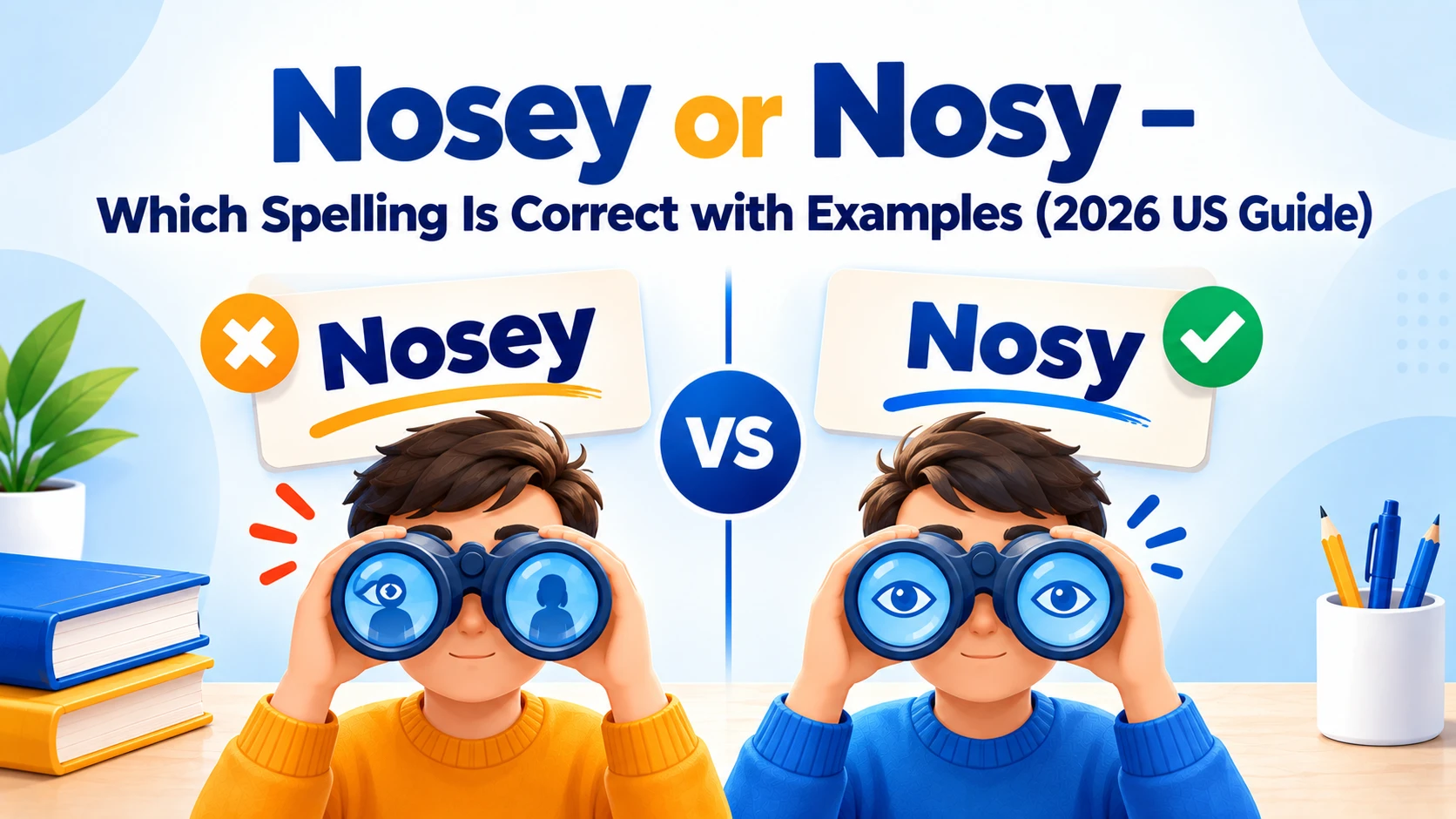
Nosey or nosy is a spelling question that looks easier than it really is. If you are writing for an American audience, nosy is the form most readers will recognize immediately, but nosey is not simply a made-up or meaningless spelling. Major dictionaries recognize both forms, and they carry the same basic meaning: being too interested in other people’s private affairs. The practical issue, then, is not whether one word has a completely different definition. It is knowing which spelling to prefer, when the alternative is acceptable, and how the word’s negative tone affects the sentence.
The word itself has an interesting connection with nose. English uses the idea of putting or poking one’s nose into something to describe unwanted involvement, and nosy developed from that figurative association. That explains why nosey looks perfectly logical to many writers. Yet English spelling does not always preserve the visible spelling of a related word. Both nosy and nosey are pronounced the same in ordinary usage, so pronunciation does not solve the spelling problem. For American English, nosy is the cleaner default, especially in edited, educational, business, and website content.
There is another issue worth understanding: nosy does not simply mean curious. Calling someone nosy usually suggests that the person has crossed a boundary or is asking about matters that do not concern them. That distinction matters in conversation, workplace writing, fiction, and social media. In this guide, you will learn nosy vs nosey, the meaning and grammar of both forms, their American and British usage, common collocations, pronunciation, the difference between nosy and curious, and the situations in which choosing a more neutral word is smarter than using either spelling.
Nosey or Nosy: Which Spelling Is Correct in American English?
The short answer is nosy is the preferred spelling to use as a practical default in American English, but nosey is also a recognized variant.
Cambridge labels nosy as an adjective and explicitly gives “also nosey.” Its American Dictionary entry does the same. Oxford’s Advanced American Dictionary likewise lists nosy (also nosey).
So these sentences have the same basic meaning:
My neighbor is nosy.
My neighbor is nosey.
For a US-focused article, school assignment, business website, or general American English content, nosy is the safest choice.
That recommendation is about preference and consistency, not about declaring the alternative nonexistent.
The simplest rule
Writing for a US audience? Use “nosy” unless you have a specific reason to retain “nosey.”
That rule gives writers a clear default without pretending that English has only one legitimate spelling.
Nosy vs Nosey at a Glance
| Feature | Nosy | Nosey |
| Meaning | Too interested in other people’s affairs | Same |
| Part of speech | Adjective | Adjective |
| American English | Preferred practical default | Recognized variant |
| British English | Used | Used |
| Pronunciation | Same ordinary pronunciation | Same ordinary pronunciation |
| Tone | Usually disapproving | Usually disapproving |
| Different meaning? | No | No |
| Best default for US content | Yes | Usually not necessary |
Oxford describes nosy as informal and disapproving, defining it as being too interested in things that do not involve you, especially other people’s affairs.
What Does “Nosy” Mean?
Nosy is an adjective describing someone who is too interested in other people’s private matters.
The important word is too. Asking questions is not automatically nosy. A person becomes nosy when their interest is perceived as excessive, intrusive, or inappropriate.
For example:
I’m curious about how the machine works.
This is normally neutral.
But:
She’s nosy about everyone’s salary.
Here, the speaker is criticizing her interest in information that is considered private.
Cambridge defines nosy as being too interested in what other people are doing and wanting to discover too much about them. Oxford similarly describes it as excessive interest in matters that do not involve you.
Nosy is an adjective
You can use nosy to describe:
- a nosy neighbor
- a nosy coworker
- a nosy relative
- a nosy reporter
- a nosy question
- a nosy person
- nosy behavior
For example:
Our new neighbor is extremely nosy.
That was a pretty nosy question.
I don’t want to be nosy, but are you moving?
The last example is especially common in conversation because the speaker recognizes that the question may be intrusive.
Nosy can describe one action, not someone’s entire personality
Calling someone nosy does not necessarily mean they are permanently nosy.
Compare:
Mark is nosy.
This sounds like a general judgment about his personality.
With:
Mark asked a nosy question.
The criticism is directed at one question.
That distinction can make a significant difference in sensitive conversations.
Why Do People Confuse “Nosy” and “Nosey”?
The spelling confusion is understandable because nosey looks closely connected to nose.
And in a semantic sense, that connection makes perfect sense.
English has expressions involving the nose that refer to interfering in matters that do not concern you. Cambridge, for example, lists nose as a verb meaning to look around or search in order to discover something, especially something another person does not want you to find.
So a learner may naturally reason:
nose → nosey
That spelling feels intuitive.
The problem is that English spelling is conventional rather than perfectly logical. A word can be related to another word in meaning without preserving every letter of its spelling.
Why “nosy” looks strange to some writers
If you already know the noun nose, the shorter spelling can seem incomplete:
- nose
- nosey
looks visually connected.
But:
- nosy
is the established spelling that dictionaries commonly present as the main entry.
Oxford lists nosy as the headword and gives nosey as an alternative. Cambridge does the same.
Pronunciation does not settle the question
The two spellings are pronounced alike in ordinary English.
Cambridge gives the US pronunciation of nosy as /ˈnoʊ.zi/ and identifies nosey as an alternative spelling. Oxford’s American entry likewise gives the pronunciation for nosy and treats nosey as an equivalent variant.
So if someone says the word aloud, you cannot reliably determine whether they would spell it nosy or nosey.
Where Did “Nosy” Come From?
The modern meaning is closely connected with the figurative idea of using your nose to investigate things that are not your business.
English has long used body-part imagery metaphorically. The nose can represent curiosity, intrusion, or unwanted involvement. Expressions such as stick your nose into something capture that idea directly.
The adjective nosy developed from this broader association.
The connection with “nose”
Consider:
Don’t stick your nose into other people’s business.
This means:
Don’t interfere in matters that do not concern you.
From the same conceptual territory, describing someone as nosy suggests that they are excessively interested in other people’s affairs.
That does not mean nosy literally means “having a nose.” It is a figurative adjective describing intrusive curiosity.
Why did both spellings survive?
English has many spelling variants that persist because different forms become established through usage.
In this case, reputable dictionaries do not force a strict distinction between the two. Oxford lists nosey as “also nosy” and nosy as “also nosey,” while the American entries treat them as equivalent forms.
That is why an editor should be careful about calling nosey a simple spelling error.
Nosy vs Nosey: What Is the Actual Difference?
For ordinary use, there is no meaningful difference in meaning between nosy and nosey.
Either describe someone who takes too much interest in matters that do not concern them.
Both can describe:
- people
- questions
- behavior
- curiosity about private information
Both also have the same ordinary pronunciation.
The meaningful distinction for a US writer is therefore spelling preference, not vocabulary meaning.
Side-by-side examples
My nosy aunt asked how much I paid for my car.
My nosey aunt asked how much I paid for my car.
The message is the same.
Likewise:
Don’t be so nosy.
and:
Don’t be so nosey.
Both communicate the same warning.
The practical difference for American writers
If you are producing original American English content, nosy is the form to reach for first.
If you encounter nosey in a quotation, an existing publication, or another established source, that does not automatically give you a reason to “correct” it.
The distinction is therefore:
meaning: same
pronunciation: same
spelling: different
US editorial preference: generally nosy
Why “Nosy” Is the Better Default for a US Audience
For a US-focused publication, nosy has a practical advantage: it is the form presented as the main American English headword by major learner dictionaries.
Oxford’s Advanced American Dictionary lists:
nosy — (also nosey)
and gives the US pronunciation.
Cambridge’s American Dictionary likewise lists nosy and identifies nosey as an alternative.
This makes nosy a sensible editorial default.
In educational content
If you are teaching American English, introducing nosy first keeps the lesson straightforward.
You can mention nosey as a recognized variant afterward rather than presenting two forms as though learners must memorize an arbitrary difference.
In websites and digital content
For a US-focused grammar or vocabulary site, consistent use of nosy reduces unnecessary variation.
It also helps keep:
- headings consistent
- examples consistent
- image text consistent
- internal references consistent
- editorial corrections predictable
The goal is not to eliminate a legitimate variant. It is to choose a clear house preference.
Is “Nosey” Wrong?
No. Saying that nosey is always wrong would be too strong.
Both Cambridge and Oxford recognize it. Cambridge explicitly labels nosy as “also nosey,” while Oxford does the reverse on its nosey entry: “also nosy.”
The better distinction is:
Nosy = preferred default for US-focused writing.
Nosey = recognized alternative spelling.
That is much more accurate than:
“Nosy is correct; nosey is incorrect.”
When can “nosey” reasonably appear?
There are several situations where retaining nosey is perfectly defensible:
- A quotation uses it.
- A publication’s established style uses it.
- You are discussing spelling variants.
- You are writing in a context where the variant is familiar.
- A fictional character deliberately uses that spelling.
- You are preserving an original source rather than standardizing it.
Why context matters
Imagine an editor sees:
“Don’t be so nosey,” she said.
If this is dialogue in a novel, changing nosey to nosy without checking the author’s intent may be unnecessary.
Likewise, changing a quotation can create an accuracy problem.
Editing is not just correcting unfamiliar spellings. It is preserving meaning, voice, and editorial consistency.
Nosy vs Nosey in British and American English
The popular explanation that nosy is American and nosey is British is too simple.
Current dictionary evidence shows that both spellings occur in both varieties.
Cambridge gives US and UK pronunciations for nosy and explicitly recognizes nosey as an alternative. Oxford’s American Dictionary also lists both.
American English
For American English, use:
nosy
as your normal default.
Examples:
My nosy neighbor always asks where I’m going.
That’s a nosy question.
British English
British readers also encounter nosy and nosey.
There is an additional British expression worth knowing:
nosy parker
Oxford labels nosy parker as British, informal, and becoming old-fashioned. It refers to someone who is too interested in other people’s affairs.
That expression demonstrates how the nosy family has developed into a broader set of informal vocabulary.
International English
For an international audience, nosy is a clear and easily recognizable choice.
But there is no need to treat nosey as an error simply because it is not your preferred form.
How to Use “Nosy” Naturally in a Sentence
The easiest way to understand nosy is to look at the structures in which it commonly appears.
Describing a person
My nosy neighbor keeps asking who visits me.
She can be a little nosy sometimes.
Describing a question
That is a very nosy question.
He asked a nosy question about my salary.
This construction is useful because the adjective criticizes the question, rather than directly attacking the person.
Using “nosy about”
A common structure is:
nosy about + topic
Examples:
She’s always nosy about my relationships.
Why are you so nosy about my finances?
The reporters were nosy about his private life.
Using “nosy” with personal information
The word commonly appears around subjects people consider private:
- relationships
- salaries
- finances
- family problems
- health
- age
- personal decisions
- living arrangements
The appropriateness of a question depends heavily on context, though. A close friend asking about a personal problem may be supportive; a stranger asking the same question may seem nosy.
Real-Life Examples of “Nosy”
Everyday conversation
My aunt is so nosy; she asks everyone about their relationships.
I don’t mean to be nosy, but are you two dating?
Our neighbor is always nosy about visitors.
Workplace situations
Asking a colleague how much they earn can come across as nosy.
He was being nosy about her plans to leave the company.
That’s a little nosy for a first conversation.
In professional settings, however, it is often better to describe the behavior more neutrally rather than directly labeling a colleague nosy.
Social media
Don’t be nosy about someone’s private relationship.
Some commenters became surprisingly nosy after the announcement.
Social platforms make the word especially relevant because people can ask personal questions publicly, often without realizing how intrusive they sound.
Fiction and dialogue
“Why do you want to know?” she asked. “You’re being nosy.”
This is a natural conversational use because nosy is an informal word. Oxford explicitly labels it informal and disapproving.
Nosy vs Curious: They Are Not the Same
One of the most important semantic distinctions is between nosy and curious.
They overlap because both involve wanting information. The difference is why the person wants the information and whether the interest crosses a boundary.
| Word | Main idea | Usual tone | Example |
| curious | Interested in knowing or learning | Neutral/positive | “I’m curious about how it works.” |
| nosy | Too interested in another person’s private affairs | Negative | “She’s nosy about my relationship.” |
| inquisitive | Eager to ask questions or learn | Usually positive/neutral | “He’s an inquisitive student.” |
| intrusive | Unwelcome interference with privacy | Negative/formal | “That was an intrusive question.” |
| meddlesome | Unwanted interference in other people’s affairs | Strongly negative | “His meddlesome behavior caused problems.” |
When does curiosity become nosiness?
Imagine someone has just moved to a new city.
Asking:
“How are you finding the new neighborhood?”
is ordinary curiosity.
Asking:
“How much did you pay for your house?”
may be more personal.
Asking:
“Why did you and your spouse separate?”
without any invitation to discuss the matter may clearly feel intrusive.
The vocabulary changes because social boundaries change.
A useful test
Before calling someone nosy—or asking a question yourself—consider:
- Is the information relevant?
- Has the person invited discussion of it?
- Could the question reasonably make them uncomfortable?
- Would I answer the same question comfortably myself?
These questions help distinguish genuine curiosity from unnecessary intrusion.
Nosy, Inquisitive, Intrusive, and Meddlesome: Choosing the Right Word
These words are related, but they are not interchangeable.
Use “curious” for neutral interest
I’m curious about the results.
This usually sounds harmless.
Use “inquisitive” for an eagerness to learn
She’s an inquisitive student who asks thoughtful questions.
This can be positive.
Use “intrusive” when privacy is crossed
The interviewer asked several intrusive questions.
This is more formal and stronger than nosy.
Use “meddlesome” when someone interferes
His meddlesome behavior created tension between the families.
Meddlesome goes beyond asking questions. It suggests interference or unwanted involvement.
This distinction is useful for writers because choosing nosy simply because it is familiar can make a sentence less precise.
Common Expressions and Collocations With “Nosy”
Some combinations sound particularly natural.
“Nosy neighbor”
We have a nosy neighbor who watches everyone coming and going.
This is one of the most familiar everyday uses.
“Nosy question”
That’s a nosy question.
This is useful when you want to criticize the question without making a sweeping judgment about the person.
“Nosy person”
He’s a nosy person who wants to know everyone’s business.
This focuses on personality.
“Don’t be nosy”
Don’t be nosy.
Depending on tone, this can sound playful, irritated, or genuinely confrontational.
“I don’t mean to be nosy”
I don’t mean to be nosy, but did you already know about the change?
This phrase acts as a softener. The speaker signals awareness that the question may be personal.
Common Mistakes With Nosy and Nosey
Mistake #1: Assuming “nosey” must be the correct spelling because of “nose”
The connection is understandable, but spelling does not always work that way.
Better: Learn nosy as the preferred US form and recognize nosey as a legitimate variant.
Mistake #2: Calling “nosey” completely incorrect
This ignores dictionary evidence.
Cambridge and Oxford both recognize the alternative.
Better: Describe it as a variant rather than an automatic error.
Mistake #3: Thinking the spellings have different meanings
They generally do not.
nosy neighbor
and
nosey neighbor
refer to the same kind of person.
Mistake #4: Using “nosy” when you really mean “curious”
Consider:
I’m nosy about astronomy.
This sounds strange if you simply mean that you are interested in astronomy.
Better:
I’m curious about astronomy.
Nosy is specifically associated with other people’s affairs and excessive personal curiosity.
Mistake #5: Calling a professional colleague “nosy”
Even when accurate, nosy is informal and disapproving. Oxford explicitly identifies the word with that register and tone.
In a workplace complaint, something like:
“The questions felt overly personal.”
may be more professional than:
“My coworker is nosy.”
Is “Nosy” Appropriate in Professional Writing?
Sometimes, but it depends on what you are writing.
Nosy is informal, so it works naturally in:
- blogs
- casual articles
- dialogue
- personal writing
- informal messages
- explanations of everyday English
It is less suitable when you need a neutral or formal register.
Better formal alternatives
Instead of:
The interviewer was nosy.
consider:
The interviewer asked intrusive questions.
Instead of:
She was nosy about his finances.
consider:
She showed unnecessary interest in his financial affairs.
Instead of:
He is a nosy employee.
consider:
He frequently asks overly personal questions.
The replacement is not always a synonym. It is a tone adjustment.
A Simple Memory Trick for “Nosy”
For American English, remember:
Nosy = the standard short form to reach for first.
You do not need to invent a complicated spelling rule.
If you see nosey, remember:
It exists, but you don’t have to prefer it.
A useful mental distinction is:
nose = the body part
nosy = overly interested in other people’s business
The missing e is simply part of the established spelling.
A quick proofreading question
Before publishing, ask:
Am I writing for a US audience, and do I need a reason to use the variant “nosey”?
If the answer is no, choose nosy.
A Practical Editing Checklist
Use this checklist when reviewing your writing:
- Does the word mean too interested in someone else’s affairs?
- Am I writing primarily for a US audience?
- If so, have I used nosy consistently?
- Is nosey part of a direct quotation?
- Does the publication have a house style?
- Would curious be more accurate?
- Would inquisitive sound more appropriate?
- Is intrusive a better description of the behavior?
- Am I criticizing a person when I only need to describe one question?
- Does the informal tone of nosy fit the context?
This last point is easy to overlook. Correct spelling does not guarantee appropriate wording.
A sentence can be perfectly spelled and still use a word that is too blunt, too casual, or too judgmental for the situation.
Conclusion
For a US audience, nosy is the best default spelling, but that does not make nosey an illegitimate word. Major dictionaries recognize both forms, and neither spelling changes the basic meaning or ordinary pronunciation. The more important writing decision is often context: nosy is informal and usually disapproving, while curious or inquisitive may be better when the interest is neutral or positive. One final actionable tip: if you are publishing American English content, choose nosy and use it consistently. A common mistake to avoid is treating every unfamiliar variant as an error. Good editing considers dictionary evidence, audience, tone, and purpose—not just whether a spelling looks intuitive.
Frequently Asked Questions
Q1. Is “nosy” or “nosey” preferred in American English?
Nosy is the practical default for American English. However, nosey is also recognized by major dictionaries as a variant, including American English dictionaries. The two forms have the same meaning, so choosing nosy is mainly a matter of standard preference and consistency, not a difference in definition.
Q2. Is “nosey” considered a misspelling?
No. Nosey is an established variant spelling, not simply a random error. Cambridge lists it as an alternative to nosy, and Oxford does the same. If you are editing US content, nosy is usually the cleaner default, but correcting every instance of nosey is not necessarily justified.
Q3. Do “nosy” and “nosey” sound different?
In ordinary English, they are pronounced the same. Cambridge gives the US pronunciation of nosy as /ˈnoʊ.zi/ and identifies nosey as an alternative spelling. The extra e therefore does not normally signal a different pronunciation.
Q4. Is “nosy” the same as “curious”?
Not quite. Curious is generally neutral or positive and can describe an interest in almost anything. Nosy usually implies excessive interest in another person’s private affairs. A student can be curious about science, for example, but asking strangers highly personal questions may be described as nosy.
Q5. Can “nosy” be used as a noun?
Yes, but this is much more associated with British informal usage. Cambridge lists nosy as a UK informal noun meaning an act of looking around because you are interested, as in “have a nosy.” American writers generally use nosy as the adjective rather than this British noun construction.
