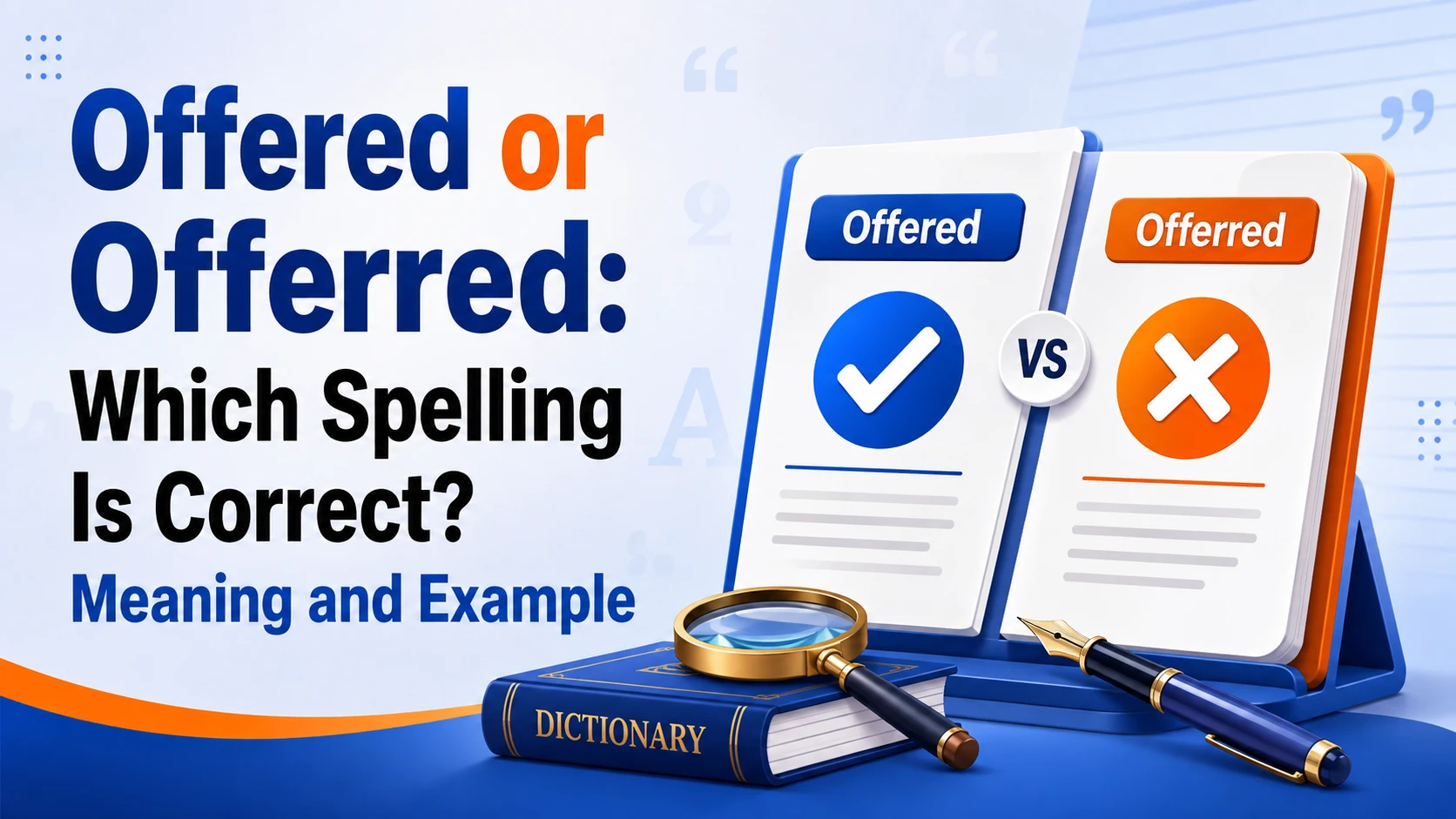
Offered or offerred—which spelling is correct? The correct spelling is offered, while offerred is a misspelling in standard English. This confusion often occurs because the two forms differ by only one letter, and many writers are unsure whether the final r in offer should be doubled before adding -ed. Knowing the correct form helps you avoid spelling errors and write with greater accuracy in emails, assignments, professional documents, and everyday communication.
The word offered is the past tense and past participle of the verb offer. It can mean to present, provide, suggest, or make something available for someone to accept or consider. For example, The company offered her a new position, or He offered to help with the project. Although offerred may look similar to words such as preferred or referred, it does not follow the same spelling pattern and is not accepted in standard English.
This guide explains why offered is correct, why offerred is incorrect, and how English spelling rules determine the proper form. You will also learn the meaning of offered, see clear sentence examples, understand the relevant grammar rule, and discover an easy spelling tip to remember the correct version. By the end, you will be able to use offered confidently in academic, professional, and casual writing.
Offered vs Offerred: Quick Answer
If you only need the short answer, here it is.
| Word | Correct? | Explanation |
| Offered | ✅ Correct | Proper past tense of “offer” |
| Offerred | ❌ Incorrect | Misspelling |
Correct Spelling: Offered
The correct spelling is offered with one “r.”
Examples:
- She offered me help.
- The store offered free delivery.
- They offered a better solution.
You’ll see this spelling in:
- Dictionaries
- Newspapers
- Universities
- Corporate documents
- Grammar software
Incorrect Spelling: Offerred
The spelling offerred is incorrect.
Examples:
- He offerred assistance. ❌
- They offerred a refund. ❌
No major dictionary accepts this spelling.
Many writers accidentally add the extra “r” because English contains several words that double consonants before “-ed.” However, “offer” does not follow that pattern.
What Does “Offered” Mean?
The word offered comes from the verb offer.
It means:
- To present something willingly
- To provide help, services, or opportunities
- To suggest or propose something
Simple Examples
| Sentence | Meaning |
| She offered advice. | She gave advice willingly |
| The company offered discounts. | The company provided discounts |
| He offered to drive us home. | He volunteered to help |
The word works in many situations:
- Business
- Education
- Sales
- Relationships
- Customer service
- Formal writing
That flexibility explains why “offered” appears constantly in daily communication.
Why “Offered” Has One “R”
This is where most people get confused.
English does sometimes double the final consonant before adding “-ed.”
For example:
- Prefer → Preferred
- Refer → Referred
- Admit → Admitted
So why not:
- Offer → Offerred?
Because English spelling depends heavily on stress patterns.
The Real Grammar Rule
A final consonant usually doubles when:
- The word has two syllables
- The stress falls on the final syllable
- The word ends in vowel + consonant
Examples:
- pre-FER → preferred
- re-FER → referred
Notice the stress lands on the second syllable.
Now look at offer:
- OF-fer
The stress falls on the first syllable, not the second.
That changes everything.
So the correct form becomes:
- Offer → Offered
Not:
- Offerred ❌
Easy Way to Remember It
Here’s a simple trick:
If the stress stays at the beginning, you usually don’t double the consonant.
Examples:
- Offer → Offered
- Suffer → Suffered
- Enter → Entered
But:
- Prefer → Preferred
- Refer → Referred
That single rule solves many English spelling problems instantly.
Offered vs Offerred: Side-by-Side Comparison
| Feature | Offered | Offerred |
| Correct English spelling | ✅ Yes | ❌ No |
| Found in dictionaries | ✅ Yes | ❌ No |
| Accepted in British English | ✅ Yes | ❌ No |
| Accepted in American English | ✅ Yes | ❌ No |
| Used in academic writing | ✅ Yes | ❌ No |
| Approved by Grammarly | ✅ Yes | ❌ No |
The confusion exists because “offerred” looks believable. Yet English spelling rules don’t always follow visual logic.
Is “Offerred” Correct in British English?
This myth spreads online constantly.
Some people assume British English allows “offerred” because British spelling sometimes doubles consonants.
For example:
| American English | British English |
| Traveled | Travelled |
| Canceled | Cancelled |
| Labeled | Labelled |
That pattern makes writers think:
- Offered → Offerred?
But that assumption is wrong.
Why British English Still Uses “Offered”
Both British and American English spell the word exactly the same way:
- Offered ✅
The extra “r” never appears in standard English.
You can confirm this in:
- Oxford English Dictionary
- Cambridge Dictionary
- Merriam-Webster
- Collins Dictionary
No trusted grammar authority accepts “offerred.”
Common Mistakes With “Offered or Offerred”
Spelling errors rarely happen randomly. Usually, they follow patterns.
Here are the biggest reasons people write “offerred.”
Doubling the “R” Automatically
Many writers memorize patterns like:
- Preferred
- Referred
- Transferred
Then they apply that rule to every word ending in “-er.”
That shortcut creates mistakes.
Confusing Pronunciation With Spelling
“Offerred” can sound correct when spoken quickly.
English pronunciation often hides spelling details. That’s why people type words based on sound instead of grammar rules.
Fast Typing and Autocorrect Errors
Typing quickly increases repetition mistakes:
- Offerred
- Occured
- Untill
- Begining
Even experienced writers make them occasionally.
That’s why proofreading matters.
Words Similar to “Offered” That Follow the Same Rule
Many verbs follow the exact same pattern as “offered.”
| Base Word | Correct Past Form | Incorrect Form |
| Offer | Offered | Offerred |
| Suffer | Suffered | Sufferrred |
| Enter | Entered | Enterred |
| Whisper | Whispered | Whisperred |
Notice something important:
- Stress falls on the first syllable
- Final consonant stays single
That’s the key pattern.
Words That Actually Double the Final Letter
Now let’s compare words that have double consonants.
| Base Word | Correct Past Form |
| Prefer | Preferred |
| Refer | Referred |
| Transfer | Transferred |
| Admit | Admitted |
These words stress the final syllable:
- pre-FER
- re-FER
- trans-FER
That stress triggers consonant doubling.
Quick Pattern Recognition Guide
| Stress Pattern | Example | Result |
| Stress on first syllable | Offer | Offered |
| Stress on last syllable | Prefer | Preferred |
This grammar rule helps with hundreds of English verbs.
Real Examples of “Offered” in Everyday Writing
Grammar rules become easier when you see real usage.
Offered in Emails
Professional communication uses “offered” constantly.
Examples:
- We offered a revised proposal yesterday.
- The company offered flexible work hours.
- She offered additional support during onboarding.
These sentences sound polished and professional because the spelling is correct.
Offered in Business Writing
Marketing teams often use the word in promotions and sales copy.
Examples:
- Limited-time discounts offered this weekend
- Services offered by our agency
- Extended warranty offered with purchase
Using “offerred” in business content damages credibility immediately.
Readers notice spelling errors fast.
Offered in Academic Writing
Students frequently use “offered” in essays and reports.
Examples:
- The research offered valuable insight.
- The author offered a different interpretation.
- The study offered statistical evidence.
Academic institutions expect correct spelling at all times.
Offered in Social Media
Short-form content still needs proper grammar.
Examples:
- They offered free tickets!
- My friend offered amazing advice today.
- The restaurant offered complimentary desserts.
One spelling mistake can distract readers instantly.
Why Correct Spelling Matters More Than People Think
Some writers treat spelling as a tiny detail. It isn’t.
Spelling directly affects:
- Credibility
- Trust
- Professionalism
- SEO performance
- User experience
Imagine seeing this sentence on a business website:
“We offerred premium consulting services.”
Most readers immediately notice the mistake. Some may even leave the page.
That single typo creates doubt.
People subconsciously connect grammar quality with expertise.
How Search Engines View Misspelled Keywords
Google understands spelling mistakes better than ever. If someone searches:
- offered or offerred
Google usually shows results for:
- offered or offered spelling
Still, correctly written content performs better long term because:
- It builds authority
- It improves readability
- It reduces bounce rates
- It earns more backlinks naturally
Professional writing always wins eventually.
Dictionary Definitions of “Offered”
Here’s how major dictionaries define the word.
| Dictionary | Definition Summary |
| Merriam-Webster | To present for acceptance |
| Cambridge Dictionary | To ask someone if they would like something |
| Oxford Dictionary | To express willingness to do something |
Every dictionary uses:
- Offered ✅
- Never offerred ❌
Common Grammar Myths About “Offerred”
English learners often hear incorrect advice online.
Let’s clear up the biggest myths.
Myth: British English Uses “Offerred”
False.
British English still uses:
- Offered
The spelling never changes.
Myth: Double “R” Looks More Professional
Also false.
In reality, “offerred” signals poor grammar knowledge.
Professional editors immediately correct it.
Myth: Spellcheck Sometimes Accepts “Offerred”
Rarely.
Most grammar tools flag it instantly.
Programs like:
- Grammarly
- Microsoft Editor
- Google Docs
all mark “offerred” as incorrect.
How to Never Misspell “Offered” Again
Memory tricks help more than memorizing random rules.
Try these methods.
Think About Stress
Say the word aloud:
- OF-fer
The stress stays at the front.
No double “r.”
Compare It to “Suffered”
Both words follow the same pattern:
- Offer → Offered
- Suffer → Suffered
That similarity makes the rule easier to remember.
Read More Professionally Written Content
Exposure improves spelling naturally.
You start recognizing:
- correct patterns
- incorrect forms
- standard grammar usage
Over time, “offerred” begins to look obviously wrong.
Conclusion
Understanding the difference between offered and offerred is essential for improving writing accuracy, language accuracy, and communication clarity. While the two forms may look like similar-looking words, only offered is the correct spelling, accepted spelling, and standard usage in English grammar and standard English. The confusion often comes from spelling rules, the double-letter rule, and assumptions about verb endings, but learning the correct word formation pattern makes the choice much easier. In academic writing, professional writing, emails, exams, and everyday communication, using offered correctly helps maintain grammatical accuracy, readability, and effective communication. With a better understanding of grammar rules, contextual meaning, word usage, and proper usage, writers can avoid a common spelling mistake, strengthen language proficiency, and communicate with greater confidence.
FAQs
Q1. Is “Offerred” a Correct Spelling in English?
No. Offerred is an incorrect spelling, misspelling, and a common spelling mistake. In standard English, offered is the correct spelling, accepted spelling, and the proper past tense and past participle form of the verb offer.
Q2. Why Is It “Offered” and Not “Offerred”?
The word offered follows standard English spelling rules, grammar rules, and common word formation patterns. The verb offer does not require an extra r before adding the -ed ending, which is why offerred is considered an incorrect form.
Q3. What Does “Offered” Mean?
The offered meaning is to present, suggest, or provide something for consideration. It is commonly used in professional communication, academic writing, emails, and everyday writing when describing an action completed in the past.
Q4. Is the spelling different in British English and American English?
No. In both British English and American English, offered is the correct word and standard spelling. There is no accepted version where offerred is considered correct, regardless of UK spelling or regional language usage.
Q5. How Can I Remember the Correct Spelling of Offered?
A simple spelling trick is to remember that offer becomes offered by adding only the -ed ending. There is no need for an extra r. This easy method improves word recognition, reduces spelling confusion, helps you avoid mistakes, and builds writing confidence in both formal communication and casual communication.
