
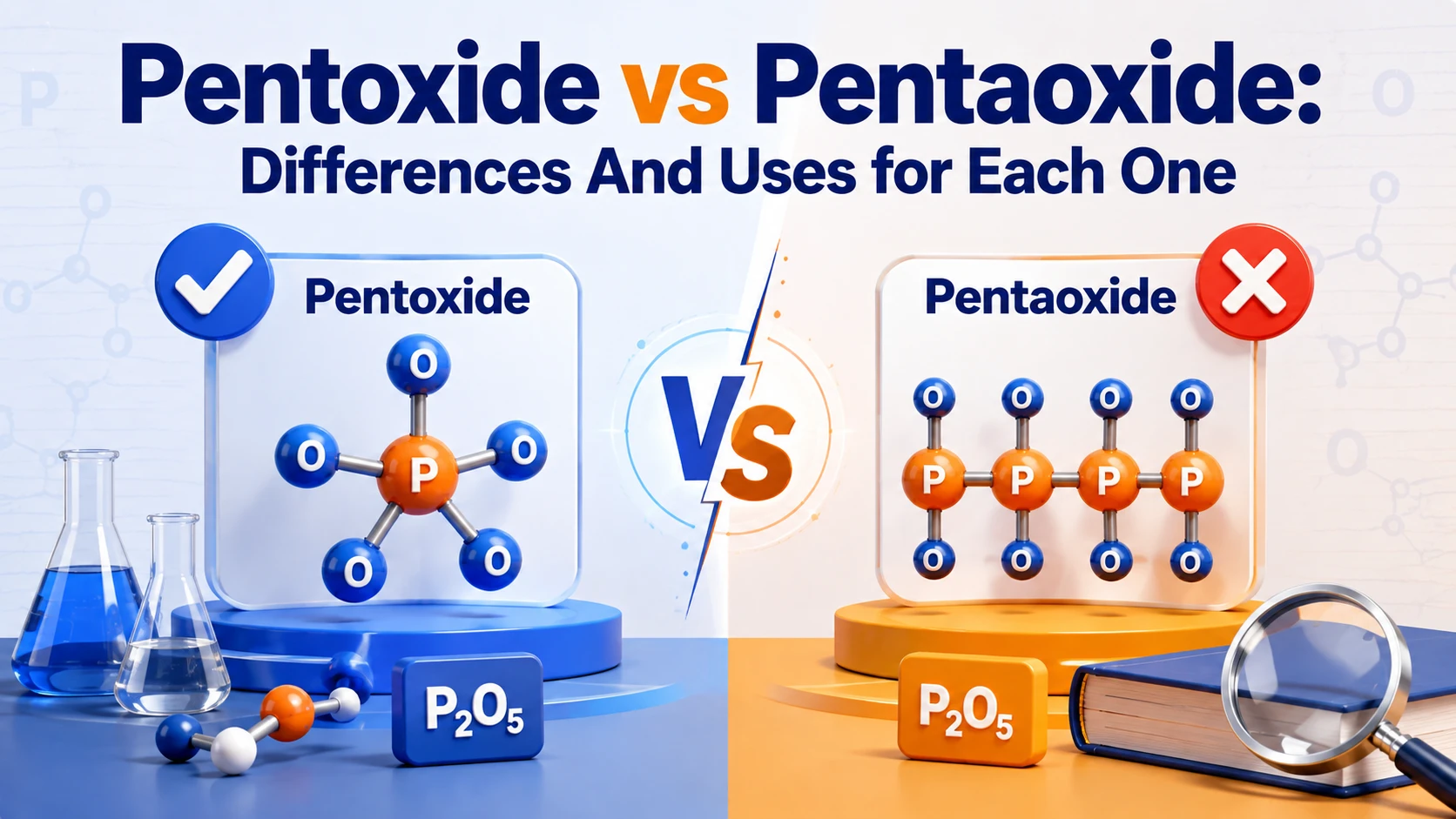
Pentoxide vs pentaoxide is a question that often puzzles chemistry students, science enthusiasts, technical writers, and even professionals who don’t regularly work with chemical nomenclature. At first glance, both words appear logical because the prefix penta- means “five,” leading many people to believe that pentaoxide should be the correct spelling for compounds containing five oxygen atoms. However, chemistry follows standardized naming conventions, and those conventions don’t always match what seems intuitive. Knowing the correct term is essential for writing accurate laboratory reports, understanding textbooks, and communicating clearly in scientific settings.
The confusion comes from the way chemical names are formed. Unlike everyday English, chemical nomenclature follows internationally accepted rules developed to make compound names consistent across countries, languages, and scientific disciplines. One of those rules allows certain vowels to be omitted when two vowel sounds appear together. As a result, many students who rely solely on the numerical prefix accidentally write pentaoxide, even though pentoxide is the accepted form used in modern chemistry. Understanding why the spelling changes is much more valuable than simply memorizing it.
In this guide, you’ll learn the difference between pentoxide and pentaoxide, why one spelling is preferred, how the naming rule works, where these terms appear in chemistry, and how to avoid one of the most common mistakes in scientific writing. You’ll also see comparison tables, real examples, expert tips, and practical explanations that make the concept easy to remember whether you’re preparing for an exam or writing professional scientific content.
Pentoxide vs Pentaoxide: What’s the Difference?
Although pentoxide and pentaoxide differ by only one letter, they are not equally accepted in modern chemistry.
Pentoxide is the standard scientific spelling used in textbooks, research papers, laboratory manuals, safety documents, and educational resources. It follows accepted chemical naming conventions, making it the correct choice in nearly every scientific context.
Pentaoxide, on the other hand, is generally considered a non-standard spelling. It appears occasionally because people naturally combine the Greek prefix penta- with oxide, but accepted nomenclature removes the final “a” to improve pronunciation.
Simply put:
- Pentoxide ✔ Correct and recommended
- Pentaoxide ✘ Generally not used in modern scientific writing
Quick Answer
If you’re writing:
- A chemistry assignment
- A laboratory report
- A research paper
- Technical documentation
- Educational material
you should almost always use pentoxide.
Examples include:
- Dinitrogen pentoxide (N₂O₅)
- Vanadium pentoxide (V₂O₅)
- Iodine pentoxide (I₂O₅)
- Phosphorus pentoxide (common historical name for phosphorus(V) oxide)
These names are widely recognized and follow accepted chemical naming practices.
Which Spelling Is Scientifically Correct?
The scientifically accepted spelling is pentoxide.
The reason lies in a naming convention used for many molecular compounds. The Greek prefix penta- indicates the number five, but when it comes immediately before oxide, the final “a” is dropped to make the name easier to pronounce.
Instead of:
Penta + oxide
chemists write:
Pent + oxide = Pentoxide
This change affects pronunciation only. It does not change the meaning or chemical composition of the compound.
Key Point
Pentoxide still means the compound contains five oxygen atoms. The spelling simply follows standardized chemical nomenclature.
Side-by-Side Comparison
| Feature | Pentoxide | Pentaoxide |
| Scientific acceptance | ✔ Standard | ✘ Generally not accepted |
| Used in textbooks | Yes | Rare |
| Used in research papers | Yes | Very uncommon |
| Recommended for students | Yes | No |
| Based on accepted nomenclature | Yes | No |
Remember: If you’re unsure which spelling to use, pentoxide is almost always the correct choice.
What Does “Pentoxide” Mean?
The word pentoxide doesn’t refer to one specific chemical. Instead, it is part of the name of several compounds that contain five oxygen atoms.
For example:
- Dinitrogen pentoxide
- Vanadium pentoxide
- Iodine pentoxide
- Phosphorus pentoxide
Although these compounds share the word pentoxide, they have completely different chemical properties, structures, and applications.
Definition in Chemistry
In chemical nomenclature, pentoxide indicates that a compound contains five oxygen atoms.
Take dinitrogen pentoxide (N₂O₅) as an example.
The name can be broken down into two parts:
- Di- means two nitrogen atoms.
- Pentoxide means five oxygen atoms.
Together, the name describes the molecular composition of the compound without requiring you to see its chemical formula.
This systematic naming system allows chemists around the world to communicate clearly and consistently.
Why the Prefix “Pent-” Is Used
Chemistry uses Greek numerical prefixes to indicate the number of atoms present in molecular compounds.
Here are some of the most common prefixes:
| Prefix | Number of Atoms |
| Mono- | 1 |
| Di- | 2 |
| Tri- | 3 |
| Tetra- | 4 |
| Penta- | 5 |
| Hexa- | 6 |
| Hepta- | 7 |
| Octa- | 8 |
| Nona- | 9 |
| Deca- | 10 |
These prefixes make compound names descriptive and consistent.
For example:
- Carbon monoxide
- Carbon dioxide
- Dinitrogen tetroxide
- Dinitrogen pentoxide
Once you understand the prefixes, many chemical names become much easier to interpret.
How Pentoxide Fits Chemical Nomenclature
Chemical naming follows internationally recognized rules established by the International Union of Pure and Applied Chemistry (IUPAC). These rules help ensure that scientists everywhere use the same names for the same substances.
When naming many binary molecular compounds, chemists generally:
- Use Greek prefixes to indicate the number of atoms.
- Name the first element first.
- Name oxygen as oxide.
- Omit certain ending vowels when doing so improves pronunciation.
That’s why you see:
- Monoxide instead of monooxide
- Tetroxide instead of tetraoxide
- Pentoxide instead of pentaoxide
These spelling adjustments make chemical names smoother to pronounce while preserving their meaning.
Expert Insight
The dropped vowel isn’t an exception made only for pentoxide. It’s part of a broader pronunciation rule used throughout chemical nomenclature, which is why similar patterns appear in several other compound names.
Common Compounds That Contain “Pentoxide”
Several well-known compounds include pentoxide in their names.
Phosphorus Pentoxide
Although its molecular formula is P₄O₁₀, the traditional name phosphorus pentoxide remains widely used.
Common applications include:
- Drying gases
- Removing water from chemical reactions
- Laboratory dehydration
- Industrial chemical production
Its strong affinity for water makes it one of the most effective laboratory desiccants.
Dinitrogen Pentoxide
Formula: N₂O₅
This compound is commonly encountered in:
- Chemistry textbooks
- University laboratories
- Chemical synthesis
- Studies of nitrogen oxides
It is frequently used as an example when teaching molecular naming because its name clearly demonstrates how numerical prefixes work.
Vanadium Pentoxide
Formula: V₂O₅
Vanadium pentoxide is an important industrial compound used in:
- Sulfuric acid manufacturing
- Industrial catalysts
- Ceramic production
- Specialty glass
- Advanced materials research
Its catalytic properties make it valuable in large-scale chemical processes.
Iodine Pentoxide
Formula: I₂O₅
Although less common, iodine pentoxide has important laboratory uses, including:
- Analytical chemistry
- Carbon monoxide analysis
- Gas testing
- Chemical research
Its predictable chemical behavior makes it useful for precise analytical measurements.
Practical Tip
Don’t assume that compounds ending in pentoxide behave similarly. The shared name only indicates the presence of five oxygen atoms. Their chemical properties, reactivity, hazards, and applications depend on the other element or elements in the compound.
Is “Pentaoxide” a Correct Scientific Term?
One of the most common questions students ask is whether pentaoxide is actually wrong or simply an alternative spelling. The answer requires a bit of context.
From a linguistic perspective, pentaoxide is understandable because the Greek prefix penta- means “five” and oxide refers to oxygen. However, modern chemical nomenclature follows pronunciation rules that simplify certain combinations of vowels. As a result, pentoxide became the accepted form used in scientific communication.
In other words, pentaoxide isn’t the preferred scientific term, even though the logic behind its formation is easy to understand.
Why Some People Write “Pentaoxide”
There are several reasons why this spelling appears online and in student work.
The most common include:
- Applying the prefix penta- literally without knowing the pronunciation rule.
- Assuming every Greek prefix remains unchanged.
- Copying informal websites that use non-standard spellings.
- Confusing everyday word formation with chemical nomenclature.
For example, someone learning prefixes may naturally write:
- Dinitrogen pentaoxide
- Phosphorus pentaoxide
Although the meaning is understandable, these spellings don’t match the conventions used in modern chemistry textbooks or scientific journals.
Beginner’s Insight
This mistake isn’t caused by poor chemistry knowledge. It’s usually the result of applying an English language rule instead of a chemistry naming rule.
IUPAC Naming Conventions and Accepted Terminology
Modern chemical names are standardized by the International Union of Pure and Applied Chemistry (IUPAC). These guidelines help scientists around the world communicate using consistent terminology.
One important convention is vowel elision, which removes the ending vowel from certain numerical prefixes when the next word begins with another vowel.
That’s why chemists write:
- Monoxide instead of monooxide
- Pentoxide instead of pentaoxide
The purpose isn’t to change the chemistry—it simply creates names that are easier to pronounce while maintaining consistency across scientific literature.
Although traditional names still exist for some compounds, the spelling pentoxide remains the accepted form in modern usage.
When You Might Encounter “Pentaoxide”
Despite not being the preferred spelling, you may still come across pentaoxide in certain situations.
Examples include:
- Student homework
- Personal blogs
- Online discussion forums
- Automatically generated content
- Older educational materials
- Informal notes
Finding the word doesn’t necessarily mean the chemistry is incorrect, but it does indicate that the terminology doesn’t follow current naming conventions.
When writing for school, research, publishing, or professional communication, always use pentoxide unless you’re specifically discussing historical spellings or explaining the naming rule itself.
Why “Pentoxide” Is Preferred in Textbooks and Scientific Literature
Scientific writing values consistency.
If every author used slightly different spellings for the same compound, chemical communication would quickly become confusing.
Using pentoxide provides several advantages:
- Consistent terminology across publications.
- Easier pronunciation.
- Alignment with accepted nomenclature.
- Better compatibility with scientific databases and indexes.
- Reduced ambiguity for students and researchers.
Expert Recommendation
When in doubt, use the spelling you’ll find in university textbooks, peer-reviewed research papers, and laboratory manuals. In this case, that’s pentoxide.
Pentoxide vs Pentaoxide: Side-by-Side Comparison
Understanding both terms becomes much easier when they’re compared directly.
| Feature | Pentoxide | Pentaoxide |
| Accepted scientific spelling | ✔ Yes | ✘ No (generally) |
| Used in chemistry textbooks | ✔ Frequently | Rarely |
| Follows modern naming conventions | ✔ Yes | ✘ No |
| Common in research literature | ✔ Yes | Very uncommon |
| Suitable for academic writing | ✔ Yes | Not recommended |
| Meaning intended | Five oxygen atoms | Five oxygen atoms |
Although both spellings aim to describe compounds containing five oxygen atoms, only one follows accepted scientific conventions.
Spelling
The visible difference is just one letter.
- Pentoxide
- Pentaoxide
That missing “a” exists because of the pronunciation rule discussed earlier.
For scientific writing, this seemingly minor difference matters.
Pronunciation
Interestingly, both spellings would be pronounced similarly in casual speech.
However, pentoxide flows more naturally because it avoids consecutive vowel sounds.
Approximate pronunciation:
Pentoxide
pen-TOX-ide
The smoother pronunciation is one reason the simplified spelling became standard.
Scientific Accuracy
Accuracy isn’t just about chemical formulas.
Correct terminology also matters.
Using accepted names demonstrates that you understand:
- Chemical nomenclature
- Scientific conventions
- Professional writing standards
For examinations, laboratory reports, and journal articles, using pentoxide reflects attention to detail.
Usage in Chemistry
You’ll encounter pentoxide across many scientific disciplines.
Examples include:
- Inorganic chemistry
- Analytical chemistry
- Industrial chemistry
- Materials science
- Environmental chemistry
- Chemical engineering
By contrast, pentaoxide has little practical use in modern scientific publications.
Examples in Context
Correct examples include:
- Dinitrogen pentoxide is a molecular compound.
- Vanadium pentoxide acts as an industrial catalyst.
- The laboratory stores phosphorus pentoxide in sealed containers.
Incorrect for modern scientific writing:
- Dinitrogen pentaoxide
- Vanadium pentaoxide
Why “Pentoxide” Drops the Letter “A”
At first glance, removing the “a” seems arbitrary.
In reality, it’s part of a long-established naming principle that improves pronunciation.
Understanding this rule helps explain many other chemical names as well.
The Vowel-Elision Rule in Chemical Naming
When certain numerical prefixes end with a or o and the following word begins with a vowel, chemistry often removes one of those vowels.
This process is called vowel elision.
Its purpose is simple:
- Make names easier to pronounce.
- Avoid awkward vowel combinations.
- Maintain consistency.
Without this rule, many compound names would sound unnecessarily cumbersome.
Other Chemistry Names That Follow the Same Pattern
Pentoxide isn’t unique.
Several familiar compounds follow exactly the same convention.
| Less Preferred Form | Standard Form |
| Monooxide | Monoxide |
| Tetraoxide | Tetroxide |
| Pentaoxide | Pentoxide |
These examples illustrate that dropping the final vowel is part of a broader naming system rather than an isolated exception.
Cases Where the Vowel Is Not Dropped
Not every chemical name removes a vowel.
The exact form depends on the naming rules for that particular compound.
For example:
- Pentafluoride
- Pentachloride
- Pentabromide
In these cases, removing the “a” would reduce clarity or produce an awkward word.
This is why understanding the naming convention is more useful than memorizing isolated examples.
Practical Tip
Rather than trying to predict every spelling, consult accepted chemical names when writing scientific documents. Standard references and textbooks consistently use pentoxide.
How to Use “Pentoxide” Correctly in Sentences
Knowing the correct spelling is only part of the process.
You should also know how scientists naturally use the term in different kinds of writing.
Academic Writing Examples
In schools and universities, pentoxide often appears in explanations of molecular compounds and nomenclature.
Examples:
- Students learned why dinitrogen pentoxide follows standard naming conventions.
- The chemistry instructor explained the structure of vanadium pentoxide.
- Our assignment compared the properties of several pentoxide compounds.
Notice that the word appears as part of the compound’s official name rather than standing alone.
Laboratory and Research Examples
Researchers use pentoxide in technical descriptions where precision is essential.
Examples:
- The experiment required freshly prepared phosphorus pentoxide as a drying agent.
- Scientists measured the catalytic activity of vanadium pentoxide.
- The sample contained traces of iodine pentoxide.
Scientific writing typically focuses on the compound’s properties, reactions, or applications.
Industrial Examples
Many industries rely on compounds containing pentoxide.
Examples:
- The catalyst consisted primarily of vanadium pentoxide.
- Engineers monitored the storage conditions for phosphorus pentoxide.
- The manufacturing process required high-purity pentoxide compounds.
Here, accuracy is important because different compounds have different safety requirements and industrial functions.
Everyday Educational Examples
Even outside laboratories, students encounter pentoxide while learning chemistry.
Examples:
- Remember that pentoxide is the correct spelling, not pentaoxide.
- Our teacher used dinitrogen pentoxide to explain numerical prefixes.
- The quiz included several compounds ending in pentoxide.
Writing Tip
Whenever you’re naming a chemical compound containing five oxygen atoms, verify its accepted scientific name instead of assuming the prefix remains unchanged. Following established nomenclature makes your writing clearer, more accurate, and more professional.
Common Pentoxide Compounds and Their Uses
The word pentoxide appears in the names of several important chemical compounds, but they are not interchangeable. Each compound has its own chemical formula, physical properties, hazards, and applications. Knowing these differences helps you understand why simply recognizing the suffix -pentoxide isn’t enough—you must also know the element it is paired with.
Phosphorus Pentoxide
Although commonly called phosphorus pentoxide, the compound actually exists as P₄O₁₀ in its molecular form. The traditional name remains widely used in textbooks, laboratories, and industry because it is familiar and well established.
Properties
- White crystalline solid
- Extremely hygroscopic (absorbs moisture readily)
- Powerful dehydrating agent
- Reacts vigorously with water to form phosphoric acid
- Corrosive and requires careful handling
One reason chemists value phosphorus pentoxide is its remarkable ability to remove even trace amounts of water from gases and chemical mixtures.
Common Applications
Phosphorus pentoxide is widely used in:
- Drying laboratory gases
- Organic synthesis
- Producing phosphoric acid
- Dehydration reactions
- Chemical manufacturing
Safety Note
Because phosphorus pentoxide reacts violently with moisture, it should always be handled using appropriate protective equipment and stored in tightly sealed containers.
Dinitrogen Pentoxide
Dinitrogen pentoxide (N₂O₅) is an important nitrogen oxide that frequently appears in chemistry courses because it clearly demonstrates molecular naming rules.
Properties
- Colorless crystalline solid under suitable conditions
- Strong oxidizing agent
- Decomposes into nitrogen dioxide and oxygen when heated
- Sensitive to moisture
Its instability means it is usually encountered in controlled laboratory environments rather than everyday industrial settings.
Practical Uses
Scientists use dinitrogen pentoxide in:
- Chemical research
- Laboratory synthesis
- Nitration reactions
- Teaching molecular nomenclature
For many students, it serves as the classic example explaining why pentoxide, not pentaoxide, is the accepted spelling.
Vanadium Pentoxide
Among all pentoxide compounds, vanadium pentoxide (V₂O₅) has some of the greatest industrial importance.
Industrial Importance
Vanadium pentoxide functions primarily as a catalyst, meaning it speeds up chemical reactions without being permanently consumed.
Major applications include:
- Sulfuric acid production
- Catalyst manufacturing
- Ceramic glazes
- Specialty glass
- Battery research
- Advanced materials science
Its catalytic role makes it indispensable in many large-scale industrial processes.
Environmental Considerations
Despite its usefulness, vanadium pentoxide must be handled responsibly.
Industrial facilities often monitor:
- Air emissions
- Worker exposure
- Waste disposal
- Storage conditions
Following established environmental and occupational safety guidelines helps minimize potential risks associated with long-term exposure.
Iodine Pentoxide
Iodine pentoxide (I₂O₅) is less familiar than the previous compounds but remains valuable in analytical chemistry.
Laboratory Applications
Scientists commonly use iodine pentoxide for:
- Carbon monoxide detection
- Gas analysis
- Analytical chemistry
- Research experiments
Because it reacts predictably with carbon monoxide, it has long been useful in laboratory testing and measurement techniques.
Summary of Common Pentoxide Compounds
| Compound | Formula | Primary Use |
| Phosphorus pentoxide | P₄O₁₀ | Drying agent and dehydration reactions |
| Dinitrogen pentoxide | N₂O₅ | Chemical research and teaching |
| Vanadium pentoxide | V₂O₅ | Industrial catalyst |
| Iodine pentoxide | I₂O₅ | Gas analysis and laboratory testing |
Expert Insight
The word pentoxide tells you only that the compound contains five oxygen atoms. It does not indicate how the compound behaves chemically. Always consider the entire compound name rather than focusing solely on the suffix.
Common Mistakes Writers and Students Make
Even students who understand chemistry sometimes make naming errors. Most of these mistakes stem from misunderstanding nomenclature rather than misunderstanding the science itself.
Learning the most common errors can save points on exams and improve the accuracy of scientific writing.
Writing “Pentaoxide” Instead of “Pentoxide”
This is by far the most common mistake.
Since the numerical prefix is penta-, many beginners naturally write:
❌ Dinitrogen pentaoxide
The accepted form is:
✔ Dinitrogen pentoxide
The dropped vowel follows established chemical naming conventions.
Confusing Prefixes with Complete Compound Names
Another common misconception is assuming every prefix directly forms the finished compound name.
For example:
Students may correctly know:
- Mono = one
- Di = two
- Tri = three
- Penta = five
But they mistakenly believe those prefixes never change.
In reality, pronunciation rules sometimes modify them when they combine with another word.
Understanding the naming system is much more useful than memorizing isolated examples.
Mispronouncing Chemical Names
Spelling mistakes often lead to pronunciation mistakes.
For example:
Some students pronounce:
“Penta-oxide”
instead of the smoother:
“Pent-oxide”
Although pronunciation differences rarely change the scientific meaning, using accepted terminology helps communicate more professionally during presentations, laboratory work, and classroom discussions.
Assuming Both Spellings Are Equally Accepted
Because search engines return results for both spellings, some writers conclude that both are equally correct.
That’s not the case.
Scientific publications overwhelmingly use pentoxide because it follows accepted naming conventions.
Using pentaoxide in academic writing may suggest unfamiliarity with standard nomenclature.
Writing Tip
If your chemistry textbook consistently uses one spelling, follow it throughout your report or assignment. Consistency is an important part of scientific communication.
How to Remember the Correct Spelling
Memorizing a rule is helpful, but understanding why it exists makes it much easier to remember months or even years later.
These techniques can help you avoid confusion.
Simple Mnemonic
Remember this phrase:
“Five oxygens, one smooth word.”
The idea is simple.
Although the prefix is penta-, chemistry removes the extra vowel before oxide, giving you the smoother word:
Pentoxide
Thinking about pronunciation instead of spelling often makes the rule easier to recall.
The Chemistry Naming Shortcut
When naming molecular compounds:
- Identify the numerical prefix.
- Check whether the second word begins with a vowel.
- If accepted nomenclature removes the final vowel, use the standard form.
Examples:
- Mono + oxide → Monoxide
- Tetra + oxide → Tetroxide
- Penta + oxide → Pentoxide
Recognizing this pattern helps with many chemical names—not just pentoxide.
A Quick Proofreading Checklist
Before submitting a chemistry assignment, ask yourself these questions:
| Checklist | Yes/No |
| Did I use the accepted compound name? | ☐ |
| Did I write pentoxide instead of pentaoxide? | ☐ |
| Does the chemical formula match the compound name? | ☐ |
| Did I verify the spelling using a reliable chemistry source? | ☐ |
| Is my terminology consistent throughout the document? | ☐ |
Completing this quick review takes less than a minute and can prevent common naming errors.
Final Expert Tip
Don’t rely solely on spell-check software for scientific writing. Many writing tools focus on general English rather than chemical nomenclature. Verifying compound names against trusted chemistry references or your course materials is a much more reliable habit.
Mini Quiz: Test Your Understanding
A short quiz is an effective way to check whether you understand the difference between pentoxide and pentaoxide. Try answering each question before looking at the explanations.
Five Multiple-Choice Questions
1. Which spelling follows accepted modern chemical nomenclature?
A. Pentaoxide
B. Pentoxide
C. Both are equally correct
D. Neither
2. Why is the final “a” removed from “penta-” in “pentoxide”?
A. It changes the chemical formula.
B. It follows a vowel-elision rule that improves pronunciation.
C. It indicates a different oxidation state.
D. It is an American English spelling.
3. Which compound name is correct?
A. Dinitrogen pentaoxide
B. Dinitrogen penoxide
C. Nitrogen five oxide
D. Dinitrogen oxygen-five
4. Which compound is widely used as an industrial catalyst in sulfuric acid production?
A. Iodine pentoxide
B. Dinitrogen pentoxide
C. Vanadium pentoxide
D. Carbon monoxide
5. In which type of document should you always use “pentoxide”?
A. Chemistry laboratory reports
B. Scientific research papers
C. University assignments
D. All of the above
Answers with Explanations
| Question | Correct Answer | Explanation |
| 1 | B | Pentoxide is the accepted scientific spelling used in modern chemistry. |
| 2 | B | Chemistry removes the extra vowel to create a smoother pronunciation while preserving the meaning. |
| 3 | B | Dinitrogen pentoxide follows accepted chemical naming conventions. |
| 4 | C | Vanadium pentoxide (V₂O₅) is widely used as an industrial catalyst. |
| 5 | D | Standard scientific writing consistently uses pentoxide in all professional and academic contexts. |
Study Tip
If you remember that “chemistry prefers smoother pronunciation”, you’ll naturally choose pentoxide instead of pentaoxide.
Conclusion
Understanding the difference between pentoxide and pentaoxide is less about memorizing a spelling and more about understanding how scientific naming conventions work. While the prefix penta- correctly represents the number five, accepted chemical nomenclature removes the final vowel before oxide, making pentoxide the standard term used in textbooks, laboratories, research papers, and professional communication. Recognizing this pattern will also help you interpret many other molecular compound names with greater confidence. One final actionable tip: Whenever you write the name of a chemical compound, verify it against a trusted chemistry textbook or an accepted nomenclature reference instead of relying solely on memory or spell-check software. A common mistake to avoid: Don’t assume that a word is scientifically correct simply because it looks logical. Chemical terminology follows established conventions, and using the accepted name improves both accuracy and credibility in academic and professional writing.
Frequently Asked Questions
Q1. Is pentaoxide a real word?
Pentaoxide occasionally appears in informal writing because it seems logically formed from the prefix penta- and the word oxide. However, modern scientific nomenclature prefers “pentoxide,” making it the correct choice for academic, laboratory, and professional chemistry writing.
Q2. Why is it pentoxide instead of pentaoxide?
The final “a” in penta- is usually omitted before oxide to improve pronunciation. This vowel-elision rule is widely used in chemical nomenclature and produces smoother names such as monoxide, tetroxide, and pentoxide without changing the compound’s meaning.
Q3. Does IUPAC recognize pentaoxide?
Modern IUPAC-based naming conventions use pentoxide rather than pentaoxide for standard compound names. While you may occasionally encounter the alternative spelling in informal sources, pentoxide is the accepted form for textbooks, scientific literature, and educational materials.
Q4. Which spelling should I use in school or scientific writing?
Always use pentoxide unless you’re specifically discussing historical terminology or explaining why the alternative spelling exists. Using the accepted scientific name demonstrates accuracy, attention to detail, and familiarity with standard chemical nomenclature, which is especially important in examinations and laboratory reports.
Q5. What are the most common pentoxide compounds?
Some of the best-known examples are phosphorus pentoxide, dinitrogen pentoxide, vanadium pentoxide, and iodine pentoxide. Although they all contain five oxygen atoms, each compound has different properties, applications, and safety considerations, so they should never be treated as interchangeable substances.
