
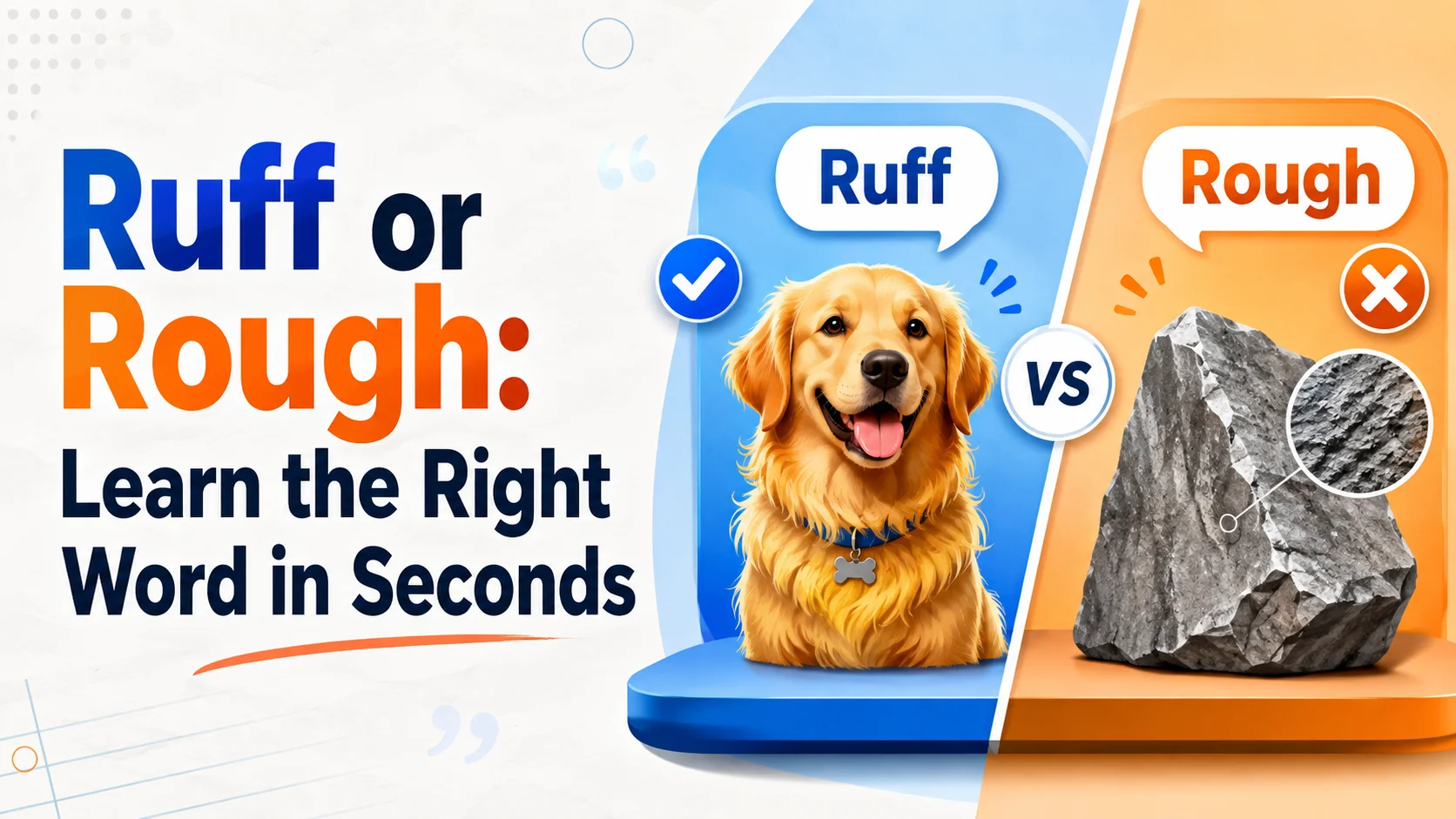
Ruff or rough may sound exactly the same when spoken, but the two words are not interchangeable. Rough is the everyday word you need when something is uneven, difficult, harsh, approximate, unfinished, or turbulent. Ruff, by contrast, is a separate noun with specialized meanings, including a historical collar, a ring of feathers or fur around an animal’s neck, and the name of a bird. Both are pronounced /rʌf/ in standard British and American English, which explains why spelling them correctly can be surprisingly tricky.
The confusion becomes especially noticeable in writing because sound cannot tell you which spelling to choose. If someone says, “I had a rough day,” you cannot identify the spelling from pronunciation alone. You have to understand the meaning and context. That is why sentences such as rough day, rough draft, and rough estimate use rough, while a historical costume can have a ruff, and an animal can have a neck ruff. Learning these meaning-based patterns is much more reliable than memorizing isolated spellings.
This guide breaks the difference down in practical terms. You will learn what rough means, where ruff is genuinely correct, why the two words sound alike, which common phrases always use rough, and how to avoid mistakes in school, professional, and everyday writing. You will also see context-based examples, a quick decision guide, word-history notes, and a short test so you can choose the correct spelling without hesitation.
Ruff vs. Rough at a Glance
The easiest way to understand the distinction is to stop treating ruff as a misspelling of rough. They are two different words that happen to share the same pronunciation.
| Feature | Rough | Ruff |
| Pronunciation | /rʌf/ | /rʌf/ |
| Most common role | Adjective | Noun |
| Main meanings | Uneven, difficult, harsh, approximate, unfinished | Historical collar, animal neck feathers/fur, bird, card-game term |
| Common phrase | Rough day, rough draft, rough estimate | A neck ruff, Elizabethan ruff |
| Everyday frequency | Very common | Much less common |
| Dog-bark use | No | Sometimes used informally as a playful bark imitation |
| British/American spelling | Rough | Ruff |
| Can it mean the other word? | No | No |
Quick rule: If you mean difficult, uneven, harsh, approximate, or unfinished, use rough. If you mean a collar, animal neck feature, bird, or specialized card-game term, ruff may be the correct word.
What Does “Rough” Mean?
Rough is a highly versatile English word. It can describe a physical surface, a difficult experience, turbulent conditions, approximate information, unfinished work, a harsh sound, or forceful behavior.
Cambridge lists several major senses of roughness, including not smooth, not exact, difficult or unpleasant, violent or stormy, and not carefully or completely made.
Rough as an Adjective
The adjective rough is the form you will encounter most often.
1. Rough means “not smooth”
Use it for surfaces that feel uneven, coarse, jagged, or unpolished.
- The stone has a rough surface.
- The old wooden table feels rough.
- We drove along a rough road.
- This fabric is too rough against my skin.
The opposite is often smooth.
2. Rough means difficult or unpleasant
The word can describe an experience or period that is hard to deal with.
- She had a rough day at work.
- The family went through a rough period.
- It has been a rough year.
- We had a rough journey.
Here, rough has nothing to do with physical texture. It describes the quality of an experience.
3. Rough means approximate
This is one of the most important uses in professional and academic writing.
- Can you give me a rough estimate?
- I have a rough idea of the cost.
- We need a rough figure before the meeting.
- She gave us a rough calculation.
In these examples, rough means not exact but reasonably close. Cambridge similarly defines this sense as approximate or not exact.
4. Rough means unfinished or preliminary
A first version of something can be called rough because it has not yet been refined.
- I finished the rough draft.
- Here’s a rough sketch of the design.
- The architect showed us a rough plan.
- This is only a rough outline.
This is particularly useful in writing, design, engineering, business planning, and creative work.
5. Rough can describe violent or forceful behavior
For example:
- The players were getting rough.
- The sea became rough.
- The game was more rough than expected.
Context determines whether rough means physically uneven, difficult, forceful, or turbulent.
Rough as a Noun
Although less common for beginners, rough can also function as a noun.
One familiar example comes from golf:
The ball landed in the rough.
In golf, the rough refers to areas of longer grass outside the closely maintained playing areas. Cambridge specifically recognizes this golfing sense.
Rough can also refer to a preliminary drawing:
- The designer showed us several roughs.
This is related to the idea of an early, undeveloped version.
Rough as a Verb
Rough can also function as a verb.
For example:
- The treatment roughed the surface.
- The artist roughed out the basic design.
- They had to rough it during the trip.
The phrasal verb rough out means to produce something in a preliminary form, while rough it means to live temporarily with limited comfort. Cambridge recognizes rough it as an informal expression for living in basic, uncomfortable conditions.
What Does “Ruff” Mean?
Ruff is a real English word, but it is not the alternative spelling of rough.
Its meanings are much more specialized.
A Ruff as a Historical Collar
A ruff was a large, stiff, pleated collar worn in Europe, particularly during the 16th and 17th centuries. It appears frequently in historical portraits and discussions of period clothing.
For example:
- The portrait shows a man wearing an elaborate ruff.
- The costume included a high white ruff around the neck.
- The museum displayed several historical ruffs.
So if you are writing about Elizabethan or early modern clothing, ruff is the correct spelling.
A Ruff as an Animal Feature
A ruff can also mean a circle or fringe of hair or feathers around the neck of a bird or animal.
Examples:
- The bird has a distinctive neck ruff.
- The cat’s thick ruff made its neck appear larger.
- The animal developed a fuller ruff during adulthood.
This meaning explains why you may encounter the word in zoology, wildlife writing, veterinary contexts, or descriptions of animals.
A Ruff Is Also a Bird
Ruff is the name of a Eurasian wading bird, Calidris pugnax. The bird’s name is spelled ruff, not rough. Merriam-Webster also identifies this bird as one of the established meanings of ruff.
For example:
- Birdwatchers spotted a ruff near the wetlands.
- The ruff is a migratory wading bird.
This is a proper vocabulary item, not a spelling variation.
Ruff in Card Games
There is another specialized meaning that most everyday writers will rarely need.
In card games, to ruff can mean to play a trump card on a card that has been led or played. The noun can refer to the act of trumping.
For example:
- She ruffed the trick with a trump.
- He chose to ruff the opponent’s lead.
This is a specialized technical use, so it should not be confused with ordinary rough.
“Ruff” as a Playful Dog Sound
You may also see “ruff!” in informal writing as an imitation of a dog’s bark.
For example:
“Ruff! Ruff!” the puppy seemed to say.
This is playful sound-based writing, not the standard adjective rough. It commonly appears in children’s writing, comics, pet-themed humor, or deliberately informal dialogue.
That distinction matters because a writer might intentionally type ruff when imitating a dog, while accidentally typing ruff on a rough day would simply be a spelling error.
Ruff or Rough: Which One Should You Use?
Use the meaning of the sentence as your test.
| What you want to express | Correct word | Example |
| Uneven surface | rough | The road is rough. |
| Difficult experience | rough | She had a rough day. |
| Harsh conditions | rough | The sea was rough. |
| Approximate amount | rough | Give me a rough estimate. |
| Preliminary work | rough | I completed a rough draft. |
| Golf’s long grass | rough | The ball landed in the rough. |
| Historical collar | ruff | He wore an elaborate ruff. |
| Neck feathers/fur | ruff | The cat has a thick ruff. |
| Bird | ruff | A ruff was spotted nearby. |
| Card-game action | ruff | She ruffed the trick. |
| Playful dog sound | ruff | “Ruff!” barked the puppy. |
Use “Rough” for Texture and Physical Surfaces
Think:
rough stone → rough road → rough fabric → rough wood
If the opposite could reasonably be smooth, rough is almost certainly what you need.
Use “Rough” for Difficult Experiences
Think:
rough day → rough week → rough time → rough patch → rough year
The word describes the experience, not a physical surface.
Use “Rough” for Approximate Information
This is particularly common in professional communication:
- rough estimate
- rough figure
- rough calculation
- rough idea
- rough guide
A useful distinction is that rough does not mean random. A rough estimate is an informed approximation, not necessarily a careless guess.
Use “Rough” for Preliminary Work
If something is a first version rather than the finished product, rough is generally appropriate:
- rough draft
- rough sketch
- rough outline
- rough plan
- rough design
Use “Ruff” for Its Specialized Meanings
Choose ruff when the surrounding context clearly points to:
- historical clothing
- animal neck fur or feathers
- the bird
- card games
- playful barking
“Rough Day” or “Ruff Day”?
The standard expression is rough day.
Correct: I had a rough day.
Incorrect: I had a ruff day.
Why? Because rough here means difficult or unpleasant. The word has nothing to do with a dog, a collar, or feathers.
The same principle applies to several common expressions:
- rough day, not ruff day
- rough draft, not ruff draft
- rough estimate, not ruff estimate
- rough road, not ruff road
- rough patch, not ruff patch
When Could “Ruff Day” Be Intentional?
There is one important exception: wordplay.
A pet brand, cartoon, children’s book, or humorous social post might deliberately write ruff day because it is making a joke about a dog.
For example:
“Having a ruff day?”
That can work as a pun. But it should not be mistaken for standard spelling.
Common Phrases With “Rough”
Some expressions are so established that recognizing them can make the spelling decision almost automatic.
Rough Draft
A rough draft is an early version that still needs revision.
I submitted my rough draft before starting the final version.
Rough Estimate
A rough estimate gives an approximate amount rather than an exact figure.
The repairs will cost a rough estimate of $2,000.
A more natural construction in many situations is a rough estimate of about $2,000 or simply an estimate of about $2,000.
Rough Patch
A rough patch is a difficult period in someone’s life, relationship, work, or circumstances.
The team went through a rough patch but recovered.
Rough Around the Edges
This expression can describe someone or something that lacks polish or refinement.
The proposal is still rough around the edges.
It can also describe a person’s manners or behavior.
Rough It
To rough it means to live temporarily with fewer comforts than usual.
We decided to rough it during the camping trip.
In the Rough
This expression has several uses. In golf, the rough is the area of longer grass away from the closely maintained playing surface.
Rough Ride
A rough ride can describe literal physical movement or a difficult experience.
The bus gave us a rough ride.
It can also be metaphorical:
The company is in for a rough ride.
Why Do Ruff and Rough Sound the Same?
Both words are pronounced /rʌf/ in standard British and American English. Cambridge gives the same pronunciation for rough and ruff.
The confusing part is the rough spelling.
In rough, the letters ough do not produce the pronunciation a learner might expect from looking at the word. English has many historical spellings that cannot be decoded perfectly from modern pronunciation alone.
That creates an important spelling lesson:
Pronunciation and spelling are related, but they are not the same system.
You can hear /rʌf/ and still need context to decide whether the writer means rough or ruff.
Why Hearing the Word Isn’t Enough
Imagine someone says:
“The road is rough.”
You hear /rʌf/. The sound itself does not tell you whether the speaker would write rough or ruff. But the meaning does.
A road that is uneven is rough.
Likewise:
“The cat has a thick ruff.”
The pronunciation is still /rʌf/, but the animal-feature meaning requires ruff.
Common Mistakes With Ruff and Rough
Mistake 1: Writing “Ruff” for Difficult
❌ I had a ruff week.
✅ I had a rough week.
The intended meaning is “difficult,” so rough is required.
Mistake 2: Writing “Ruff Draft”
❌ Please send the ruff draft.
✅ Please send the rough draft.
A draft is preliminary or unfinished, which is one of the established meanings of rough.
Mistake 3: Assuming Ruff Is a Shorter Version
Some writers assume ruff is simply an easier spelling of rough.
It is not.
Ruff is its own word. Substituting it for rough changes the word even though the pronunciation remains the same.
Mistake 4: Trusting Spellcheck Too Much
This is a particularly useful lesson for digital writing.
If you type:
I had a ruff day.
A spellchecker may not flag ruff, because ruff is a correctly spelled English word. The problem is word choice, not spelling validity.
That is why context-aware proofreading is more useful than checking whether every word exists in a dictionary.
Mistake 5: Confusing “Ruff” With “Rough” in Historical Writing
If you are describing a sixteenth-century portrait, ruff may be exactly right:
The nobleman wore a large white ruff.
Changing it to rough would create a completely different word.
Rough vs. Ruff in Real-World Writing
Everyday Conversation and Texting
In ordinary communication, roughness is overwhelmingly more likely when discussing problems, surfaces, or difficult experiences.
That was a rough morning.
This road is really rough.
Can you give me a rough estimate?
Ruff appears mainly when the conversation involves one of its specialized meanings or deliberate dog-related wordplay.
School and Academic Writing
Students commonly need rough for:
- rough draft
- rough outline
- rough estimate
- rough calculation
- rough sketch
One practical proofreading trick is to ask: Am I describing something preliminary, approximate, uneven, or difficult? If so, rough is probably the answer.
Professional Writing
In business, project planning, design, construction, and other professional settings, rough frequently signals that a figure or version is preliminary rather than final.
Here is a rough estimate of the project cost.
I’ve attached a rough outline of the proposal.
That wording can be useful because it tells readers not to interpret the information as final or exact.
Creative and Historical Writing
Both words can legitimately appear in creative writing, but their meanings remain distinct.
The sailor struggled through rough seas.
versus:
The character appeared in a starched ruff.
A writer can even use both in the same passage:
The journey was rough, but the portrait showed the traveler wearing an elaborate ruff.
How to Remember Ruff vs. Rough in Seconds
The “Difficult or Uneven?” Test
Ask yourself:
Does the word mean difficult, uneven, harsh, approximate, or unfinished?
If yes, choose rough.
The “Special Thing” Test
If you are talking about a:
- historical collar
- neck fringe of feathers or fur
- particular bird
- card-game action
- playful dog sound
then ruff may be correct.
A Simple Visual Memory Trick
Associate each spelling with a concrete image:
Rough → a rough road
Ruff → a dog saying “ruff!”
The goal is not to memorize a complicated rule. You are simply connecting each spelling to its most recognizable context.
Memory shortcut: Rough describes a condition; ruff usually names a specific thing.
Why Sound Is Not Enough
Never use pronunciation as your only spelling test here. Since rough and ruff are homophones, listening carefully will not solve the problem.
Meaning beats sound.
Rough vs. Ruff: Synonyms and Related Words
The best synonym depends on which meaning of rough you intend.
| Meaning of “rough” | Useful alternatives |
| Not smooth | uneven, coarse, rugged, jagged |
| Difficult | hard, challenging, tough, unpleasant |
| Harsh | severe, abrasive, stern |
| Approximate | estimated, approximate, inexact |
| Preliminary | unfinished, preliminary, unpolished |
| Turbulent | stormy, choppy, violent |
Antonyms for Rough
Depending on context, useful opposites include:
- smooth for texture
- easy for difficulty
- precise for approximation
- finished for preliminary work
- gentle for forceful behavior
- calm for turbulent conditions
Related Forms of Rough
You may also encounter:
- roughly — approximately or in a rough manner
- roughness — the quality of being rough
- roughen — to make rough
- roughly drawn — drawn without detailed refinement
- rough-cut — not fully finished or polished
- rough-and-ready — practical but not highly refined
These forms reinforce an important point: rough has a large family of ordinary English uses, while ruff has a much narrower set of meanings.
Ruff vs. Rough in British and American English
There is no British-versus-American spelling rule that turns rough into ruff.
Both British and American English use rough for the ordinary meanings discussed above. Cambridge lists /rʌf/ as the pronunciation in both varieties and gives the same core meanings.
Likewise, ruff remains ruff when it means the collar, animal neck feature, bird, or card-game term.
So if you are wondering whether ruff is an American spelling and rough is British, the answer is no.
The difference is lexical, not regional.
Ruff and Rough Word History
The two words are not simply modern spellings of one word.
Rough has a long history in English, with its unusual modern spelling reflecting historical developments in the language. Its pronunciation and spelling diverged considerably over time, which helps explain why the sequence ough is so unpredictable to modern learners.
Ruff, meanwhile, has its own histories and senses. Merriam-Webster records several separate entries, including the collar and animal-feature meanings, and gives historical information tracing these uses to earlier forms and related words. Its dictionary record dates the collar sense to the sixteenth century and the bird sense to the nineteenth century.
The important takeaway is practical rather than purely historical:
Different histories produced different words, even though modern pronunciation brought them together.
That is why ruff should never be treated as a spelling variant of rough.
Ruff or Rough? Test Yourself
Choose rough or ruff in each sentence.
- The mountain trail was extremely ___.
- Could you give me a ___ estimate?
- I am having a ___ week.
- The designer submitted a ___ sketch.
- The cat has a thick neck ___.
- The historical portrait shows an elaborate ___.
- The birdwatcher identified a ___.
- “___!” the puppy barked playfully.
- The golf ball landed in the ___.
- The sea became ___ during the afternoon.
Answers
| No. | Answer | Why? |
| 1 | rough | The trail is uneven. |
| 2 | rough | The estimate is approximate. |
| 3 | rough | The week is difficult. |
| 4 | rough | The sketch is preliminary. |
| 5 | ruff | It refers to neck fur. |
| 6 | ruff | It refers to historical clothing. |
| 7 | ruff | It is the bird’s name. |
| 8 | ruff | It imitates a dog’s bark. |
| 9 | rough | Golf’s rough is the long-grass area. |
| 10 | rough | The sea is turbulent. |
Notice that the pronunciation gives you no help in several of these examples. The surrounding meaning does the work.
Conclusion
Rough and ruff sound alike, but their meanings are far apart. Use rough when you mean an uneven surface, a difficult experience, harsh conditions, an approximate figure, or unfinished work. Use ruff for its specific meanings, such as a historical collar, an animal’s neck feathers or fur, the bird, or a specialized card-game term. The pronunciation /rʌf/ is identical, so listening alone cannot settle the spelling. One final actionable tip: when you hesitate, ignore the sound and ask what the word means in the sentence. If it means difficult, uneven, approximate, or unfinished, choose rough. If it names a collar, animal feature, bird, or specialized term, choose ruff. A common mistake to avoid is assuming that a spellchecker will catch the error; both words are legitimate English words, so context—not spelling software—must decide. Once you connect each spelling to its meaning, this pair becomes remarkably easy to handle.
Frequently Asked Questions
Q1. Is “ruff” a correct spelling of “rough”?
Ruff is a correct English word, but it is not normally an alternative spelling of rough. It refers to things such as a historical collar, an animal’s neck feathers or fur, a bird, and a card-game action. For meanings such as difficult, uneven, approximate, or unfinished, use rough.
Q2. Is “I had a ruff day” correct?
Not in standard English when you mean that the day was difficult or unpleasant. The correct expression is “I had a rough day.” Ruff day could appear intentionally as a dog-related pun, but that is playful wordplay rather than the standard spelling.
Q3. Are “rough” and “ruff” pronounced the same?
Yes. In standard British and American English, both are pronounced /rʌf/. Because they are homophones, pronunciation alone cannot tell you which spelling belongs in a sentence.
Q4. Is “rough draft” or “ruff draft” correct?
The standard expression is rough draft. It describes an early or unfinished version of a piece of writing. Ruff draft would normally be a mistake, unless someone deliberately uses it as a humorous dog-related pun.
Q5. What is a “ruff” on an animal?
A ruff is a circle or fringe of hair or feathers around an animal’s neck. The term can be used for birds and mammals and is especially useful when describing a distinctive neck feature.
