
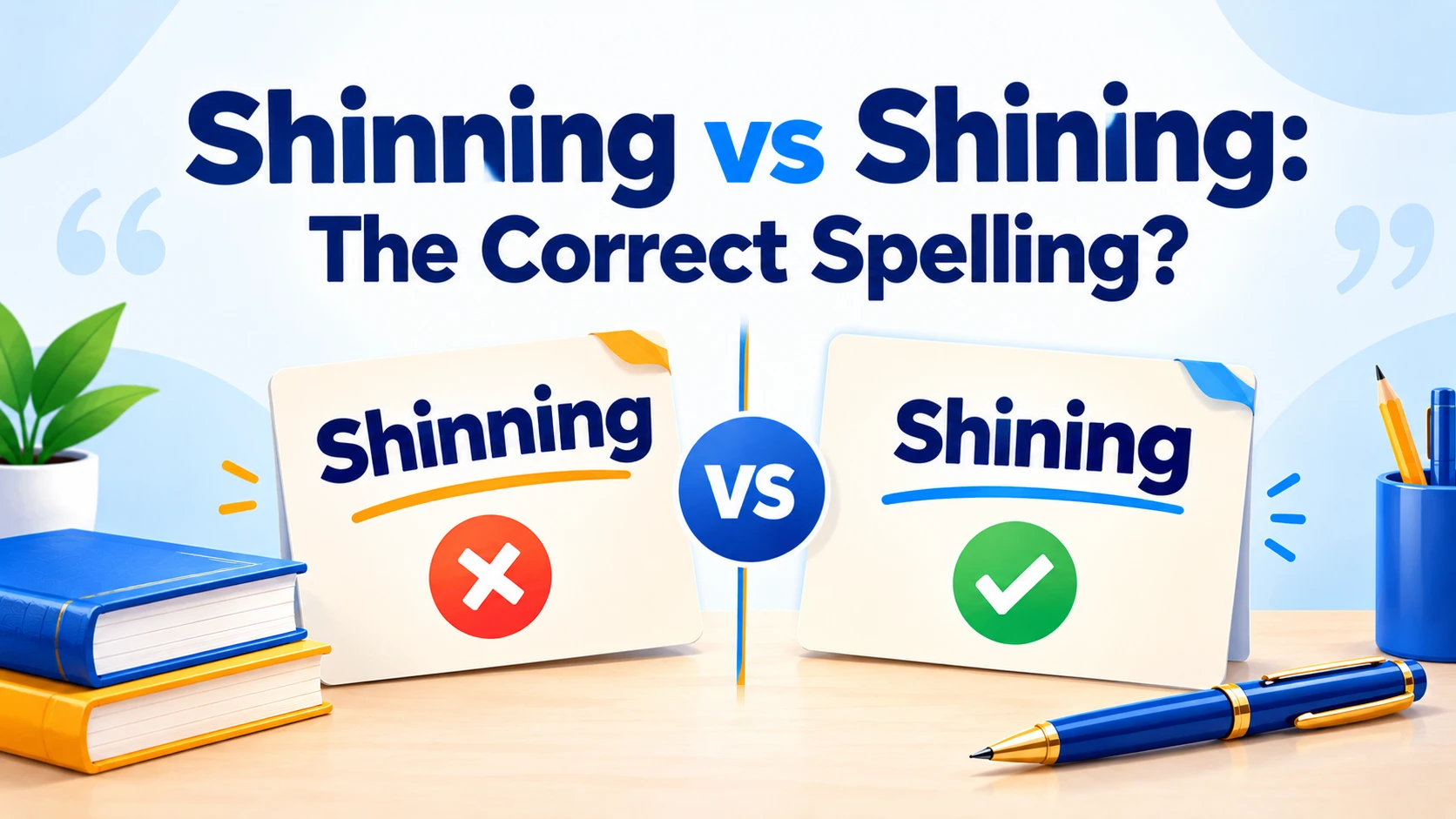
Shinning vs shining is a confusing spelling question because the two forms differ by only one letter, yet they come from different verbs. If you mean giving off light, reflecting brightness, or performing exceptionally well, the correct spelling is shining. For example, The sun is shining and She is shining in her new role both use the correct form.
The confusion often comes from a familiar English spelling pattern. Some verbs double their final consonant before -ing, as in run → running and sit → sitting. That can make shinning look logical. But shine does not follow that pattern. Its final silent e is removed before -ing, giving us shine → shining. Understanding the base verb makes the spelling much easier to remember.
There is one useful exception worth knowing. Shinning is a real word, but it does not normally mean “giving off light.” It is the present participle of shin, a verb meaning to climb or move by gripping with the hands and legs. This article explains the difference, the spelling rule behind shining, common mistakes, real examples, and the rare situations in which shinning is genuinely correct.
Shinning vs. Shining: Quick Answer
If you are asking which spelling to use when talking about light, brightness, brilliance, or exceptional performance, the answer is:
Shining is correct.
Examples:
- The sun is shining brightly.
- The stars are shining tonight.
- Her shoes were shining after they were polished.
- He gave a shining performance.
- She is a shining example of dedication.
Shinning is not the correct spelling of these uses.
However, shinning is not simply a nonexistent word. It is the present participle of the verb shin, which can mean to climb by using the hands and legs. Merriam-Webster gives shinned and shinning as forms of shin, while American Heritage likewise lists shinning as the present participle.
The easiest rule to remember
shine → shining
shin → shinning
So, if your sentence is about light or excellence, choose shining.
If it describes someone climbing or moving by using the legs and arms, shinning can be correct, although that use is relatively uncommon.
What Does “Shining” Mean?
Shining is the present participle and -ing form of the verb shine.
The verb shine has several related meanings. It can describe something that produces light, reflects light, looks bright, or stands out because of exceptional ability or performance. Merriam-Webster includes meanings involving emitting light, reflecting light, being distinguished, and performing extremely well.
The basic forms are:
| Verb form | Word | Example |
| Base form | shine | Stars shine at night. |
| Third-person singular | shines | The sun shines brightly. |
| Past tense | shone / shined | The moon shone through the clouds. |
| Present participle | shining | The moon is shining. |
| Past participle | shone / shined | The light has shone through the window. |
The form that causes the spelling problem is the present participle:
shine + ing → shining
The final e is removed, but the n is not doubled.
Literal meaning of shining
In its most straightforward use, shining describes something that gives off or reflects light.
For example:
The sun is shining through the clouds.
The stars were shining above the mountains.
The polished silver was shining under the lamp.
The word can describe natural light, artificial light, reflected light, or a visibly bright surface.
Figurative meaning of shining
Shining can also describe excellence, distinction, or outstanding performance.
Consider:
She delivered a shining performance.
Here, nobody is suggesting that the performer literally emitted light. The adjective shining means excellent or impressive.
The same idea appears in familiar expressions such as:
- a shining example
- a shining achievement
- a shining career
- a shining performance
- a shining star
This figurative use is important because some people associate shining only with physical brightness.
What Does “Shinning” Mean?
Is “shinning” a real word?
Yes—but its meaning is different.
Shinning is the present participle of the verb shin. In this verb sense, shin means to climb by gripping and pulling oneself along with the hands and legs. Merriam-Webster and American Heritage both record this verb and its forms shinned and shinning.
For example:
The boy was shinning up the pole.
Here, shinning has nothing to do with brightness.
It comes from:
shin → shinning
not:
shine → shinning
That distinction solves the apparent contradiction. Shinning can be a correctly spelled English word, but it is not the normal form of shine.
Examples of “shinning”
You might encounter shinning in descriptions involving climbing:
- He was shinning up the rope.
- The climber went shinning up the pole.
- They watched him shinning over the fence.
The word is uncommon in everyday modern English, so many readers will rarely encounter it.
That also creates a practical problem: when readers see shinning in a sentence about sunlight, stars, or brightness, they will generally assume the writer intended shining.
Shinning vs. Shining: Side-by-Side Comparison
| Feature | Shining | Shinning |
| Base verb | shine | shin |
| Main meaning | Giving off or reflecting light; standing out | Climbing or moving using the hands and legs |
| Common in everyday English | Yes | Rare |
| Correct for brightness | Yes | No |
| Correct for exceptional performance | Yes | No |
| Correct for climbing | No | Yes, in the relevant sense |
| Spelling pattern | shine → shining | shin → shinning |
| Typical example | The stars are shining. | He was shinning up the pole. |
The crucial point is that this is not really a contest between two spellings of the same ordinary word.
There are two base verbs:
shine → shining
shin → shinning
Once you identify the base verb, the spelling becomes much easier.
Why Do People Confuse Shinning and Shining?
The error is understandable because English has a real rule involving doubled consonants.
The temptation to double the “n”
Look at these familiar examples:
- run → running
- sit → sitting
- swim → swimming
- stop → stopping
- plan → planning
In each case, the final consonant is doubled before -ing under the relevant spelling conditions.
A learner who knows this pattern may reason:
shine → shinning
But that reasoning starts with the wrong spelling pattern.
The verb shine ends with a silent e. Its -ing form follows the silent-e pattern:
shine → shining
The e disappears.
The silent-e pattern
Compare these forms:
| Base verb | Correct -ing form |
| make | making |
| hope | hoping |
| write | writing |
| drive | driving |
| smile | smiling |
| shine | shining |
The final e is removed before the -ing ending.
That is why shineing is also incorrect.
You should not keep the e, and you should not replace it by doubling the n.
The correct result is simply:
shining
Pronunciation does not solve the problem
English spelling often cannot be reconstructed reliably from sound alone.
When you hear:
“The stars are shining.”
the pronunciation does not tell you whether the written word contains one n or two.
That is why learners benefit from identifying the base word rather than spelling the word from memory alone.
Ask:
What is the base verb?
If the answer is shine, the -ing form is shining.
The Grammar Rule Behind “Shine → Shining”
The spelling of shining becomes much clearer when you separate two English patterns.
Verbs ending in silent “e”
Many verbs ending in a silent e drop that e before adding -ing.
Examples include:
- bake → baking
- dance → dancing
- hope → hoping
- use → using
- move → moving
- shine → shining
So:
shine + ing = shining
not:
shine + ing = shineing
Why the “n” is not doubled
Consonant doubling applies under particular spelling conditions. It is not a rule that says:
“Any verb ending in a consonant doubles that consonant before -ing.”
If it were, we would have forms such as walking → walkking or helping → helpping. English obviously does not work that way.
Compare:
run → running
with:
shine → shining
The first has the spelling environment that triggers consonant doubling. The second is a silent-e verb.
A useful comparison
| Verb | What happens? | -ing form |
| run | Double final consonant | running |
| sit | Double final consonant | sitting |
| swim | Double final consonant | swimming |
| make | Drop silent e | making |
| hope | Drop silent e | hoping |
| shine | Drop silent e | shining |
You do not need to memorize shining as an isolated spelling if you understand the pattern.
When to Use “Shining”
Use “shining” for light
This is the most common use.
The sun is shining.
The stars were shining above the lake.
A bright lamp was shining through the window.
The subject can be a natural source of light or something that reflects it.
Use “shining” for reflected brightness
Something does not have to produce its own light to be described as shining.
For example:
Her polished shoes were shining.
The freshly cleaned floor was shining.
In these cases, shining describes a bright or glossy appearance.
Use “shining” for excellence
The word also works figuratively:
He had a shining career.
She gave a shining performance.
The student became a shining example of perseverance.
Here, shining means outstanding, impressive, or exemplary.
Use “shining” in “shining star”
Shining star is a standard phrase.
It can be literal:
The telescope captured a distant shining star.
Or figurative:
Maya has become a shining star on the school debate team.
The figurative version means someone who stands out because of talent or achievement.
When Can “Shinning” Be Correct?
This is where a simplistic article would get the answer wrong.
Shinning can be grammatically correct when it comes from the verb shin.
The verb shin can mean to climb by gripping and pulling with the hands and legs. American Heritage gives examples involving climbing a rope or pole, while Merriam-Webster defines the verb in similar terms.
So:
He was shinning up the pole.
can be correct.
But:
The sun was shinning.
is not correct if the intended meaning is that the sun was giving off light.
The distinction is semantic as much as grammatical.
Why “shinning” is uncommon
Most people encounter shine far more often than the climbing verb shin.
That means shining is familiar in everyday descriptions:
- shining sun
- shining stars
- shining light
- shining surface
- shining example
By comparison, shinning usually appears only when someone is describing the relatively uncommon action of climbing or moving in the manner associated with shin.
Dictionary.com also identifies shinning specifically as the present participle of shin.
A useful context test
Look at the sentence:
The children were ___ up the rope.
The context involves climbing, so shinning may be the intended word.
Now consider:
The children were ___ in the sunlight.
The context involves light or brightness, so shining is correct.
The surrounding meaning provides the clue.
Shining vs. Shinning in American and British English
This is not primarily a British-versus-American spelling difference.
You should not think of the pair as:
American: shining
British: shinning
That would be incorrect.
Shining is the normal -ing form of shine in both standard American and British English.
Likewise, shinning can exist in English because it comes from the separate verb shin.
The important distinction is therefore meaning and word formation, not national spelling preference.
Is “shinning” a British spelling of “shining”?
No.
If you are writing about sunlight, stars, brightness, or excellence, changing shining to shinning will not make your spelling British.
For example:
The sun is shining.
remains correct in both American and British English.
Common Mistakes With Shining
Mistake 1: Writing “shinning” when you mean brightness
Incorrect:
The sun is shinning brightly.
Correct:
The sun is shining brightly.
The base verb is shine, so the correct -ing form is shining.
Mistake 2: Writing “shineing”
Incorrect:
The stars are shineing.
Correct:
The stars are shining.
The silent e is removed before -ing.
Mistake 3: Doubling the “n” automatically
Incorrect:
Her eyes were shinning in the light.
Correct:
Her eyes were shining in the light.
The fact that some verbs double their final consonant does not mean shine does.
Mistake 4: Assuming “shinning” can never be correct
This is the opposite error.
If someone writes:
The climber was shinning up the pole.
the word may be completely legitimate because it comes from shin, not shine.
The correct editorial approach is to examine the meaning before correcting the spelling.
Mistake 5: Treating pronunciation as a spelling rule
Words that sound similar or contain similar sounds do not necessarily follow identical spelling patterns.
For shining, the safest approach is to remember the base form:
shine → shining
Shining vs. Shine: The Forms You Should Know
Understanding the related forms of shine helps prevent future mistakes.
| Form | Example |
| shine | Stars shine at night. |
| shines | The sun shines through the window. |
| shone | The moon shone brightly. |
| shined | He shined his shoes. |
| shining | The stars are shining. |
The past-tense forms deserve a quick note. Shine can use shone and, in certain uses, shined. Merriam-Webster lists shone and shined and notes shined particularly for the transitive sense of making something bright by polishing.
That issue is separate from shining vs. shinning, but knowing the family of forms makes the spelling relationship easier to see.
“Shinning” in a Sentence: Correct and Incorrect Uses
The fastest way to understand the distinction is to compare sentences.
Correct uses of “shining”
The sun is shining through the clouds.
Her necklace was shining under the lights.
The stars were shining above the desert.
He is shining in his new position.
She is a shining example of patience.
Each sentence uses shine → shining.
Correct use of “shinning”
The boy was shinning up the pole.
Here, shinning comes from shin and refers to climbing.
Incorrect use of “shinning”
The moon is shinning tonight.
If the intended meaning is that the moon is giving off or reflecting light, this should be:
The moon is shining tonight.
Likewise:
Her shoes were shinning after polishing.
should be:
Her shoes were shining after polishing.
A Practical Decision Guide: Shining or Shinning?
When you’re editing a sentence, use this quick test.
| If you mean… | Choose | Example |
| Giving off light | shining | The lamp is shining brightly. |
| Reflecting light | shining | The metal was shining. |
| Looking bright | shining | Her face was shining with excitement. |
| Being outstanding | shining | He gave a shining performance. |
| Being an excellent example | shining | She is a shining example of leadership. |
| Climbing with hands and legs | shinning | He was shinning up the rope. |
The three-second test
Ask yourself:
1. Is this about light or excellence?
Use shining.
2. Is this about climbing or moving using the verb shin?
Shinning may be correct.
3. Am I simply trying to apply the consonant-doubling rule?
Check the base verb before doubling anything.
This approach is more reliable than memorizing a list of isolated spellings.
How to Remember the Correct Spelling of Shining
A simple memory trick is:
Shine loses the E, not the spelling identity of the N.
Start with:
SHINE
Remove the silent E before adding -ing:
SHIN + ING
The result is:
SHINING
Do not add another n.
Compare the two families
SHINE → SHINING
SHIN → SHINNING
This is especially useful because it explains why both spellings can exist without being interchangeable.
The “light rule”
If you’re talking about light, remember:
Light shines. Light is shining.
So:
shining light
not:
shinning light
That simple association will solve most everyday spelling questions.
A Quick Practice Test
Choose shining or shinning in each sentence.
- The stars were ______ brightly above the village.
- The climber was ______ up the pole.
- Her polished shoes were ______ in the sunlight.
- The sun is ______ through the clouds.
- He gave a ______ performance.
- The boy went ______ up the rope.
- The moon was ______ over the lake.
- She has become a ______ example of determination.
Answers and explanations
- shining — the stars give off or appear to give off light.
- shinning — the verb refers to climbing.
- shining — the shoes have a bright or polished appearance.
- shining — the sun is producing light.
- shining — the meaning is figurative: outstanding.
- shinning — the context describes climbing.
- shining — the sentence concerns moonlight.
- shining — the phrase means an excellent example.
The exercise demonstrates why context matters more than the number of letters.
Why “Shinning” Looks So Convincing
There is a useful lesson hidden inside this spelling mistake.
A word can look grammatically plausible and still be wrong for the intended meaning.
Shinning looks convincing because English really does contain words with doubled final consonants before -ing. It also happens to be a genuine word. That combination makes the error unusually persistent.
But spelling should follow the base word and meaning.
If the base verb is:
shine
then the form is:
shining
If the base verb is:
shin
then:
shinning
This is why simply telling learners “never spell it shinning” is less useful than explaining the underlying distinction.
Shining vs. Shinning: The Professional Writing Rule
In professional, academic, workplace, and general online writing, shining is the form you will normally need when discussing brightness or excellence.
Before submitting an article, report, assignment, email, or social post, scan for shinning.
If the sentence is about:
- light
- brightness
- reflection
- brilliance
- success
- talent
- excellence
- an outstanding example
change it to shining if necessary.
But don’t automatically replace every occurrence of shinning. If the sentence genuinely describes someone climbing using the verb shin, the spelling can be correct.
This distinction reflects good editing practice: correct an error without “correcting” a legitimate word simply because it is unfamiliar.
Conclusion
The easiest way to settle shinning vs. shining is to stop treating them as two spellings of one ordinary word. Shining comes from shine and is the correct choice for light, brightness, reflection, brilliance, and figurative excellence. Shinning comes from shin and can describe climbing or moving by gripping with the hands and legs, although that use is uncommon. The practical rule is simple: shine → shining; shin → shinning. One final actionable tip: whenever you’re unsure, identify the base verb before adding -ing. A common mistake to avoid is assuming every English verb doubles its final consonant. In this case, shine drops its silent e and keeps one n.
Frequently Asked Questions
Q1. Is “shinning” a correct spelling of “shining”?
No, not when you mean giving off light, reflecting brightness, or performing exceptionally well. The correct form of shine is shining. However, shinning is a legitimate word when it is the present participle of the separate verb shin, meaning to climb or move using the hands and legs.
Q2. Why is shining spelled with one “n”?
Because shine is a verb ending in a silent e. Before -ing, the final e is removed: shine → shining. There is no consonant-doubling step. Compare run → running, where doubling is part of the applicable spelling pattern.
Q3. Is “shinning” a real English word?
Yes. Shinning is the present participle of shin, a verb that can mean climbing by gripping and pulling with the hands and legs. It is uncommon in everyday conversation, which is why many readers assume it is simply a misspelling of shining. Merriam-Webster and American Heritage both record it.
Q4. Should I write “shining star” or “shinning star”?
Write shining star. The phrase describes a star that emits or appears to emit light, or figuratively, a person who stands out for talent or achievement. Shinning star would be inappropriate unless the surrounding context somehow involved the unusual verb shin.
Q5. Is “shinning” a British spelling of “shining”?
No. Shinning is not the British spelling of shining. Both American and British English use shining as the normal -ing form of shine. The doubled-n form belongs to the separate verb shin, not to a regional spelling variation of shine.
