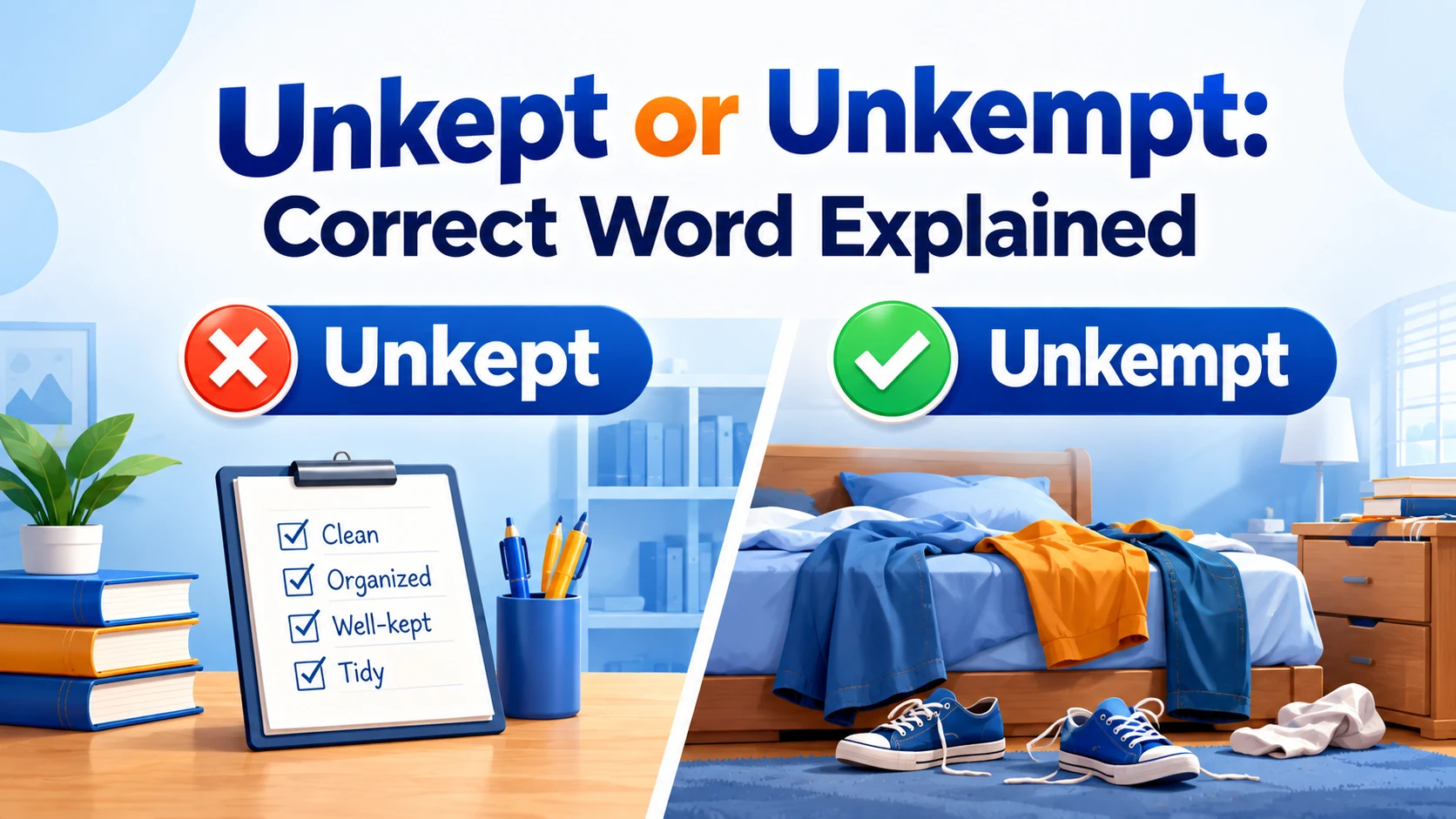
Unkept or unkempt can be confusing because the two words look almost identical and both begin with un-. If you’re describing messy hair, a scruffy appearance, or a neglected garden, the word you usually want is unkempt. However, unkept is also a legitimate English word. It means that something has not been kept, fulfilled, maintained, or observed, depending on the context. That distinction matters because replacing one with the other can change your meaning entirely. A person can look unkempt, while a promise can be unkept. The spelling difference comes from their different histories.
The confusion becomes easier to understand once you stop treating unkempt as if it were simply un + kept. Historically, unkempt is connected with an older word meaning combed or groomed, while unkept is transparently related to the verb keep. Modern dictionaries recognize both forms, but they give them different jobs. Cambridge defines unkempt as messy or not cared for and gives examples involving hair and lawns. It separately defines unkept for promises and for things such as gardens or buildings that have not been cared for properly.
This guide explains unkempt vs. unkept from spelling, meaning, grammar, pronunciation, and real-world usage. You’ll see why unkempt hair is standard while an unkept promise is perfectly acceptable. We’ll also examine cases where unkept can describe neglected property and where another word such as unfulfilled, broken, neglected, or unmaintained may be clearer. By the end, you’ll have a simple decision rule you can use whenever these two easily confused words appear on your screen.
Unkept or Unkempt: Which Spelling Is Correct?
The answer is both spellings can be correct, but they don’t normally mean the same thing.
Use unkempt when you mean messy, untidy, disheveled, or poorly groomed. It is especially common for hair, beards, clothing, personal appearance, lawns, gardens, and other things that look neglected.
Use unkept when something has not been kept in the relevant sense. That can mean a promise was not fulfilled or a commitment was not honored. It can also describe something that has not been properly cared for or maintained.
| Word | Core meaning | Typical examples | Natural example |
| unkempt | Messy, untidy, or poorly groomed | hair, beard, appearance, lawn, garden | His hair looked unkempt. |
| unkept | Not kept, fulfilled, honored, or maintained | promises, commitments, gardens, buildings | She was upset by his unkept promise. |
Cambridge and Collins both distinguish the words rather than treating unkept as a simple spelling error.
The easiest rule to remember
Messy appearance → unkempt
Something not kept or fulfilled → unkept
That rule will solve most everyday cases.
What Does “Unkempt” Mean?
Unkempt is an adjective describing something that is not neat, tidy, groomed, or well cared for.
Cambridge gives unkempt the meanings “untidy” and “not cared for.” Its American English entry similarly describes something as not neat or cared for and uses unkempt hair as an example.
Consider these examples:
- His hair was unkempt after several days without a haircut.
- The man arrived at the interview looking unkempt.
- The abandoned property had an unkempt lawn.
- Weeds had taken over the unkempt garden.
- She wore an old coat and had an unkempt appearance.
The word often carries an implication of visible neglect. It doesn’t necessarily mean something is dirty.
Unkempt describes more than personal appearance
Many learners first encounter unkempt with hair. That is probably its most familiar use. The word can go much further, though.
You can describe:
- Hair: unkempt hair
- Beard: an unkempt beard
- Appearance: an unkempt appearance
- Clothing: unkempt or untidy clothing
- Garden: an unkempt garden
- Lawn: an unkempt lawn
- Property: an unkempt property
- Surroundings: unkempt surroundings
Collins specifically includes hair, appearance, clothes, lawns, and neglected surroundings among its uses.
Unkempt does not simply mean “dirty”
This is an important distinction.
Something can be unkempt without being dirty.
Imagine someone who showered that morning but hasn’t combed their hair or straightened their clothes. You could reasonably describe their appearance as unkempt. The problem is primarily lack of neatness or grooming.
By contrast, dirty specifically points toward soil, stains, grime, or lack of cleanliness.
| Word | Main idea |
| Unkempt | Untidy or poorly groomed |
| Dirty | Covered with dirt or otherwise unclean |
| Disheveled | Very untidy or disordered in appearance |
| Neglected | Not receiving the care or attention needed |
| Scruffy | Rough, untidy, or shabby in appearance |
Choosing the more precise word makes your writing stronger.
What Does “Unkept” Mean?
Unkept is a genuine adjective. It is formed from the familiar verb keep and generally means that something has not been kept in a particular sense.
One of its clearest uses involves promises.
For example:
- He made an unkept promise.
- The campaign was criticized for its unkept promises.
- She was disappointed by another unkept commitment.
Cambridge specifically defines an unkept promise as one where the person who made it did not do what they said they would do.
Collins gives a broader definition. It includes things such as promises, secrets, and appointments that have been broken or disregarded. It also recognizes unkept for people or property that have not been maintained or looked after.
Unkept promises and commitments
This is where the difference from unkempt becomes especially obvious.
A promise cannot normally be messy or poorly groomed, so unkempt makes no semantic sense in that context.
Compare:
He broke his promise.
He made an unkept promise.
His promise remained unfulfilled.
All three communicate related ideas. Unkept emphasizes that the promise was not kept.
By contrast:
He made an unkempt promise.
That sounds wrong because unkempt belongs to the semantic field of untidiness and grooming, not promises.
Unkept can describe neglected things
There is a subtle point that many quick spelling guides miss.
Unkept is not restricted to promises.
Cambridge gives examples involving an unkept lawn and unkept buildings. Collins likewise includes people or property that have not been maintained or looked after.
So these can occur:
- an unkept garden
- an unkept building
- an unkept lawn
However, that doesn’t mean unkept and unkempt are interchangeable in every description of a neglected place.
For a garden that is visibly messy and overgrown, unkempt garden is often the more natural choice. For a garden that simply hasn’t been cared for or maintained, unkept garden can work.
That is a context distinction, not a spelling rule.
Unkempt vs. Unkept: What Is the Actual Difference?
The simplest way to understand the difference is to ask what kind of “keeping” is involved.
Unkempt describes the condition or appearance of something.
Unkept describes something that has not been kept in the relevant sense.
Consider this pair:
- The man’s hair was unkempt.
- The man’s promise was unkept.
The first concerns grooming. The second concerns fulfillment.
A useful decision table
| If you are describing… | Best choice | Why? |
| Messy hair | unkempt | Hair looks ungroomed |
| A scruffy beard | unkempt | Appearance is untidy |
| A messy person | unkempt | Describes appearance |
| An overgrown garden | unkempt | Visible disorder or neglect |
| A broken promise | unkept | The promise wasn’t kept |
| An ignored commitment | unkept | The commitment wasn’t honored |
| A poorly maintained building | unkept or neglected | It hasn’t been properly cared for |
| A dirty shirt | dirty | Dirt is the specific issue |
| An unfinished obligation | unfulfilled | This is often more precise |
Why “unkept hair” is usually not the best choice
You may occasionally encounter unkept hair. Its literal logic is understandable: the hair has not been kept or maintained.
But if you mean that the hair looks messy, tangled, or ungroomed, unkempt hair is the established and much more idiomatic choice.
For example:
Natural:
His unkempt hair made him look as though he’d just rolled out of bed.
Less natural for this meaning:
His unkept hair made him look as though he’d just rolled out of bed.
The second sentence isn’t simply impossible to interpret. It is just not the normal lexical choice for appearance.
Why “unkempt promise” is wrong
The reverse mistake is clearer.
A promise is not something you groom or arrange. Therefore:
Correct: an unkept promise
Better alternatives: a broken promise, an unfulfilled promise
Incorrect for the intended meaning: an unkempt promise
This distinction is especially useful for proofreading because spellcheckers may not catch the problem. Both unkept and unkempt are valid dictionary words. The issue is meaning, not merely spelling.
Why Is “Unkempt” Spelled With an “M”?
This is the part that causes the original confusion.
At first glance, un + kept seems like it should produce unkept. After all, kept is the past participle of keep. But unkempt did not develop that way.
Collins traces unkempt to older forms associated with combing. Its word origin is connected with Old English uncembed and the verb meaning “to comb.” The modern spelling and meaning developed historically from that older form.
That history explains the seemingly strange m.
Unkempt is historically connected with “comb”
The older word behind unkempt referred to something not combed or groomed. Over time, the word developed into the modern adjective we use for things that are messy or poorly cared for.
That gives you a useful conceptual link:
unkempt → grooming → messy appearance
It does not mean:
un + kept → not kept
The latter analysis belongs to unkept.
Why the spelling is easy to misread
English contains many productive un- formations:
- unhappy
- unclear
- unfinished
- unopened
- unkept
That makes unkempt look as though it should be another straightforward un + kept construction.
It isn’t.
This is one of those cases where etymology explains a spelling that modern logic alone doesn’t predict.
Unkept or Unkempt in Real-World Contexts
The best way to master the distinction is to see how context controls the choice.
Personal appearance
Use unkempt when describing a person’s grooming or overall appearance.
He arrived with unkempt hair and a wrinkled shirt.
The detective looked tired and unkempt after working all night.
Her normally neat appearance had become noticeably unkempt.
Here the adjective describes visible untidiness.
Gardens and lawns
Both words can occur with gardens and lawns. The intended emphasis matters.
The backyard looked unkempt after months without gardening.
This emphasizes a messy, overgrown appearance.
The garden had remained unkept for several years.
This emphasizes the fact that it had not been cared for.
In ordinary modern writing, unkempt is often the smoother choice when you’re describing how the place looks. Unkept is useful when the idea of not maintaining or caring for it is central.
Promises and commitments
Use unkept when something promised has not been delivered.
Voters were frustrated by the government’s unkept promises.
The company faced criticism over several unkept commitments.
He apologized for his unkept promise.
You could often substitute broken or unfulfilled. In fact, those alternatives may sound more natural in some contexts.
Buildings and property
Both words can appear here, but they can create slightly different emphasis.
The abandoned house had an unkempt yard.
The focus is the yard’s visible condition.
The building remained unkept for years.
The focus is the building’s lack of maintenance.
If you are writing formal property, engineering, or maintenance documentation, poorly maintained or unmaintained may be more precise than either word.
Common Mistakes With Unkept and Unkempt
Mistake 1: Writing “unkept hair”
If you’re describing hair that looks messy or hasn’t been groomed, choose unkempt hair.
❌ He had unkept hair.
✅ He had unkempt hair.
The correction isn’t about pronunciation. It is about choosing the adjective whose established meaning matches the context.
Mistake 2: Writing “unkempt promise”
A promise that wasn’t honored is unkept, broken, or unfulfilled.
❌ The politician made several unkempt promises.
✅ The politician made several unkept promises.
✅ The politician made several broken promises.
Mistake 3: Assuming “unkept” is always wrong
This is an important misconception.
Unkept is a dictionary-recognized word. Cambridge and Collins both document it.
So correcting every occurrence of unkept to unkempt would create errors of its own.
Mistake 4: Assuming “unkempt” means exactly “not kept”
The spelling may suggest that interpretation. The modern meaning does not.
When you see unkempt, think primarily of untidiness, grooming, or visible neglect.
Mistake 5: Using either word when another adjective is clearer
Sometimes the best edit is neither.
For example:
- an unfulfilled obligation
- a broken promise
- an unmaintained road
- a neglected property
- a messy bedroom
- a disheveled appearance
Good writing isn’t about forcing a particular vocabulary word into every sentence. It’s about choosing the word that communicates the intended idea most accurately.
Pronunciation of Unkempt and Unkept
The words are also pronounced differently enough to provide a useful clue.
Unkempt is pronounced with the stress on the second syllable and contains the consonant cluster heard at the end of kempt. Cambridge gives the pronunciation as /ʌnˈkempt/.
Unkept is pronounced /ˌʌnˈkept/ according to Cambridge.
For learners, the spelling is often more troublesome than the sound because the words are close in pronunciation.
The practical solution is not to rely on sound alone. Use the meaning to confirm the spelling.
If the sentence is about grooming, appearance, or untidiness, your mental alarm should point toward unkempt.
If it is about something that wasn’t kept or fulfilled, consider unkept.
Synonyms for Unkempt and Unkept
Knowing the alternatives helps you choose the right level of precision.
Synonyms for “unkempt”
Depending on context, you might use:
- untidy
- messy
- disheveled
- ungroomed
- scruffy
- shaggy
- neglected
- unkempt-looking
These aren’t perfect substitutes.
For example, disheveled is especially useful for a person’s appearance or clothing. Shaggy often works well for hair or fur. Neglected emphasizes a lack of care rather than appearance alone.
Synonyms for “unkept”
Depending on the context, alternatives include:
- unfulfilled
- broken
- unhonored
- disregarded
- unmaintained
- neglected
For promises, broken and unfulfilled are often particularly natural.
For property, unmaintained may be more precise.
Why synonyms matter
Suppose you’re writing:
The property was unkept.
That’s understandable. But if the document is a formal inspection report, you might prefer:
The property was poorly maintained.
That version tells the reader exactly what the problem was.
By contrast, a novelist might prefer:
The property looked unkempt.
That choice emphasizes what the character sees.
Register and purpose matter just as much as dictionary definitions.
Quick Decision Guide: Unkept or Unkempt?
When you’re unsure, use this checklist.
Choose “unkempt” if:
- You’re describing messy hair.
- You’re describing a scruffy beard.
- Someone looks poorly groomed.
- A person’s appearance is untidy.
- A lawn or garden looks messy and neglected.
- A place has a visibly disordered appearance.
Choose “unkept” if:
- A promise wasn’t fulfilled.
- A commitment wasn’t honored.
- An appointment or similar obligation was not kept, where the phrasing fits.
- Something has not been maintained or cared for and that meaning is central.
Consider another word if:
- You specifically mean dirty → use dirty.
- You mean a promise wasn’t fulfilled → unfulfilled may be clearer.
- You mean a promise was violated → broken may be stronger.
- You mean maintenance was neglected → unmaintained may be more precise.
- You mean something was simply messy → messy or untidy may be more direct.
A five-second test
Ask:
“Am I describing how something looks, or whether something was kept?”
If you’re describing appearance, especially grooming or tidiness, choose unkempt.
If you’re describing whether something was kept, honored, fulfilled, or maintained, unkept may be appropriate.
A Practical Editing Checklist
Before publishing or submitting your sentence, check these points:
| Question | If yes | Likely choice |
| Is the subject a person’s messy appearance? | Yes | Unkempt |
| Is the subject hair or a beard? | Yes | Unkempt |
| Is a lawn visibly overgrown or untidy? | Yes | Unkempt |
| Is a promise not fulfilled? | Yes | Unkept |
| Is a commitment not honored? | Yes | Unkept |
| Is a property poorly maintained? | Yes | Unkept / unkempt, depending on emphasis |
| Would “broken” be clearer for a promise? | Yes | Consider broken |
| Would “poorly maintained” be more precise? | Yes | Consider that phrase |
The last two questions are particularly useful for professional writing. Correctness isn’t the only goal. Clarity is part of correctness.
Conclusion
Unkept or unkempt isn’t a case where one spelling is always correct and the other is always wrong. They are different words with overlapping possibilities in a few contexts. Use unkempt when you mean messy, untidy, disheveled, or poorly groomed. Use unkept when something hasn’t been kept, fulfilled, honored, or maintained. The distinction is especially clear in phrases such as unkempt hair and an unkept promise. One final actionable tip: before choosing the spelling, identify the idea behind the adjective. Are you describing appearance and grooming, or are you describing something that wasn’t kept? That single question will resolve most cases instantly. A common mistake to avoid: don’t “correct” every occurrence of unkept to unkempt. Both are valid words. The real test is whether the word matches the meaning of your sentence. Once you connect unkempt with untidiness and unkept with something not kept, the spelling stops being confusing.
Frequently Asked Questions
Q1. Is “unkept” a correct English word?
Yes. Unkept is a legitimate English adjective, not simply a misspelling of unkempt. Dictionaries recognize it for things such as promises that haven’t been fulfilled and property that hasn’t been cared for. The important issue is context. Use it when the meaning involves something not being kept or maintained.
Q2. Is “unkempt” the correct spelling for messy hair?
Yes. Unkempt hair is the standard expression when hair looks messy, disheveled, or poorly groomed. Cambridge specifically uses unkempt hair in its American English definition. The word historically relates to combing and grooming, which also helps explain its unusual spelling.
Q3. Should I write “unkept promise” or “unkempt promise”?
Write unkept promise. A promise can be kept or not kept, so unkept fits the meaning. Unkempt refers to untidiness or poor grooming. Depending on your sentence, broken promise or unfulfilled promise may sound even more natural.
Q4. Can a garden be “unkept” and “unkempt”?
Yes. Both forms can describe a neglected garden, but the emphasis can differ. Unkempt commonly highlights its messy or overgrown appearance. Unkept can emphasize that it has not been cared for or maintained. Cambridge and Collins both document unkept for neglected gardens or property.
Q5. Why does “unkempt” have an “m” if it doesn’t mean “un-kept”?
Because unkempt has a different historical origin from unkept. Its history is connected with older forms meaning “not combed.” Collins traces it to Old English forms related to comb. So the modern spelling isn’t simply un- attached to the past participle kept.
