
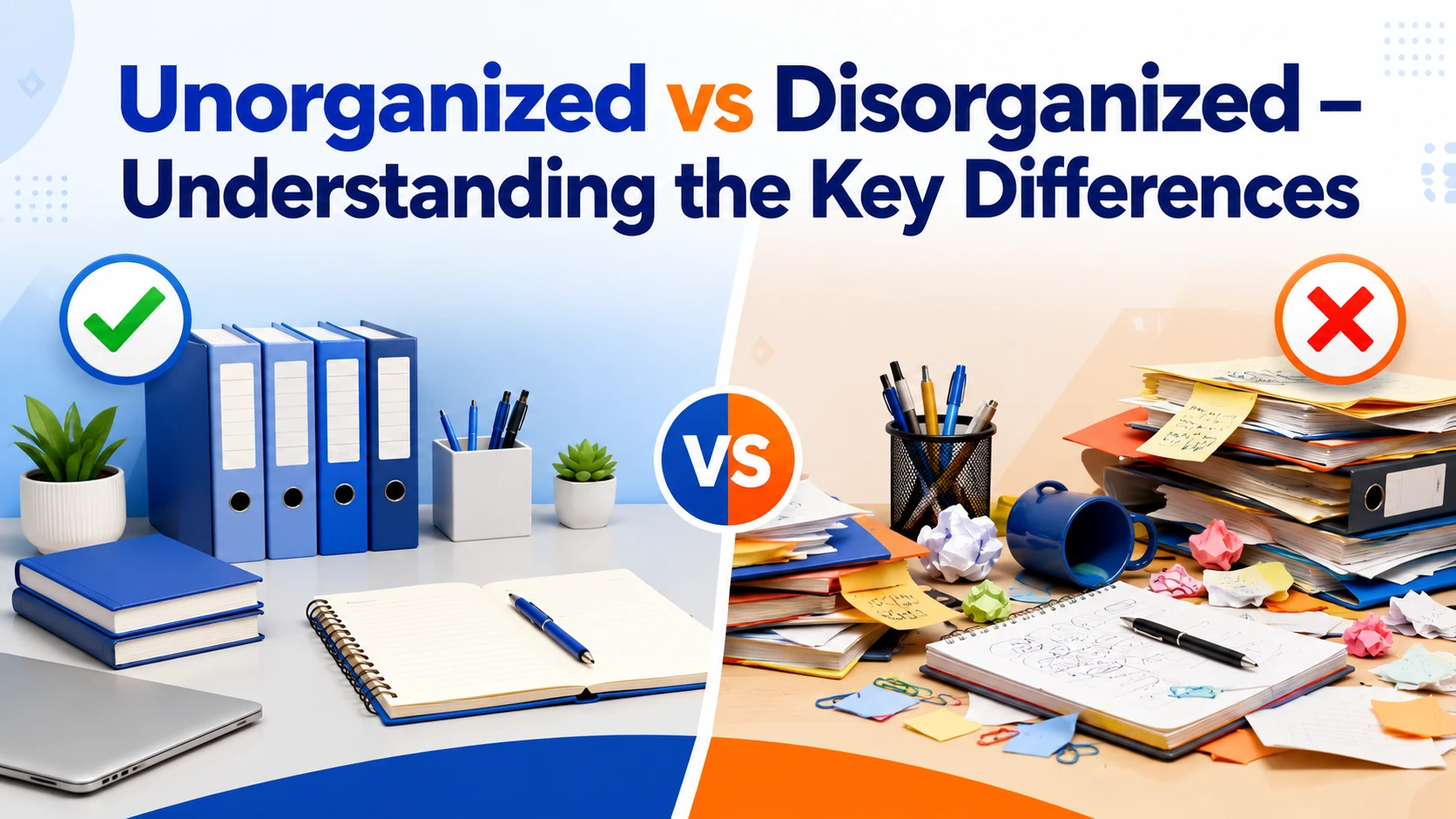
Unorganized vs disorganized can be confusing because both words describe a lack of order or organization. In everyday English, they sometimes overlap, but they can carry slightly different meanings depending on context. Unorganized usually emphasizes that something lacks an organized structure or system, while disorganized often suggests disorder, poor planning, confusion, or ineffective organization. Knowing this distinction can help you choose the word that best matches your meaning, especially when you’re describing people, files, schedules, projects, workplaces, or everyday situations.
The difference isn’t as simple as saying that unorganized means “never organized” and disorganized means “organized before but no longer organized.” That popular explanation can work in a few contexts, but it isn’t a strict rule. A newly created project can be disorganized from the beginning if it has poor planning or unclear responsibilities. Likewise, something that was once organized can become unorganized if you’re simply describing its current lack of organization. Context, emphasis, and tone matter more than a rigid timeline.
So, which word should you use? Start by asking what you want your reader to understand. If you’re pointing out that organization is absent, unorganized may be the better choice. If you’re describing confusion, disorder, poor planning, or ineffective organization, disorganized will often sound more natural. This guide explains both words, compares their meanings, explores common mistakes, and gives you practical examples so you can choose confidently without overthinking the distinction.
Unorganized vs Disorganized: The Basic Difference
The simplest way to understand the difference is:
Unorganized means lacking organization or an organized structure.
Disorganized means poorly organized, disorderly, confusing, or badly planned.
These meanings overlap. In some sentences, either word can work. However, they don’t always create exactly the same impression.
| Feature | Unorganized | Disorganized |
| Basic meaning | Not organized | Poorly organized or lacking effective order |
| Main emphasis | Absence of organization | Disorder or ineffective organization |
| Typical tone | Often neutral | Often more critical |
| Common with people | Less common | Very common |
| Common with files | Yes | Yes |
| Common with projects | Yes | Yes |
| Requires previous organization? | No | No |
| Can describe poor planning? | Sometimes | Yes, very naturally |
| Can describe confusion? | Sometimes | More strongly |
A useful rule of thumb
If you’re simply saying “there is no organization,” consider unorganized.
If you’re saying “the organization is poor, confusing, or ineffective,” consider disorganized.
This isn’t an absolute grammar rule. It’s a practical way to identify the difference in emphasis.
What Does Unorganized Mean?
Unorganized is an adjective that describes something that has not been organized or does not have an organized structure.
It can refer to physical objects, information, documents, groups, activities, or systems.
For example:
“The photographs are unorganized.”
This tells us that the photographs aren’t arranged in a useful system. It doesn’t necessarily tell us why.
- Maybe nobody has sorted them yet.
- Maybe there are too many photographs to categorize.
- Maybe the owner hasn’t decided how to arrange them.
The word simply identifies the absence of organization.
Examples of unorganized
- an unorganized collection of books
- unorganized notes
- unorganized files
- unorganized data
- an unorganized group
- unorganized materials
- an unorganized event
Consider these sentences:
“The research notes were unorganized.”
“The documents arrived unorganized.”
“The photographs were unorganized when we received them.”
“The data was unorganized and needed to be categorized.”
In each example, the emphasis is primarily on lack of structure or arrangement.
Is unorganized always neutral?
No.
Although unorganized can sound neutral, the context can make it clearly negative.
Compare:
“The files are currently unorganized.”
with:
“The entire department is unorganized and constantly misses deadlines.”
The second sentence is obviously critical. The adjective itself hasn’t changed. The context determines the tone.
What Does Disorganized Mean?
Disorganized usually describes something that is poorly organized, disorderly, confusing, or badly planned.
It can describe both things and people.
For example:
“The meeting was disorganized.”
This often suggests more than simply the absence of an agenda. It may imply that people were confused, responsibilities were unclear, or the meeting failed to follow a sensible structure.
You can also say:
“She is disorganized.”
That usually means she struggles with planning, arranging tasks, keeping track of things, or managing responsibilities.
Common examples of disorganized
- a disorganized office
- a disorganized desk
- a disorganized schedule
- a disorganized meeting
- a disorganized project
- a disorganized workflow
- a disorganized filing system
- a disorganized person
- disorganized notes
- disorganized records
Consider:
“The project became disorganized after the team changed its deadlines.”
This suggests that the project isn’t simply lacking organization. Its organization has become ineffective.
Why disorganized can sound stronger
Compare:
“The office is unorganized.”
with:
“The office is disorganized.”
The first can simply describe the absence of an arrangement.
The second is more likely to suggest that the office is messy, confusing, inefficient, or poorly managed.
That difference becomes especially important in professional writing.
Unorganized vs Disorganized: Are They Synonyms?
They are near-synonyms, not perfect synonyms.
Both can communicate a general lack of order, but each can emphasize a slightly different aspect of that condition.
Where they overlap
Suppose you have a box containing hundreds of documents.
You could write:
“The documents are unorganized.”
You could also write:
“The documents are disorganized.”
Both sentences can be understood.
But the first may simply mean the documents haven’t been sorted.
The second may suggest that the documents are scattered, confusing, or difficult to manage.
Why context matters
Imagine a newly created folder containing 2,000 files.
If you haven’t created categories yet:
“The folder is unorganized.”
If the folder contains random filenames, duplicate documents, outdated versions, and files saved in inconsistent locations:
“The folder is disorganized.”
The physical situation may look similar. The message you’re emphasizing is different.
Does Disorganized Mean It Was Organized Before?
No.
This is one of the most common misconceptions about these words.
Some explanations claim:
- unorganized = never organized
- disorganized = organized previously and then lost its organization
This distinction may occasionally help explain a particular situation, but it isn’t a universal rule of English.
A newly created project can be disorganized
Imagine a company launches a new project.
From the first day:
- nobody knows their responsibilities
- deadlines are unclear
- communication is inconsistent
- tasks overlap
- important information is missing
You can naturally say:
“The project is disorganized.”
The project doesn’t need to have been organized first.
The better question
Instead of asking:
“Was it organized before?”
ask:
“What exactly am I emphasizing?”
If you’re emphasizing the absence of organization, unorganized may fit.
If you’re emphasizing poor planning, disorder, confusion, or ineffective organization, disorganized may fit better.
This is a much more reliable approach.
Unorganized vs Disorganized and the Prefixes Un- and Dis-
The prefixes provide useful clues about the words, but they don’t tell the entire story.
What does un- mean?
The prefix un- often creates a negative form.
For example:
- happy → unhappy
- prepared → unprepared
- finished → unfinished
- organized → unorganized
In unorganized, the basic idea is therefore easy to recognize:
not organized
That’s why unorganized often works well when you simply want to describe the absence of organization.
What does dis- mean?
The prefix dis- has several functions in English. Depending on the word, it can express ideas related to negation, separation, reversal, or an opposing condition.
In disorganized, the resulting meaning is associated with poor or ineffective organization.
However, don’t turn the prefix into an inflexible rule.
It would be incorrect to assume:
“Dis- always means something used to be organized.”
English morphology doesn’t work that neatly.
Why dictionary meaning matters more
Prefixes can help you understand how words developed, but actual usage depends on the complete word.
When deciding between unorganized and disorganized, consider:
- meaning
- context
- tone
- common usage
- what you want your reader to understand
Unorganized vs Disorganized in Grammar
Both unorganized and disorganized are adjectives.
They can describe nouns directly or appear after linking verbs.
Before a noun
“We received an unorganized collection of documents.”
“We inherited a disorganized filing system.”
After a linking verb
“The documents are unorganized.”
“The filing system is disorganized.”
Both constructions are grammatically correct.
Related forms
The broader word family includes:
- organize
- organized
- organizing
- organization
- organizational
- unorganized
- disorganized
- disorganization
The important point is that unorganized and disorganized are both adjectives. Their main difference is semantic and contextual, not grammatical.
Unorganized vs Disorganized in American English
Because this guide uses US English, the standard American spellings are:
- organized
- organizing
- organization
- unorganized
- disorganized
British English commonly uses forms ending in -s:
- organised
- organising
- organisation
- unorganised
- disorganised
These spelling differences don’t create different meanings.
Example
American English:
“The files are disorganized.”
British English:
“The files are disorganised.”
The meaning is the same.
When Should You Use Unorganized?
Use unorganized when the main point is that something lacks an organizational structure.
When something hasn’t been sorted yet
“The books are still unorganized.”
This can mean that nobody has arranged them yet.
When no system exists
“The records are unorganized because we haven’t created categories.”
Here, the problem is the absence of a system.
When describing raw information
“The survey responses were unorganized.”
This could mean the responses haven’t been classified or arranged.
Examples
“I found an unorganized collection of photographs in the attic.”
“The notes were unorganized, so I grouped them by topic.”
“The files arrived unorganized.”
“The materials were unorganized when the project began.”
The word works particularly well when organization has not yet happened.
When Should You Use Disorganized?
Use disorganized when the situation involves poor planning, confusion, disorder, or ineffective organization.
When describing a person’s habits
“My manager is disorganized.”
“She is disorganized and often forgets appointments.”
“He has become increasingly disorganized at work.”
This is one of the clearest situations where disorganized is the natural choice.
When describing a poorly managed project
“The project is disorganized.”
This can suggest unclear responsibilities, inconsistent communication, missed deadlines, or poor coordination.
When describing confusion
“The meeting became disorganized.”
This suggests that the meeting lost its structure or was poorly managed.
When describing an ineffective system
“The company’s filing system is disorganized.”
This suggests that the system itself causes difficulty.
Unorganized vs Disorganized: Real-World Examples
Files
Unorganized:
“The files are unorganized because nobody has sorted them by date.”
The focus is on missing organization.
Disorganized:
“The files are disorganized, and employees can’t find the correct versions.”
The focus is on confusion and ineffective organization.
Meetings
Unorganized:
“The meeting was unorganized because there was no agenda.”
This identifies a missing planning element.
Disorganized:
“The meeting was disorganized. Several people spoke at once, and nobody knew who was responsible for the presentation.”
This emphasizes disorder.
Students
Unorganized:
“His study materials are unorganized.”
This could simply mean he hasn’t arranged them.
Disorganized:
“He is disorganized and frequently forgets assignment deadlines.”
Now the adjective describes a recurring behavior pattern.
Workplace
Unorganized:
“The department’s records are unorganized.”
This may indicate that the records lack a clear filing system.
Disorganized:
“The department is disorganized, and employees receive conflicting instructions.”
This describes a broader management problem.
Unorganized vs Disorganized: Which Word Is More Negative?
Generally, disorganized carries a stronger negative implication.
That’s because it often suggests that organization is poor or ineffective, rather than simply absent.
Compare:
“The room is unorganized.”
with:
“The room is disorganized.”
The second can sound more like criticism.
However, neither word is automatically positive or negative.
Tone depends on context
Consider:
“The garage is unorganized because we’re still moving.”
That’s neutral.
Now:
“The garage is disorganized, and we can’t find any of our tools.”
That’s negative because the disorder is causing a problem.
The lesson is simple:
Don’t judge tone from the adjective alone. Consider the complete sentence.
Common Mistakes With Unorganized and Disorganized
Mistake 1: Treating them as completely interchangeable
They’re close, but they can emphasize different things.
If the distinction matters to your sentence, consider whether you’re describing absence or poor organization.
Mistake 2: Believing disorganized always means “previously organized”
It doesn’t.
A project can be disorganized from day one.
Mistake 3: Thinking unorganized is always neutral
It isn’t.
A person or department can be called unorganized in a strongly critical sentence.
Mistake 4: Using unorganized for a person’s habits
Although possible, disorganized is usually more natural when describing someone who repeatedly struggles with planning or organization.
“She is disorganized.”
sounds much more idiomatic than:
“She is unorganized.”
Mistake 5: Using disorganized when you only mean “not sorted yet”
If materials simply haven’t been arranged, unorganized may be a better choice.
“The files are currently unorganized.”
This doesn’t necessarily imply that anyone has created a bad system.
Mistake 6: Forcing a distinction that the context doesn’t need
Sometimes either word works.
Good writing isn’t about proving that two similar words have completely separate meanings. It’s about choosing the word that communicates your intended idea most efficiently.
Unorganized vs Disorganized in Different Contexts
| Context | More natural choice | Why |
| A pile hasn’t been sorted | Unorganized | No system has been applied |
| A filing system is confusing | Disorganized | The system works poorly |
| A person struggles with planning | Disorganized | Describes behavior |
| Raw data has no categories | Unorganized | Organization is absent |
| A project has unclear responsibilities | Disorganized | Planning is ineffective |
| A group has no formal structure | Unorganized | Formal organization is missing |
| A meeting lacks preparation | Either | Context determines emphasis |
| A meeting becomes chaotic | Disorganized | Disorder is central |
| Books haven’t been arranged | Unorganized | Arrangement hasn’t happened |
| Books are randomly placed throughout a library | Disorganized | Arrangement is ineffective |
Unorganized vs Disorganized: Better Alternatives
Sometimes neither word is as precise as another adjective.
Use unsorted when classification is the issue
“The documents are unsorted.”
This is more specific than unorganized if you mean they haven’t been placed into categories.
Use unstructured when structure is missing
“The information is unstructured.”
This is useful when discussing information, writing, systems, or data.
Use unplanned when preparation is the problem
“The event was unplanned.”
This tells the reader specifically that preparation was lacking.
Use scattered when things are spread around
“The files are scattered across several folders.”
This can be much clearer than either unorganized or disorganized.
Use chaotic when the disorder is extreme
“The office was chaotic after the renovation.”
Chaotic is stronger than disorganized, so don’t use it unless the situation genuinely deserves that description.
How to Choose Between Unorganized and Disorganized
When you’re unsure, use this decision process.
Step 1: Identify the problem
Ask:
Is organization simply missing?
If yes, unorganized may be suitable.
Ask:
Is the existing arrangement confusing or ineffective?
If yes, disorganized may be better.
Step 2: Consider whether you’re describing a person
For a person’s habits, disorganized is generally the more natural choice.
“Tom is disorganized.”
Step 3: Consider your tone
If you’re writing professional feedback, unorganized may sometimes sound less judgmental.
Compare:
“Your notes are unorganized.”
with:
“Your notes are disorganized.”
The second can sound more critical.
Step 4: Look for consequences
If the lack of order causes:
- missed deadlines
- confusion
- mistakes
- duplicated work
- lost information
- poor communication
then disorganized may better express the situation.
Step 5: Consider a more precise word
Maybe you don’t need either word.
- If the files aren’t categorized, say unsorted.
- If a process lacks structure, say unstructured.
- If preparation was missing, say unplanned.
Precision is often better than forcing a choice between two near-synonyms.
A Quick Decision Table
| What do you want to say? | Best choice |
| “There is no organization yet.” | Unorganized |
| “No system has been created.” | Unorganized |
| “The arrangement is confusing.” | Disorganized |
| “The planning is poor.” | Disorganized |
| “The person struggles to manage tasks.” | Disorganized |
| “The files haven’t been sorted.” | Unorganized |
| “The files are difficult to navigate.” | Disorganized |
| “The information lacks structure.” | Unstructured |
| “The items haven’t been categorized.” | Unsorted |
| “The event wasn’t properly prepared.” | Poorly planned or unplanned |
A Simple Memory Trick
You don’t need a complicated mnemonic.
Remember:
UN = organization is missing.
DIS = organization isn’t working well.
Think about two offices.
Office A: The employees haven’t created a filing system yet.
→ The files are unorganized.
Office B: A filing system exists, but files are stored in the wrong places, names are inconsistent, and employees can’t find documents.
→ The system is disorganized.
This isn’t a rigid grammatical formula. It’s simply a useful way to remember the difference in emphasis.
Practice: Unorganized or Disorganized?
Choose the word that best fits each sentence.
Fill in the blanks
- The photographs were ______ because nobody had sorted them by date.
- Sarah is extremely ______ and often forgets important appointments.
- The project became ______ after several team members received conflicting instructions.
- The documents were still ______ when we received them.
- The filing system is so ______ that employees struggle to find anything.
Answers
- unorganized
- disorganized
- disorganized
- unorganized
- disorganized
Why these answers work
In sentences 1 and 4, the focus is primarily on materials that haven’t been organized yet.
In sentences 2, 3, and 5, the emphasis is on poor planning, disorder, or ineffective organization.
Conclusion
The difference between unorganized vs disorganized comes down mainly to what you want to emphasize. Unorganized generally describes something that lacks organization, structure, or arrangement. Disorganized more often describes something affected by disorder, poor planning, confusion, or ineffective organization. The two words can overlap, so you shouldn’t force an artificial distinction between them. One final actionable tip: when you’re unsure, ask whether the problem is simply that organization is missing or whether the organization itself is failing. Choose unorganized for the first idea and disorganized for the second. A common mistake to avoid is believing that disorganized always means “previously organized.” It doesn’t. Good word choice isn’t about memorizing rigid rules. It’s about identifying the exact meaning your sentence needs and choosing the clearest word.
Frequently Asked Questions
Q1. Is “unorganized” grammatically correct?
Yes. Unorganized is a correct English adjective. It describes something that is not organized or lacks organization. It can be used for files, information, groups, materials, records, and other things. In many contexts, it overlaps with disorganized.
Q2. Is “disorganized” stronger than “unorganized”?
Often, yes. Disorganized frequently suggests confusion, disorder, poor planning, or ineffective organization, so it can sound more critical. However, the strength depends on context. Unorganized can also be negative when the surrounding sentence clearly expresses criticism.
Q3. Can I say “an unorganized person”?
You can, but a disorganized person is usually more natural when describing someone who struggles with planning, time management, or keeping things in order. “Unorganized person” is understandable, but it is less common in this particular sense.
Q4. Does “disorganized” mean something was organized before?
Not necessarily. A newly created project, meeting, or system can be disorganized from the beginning. The word commonly describes something that is poorly planned or lacks effective order, regardless of whether it was previously organized.
Q5. Which word should I use in formal writing?
Choose based on your intended meaning. Use unorganized when emphasizing a lack of organization. Use disorganized when emphasizing poor planning, disorder, or ineffective organization. If greater precision is needed, words such as unstructured, unsorted, or poorly planned may be better.
