
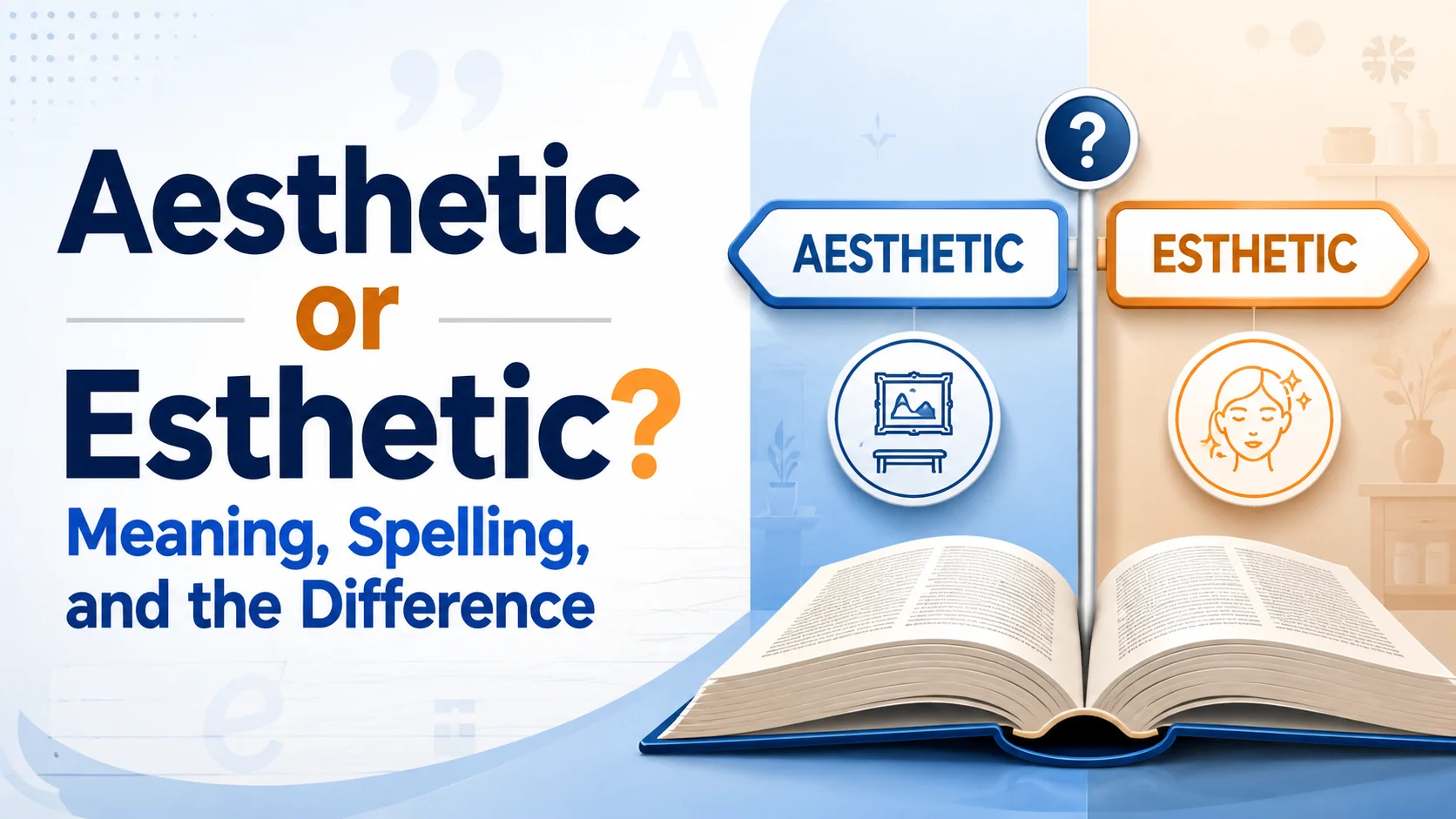
Aesthetic or esthetic? If you have ever written about art, design, photography, fashion, or visual culture, you have probably wondered which spelling belongs on the page. The good news is that both forms are legitimate. The more widely recognized form is aesthetic, while esthetic is an established U.S. spelling variant. Cambridge Dictionary explicitly lists esthetic as a U.S. spelling of aesthetic, so treating it as a simple spelling mistake would be misleading.
The confusion becomes more interesting because aesthetic is not limited to the idea of something being “pretty.” In art, it can describe qualities related to beauty, artistic principles, perception, or the characteristic style of a movement or creator. In everyday modern English, it can also function as a noun: someone might say that a room has a particular “aesthetic.” Understanding these different uses makes the spelling question much easier to handle.
So which should you choose? For most general, academic, artistic, and international writing, aesthetic is the safest default. Esthetic is perfectly acceptable where American spelling or a particular professional convention calls for it. This guide explains the difference, shows how each word works in real sentences, separates aesthetic from aesthetics and aesthetically, and clears up several related mistakes that often trip up writers and English learners.
Aesthetic or Esthetic: What’s the Correct Spelling?
The simplest answer is:
Aesthetic is the standard form you will encounter most broadly, while esthetic is a legitimate U.S. variant.
The two forms generally carry the same core meaning. The difference is primarily spelling and usage convention, not a difference in the underlying concept.
| Word | Status | Core meaning | Best default use |
| aesthetic | Standard, widely used form | Related to beauty, art, artistic principles, or visual style | General and international writing |
| esthetic | Established U.S. variant | Same basic meaning as aesthetic | American or field-specific contexts |
| aesthetics | Related noun | Study of beauty/art or qualities of beauty | Philosophy, art criticism, design |
| esthetics | Variant noun | Variant of aesthetics | Some American contexts |
| aesthetically | Adverb | In a way related to beauty or artistic qualities | Describing how something is designed/perceived |
| esthetician | Noun | A beauty/skincare professional | Personal-care terminology |
Cambridge lists aesthetic as an adjective and noun and identifies esthetic as a U.S. spelling. It also recognizes aesthetics as the term for the formal study of art and beauty.
That means a sentence such as “The sculpture has strong aesthetic qualities” is entirely standard, while “The sculpture has strong esthetic qualities” is also possible, particularly under American spelling conventions.
Why Are There Two Spellings?
The variation reflects the way English has historically adapted words from other languages. The term ultimately traces back to Greek aisthētikos, associated with perception and sensation. English developed the form aesthetic, preserving the ae spelling.
Over time, English developed shortened or simplified spellings in some varieties and specialized contexts. Esthetic emerged as a recognized alternative rather than an accidental modern typo.
This is an important distinction for writers: a dictionary-listed variant does not become “wrong” simply because another form is more common.
What Does “Aesthetic” Mean in Art?
In art, aesthetic has a broader meaning than “beautiful.”
It can refer to the qualities through which an artwork is experienced, including its visual character, style, formal choices, and relationship to ideas about beauty or artistic value.
For example:
- The painting has a restrained aesthetic.
- The artist developed a distinctive aesthetic over several decades.
- The museum exhibition explores the aesthetic principles of Modernism.
- The sculpture creates a striking contrast between organic and geometric forms.
In each case, aesthetic is doing more than saying something looks nice.
Aesthetic as an Adjective
As an adjective, aesthetic describes something connected with beauty, artistic qualities, or the appreciation and study of beauty. Cambridge gives meanings involving the enjoyment or study of beauty and also uses the word for something intended to improve appearance.
In art criticism, you might write:
The artist’s aesthetic choices emphasize simplicity and repetition.
Here, aesthetic modifies choices. It tells the reader that the choices concern the artwork’s artistic or sensory qualities.
Other natural combinations include:
- aesthetic value
- aesthetic qualities
- aesthetic experience
- aesthetic principles
- aesthetic judgment
- aesthetic appeal
- aesthetic considerations
- aesthetic style
Aesthetic as a Noun
Modern English also uses aesthetic as a noun.
In this form, it can mean a distinctive style, visual character, or set of artistic principles.
For example:
The gallery’s new exhibition has a minimalist aesthetic.
Or:
Her work combines a traditional aesthetic with contemporary materials.
This noun use is especially common in art, design, fashion, photography, architecture, and popular culture. Cambridge recognizes the noun as referring to a set of principles associated with an artistic movement or to the particular style or appearance of a person or thing.
Aesthetic Does Not Always Mean “Beautiful”
This is one of the most useful distinctions to understand.
Aesthetic qualities can be beautiful, unsettling, austere, chaotic, grotesque, playful, severe, or deliberately plain.
Imagine a contemporary installation consisting of bare concrete, harsh lighting, and repetitive industrial sounds. You might dislike its appearance, but it can still have a carefully constructed aesthetic.
So:
Aesthetic ≠ automatically beautiful.
Aesthetic discussion is often about how something creates a sensory or artistic experience, not whether everyone considers it attractive.
What Does “Esthetic” Mean?
Esthetic is an established variant spelling of aesthetic. Cambridge identifies it specifically as a U.S. spelling of aesthetic.
Its meaning is therefore not fundamentally different.
Compare:
- The building has strong aesthetic appeal.
- The building has strong aesthetic appeal.
Both can express the same idea.
The choice depends largely on the spelling convention being followed.
Where Is “Esthetic” Commonly Used?
You are particularly likely to encounter esthetic in American English and in certain professional or institutional contexts.
It can appear in discussions of:
- art
- design
- appearance
- cosmetic procedures
- beauty services
- medicine
- academic writing
- visual culture
Cambridge’s examples include esthetic factors, esthetic experience, and esthetic surgery, demonstrating that the spelling has established real-world usage rather than being merely an informal abbreviation.
Is “Esthetic” Correct in Art Writing?
Yes.
There is no grammatical rule saying that an art writer must use aesthetics and can never use esthetic. The more useful question is whether the spelling fits the publication, audience, or style guide.
For a broad international audience, aesthetic is generally the clearest choice because readers are more likely to recognize it immediately.
If an American institution, publication, or professional field consistently uses esthetic, retaining that spelling can make sense.
Aesthetic vs. Esthetic: What Is the Actual Difference?
The easiest way to understand the relationship is to separate meaning from convention.
Difference in Spelling
The visible difference is simple:
aesthetic → includes ae
esthetic → begins with e
That spelling difference does not normally create a different definition.
Difference in Meaning
In ordinary usage, there is no major semantic distinction between the two forms.
Both can describe:
- beauty
- artistic qualities
- sensory qualities
- artistic principles
- appearance
- visual style
Cambridge directly connects esthetic to aesthetic rather than defining it as an unrelated concept.
Difference in Usage
The meaningful difference is where and how the spellings are preferred.
| Situation | Recommended form | Why |
| International audience | aesthetic | Widely recognizable |
| General English | aesthetic | Common standard form |
| Art history | aesthetic | Familiar scholarly convention |
| British English | aesthetic | Conventional spelling |
| American English | aesthetic / esthetic | Both occur |
| A publication using U.S. variants | esthetic may be preferred | Matches house style |
| Existing quotation/title | Preserve original | Accuracy and consistency |
The important point is not to invent a meaning distinction that dictionaries do not support.
Aesthetic in Art, Design, and Visual Culture
The word becomes much easier to understand when you see how professionals actually use it.
Aesthetic in Art Criticism
An art critic may discuss an artist’s aesthetic choices rather than simply describing a painting as attractive.
For example:
The artist’s muted palette and fragmented composition create a deliberately austere aesthetic.
The word here encompasses several artistic decisions working together.
Aesthetic in Graphic Design
A designer may use aesthetic to describe a visual system involving:
- typography
- color
- spacing
- imagery
- shape
- composition
- texture
- visual hierarchy
A website can therefore have a minimalist aesthetic even if its individual elements are not especially unusual.
Aesthetic in Architecture
Architecture provides another useful example.
A building’s aesthetic can involve its:
- materials
- proportions
- façade
- geometry
- relationship with light
- interior atmosphere
- historical influences
Calling a building’s aesthetic “industrial” or “ornamental” tells the reader something about its overall visual and conceptual character.
Aesthetic in Photography and Fashion
In photography, an aesthetic may refer to a consistent approach to:
- lighting
- color grading
- composition
- subject selection
- texture
- mood
Fashion uses the term similarly. A designer may establish a retro aesthetic, while a photographer may develop a cinematic aesthetic.
These uses show why aesthetic is broader than a synonym for “pretty.”
The Modern Meaning of “An Aesthetic”
One reason this word has become confusing is its increasingly common use as a noun.
You may hear:
That café has a cozy aesthetic.
Or:
I love the aesthetic of this album.
This usage is now familiar in everyday discussions of visual identity and style. Cambridge also records the noun meaning of a particular style or appearance.
What Does “An Aesthetic” Mean?
In modern everyday English, an aesthetic usually means a recognizable visual or stylistic identity.
For example:
- cottagecore aesthetic
- minimalist aesthetic
- vintage aesthetic
- industrial aesthetic
- futuristic aesthetic
The word does not necessarily mean a complete artistic philosophy. In casual contexts, it can simply mean the overall look and feel.
That is different from the more specialized philosophical meaning of aesthetics.
Aesthetic vs. Aesthetics: Don’t Confuse Them
These words are related, but they do different grammatical jobs.
Aesthetic
Usually an adjective or singular noun:
The sculpture has aesthetic value.
The gallery has a modern aesthetic.
Aesthetics
Usually a noun referring to the study of beauty and art or the aesthetic qualities of something.
For example:
She studied aesthetics as part of her philosophy degree.
Cambridge defines aesthetics in an art context as the formal study of art, particularly in relation to beauty.
A useful shortcut is:
aesthetic = a quality, characteristic, or style
aesthetics = the field, principles, or broader qualities
This is not an absolute rule for every sentence, but it works well for most learners.
Aesthetic vs. Aesthetically
The ending -ly changes the grammatical role.
Aesthetic can describe a noun:
The design has aesthetic appeal.
Aesthetically modifies an action, description, or adjective:
The elements are aesthetically balanced.
Cambridge lists aesthetically as the adverb meaning “in a way that relates to beauty” or “in a beautiful or artistic way.”
A common mistake is writing:
The room is aesthetically pleasing.
That is incorrect.
Write:
The room is aesthetically pleasing.
Is “Esthetician” the Same Kind of Spelling?
This is where things get particularly interesting.
Esthetician is a noun used for a professional who provides certain beauty and skincare services. The word is related to esthetic, but that does not mean every sentence involving art should automatically use the shorter spelling.
In other words, don’t reason:
“The word is esthetician, so the adjective must always be esthetic.”
English vocabulary does not work that mechanically.
You can have:
- aesthetic theory
- aesthetic value
- aesthetic experience
- esthetician
- esthetic services
The preferred spelling can depend on the specific word and professional convention.
Aesthetic or Esthetic: Examples in Real Sentences
| Context | Aesthetic | Esthetic |
| Art | The painting has a distinctive aesthetic. | The painting has a distinctive aesthetic. |
| Design | The website has a minimalist aesthetic. | The website has a minimalist aesthetic. |
| Architecture | The building’s aesthetic reflects Modernism. | The building’s aesthetic reflects Modernism. |
| Academic writing | The study examines aesthetic judgment. | The study examines esthetic judgment. |
| Appearance | The treatment has aesthetic benefits. | The treatment has aesthetic benefits. |
| General audience | Usually the clearer choice | Acceptable but less familiar to many readers |
The important lesson is that changing the spelling does not automatically change the meaning.
Common Mistakes With Aesthetic and Esthetic
Mistake 1: Calling “esthetic” a misspelling
This is the biggest error.
Correction: Esthetic is an established U.S. spelling variant.
Mistake 2: Assuming aesthetic means “pretty”
Beauty is part of the concept, but aesthetic discussion can involve much more.
Better understanding: Think in terms of artistic qualities, sensory experience, style, and principles.
Mistake 3: Confusing aesthetic with aesthetics
You might write:
He studies aesthetic at university.
If you mean the academic field, aesthetics is normally the appropriate word.
Mistake 4: Using “aesthetic” as an adverb
Don’t write:
The objects were aesthetically arranged.
Use:
The objects were aesthetically arranged.
Mistake 5: Switching spellings randomly
If an article begins with aesthetic, suddenly changing to esthetic without a reason makes the writing look inconsistent.
Expert practice: Pick the convention that suits your audience and use it consistently.
Which Spelling Should You Use?
Use this quick decision guide.
| If you are writing… | Best choice |
| A general English article | aesthetic |
| An international art article | aesthetic |
| An art-history essay | aesthetic |
| A British-English publication | aesthetic |
| An American publication | aesthetic or esthetic, depending on house style |
| A document following an existing institutional style | Follow that style |
| A quotation or official title | Preserve the original spelling |
| A professional context that consistently uses esthetic | esthetic |
Why Aesthetic Is the Better Default
There is a practical reason to favor aesthetics when no style guide tells you otherwise: it is broadly recognizable across English varieties and strongly associated with art, design, philosophy, and culture.
That does not make esthetics inferior or incorrect.
It simply makes aesthetic the safer general-purpose choice.
Expert tip: Don’t “correct” esthetic to aesthetic automatically when editing someone else’s work. First determine whether the writer is following an American or professional spelling convention.
A Simple Rule for Remembering Aesthetic vs. Esthetic
If you need one rule, use this:
Choose “aesthetic” by default; recognize “esthetic” as a valid American variant.
Then apply three checks:
- Who will read the text?
- What spelling convention does the publication use?
- Does the surrounding vocabulary already follow one spelling system?
Consistency is especially important in edited content. A document that uses esthetic in one paragraph and aesthetic in the next may technically remain understandable, but an editor may reasonably standardize it.
Conclusion
The aesthetic vs. esthetic question looks like a simple spelling dispute, but the real answer is more useful: both forms are legitimate, and the choice depends largely on convention. Aesthetic is the strongest default for general, international, and art-related writing, while esthetic is an established U.S. variant.
Remember that aesthetic is broader than “pretty.” In art and design, it can describe a work’s qualities, style, principles, or overall sensory character. Keep it separate from aesthetics, which commonly refers to the study or broader principles of beauty and art, and from aesthetically, the adverb.
One final actionable tip: if no style guide requires otherwise, choose aesthetic and use it consistently. A common mistake to avoid is labeling esthetics incorrectly simply because it looks unfamiliar. Good editing recognizes legitimate variation rather than eliminating it.
The best spelling is not always the one that looks most familiar—it is the one that fits the language, audience, and context.
Frequently Asked Questions
Q1. Is “esthetic” a correct word?
Yes. Esthetic is a legitimate spelling variant of aesthetic, especially associated with U.S. English. It is recognized by major dictionaries rather than being treated as a simple typo. The two forms generally share the same basic meaning, so choosing between them is mainly a matter of spelling convention and context.
Q2. Is “aesthetic” or “esthetic” more common in general writing?
Aesthetic is generally the safer and more widely recognizable choice for general and international writing. It is particularly familiar in art, design, architecture, fashion, and cultural criticism. Esthetic remains correct, but readers outside U.S. conventions may encounter it less frequently.
Q3. Is aesthetic British or American English?
Aesthetic is used in both British and American English. American English also accepts the spelling esthetic. Cambridge specifically labels esthetic as a U.S. spelling of aesthetic, making the distinction one of regional spelling preference rather than meaning.
Q4. What is the difference between aesthetic and aesthetics?
Aesthetic can function as an adjective or singular noun describing artistic qualities or a particular style. Aesthetics is a noun commonly used for the study of beauty and art, as well as broader aesthetic qualities. For example, you can discuss an artist’s aesthetic or study aesthetics academically.
Q5. Does aesthetic mean beautiful?
Not necessarily. Aesthetics can relate to beauty, but it also covers artistic style, sensory qualities, principles, and judgments. An artwork can have a deliberately disturbing, austere, or unconventional aesthetic. Therefore, replacing aesthetic with simply beautiful can make your description much narrower than intended.
