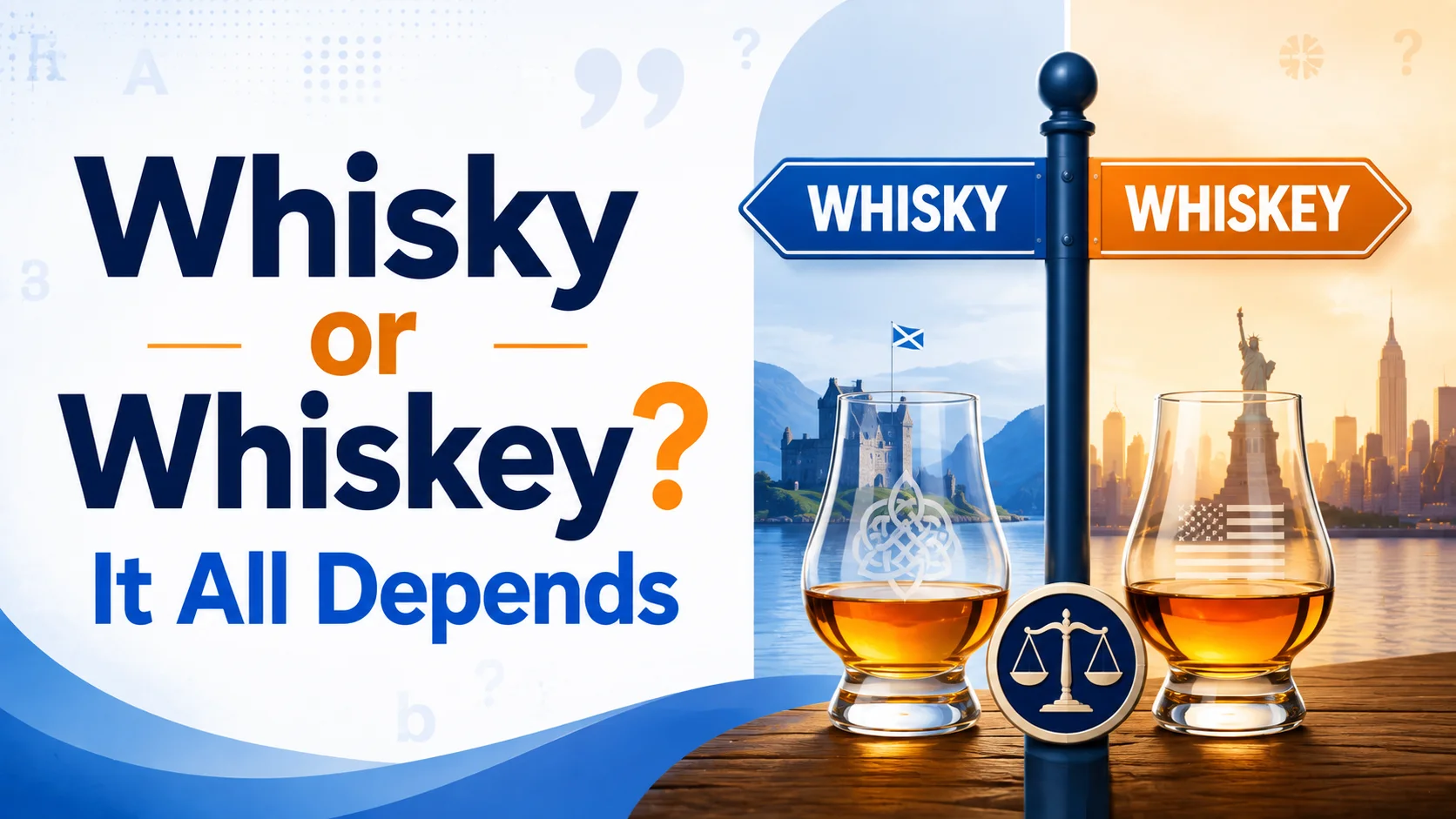
Whisky or whiskey—which spelling is correct? The answer is more interesting than simply choosing one and calling the other wrong. Both spellings are established English forms, but they are strongly associated with different whisky-producing traditions. In broad terms, Scotch whisky, Canadian whisky, and Japanese whisky use whisky, while Irish whiskey and American whiskey generally use whiskey. Even that rule has exceptions, however, because individual producers sometimes preserve a particular spelling for historical or branding reasons. The key is understanding the convention rather than memorizing a rigid rule.
The difference matters most when you’re writing about a particular country, product, or tradition. Calling it “Scotch whiskey,” for example, misses the established terminology used by the Scottish industry, while changing Irish whiskey to Irish whiskey makes the same kind of mistake in the opposite direction. The distinction also appears in official regulatory terminology. U.S. regulations recognize terms such as Scotch Whisky, Irish Whisky, Canadian Whisky, Bourbon Whisky, and Whisky, showing that the underlying spirit category is broader than the spelling alone suggests.
So why did English end up with two spellings in the first place? The answer reaches back to Gaelic language, regional history, migration, and changing English spelling conventions. From there, different whisky-producing countries developed their own terminology. This guide explains where whisky and whiskey came from, which regions normally use each spelling, why exceptions exist, and how to choose the right form when you’re writing. By the end, you won’t need to guess: follow the tradition and, when discussing a specific product, follow the producer’s official spelling.
Whisky vs. Whiskey: The Quick Answer
The simplest useful rule is this:
- Scotland → whisky
- Canada → whisky
- Japan → whisky
- Ireland → whiskey
- United States → whiskey
The word is broadly associated with a family of distilled spirits made from fermented grain, but spelling is not itself a definition of production method. A Scotch whisky and an American whiskey can differ enormously because of their respective regulations, ingredients, distillation methods, maturation requirements, and traditions—not merely because one has an e.
The Scotch Whisky Association itself notes that whisky and whiskey are both used internationally and that production and maturation are governed by law rather than by the spelling of the word. It also identifies the familiar distinction between Scotch Whisky, Irish Whiskey, and American whiskey.
Is “Whisky” or “Whiskey” the Correct Spelling?
Both are correct.
The correct choice depends on context.
If you’re writing about Scotland, use whisky. If you’re discussing Ireland or the United States, whiskey is normally appropriate. When the subject is a particular producer, however, the safest approach is to reproduce the spelling used by that producer.
That last point is important because geographical rules are useful shortcuts, not absolute laws.
Does the spelling change the meaning?
Not by itself.
The spelling can tell a reader something about the linguistic or regional tradition being discussed, but it doesn’t tell you everything about the spirit.
For example:
Scotch whisky = Scottish whisky tradition
Irish whiskey = Irish whiskey tradition
Bourbon whiskey = an American whiskey category
The production requirements attached to those terms are much more important than the presence or absence of an e.
Where Is “Whisky” Used?
Scotland: Scotch Whisky
Scotland is probably the clearest example of the whisky spelling.
The established term is Scotch Whisky, not “Scotch Whiskey.” Scotch whisky is legally defined and protected as a distinctive Scottish product. U.S. regulatory material likewise recognizes Scotch Whisky as a product of Scotland made in compliance with the applicable Scottish and UK requirements.
This is why writers should treat Scotch whisky as a fixed conventional expression rather than translating it into whichever spelling seems more familiar.
Scotch itself also has several recognized categories, including single malt, single grain, blended malt, blended grain, and blended Scotch whisky. The category tells you far more about what is being discussed than the spelling of whisky alone.
Canada: Canadian Whisky
Canada traditionally uses Canadian whisky.
The U.S. Alcohol and Tobacco Tax and Trade Bureau (TTB) recognizes Canadian Whisky as a distinctive product of Canada and uses that spelling in its regulatory terminology.
This is a useful example because it shows why the “no e = Scotland” shortcut doesn’t work. Canadian whisky has no e, but it isn’t Scotch.
Japan: Japanese Whisky
Japanese producers generally use whisky.
The convention reflects the historical influence of Scottish whisky-making on Japan, but Japanese whisky has developed its own production culture and identity. Modern discussions of Japanese whisky therefore use whisky as the established form rather than treating it as an extension of Scotch.
The broader lesson is simple: shared spelling does not mean shared origin.
Other Countries Using “Whisky”
The whisky spelling is also found in other whisky-producing regions. English, Welsh, Japanese, and many other international whisky traditions commonly use the form without an e. The Scotch Whisky Association specifically notes that American whiskey is usually spelled with an e, while English, Welsh, Japanese, and most other world whiskies are generally spelled without it.
Where Is “Whiskey” Used?
Ireland: Irish Whiskey
Ireland is one of the two major places where whiskey with an e is firmly established.
The standard expression is:
Irish whiskey
This spelling is not an accidental American invention. It belongs to the Irish tradition itself.
The distinction is sufficiently established that U.S. regulatory terminology separately recognizes Irish Whisky/Irish Whiskey as a distinctive product of Ireland or Northern Ireland, subject to the relevant origin requirements.
United States: American Whiskey
In the United States, whiskey is the usual spelling.
That includes terminology such as:
- American whiskey
- bourbon whiskey
- rye whiskey
- Tennessee whiskey
American regulations, however, demonstrate an interesting complication: U.S. legal terminology does not always follow the spelling rule people learn in school. TTB materials contain both whisky and whiskey in different official designations.
That makes an important point: English spelling convention and legal terminology are not always identical things.
Why Does American Whiskey Usually Have an “E”?
The usual explanation connects American usage with Irish linguistic and immigrant influence, alongside the historical development of English spelling in Ireland and North America.
It is better not to imagine a single person deciding to add an e. Language rarely develops that neatly. Spellings emerge gradually through documents, pronunciation, publishing habits, regional usage, and institutional conventions.
So the e in whiskey is best understood as part of a historical spelling tradition, not as a grammatical rule.
Where Did the Two Spellings Come From?
The Gaelic Roots of the Word
The story begins with Gaelic terminology associated with the phrase meaning “water of life.”
The Scotch Whisky Association explains that the word traces back to the Gaelic “uisge beatha” or “usquebaugh.”
As the term moved through different languages and English-speaking communities, its spelling changed. Pronunciation shifted as well. Eventually, regional forms became established strongly enough that whisky and whiskey survived side by side.
This is a useful reminder that English spelling is often historical rather than perfectly logical.
How “Uisge Beatha” Became “Whisky” and “Whiskey”
The development was gradual.
The Gaelic expression was shortened and adapted as speakers of English encountered it. Different communities represented the sound using the spelling conventions available to them.
Over generations, those regional forms became associated with particular traditions.
The result is what we see today:
whisky and whiskey are related words with a shared linguistic history, but they developed different regional identities.
When Did the “E” Become Part of the Word?
There wasn’t one universal date when whiskey suddenly became correct.
Instead, spelling conventions developed over time in different communities. Irish and American usage eventually favored whiskey, while Scottish usage strongly favored whisky.
That is why saying “whisky is the original spelling and whiskey is a later mistake” is misleading. The two forms have genuine historical roots.
Whisky vs. Whiskey: The Difference by Country
| Region | Usual spelling | Familiar expression | Important point |
| Scotland | Whisky | Scotch whisky | Established Scottish convention |
| Ireland | Whiskey | Irish whiskey | Established Irish convention |
| United States | Whiskey | American whiskey | Standard American usage |
| Canada | Whisky | Canadian whisky | Canadian convention |
| Japan | Whisky | Japanese whisky | Established Japanese usage |
| England | Whisky | English whisky | Usually follows the no-e form |
| Wales | Whisky | Welsh whisky | Generally follows the no-e form |
The table is a writing guide, not a substitute for checking a producer’s official name. Specific brands can deliberately use a different spelling.
Is Scotch Whisky or Whiskey?
The standard term is Scotch whisky.
If you’re writing an article, school assignment, report, or product description about whisky produced in Scotland, use whisky.
The distinction is more than cosmetic because “Scotch Whisky” is a protected geographical and legal designation. Scotch whisky must meet the relevant requirements governing its production and maturation.
What Makes Scotch Whisky “Scotch”?
The defining feature is not simply that the word is spelled without an e.
Origin and legal requirements matter.
Scotch whisky is produced in Scotland from cereals, water, and yeast, and its production and maturation are subject to specific legal requirements.
This is why:
“It says whisky, so it must be Scotch.”
is incorrect.
Canadian and Japanese whisky also use whisky, yet neither is Scotch.
Is Bourbon Whisky or Whiskey?
In ordinary American usage, the answer is bourbon whiskey.
Bourbon is an American category with its own legal identity. The word bourbon does not simply mean “American whiskey with a particular spelling.”
The TTB recognizes Bourbon Whisky, Straight Bourbon Whisky, and related designations under U.S. standards.
Bourbon vs. American Whiskey
Think of the relationship this way:
American whiskey
↓
Bourbon = one specific category within American whiskey
Other American whiskey categories include rye whiskey and other legally recognized styles.
So these statements are not equivalent:
- “Bourbon is American whiskey.” — broadly correct.
- “All American whiskey is bourbon.” — incorrect.
That distinction is much more important than whether someone writes whisky or whiskey.
What About Irish Whiskey?
Irish whiskey is the standard spelling.
Ireland has several recognized whiskey traditions, and the word whiskey helps identify the conventional terminology used for the Irish category.
The important point for writers is that the spelling is part of the established name, much like Scotch whisky.
If you’re describing an Irish producer, don’t “correct” its spelling by removing the e. Doing so can actually make your writing less accurate.
Why Do Some Brands Break the “Country = Spelling” Rule?
This is where simple internet explanations often become too confident.
The country rule is useful, but producer-specific usage can override the general pattern.
A famous example is Maker’s Mark, an American bourbon brand that uses the spelling whisky. That doesn’t mean the United States suddenly switched spelling conventions. It means an individual producer has a particular established naming tradition.
The practical rule is therefore:
Country tells you the usual spelling; the producer’s official name tells you the spelling to use for that specific product.
This distinction is particularly important for journalists, editors, researchers, marketers, and anyone writing about named products.
Why Is Maker’s Mark Called “Whisky”?
The brand deliberately uses whisky as part of its established identity.
That makes it a useful exception to the oversimplified rule:
“America always uses whiskey.”
A better rule is:
“American English generally uses whiskey, but individual producers may use whisky.”
That version is both more accurate and easier to apply.
Whisky Around the World
The international whisky industry demonstrates why spelling should never be treated as a complete classification system.
Indian Whisky
Indian producers commonly use whisky.
However, the word itself tells you little about the exact ingredients, production process, or regulatory category of a particular Indian product.
If accuracy matters, look beyond the spelling and examine the country of production, legal designation, and producer information.
Japanese Whisky
Japanese whisky normally uses whisky.
Its historical connection with Scotch is well known, but modern Japanese whisky should be understood on its own terms. The country has developed a distinct whisky industry and terminology.
Canadian Whisky
Canadian whisky also normally uses whisky.
Its spelling therefore resembles Scotch and Japanese whisky even though its production traditions and legal framework are different.
Emerging Whisky-Producing Regions
Whisky is no longer associated only with Scotland, Ireland, Canada, the United States, and Japan.
Producers in countries such as Australia and other regions have developed their own whisky industries. This makes a purely geographical spelling rule increasingly inadequate.
The more international whisky becomes, the more useful it is to treat spelling as a convention rather than a definition.
Does Whisky Taste Different From Whiskey?
The spelling itself does not determine taste.
That’s one of the most important misconceptions to remove.
A drink’s characteristics can be influenced by many factors, including:
- The grains used
- Fermentation
- Distillation technique
- Still design
- Maturation
- Type of wood
- Cask history
- Climate
- Blending
- Local regulations
- Producer decisions
Consequently, two products with the same spelling can be very different, while two products with different spellings can share certain characteristics.
What Actually Creates Regional Differences?
Consider the difference between Scotch whisky and American whiskey. Their contrasting styles arise from production traditions and legal frameworks, not because one word contains an e.
The same principle applies to Canadian, Irish, and Japanese traditions.
Spelling identifies a linguistic convention. Production determines the character of the spirit.
That is the distinction beginners most often miss
Common Whisky and Whiskey Spelling Mistakes
Writing “Scotch Whiskey”
The standard expression is:
Scotch whisky
Use the established form when referring to the Scottish category.
Assuming Every American Product Uses “Whiskey”
Usually, yes—but not always.
Individual producers can preserve a different spelling. Maker’s Mark is the classic example.
Assuming “Whisky” and “Whiskey” Are Completely Different Drinks
They’re not two unrelated beverages.
The terms belong to the same broad linguistic and product family, although national regulations create meaningful differences between categories.
Treating Bourbon and Whiskey as Synonyms
Bourbon is a specific American whiskey category, not a universal synonym for whiskey.
Changing a Brand’s Official Spelling
If a producer officially writes whisky, don’t “correct” it to whiskey simply because the product comes from the United States.
Proper names should be preserved.
Whisky or Whiskey in American, British, and International English
American English
American English generally favors whiskey when discussing American whiskey.
For formal writing, however, use the exact terminology attached to the particular category or producer.
British English
British English uses both forms because British writers routinely discuss products from different countries.
For example:
- Scotch whisky
- Irish whiskey
- American whiskey
- Canadian whisky
- Japanese whisky
So British English does not require writers to choose one spelling for every situation.
International English
For an international audience, context is king.
If your article is about Scotch, use whisky. If it is about Irish whiskey, use whiskey. If you’re discussing the broad category, establish your preferred terminology and remain consistent.
How to Choose the Right Spelling When Writing
A reliable writing process takes only a few seconds.
If You’re Writing About a Specific Bottle or Brand
Check the official spelling first.
Don’t rely on the country alone.
If You’re Writing About Scotch
Use:
Scotch whisky
If You’re Writing About Ireland
Use:
Irish whiskey
If You’re Writing About American Whiskey
Use:
American whiskey
unless the specific product or producer uses another established form.
If You’re Writing About the General Category
Either form can appear depending on your audience and editorial style.
The important thing is to define your usage and stay consistent.
If You’re Writing for SEO
Don’t create awkward sentences just to place both spellings repeatedly.
A better strategy is to cover the genuine questions readers ask:
- Why are whisky and whiskey spelled differently?
- Which countries use whisky?
- Which countries use whiskey?
- Why is Scotch whisky spelled without an e?
- Why is Irish whiskey spelled with an e?
- Is bourbon whiskey or whisky?
- Can a brand use an unexpected spelling?
This naturally covers the search topic without keyword stuffing.
A Practical Decision Guide
| If you’re writing about… | Use… | Why? |
| Scotch from Scotland | whisky | Established Scottish terminology |
| Irish production | whiskey | Established Irish terminology |
| American whiskey generally | whiskey | Standard U.S. usage |
| Bourbon | whiskey | Standard American terminology |
| Canadian production | whisky | Established Canadian convention |
| Japanese production | whisky | Established Japanese convention |
| A named brand | Producer’s spelling | Proper naming takes priority |
| The broad category | Whisky/whiskey, depending on audience | Both forms are established |
A Simple Rule for Remembering Whisky vs. Whiskey
If you need a quick memory aid, think:
Scotland, Canada, Japan → whisky
Ireland, United States → whiskey
The shortcut works surprisingly well, but don’t treat it as an absolute law.
The better version is:
Learn the regional convention, then check the specific producer when a brand name is involved.
The “E” Memory Trick
Some writers remember:
“E” for Ireland and America.
It’s a useful mnemonic, but it is not an explanation of the word’s history and it doesn’t account for every exception.
Use it to remember the common pattern—not to decide whether a producer’s official spelling is “wrong.”
Conclusion
Whisky and whiskey are both correct spellings, but they belong to different linguistic and regional traditions. Scotland, Canada, and Japan generally favor whisky, while Ireland and the United States generally favor whiskey. Those conventions are useful, but they are not perfect rules; individual producers can deliberately use a different spelling. The bigger lesson is that spelling does not define the spirit’s entire identity. Origin, regulations, ingredients, production methods, maturation, and category matter far more. When writing about a specific product, the safest professional approach is to follow the producer’s official spelling. When writing about a country or style, follow its established terminology.
Frequently Asked Questions
Q1. Is whisky and whiskey the same thing?
Broadly, they belong to the same family of grain-based distilled spirits, but regional laws and production traditions differ. The spelling mainly reflects linguistic and geographical convention. It does not, by itself, tell you the ingredients, maturation process, or exact legal category.
Q2. Why does whiskey have an “e”?
The e developed through Irish and later American spelling traditions rather than through a single spelling reform. The word ultimately traces back to Gaelic terminology associated with “water of life.” Different English-speaking communities developed different written forms over time.
Q3. Why is Scotch called whisky instead of whiskey?
Scotch whisky follows the established Scottish spelling tradition. The term is also a legally protected geographical designation, so “Scotch whisky” refers to a product meeting specific Scottish requirements. The spelling is therefore part of established terminology, not simply a stylistic preference.
Q4. Can American whiskey be spelled whisky?
Yes. Most American usage favors “whiskey,” but individual producers can use “whisky.” Maker’s Mark is a well-known example. When discussing a particular brand, its official spelling should take precedence over a general country-based rule.
Q5. Which spelling should I use in a professional article?
Use the spelling appropriate to the country, category, or producer you’re discussing. For a named product, verify its official spelling. For general writing, choose the form that fits your audience and editorial style, then use terminology consistently throughout the article.
