
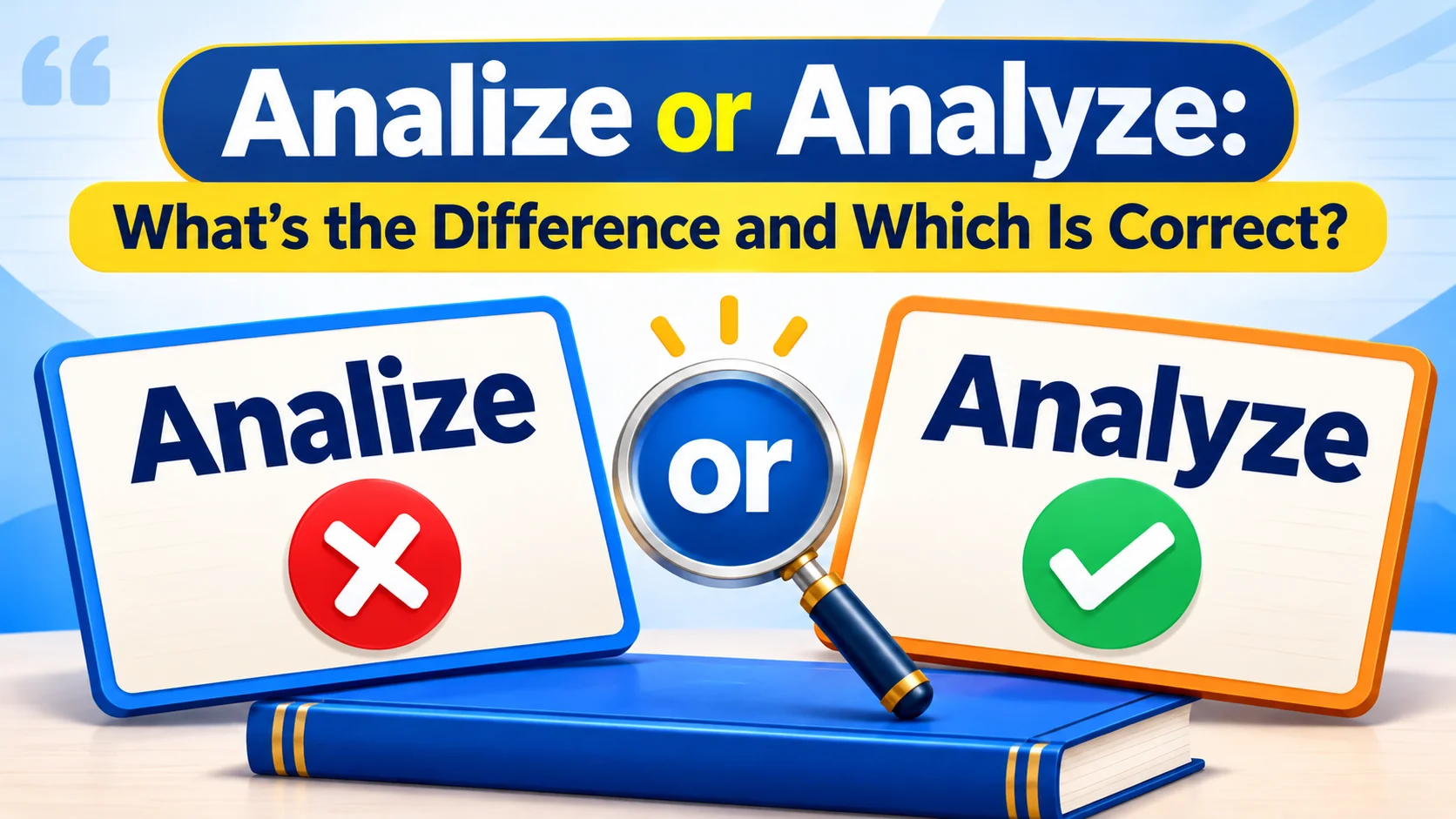
Analize or Analyze is a common spelling question, especially among English learners who are unsure whether the word should contain an S or a Z. The confusion is understandable because English has several regional spelling conventions, and some words change depending on whether someone follows American or British English. However, there is an important distinction: analyze is the correct American English spelling, analyse is the accepted British English spelling, and analize is not a standard spelling in either variety.
The difference between analyze and analyse does not involve meaning, pronunciation, or grammatical function. Both words describe the same action: examining something carefully to understand its parts, identify patterns, or reach a conclusion. The spelling simply reflects different English conventions. For instance, an American student might write, “We need to analyze the results,” while a British student would write, “We need to analyse the results.” Both sentences are correct.
In this guide, you will learn why analize is incorrect, when to choose analyze or analyse, and how their related forms change in different English varieties. We will also explore sentence examples, common spelling mistakes, academic and professional usage, and practical ways to maintain consistency. Whether you are writing an assignment, preparing a business report, editing a website, or improving your everyday English, you will know exactly which spelling to use and why.
Analize or Analyze: Which Spelling Is Correct?
The correct spelling depends on which English convention you follow, but analize is incorrect in standard English.
There are two accepted spellings of the verb:
- Analyze: The standard spelling in American English.
- Analyse: The standard spelling in British English and several other English varieties.
- Analize: A misspelling that should be avoided in formal and standard writing.
The distinction is important because analyze and analyse are not competing words with different definitions. They are regional spelling variations of the same verb.
For example:
- American English: The researcher will analyze the survey results.
- British English: The researcher will analyse the survey results.
Both sentences communicate exactly the same information.
Is Analize a Real Word?
No. Analize is not a recognized standard spelling of the English verb.
People sometimes write it because they hear the word and assume that its spelling follows a simple phonetic pattern. Others may know that American English uses Z in analyze but accidentally place the Z in the wrong position or omit the final E.
There is also confusion because English contains many words with similar endings, including organize, recognize, and realize.
However, the accepted spelling is not determined by how someone thinks a word should sound.
If you encounter analize in an email, online discussion, assignment, or article, treat it as a spelling error rather than an alternative regional form.
Analyze vs Analyse vs Analize at a Glance
| Spelling | Correct in standard English? | Usage |
| Analyze | Yes | American English |
| Analyse | Yes | British English |
| Analize | No | Nonstandard spelling |
Quick rule: Choose analyze for American English and analyse for British English. Avoid analize in both.
What Does Analyze Mean?
Analyze is a verb meaning to examine something carefully and systematically to understand how it works, what it contains, or what it reveals.
When you analyze something, you do more than simply look at it. You investigate its individual parts, consider how those parts relate to one another, and use the information to develop a clearer understanding.
For example, a teacher might ask students to analyze a poem. This means they should examine its language, structure, imagery, and meaning rather than simply read it aloud.
Similarly, a business owner might analyze monthly sales figures to identify which products are performing well and where improvements are needed.
The word is commonly used in:
- Education and academic research.
- Science and technology.
- Business and finance.
- Literature and writing.
- Psychology and behavioral studies.
- Everyday problem-solving.
Analyze as a Verb: Meaning and Function
Grammatically, analyze is a transitive verb in its most common uses. A transitive verb takes a direct object—the person or thing receiving the action.
Consider these examples:
- The scientist analyzed the samples.
- Our team will analyze the proposal.
- Students analyze historical documents.
- The software analyzes customer behavior.
In each sentence, the verb describes an action performed on something.
The word can also appear in other grammatical constructions:
- Infinitive: We need to analyze the evidence.
- Present participle: She is analyzing the results.
- Past tense: He analyzed the report yesterday.
- Past participle: The data has been analyzed.
Understanding these forms makes it easier to use the word correctly in different sentence structures.
Common Meanings of Analyze in Different Contexts
Although the basic definition remains the same, the type of examination changes depending on the subject.
| Context | What Analyze Means | Example |
| Education | Examine ideas or information | Students analyze the novel. |
| Science | Study observations or experimental results | Researchers analyze the samples. |
| Business | Evaluate performance or decisions | Managers analyze sales figures. |
| Finance | Examine financial information | Investors analyze market trends. |
| Technology | Process information to identify patterns | The system analyzes user activity. |
| Everyday life | Think carefully about a situation | I need to analyze what happened. |
The important point is that analyzing involves careful examination and interpretation, not merely collecting information.
Analyze or Analyse: Why Are Both Spellings Correct?
English has developed different spelling conventions in different parts of the world. American and British English share the same basic language, but their written standards sometimes differ.
The spelling of analyze is one example.
American English generally uses analyze, while British English commonly uses analyse. Both spellings are accepted within their respective conventions.
The distinction is largely historical. English spelling developed over centuries through influences from Latin, French, Greek, and other languages. Dictionaries, publishing traditions, and regional education systems helped establish different spelling preferences.
The American spelling preference for Z in words such as organize and recognize is particularly noticeable. British English generally retains S in many corresponding words, although there are important exceptions.
Analyze is one such exception: British English normally retains the Z in analyze in some dictionaries and style systems, but analyse is the dominant British form.
Analyze in American English
In the United States, analyze is the standard spelling.
American dictionaries, educational materials, newspapers, and professional publications generally use this form.
Examples:
- We need to analyze the available evidence.
- The professor asked us to analyze the article.
- The company will analyze its financial performance.
- Researchers are analyzing the latest findings.
American English also uses related forms such as:
- Analyzing
- Analyzed
If you are writing for an American university, employer, newspaper, or website, analyze is normally the appropriate choice.
Analyse in British English
In British English, analyse is the usual spelling.
It is widely used in the United Kingdom and in other English-speaking communities that follow British spelling conventions.
Examples:
- We need to analyse the available evidence.
- The professor asked us to analyse the article.
- The company will analyse its financial performance.
- Researchers are analysing the latest findings.
The corresponding forms include:
- Analysing
- Analysed
One important detail: British English does not simply replace every American Z with S. English spelling has exceptions, so it is better to learn the accepted form of each word rather than rely on one universal rule.
Do Canada, Australia, and Other English-Speaking Countries Use Analyze or Analyse?
Not every English-speaking country follows exactly the same spelling system.
Australia generally follows British conventions and commonly uses analyse. The same spelling is also familiar in New Zealand and many other Commonwealth English contexts.
Canada is more complicated. Canadian English combines British and American influences. Some words follow British spelling, while others follow American conventions. Canadian publishers and institutions may also establish their own preferences.
Here is a practical guide:
| Country or Region | Common Preferred Spelling |
| United States | Analyze |
| United Kingdom | Analyse |
| Australia | Analyse |
| New Zealand | Analyse |
| Canada | Depends on the style guide |
| India | Generally Analyse |
| Ireland | Generally Analyse |
For professional writing, the safest approach is to follow the spelling conventions used by your intended readers or the organization publishing your work.
Analyze vs Analyse vs Analize: Complete Comparison
The three spellings may look similar, but they do not have the same status.
| Feature | Analyze | Analyse | Analize |
| Standard spelling | Yes | Yes | No |
| English variety | American | British | None |
| Part of speech | Verb | Verb | Nonstandard form |
| Meaning | Examine carefully | Examine carefully | Intended meaning is usually analyze |
| Pronunciation | Same | Same | Not a standard spelling |
| Formal writing | Accepted | Accepted | Avoid |
| Academic usage | Accepted | Accepted | Incorrect |
| SEO content | Accepted | Accepted | Avoid |
Do Analyze and Analyse Have Different Meanings?
No. They have the same meaning and grammatical function.
The difference is entirely in their written form.
For example:
American English:
“The students will analyze the historical documents.”
British English:
“The students will analyse the historical documents.”
Both sentences describe students examining historical documents to understand their content and significance.
You do not need to change the sentence structure or meaning when switching between these spelling conventions.
Is One Spelling More Correct Than the Other?
Neither analyze nor analyse is universally more correct.
Correctness depends on the variety of English being used.
If you are preparing a document for an American university, analyze is the natural choice. If you are writing for a British publication, analyse is generally expected.
The only spelling you should avoid in standard writing is analize.
Analyze, Analyzing, Analyzed, and Analysis: Understanding Every Word Form
Learning the base spelling is useful, but writers also need to understand how the word changes when used in different grammatical situations.
This is where additional confusion often occurs. The noun analysis, for example, is not spelled analyzis in American English or analysys in British English.
The spelling differences also affect certain verb forms.
Analyze vs Analyse
These are the base forms of the verb.
- Analyze: American English.
- Analyse: British English.
Examples:
- American: Please analyze the report before Friday.
- British: Please analyse the report before Friday.
Both are infinitive forms and can follow modal verbs such as can, should, must, and will.
Analyzing vs Analysing
When forming the present participle, the final E is removed before adding -ing.
| American English | British English |
| Analyzing | Analysing |
Examples:
- She is analyzing the financial report.
- She is analysing the financial report.
Both forms can describe an action happening now or function as gerunds.
For example:
- Analyzing the evidence requires patience.
- Analysing the evidence requires patience.
A common mistake is to write analyzeing or analyseing. Neither is correct.
Analyzed vs Analysed
The past-tense and past-participle forms also follow regional spelling conventions.
| American English | British English |
| Analyzed | Analysed |
Examples:
- The team analyzed the results yesterday.
- The team analysed the results yesterday.
The same distinction applies when using the present perfect:
- We have analyzed the findings.
- We have analysed the findings.
Remember to keep the spelling consistent with the rest of your document.
Analysis vs Analyses
This distinction is especially important because these two words have different grammatical functions.
Analysis is the singular noun. It refers to the process of examining something or the result of that examination.
Analyses is the plural form of analysis.
Examples:
- The analysis was detailed.
- The researchers completed three separate analyses.
- Her analysis revealed an important problem.
- The report contains several financial analyses.
Notice that the spelling analysis does not change between American and British English.
Also, analyses is not simply another spelling of analyze. The two words have different meanings and grammatical roles.
Analyst vs Analytical vs Analytically
Several other words belong to the same word family.
| Word | Part of Speech | Meaning | Example |
| Analyst | Noun | Someone who examines information | The analyst reviewed the figures. |
| Analytical | Adjective | Involving careful examination | She has an analytical approach. |
| Analytically | Adverb | In a way involving analysis | He thinks analytically. |
| Analysis | Noun | The process or result of examination | The analysis was thorough. |
| Analyses | Plural noun | More than one analysis | The report includes two analyses. |
These related words generally retain the same spelling in American and British English.
How to Use Analyze Correctly in a Sentence
The easiest way to understand analyze is to see how it works in different types of sentences.
Because it is commonly a transitive verb, it usually appears with an object that identifies what is being examined.
A simple structure is:
Subject + Analyze + Object
For example:
“The researcher analyzed the information.”
Here:
- Subject: The researcher.
- Verb: Analyzed.
- Object: The information.
However, the word can also appear in longer sentences with additional details.
Analyze in Academic and Educational Sentences
Academic writing frequently uses analyze when students are expected to examine evidence rather than simply describe it.
Examples:
- Students must analyze the author’s argument before writing their essays.
- The researcher will analyze the survey responses.
- The professor asked the class to analyze the historical event.
- The study analyzes the relationship between sleep and concentration.
- We analyzed the results to determine whether the hypothesis was supported.
Practical advice: When an assignment asks you to analyze something, do not simply summarize it. Explain its important parts, relationships, implications, and supporting evidence.
Analyze in Business and Professional Writing
In professional settings, the word often describes evaluating information before making a decision.
Examples:
- Our team will analyze customer feedback.
- The finance department analyzed last quarter’s expenses.
- Managers need to analyze performance before setting new targets.
- The company uses software to analyze purchasing patterns.
- We should analyze the risks before approving the proposal.
In these situations, analysis can help organizations identify problems, understand performance, and make better-informed decisions.
Analyze in Everyday Conversation
The word is not limited to formal writing. It is also useful in ordinary conversations.
Examples:
- Let me analyze the situation before I respond.
- You should analyze your options carefully.
- I need some time to analyze what happened.
- We analyzed the problem and found a solution.
- Don’t analyze every little detail.
The last example is particularly interesting because analyze can sometimes suggest thinking too deeply about something.
Analyze in Different Verb Tenses
| Tense | Example |
| Present simple | I analyze the reports every week. |
| Present continuous | I am analyzing the report now. |
| Past simple | I analyzed the results yesterday. |
| Present perfect | I have analyzed the available information. |
| Past perfect | She had analyzed the data before the meeting. |
| Future simple | We will analyze the findings tomorrow. |
For British English, replace the relevant forms with analyse, analysing, and analysed.
Analyze or Analyse in Different Types of Writing
Choosing the correct spelling is not only about knowing regional rules. It also involves understanding the expectations of the audience and the publication.
Academic Writing
Universities and academic journals often require a specific spelling convention.
For example, an American university may follow a style guide that prefers analyze, while a British university may expect analyse.
Before submitting an assignment or research paper:
- Check the university’s writing guidelines.
- Follow the required dictionary or style guide.
- Maintain the same spelling throughout the document.
- Check related forms such as analyzing and analyzed.
The important thing is not choosing the spelling you personally prefer. It is meeting the publication’s requirements.
Business and Corporate Communication
Businesses often create editorial guidelines to maintain a consistent professional identity.
Imagine a company with offices in London and New York. If both offices produce documents for the same website, they may need a shared spelling policy.
One department using analyze while another uses analyse can make the company’s content look inconsistent.
A company should therefore establish whether its primary written communication follows American or British English.
Journalism and Online Publishing
Newspapers, magazines, and digital publishers generally follow established editorial conventions.
Editors typically standardize spelling before publication. This helps ensure that articles written by different contributors feel consistent.
If you write for an international publication, ask whether it follows a particular house style rather than assuming that both forms can be mixed freely.
SEO Content and International Websites
For website owners and content writers, spelling consistency is especially useful when producing content for different audiences.
Suppose your website primarily targets American readers. Using analyze consistently is a sensible editorial decision.
If your main audience is in the United Kingdom or Australia, analyse may be more appropriate.
Consider these practices:
- Identify your primary audience before writing.
- Use the spelling expected by that audience.
- Keep related word forms consistent.
- Avoid inserting alternative spellings unnaturally.
- Review older content when updating your website’s editorial standards.
There is no need to repeat both spellings throughout every paragraph simply to target additional search queries. A clear explanation of the difference is more useful to readers.
Common Mistakes People Make With Analyze and Analyse
Even experienced writers occasionally make spelling mistakes, particularly when switching between different English varieties.
Here are the mistakes worth watching for.
Writing Analize Instead of Analyze
This is the main mistake behind the search query.
Incorrect: We need to analize the information.
Correct: We need to analyze the information.
British alternative: We need to analyse the information.
The easiest solution is to remember that the accepted American spelling contains -lyze, while the British form contains -lyse.
Assuming Analyse Is Always Incorrect
Some American writers mistakenly assume that analyse is simply a misspelling.
That is not true.
Analyse is a legitimate spelling in British English. It is perfectly acceptable in British academic papers, professional reports, and everyday writing.
The correct choice depends on the intended English variety.
Mixing American and British Spellings
Consider this sentence:
“Our team is analysing the data that we analyzed yesterday.”
This sentence mixes British analysing with American analyzed.
Although readers will understand it, the inconsistent spelling may look unprofessional in a document that follows one regional standard.
A consistent American version would be:
“Our team is analyzing the data that we analyzed yesterday.”
A consistent British version would be:
“Our team is analysing the data that we analysed yesterday.”
Confusing Analysis With Analyze
These words are related but cannot be substituted for each other.
Incorrect: We need to analysis the report.
Correct: We need to analyze the report.
Another correct sentence:
“We need to complete an analysis of the report.”
Use analyze when describing the action and analysis when referring to the examination itself.
Applying the Same Z or S Rule to Every Word
English spelling is not completely predictable.
Although American English often favors Z in words ending in -ize, British English also uses Z in some words. Likewise, certain British words retain S regardless of American spelling conventions.
Do not assume that every word has two interchangeable regional forms. Check the individual word when uncertain.
Analyze or Analyse: Easy Ways to Remember the Correct Spelling
Remembering the difference becomes easier when you connect the spelling to the audience rather than trying to memorize complicated historical explanations.
The American Z Rule
If you are writing for an American audience, use analyze.
Think of the Z as a reminder of the American spelling convention.
Examples:
- Analyze
- Analyzing
- Analyzed
The British S Rule
If you are following British English, use analyse.
Its related forms are:
- Analyse
- Analysing
- Analysed
Remember that this is a convention for this particular word family, not a rule that every British word must replace Z with S.
Check Your Audience Before Writing
Before starting an article, essay, or report, ask yourself:
- Who will read this document?
- Does the organization require American or British English?
- Is there an established editorial style?
- Have I used the same spelling in related words?
Answering these questions early can prevent unnecessary editing later.
A Simple Editing Checklist
Use this checklist when proofreading:
- Have I avoided the misspelling analize?
- Am I using analyze or analyse according to my chosen English variety?
- Are analyzing and analyzed consistent with the base form?
- Have I distinguished analysis from analyze?
- Does the spelling match my organization’s style guide?
Conclusion
The difference between analize or analyze becomes straightforward once you understand regional English spelling. Analyze is the accepted American form, while analyse is commonly used in British English and other varieties that follow its conventions. Analize is not a standard English spelling, so it should be avoided in formal and informal writing alike. One final actionable tip: choose your English variety before beginning an article, assignment, or professional document, then check related forms such as analyzing, analysing, analyzed, and analysed. A common mistake to avoid is assuming that every Z or S spelling follows one universal rule. Good writing is not about choosing one country’s spelling over another; it is about using the correct convention consistently and communicating clearly.
Frequently Asked Questions
Q1. Is It Analize or Analyze?
Analyze is the correct American English spelling. British English commonly uses analyse. The spelling analize is incorrect in standard English and should not be used in formal documents, academic assignments, professional emails, or published articles.
Q2. Is Analyze or Analyse Correct in English?
Both spellings are correct, but they belong to different regional conventions. Analyze is standard in American English, while analyse is standard in British English. Neither changes the meaning or pronunciation of the verb.
Q3. Why Do Americans Spell Analyze With a Z?
American English generally favors Z in several words that have different British spellings. This preference developed through historical spelling conventions and American dictionary traditions. Examples include organize and recognize, although English has exceptions to this pattern.
Q4. Is Analize Ever Correct?
No, analize is not an accepted standard spelling of the English verb. It may appear in informal messages or online because of typing mistakes, but it should be corrected to analyze or analyse, depending on the intended regional English standard.
Q5. Do Australians Use Analyze or Analyse?
Australian English generally follows British spelling conventions, so analyse is the usual form. Australian students, publishers, and professional writers should normally use analyse, analysing, and analysed, unless a particular organization requires another spelling style.
