
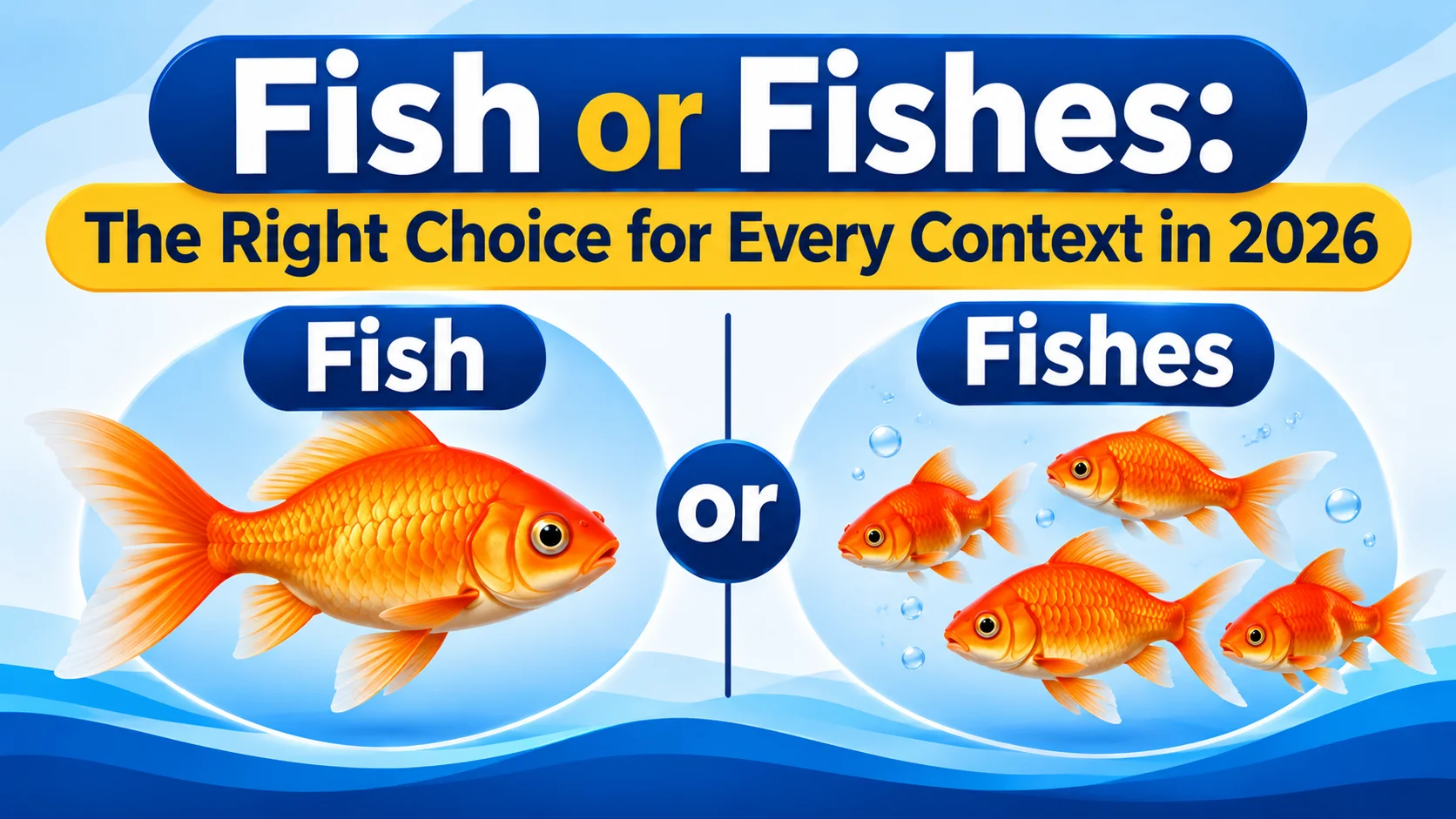
The difference between fish or fishes is one of those small English grammar questions that can make even confident writers pause. Should you write “There are five fish in the pond” or “There are five fishes in the pond”? Interestingly, both forms exist, but they do not always communicate the same emphasis. Fish is the usual plural when counting individual animals, while fishes is often used when discussing different species or varieties. Understanding this distinction will help you write more naturally, avoid unnecessary corrections, and choose the appropriate expression in different situations.
The confusion comes from an unusual feature of English: some nouns change when they become plural, while others remain exactly the same. For example, we say one cat, two cats, but one fish, two fish. This unchanged plural form is known as a zero plural. However, English also recognizes fishes as a legitimate plural. The important point is that the choice is not simply about singular versus plural. It is about what you want to describe, whether individual animals, a general population, different species, or fish as food.
In this guide, you will discover how fish and fishes work in everyday English, formal writing, scientific discussions, aquariums, restaurants, and educational contexts. We will examine the difference between counting individual animals and identifying species, explain related expressions such as fish species, school of fish, fish’s, and fishes’, and look at mistakes that often appear in writing. You will also find practical examples, comparison tables, and exercises to help you apply the rules. By the end, you will know which form to choose and why.
Fish or Fishes: Which Is Correct?
Both fish and fishes are correct English words. They are accepted plural forms of the noun fish, but they are generally used in different contexts.
The usual plural is fish. It is the natural choice when talking about two or more individual fish, whether you are describing animals in an aquarium, fish in a river, or a catch from a fishing trip.
Fishes is also correct. It is often used when the writer wants to emphasize different species, varieties, or kinds of fish. This use is particularly noticeable in discussions of aquatic biodiversity, marine biology, ecology, and collections of different species.
Consider these examples:
- There are eight fish in the aquarium.
- The reef supports many colorful fishes.
- We caught four fish during our trip.
- The researchers studied several tropical fishes.
The distinction is about emphasis, not an absolute grammatical boundary. You can also say “The reef supports many colorful fish” or “The researchers studied several tropical fish.” Both are correct.
The basic rule
| Word | Typical use | Example |
| Fish | One individual animal | I saw one fish. |
| Fish | Multiple individual animals | We saw six fish. |
| Fish | Fish as food | We ate fish for dinner. |
| Fishes | Different kinds or species | The region has many native fishes. |
Remember: If you are simply counting individual fish, use fish. If you want to emphasize the variety of species, fishes may be appropriate.
What Does Fish Mean?
The word fish is a noun referring to an aquatic animal that typically has gills, fins, and a backbone. Fish live in a wide range of environments, including oceans, rivers, lakes, streams, and other aquatic habitats.
The word has several grammatical uses. Understanding them makes the difference between fish and fishes much easier to recognize.
1. Fish as a singular noun
When you are talking about one aquatic animal, use fish.
Examples:
- A fish is swimming near the surface.
- I bought a small fish for my aquarium.
- That fish has beautiful orange scales.
- The fish is hiding behind a rock.
- A large fish appeared near the boat.
In these examples, fish refers to one individual animal. The verb also agrees with the singular subject: “The fish is swimming,” not “The fish are swimming.”
This is important because the word itself does not show whether it is singular or plural. You must use the surrounding words and verb to understand the meaning.
2. Fish as a plural noun
One unusual feature of the noun fish is that its plural can have exactly the same spelling as its singular form.
Examples:
- Two fish are swimming together.
- Five fish live in this aquarium.
- Several fish were caught near the shore.
- The pond contains hundreds of fish.
- Many fish migrate during particular seasons.
This type of plural is called a zero plural because no additional ending is required.
Compare:
| Singular | Plural |
| One fish | Two fish |
| One deer | Three deer |
| One sheep | Five sheep |
| One aircraft | Several aircraft |
Not all nouns follow this pattern. Most English countable nouns form their plurals by adding -s or -es, but certain nouns have unchanged plural forms.
3. Fish as a food noun
Fish can also describe food rather than living animals. In this situation, it commonly functions as an uncountable or mass noun.
Examples:
- We had fish for lunch.
- She prefers fish to beef.
- Fresh fish is available at the market.
- This recipe requires white fish.
- I do not eat fish.
When discussing food generally, you normally do not say fishes.
However, you can count separate portions or prepared items by adding a suitable counting expression:
- Two pieces of fish
- Three fish fillets
- Four servings of fish
- Two portions of grilled fish
The counting word identifies what is being measured. This is why “three servings of fish” is more precise when you are talking about meals rather than three living animals.
4. Fish as a general category
The word fish can also describe fish collectively, without referring to a particular number of animals.
Examples:
- Fish are an important part of aquatic ecosystems.
- Some fish live in freshwater environments.
- Many fish depend on healthy habitats.
- Fish can have different feeding behaviors.
- Some fish travel long distances during migration.
Here, fish refers to a broad category. The sentence may apply to many species, but there is no requirement to use fishes.
What Does Fishes Mean?
Fishes is the recognized plural form of fish. It is particularly useful when a sentence focuses on the diversity of fish rather than simply the number of individual animals.
For example:
- Tropical fishes display a remarkable range of colors.
- The museum has a collection of rare freshwater fishes.
- Researchers documented several native fishes in the region.
- The coral reef supports numerous marine fishes.
These sentences draw attention to the different kinds of fish being discussed.
However, it would be inaccurate to say that fishes always means different species and fish always means individual animals. English usage is more flexible than that. Writers can use fish for multiple species, and fishes can sometimes refer more broadly to groups of fish.
Why do writers use fishes?
There are several reasons.
1. To emphasize species diversity
A biologist describing an ecosystem may want to discuss the variety of species rather than simply count the animals living there.
For example:
“The coastal waters contain many native fishes.”
The wording draws attention to the range of fish represented in that environment.
2. To describe different varieties
An aquarium might contain many kinds of fish with different colors, sizes, and habitat requirements.
Example:
“The exhibition features tropical fishes from several parts of the world.”
3. To discuss biological collections
Museums, research institutions, and educational organizations sometimes use fishes when referring to collections containing different species.
Example:
“The university maintains a collection of freshwater and marine fishes.”
4. To distinguish types in a particular discussion
When the difference between kinds is central to the subject, fishes can make that emphasis clearer.
Even so, there is no rule requiring scientific writers to use fishes. Expressions such as fish species, fish populations, and fish diversity are also widely used.
Fish vs. Fishes: A Detailed Comparison
The following comparison explains the differences in meaning, grammar, and typical usage.
| Comparison point | Fish | Fishes |
| Singular form | Yes | No |
| Plural form | Yes | Yes |
| Standard spelling | Fish | Fishes |
| Used for counting animals | Very common | Less common |
| Used for general descriptions | Very common | Possible |
| Emphasizes different species | Possible | Often useful |
| Used for food generally | Yes | Not normally |
| Used in everyday conversation | Very common | Less common |
| Used in scientific writing | Common | Useful in some contexts |
| Example | Ten fish are swimming. | The region contains many fishes. |
The most important distinction is not that one form is correct and the other is incorrect. Both are valid. The difference lies in the writer’s intended meaning and emphasis.
Fish and fishes in example sentences
| Sentence | Explanation |
| I saw three fish in the river. | Counts individual animals. |
| The aquarium contains tropical fishes. | Can emphasize different varieties. |
| Fish are found in many aquatic environments. | Refers to fish generally. |
| The study examines several fishes. | May emphasize species diversity. |
| We ordered fish at the restaurant. | Refers to food. |
| The museum displays rare fish species. | Identifies different species directly. |
Notice that fish species is often the clearest expression when the writer wants to avoid ambiguity.
When Should You Use Fish?
In most everyday situations, fish is the preferred plural form. It is simple, natural, and widely understood.
Use it when counting animals, talking about pets, describing aquatic environments, or referring to fish as food.
1. When counting individual fish
If you are describing how many individual animals are present, fish is normally the best choice.
Examples:
- There are four fish in my aquarium.
- We caught seven fish yesterday.
- Two fish are swimming beneath the boat.
- The pond has around twenty fish.
- I saw three colorful fish near the rocks.
The number already tells the reader that more than one animal is involved. You do not need to add -es.
Practical advice: When writing a sentence with a specific number, such as two, five, ten, or twenty, choose fish unless you have a particular reason to emphasize different kinds.
2. When talking about pets
People generally use fish when discussing animals they keep at home.
Examples:
- My brother has three goldfish.
- We bought two new fish for the aquarium.
- Her fish are healthy and active.
- I feed my fish every morning.
Using fishes in a casual conversation about pets can sound unnecessarily formal.
For example:
- Natural: “I have five fish in my aquarium.”
- Less natural in ordinary conversation: “I have five fishes in my aquarium.”
The second sentence is not automatically ungrammatical, but the first is the usual choice.
3. When discussing fish in rivers, lakes, and oceans
Use fish when making general statements about aquatic animals.
Examples:
- Many fish live in freshwater rivers.
- The lake contains different types of fish.
- Some fish swim in large groups.
- The ocean supports countless fish.
- Several fish were visible near the surface.
These examples describe animals without needing to emphasize their species individually.
4. When talking about food
Use fish when discussing seafood as a general food category.
Examples:
- We are having fish for dinner.
- Fresh fish is expensive in this market.
- I prefer grilled fish.
- This restaurant serves excellent fish dishes.
If you want to specify the quantity, use a measurement or serving expression:
- Two fish sandwiches
- Three fish fillets
- Four portions of fish
5. In educational writing
For general educational explanations, fish is usually sufficient.
Example:
“Fish have different adaptations that help them survive in aquatic environments.”
This sentence can refer to many different kinds of fish. The plural does not need to become fishes simply because the statement covers several species.
When Should You Use Fishes?
Use fishes when the sentence benefits from emphasizing different types or species of fish. This is especially useful in writing about marine life, biodiversity, research collections, and ecological classification.
1. When discussing different species
Imagine a researcher studying a coastal region containing several species of fish.
The researcher might write:
“The survey recorded several native fishes along the coastline.”
This wording can highlight the variety of species found in the region.
Another example:
“Some fishes have adapted to survive in environments with very little light.”
The sentence focuses on different types of fish and their adaptations.
2. When discussing biodiversity
Biodiversity refers to the variety of living organisms in a particular environment. When the writer wants to emphasize the diversity of fish species, fishes can be an appropriate choice.
Examples:
- The reef supports a diverse range of marine fishes.
- The protected area contains several rare fishes.
- Researchers are studying the region’s freshwater fishes.
- The report describes the diversity of native fishes.
However, fish diversity is also a natural and widely used expression. You should not force fishes into every sentence about biodiversity.
3. In museums and aquariums
A museum may maintain a collection of different fish species from around the world.
Example:
“The natural history museum displays freshwater and marine fishes from several continents.”
Here, the word fishes helps emphasize the variety of species represented in the exhibition.
In an ordinary aquarium description, however, fish is often more natural:
“The aquarium contains hundreds of colorful fish.”
Both choices can work, depending on what the writer wants to highlight.
4. In research and scientific discussions
Scientific writing sometimes uses fishes to refer to a collection of species or taxonomic diversity.
For example:
“The research examines the distribution of freshwater fishes across several river systems.”
The word is useful because the study concerns different fish species and their distribution.
But scientific writing does not have one universal rule that requires fishes. Some researchers prefer fish even when discussing several species.
For professional work, follow the terminology and style conventions of the relevant journal, textbook, or organization.
Is It Two Fish or Two Fishes?
The most natural expression in everyday English is two fish.
Examples:
- I saw two fish in the pond.
- She bought two fish for her aquarium.
- We caught two fish during the trip.
- Two fish were swimming near the rocks.
This is because fish has an unchanged plural form.
However, two fishes can be appropriate when the sentence is discussing two different kinds or species, rather than merely counting two individual animals.
For example:
“The educational display compares two fishes with very different feeding adaptations.”
Even in this situation, a clearer alternative might be:
“The educational display compares two fish species with very different feeding adaptations.”
That version removes any uncertainty about what is being compared.
Which expression should you choose?
| Intended meaning | Recommended expression |
| Two individual animals | Two fish |
| Two different species | Two fish species |
| Two kinds, emphasizing variety | Two fishes may be suitable |
| Two portions of food | Two servings of fish |
| Two prepared pieces | Two pieces of fish |
| Two aquarium pets | Two fish |
Best practice: Use two fish when counting animals. Use two fish species when you specifically mean two species.
Fish or Fishes in Different Real-World Situations
The distinction becomes easier when you consider the context in which the word appears.
Fish or fishes in an aquarium
If you are simply describing the animals inside an aquarium, use fish.
Example:
“There are fifteen fish in the large aquarium.”
If you are discussing the different species in an exhibition, fishes may be suitable.
Example:
“The exhibition introduces visitors to tropical fishes from different regions.”
Fish or fishes in a river
Use fish for general statements or counts.
Example:
“Many fish live in this river.”
If you are discussing the range of species living there, either fish or fishes can work.
Example:
“The river supports several native fishes.”
Alternatively:
“The river supports several native fish species.”
Fish or fishes in scientific research
The choice depends on the research question.
If a study counts individual animals, fish is normally appropriate.
If it examines the variety of species, fishes may be useful.
For example:
- Population count: “Researchers counted 200 fish.”
- Species diversity: “Researchers documented 12 fish species.”
- Species-focused description: “Researchers examined the region’s native fishes.”
Fish or fishes in restaurants
When discussing food, use fish.
Examples:
- We ordered grilled fish.
- The restaurant serves fresh fish.
- She prefers fish to chicken.
For portions, use expressions such as two fish fillets or three servings of fish.
Fish or fishes in school assignments
For general school-level writing, fish is usually the simplest and most natural choice.
Example:
“Fish live in freshwater and saltwater environments.”
If the assignment specifically discusses different species, you can use fishes or the more precise expression fish species.
Fish, Fishes, and Fish Species: Understanding the Difference
One source of confusion is the relationship between the words fish, fishes, and species.
These terms are connected, but they do not mean exactly the same thing.
What does fish species mean?
A fish species is a particular biological kind or classification of fish.
Examples:
- Salmon is a common name used for several fish species.
- The researchers identified a new fish species.
- Some fish species are adapted to cold water.
- The report describes endangered fish species.
The plural of species is also species.
| Singular | Plural |
| One species | Several species |
| One fish species | Several fish species |
| One endangered species | Many endangered species |
You should not write specieses in standard English.
Are fishes and fish species interchangeable?
Not always.
Fishes is a plural noun. Fish species is a noun phrase that explicitly identifies different biological species.
Compare:
- “The region contains many fishes.”
- “The region contains many fish species.”
Both may communicate species diversity, but the second is more explicit.
For scientific, educational, and technical writing, fish species is often the clearest expression when species classification is central to the discussion.
Fish’s or Fishes’: Understanding Possessive Forms
Another common difficulty is knowing when to use fish’s and fishes’.
These forms show possession. They are not alternative plurals.
Fish’s: Singular possessive
Use fish’s when something belongs to one fish.
Examples:
- The fish’s tail is damaged.
- The fish’s scales are unusually bright.
- The fish’s movement attracted attention.
- The fish’s habitat needs protection.
The apostrophe comes before the s because the word is singular.
Fishes’: Plural possessive
Use fishes’ when referring to something belonging to multiple fish, using fishes as the plural noun.
Examples:
- The fishes’ habitats were studied.
- Researchers compared the fishes’ feeding patterns.
- The fishes’ different adaptations were documented.
However, because fish is also a plural noun, you may often write a more straightforward sentence using fish.
For example:
“The fish’s habitats were studied” can be ambiguous without context. A clearer alternative is:
“The habitats of the fish were studied.”
This avoids uncertainty about whether you mean one animal or several.
Fish vs. fish’s vs. fishes vs. fishes’
| Form | Grammatical function | Example |
| Fish | Singular noun | One fish is swimming. |
| Fish | Plural noun | Five fish are swimming. |
| Fish’s | Singular possessive | The fish’s tail is injured. |
| Fishes | Plural noun | The region contains many fishes. |
| Fishes’ | Plural possessive | The fishes’ habitats differ. |
The apostrophe changes the grammatical function, so pay attention to whether you are showing possession or simply making the noun plural.
What Is a School of Fish?
A school of fish is a group of fish swimming together in a coordinated way.
The word school is a collective noun in this expression. It describes a group, so you do not need to change fish to fishes.
Examples:
- A school of fish moved through the water.
- We watched a large school of fish near the reef.
- A school of small fish passed beneath the boat.
A related term is shoal. A shoal is a group of fish gathered together, while school is often used when the fish swim in a coordinated formation. The terms can overlap in ordinary usage.
Other useful expressions include:
- A group of fish
- A population of fish
- A species of fish
- A variety of fish
- A catch of fish
These expressions are useful in descriptive and scientific writing because they identify the kind of group being discussed.
Common Mistakes When Using Fish or Fishes
Even experienced English learners sometimes confuse these forms. Most mistakes happen because writers assume that every plural noun must follow the same pattern.
Here are the errors worth avoiding.
Mistake 1: Writing fishs instead of fishes
Incorrect:
“There are many tropical fishs in the aquarium.”
Correct:
“There are many tropical fish in the aquarium.”
Also correct:
“There are many tropical fishes in the aquarium.”
The spelling fishs is not the standard plural form.
Mistake 2: Assuming fishes is always incorrect
Incorrect assumption:
“You should never use fishes because fish is already plural.”
Correct understanding:
Fishes is an accepted plural form. It is often useful when emphasizing different species or varieties.
Do not mark it as a mistake without considering the sentence.
Mistake 3: Using fishes every time there is more than one fish
Less natural:
“I saw four fishes swimming in the pond.”
More natural:
“I saw four fish swimming in the pond.”
If you are simply counting individual animals, fish is normally the preferred choice.
Mistake 4: Confusing food with living animals
Compare:
- There are three fish in the tank. — Animals.
- We ate fish for dinner. — Food.
- We ordered three portions of fish. — Servings.
The grammatical treatment depends on the meaning, not just the number.
Mistake 5: Believing that fishes is compulsory in scientific writing
Scientific writers do not have to use fishes whenever they mention multiple species.
These expressions are all possible:
- Fish species
- Fish populations
- Fish diversity
- Freshwater fishes
- Marine fish
The best option depends on the sentence and the publication’s preferred terminology.
Mistake 6: Using fishes when fish species would be clearer
Sometimes fishes is grammatically acceptable but does not communicate the intended meaning as precisely as it could.
Less precise:
“The researchers compared two fishes.”
Clearer:
“The researchers compared two fish species.”
The second sentence tells the reader exactly what is being compared.
How to Remember When to Use Fish or Fishes
You do not need to memorize dozens of examples. A simple decision-making method will help you choose correctly.
Use fish when:
- You are counting individual animals.
- You are discussing fish as pets.
- You are describing fish in rivers, lakes, or oceans.
- You are talking about fish as food.
- You are making a general statement about fish.
Consider fishes when:
- You want to emphasize different species.
- You are discussing biodiversity.
- You are describing a collection of different kinds.
- The variety of fish is important to your explanation.
A quick decision table
| Question | Recommended choice |
| Am I talking about one animal? | Fish |
| Am I counting several animals? | Fish |
| Am I discussing fish as food? | Fish |
| Am I emphasizing different species? | Fishes may work |
| Am I writing about species classification? | Fish species is often clearest |
| Am I unsure which plural to use? | Fish is usually the safest choice |
An easy memory trick
Think of fish as the everyday plural and fishes as a form that can highlight variety.
For example:
- “I saw ten fish” tells you how many animals were present.
- “The region contains many fishes” can draw attention to the different kinds living there.
This is a useful guideline, but remember that the distinction is flexible. The word fish can also refer to many species.
Practice Exercise: Choose Fish or Fishes
Test your understanding by completing the following sentences. Choose the form that best fits the intended meaning.
- There are seven _____ in the aquarium.
- The researcher examined several species of _____.
- We had grilled _____ for dinner.
- The museum displays rare tropical _____.
- Two _____ were swimming near the surface.
- Many _____ live in freshwater habitats.
- The exhibition explores the diversity of marine _____.
- My friend bought three gold_____ for her aquarium.
- The lake contains several different _____ species.
- The fisherman caught five _____ yesterday.
Answers and explanations
| No. | Answer | Explanation |
| 1 | Fish | Counts individual animals. |
| 2 | Fish | “Species of fish” is the standard expression. |
| 3 | Fish | Refers to food. |
| 4 | Fishes or fish | Both can work; fishes may emphasize variety. |
| 5 | Fish | Counts two individual animals. |
| 6 | Fish | General statement about aquatic animals. |
| 7 | Fishes or fish | Both are possible when discussing marine diversity. |
| 8 | Goldfish | The usual plural of goldfish is unchanged. |
| 9 | Fish | “Fish species” is the natural expression. |
| 10 | Fish | Counts individual animals caught. |
The exercise demonstrates an important point: fish is the more widely useful plural, while fishes is an additional option when the context makes its emphasis helpful.
Conclusion
The difference between fish or fishes is less complicated than it first appears. Both forms are correct, but fish is the normal choice when counting individual animals, discussing aquatic life generally, or referring to fish as food. Fishes is useful when you want to emphasize different species or varieties, particularly in discussions of biodiversity and marine research. One final actionable tip: before choosing a plural, decide whether your sentence focuses on the number of animals or the diversity of species. A common mistake to avoid is assuming that fishes is always wrong or that it must be used in scientific writing. English allows both forms. Use the one that communicates your meaning most clearly, and your writing will sound more accurate and natural.
Frequently Asked Questions
Q1. Is fishes grammatically correct in English?
Yes. Fishes is a grammatically accepted plural of fish. It is often used when discussing different species or varieties, especially in biological and ecological contexts. It is less common than fish when counting individual animals, but it is not an incorrect word.
Q2. Can I use fishes when talking about two or three individual fish?
You can encounter fishes in this context, but two fish and three fish are more natural for ordinary counting. If you mean two or three different species, use two fish species or three fish species to make the meaning precise.
Q3. What is the plural of goldfish, starfish, and jellyfish?
The usual plurals are goldfish, starfish, and jellyfish. These compound nouns generally retain the unchanged plural form of fish. For example, “There are three goldfish in the tank.” Some other animal names ending in -fish follow the same pattern.
Q4. Is fish countable or uncountable?
Fish can be both countable and uncountable, depending on meaning. It is countable when referring to individual animals: “I saw four fish.” It is generally uncountable when referring to food: “We ate fish for dinner.” The context determines its grammatical use.
Q5. Why do scientists sometimes say fishes instead of fish?
Scientists may use fishes when they want to emphasize the variety of species being studied, rather than simply the number of individual animals. However, scientific writers also commonly use fish, fish species, and fish diversity. There is no universal requirement to use fishes.
