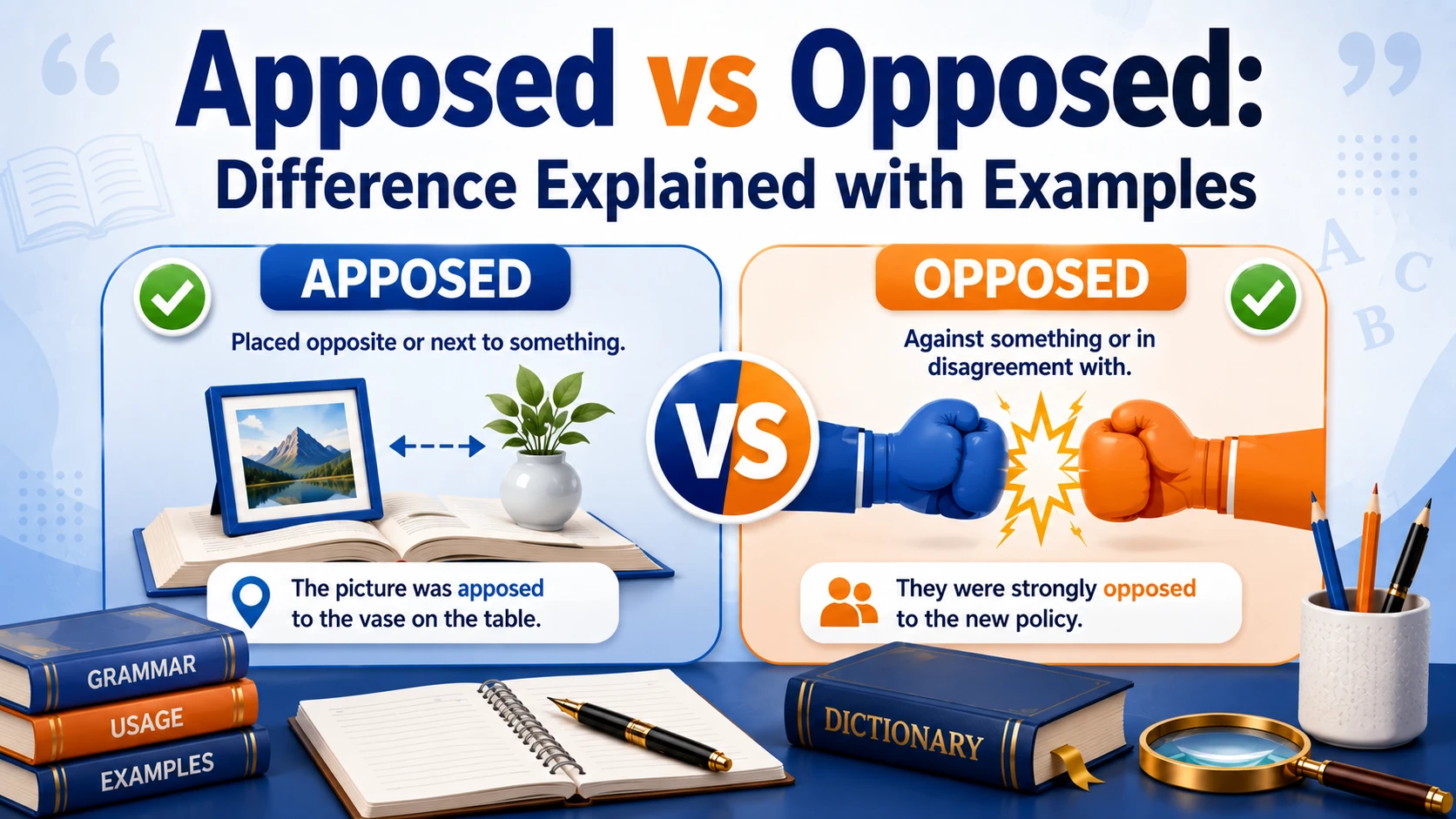
Apposed vs opposed can look like two spellings of the same word at first glance. They aren’t. Apposed is a specialized word that generally describes things placed side by side or brought into close contact. Opposed is much more common and usually means against, resistant to, or in disagreement with something. The difference becomes especially important when you’re writing about grammar, anatomy, linguistics, science, or formal arguments. A single letter changes the meaning completely. Once you understand what the prefixes ad- and ob- contribute to these words, the distinction becomes much easier to remember and apply accurately.
The confusion often comes from visual similarity. Both words contain -posed, which comes from the Latin ponere, meaning “to put” or “place.” The prefixes change the direction of that idea. Apposed developed around the idea of placing something beside or against another thing, particularly in specialized terminology. Opposed, meanwhile, developed the sense of placing something against another position in a figurative or adversarial way. That is why you’ll encounter opposed to a proposal, but you may encounter apposed structures in technical writing. The words overlap historically without being interchangeable today.
This guide explains apposed and opposed from both practical and technical perspectives. You’ll learn what each word means, how it functions grammatically, where each term appears, and how to recognize the intended meaning from context. You’ll also see side-by-side examples, common mistakes, related words such as apposition, appose, oppose, and opposition, and a simple decision method you can use while editing. By the end, you should be able to determine quickly whether a sentence needs apposed or opposed without relying on guesswork or treating one as a variant spelling of the other.
Apposed vs Opposed: What’s the Difference?
The central difference is straightforward:
- Apposed means placed next to, alongside, or in close contact with something else.
- Opposed means against, resistant to, contrary to, or in disagreement with something.
The two words can both involve the idea of things being positioned in relation to each other. Their modern meanings are different enough that substituting one for the other can make a sentence inaccurate.
| Word | Main meaning | Typical use | Example |
| Apposed | Placed alongside or brought into close contact | Technical, linguistic, anatomical, scientific contexts | “The two surfaces were apposed.” |
| Opposed | Against or in disagreement with | Everyday, political, academic, personal, argumentative contexts | “The committee was opposed to the proposal.” |
| Appose | To place beside or alongside | Specialized writing | “The structures appose one another.” |
| Oppose | To resist, disagree with, or act against | General English | “Several residents oppose the plan.” |
A useful distinction is physical or structural relationship versus disagreement or resistance.
If two structures are apposed, they are positioned beside or against each other in a physical or structural sense.
If someone is opposed to an idea, they disagree with it or resist it.
Quick rule: If you can replace the word with “against” in the sense of disagreement, opposed is almost certainly the word you need. If you mean “placed alongside,” consider apposed.
What Does “Apposed” Mean?
Apposed Definition and Meaning
Apposed is the past participle and adjective form associated with appose. It generally means placed next to, positioned alongside, or brought into close contact with another thing.
The word is uncommon in ordinary conversation. You’re more likely to see it in linguistics, anatomy, biology, medicine, and other technical writing.
For example:
“The two surfaces were apposed closely.”
Here, apposed describes the relationship between the surfaces. It doesn’t mean that one surface disagreed with the other. It describes position or contact.
That distinction is critical because many readers encounter the word only occasionally. When a specialized term appears outside its usual field, it can look like a spelling mistake for the much more familiar opposed.
What “Apposed” Means in Grammar and Specialized Writing
In grammar and linguistics, words derived from appose are connected with the idea of placing linguistic elements beside one another.
The related noun apposition is much more familiar to students of English grammar.
Consider:
“My brother, a doctor, lives in Chicago.”
The phrase a doctor is in apposition to my brother. It sits beside the noun phrase and provides additional identifying information.
However, apposed itself isn’t the everyday term most writers use when explaining this grammatical construction. In a grammar article, you’re far more likely to encounter appositive, apposition, or appositional.
This matters because seeing apposed in a linguistic context doesn’t automatically mean it is referring to ordinary physical placement. The broader concept is still one of elements being positioned alongside one another.
How Apposed Describes Things Placed Side by Side
The strongest practical meaning of apposed is adjacent or closely positioned.
Imagine two surfaces that come together. If a technical description says they are apposed, the writer is focusing on their physical relationship.
For example:
“The edges were carefully apposed before the procedure was completed.”
The sentence describes alignment and contact, not opposition.
Another example:
“The two layers remained apposed throughout the process.”
Again, the word tells you about position.
Examples of “Apposed” in Sentences
Here are several examples showing how the word works:
- “The two surfaces were apposed along their entire length.”
- “The structures became closely apposed after movement.”
- “The tissue layers were carefully apposed.”
- “The two components were apposed rather than separated.”
- “In the diagram, the paired structures appear apposed.”
- “The linguistic elements are apposed within the construction.”
These examples share one important feature: apposed describes placement or structural proximity.
When “Apposed” Is the Right Word
Use apposed when the sentence needs to describe something being:
- placed beside another thing
- positioned alongside another element
- brought into close contact
- aligned closely with another structure
- situated next to something in a technical relationship
Don’t use it simply because you mean “against.” The word against has several meanings in English. When “against” means disagreement or resistance, opposed is normally appropriate.
Apposed in Linguistics and Grammar
The related term apposition is important in grammar.
An appositive gives another name or description for a nearby noun or noun phrase:
“Maria, the team captain, addressed the players.”
Here, the team captain is an appositive phrase.
The two expressions refer to the same person. They are placed next to each other in the sentence.
This is one reason the app- family can be associated with the idea of placement beside something.
Apposed in Anatomy, Biology, and Technical Contexts
Technical fields may use apposed to describe structures that are closely positioned or in contact.
A technical writer may choose the term because it conveys a more precise relationship than a general phrase such as next to.
That precision is useful for specialists. It can be less useful for general readers.
If you’re writing for a broad audience, consider whether placed alongside or in close contact communicates the same idea more clearly.
What Does “Opposed” Mean?
Opposed Definition and Meaning
Opposed is the past tense and past participle of oppose. It is also commonly used as an adjective.
The basic meaning is against something or someone.
For example:
“The residents were opposed to the new development.”
The residents didn’t merely stand beside the development. They disagreed with or resisted it.
This is the meaning most English speakers encounter every day.
Opposed as a Verb Form of “Oppose”
As a verb, opposed can describe an action of resisting or challenging something.
“The senator opposed the proposed legislation.”
Here, opposed means resisted or disagreed with the legislation.
Another example:
“Several employees opposed the change.”
The employees expressed disagreement or resistance.
Opposed as an Adjective
Opposed can also describe a person’s or group’s position:
“She is strongly opposed to animal testing.”
The adjective describes her attitude toward the subject.
This construction is especially common:
opposed to + noun
“They are opposed to the policy.”
It can also appear with a gerund:
“He is opposed to working on Sundays.”
The word to here is a preposition. That’s why the following verb appears in the -ing form, not the infinitive.
Correct:
“She is opposed to changing the schedule.”
Incorrect:
“She is opposed to change the schedule.”
How “Opposed to” Is Used
Opposed to is one of the most useful patterns to remember.
It can express disagreement with:
- an idea
- a policy
- a person
- an action
- a proposal
- a practice
- a decision
- a change
Examples:
“The board is opposed to the merger.”
“I’m opposed to raising the fees.”
“They were opposed to the proposed restrictions.”
The construction can express anything from mild disagreement to strong resistance. The surrounding context determines the strength.
Examples of “Opposed” in Sentences
- “She is opposed to the new rule.”
- “The committee opposed the proposal.”
- “Many voters were opposed to the measure.”
- “He strongly opposed the decision.”
- “The two candidates held opposed positions.”
- “The organization is firmly opposed to discrimination.”
- “Several members opposed changing the schedule.”
In every example, opposed concerns conflict, disagreement, resistance, or contrary positions.
Apposed vs Opposed: The Key Difference
The easiest way to separate the words is to ask what kind of relationship the sentence describes.
Apposed concerns placement.
Opposed concerns resistance or disagreement.
Think of two objects touching:
A | B
They can be described as apposed if the emphasis is on their close placement.
Now think about two people with conflicting opinions:
A ↔ B
If one person rejects the other person’s proposal, they are opposed.
The Simplest Test for Choosing the Right Word
Ask:
Do I mean “placed alongside,” or do I mean “against”?
If the answer is placed alongside, apposed may be correct.
If the answer is against or disagreeing, choose opposed.
| If you mean… | Use… | Example |
| Placed beside | apposed | “The surfaces were apposed.” |
| In close contact | apposed | “The layers remained apposed.” |
| Against an idea | opposed | “She was opposed to the idea.” |
| Resistant to a proposal | opposed | “The board opposed the proposal.” |
| In disagreement | opposed | “They held opposed views.” |
| A grammatical relationship involving placement | apposition/appositional may be appropriate | “The noun has an appositive phrase.” |
Apposed vs Opposed in Real Sentences
Examples of Correct “Apposed” Usage
“The two surfaces were apposed along their borders.”
The sentence focuses on physical positioning.
“The paired structures remained apposed.”
The structures are closely positioned.
“The elements are apposed in the construction.”
The sentence describes their relationship within a structure.
Examples of Correct “Opposed” Usage
“The employees were opposed to the new schedule.”
They disagreed with it.
“She opposed the proposal during the meeting.”
She actively resisted or rejected it.
“The two groups were opposed on the issue.”
Their positions conflicted.
Paired Examples That Show the Contrast
Compare these:
“The two surfaces were apposed.”
The surfaces were positioned together.
“The two groups were opposed.”
The groups held conflicting positions.
Another pair:
“The structures became apposed.”
Their physical relationship changed.
“The researchers were opposed to the proposal.”
Their opinions differed from the proposal.
The spelling difference is small. The semantic difference is substantial.
Incorrect Sentences and How to Fix Them
Incorrect or misleading:
“I am apposed to the new policy.”
Correct:
“I am opposed to the new policy.”
The writer means disagreement rather than physical placement.
Another example:
“The two tissue layers were opposed.”
This might be understandable in some contexts, but if the intended technical meaning is that the surfaces were brought into close contact, apposed may provide the more precise description.
The important lesson is to consider meaning before spelling.
Apposed vs Opposed in Different Contexts
Everyday English
In ordinary conversation and general writing, opposed is by far the more familiar word.
You may say:
“I’m opposed to the idea.”
You normally wouldn’t say:
“I’m apposed to the idea.”
The second sentence is not a standard substitute for the first.
Academic and Formal Writing
Opposed is common when discussing competing theories, positions, policies, or interpretations.
“The authors were opposed to the proposed interpretation.”
Apposed may appear in specialized academic writing when physical or structural positioning matters.
The best choice depends on the discipline and the exact relationship being described.
Linguistics and Grammar
Grammar introduces an important related term: apposition.
For example:
“Dr. Patel, the department chair, welcomed the students.”
The phrase the department chair is an appositive.
If you’re discussing this grammatical relationship, apposition and appositive are usually more useful terms than simply saying apposed.
Anatomy and Biology
Technical descriptions may use apposed when two structures are closely positioned or brought into contact.
This specialized usage is one reason the word exists independently from opposed.
Science and Technical Writing
In scientific prose, terminology often distinguishes relationships that everyday English describes with broader phrases.
A specialist might prefer apposed when precise spatial relationships matter.
A general audience may understand next to, adjacent to, or in close contact with more quickly.
Why Context Matters
Words don’t exist in isolation. Context determines whether the relationship is physical, grammatical, conceptual, or adversarial.
If the subject is a policy, opinion, proposal, or argument, opposed is usually the natural choice.
If the subject is the arrangement of structures or elements, apposed may be appropriate.
Common Mistakes With Apposed and Opposed
Mistaking the Extra “P” for a Spelling Variation
Some writers assume apposed is simply an unusual spelling of opposed.
It isn’t.
The difference isn’t decorative. The words developed with different meanings.
Using “Apposed” When You Mean “Opposed”
This is the most likely mistake in everyday writing.
“He was apposed to the decision.”
Change it to:
“He was opposed to the decision.”
A quick substitution test helps. If against makes sense, opposed is probably what you need.
Treating “Apposed” as a Common Alternative to “Opposed”
The words aren’t interchangeable simply because they look similar.
You wouldn’t normally replace:
“They opposed the proposal.”
with:
“They apposed the proposal.”
The second version changes the intended meaning.
Confusing “Apposed” With “Opposite”
Opposed and opposite are related in meaning but aren’t interchangeable in every grammatical position.
Compare:
“She is opposed to the plan.”
with:
“The two buildings are on opposite sides of the street.”
Opposed often describes a stance or resistance.
Opposite often describes position, contrast, or a contrary thing.
Assuming “Apposed” and “Opposed” Are Interchangeable
They aren’t. Their shared -posed element can make them look related enough to invite substitution. Meaning should always control the choice.
Apposed vs Opposed: Appose, Oppose, and Related Words
Appose vs Oppose
Appose means to place something beside or alongside another thing.
Oppose means to resist, challenge, or disagree with something.
| Word | Meaning | Example |
| Appose | Place alongside | “The surfaces appose one another.” |
| Apposed | Placed alongside | “The surfaces are apposed.” |
| Apposition | Placement beside another linguistic element | “The phrase is in apposition.” |
| Appositive | A noun or phrase placed beside another to identify or describe it | “The teacher, an expert, spoke first.” |
| Oppose | Resist or disagree with | “They oppose the policy.” |
| Opposed | Against or resistant | “They are opposed to the policy.” |
| Opposition | Resistance or disagreement | “The plan faced opposition.” |
| Opposite | Contrary or situated across from something | “The store is on the opposite side.” |
Apposition vs Opposition
This is another useful distinction.
Apposition is associated with placement beside something.
Opposition is associated with resistance or conflict.
A grammar student may study apposition.
A political journalist may write about opposition to a bill.
The words look related because their roots overlap. Their modern applications are quite different.
Opposite vs Opposed
These two are especially easy to confuse because both can relate to contrast.
“The two teams are opposed.”
This can describe competing sides.
“The two teams are on opposite sides.”
This emphasizes contrasting positions.
Use opposed when the relationship involves conflict or resistance.
Use opposite when the focus is contrasting position, direction, or character.
How to Remember Apposed vs Opposed
A Simple Memory Trick
Associate the first letters with the basic ideas:
A = alongside
O = opposition
So:
Apposed → alongside
Opposed → against
This isn’t a complete explanation of the words’ etymology. It’s simply a practical memory aid.
The “A = Alongside” Association
When you see apposed, picture two objects sitting close together:
A + beside
That visual association can help you remember the specialized meaning.
The “O = Against” Association
When you see opposed, picture two positions facing each other:
O + against
Think:
“I oppose the proposal.”
That makes opposed to easier to recall.
A One-Question Decision Rule
Before typing either word, ask:
Am I describing where something is or what someone thinks?
If you’re describing where something is positioned, apposed may fit.
If you’re describing what someone thinks or resists, opposed is usually correct.
Quick Mental Test
Try replacing the word with one of these:
- alongside
- next to
- in close contact
If one fits naturally, investigate apposed.
Then try:
- against
- resistant to
- disagreeing with
If one fits naturally, choose opposed.
Synonyms and Better Alternatives
Synonyms for “Apposed”
Depending on context, possible alternatives include:
- placed alongside
- positioned beside
- adjacent
- juxtaposed
- closely positioned
- in contact
- aligned
These aren’t perfect substitutes in every technical context.
For example, juxtaposed often emphasizes deliberate placement for comparison or contrast. Apposed can be more specifically concerned with close positioning or contact.
Synonyms for “Opposed”
Depending on the sentence, alternatives include:
- against
- resistant
- contrary
- objecting
- disagreeing
- challenging
- resisting
- adverse to
Again, context matters.
“She was opposed to the proposal.”
can become:
“She was against the proposal.”
But against may be less formal depending on the context.
When a Simpler Synonym Is Better
Technical accuracy isn’t the same thing as using the most specialized word available.
If your audience isn’t familiar with apposed, saying placed alongside may be clearer.
For general writing, clarity should usually win.
For a specialist audience, however, apposed can efficiently communicate a precise relationship.
Expert recommendation: Choose the most precise word your intended reader can understand without unnecessary interpretation.
Apposed vs Opposed: Which Word Should You Use?
Use “Apposed” When Describing Position or Placement
Choose apposed when the sentence concerns objects, structures, elements, or linguistic units that are placed alongside or closely against one another.
Example:
“The two surfaces were apposed.”
The emphasis is on spatial relationship.
Use “Opposed” When Describing Disagreement or Resistance
Choose opposed when someone or something is against an idea, action, policy, person, or position.
Example:
“The board was opposed to the proposal.”
The emphasis is on resistance or disagreement.
Use “Opposed to” for Expressing Disagreement
The pattern opposed to is extremely common:
“They are opposed to the changes.”
“She is opposed to raising the price.”
“The organization is opposed to the policy.”
When to is followed by a verb, use the gerund:
“He is opposed to making the change.”
Not:
“He is opposed to make the change.”
Use a More Familiar Alternative When Appropriate
If you’re explaining a technical concept to beginners, don’t assume they know apposed.
For example:
“The two surfaces were apposed, meaning they were positioned closely together.”
That one clarification makes the specialized term accessible.
Quick Decision Guide for Apposed vs Opposed
Use this decision matrix when editing:
| Question | If yes | Best choice |
| Does the word mean placed alongside? | Yes | Apposed |
| Does it describe close physical contact? | Yes | Apposed |
| Does it describe disagreement? | Yes | Opposed |
| Does it mean resistant to a proposal? | Yes | Opposed |
| Does it follow “to” when expressing disagreement? | Yes | Opposed to |
| Is the topic grammatical placement beside another expression? | Yes | Apposition/appositive may be better |
| Does the sentence concern contrary positions? | Yes | Opposed |
| Would “against” preserve the intended meaning? | Yes | Opposed |
Are the Things Positioned Beside Each Other?
If yes, consider apposed.
Example:
“The structures were apposed.”
Does the Sentence Describe Disagreement, Resistance, or Being Against Something?
Use opposed.
Example:
“The residents were opposed to the development.”
Does the Sentence Describe a Grammatical Relationship?
Check whether apposition, appositive, or appositional is the more accurate term.
Does “Against” Fit Naturally?
If replacing the word with against preserves the intended meaning, opposed is the safer choice.
Mini Practice: Can You Choose the Right Word?
Choose apposed or opposed in each sentence.
- The committee was ______ to the proposed changes.
- The two surfaces remained closely ______.
- Several residents ______ the construction plan.
- The structures were positioned and then ______.
- She was strongly ______ to the proposal.
- The two layers were ______ along their edges.
Answers
- opposed — The committee disagreed with the changes.
- apposed — The sentence describes close positioning.
- opposed — The residents resisted the plan.
- apposed — The word describes physical placement.
- opposed — “Opposed to” expresses disagreement.
- apposed — The layers were placed closely together.
What the Examples Reveal
Notice that the subject doesn’t determine the answer by itself. The relationship being described determines it.
A technical subject can use opposed:
“The researchers were opposed to the theory.”
An ordinary subject can theoretically use apposed if the sentence describes physical positioning:
“The edges were apposed.”
That’s why memorizing a list of fields isn’t enough. You need to identify the meaning of the word in the sentence.
Conclusion
The difference between apposed and opposed comes down to the relationship you want to describe. Apposed refers primarily to things being placed alongside or brought into close contact, which is why it appears more often in specialized technical and linguistic contexts. Opposed describes resistance, disagreement, or a contrary position and is the natural choice in everyday expressions such as “opposed to the proposal.” One final actionable tip: before choosing the spelling, replace the word mentally with “alongside” or “against.” The meaning that fits usually reveals the answer immediately. A common mistake to avoid is treating apposed as an alternative spelling of opposed. They may look similar, but their meanings serve different jobs. Let meaning—not appearance—choose the word.
Frequently Asked Questions
Q1. Is “apposed” a correct word?
Yes. Apposed is a legitimate English word. It is associated with appose and generally means placed alongside or brought into close contact. It is much less common than opposed and is most likely to appear in technical, scientific, anatomical, or linguistic contexts.
Q2. Is “apposed” the same as “opposed”?
No. Apposed generally concerns placement or close positioning, while opposed concerns disagreement, resistance, or being against something. They may look similar because they share a historical root element, but their modern meanings aren’t interchangeable.
Q3. Does apposed mean next to?
Generally, yes. Apposed can describe things that are placed alongside or in close contact with one another. In specialized writing, it may communicate a more precise structural relationship than ordinary phrases such as “next to” or “beside.”
Q4. Does opposed always mean against?
In its main modern uses, opposed expresses some form of resistance, disagreement, conflict, or contrary position. The exact strength depends on context. “Opposed to the proposal” clearly means against it, while “opposed positions” can simply indicate contrasting or conflicting viewpoints.
Q5. Which is correct: “apposed to” or “opposed to”?
If you’re expressing disagreement with an idea, action, policy, or proposal, use opposed to. For example, “She is opposed to the plan.” Apposed doesn’t function as a general replacement for this construction. Its meaning is related to being placed alongside or in close contact.
