
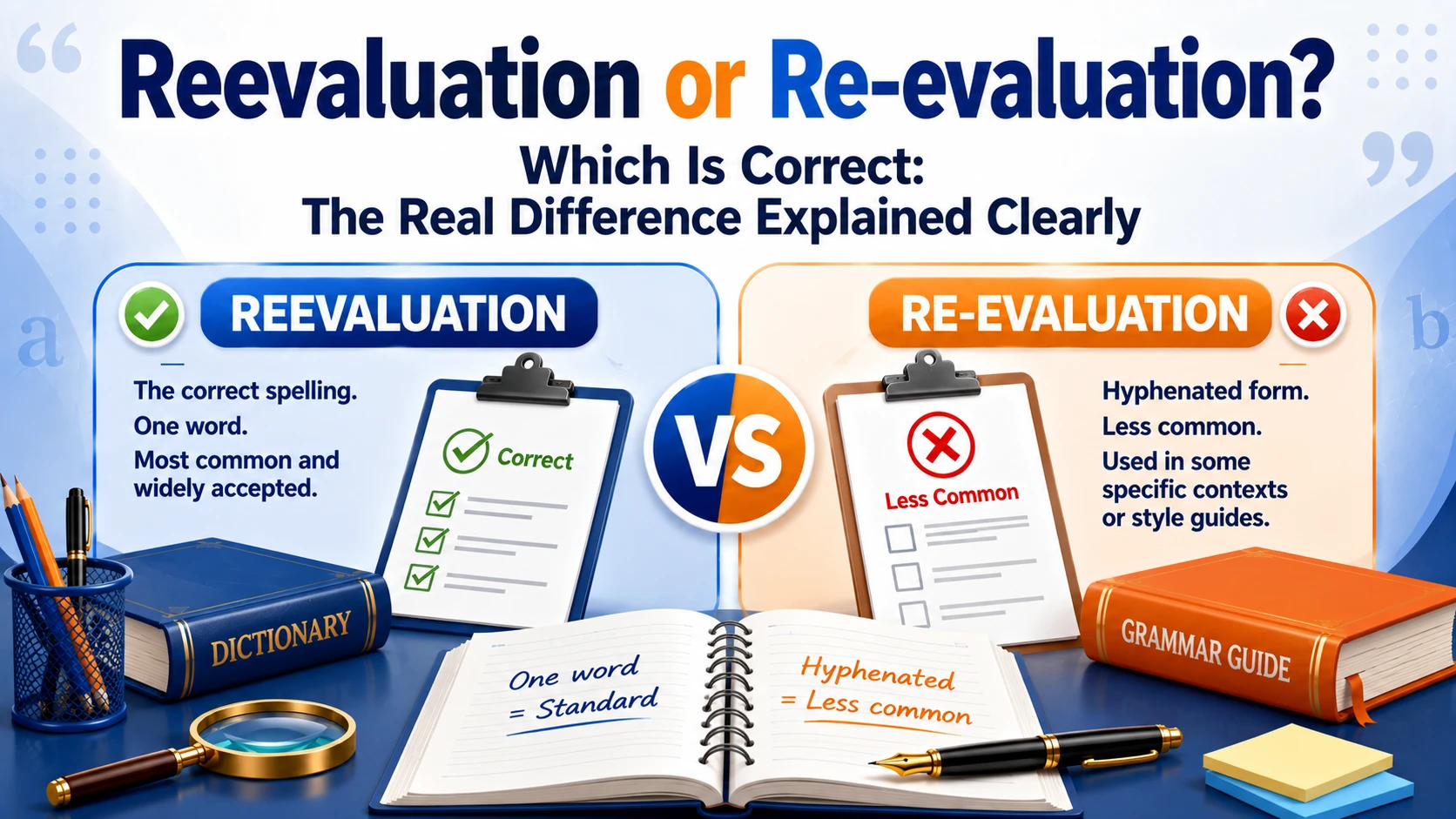
Reevaluation or re-evaluation are two spellings of the same noun, and the difference is mainly one of hyphenation, not meaning. In modern American English, reevaluation is generally the better default because the closed form is well established. Re-evaluation is also a legitimate spelling and remains common in some dictionaries, style systems, and varieties of English. If you’re writing an essay, report, website, or professional document, the real question isn’t whether one form changes the definition. It doesn’t. The more useful question is which spelling fits your style guide, audience, and surrounding vocabulary.
The word itself means the act of evaluating something again, usually because new information, changed circumstances, or a previous uncertainty makes another assessment worthwhile. You might see it in a business report, academic paper, medical discussion, performance review, or policy document. The spelling can create hesitation because English has no universal rule saying that every word beginning with re- must either have or lack a hyphen. Some forms are closed, some are hyphenated, and a few require context to determine the best treatment. Reevaluation has become a natural closed compound in general usage, while re-evaluation remains defensible in contexts that favor the hyphen.
This guide separates the meaning, spelling, grammar, style, and usage questions so you don’t have to rely on a vague “one is right, one is wrong” rule. You’ll learn why the closed spelling is a strong default, when the hyphenated version still makes sense, why re evaluation is normally not the correct form, and how related words such as reevaluate, reevaluated, reassessment, review, and reconsideration differ. Most importantly, you’ll have a practical method for choosing the form that fits your writing instead of treating the hyphen as a matter of guesswork.
Reevaluation vs. Re-evaluation: The Quick Answer
Reevaluation and re-evaluation generally have the same meaning: evaluating something again.
The main difference is spelling:
- Reevaluation = closed form, written as one word.
- Re-evaluation = hyphenated form.
- Re evaluation = normally incorrect when intended as the noun meaning “evaluation again.”
For most contemporary American English writing, reevaluation is the best default.
That doesn’t make re-evaluation an outright spelling error. The hyphenated form can still appear in edited English, particularly where a publisher, institution, dictionary, or house style prefers it.
| Form | Meaning | General status | Recommended use |
| reevaluation | Evaluation again | Standard closed form | Best general default |
| re-evaluation | Evaluation again | Established hyphenated variant | Use when style or context favors it |
| re evaluation | Evaluation again | Normally nonstandard | Avoid |
Is “reevaluation” correct?
Yes. Reevaluation is a correct English word.
It is formed from re- + evaluation, with the prefix and base word written together.
“The committee ordered a reevaluation of the proposal.”
Is “re-evaluation” correct?
Yes. Re-evaluation is also an established spelling.
“The committee ordered a re-evaluation of the proposal.”
The meaning remains the same.
Does the hyphen change the meaning?
No. In ordinary usage, the hyphen doesn’t create a different definition.
The two forms both communicate the idea of evaluating something again.
The preferred form in modern American English
If you need a simple answer for general American English, choose:
reevaluation
It is clean, familiar, and avoids an unnecessary hyphen in most ordinary contexts.
Quick rule: Use reevaluation unless a particular style guide, publication, institution, or established house style tells you to retain re-evaluation.
What Does “Reevaluation” Mean?
Definition and Meaning of Reevaluation
Reevaluation means a new or repeated evaluation of something that has already been evaluated.
The prefix re- commonly carries the meaning “again” or “anew.” Evaluation refers to the process of judging, assessing, or determining the value, quality, importance, effectiveness, or condition of something.
Put them together:
re- + evaluation = reevaluation
For example:
“The new evidence led to a reevaluation of the original conclusion.”
The sentence tells us that the original conclusion was examined again because something changed or new information became available.
Why “Reevaluation” Means “Evaluating Again”
Consider a company reviewing a project.
The project was evaluated six months ago. Since then, costs have increased and market conditions have changed.
The company might conduct a reevaluation.
That doesn’t necessarily mean the first evaluation was wrong. It simply means the original assessment may no longer be sufficient.
This distinction is useful in professional writing. Reevaluation often responds to changed circumstances, rather than automatically implying that an earlier judgment was mistaken.
Examples of Reevaluation in Everyday and Formal Writing
- “The evidence prompted a reevaluation of the case.”
- “The company announced a reevaluation of its pricing strategy.”
- “The student’s progress required a reevaluation of the original plan.”
- “The discovery led to a reevaluation of the theory.”
- “The committee completed its reevaluation of the policy.”
- “A yearly reevaluation of the program helps identify weaknesses.”
Each sentence describes an assessment that happens again.
What Does “Re-evaluation” Mean?
Definition and Meaning of Re-evaluation
Re-evaluation has essentially the same meaning as reevaluation.
It refers to evaluating something again or reconsidering its assessed value, quality, effectiveness, or significance.
For example:
“The new data resulted in a re-evaluation of the study’s findings.”
You could replace re-evaluation with reevaluation without changing the basic meaning:
“The new data resulted in a reevaluation of the study’s findings.”
Why the Hyphenated Form Is Still Used
English spelling doesn’t change at the same speed in every publication or region.
Hyphenated forms can persist even after a closed form becomes increasingly common. Writers may also retain a hyphen because:
- a house style requires it
- a dictionary lists it as a variant
- a professional field traditionally uses it
- the writer wants the word’s structure to be immediately visible
- related words in the same document use similar hyphenation
The important point is that the hyphenated spelling isn’t automatically evidence of poor grammar.
Examples of Re-evaluation in Sentences
“The results called for a re-evaluation of the original hypothesis.”
“The manager requested a re-evaluation of the employee’s performance.”
“The policy is undergoing re-evaluation.”
“The new information triggered a complete re-evaluation of the project.”
These sentences work just as well semantically with reevaluation.
Reevaluation vs. Re-evaluation: What Is the Actual Difference?
There is no meaningful difference in the core definition.
The distinction is primarily orthographic: one form is closed and the other is hyphenated.
Same Meaning, Different Styling
Think of the two forms as different presentations of the same noun:
reevaluation
re-evaluation
Neither spelling changes what the writer is saying.
This is different from pairs such as recover and re-cover, where a hyphen can distinguish two different meanings.
With reevaluation, the hyphen normally does not create a separate semantic category.
Why the Two Forms Exist Side by Side
English compounds often move through different stages of spelling.
A combination may begin as:
re-evaluation
and later become:
reevaluation
This isn’t a rigid rule that applies to every English word. Dictionaries, publishers, usage communities, and regional conventions can preserve different forms.
That’s why the presence of a hyphen shouldn’t be treated as proof that one writer understands the word and another doesn’t.
When the Hyphen Helps Readers
A hyphen can sometimes make the structure of a word easier to see:
re-evaluation
The reader immediately sees:
re- + evaluation
That can be useful in teaching or in certain technical environments.
But readability isn’t the only consideration. If a publication’s style consistently uses closed forms, adding a hyphen can actually create inconsistency.
Reevaluation vs. Re-evaluation Comparison
| Feature | Reevaluation | Re-evaluation |
| Meaning | Evaluating again | Evaluating again |
| Part of speech | Noun | Noun |
| Spelling | Closed | Hyphenated |
| Pronunciation | Essentially the same | Essentially the same |
| Semantic difference | None in ordinary use | None in ordinary use |
| American English | Strong general default | Accepted variant |
| Best approach | Use when no house style says otherwise | Use when required or preferred by the relevant style |
Is “Reevaluation” or “Re-evaluation” Preferred in American English?
Why “Reevaluation” Is Generally the Better Default
Modern English has many closed compounds formed from prefixes and established base words.
Reevaluation fits that pattern naturally.
For a general American audience, it is usually the cleaner choice:
“The committee conducted a reevaluation of the program.”
There is no need to add punctuation simply to show that re- means “again.”
When Writers May Still Choose the Hyphenated Form
A writer may choose re-evaluation when:
- a specific editorial guide uses it
- the organization has an established spelling
- the publication’s existing articles use it
- the field has a traditional preference
- the writer wants to make the prefix boundary visually obvious
The key is consistency.
If your document begins with reevaluation, don’t suddenly switch to re-evaluation halfway through unless there is a genuine reason.
Why Consistency Matters More Than Switching Forms
Imagine a 20-page report containing both:
“The reevaluation found several problems.”
and later:
“The re-evaluation process continued.”
A reader may wonder whether the author intended a distinction.
There isn’t one in ordinary usage.
Choosing one form and maintaining it throughout the document creates a cleaner editorial result.
American English vs. British English: Does the Spelling Change?
Regional spelling can influence preferences, but this isn’t a simple American = one spelling, British = another situation.
Both reevaluation and re-evaluation can be encountered in different varieties and publications.
Reevaluation in American English
For general American English, reevaluation is a strong default.
It is especially suitable for:
- websites
- business documents
- general nonfiction
- educational material
- contemporary professional writing
Re-evaluation in British and International Writing
British and international publications may retain re-evaluation in some contexts.
However, it would be misleading to claim that British English universally requires the hyphen.
English style varies by dictionary, publisher, institution, and editorial tradition.
Why Regional Preference Isn’t an Absolute Rule
A common mistake is to turn a usage tendency into an absolute grammar rule.
For example:
“British English always uses re-evaluation.”
That’s too broad.
The better approach is:
Check the style system used by your publication or institution.
If no specific style requirement exists, choose the form that is standard for your intended audience and apply it consistently.
When to Use “Reevaluation”
Use Reevaluation in General Prose
If you’re writing for a broad audience and don’t have a house style requiring the hyphen, reevaluation is a sensible choice.
“The company announced a reevaluation of its strategy.”
Use Reevaluation in Academic and Professional Writing
Academic and professional writing benefits from consistency.
If your chosen style accepts the closed form, use it throughout:
“The findings led to a reevaluation of the original assumptions.”
Don’t add a hyphen simply because the word feels visually long.
Use Reevaluation When the Meaning Is Immediately Clear
The closed form works especially well when the sentence is straightforward:
“The committee recommended reevaluation after the new evidence emerged.”
There is little risk of misunderstanding the word.
Examples of Correct Reevaluation Usage
Workplace and Business Examples
“The department is conducting a reevaluation of its hiring process.”
“Budget changes forced a reevaluation of the expansion plan.”
Academic Examples
“The discovery encouraged a reevaluation of the earlier interpretation.”
“The researchers called for a reevaluation of the available evidence.”
Medical and Professional Examples
“The patient’s progress may require a reevaluation of the treatment plan.”
Everyday Examples
“After seeing the results, I had a complete reevaluation of my assumptions.”
When “Re-evaluation” Still Makes Sense
When a Style Guide or Organization Prefers the Hyphen
If your employer, publisher, university, or professional organization has a house style that specifies re-evaluation, follow it.
Style consistency takes priority over personal preference.
When a Writer Wants to Make the Word Easier to Parse
The hyphen visually separates the prefix:
re- + evaluation
That can help readers recognize how the word was constructed.
This is a stylistic advantage, not a change in meaning.
When Maintaining Consistency With Related Terminology
Suppose a technical document already uses a series of hyphenated terms beginning with re-. A writer may choose re-evaluation to maintain a deliberate visual pattern.
The decision should be systematic rather than random.
Examples of Correct Re-evaluation Usage
“The findings prompted a re-evaluation of the original proposal.”
“The patient’s condition required further re-evaluation.”
“The committee scheduled a re-evaluation after six months.”
Why the Hyphenated Version Shouldn’t Automatically Be Called a Misspelling
A spelling can be less preferred without being incorrect.
That distinction matters in editing.
If a dictionary or established editorial source recognizes re-evaluation, calling it “wrong” is unnecessarily absolute.
A professional editor should instead ask:
- Is the form recognized?
- What does the target style prefer?
- Is the usage consistent throughout the document?
That’s a much better editorial process than treating every hyphen difference as a grammar error.
What About “Re Evaluation” Without a Hyphen?
Why “Re Evaluation” Is Normally Incorrect
If re- is functioning as a prefix meaning “again,” it normally shouldn’t be separated from evaluation by a space.
So this:
❌ “The project needs a re evaluation.”
should generally become:
✅ “The project needs a reevaluation.”
or:
✅ “The project needs a re-evaluation.”
The Difference Between a Prefix and a Separate Word
A prefix attaches to a base word.
Examples include:
- rewrite
- reconsider
- reorganize
- reevaluate
The re- in these words isn’t functioning as an independent word.
That’s why inserting a space creates an inappropriate structure.
When “Re” Could Function Independently in English
There are contexts where re can appear independently, particularly in specialized notation or correspondence where it means something like “regarding.”
For example:
“Re: Your application”
That is not the same grammatical construction as the prefix in reevaluation.
Don’t confuse the two.
Correcting Common Spacing Mistakes
| Incorrect form | Better form | Reason |
| re evaluation | reevaluation | Closed compound |
| re evaluation | re-evaluation | Hyphenated variant |
| reevaluation | Correct | Standard closed form |
| re-evaluation | Correct variant | Established hyphenated form |
How the Prefix “Re-” Works in Reevaluation
What “Re-” Means
In reevaluation, the prefix re- means roughly again or anew.
Compare:
- reevaluate = evaluate again
- reconsider = consider again
- rewrite = write again
- reorganize = organize again
That makes the meaning of reevaluation fairly transparent.
Re- + Evaluate → Reevaluate
The verb is:
reevaluate
The noun is:
reevaluation
The spelling follows the same basic closed pattern.
Why Some Re- Words Take Hyphens and Others Don’t
This is where English becomes less mechanical.
You can’t simply say:
“Every re- word must be closed.”
Nor can you say:
“Every re- word needs a hyphen.”
Different words have different established spellings.
Some hyphens help distinguish meanings:
recover vs. re-cover
Recover means regain or get better.
Re-cover means cover again.
With reevaluation, there isn’t normally a comparable meaning distinction between the closed and hyphenated forms.
Examples: Re-cover vs. Recover
“The patient began to recover.”
versus:
“We need to re-cover the old chair.”
Here, the hyphen helps distinguish two meanings.
That is a useful reminder: hyphens sometimes carry semantic weight, but not every hyphen variation does.
Why Reevaluation Usually Doesn’t Need That Distinction
The meaning of reevaluation is already clear:
evaluate again.
There isn’t a competing common meaning of reevaluation that the hyphen needs to separate.
Reevaluation as a Noun, Verb, and Related Word Forms
Understanding the word family helps prevent another common error: using the noun when the sentence needs a verb.
Reevaluation vs. Reevaluate
Reevaluation is a noun.
“The reevaluation took three weeks.”
Reevaluate is a verb.
“The committee will reevaluate the plan.”
Don’t write:
❌ “The committee will reevaluation the plan.”
Use:
✅ “The committee will reevaluate the plan.”
Reevaluated and Reevaluating
The related forms are:
- reevaluate
- reevaluates
- reevaluated
- reevaluating
- reevaluation
Examples:
“The team reevaluated the proposal.”
“The team is reevaluating the proposal.”
“The reevaluation produced a different recommendation.”
Re-evaluation, Re-evaluate, and Related Hyphenated Forms
If a style system uses the hyphenated family, you may encounter:
- re-evaluate
- re-evaluated
- re-evaluating
- re-evaluation
The important editorial principle is to maintain a coherent style.
Don’t use re-evaluate in one paragraph and reevaluation in the next without a reason.
| Word | Part of speech | Example |
| reevaluate | Verb | “We need to reevaluate the plan.” |
| reevaluation | Noun | “The plan needs reevaluation.” |
| reevaluated | Past tense/past participle | “They reevaluated the evidence.” |
| reevaluating | Present participle | “They are reevaluating the evidence.” |
Common Mistakes With Reevaluation and Re-evaluation
Assuming the Hyphenated Form Is the Only Correct Spelling
This is a frequent misconception.
Re-evaluation is not the only legitimate form.
Reevaluation is also correct and is often the better modern default.
Assuming the Closed Form Is Always Wrong
The opposite claim is equally inaccurate.
If someone tells you:
“Reevaluation is misspelled because re- must have a hyphen.”
that’s an unreliable rule.
English prefixes don’t work that mechanically.
Writing “Re Evaluation” as Two Words
This is the clearest form to avoid.
❌ re evaluation
✅ reevaluation
✅ re-evaluation
Switching Between Forms Within the Same Article
A document should normally choose one spelling and stick with it.
Inconsistent spelling makes the text look less carefully edited even when both forms are individually defensible.
Confusing Reevaluation With “Review” or “Revision”
These words overlap but aren’t identical.
A reevaluation means assessing something again.
A review can simply mean examining something.
A revision usually means changing the thing itself.
A reconsideration focuses more specifically on thinking about a decision or position again.
Using the Wrong Related Form
Remember:
reevaluate = verb
reevaluation = noun
Compare:
“We need to reevaluate the strategy.”
with:
“The strategy needs reevaluation.”
Reevaluation vs. Re-evaluation in Different Contexts
Business and Workplace Writing
Either spelling can work, depending on the organization’s style.
For example:
“The annual reevaluation of supplier contracts begins in June.”
The noun describes a formal process of assessing existing arrangements again.
Academic and Research Writing
Academic writing places a premium on consistency.
If the publication’s style uses reevaluation, follow that convention throughout the paper.
If the journal uses re-evaluation, retain the hyphen.
Medical and Professional Contexts
Medical writing may use either form depending on the publication or institution.
For example:
“The patient requires reevaluation.”
The important issue is not whether the hyphen appears. It’s whether the terminology and spelling conform to the document’s editorial standards.
Legal and Policy Writing
Legal and policy documents often use established institutional terminology.
If a regulation, agency, or organization consistently uses one form, reproducing that form may be preferable.
Websites, Blogs, and General Online Content
For general web writing, reevaluation is usually the simplest default.
It is compact, recognizable, and easy to use consistently.
Don’t add a hyphen merely because you think it makes the keyword look more formal.
Does “Reevaluation” Mean the Same as “Review”?
Not quite.
These words overlap, but choosing the more precise one can improve your writing.
| Word | Main idea | Typical implication |
| Reevaluation | Evaluate again | A previous assessment is being reconsidered |
| Review | Examine or inspect | May or may not involve a formal new evaluation |
| Reassessment | Assess again | Often emphasizes a fresh assessment based on current conditions |
| Reconsideration | Think about a decision again | Focuses on a judgment, choice, or position |
| Revision | Modify or improve | The thing being revised is changed |
Reevaluation vs. Review
“The committee conducted a review of the report.”
This could simply mean they examined it.
“The committee conducted a reevaluation of the report.”
This more strongly suggests they assessed its value, accuracy, significance, or conclusions again.
Reevaluation vs. Reassessment
Reassessment is particularly common when circumstances have changed.
For example:
“The patient’s condition required reassessment.”
Reevaluation can be broader and may focus on the value or effectiveness of a previous judgment.
The two can overlap considerably.
Reevaluation vs. Reconsideration
Reconsideration is often about a decision or position.
“The board requested reconsideration of the earlier decision.”
Reevaluation focuses more on the assessment itself.
Reevaluation vs. Revision
A revision changes the document, plan, or product.
A reevaluation reassesses it.
One may lead to the other:
reevaluation → new findings → revision
For example, a company might reevaluate a strategy and then revise it.
How to Choose Between Reevaluation and Re-evaluation
Use “Reevaluation” as Your Default
If you aren’t working under a specific house style, reevaluation is a strong choice.
Use “Re-evaluation” When Your Style Guide Calls for It
Follow the conventions of your employer, publisher, school, journal, or organization.
Check the Publication’s Existing Spelling Conventions
If you’re editing an established website, don’t change every occurrence simply because you personally prefer another form.
Look at the site’s existing terminology first.
Don’t Alternate Unnecessarily
Choose one form.
Then apply it consistently.
A Practical Decision Tree
1: Does your style guide specify the spelling?
- Yes → follow it.
- No → continue.
2: Are you writing general American English?
- Yes → reevaluation is a strong default.
- No → check the relevant regional or institutional convention.
3: Does your document already consistently use re-evaluation?
- Yes → keep the established form unless you’re deliberately editing the style.
- No → choose one form and apply it consistently.
Common Questions Writers Have About the Hyphen
Why Is Reevaluation Sometimes Written With a Hyphen?
The hyphenated spelling re-evaluation reflects the transparent construction re- + evaluation. Hyphenation conventions can persist even when a closed spelling becomes established. Different dictionaries, publishers, and style systems may therefore show different preferences.
Does Adding a Hyphen Change the Pronunciation?
Generally, no. Reevaluation and re-evaluation are pronounced essentially the same way in ordinary English. The hyphen mainly affects the written presentation of the word rather than creating a separate pronunciation.
Does the Hyphen Change the Meaning?
No. In ordinary use, reevaluation and re-evaluation mean the same thing: evaluation again. The choice is primarily a matter of spelling convention and editorial style rather than semantics.
Is “Re-evaluation” More Formal Than “Reevaluation”?
Not inherently. A hyphen doesn’t automatically make a word more formal. Reevaluation can appear in highly formal academic, professional, and technical writing. Formality comes from the overall language and context, not simply from adding punctuation.
Should I Use the Same Rule for Every Word Beginning With “Re-”?
No. English doesn’t have one universal rule that determines the spelling of every re- word. Some are closed, some are hyphenated, and some distinctions depend on meaning. Treat each established word according to accepted usage and the relevant style guide.
Should You Rely on Spellcheck for Reevaluation?
Spellcheck is useful, but it shouldn’t be your only authority.
A spellchecker may:
- accept both forms
- prefer one form based on its dictionary
- flag a form because of regional settings
- miss an inconsistency between two accepted variants
That’s why professional editing requires more than clicking “accept.”
Why Spellcheckers May Accept Both Forms
Modern spelling tools often contain multiple dictionaries or language variants.
If both reevaluation and re-evaluation are recognized, the software may accept both.
That doesn’t tell you which one your publication prefers.
Why Dictionary and Style-Guide Preferences Matter
When a spelling question involves hyphenation, consult a reputable dictionary or the style guide governing your document.
The right source depends on your purpose.
For example:
- General American writing → an authoritative American dictionary or style reference
- Academic publishing → the journal’s instructions and required style manual
- Company documentation → the organization’s house style
- British publication → the publication’s preferred British dictionary/style system
How to Verify an Uncertain Spelling
Use this order:
- Check the organization’s style guide.
- Check the publication’s existing usage.
- Consult a reputable dictionary.
- Choose one accepted form.
- Apply it consistently.
That process is more reliable than trusting a red underline.
Memory Trick: How to Remember the Preferred Spelling
Think of “Reevaluate” as One Complete Word
For a general American English audience, remember:
evaluate → reevaluate → reevaluation
The related forms can be kept together as a word family.
The “Evaluate Again” Test
When you see reevaluation, mentally expand it:
reevaluation = evaluation again
If that meaning fits your sentence, you have the right word conceptually.
A Simple Rule for Remembering the Noun
Think:
Verb: reevaluate
Noun: reevaluation
If you’re writing about the process or act, use the noun.
“The reevaluation took several weeks.”
If you’re describing what someone does, use the verb.
“The team will reevaluate the results.”
Don’t Confuse the Hyphen With a Meaning Difference
The hyphen is the easy part.
The more important distinction is between the noun and its related forms.
reevaluation = the assessment
reevaluate = perform the assessment again
Once that is clear, the spelling decision becomes much easier.
Conclusion
Reevaluation and re-evaluation mean the same thing: assessing something again. The main difference is simply hyphenation. For general contemporary American English, reevaluation is the best default when no specific editorial rule says otherwise. Re-evaluation remains an established variant and can be entirely appropriate when a publication, institution, or style guide prefers it. The form to avoid in ordinary writing is re evaluation, because re- functions as a prefix rather than a separate word. One final actionable tip: decide which spelling fits your audience and style requirements before you begin editing, then use it consistently. A common mistake to avoid is treating the hyphenated version as automatically wrong—or assuming the closed version is always mandatory. In professional writing, consistency and context matter more than personal preference.
Frequently Asked Question
Q1. Is “reevaluation” one word or two?
Reevaluation is one word. It is the closed spelling of the noun meaning an evaluation performed again. Re-evaluation is the hyphenated variant. The form re evaluation, with a space, is normally not appropriate when re- is functioning as a prefix.
Q2. Is “re-evaluation” grammatically correct?
Yes. Re-evaluation is an accepted spelling variant of reevaluation. The hyphen doesn’t change the noun’s meaning. Whether you should use it depends on your dictionary, regional convention, publication requirements, or house style.
Q3. Which is more common: reevaluation or re-evaluation?
For contemporary general American English, reevaluation is a strong default. However, re-evaluation remains established in edited writing. Rather than treating frequency as an absolute correctness test, check the style governing your particular document.
Q4. Is “re evaluation” ever correct?
Not normally when re- means “again.” In that construction, use reevaluation or re-evaluation. A separate re can occur in other contexts, such as “Re:” in correspondence, but that is a different grammatical use.
Q5. Should I use reevaluation or re-evaluation in formal writing?
Either can be appropriate if recognized by the relevant style system. If you have no specific requirement and are writing general American English, reevaluation is a practical default. The most important editorial rule is to choose one form and use it consistently.
