
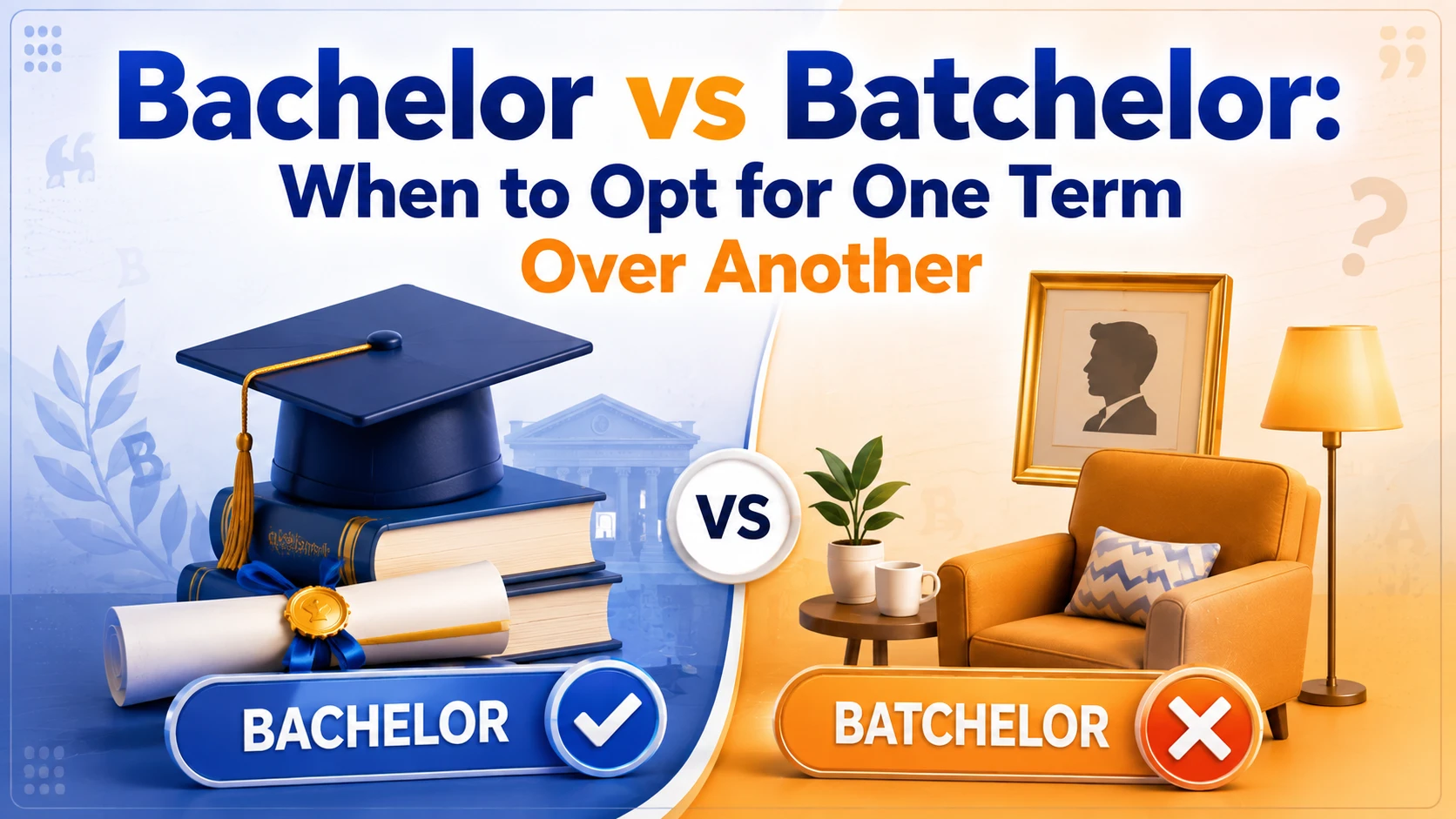
Bachelor vs Batchelor is a common spelling dilemma that catches students, job seekers, and even experienced writers off guard. At first glance, the two words appear almost identical, yet only one is correct in standard English for most situations. Whether you’re referring to an unmarried man, an academic degree, or proofreading an important document, choosing the correct spelling matters. A single misplaced letter can make your writing look unprofessional or lead readers to question its accuracy. This guide explains the difference clearly, helping you use the right term with confidence.
Many people assume Batchelor is simply an alternative spelling of Bachelor, but that’s rarely true. In modern English, Bachelor is the accepted spelling found in dictionaries and style guides, while Batchelor is generally encountered as a surname, business name, or place name rather than a standard vocabulary word. Understanding this distinction saves you from common spelling mistakes and helps you write more precisely in academic, professional, and everyday contexts.
Whether you’re writing about a bachelor’s degree, describing someone’s marital status, completing a résumé, or editing formal content, this article covers everything you need to know. You’ll learn the meanings of both terms, discover why people often confuse them, see practical examples, explore grammar rules, and understand the few situations where Batchelor is actually correct. By the end, you’ll know exactly when to use Bachelor and when Batchelor belongs only as a proper name.
Bachelor vs Batchelor: The Quick Answer
If you’re looking for the short answer, here it is:
- Bachelor is the correct English spelling. It refers to an unmarried man, a person who holds a bachelor’s degree, or appears in several traditional expressions.
- Batchelor is not the standard spelling of the English word. In most cases, it is simply a misspelling of Bachelor. However, Batchelor is a legitimate surname and may also appear in business names, geographic locations, or organizations.
That means if you’re writing about education, relationships, or general English vocabulary, you almost always need Bachelor.
Which Spelling Is Correct?
For standard English writing, the answer is simple:
✅ Bachelor
❌ Batchelor (unless it’s someone’s name or part of an official title)
Major English dictionaries consistently recognize Bachelor as the correct spelling.
Examples:
- He earned a Bachelor of Science in Biology.
- My brother is still a bachelor.
- She completed her bachelor’s degree last year.
Is “Batchelor” Ever Correct?
Yes—but only in specific contexts.
Batchelor is correctly used when it forms part of a proper noun, such as:
- A person’s last name
- A company name
- A school or institution
- A geographic location
For example:
- Dr. Batchelor published a new research paper.
- We met Professor Batchelor after the conference.
In these examples, Batchelor isn’t replacing the English noun bachelor. Instead, it functions as a surname.
Key takeaway: If you’re talking about a degree or an unmarried man, use Bachelor. If you’re referring to someone’s official name, use Batchelor exactly as it’s spelled.
Quick Comparison Table
| Feature | Bachelor | Batchelor |
| Standard English spelling | ✅ Yes | ❌ No |
| Found in dictionaries as a common noun | ✅ Yes | ❌ No |
| Means an unmarried man | ✅ Yes | ❌ No |
| Refers to an academic degree | ✅ Yes | ❌ No |
| Used as a surname | Sometimes | ✅ Yes |
| Appropriate in everyday writing | ✅ Yes | Only as a proper noun |
What Does “Bachelor” Mean?
The word Bachelor has several accepted meanings in English, but they all share one thing in common: they are recognized by dictionaries, educational institutions, and style guides.
Most people encounter the word in one of two situations:
- Describing an unmarried adult man
- Referring to an undergraduate academic degree
Depending on the context, the intended meaning becomes immediately clear.
Dictionary Definition
As a noun, bachelor commonly means:
- An unmarried adult man.
- A person who has earned a bachelor’s degree from a college or university.
Historically, the word has also referred to a junior member of certain professions or organizations, although these uses are far less common today.
Bachelor as an Unmarried Man
One of the oldest and most familiar meanings of bachelor is an adult man who has never been married.
Examples:
- My cousin has remained a bachelor throughout his life.
- He enjoys the freedom that comes with being a bachelor.
- The magazine featured several successful young bachelors.
It’s worth noting that in modern English, the term describes marital status, not lifestyle or personality. A bachelor may live alone, with roommates, or with family members. Likewise, not every unmarried man identifies with the label, so context and personal preference still matter.
Expert insight: In legal or demographic contexts, “bachelor” may simply indicate that a man has never married. In everyday conversation, however, the word sometimes carries social or cultural connotations that vary by region.
Bachelor as an Academic Degree
The second major meaning of Bachelor appears in education.
A bachelor’s degree is an undergraduate academic qualification awarded by colleges and universities after completing an approved program of study. Depending on the country and institution, earning this degree typically takes three to four years of full-time study.
Common examples include:
- Bachelor of Arts (BA)
- Bachelor of Science (BS or BSc)
- Bachelor of Business Administration (BBA)
- Bachelor of Engineering (BE or BEng)
- Bachelor of Fine Arts (BFA)
Examples in sentences:
- She completed her Bachelor of Science in Computer Science.
- After earning his bachelor’s degree, he began working as an engineer.
- Many graduate programs require applicants to hold a bachelor’s degree.
Unlike the meaning related to marital status, this usage always refers to an academic qualification.
Other Accepted Meanings of Bachelor
Although less common today, Bachelor appears in a few traditional and specialized contexts.
Bachelor in Professional Titles
Certain historical institutions and professional organizations have used Bachelor as part of an official title.
Examples include:
- Bachelor of Divinity
- Bachelor of Laws
- Bachelor of Medicine
Many universities continue to award these degrees, even though modern naming conventions have evolved in some countries.
Bachelor in Historical and Traditional Contexts
Older English literature occasionally uses bachelor to describe:
- A young knight who had not yet achieved full rank
- A junior member of a guild
- Someone holding an introductory level within an organization
While these meanings still appear in historical texts, they are uncommon in contemporary everyday English.
Correct Sentence Examples
Seeing the word used naturally makes it easier to remember the correct spelling.
Everyday English
- David has been a bachelor for several years.
- My uncle remained a bachelor throughout his career.
- Many young professionals choose to stay bachelors until later in life.
Academic Writing
- She earned a Bachelor of Arts in English Literature.
- A bachelor’s degree is often the minimum educational requirement for this position.
- The university offers more than fifty bachelor’s degree programs.
Professional Communication
- Applicants must possess at least a bachelor’s degree in accounting.
- The position requires a Bachelor of Engineering or equivalent qualification.
- His Bachelor of Business Administration prepared him for management roles.
Common Situations Where You’ll Use “Bachelor”
Understanding where the word naturally appears can help you avoid spelling mistakes.
You’ll commonly see Bachelor in:
- University admissions
- Degree certificates
- Résumés and CVs
- Job advertisements
- Scholarship applications
- Graduation ceremonies
- Census and demographic reports
- Relationship discussions
- Academic transcripts
- Professional licensing requirements
For example:
Candidates must hold a bachelor’s degree from an accredited institution.
or
According to the survey, nearly one-third of respondents identified as bachelors.
Recognizing these common contexts makes the correct spelling almost automatic.
Common Words Frequently Used with “Bachelor”
Certain words regularly appear alongside Bachelor, especially in academic and professional writing.
Some of the most common collocations include:
- Bachelor’s degree
- Bachelor of Arts
- Bachelor of Science
- Bachelor of Engineering
- Eligible bachelor
- Lifelong bachelor
- Bachelor apartment
- Bachelor program
- Bachelor thesis
- Bachelor’s certificate
- Bachelor’s qualification
- Undergraduate degree
- Academic credential
- Degree holder
- University graduate
Learning these natural word combinations will improve both your writing accuracy and your vocabulary.
Did You Know? The apostrophe in bachelor’s degree is important because the degree originally meant a degree belonging to or awarded at the bachelor level. Omitting the apostrophe—writing bachelor degree—is considered incorrect in standard English, although some institutional names may follow their own official style.
What Does “Batchelor” Mean?
Unlike Bachelor, Batchelor is not a standard English noun. If you write Batchelor when referring to an unmarried man or an academic degree, you’ve almost certainly made a spelling mistake. However, that doesn’t mean the word is always incorrect. Batchelor exists as a proper noun, primarily as a surname and occasionally as part of official names for businesses, organizations, and places.
Understanding this distinction is important because spell-checkers may not always flag Batchelor as an error when it’s capitalized or used in a name. The key is to determine whether you’re using it as a common noun or as an official name.
Is Batchelor a Real Word?
Yes—but not in the way most people think.
Batchelor is a legitimate family name, not an alternative spelling of the English word bachelor.
For example:
- Professor Batchelor presented the keynote speech.
- Dr. Batchelor published a study on environmental policy.
- The award was established by the Batchelor Foundation.
In each case, Batchelor is part of a person’s or organization’s official name.
Important: If you’re writing about education, marriage, employment, or general English vocabulary, Bachelor is the correct spelling.
Why People Spell “Bachelor” as “Batchelor”
The extra “t” in Batchelor isn’t random. It usually appears because of the way English speakers pronounce the word.
Several factors contribute to this common mistake:
- The “ch” sound leads some writers to assume a “tch” spelling.
- English contains many words such as catch, kitchen, and watch, where “tch” follows a short vowel.
- People often spell words according to sound rather than memorized spelling.
- Fast typing and proofreading oversights allow the mistake to slip through.
This is an example of a phonetic spelling error—the writer records what they hear instead of the standard spelling.
When “Batchelor” Is Correct as a Proper Noun
There are situations where changing Batchelor to Bachelor would actually create an error.
These include official names that must retain their original spelling.
Batchelor as a Surname
Many individuals around the world have the surname Batchelor.
Examples:
- Sarah Batchelor
- David Batchelor
- Professor Batchelor
Changing the spelling of someone’s name is incorrect, even if it resembles a common English word.
Businesses and Place Names Using “Batchelor”
You’ll also encounter Batchelor in the names of organizations, institutions, and geographic locations.
Examples might include:
- Batchelor Enterprises
- Batchelor Road
- Batchelor Institute
- Batchelor Park
Because these are official names, they should always be written exactly as registered.
Examples Showing the Difference
The easiest way to understand the distinction is by comparing correct and incorrect usage.
| Sentence | Correct? | Why |
| She earned a Bachelor of Arts. | ✅ | Standard academic degree. |
| He has remained a bachelor for years. | ✅ | Correct common noun. |
| Professor Batchelor teaches history. | ✅ | Proper surname. |
| I completed my Batchelor’s degree. | ❌ | Should be Bachelor’s degree. |
| Every Batchelor must sign the application. | ❌ | Should be Bachelor if referring to the noun. |
Bachelor vs Batchelor: Side-by-Side Comparison
Although only one letter separates these spellings, they serve entirely different purposes.
| Feature | Bachelor | Batchelor |
| Standard dictionary word | ✅ Yes | ❌ No |
| Correct English spelling | ✅ Yes | ❌ No |
| Common noun | ✅ Yes | ❌ No |
| Academic degree | ✅ Yes | ❌ No |
| Unmarried man | ✅ Yes | ❌ No |
| Proper surname | Rare | ✅ Yes |
| Everyday writing | Frequently | Only when it’s an official name |
Meaning
Bachelor
A recognized English noun referring to:
- an unmarried adult man
- a person holding a bachelor’s degree
- certain traditional academic or professional titles
Batchelor
A proper noun used mainly as:
- a surname
- a business name
- an institution’s name
- a geographic name
The meanings do not overlap.
Spelling
This is where most confusion begins.
Correct:
- bachelor
- bachelor’s
- Bachelor of Science
- Bachelor of Arts
Incorrect:
- batchelor
- batchelor’s degree
- batchelor of science
Unless Batchelor is someone’s official name, avoid inserting the extra t.
Pronunciation
Interestingly, the pronunciation remains almost identical.
| Word | Approximate Pronunciation |
| Bachelor | BACH-uh-lər |
| Batchelor (surname) | Usually pronounced the same |
Because the spoken forms are so similar, pronunciation offers little help when deciding which spelling to use. Context is far more reliable.
Grammar and Part of Speech
| Word | Part of Speech |
| Bachelor | Common noun |
| Batchelor | Proper noun (usually a surname) |
This grammatical distinction explains why one word appears in dictionaries while the other generally appears in directories, biographies, and official records.
Common Usage
You’ll commonly encounter Bachelor in:
- university websites
- degree certificates
- employment advertisements
- educational articles
- grammar resources
- dictionaries
You’ll encounter Batchelor in:
- family names
- author names
- research publications
- company registrations
- maps and addresses
Recognizing where the word appears often tells you immediately which spelling belongs.
How to Know Which One to Use
If you’re unsure which spelling is correct, don’t rely on memory alone. Instead, think about what you’re referring to.
Writing About Education
Whenever the topic involves:
- college
- university
- undergraduate study
- academic qualifications
- degree programs
use Bachelor.
Examples:
- Bachelor of Engineering
- bachelor’s degree
- Bachelor of Fine Arts
Never write:
❌ Batchelor’s degree
Writing About Marital Status
Use bachelor whenever describing an unmarried adult man.
Examples:
- He’s still a bachelor.
- The novel follows the life of a wealthy bachelor.
- Census data recorded the number of bachelors in the city.
Again, Batchelor is incorrect here.
Referring to a Person’s Name
If someone’s legal surname is Batchelor, preserve the spelling exactly.
Examples:
- Professor Batchelor
- Ms. Batchelor
- The Batchelor family
Names should never be altered simply because they resemble dictionary words.
A Simple Decision Guide
Use this quick checklist whenever you’re writing.
| Ask Yourself… | Correct Choice |
| Am I referring to an academic degree? | Bachelor |
| Am I describing an unmarried man? | Bachelor |
| Is this someone’s surname? | Batchelor |
| Is this an official business or place name? | Batchelor |
| Could I replace it with “Bachelor of Arts” or “Bachelor’s degree”? | Bachelor |
| Am I writing normal English rather than someone’s name? | Bachelor |
Quick Tip: If you’re unsure, ask yourself whether the word could appear in a dictionary definition or on a university diploma. If the answer is yes, Bachelor is almost certainly correct. If it appears on a passport, company registration, or street sign, Batchelor may be the intended spelling.
A Practical Editing Checklist
Before publishing or submitting your writing, take a few seconds to verify the spelling.
- ✓ Does the sentence discuss education or degrees?
- ✓ Is the word describing an unmarried man?
- ✓ Is it part of a person’s official name?
- ✓ Have you accidentally inserted an extra “t”?
- ✓ Have you checked any proper names against reliable sources?
This quick review helps eliminate one of the most common spelling errors involving Bachelor.
Editor’s Note: In professional writing, small spelling mistakes can undermine credibility. While Batchelor is perfectly correct as a surname, using it in place of Bachelor in academic, legal, or business writing creates an avoidable error. Paying attention to context—not just pronunciation—is the simplest way to get it right every time.
Common Mistakes and How to Avoid Them
Most errors involving Bachelor and Batchelor happen because writers rely on pronunciation instead of the correct spelling. While the difference is only one letter, using the wrong form can make an academic paper, résumé, or professional email appear less polished.
Here are the mistakes you’ll see most often—and how to avoid them.
Writing “Batchelor’s Degree” Instead of “Bachelor’s Degree”
This is by far the most common error.
❌ She earned her Batchelor’s degree in Chemistry.
✔ She earned her Bachelor’s degree in Chemistry.
Universities, employers, and official documents all use Bachelor’s degree. If you add an extra “t,” you’re creating a spelling mistake unless you’re referring to someone’s surname.
Misspelling Bachelor in Formal Documents
Applications, résumés, LinkedIn profiles, and university forms should always use the standard spelling.
Incorrect spelling in these documents may give employers or admissions officers the impression that the document wasn’t carefully proofread.
Examples:
❌ Bachelor of Arts → Batchelor of Arts
❌ Bachelor of Science → Batchelor of Science
Always compare your wording with the official degree title awarded by your institution.
Confusing Bachelor with Bachelorette
These words are related but have different meanings.
| Word | Meaning |
| Bachelor | An unmarried man or a person holding a bachelor’s degree |
| Bachelorette | An unmarried woman (less common in formal English) or a woman celebrated before marriage in a bachelorette party |
Because the meanings differ, they should never be substituted for one another.
Assuming Every “Batchelor” Is a Spelling Mistake
This assumption can also create problems.
If you’re editing a document that mentions:
- Professor Batchelor
- Dr. Batchelor
- The Batchelor Foundation
do not change the spelling automatically.
Proper names must always retain their official spelling.
Proofreading Tips
Before submitting your work, check the following:
- Is the word referring to education?
- Does it describe marital status?
- Is it part of someone’s legal name?
- Did spell-check miss a contextual error?
- Have you copied the official degree title exactly?
A careful thirty-second review can prevent an embarrassing mistake.
Grammar Rules for Bachelor
Besides spelling, many writers struggle with capitalization, plurals, and apostrophes.
Understanding these grammar rules helps you write more naturally.
Is Bachelor a Noun?
Yes.
Bachelor is primarily a countable noun.
Examples:
- He is a bachelor.
- Several bachelors attended the event.
- She completed a Bachelor of Science.
Depending on context, it can refer to either a person or an academic qualification.
Singular and Plural Forms
The plural depends on the meaning.
| Singular | Plural |
| bachelor | bachelors |
| bachelor’s degree | bachelor’s degrees |
Examples:
- Two bachelors rented the apartment.
- The university offers more than thirty bachelor’s degrees.
Bachelor’s vs Bachelors
This is another common source of confusion.
Bachelor’s (with an apostrophe) is used when referring to the degree.
Examples:
- Bachelor’s degree
- Bachelor’s program
- Bachelor’s thesis
Bachelors (without an apostrophe) is simply the plural noun.
Examples:
- The television show featured several bachelors.
- Many bachelors attended the networking event.
Remember:
- Bachelor’s = degree
- Bachelors = multiple unmarried men
When to Capitalize Bachelor’s Degree
Capitalization depends on context.
Use lowercase for general references:
- bachelor’s degree
- bachelor’s program
- bachelor’s student
Capitalize official degree names:
- Bachelor of Arts
- Bachelor of Science
- Bachelor of Engineering
- Bachelor of Fine Arts
This follows the style guidance used by many universities and editorial style guides.
Is Bachelor Ever Used as an Adjective?
Occasionally.
Examples include:
- bachelor apartment
- bachelor lifestyle
- bachelor party
In these cases, bachelor modifies another noun rather than acting as the main noun itself.
Bachelor’s Degree vs Bachelor Degree
This question appears frequently because both versions circulate online.
Which Form Is Grammatically Correct?
The correct expression is:
✅ Bachelor’s degree
The possessive apostrophe reflects the traditional meaning of the qualification.
Examples:
- She completed her bachelor’s degree in Economics.
- A bachelor’s degree is required for this position.
The version Bachelor degree is generally considered incorrect in standard English unless it forms part of an institution’s official wording.
Why the Apostrophe Matters
The apostrophe indicates possession.
Historically, the degree belonged to the level or rank of bachelor, which is why the possessive form became standard.
Although many people omit the apostrophe in casual writing, professional, academic, and published content should retain it.
Examples in Academic Writing
Correct:
- Applicants must hold a bachelor’s degree.
- The university awarded 500 bachelor’s degrees this year.
- She earned a Bachelor of Arts in Psychology.
Incorrect:
- Bachelor degree
- Batchelor degree
- Batchelor’s degree
Bachelor vs Bachelor’s vs Bachelor’s Degree
These expressions are related but not interchangeable.
| Expression | Correct Usage | Example |
| Bachelor | Person or official degree title | Bachelor of Science |
| Bachelor’s | Possessive adjective | Bachelor’s thesis |
| Bachelor’s degree | Complete academic qualification | She earned a bachelor’s degree. |
Using the right form depends on whether you’re referring to a person, an official degree title, or the qualification itself.
Correct Examples
- He is a lifelong bachelor.
- She earned a Bachelor of Science.
- His bachelor’s degree helped him qualify for graduate school.
- The bachelor’s program begins in September.
Common Writing Errors
Avoid these common mistakes:
❌ bachelor’s of science
✔ Bachelor of Science
❌ bachelor science degree
✔ bachelor’s degree in science
❌ batchelor’s degree
✔ bachelor’s degree
These small corrections make your writing appear much more professional.
Words Commonly Confused with Bachelor
Several similar terms create confusion because they relate to education or relationships.
Bachelor vs Bachelorette
A bachelor traditionally refers to an unmarried man, while bachelorette refers to an unmarried woman. Today, however, bachelorette is most commonly associated with pre-wedding celebrations, whereas bachelor remains the standard term for both marital status and phrases like bachelor party.
Bachelor vs Graduate
A graduate is anyone who has successfully completed a course of study.
A bachelor is someone who has earned a bachelor’s degree—or, in another context, an unmarried man.
Someone with a master’s or doctoral degree is a graduate but not necessarily a bachelor’s degree holder.
Bachelor vs Undergraduate
An undergraduate is a student currently studying toward a bachelor’s degree.
A person becomes a bachelor’s degree holder only after successfully completing the program.
Bachelor vs Spinster (Historical Usage)
Historically, spinster described an unmarried woman.
Modern English rarely uses this word because it can sound outdated or offensive. In contrast, bachelor remains a neutral and widely accepted term.
Memory Tricks to Remember the Correct Spelling
Memorization becomes easier when you connect the spelling to familiar ideas.
Easy Spelling Rule
Remember:
Bachelor has no extra “t.”
If you automatically type Batchelor, pause and remove the extra letter.
Visual Memory Technique
Picture a university diploma with the words:
Bachelor of Science
You’ve probably seen this phrase many times on graduation certificates and university websites. Recalling that familiar image makes the correct spelling much easier to remember.
One-Sentence Memory Trick
Every university awards a Bachelor’s degree—not a Batchelor’s degree.
This simple sentence reinforces both the correct spelling and the correct apostrophe usage.
Expert Writing Tips
Writers, editors, and recruiters rarely struggle with Bachelor because they rely on context rather than pronunciation.
Here are a few habits worth adopting.
In Academic Writing
Always copy the official degree title exactly as your university presents it.
Examples:
- Bachelor of Arts
- Bachelor of Science
- Bachelor of Engineering
Consistency is especially important on résumés, research papers, and graduate school applications.
In Professional Communication
When writing job descriptions or reviewing applications:
- verify degree names carefully
- preserve official capitalization
- proofread apostrophes
- avoid phonetic spelling
Small details contribute to a professional impression.
In Everyday English
Use bachelor naturally when referring to an unmarried man, but avoid assuming it describes someone’s lifestyle or personal choices. In many contexts, it’s simply a neutral description of marital status.
When Referring to Proper Names
Always verify the spelling of surnames.
If a person’s last name is Batchelor, never “correct” it to Bachelor.
Likewise, if the word refers to the common English noun, don’t add the extra “t.”
Professional Tip: Whenever you’re editing educational or employment documents, compare the spelling against an official university transcript or degree certificate. This simple habit prevents one of the most common errors in academic and professional writing.
Key Takeaways
| Question | Correct Answer |
| Which spelling is correct in standard English? | Bachelor |
| What does Bachelor mean? | An unmarried man or a person holding an undergraduate degree, depending on the context. |
| Is Batchelor a standard English word? | No. It is generally used only as a surname or another proper noun. |
| Can Batchelor ever be correct? | Yes, when it is part of a person’s legal name, a business name, or a place name. |
| How do you write the academic qualification? | Bachelor’s degree or the official title, such as Bachelor of Science. |
| Best memory rule | Degrees and dictionaries use Bachelor. Names may use Batchelor. |
Editor’s Note: Correct spelling reflects attention to detail and strengthens your credibility as a writer. Whether you’re updating a résumé, preparing university applications, writing academic content, or proofreading professional documents, using Bachelor and Batchelor correctly ensures your message is clear, accurate, and trustworthy. A single letter can make a significant difference, especially in formal writing where precision matters.
Conclusion
Choosing between Bachelor and Batchelor is easier once you understand their roles. Bachelor is the correct English spelling for an unmarried man, a bachelor’s degree, and related academic or general contexts. Batchelor, on the other hand, is typically used only as a surname or part of an official name. Paying attention to context will help you avoid one of the most common spelling mistakes in English. One final actionable tip: whenever you’re writing about education, compare the degree title with your university’s official wording before publishing or submitting your work. A common mistake to avoid is adding an unnecessary “t” simply because the pronunciation seems to suggest it. Master this distinction once, and your writing will become more accurate, professional, and credible.
Frequently Asked Questions
Q1. Is “Batchelor” always a misspelling?
No. Batchelor is a legitimate surname and may appear in official business names, institutions, or place names. However, if you’re referring to an unmarried man or an academic degree, Bachelor is the correct spelling in standard English.
Q2. Why is it spelled “Bachelor” and not “Batchelor”?
Bachelor is the historically accepted spelling in English and is recognized by major dictionaries and educational institutions. The spelling Batchelor usually results from a phonetic mistake, where writers add an extra “t” because of how the word sounds when spoken.
Q3. Is “Bachelor’s degree” always written with an apostrophe?
Yes. In standard English, bachelor’s degree includes an apostrophe because it’s the grammatically correct possessive form. However, official degree titles, such as Bachelor of Arts or Bachelor of Science, do not use an apostrophe because they are formal names.
Q4. Can Batchelor be someone’s last name?
Yes. Batchelor is a recognized family name, so you may see it in personal names, company names, or institutional titles. When it appears as a proper noun, the spelling should never be changed, even though it differs from the common English word Bachelor.
Q5. How can I remember the correct spelling of bachelor?
A simple way to remember it is this: universities award a “Bachelor’s degree,” not a “Batchelor’s degree.” If you’re writing about education or an unmarried man, use Bachelor. Reserve Batchelor only for someone’s official surname or another proper name.
