
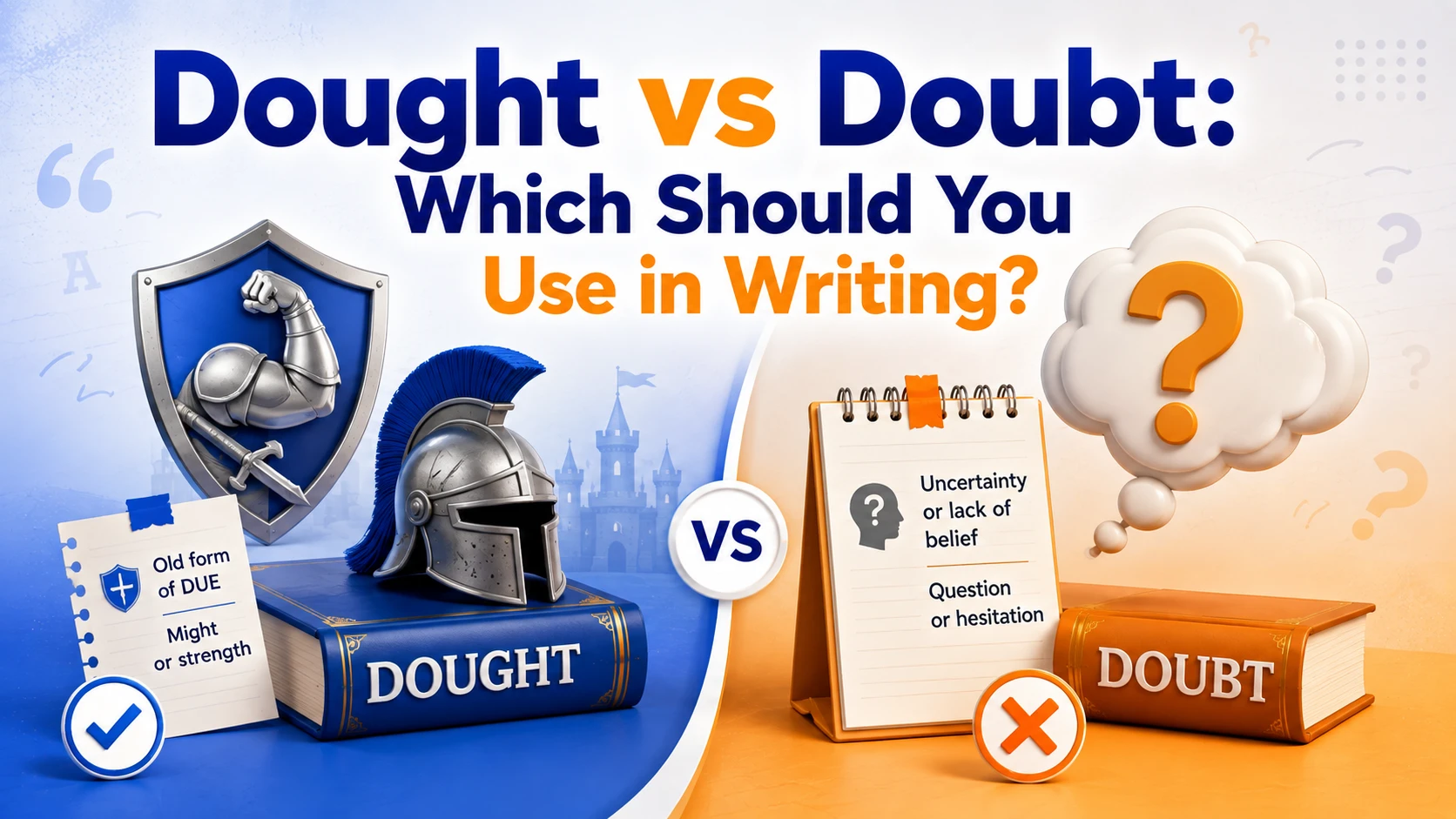
Doubt is the correct spelling in modern English, while dought is almost always a misspelling or an obsolete word found only in historical texts. Yet many writers pause when they see these two spellings because English is full of words ending in -ought, such as thought, brought, and fought. It’s easy to assume that dought follows the same pattern. In reality, it doesn’t. Understanding why can save you from an embarrassing spelling mistake and improve the clarity of your writing.
Whether you’re writing an essay, an email, a business report, or a social media post, using the correct word reflects attention to detail and strengthens your credibility. Readers may overlook a typo once or twice, but consistently using incorrect spellings can distract them from your message. That’s especially important for students, professionals, and anyone who writes for an audience.
This guide explains the difference between dought and doubt, explores their meanings and history, shows when each word is appropriate, and provides practical examples you can use immediately. You’ll also learn why people confuse these words, how to remember the correct spelling, and which common mistakes professional editors look for.
The Short Answer
If you’re looking for the quick answer, here it is:
- Doubt is the correct spelling in modern English.
- Dought is not accepted in standard English writing.
- You should use doubt in almost every situation.
- The only time you’ll encounter dought is in historical documents, old literature, or discussions about language history.
Quick Tip: If you’re expressing uncertainty, hesitation, or lack of confidence, the correct word is always doubt.
Dought vs Doubt at a Glance
| Feature | Doubt | Dought |
| Modern English | ✅ Correct | ❌ Incorrect in standard usage |
| Meaning | Uncertainty or lack of confidence | Obsolete historical form |
| Part of Speech | Noun and Verb | Historical or dialectal word |
| Found in Modern Dictionaries | Yes | Usually marked obsolete or omitted |
| Suitable for Everyday Writing | Yes | No |
| Recommended Usage | Always | Only in historical discussions |
The comparison makes one thing clear: doubt is the only spelling you should normally use.
What Does “Doubt” Mean?
Definition of Doubt
Doubt refers to uncertainty, disbelief, hesitation, or lack of confidence. It can describe a feeling, a thought, or the act of questioning whether something is true or likely to happen.
The word functions as both a noun and a verb, making it one of the most versatile words in English.
For example:
- I have no doubt you’ll succeed.
- She doubts the accuracy of the report.
- His explanation removed everyone’s doubts.
In each example, the central idea is uncertainty.
The Origin of the Word “Doubt”
The history of doubt explains why its spelling seems unusual.
The word entered English from the Old French word doute, which originated from the Latin verb dubitare, meaning to hesitate or question.
During the Renaissance, scholars restored the silent b to reflect its Latin origin. Although the spelling changed, the pronunciation remained simple. That’s why the b is still silent today.
Understanding this history makes the spelling easier to remember because it wasn’t created randomly—it reflects centuries of language development.
Common Meanings of Doubt
The word doubt appears in several different situations.
Expressing Uncertainty
The most common use describes uncertainty about facts or outcomes.
Examples:
- I doubt we’ll arrive before noon.
- Many people doubted the prediction.
Showing Lack of Confidence
Sometimes doubt refers to uncertainty about your own abilities.
Examples:
- Self-doubt kept her from applying.
- Don’t let doubt stop your progress.
Expressing Skepticism
Doubt can also mean questioning someone’s claim or evidence.
Examples:
- Scientists doubt the results until further testing.
- The jury had reason to doubt the witness.
Synonyms of Doubt
Depending on the context, you could replace doubt with:
- uncertainty
- hesitation
- skepticism
- suspicion
- disbelief
- reservation
- concern
- mistrust
Each carries a slightly different nuance, but all relate to questioning or uncertainty.
Antonyms of Doubt
Words with the opposite meaning include:
- certainty
- confidence
- assurance
- belief
- trust
- conviction
- faith
Choosing the right opposite depends on the context in which doubt appears.
What Does “Dought” Mean?
Is Dought a Real Word?
Technically, yes.
Practically, no.
Dought existed in older forms of English and occasionally appears in historical records or regional dialects. However, it is not part of standard modern English.
If you’re writing for today’s readers, you should almost never use it.
Historical Background
Before English spelling became standardized, writers often spelled words differently.
Because of that, forms resembling dought appeared in medieval and early modern texts. Those spellings gradually disappeared as dictionaries established consistent standards.
Today, you’ll mostly encounter dought in:
- historical manuscripts
- linguistic research
- old poetry
- archived documents
- discussions about obsolete English
Outside these specialized situations, it has little practical use.
Why Modern Dictionaries Prefer “Doubt”
Modern dictionaries aim to reflect current language usage rather than preserve every historical spelling.
Since virtually all contemporary writers use doubt, dictionaries list it as the standard spelling. When dought appears, it is typically labeled as:
- obsolete
- archaic
- historical
- dialectal
That labeling tells readers the word belongs to an earlier stage of English rather than everyday communication.
Why People Mistype “Dought”
This mistake happens because English contains many familiar words ending in -ought.
For example:
- thought
- bought
- sought
- fought
- brought
- ought
After seeing these spellings repeatedly, writers sometimes assume doubt follows the same pattern.
This is a classic example of spelling pattern interference, where the brain incorrectly applies a familiar letter combination to a different word.
Professional editors encounter this mistake regularly, especially in first drafts. Fortunately, once you recognize the pattern, it’s easy to avoid.
Why People Confuse Dought and Doubt
English spelling isn’t always logical. Many spelling mistakes happen because our brains rely on familiar patterns rather than memorizing every individual word. The confusion between dought and doubt is a perfect example. Even native English speakers occasionally type dought without realizing it because it looks like it belongs alongside other common English words.
Understanding why this mistake happens makes it much easier to avoid.
Similar Letter Patterns in English
One reason people write dought is that English contains many frequently used words ending in -ought.
Examples include:
- thought
- brought
- bought
- fought
- sought
- ought
Because these words appear so often, your brain naturally begins to expect the same spelling pattern elsewhere. When you hear the sound in doubt, it’s easy to mistakenly insert -gh-, even though it doesn’t belong.
This is called analogy-based spelling, where a familiar spelling pattern influences another word.
Silent Letters Make English More Challenging
Another source of confusion is the presence of silent letters.
The word doubt contains a silent b, while words like thought contain the letters gh, which together produce a different pronunciation pattern.
Compare them:
| Word | Silent Letter(s) | Pronunciation |
| doubt | b | /dout/ |
| thought | gh | /thawt/ |
| bought | gh | /bawt/ |
| brought | gh | /brawt/ |
Although these words look similar on paper, they developed from different historical roots. Their spellings reflect different stages of language evolution rather than a single consistent rule.
The Influence of Similar Words
Your brain recognizes visual patterns much faster than it analyzes spelling rules.
Imagine you’ve just written:
- thought
- fought
- bought
The next time you need to write doubt, your fingers may automatically produce dought because the -ought ending feels familiar.
This is a common typing habit rather than a misunderstanding of meaning.
Professional proofreaders often notice this error because writers focus on expressing ideas, not individual letters.
Autocorrect Doesn’t Catch Every Mistake
Many writers rely on spell-check software, but that isn’t always enough.
Some writing tools may:
- overlook rare spellings
- fail to recognize contextual errors
- miss historical forms
- ignore names or specialized vocabulary
That’s why experienced editors still proofread manually.
Good writing depends on careful review, not just technology.
When Should You Use “Doubt”?
For almost every modern writing situation, doubt is the correct choice.
Whether you’re writing formally or casually, readers expect this standard spelling.
Everyday Conversation
Most uses of doubt appear in ordinary conversation.
Examples include:
- I doubt he’ll arrive before lunch.
- There’s no doubt she worked hard.
- We doubted the weather forecast.
These sentences sound natural because doubt is part of everyday English.
Academic Writing
In schools, colleges, and universities, doubt appears frequently in essays, research papers, and reports.
For example:
- Researchers expressed doubt about the initial findings.
- There is little doubt that climate affects agriculture.
- Historians doubt the accuracy of the legend.
Academic writing values precision, making correct spelling especially important.
Business and Professional Communication
Professional writing should always use doubt.
Examples include:
- We have no doubt that your application has been received.
- Investors expressed doubt regarding future profits.
- The committee doubted whether the proposal met safety standards.
Using dought in business communication may create the impression of poor proofreading.
Creative Writing
Novelists and storytellers frequently use doubt to describe emotions and internal conflict.
For example:
A moment of doubt crossed her mind before she stepped onto the stage.
This kind of emotional uncertainty is exactly what the word was designed to express.
When Can You Use “Dought”?
The honest answer is very rarely.
Unless you’re discussing historical English, you probably won’t need this word.
Discussing Historical Texts
Scholars sometimes encounter dought while studying:
- medieval manuscripts
- early English literature
- historical letters
- linguistic records
In these cases, preserving the original spelling is important because it reflects the source material.
Referring to Regional or Dialectal Language
Certain regional dialects preserved unusual spellings longer than standard English.
If you’re quoting authentic dialect speech or analyzing historical pronunciation, dought may appear exactly as written in the original document.
However, modern editors generally leave these spellings unchanged only when historical accuracy matters.
Literary or Linguistic Analysis
Writers discussing the history of English may intentionally mention dought.
For example:
Early manuscripts occasionally contain spellings such as dought, illustrating the lack of standardized English during the period.
Here, the word is being analyzed rather than used as normal vocabulary.
Situations Where You Should Avoid It
Avoid dought in:
- emails
- essays
- resumes
- reports
- websites
- blog posts
- newspapers
- business documents
- textbooks
- everyday messages
In all of these situations, doubt is the correct spelling.
Examples of “Doubt” Used Correctly
Seeing words in context is often the easiest way to remember them.
Everyday Examples
- I doubt we’ll finish before sunset.
- She never doubted her family’s support.
- There is no doubt he made the right choice.
- They began to doubt the rumor.
Academic Examples
- Scientists doubt conclusions that lack sufficient evidence.
- The professor doubted the reliability of the survey.
- Researchers removed any doubt through repeated experiments.
Business Examples
- Customers rarely doubt companies that communicate honestly.
- Investors expressed doubt after the financial report.
- The manager doubted the project’s timeline.
Formal Writing Examples
- There can be little doubt regarding the committee’s decision.
- The evidence leaves no room for doubt.
- Legal experts doubt the claim’s validity.
Informal Conversation Examples
- I doubt it.
- Don’t doubt yourself.
- We had our doubts at first.
- No doubt she’ll call later.
Examples of “Dought” in Context
Although uncommon, seeing historical examples helps explain why the word still appears occasionally.
Historical Literature
Older documents sometimes contain spellings that differ from modern English.
Example:
“…the knight sought not to fear his enemies…”
Modern editions usually standardize this spelling unless preserving the original text.
Regional References
Some dialect studies reproduce historical spellings exactly as speakers recorded them.
These examples serve linguistic research rather than everyday communication.
Why These Examples Don’t Apply Today
Modern English has standardized spelling through dictionaries, education, publishing, and style guides.
As a result:
- readers expect doubt
- editors correct dought
- publishers rarely allow the obsolete spelling
Unless historical authenticity is your goal, always choose doubt.
Common Phrases and Idioms with “Doubt”
The word doubt appears in many everyday expressions. Learning these phrases not only improves your vocabulary but also helps you use the word naturally in conversation and writing.
Without a Doubt
This expression means certainly or without any uncertainty.
Examples:
- She is without a doubt the best candidate for the position.
- That was without a doubt the highlight of the trip.
- It’s without a doubt one of the most influential books on the subject.
Best use: Formal and informal writing.
No Doubt
No doubt suggests strong confidence that something is true or will happen.
Examples:
- He will no doubt appreciate your help.
- There is no doubt that education changes lives.
- She’ll no doubt arrive before everyone else.
Be careful not to overuse this phrase. In professional writing, repeating it too often can make your sentences feel predictable.
Beyond Doubt
This phrase means completely certain or proven beyond question.
Examples:
- The evidence proved his innocence beyond doubt.
- Her dedication is beyond doubt.
You’ll often find this phrase in legal, academic, and formal contexts.
In Doubt
Use in doubt when something remains uncertain.
Examples:
- If you’re in doubt, ask for clarification.
- The outcome is still in doubt.
- Leave the field blank if you’re in doubt.
This expression is especially common in instructions and workplace communication.
Cast Doubt On
To cast doubt on something means to make people question its truth or reliability.
Examples:
- The missing documents cast doubt on the investigation.
- His inconsistent statements cast doubt on his credibility.
- New evidence cast doubt on the original conclusion.
This phrase frequently appears in journalism, legal writing, and research papers.
Beyond Reasonable Doubt
This legal expression refers to the standard of proof required in many criminal courts.
Example:
The prosecution must prove the defendant’s guilt beyond reasonable doubt.
Outside legal settings, the phrase is sometimes used figuratively to emphasize absolute certainty.
Grammar Rules for Using “Doubt”
One reason doubt is so common is that it functions as both a noun and a verb. Understanding each role helps you write more naturally.
Doubt as a Noun
As a noun, doubt refers to a feeling or state of uncertainty.
Examples:
- Her answer removed all doubt.
- There is considerable doubt about the results.
- Their success was never in doubt.
Notice that the word often follows phrases like:
- no doubt
- little doubt
- serious doubt
- beyond doubt
- in doubt
Doubt as a Verb
As a verb, doubt means to question, to hesitate to believe, or to be uncertain.
Examples:
- I doubt he’ll agree.
- We doubt the accuracy of the report.
- She never doubted her abilities.
Verb forms include:
| Tense | Example |
| Base | doubt |
| Third person | doubts |
| Past | doubted |
| Present participle | doubting |
| Past participle | doubted |
Common Sentence Patterns
Professional writers frequently use these structures:
- I doubt + clause
I doubt he’ll finish today. - There is no doubt that + clause
There is no doubt that practice improves writing. - Doubt whether + clause
Experts doubt whether the proposal will succeed. - Have doubts about + noun
Many investors have doubts about the project.
These patterns sound natural because they reflect common English usage.
Prepositions Commonly Used with “Doubt”
Certain prepositions appear regularly with doubt.
| Expression | Example |
| doubt about | I have doubts about the plan. |
| doubt whether | We doubt whether it will work. |
| doubt that | I doubt that he’s available. |
| beyond doubt | Her skill is beyond doubt. |
| without doubt | Without doubt, this is the best option. |
Learning these combinations improves fluency more than memorizing isolated vocabulary.
Pronunciation Guide
Correct spelling is important, but so is pronunciation.
How to Pronounce “Doubt”
Doubt is pronounced:
/daʊt/
It rhymes with:
- out
- shout
- about
- route (in many dialects)
The pronunciation contains one syllable.
Why the “B” Is Silent
Many learners wonder why the b isn’t pronounced.
The answer lies in the word’s history.
The silent b was restored to reflect the Latin origin (dubitare), but English speakers had already stopped pronouncing it centuries earlier.
As a result, modern spelling preserved the letter while everyday speech did not.
This historical spelling pattern also appears in words such as:
- debt
- subtle
- doubt
Pronunciation Mistakes to Avoid
Some learners mistakenly pronounce the b.
Incorrect:
- “dub-t”
Correct:
- “dout”
Listening to native speakers and reading aloud can help reinforce the correct pronunciation.
Expert Tip: If you wouldn’t pronounce the b in debt, don’t pronounce it in doubt either.
Key Takeaways So Far
Before moving on, here’s a quick recap of the most important points:
| Question | Answer |
| Which spelling is correct today? | Doubt |
| Is “dought” a modern English word? | No. It’s obsolete or historical. |
| Can “doubt” be a noun and a verb? | Yes. |
| Is the “b” pronounced? | No, it’s silent. |
| Should I ever use “dought” in everyday writing? | No. Only in historical or linguistic discussions. |
Common Mistakes Writers Make
Even experienced writers occasionally make spelling mistakes, especially when dealing with words that contain silent letters or resemble other English words. Fortunately, the confusion between dought and doubt is easy to eliminate once you know what to watch for.
Writing “Dought” Instead of “Doubt”
This is by far the most common mistake.
Because words like thought, brought, and fought are so familiar, many people instinctively add -gh- to doubt. However, modern English does not recognize dought as the standard spelling.
❌ Incorrect:
- I dought he will come.
- There is no dought about it.
✅ Correct:
- I doubt he will come.
- There is no doubt about it.
Whenever you’re expressing uncertainty, choose doubt.
Confusing It with Words Ending in “-ought”
Many spelling errors occur because writers group visually similar words together.
Consider these examples:
| Correct Word | Meaning |
| thought | An idea or opinion |
| bought | Purchased |
| brought | Carried |
| fought | Engaged in conflict |
| sought | Looked for |
| doubt | Uncertainty |
Although most of these words share the -ought pattern, doubt does not. Treat it as its own spelling rather than trying to fit it into the same family.
Assuming Spell Check Will Catch Everything
Spell-check tools are helpful, but they aren’t perfect.
Professional editors never rely solely on software because automated tools may:
- miss unusual spellings
- overlook contextual errors
- ignore historical forms
- fail to recognize specialized language
The best habit is to proofread slowly, paying attention to words that commonly cause confusion.
Forgetting the Silent “B”
Some writers accidentally omit the b altogether.
❌ dout
✅ doubt
The silent b may not affect pronunciation, but it is essential for correct spelling.
Dought vs Doubt vs Similar Words
Understanding related words helps prevent future mistakes.
| Word | Meaning | Example |
| Doubt | Uncertainty or lack of belief | I doubt the rumor. |
| Thought | An idea or mental process | That’s an interesting thought. |
| Suspicion | A belief that something may be wrong | Police had suspicions. |
| Uncertainty | A lack of certainty | Economic uncertainty affected investors. |
| Hesitation | Delay caused by uncertainty | She answered with hesitation. |
Although these words are related in meaning, they are not interchangeable in every sentence.
Doubt vs Thought
These two words are often confused because of their similar pronunciation patterns.
- A thought is an idea.
- A doubt is uncertainty.
Example:
- I had a thought about the project.
- I have doubts about the project’s timeline.
Doubt vs Suspicion
These words overlap but carry different meanings.
- Doubt questions whether something is true.
- Suspicion suggests believing something may be wrong or dishonest.
Example:
- I doubt the numbers are correct.
- I suspect someone changed the numbers.
Doubt vs Uncertainty
Uncertainty often describes a situation, while doubt describes a person’s feeling or judgment.
Example:
Economic uncertainty created doubt among investors.
How to Remember the Correct Spelling
Memorizing spelling rules isn’t always effective. Instead, use simple memory techniques that connect the word with its meaning.
Memory Trick #1: Think of the Silent “B”
Remember this sentence:
“The silent B belongs in doubt.”
Every time you write the word, picture the silent b hiding inside it.
Memory Trick #2: Link It to “Double Check”
Both words begin with D.
When you’re uncertain, you double-check because you have doubt.
That mental connection helps reinforce the correct spelling.
Memory Trick #3: Eliminate the Impossible Choice
Ask yourself:
“Am I writing about uncertainty?”
If the answer is yes, the correct spelling is always doubt.
You don’t even need to consider dought.
Quick Decision Guide
Use this table whenever you’re unsure.
| If you’re writing about… | Use |
| Uncertainty | ✅ Doubt |
| Lack of confidence | ✅ Doubt |
| Skepticism | ✅ Doubt |
| Everyday English | ✅ Doubt |
| Business writing | ✅ Doubt |
| Academic writing | ✅ Doubt |
| Historical manuscripts | Rarely dought if preserving the original text |
| Modern communication | Never dought |
Practical Editing Checklist
Before publishing your writing, ask yourself:
- ✔ Did I write doubt, not dought?
- ✔ Does the sentence express uncertainty?
- ✔ Have I checked the spelling carefully?
- ✔ Would a modern dictionary recognize the word?
- ✔ Does the sentence sound natural when read aloud?
If you answered yes to these questions, you’re using the word correctly.
Mini Quiz: Test Your Understanding
Choose the correct answer before checking the solutions.
Question 1
I ______ he’ll finish before noon.
A. dought
B. doubt
✅ Answer: B. doubt
Question 2
Which spelling is accepted in modern English?
A. dought
B. doubt
✅ Answer: B. doubt
Question 3
Which word may appear in historical documents but is rarely used today?
A. doubt
B. dought
✅ Answer: B. dought
Question 4
Fill in the blank:
There is no ______ that practice improves writing.
✅ Answer: doubt
Question 5
True or False:
“Dought” is the preferred spelling in business writing.
✅ Answer: False
Expert Tips for Avoiding This Mistake
Professional editors often recommend these habits:
- Read your writing aloud before submitting it.
- Use a trusted dictionary when you’re unsure.
- Learn common silent-letter words together.
- Don’t rely entirely on autocorrect.
- Proofread slowly after taking a short break.
- Keep a personal list of words you frequently misspell.
These simple practices dramatically reduce spelling errors over time.
Conclusion
The distinction between dought and doubt is much simpler than it first appears. In modern English, doubt is the only standard spelling for expressing uncertainty, hesitation, or skepticism. Although dought has historical roots and may appear in old manuscripts or discussions of language history, it has no place in everyday, academic, or professional writing. The easiest way to avoid mistakes is to remember that doubt contains a silent “b”, while dought is an obsolete form that most readers will interpret as a typo. Developing this habit will improve your spelling accuracy and make your writing appear more polished and trustworthy. One final actionable tip: Whenever you’re unsure, pause for a second and ask yourself whether you’re writing for a modern audience. If the answer is yes, choose doubt without hesitation. A common mistake to avoid: Don’t assume every word that sounds similar to thought or brought should end in -ought. English spelling often follows historical patterns rather than pronunciation, and doubt is one of the best examples.
Frequently Asked Questions
Q1. Is dought a real English word?
Yes, dought exists as an obsolete or historical form found in older English texts and some dialects. However, it is not accepted in standard modern English, so you should use doubt in almost every contemporary writing situation.
Q2. Why do people accidentally write dought?
Many writers confuse the spelling because they are familiar with words like thought, brought, and fought. Their brains apply the common -ought pattern to doubt, even though the correct spelling contains a silent “b” instead.
Q3. Can I ever use dought in modern writing?
Only in specialized contexts, such as quoting historical documents, discussing obsolete English spellings, or analyzing old literature. For emails, reports, essays, blogs, and everyday communication, doubt is always the appropriate choice.
Q4. How can I remember the correct spelling of doubt?
A simple trick is to remember the phrase “The silent B belongs in doubt.” Associating the word with its silent “b” makes it easier to avoid accidentally adding -gh- from similar-looking words.
Q5. Which dictionaries recognize dought?
Some historical and comprehensive dictionaries include dought because it appeared in earlier stages of English. However, they usually label it as obsolete, archaic, or dialectal, while doubt remains the standard spelling for modern usage.
