
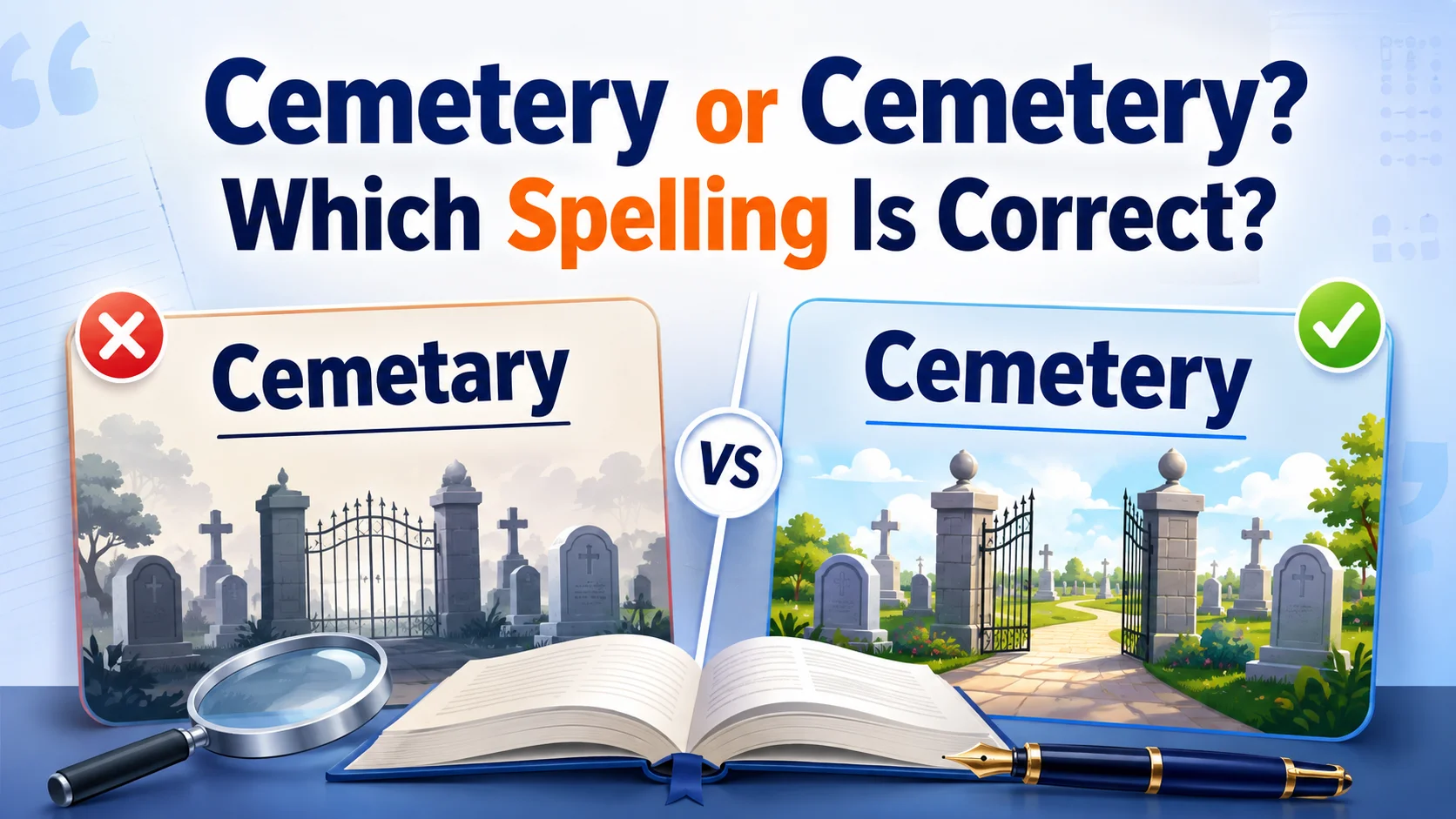
Cemetery or cemetery is a common spelling question because the word is pronounced differently from the way many people expect it to look on the page. The correct spelling is cemetery, while cemetery is a misspelling. The confusion becomes understandable when you notice how easily the middle of the word can be rearranged in memory. If you are writing a school assignment, historical description, formal document, or even a simple message, getting this word right matters because a familiar misspelling can make otherwise polished writing look careless. In this guide, you will learn the correct spelling, meaning, pronunciation, common mistakes, related word forms, and easy ways to remember it.
The word cemetery is a noun meaning a place where people are buried. It can refer to a large public burial ground, a historic cemetery, a family cemetery, or a cemetery maintained by a religious or other community organization. The incorrect spelling cemetery has no standard English meaning in this context. Another frequent error is cemetary, which looks plausible because the final sound can encourage writers to place the letters in the wrong order. Understanding why these errors happen is more useful than simply memorizing a correction, so this article also examines cemetery vs. graveyard, related expressions, capitalization, plurals, and practical examples.
There is one spelling worth committing to memory: cemetery. Once you recognize its internal pattern, the word becomes much easier to reproduce accurately. You will also see how cemetery works grammatically, when graveyard may be a better word, and why spellcheck should be treated as a backup rather than your only proofreading method. Whether you searched for “cemetery or cementery,” “cemetery or cemetery,” “how to spell cemetery,” or simply want to stop making the same spelling mistake, the sections below give you a reliable way to handle the word confidently.
Cemetery or Cementery
- Cemetery is the correct spelling.
- Cemetery is incorrect when you mean a place where people are buried.
| Spelling | Correct? | Meaning |
| cemetery | Yes | A place where people are buried |
| cementery | No | Common misspelling of cemetery |
| cemetary | No | Another common misspelling |
For example:
Correct: We walked through the old cemetery.
Incorrect: We walked through the old cemetery.
Incorrect: We walked through the old cemetery.
The safest approach is not to try to construct the spelling from pronunciation. Instead, remember the written form cemetery as a complete word.
What Does Cemetery Mean?
Cemetery as a Noun
A cemetery is a place set aside for the burial of people who have died. It generally contains individual graves and may also include monuments, headstones, mausoleums, memorials, pathways, landscaping, or other features.
The word is broad enough to describe many different kinds of burial places:
- a public cemetery
- a historic cemetery
- a family cemetery
- a military cemetery
- a religious cemetery
- a rural cemetery
- a municipal cemetery
The surrounding context tells the reader what type of cemetery is being discussed.
Examples of Cemetery in a Sentence
Here are several natural uses:
- The cemetery is located just outside the town.
- Researchers examined the records of the historic cemetery.
- Her family has maintained the small cemetery for generations.
- The soldiers were buried in a nearby military cemetery.
- The old cemetery contains several nineteenth-century headstones.
Notice that cemetery consistently functions as a noun. It names a place rather than an action.
Why Is “Cementery” Incorrect?
The spelling cemetery is an understandable mistake, but it is not the standard spelling of the burial-place noun.
One reason the error occurs is the visual similarity between cemetery and cement. A writer may unconsciously connect the beginning of cemetery with the familiar word cement and produce cementery.
Compare them:
- cement → C-E-M-E-N-T
- cemetery → C-E-M-E-T-E-R-Y
They are different words with different histories and meanings. The fact that they share the opening letters cem does not mean that cemetery contains the spelling pattern of cement.
Why Do People Add an “n” to Cemetery?
When someone writes cementery, the extra n usually reflects a spelling association rather than a meaningful grammatical rule. The writer knows the sound of the word but retrieves a familiar-looking sequence from memory.
This is a useful lesson about English spelling: pronunciation alone is not always a reliable spelling guide. Some words have to be learned through repeated exposure to their written forms.
Tip: If you regularly confuse cemetery with cemetery, focus on the visual sequence cemetery, rather than trying to spell the word phonetically.
Cemetery vs. Cemetery at a Glance
The difference is straightforward once the two forms are placed side by side.
| Feature | Cemetery | Cementery |
| Standard spelling | Yes | No |
| Part of speech | Noun | Not the standard noun |
| Meaning | Burial place | No standard meaning for this context |
| Example | They visited the cemetery. | Incorrect |
| Best choice in formal writing | Yes | Never |
So, when referring to a place where people are buried, use a cemetery.
How Do You Spell Cemetery Correctly?
The standard spelling is:
C-E-M-E-T-E-R-Y
The part that causes the most trouble is the middle and ending:
cem + eter + y
This is not intended as a pronunciation guide; it is simply a visual way to organize the letters.
A useful strategy is to stop thinking of the word as something that must be rebuilt letter by letter. Treat the cemetery as a familiar visual unit.
A Simple Spelling Memory Trick for Cemetery
A practical memory trick is to focus on the sequence:
CEME-TERY
The key is remembering that after cem, the word continues with e, not n.
You can also write the word several times in meaningful sentences rather than copying it repeatedly:
The cemetery is old.
The cemetery is near the church.
We studied the cemetery records.
This connects the spelling to actual language use.
“Cemetery” Spelling Practice
Try reading these sentences aloud while paying attention to the written form:
- The historic cemetery attracts visitors every year.
- The map shows the location of the cemetery.
- Several members of the family are buried in the cemetery.
- The city is responsible for maintaining the cemetery grounds.
The goal is to make cemetery visually familiar enough that cemetery starts to look obviously wrong.
Cemetery Pronunciation and Why It Causes Spelling Confusion
Cemetery is commonly pronounced approximately like SEM-uh-ter-ee, although exact pronunciation can vary by accent.
That pronunciation helps explain the spelling problem. When people hear the word, they may not clearly perceive every written vowel. English frequently contains letters that are reduced or pronounced differently from how a learner might expect.
This creates a common trap: a person remembers how the word sounds but not its exact written sequence.
The solution is simple: learn the pronunciation and spelling as related but separate pieces of information.
For spelling purposes, remember:
cemetery — not cemetery and not cemetery.
Common Misspellings of Cemetery
Cemetary
Cemetery is one of the most common incorrect forms.
It is easy to understand why. The ending sounds can make -ary seem natural, particularly if the writer is spelling from memory.
Correct:
cemetery
Incorrect:
cemetary
Cementery
Cemetery is another frequent error. Here, the writer has inserted n, probably because the beginning resembles cement.
Correct:
cemetery
Incorrect:
cementery
Other Variations People May Type
People sometimes produce additional variations when they are unsure of the vowel sequence or final letters. The important point is not to memorize a long catalog of errors.
Instead, recognize the standard form:
cemetery
If a spelling looks like it has replaced the middle e with a or inserted n after cem, check it carefully.
Common Mistakes When Using Cemetery
Confusing Cemetery With Graveyard
Cemetery and graveyard overlap considerably in everyday English, but they are not always exact substitutes.
A cemetery is a burial ground. Graveyard can also mean a place containing graves and is often used in a more traditional, informal, or descriptive sense.
Confusing Cemetery With Grave
A grave is an individual burial place.
A cemetery is the largest place containing graves.
For example:
The family visited the grave.
The family visited the cemetery.
The first sentence focuses on a particular burial site; the second refers to the larger grounds.
Using Cemetery as Though It Were a Verb
Cemetery is a noun. You would not normally say that someone was “cemeteried.”
Use a suitable verb such as buried when describing the action:
The writer was buried in the cemetery.
Here, buried describes the action and cemetery identifies the location.
Cemetery vs. Graveyard
In ordinary conversation, cemetery and graveyard can often refer to the same general type of place: an area where people are buried.
There is, however, a traditional distinction worth knowing. Graveyard has historically been associated especially with a burial ground attached to or surrounding a church. Cemetery is a broader modern term and does not require a church connection.
That distinction is useful when precision matters, although everyday speakers do not always maintain it strictly.
| Term | General meaning | Typical nuance |
| Cemetery | Place where people are buried | Neutral, broad, commonly used |
| Graveyard | Place containing graves | Often traditional, informal, or associated with a church |
| Churchyard | Ground belonging to or surrounding a church | More geographically specific |
| Burial ground | Land used for burials | Broad and neutral |
When “Cemetery” Is the Better Word
Choose cemetery when you want a neutral, modern term or when referring to an officially named burial site.
For example:
The city established a new cemetery outside the residential area.
When “Graveyard” May Be More Natural
Graveyard can sound more natural in historical, literary, or conversational descriptions:
The old church has a small graveyard behind it.
The choice is therefore partly about context and tone, not simply correctness.
Grammar and Word Forms of Cemetery
Is Cemetery a Noun?
Yes. Cemetery is a countable noun.
You can refer to:
- a cemetery
- the cemetery
- several cemeteries
Examples:
There is a cemetery near the village.
The cemetery is more than a hundred years old.
The region contains several historic cemeteries.
What Is the Plural of Cemetery?
The plural is cemeteries.
The spelling changes from -y to -ies:
cemetery → cemeteries
Examples:
- The city maintains several cemeteries.
- Historic cemeteries can provide valuable information for researchers.
- Many old cemeteries contain distinctive monuments.
This follows a familiar English spelling pattern found in many nouns ending in consonant + y.
What Is the Possessive Form of Cemetery?
For one cemetery, use:
cemetery’s
Example:
The cemetery’s entrance was recently restored.
For more than one cemetery, the plural possessive is:
cemeteries’
Example:
The cemeteries’ records were transferred to the archive.
The apostrophe placement changes because the plural itself changes from cemetery to cemeteries.
What Is the Adjective Form Related to Cemetery?
There is no need to invent a separate adjective to describe ordinary things associated with a cemetery. English commonly uses cemetery attributively:
- cemetery records
- cemetery grounds
- cemetery entrance
- cemetery gate
- cemetery monument
For example:
The historian examined cemetery records.
Here, cemetery remains the same written form while modifying the noun records.
Cemetery in Different Types of Writing
Everyday Conversation
The word works naturally in ordinary speech:
Is there a cemetery nearby?
We visited the cemetery yesterday.
There is no special formal construction required.
Academic and Historical Writing
In historical writing, cemetery may appear alongside terms such as burial records, headstones, grave markers, interments, and genealogical research.
For example:
Researchers used cemetery records to identify previously undocumented burials.
The important point is precision. When writing about history, avoid treating cemetery, grave, churchyard, and burial ground as automatically identical.
Formal and Professional Writing
The neutral tone of the cemetery makes it appropriate for official notices, records, reports, and correspondence.
For example:
Maintenance work at the cemetery will begin on Monday.
Creative and Descriptive Writing
In creative writing, a cemetery can establish a setting without automatically implying a frightening atmosphere.
For example:
The narrow path led toward an old cemetery at the edge of the village.
The emotional tone comes from the surrounding description, not from the noun itself.
Common Phrases and Expressions With Cemetery
Some natural combinations include:
- historic cemetery
- old cemetery
- public cemetery
- family cemetery
- military cemetery
- cemetery grounds
- cemetery records
- cemetery plot
- cemetery headstone
- cemetery gate
- cemetery memorial
These combinations are useful because they show how the noun appears in real writing.
For example:
The genealogist consulted cemetery records to verify the family connection.
The town restored the entrance to the historic cemetery.
The family purchased a cemetery plot.
Cemetery and Capitalization
Normally, cemetery is lowercase because it is a common noun.
We visited the cemetery.
It becomes capitalized when it is part of a proper name:
They visited Oak Hill Cemetery.
The general rule is simple: capitalize the official name, not the ordinary noun.
This distinction matters in formal writing, especially when referring to named institutions, landmarks, or historical sites.
Cemetery, Burial Ground, Graveyard, and Churchyard: What’s the Difference?
These terms are related, but their meanings have different levels of specificity.
Cemetery is the broad modern term for a designated burial place.
Burial ground is a neutral descriptive phrase that emphasizes the land’s function.
Graveyard commonly refers to an area containing graves and has a traditional association with churchyards, although modern usage is broader.
Churchyard specifically refers to the grounds associated with a church and may contain graves.
A useful rule is to select the term that matches the physical and historical context rather than treating every burial place as interchangeable.
Why Is “Cemetery” So Difficult to Spell?
There are several reasons the word causes trouble.
First, the pronunciation does not transparently reveal every letter. When people spell a word from sound, they often simplify or rearrange vowels.
Second, the word contains several e’s, making the sequence easy to scramble.
Third, cement is a very familiar word, and its spelling can influence someone’s memory of a cemetery.
Finally, once someone repeatedly sees a misspelling such as cemetery or cemetery, the incorrect version can begin to look familiar.
That is why visual recognition is valuable. Correct spelling is partly a matter of knowing which letter pattern belongs to the word.
How to Remember the Correct Spelling of Cemetery
Focus on the “E” Pattern
The standard form is:
C-E-M-E-T-E-R-Y
Pay particular attention to the e after cem.
Don’t Spell It From “Cement”
Although the words begin similarly, cement is not a useful spelling model for a cemetery.
Think:
cemetery, not cemetery
Memorize the Whole Word
For difficult spellings, whole-word recognition is often more practical than inventing complicated rules.
Write and read:
cemetery
until its visual pattern becomes familiar.
Use the Word in Context
A sentence is more memorable than an isolated list of letters:
The historic cemetery contains many old monuments.
This reinforces both spelling and meaning at the same time.
Quick memory check: If you are deciding between cemetery, cemetary, and cementery, choose cemetery.
Does Autocorrect Make Cemetery Spelling Less Important?
Spellcheck and autocorrect are useful tools, but they should not replace basic spelling knowledge.
A spelling checker may identify an obvious misspelling such as cemetery, but relying on software has limitations. Different applications have different dictionaries, and automated tools can miss errors or make unwanted corrections.
There is also a practical difference between knowing a word is correct and merely having software correct it.
For schoolwork, professional writing, published content, or important correspondence, proofread the final text yourself. If you repeatedly misspell cemetery, add the correct form to your active vocabulary rather than depending entirely on autocorrect.
Examples
Correct Usage
- We walked past the old cemetery.
- The historic cemetery contains several notable monuments.
- The records identify everyone buried in the cemetery.
- The city plans to improve the cemetery grounds.
- Several family members are buried in the same cemetery.
Incorrect Spelling
These should be corrected:
- We visited the old cemetery.
- The historic cemetery is located outside town.
Correct versions:
- We visited the old cemetery.
- The historic cemetery is located outside town.
Quick Self-Test
Choose the correct spelling:
- cementery / cemetery
- cemetery / cemetery
- cemetery / cemetery
- cemetery / cemetery
If you select a cemetery each time, you have the standard spelling.
Cemetery Spelling: A Quick Rule to Remember
When the question is “Cemetery or cemetery?”, the answer is:
Cemetery is correct.
Remember these three forms:
- cemetery ✓
- cementery ✗
- cemetary ✗
The word refers to a place where people are buried, and its plural is cemeteries.
The most reliable spelling strategy is simply to become familiar with the correct visual form: cemetery.
Conclusion
When deciding between cemetery or cemetery, there is no complicated rule to apply: cemetery is the correct spelling. The incorrect forms cementery and cemetary are easy to produce because the word’s pronunciation does not make every letter obvious. The best solution is to recognize the correct written pattern and use it repeatedly in meaningful sentences. It is also worth distinguishing cemetery from related terms such as grave, graveyard, burial ground, and churchyard, because these words overlap without always being identical. One final actionable tip: memorize C-E-M-E-T-E-R-Y as a complete visual word. A common mistake to avoid is connecting its spelling to cement. Once cemetery becomes familiar on the page, this spelling problem largely disappears.
Frequently Asked Questions
Q1. Is “cementery” a correct spelling?
No. Cemetery is a common misspelling of cemetery. When referring to a place where people are buried, use a cemetery. The spelling has no n after cem. Remembering the complete form cemetery is more reliable than trying to spell it from pronunciation.
Q2. Is it “cemetery” or “cemetary”?
Cemetery is correct. Cemetery is a common spelling error caused by the pronunciation and the tendency to expect an -ary ending. The correct sequence is -etery: c-e-m-e-t-e-r-y. Using the word regularly in sentences can make the spelling easier to remember.
Q3. What is the plural of cemetery?
The plural of cemetery is cemeteries. The final y changes to ies, giving cemetery → cemeteries. For example: “The region contains several historic cemeteries.” This spelling pattern is similar to other English nouns ending in a consonant followed by y.
Q4. Is a cemetery the same as a graveyard?
Not always, although the terms overlap in everyday usage. Cemetery is the broader modern term for a burial place. Graveyards traditionally have a stronger association with a church or older burial ground, but modern speakers use it more broadly. Context determines which term sounds most appropriate.
Q5. What is the possessive form of cemetery?
The singular possessive is cemetery’s, as in “the cemetery’s entrance.” The plural is cemeteries, and its possessive form is cemeteries’, as in “the cemeteries’ records.” The spelling changes before the apostrophe because the plural changes from cemetery to cemeteries.
