
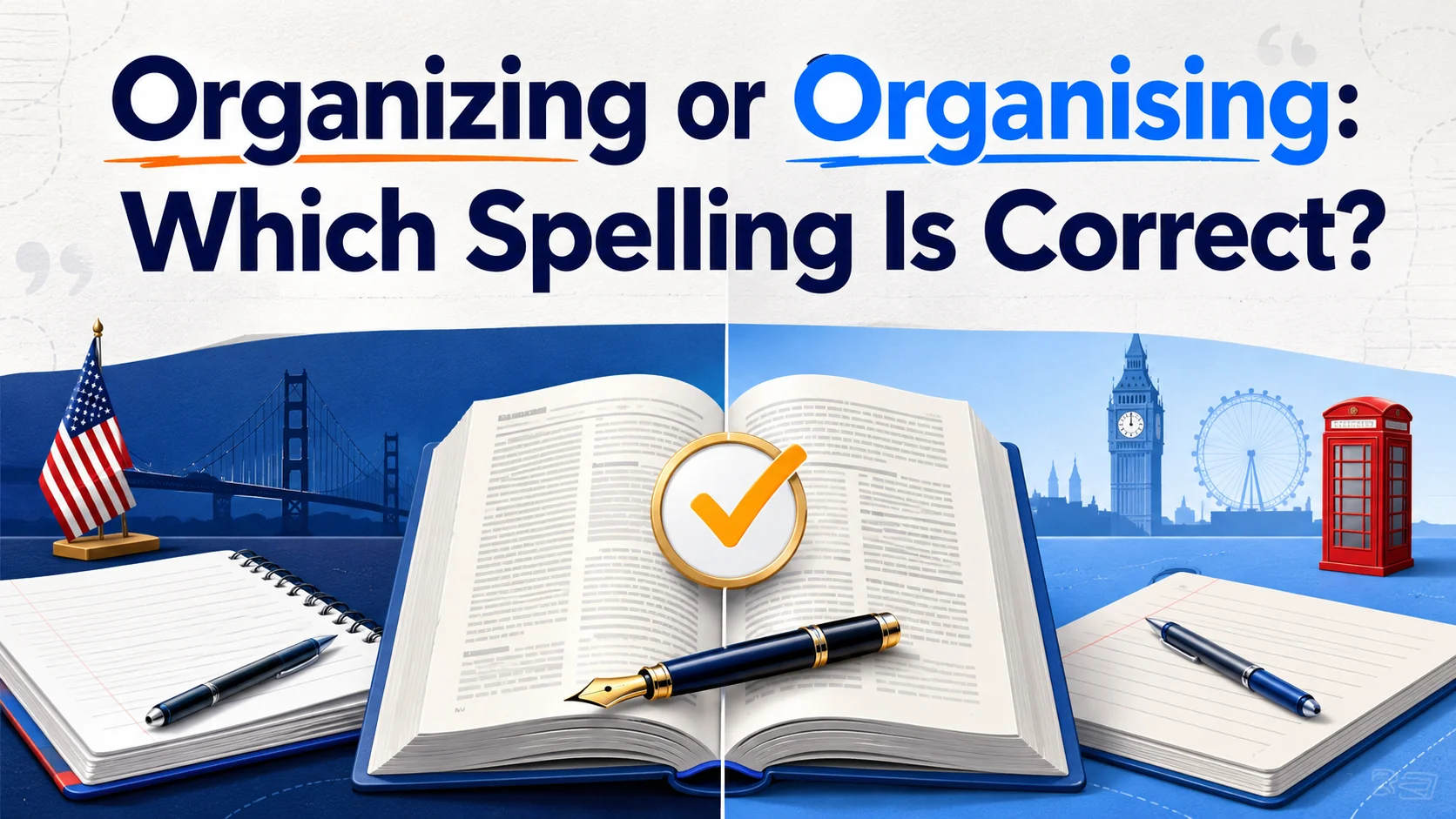
Organizing and organising are both correct spellings, but the one you should use depends on the variety of English you are writing. Organizing is the standard form in American English, while organising is the usual British English spelling. The difference is therefore not about meaning or correctness in general; it is about regional spelling conventions. Both forms describe arranging things, making plans, coordinating people, or putting information into a useful system.
The confusion usually begins when writers encounter both versions in books, websites, schoolwork, or workplace documents. A British reader may naturally expect organising, whereas an American publication will normally use organizing. Neither audience needs to interpret the other spelling as a mistake. What matters most is choosing the appropriate English variety and remaining consistent throughout a piece of writing. That principle becomes especially important in academic, professional, editorial, and published work.
In this guide, you will learn why the two spellings exist, how organizing and organising function grammatically, when each form is appropriate, and how their related words follow the same pattern. You will also see practical examples from emails, academic writing, business communication, and everyday English. By the end, choosing between the two should be straightforward: American English generally uses -ize, while British English generally uses -ise for this word.
Organizing vs. Organising
The simplest answer is:
American English: organizing
British English: organising
Meaning: the same
Pronunciation: essentially the same
Grammar: the same
The Cambridge Dictionary identifies organizing as the present participle of organize and notes that British English usually uses organise. Its definitions include making arrangements and arranging things according to a system.
So, if you are writing for an American audience, choose organizing:
- I am organizing a meeting.
- She is organizing her files.
- They are organizing a conference.
For British English, choose organising:
- I am organising a meeting.
- She is organising her files.
- They are organising a conference.
The important point is that you should not treat the two spellings as two different words.
Organizing vs. Organising at a Glance
| Feature | Organizing | Organising |
| Main spelling convention | American English | British English |
| Base verb | organize | organise |
| Meaning | Arrange, plan, coordinate, systematize | Same |
| Grammatical form | Present participle/gerund | Present participle/gerund |
| Pronunciation | Same basic pronunciation | Same basic pronunciation |
| Past tense | organized | organised |
| Noun | organization | organisation |
| Person who organizes | organizer | organiser |
| Appropriate for US-focused writing | Yes | Usually not preferred |
| Appropriate for UK-focused writing | Usually not preferred | Yes |
This spelling pattern extends beyond organizing. The related forms organizer/organiser and organization/organisation follow the same regional distinction. Cambridge likewise lists organizer as the US form and organiser as the usual UK form.
What Does Organizing or Organising Mean?
Organizing or organising is the -ing form of the verb organize/organise.
The verb has several closely related uses. At its most basic, it means putting things into an orderly or useful arrangement. It can also mean planning an event, coordinating people, or making arrangements for something to happen.
For example:
- She is organizing the books by subject.
- We are organising a school event.
- He spent the afternoon organizing his notes.
- They are organising a meeting for next week.
Cambridge gives two particularly useful senses: making arrangements for something to happen and arranging something according to a particular system.
Organizing as a Gerund
An -ing form can function as a noun, which is called a gerund.
For example:
Organizing takes more time than I expected.
Here, organizing refers to an activity rather than describing what someone is currently doing.
Another example:
Organising large events requires careful planning.
The regional spelling changes, but the grammatical function does not.
Organizing as a Present Participle
The same form can function as a present participle in a continuous verb construction:
She is organizing the conference.
They are organising the documents.
In these sentences, organizing/organising forms part of the present continuous tense.
This distinction is useful because it shows that the spelling issue has nothing to do with grammar. Whether the word functions as a gerund or participle, American English retains organizing and British English retains organising.
Why Are There Two Spellings?
The two spellings exist because English has developed different regional spelling conventions.
American English generally prefers -ize in words of this type:
- organize
- recognize
- realize
- apologize
British English commonly uses -ise:
- organise
- recognise
- realise
- apologise
That produces the corresponding forms:
- organizing / organising
- recognizing / recognising
- realizing / realising
- apologizing / apologising
The distinction is therefore part of a larger spelling pattern rather than something unique to organizing.
It is also worth avoiding an overly simple assumption that English has one single spelling system. Modern English exists in multiple established varieties, and dictionaries often label words according to regional usage. For example, Cambridge marks organize as the US spelling while noting that British English usually uses organise.
Is Organizing American or British?
Organizing is the spelling most strongly associated with American English.
Organising is the spelling most strongly associated with British English.
That does not mean a British reader cannot understand organizing. The opposite is also true: an American reader will generally understand organising immediately. The issue is primarily one of editorial consistency and regional convention, not comprehension.
This distinction matters when your writing belongs to a specific institution or publication. A US university paper, American company website, or US newspaper will generally use organizing. A British school assignment, UK publication, or British organization’s materials will generally use organising.
What About Other English-Speaking Countries?
Other varieties of English can have their own preferences and editorial traditions. It is therefore better to think in terms of the style convention required by your audience or organization rather than assuming every country fits perfectly into a US-versus-UK binary.
If a publisher, university, employer, or style guide specifies a particular form of English, follow that instruction.
Organizing vs. Organising
They have the same basic meaning.
Compare:
The committee is organizing a conference.
and:
The committee is organising a conference.
There is no difference in what the committee is doing. The first sentence follows the American spelling convention; the second follows the British convention.
The same applies to:
- organizing files / organising files
- organizing a meeting / organising a meeting
- organizing information / organising information
- organizing an event / organising an event
A common mistake is to assume that the s and z somehow indicate different meanings. They do not.
Expert tip: When you see organising in British writing, do not mentally translate it into a different English word. Simply recognize it as the British spelling of the same verb.
How to Choose the Right Spelling
The best choice depends on who will read your writing and which English variety the context requires.
Use “Organizing” in American English
Choose organizing when your writing follows American English conventions.
Typical contexts include:
- US school and college assignments
- American business documents
- US-focused websites
- American newspapers and magazines
- Documents following an American English style guide
For example:
Our department is organizing a training session for new employees.
Use “Organising” in British English
Choose organising when the document follows British English conventions.
Examples include:
- UK academic writing
- British publications
- UK workplace communication
- British educational materials
- Publications following British spelling conventions
For example:
Our department is organising a training session for new employees.
Follow the Style Guide When One Is Provided
Sometimes the question is not really “Which spelling do I personally prefer?”
It is:
Which spelling does this document require?
A publisher, university, employer, journal, or editor may have a house style. If so, that instruction takes priority.
This is one reason professional writers do not randomly alternate between regional forms. Consistency makes the document look deliberate and edited.
Organizing vs. Organising in Different Types of Writing
In Emails and Everyday Messages
In informal communication, either form will normally be understood.
Still, matching your audience is a good habit. If you are communicating with a British organization, organising will fit naturally with the surrounding spelling. If your workplace uses American English, organizing is the better choice.
In Business Writing
Professional documents benefit from a consistent spelling system.
Suppose an American company’s document says:
We are organizing the annual meeting and reviewing the organization structure.
Using organizing alongside other American spellings makes the document internally consistent.
A British company might instead write:
We are organising the annual meeting and reviewing the organisation structure.
The issue becomes more noticeable when related forms occur repeatedly throughout a report.
In Academic Writing
Academic writers should follow the requirements of their institution, instructor, publisher, or journal.
Do not switch between organizing and organising simply because you encountered both spellings while researching. Your sources may use different varieties of English, but your own prose should normally follow one consistent convention.
In Websites and SEO Content
For online content, the intended audience matters.
If a website primarily serves US readers, organizing is generally the natural choice. A UK-focused site will generally prefer organising.
There is no need to force both spellings repeatedly into the same article. That can make the writing unnatural. Instead, explain the regional difference clearly when it is genuinely relevant.
In Direct Quotes
Direct quotations are different.
If you quote a British source that uses organising, you should normally preserve the source’s spelling rather than silently changing it to organising. The same principle applies when quoting American material.
Your own surrounding prose can follow your chosen variety.
Real-World Examples of Organizing and Organising
The meaning becomes clearer when the words are used in different situations.
| Situation | American English | British English |
| Event planning | We are organizing the event. | We are organising the event. |
| Files | She is organizing her files. | She is organising her files. |
| Meeting | They are organizing a meeting. | They are organising a meeting. |
| Information | He is organizing the data. | He is organising the data. |
| Schedule | I am organizing my schedule. | I am organising my schedule. |
| Conference | The team is organizing a conference. | The team is organising a conference. |
| Community activity | They are organizing a local campaign. | They are organising a local campaign. |
Notice what remains unchanged: the meaning, grammar, and sentence structure.
Only the regional spelling changes.
Organizing a Meeting
Maria is organizing a meeting with the department heads.
This means Maria is making the necessary arrangements.
British version:
Maria is organising a meeting with the department heads.
Organizing Information
The researcher is organizing the data into several categories.
Here, the meaning is closer to arranging information according to a system.
Cambridge similarly describes organising as arranging things according to a particular system.
Organizing an Event
The students are organizing a charity event.
Here, organizing means planning and coordinating the event.
British spelling:
The students are organising a charity event.
Again, there is no difference in meaning.
Organizing vs. Organising in Common Phrases
Both spellings appear in many everyday combinations.
| American English | British English |
| organizing a meeting | organising a meeting |
| organizing an event | organising an event |
| organizing files | organising files |
| organizing information | organising information |
| organizing a schedule | organising a schedule |
| organizing a conference | organising a conference |
| organizing a team | organising a team |
| organizing a campaign | organising a campaign |
| organizing a workshop | organising a workshop |
| organizing a project | organising a project |
The phrase itself does not determine which spelling you need. Your English variety determines it.
For example, there is no special rule saying that “organizing a meeting” must use z while “organising a conference” must use s. Both phrases follow the same regional spelling principle.
Related Word Forms: Organize, Organizer, Organization, Organized
Understanding the entire word family makes the spelling much easier to remember.
| Word | American English | British English |
| Base verb | organize | organise |
| Person who organizes | organizer | organiser |
| Noun | organization | organisation |
| Past tense | organized | organised |
| Present participle | organizing | organising |
Organize vs. Organise
These are the base forms.
We need to organize the files.
We need to organise the files.
Organizer vs. Organiser
An organizer/organiser is a person or group responsible for planning or arranging something. Cambridge specifically labels organizer as the US form and organiser as the usual UK form.
Organization vs. Organisation
These nouns can refer either to a group of people working toward a purpose or to the way something is arranged.
For example:
The organization has offices in three cities.
British:
The organisation has offices in three cities.
Organized vs. Organised
The past-tense and past-participle forms follow the same regional pattern:
She organized the documents.
She organised the documents.
The adjective also follows the same convention:
He is very organized.
He is very organised.
Why Does “Organizing” Have a Z but “Organising” Have an S?
The answer lies in the spelling of the base verb.
American English:
organize → organizing
British English:
organise → organising
The -ing ending itself is not responsible for the difference. The distinction already exists in organize versus organise.
The same pattern appears elsewhere:
- recognize → recognizing / recognise → recognising
- realize → realizing / realise → realising
- apologize → apologizing / apologise → apologising
This is useful because it gives you a reliable method rather than requiring you to memorize organizing and organising separately.
Memory trick: Check the base verb first. If your English uses organize, write organizing. If it uses organise, write organising.
Does Organising Sound Different From Organizing?
No significant pronunciation difference is created by the spelling.
Cambridge gives pronunciations for organize in both UK and US English, while identifying organise as the usual British spelling.
There can naturally be regional pronunciation differences between American and British speakers, but the s versus z spelling is not a signal that these are two differently pronounced English words.
That is why saying one is “the pronunciation version” of the other would be misleading.
The distinction is primarily orthographic—that is, a difference in written spelling.
Organizing or Organising in Different English Varieties
A useful way to approach regional English is to think about the overall spelling system, not one isolated word.
| Writing situation | Recommended approach |
| US audience | Prefer organizing |
| UK audience | Prefer organising |
| US academic paper | Follow US/institutional style |
| UK academic paper | Follow UK/institutional style |
| International publication | Follow its house style |
| Quoting a source | Preserve the source’s spelling |
| Unsure of the required variety | Check the relevant style guide |
There can be nuances in countries outside the US and UK, so avoid treating “American” and “British” as the only possible English conventions. The safest professional practice is to identify the style used by the publication, institution, or audience.
Common Mistakes With Organizing and Organising
Mistake 1: Thinking One Spelling Is Wrong
Seeing organising in an American context—or organizing in a British context—does not automatically make the word a spelling error.
Check the regional convention first.
Mistake 2: Mixing Spelling Styles
A document that consistently follows American English should not randomly switch to British forms.
For example, using organizing in one paragraph and organising in the next can make the document appear inconsistent.
Mistake 3: Giving the Two Spellings Different Meanings
There is no semantic distinction between the two.
Organizing does not mean one kind of arranging while organising means another.
Mistake 4: Assuming “-ise” Is More Formal
The choice between -ize and -ise is primarily regional, not a simple formal-versus-informal distinction.
Mistake 5: Changing a Quotation
If a source says organising, do not automatically change it to organizing inside a direct quotation merely to match your preferred spelling.
Mistake 6: Forgetting the Related Forms
Writers sometimes remember organizing but then write organisation in the same American English document.
Remember the family as a system:
organize → organizing → organized → organization
or
organise → organising → organised → organisation
A Simple Rule to Remember Organizing vs. Organising
When you are unsure, ask one question:
Which variety of English am I using?
Then apply the corresponding form:
- American English → organize → organizing
- British English → organise → organising
- If your audience is American, use organizing.
- If your audience is British, use organising.
- If you are writing for an organization, university, publisher, or journal, check whether it has an established style.
- This approach is much more reliable than trying to decide which spelling “looks more correct.”
Conclusion
Organizing and organising are both correct spellings; the right choice depends on the variety of English you are using. American English generally prefers organizing, while British English generally uses organising. The words have the same meaning, grammatical role, and basic pronunciation, so there is no reason to assign them different definitions. The most useful approach is to treat the spelling as part of a larger system: organize/organise, organized/organised, organizer/organiser, and organization/organisation all follow the same regional pattern. One final actionable tip: decide which English convention your audience expects before you begin, then apply it consistently throughout the document. A common mistake to avoid is mixing -ize and -ise forms without a reason. Good writing is not about choosing the “more correct-looking” spelling; it is about making the appropriate choice for the reader and using it confidently.
Frequently Asked Questions
Q1. Is “organizing” the correct spelling?
Yes. Organizing is the standard American English spelling of the present participle of organize. It is also widely understood elsewhere. If you are writing according to US English conventions, organizing is the appropriate choice. British English generally uses organising instead.
Q2. Is “organising” a correct English word?
Yes. Organising is a standard British English spelling of the present participle of organise. It is not an error or informal variation. British dictionaries and usage references recognize the form, while American English generally uses organizing.
Q3. Which is correct: organizing or organising?
Both are correct, but they belong to different spelling conventions. Use organizing for American English and organising for British English. When writing professionally, choose the form that matches your audience, institution, publication, or required style guide.
Q4. Is “organising” more formal than “organizing”?
No. The -ise/-ize distinction does not inherently indicate formality. A formal British document may use organising, while a formal American document will normally use organizing. The important distinction is regional spelling convention, not the level of formality.
Q5. Do organizing and organising have different meanings?
No. They are regional spellings of the same word and have the same basic meanings and grammatical uses. Both can describe arranging things systematically, planning an activity, coordinating people, or making preparations for an event.
