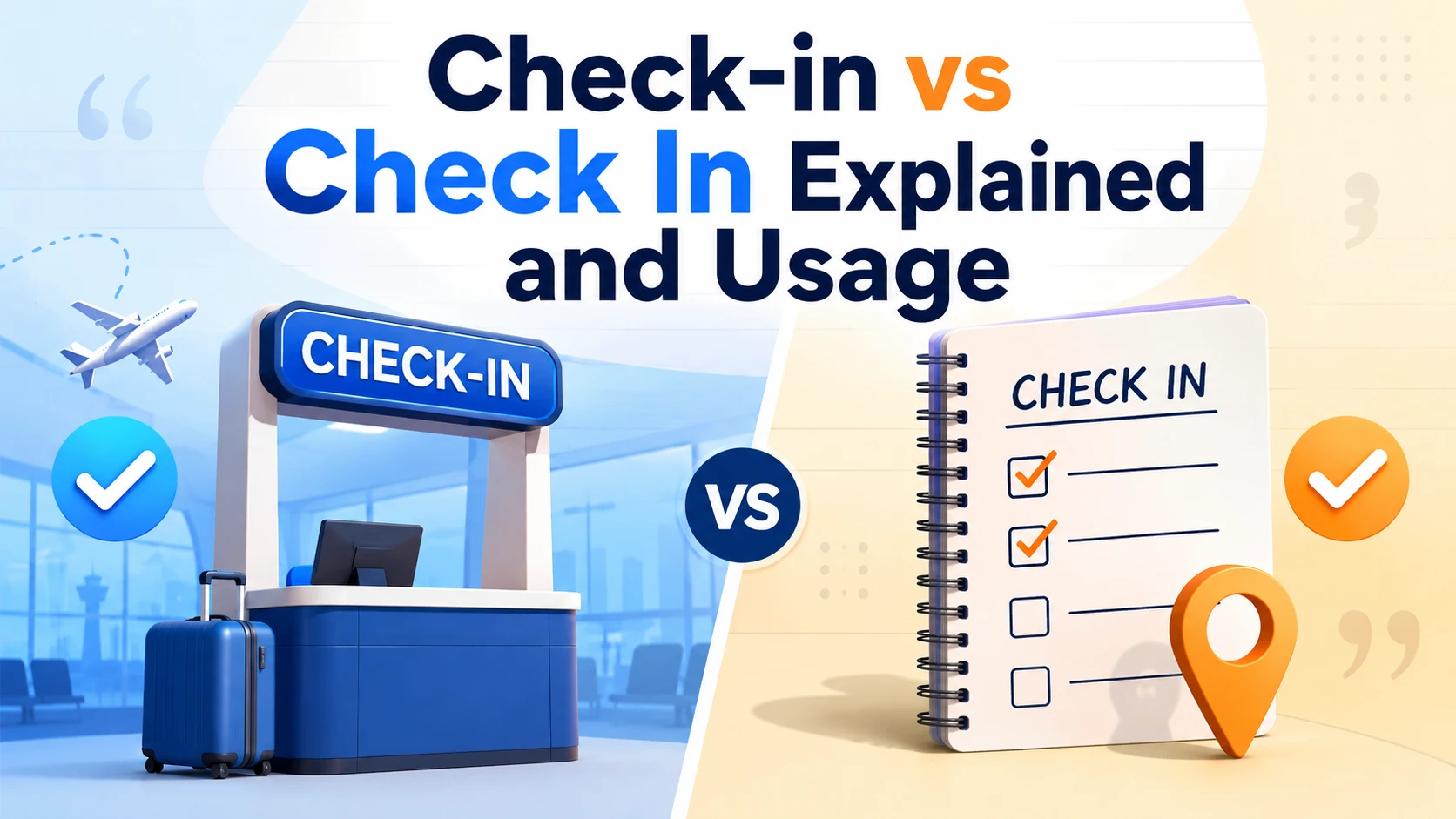
Check-in vs check in is one of those grammar questions that seems simple until you start writing emails, booking travel, or creating professional documents. You may see both forms every day, yet only one is correct in a given sentence. The difference isn’t about preference or regional spelling—it’s about grammar, sentence structure, and the role the words play. Once you understand that distinction, you’ll be able to use each form naturally whether you’re writing for work, school, or everyday communication.
Many writers assume the hyphen is optional because websites, apps, and advertisements often use inconsistent formatting. For example, you might read “hotel check-in,” “check in online,” and “self check in” on different websites. Some of those examples follow standard grammar while others are influenced by branding or design choices. Learning the actual rule helps you recognize when to follow formal English conventions and when you’re simply seeing a stylistic exception.
This guide explains what “check in” and “check-in” mean, when to use each one, why the hyphen matters, and how to avoid common mistakes. You’ll also find comparison tables, practical examples from real-life situations, memory tricks, and practice exercises so you can apply the rule with confidence rather than memorizing isolated examples.
Check-in vs Check In: The Short Answer
If you only remember one rule from this article, remember this:
- Check in = Verb (an action)
- Check-in = Noun or adjective (a thing or a describing word)
Think of it this way:
- You check in at a hotel.
- You complete the hotel check-in.
- The check-in desk opens at 2:00 p.m.
The meaning remains closely related in each sentence, but the grammatical role changes.
Which Form Is Correct?
Both are correct—but only in the right context.
| Form | Part of Speech | Correct Use | Example |
| check in | Verb | Performing the action | We need to check in before boarding. |
| check-in | Noun | Refers to the process or event | Check-in begins at noon. |
| check-in | Adjective | Describes another noun | Go to the check-in counter. |
Notice that the hyphen doesn’t change the idea. Instead, it changes how the phrase functions within the sentence.
The Simple Rule You Can Remember
Ask yourself one question:
Can I replace it with an action?
If the answer is yes, use check in.
Examples:
- We should check in now.
- Please check in online.
- Guests must check in before entering.
Now ask another question:
Am I naming something instead of doing something?
If the answer is yes, use check-in.
Examples:
- Online check-in saves time.
- The check-in took only five minutes.
- Visit the check-in desk first.
Quick Comparison Table
| If you’re talking about… | Use |
| Performing the action | check in |
| The registration process | check-in |
| A desk, counter, time, or procedure | check-in |
| An employee telling someone to register | check in |
| A scheduled team meeting | team check-in |
| Asking someone how they’re doing | check in with someone |
What Does “Check In” Mean?
The phrase check in is a phrasal verb. A phrasal verb combines a main verb with another word to create a specific meaning. In this case, check and in work together to describe the act of registering, reporting your arrival, confirming your presence, or making contact.
Unlike nouns, verbs describe actions. Whenever someone performs the act of checking in, you write the phrase as two separate words.
“Check In” as a Phrasal Verb
The verb check in appears in many situations beyond travel. While people often associate it with hotels and airports, native English speakers also use it in healthcare, business, education, customer service, and personal relationships.
Depending on the context, check in can mean:
- Register your arrival
- Confirm your attendance
- Report your status
- Let someone know you’re safe
- Make contact after some time
- Verify participation in an event
Although the situations differ, the grammatical rule stays the same because the phrase always describes an action someone performs.
How the Verb Works in a Sentence
Here are several examples from everyday English:
Travel
- We should check in two hours before departure.
- They forgot to check in online.
Hotels
- Guests may check in after 3:00 p.m.
- Please check in at the front desk.
Work
- Our manager asked everyone to check in before the meeting.
- Remote employees check in every morning.
Healthcare
- Patients should check in at reception.
- Remember to check in when you arrive.
Personal communication
- I’ll check in with you tomorrow.
- She wanted to check in after hearing the news.
In every example above, someone is doing something.
Common Actions Expressed by “Check In”
Depending on the situation, check in can describe different kinds of actions.
| Situation | Meaning |
| Hotel | Register as a guest |
| Airport | Confirm your flight reservation and baggage |
| Hospital | Register before treatment |
| Office | Record attendance or arrival |
| Online platform | Confirm participation or access |
| Personal conversation | Contact someone to see how they are |
Understanding these contextual meanings helps you recognize why English keeps the phrase as a verb in each case.
Common Contexts Where “Check In” Is Used
One reason learners become confused is that the same phrase appears in many industries. Fortunately, the grammar rule never changes.
Hotels and Resorts
At a hotel, guests check in when they arrive.
Examples:
- We need to check in before unloading our luggage.
- You can check in using the mobile app.
- Families usually check in at the reception desk.
Professional hotels may also offer:
- Early check-in
- Express check-in
- Mobile check-in
- Self-service check-in
Notice something interesting:
- Check in is the action.
- Check-in names the service.
For example:
- We will check in early.
- Early check-in costs an additional fee.
Airports and Flights
Air travel is probably where most people first encounter this grammar rule.
Passengers check in before boarding because airlines must verify:
- Identity
- Reservation
- Travel documents
- Baggage
- Seat assignment
Examples:
- Please check in online before arriving.
- Travelers should check in at least two hours before departure.
- Don’t forget to check in before security screening.
Even when airlines use branded language on signs or apps, standard English grammar still distinguishes the verb from the noun.
Hospitals and Medical Appointments
Medical facilities also require patients to check in before appointments.
This process allows staff to:
- Verify identity
- Update insurance information
- Confirm appointments
- Prepare medical records
Examples:
- Patients should check in 15 minutes early.
- You’ll check in at the reception window.
- Please check in using the kiosk if available.
Whether you’re visiting a clinic, dental office, or specialist, the grammatical rule remains identical because the phrase describes an action.
What Does “Check-in” Mean?
Unlike check in, which is a verb, check-in (with a hyphen) functions as either a noun or an adjective. Instead of describing an action, it names a process, event, place, or thing, or it modifies another noun.
A simple way to recognize the difference is this:
- If someone does something, use check in.
- If you’re talking about the process, place, or object, use check-in.
This distinction follows a common pattern in English. Similar word pairs include log in/login, set up/setup, work out/workout, and back up/backup.
“Check-in” as a Noun
As a noun, check-in refers to the registration process, arrival procedure, or scheduled status update.
Examples:
- Check-in starts at 3:00 p.m.
- Airport check-in opens three hours before departure.
- The online check-in process took less than five minutes.
- We had a weekly team check-in on Monday morning.
Notice that check-in acts like any other noun. It can be:
- the subject of a sentence
- the object of a sentence
- modified by adjectives
- preceded by articles such as the, a, or an
Examples:
- The check-in was quick.
- Our check-in lasted fifteen minutes.
- An early check-in is available.
Referring to the Registration Process
Many businesses use check-in to describe a formal procedure.
Common examples include:
- Hotel check-in
- Airport check-in
- Conference check-in
- Event check-in
- Hospital check-in
- Cruise check-in
Each phrase refers to the process itself—not the action of performing it.
Compare these examples:
✅ We completed hotel check-in in five minutes.
✅ Airport check-in opens at 5:00 a.m.
Here, check-in names an event or process.
Referring to a Scheduled Conversation or Update
Outside the travel industry, check-in has become common in workplaces, schools, and personal relationships.
Examples:
- We hold a weekly check-in every Friday.
- The project check-in lasted twenty minutes.
- Let’s schedule a monthly check-in to review progress.
Managers often use regular check-ins instead of lengthy meetings because they encourage continuous communication.
Similarly, teachers may conduct classroom check-ins, and healthcare providers may arrange patient check-ins after treatment.
“Check-in” as an Adjective
A hyphenated compound can also function as an adjective by describing another noun.
Examples include:
- check-in desk
- check-in counter
- check-in kiosk
- check-in area
- check-in process
- check-in confirmation
Here, check-in answers the question:
What kind of desk?
A check-in desk.
It modifies the noun that follows.
Common Compound Modifiers
You’ll often see check-in before another noun because English frequently hyphenates compound modifiers.
Examples:
- check-in time
- check-in instructions
- check-in procedure
- check-in receipt
- check-in system
- check-in software
Each compound creates a clearer relationship between the words.
Without the hyphen, readers may briefly misunderstand how the words connect.
Why the Hyphen Matters Before a Noun
Hyphens improve readability by showing that two words work together as one adjective.
Compare these:
❌ Please visit the check in counter.
✅ Please visit the check-in counter.
The second sentence immediately tells readers that check-in describes the counter.
Many style guides recommend hyphenating compound modifiers placed before a noun because they reduce ambiguity and improve clarity.
Expert Tip
If the phrase appears before another noun, there’s a good chance you’ll need the hyphen.
Check-in vs Check In: The Grammar Rule Explained
Many grammar mistakes happen because writers focus on the spelling instead of the grammatical role.
The real question isn’t:
Should there be a hyphen?
Instead, ask:
What job is this phrase doing in the sentence?
Once you answer that, choosing the correct form becomes straightforward.
Why One Is a Verb and the Other Is a Noun or Adjective
English often creates related words by changing their grammatical function.
Consider these familiar pairs:
| Verb | Noun/Adjective |
| log in | login |
| set up | setup |
| work out | workout |
| back up | backup |
| shut down | shutdown |
| check in | check-in |
The pattern is consistent:
- Verb = separate words
- Noun or adjective = combined or hyphenated form
Understanding this pattern helps you master many similar word pairs—not just check in and check-in.
How Hyphenation Changes the Function of the Word
A hyphen isn’t decorative punctuation.
It tells readers that two words belong together as one grammatical unit.
Compare these examples:
Verb
- Please check in before noon.
Noun
- Online check-in closes one hour before departure.
Adjective
- Visit the check-in counter first.
The meaning stays nearly identical, but the grammatical role changes completely.
The Easiest Way to Choose the Correct Form Every Time
Use this three-step method whenever you’re unsure.
| Question | If Yes | Use |
| Is someone performing an action? | Yes | check in |
| Am I naming the process? | Yes | check-in |
| Am I describing another noun? | Yes | check-in |
This quick test works in almost every situation.
When Should You Use “Check In”?
Use check in whenever someone performs the action of arriving, registering, reporting, or making contact.
Think of it as something a person does.
Sentence Patterns with the Verb
You’ll commonly see these sentence structures:
Subject + check in
- Guests check in at the front desk.
- Passengers check in online.
Need to + check in
- We need to check in now.
- You’ll need to check in before entering.
Must check in
- Employees must check in every morning.
- Visitors must check in upon arrival.
Can check in
- You can check in using the app.
- Travelers can check in 24 hours before departure.
Notice that every example contains an action.
Common Verbs That Pair with “Check In”
You’ll often find check in alongside helping verbs and time expressions.
Examples include:
- can check in
- should check in
- must check in
- forgot to check in
- remembered to check in
- check in early
- check in online
- check in later
- check in tomorrow
Recognizing these patterns makes writing sound more natural.
Everyday Examples from Different Situations
Travel
- We should check in before dropping off our luggage.
Business
- Every contractor must check in with security.
School
- Students check in using their ID cards.
Healthcare
- Please check in fifteen minutes before your appointment.
Family
- I always check in with my parents after long trips.
Notice how the meaning shifts slightly depending on context while the grammar rule stays exactly the same.
When Should You Use “Check-in”?
Use check-in whenever you’re referring to the process itself or using it to describe another noun.
As a Noun in Formal and Informal Writing
Professional writing frequently uses check-in.
Examples:
- Online check-in saves valuable time.
- Conference check-in begins at 8:00 a.m.
- The event check-in was well organized.
- Mobile check-in reduced waiting times.
The noun works equally well in formal reports, business emails, travel guides, and everyday conversations.
As an Adjective Before Another Noun
When check-in modifies another noun, keep the hyphen.
Examples include:
- check-in process
- check-in desk
- check-in email
- check-in notification
- check-in station
- check-in screen
Each compound adjective identifies a specific type of object or process.
Examples from Travel, Healthcare, Business, and Technology
Travel
- The check-in counter opened early.
- Mobile check-in is available.
Healthcare
- Hospital check-in usually requires identification.
Business
- Our weekly check-in meeting lasts thirty minutes.
Technology
- The app sends a check-in reminder before your reservation.
Across every industry, the rule remains consistent:
- check in = perform the action
- check-in = name or describe the process
Check-in, Check In, or Checkin?
Many people know that check in and check-in are both used in English, but a third spelling—checkin—sometimes appears in emails, websites, and text messages. That often leads to the question: Is “checkin” ever correct?
In standard American English, checkin (written as one word without a hyphen) is not the accepted spelling. Dictionaries and major style guides recognize check in (verb) and check-in (noun/adjective). If you’re writing for school, work, publishing, or professional communication, avoid checkin unless it’s part of a product name, brand, or software feature intentionally styled that way.
Is “Checkin” Ever a Correct Spelling?
For general writing, the answer is no.
You should write:
- ✅ Please check in before entering.
- ✅ Online check-in opens 24 hours before departure.
- ❌ Please checkin before entering.
The incorrect form often appears because people type quickly or because some mobile keyboards do not automatically suggest the hyphen.
Why This Misspelling Appears So Often
Several factors contribute to the confusion:
- Mobile typing habits often omit punctuation.
- Some apps and websites simplify labels to save space.
- Writers mistakenly assume every compound word eventually becomes one word.
- Branding sometimes ignores standard grammar for visual design.
For example, an app button might display “Check In” or “Checkin” simply because it fits the interface better. That doesn’t change the grammatical rule for formal writing.
Remember: User interface text and marketing copy don’t always follow traditional grammar. When writing professionally, follow standard English usage rather than copying a website’s design choices.
How Dictionaries and Style Guides Treat It
Most respected dictionaries and editorial style guides distinguish the forms based on their grammatical function.
| Form | Standard English | Use |
| check in | ✅ Yes | Verb |
| check-in | ✅ Yes | Noun or adjective |
| checkin | ❌ No | Generally considered a misspelling |
If you’re unsure, think about the role the phrase plays in your sentence rather than relying on how you’ve seen it displayed in an app or advertisement.
Check-in Hyphen Rules You Should Know
The hyphen in check-in isn’t optional punctuation. It serves a grammatical purpose by showing that two words work together as a single unit.
Understanding a few simple rules will help you avoid nearly every mistake.
When the Hyphen Is Required
Use the hyphen when check-in functions as a noun or an adjective.
Examples:
As a noun
- Mobile check-in saves time.
- Early check-in is available.
- Our weekly check-in lasted fifteen minutes.
As an adjective
- Visit the check-in desk.
- The check-in process was simple.
- The check-in counter is on the first floor.
In each example, the hyphen connects the words into one grammatical unit.
When the Hyphen Should Be Removed
Remove the hyphen when the phrase is a verb.
Examples:
- Please check in before noon.
- We checked in yesterday.
- They are checking in now.
- Guests may check in online.
Notice that the verb can change tense:
- check in
- checks in
- checked in
- checking in
The spacing stays the same because it’s still a verb phrase.
Cases Where Both Forms Appear in the Same Sentence
One of the easiest ways to understand the rule is to see both forms used correctly together.
Examples:
- Please check in before the hotel check-in closes.
- We checked in using the mobile check-in system.
- Guests who check in online can use the express check-in line.
- Employees check in each morning before attending the daily check-in meeting.
Although the words look almost identical, each serves a different grammatical purpose.
Quick Tip
If you can replace the phrase with register, it’s probably the verb check in. If you can replace it with registration, it’s probably the noun check-in.
Side-by-Side Comparison: Check-in vs Check In
The following table summarizes the differences you’ll encounter most often.
| Feature | Check In | Check-in |
| Part of speech | Verb | Noun or adjective |
| Function | Describes an action | Names or describes something |
| Hyphen | No | Yes |
| Typical position | After the subject | Before or after the verb, depending on sentence structure |
| Example | We check in at 3:00 p.m. | Hotel check-in starts at 3:00 p.m. |
| Common mistake | Adding an unnecessary hyphen | Forgetting the hyphen before a noun |
Decision Guide
Use this checklist whenever you’re uncertain.
| Ask Yourself | If the Answer Is Yes | Correct Form |
| Is someone performing an action? | ✔ | check in |
| Am I naming a process or event? | ✔ | check-in |
| Am I describing another noun? | ✔ | check-in |
| Does the phrase end the sentence as an action? | ✔ | check in |
| Does it come before a noun like desk or counter? | ✔ | check-in |
This simple decision process is often faster than trying to memorize dozens of examples.
Real-Life Examples in Different Contexts
Grammar rules become much easier to remember when you see them in everyday situations.
Hotel Check-in vs Checking In at a Hotel
Correct examples:
- Guests may check in after 3:00 p.m.
- Hotel check-in begins at 3:00 p.m.
- The check-in desk is beside the lobby.
- We checked in without waiting in line.
Notice how the verb describes what guests do, while the noun refers to the registration process.
Airport Check-in vs Checking In for a Flight
Air travel offers another clear example.
Correct usage:
- Please check in online before arriving.
- Airport check-in closes one hour before departure.
- Use the self-service check-in kiosk.
- Travelers who check in early usually spend less time waiting.
Many airlines also offer:
- Mobile check-in
- Express check-in
- Self-check-in
- Priority check-in
Each phrase names a service rather than an action.
Workplace Check-ins vs Checking In with Your Manager
Business communication has expanded the meaning of check-in beyond travel.
Examples:
- We have a weekly check-in every Monday.
- I’ll check in with my manager this afternoon.
- Our project check-in lasted thirty minutes.
- Team members check in before starting work.
Although both involve communication, one refers to an event while the other describes the action.
Medical Check-in vs Checking In for an Appointment
Healthcare settings also use both forms regularly.
Examples:
- Patients should check in fifteen minutes early.
- Hospital check-in requires photo identification.
- Complete your check-in forms before your visit.
- We checked in using the electronic kiosk.
Digital Products and App Check-ins
Technology has introduced additional meanings.
Examples:
- Daily check-ins help users build habits.
- Users check in to record their attendance.
- The app sends a check-in reminder every morning.
- Employees check in through the company portal.
Whether the activity is digital or in person, the grammar rule never changes.
Common Expressions That Use Check In or Check-in
Many fixed expressions include these words. Learning them helps your writing sound more natural.
| Expression | Correct Form | Why |
| check in with someone | check in | Verb phrase |
| check in online | check in | Action |
| early check-in | check-in | Noun |
| late check-in | check-in | Noun |
| self-check-in | check-in | Compound noun |
| express check-in | check-in | Compound noun |
| mobile check-in | check-in | Noun |
| daily check-in | check-in | Scheduled event |
| weekly team check-in | check-in | Noun |
| check-in desk | check-in | Compound adjective |
“Check In with Someone”
This expression is especially common outside travel.
Examples:
- I’ll check in with you tomorrow.
- She checked in after the meeting.
- Please check in if you need help.
Here, check in means to contact someone, ask how they’re doing, or provide an update.
“Check In Online”
Examples:
- You can check in online beginning 24 hours before departure.
- Travelers who check in online often save time at the airport.
Again, the phrase describes an action.
Early Check-in
Examples:
- Early check-in may require an extra fee.
- Complimentary early check-in depends on room availability.
Here, check-in names the service being offered.
Daily and Weekly Check-ins
Businesses increasingly use daily check-ins and weekly check-ins to encourage communication.
Examples:
- The morning check-in keeps everyone aligned.
- Our weekly check-in identifies problems before they become larger issues.
- Managers hold brief check-ins instead of long meetings.
This usage has become common in project management, education, coaching, healthcare, and remote work.
Common Mistakes and How to Avoid Them
Even experienced writers occasionally confuse check in and check-in because the meaning stays almost the same while the grammar changes. The good news is that most mistakes follow predictable patterns. Once you recognize them, they’re easy to avoid.
Using the Hyphen with the Verb
The most common error is adding a hyphen when check in is functioning as a verb.
❌ We need to check-in before boarding.
✅ We need to check in before boarding.
A quick test is to replace check in with register.
- We need to register before boarding.
- Because register is an action, check in should also remain a verb written as two words.
Forgetting the Hyphen in Compound Modifiers
When check-in describes another noun, keep the hyphen.
❌ Please visit the check in counter.
✅ Please visit the check-in counter.
The hyphen signals that the two words work together to describe counter.
Confusing Nouns with Verbs
Writers sometimes use the noun when the sentence requires a verb, or vice versa.
| Incorrect | Correct | Why |
| We finished our check in. | We finished our check-in. | Refers to the process (noun). |
| Guests should check-in first. | Guests should check in first. | Describes an action (verb). |
| The check in desk is open. | The check-in desk is open. | Compound adjective before a noun. |
| Let’s check-in tomorrow. | Let’s check in tomorrow. | Verb phrase. |
Capitalization Mistakes in Headings and Titles
When using title case, capitalize both words according to your chosen style.
Examples:
- Check-in vs Check In Explained
- Hotel Check-in Guide
- How to Check In Online
Maintain the same capitalization style throughout your document for consistency.
Best Practice
Before publishing, search your document for every instance of check, then verify whether each occurrence is acting as a verb, noun, or adjective.
Check-in vs Check In in American and British English
Many grammar differences exist between American and British English, but this isn’t usually one of them.
Are the Grammar Rules Different?
No. Both varieties generally follow the same distinction:
- check in = verb
- check-in = noun or adjective
Whether you’re writing for readers in the United States, the United Kingdom, Canada, Australia, or other English-speaking countries, this rule remains consistent.
Style Guide Recommendations
Editorial style guides emphasize using the correct grammatical form rather than relying on visual preference.
Although companies may adopt unique branding on websites or mobile apps, professional documents, academic writing, business reports, and most published content typically follow standard grammar conventions.
Does Usage Change Across Industries?
The core rule remains the same, but the meaning expands depending on the field.
| Industry | Common Examples |
| Hospitality | Hotel check-in, express check-in |
| Aviation | Airport check-in, online check-in |
| Healthcare | Patient check-in, clinic check-in |
| Technology | App check-in, digital check-in |
| Business | Weekly check-in, project check-in |
| Education | Student check-in, attendance check-in |
Regardless of the industry, check in still refers to the action, while check-in names the process or modifies another noun.
Similar Word Pairs That Follow the Same Grammar Pattern
Once you understand check in and check-in, you’ll recognize the same pattern in many everyday expressions.
| Verb | Noun/Adjective | Example |
| log in | login | Please log in using your login credentials. |
| set up | setup | We will set up the equipment after the setup is complete. |
| work out | workout | I work out every morning before my workout class. |
| back up | backup | Always back up your files with a backup drive. |
| shut down | shutdown | The company will shut down the system during the scheduled shutdown. |
Why These Pairs Matter
English often separates verb phrases while combining or hyphenating the corresponding nouns and adjectives. Recognizing this broader pattern helps you solve similar grammar questions without memorizing individual rules.
Memory Tricks to Never Confuse Check-in and Check In Again
Simple memory aids are often more effective than memorizing dozens of examples.
The Verb Test
Ask yourself:
Is someone doing something?
If the answer is yes, use check in.
Example:
- We need to check in before our flight.
The Noun Replacement Test
Replace the phrase with registration.
If the sentence still makes sense, use check-in.
Example:
- Online check-in is available.
- Online registration is available.
Both sentences work, confirming that check-in is a noun.
The Adjective-Before-a-Noun Test
If the phrase comes immediately before another noun, it usually needs the hyphen.
Examples:
- check-in desk
- check-in area
- check-in system
- check-in instructions
This quick visual cue can prevent many writing mistakes.
Practice Exercises
Choose the Correct Form
Select the correct option.
- Please (check in / check-in) before entering the hotel.
- Airport (check in / check-in) opens three hours before departure.
- Employees should (check in / check-in) every morning.
- The (check in / check-in) counter is on the first floor.
- We scheduled a weekly project (check in / check-in).
Fill in the Blanks
Complete each sentence with the correct form.
- Guests may __________ after 3:00 p.m.
- Mobile __________ saves valuable time.
- I’ll __________ with you next week.
- Visit the __________ desk for assistance.
- Online __________ closes one hour before departure.
Correct the Grammatical Errors
- Rewrite these sentences correctly.
- Please check-in at reception.
- The check in process was simple.
- We completed our check in quickly.
- The check in desk is near the entrance.
- I’ll check-in after I arrive.
Rewrite the Sentences Using the Proper Form
- Rewrite each sentence using the correct grammar.
- They completed the hotel registration in minutes.
- Passengers should register before boarding.
- We have a weekly progress meeting every Friday.
- Visit the registration counter first.
- She contacted her parents after landing.
Answer Key with Explanations
Choose the Correct Form
- check in
- check-in
- check in
- check-in
- check-in
Fill in the Blanks
- check in
- check-in
- check in
- check-in
- check-in
Correct the Errors
- Please check in at reception.
- The check-in process was simple.
- We completed our check-in quickly.
- The check-in desk is near the entrance.
- I’ll check in after I arrive.
Conclusion
Understanding check-in vs check in becomes much easier when you focus on grammar rather than spelling. The phrase check in always describes an action, while check-in functions as a noun or adjective that names or describes a process. Instead of memorizing dozens of examples, train yourself to identify the phrase’s role in the sentence before deciding whether you need a hyphen. One final actionable tip: whenever you’re uncertain, replace the phrase with register or registration to reveal its function. A common mistake to avoid is copying inconsistent spellings from websites or app interfaces. Following the grammatical rule—not branding choices—will keep your writing clear, professional, and accurate in every context.
Frequently Asked Questions
Q1. Is it check-in or check in at a hotel?
When describing the action, write check in: “We need to check in at the hotel.” When referring to the registration process, use check-in: “Hotel check-in begins at 3:00 p.m.” The grammatical role determines the correct form.
Q2. Is airport check-in always hyphenated?
Yes, when referring to the airport registration process, check-in is the standard noun. However, if you’re describing what passengers do, write check in: “Passengers should check in two hours before departure.”
Q3. Can check-in be used as a verb?
No. In standard English, check-in with a hyphen is not used as a verb. The verb form is always check in, regardless of tense. For example, write “They checked in yesterday,” not “They checked-in yesterday.”
Q4. Why do some websites write checkin as one word?
Some websites or apps simplify labels for branding, design, or space limitations. That doesn’t change standard grammar. In professional writing, use check in for the verb and check-in for the noun or adjective.
Q5. What’s the fastest way to remember the difference?
Remember this simple rule: actions stay separate, names stay together. If someone performs the action, use check in. If you’re naming the process or describing another noun, use check-in. This approach also works for similar pairs like log in/login and set up/setup.
