
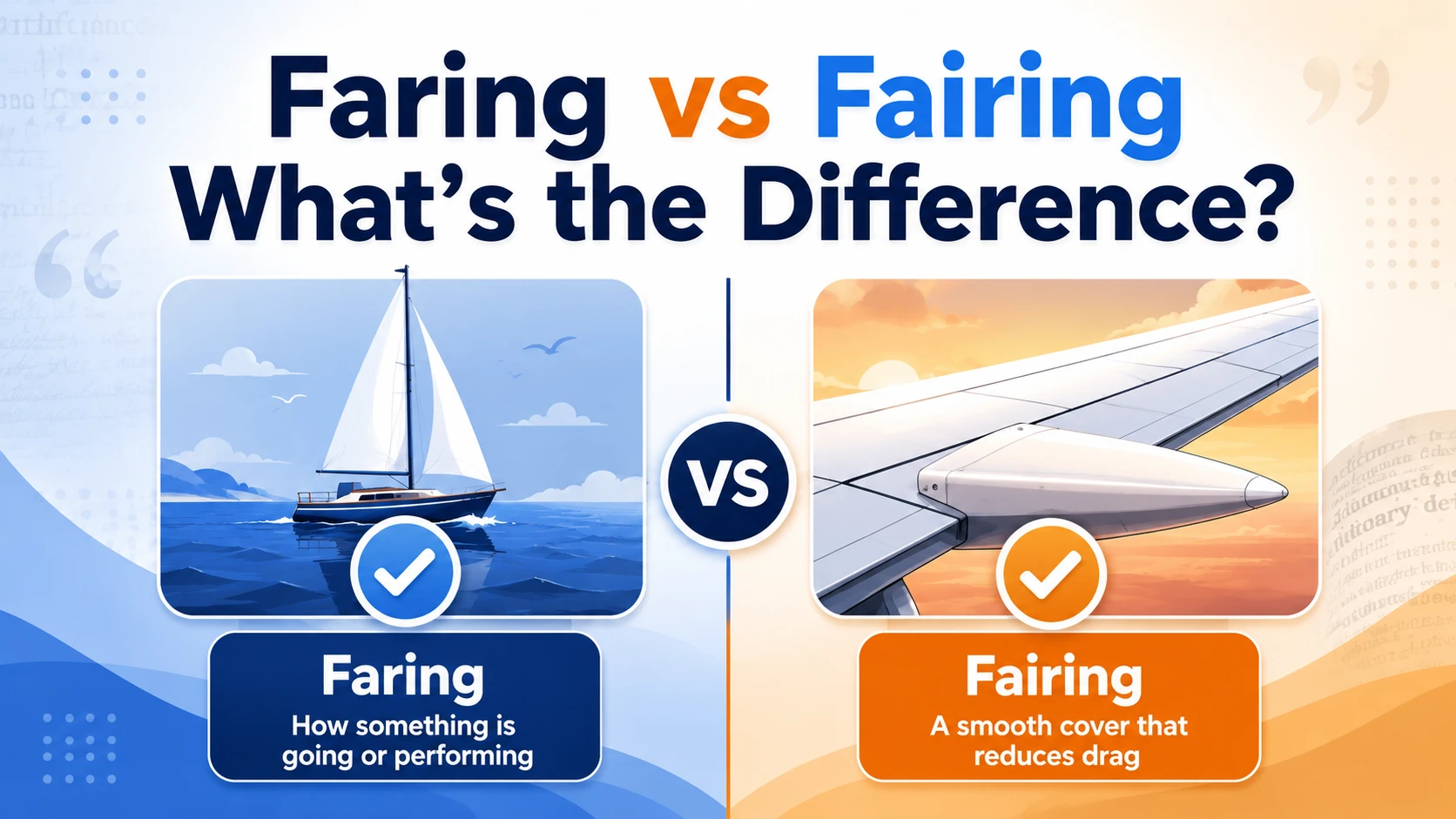
Faring vs fairing is a surprisingly common source of confusion because the two words sound exactly alike but have completely different meanings. One belongs to everyday English and describes how someone is doing or progressing, while the other is a technical term used in engineering, aviation, motorcycles, automobiles, and aerospace. Since they’re perfect homophones, even experienced writers occasionally choose the wrong spelling, especially when relying on pronunciation rather than context.
The confusion becomes more noticeable in online conversations, emails, and social media, where people often type quickly without considering the grammatical role of the word. Questions like “How are you fairing?”, “Is it faring well or fairing well?”, and “What’s a motorcycle fairing?” appear regularly because the correct answer depends entirely on the intended meaning. Understanding the distinction not only improves your writing but also helps you avoid embarrassing mistakes in both professional and casual communication.
This guide explains the meaning of faring and fairing, why they are often confused, how to use each one correctly, and the easiest ways to remember the difference. You’ll also find comparison tables, practical examples, memory tricks, common mistakes, and practice exercises so you can confidently choose the right word in any situation.
Faring vs Fairing: The Quick Answer
If you’re looking for the simplest explanation, here it is:
- Faring comes from the verb fare, meaning to get along, perform, progress, or experience a particular condition.
- Fairing is a noun that refers to a smooth covering or external structure designed to improve airflow or reduce resistance around a vehicle or mechanical component.
Although both words are pronounced the same, they belong to entirely different subjects.
Which Spelling Is Correct?
The correct spelling depends on what you’re talking about.
- Use faring when discussing people, businesses, teams, projects, health, finances, or progress.
- Use fairing when referring to motorcycles, airplanes, bicycles, rockets, boats, automobiles, or other engineered machines.
For example:
- How are you faring after your surgery?
- The company is faring well despite market challenges.
- The motorcycle’s front fairing reduced wind resistance.
- Engineers redesigned the aircraft fairing to improve fuel efficiency.
The Easiest Way to Remember the Difference
Here’s a simple memory trick:
- Fare = progress → faring
- Fairing = fitting on a machine
If the sentence involves people or performance, choose faring.
If it involves vehicles or engineering, choose fairing.
Quick Comparison Table
| Feature | Faring | Fairing |
| Pronunciation | Same as fairing | Same as faring |
| Part of speech | Present participle of fare | Noun |
| Main meaning | Progressing or doing | Aerodynamic covering or protective structure |
| Common context | Life, work, health, business | Engineering, aviation, motorcycles, automotive |
| Example | She’s faring much better today. | The bike has a carbon-fiber fairing. |
What Does “Faring” Mean?
Faring is the present participle of the verb fare. It describes how someone or something is progressing, performing, surviving, or experiencing a situation.
Unlike many modern verbs, fare isn’t used constantly in everyday conversation, but it remains common in journalism, business writing, literature, formal English, and polite conversation.
Examples include:
- How are you faring?
- The local economy is faring better than expected.
- Students are faring well in science this year.
In each example, faring describes a current state or ongoing progress rather than a physical action.
The Meaning of Faring in Modern English
Today, faring most often answers questions such as:
- How is someone doing?
- How successful is something?
- Is the situation improving or worsening?
- What progress has been made?
It can describe individuals, organizations, communities, industries, or even countries.
Examples:
- Small businesses are faring better this quarter.
- Patients are faring well after treatment.
- Wildlife populations are faring differently across regions.
- New graduates are faring well in today’s job market.
Although the subject changes, the underlying meaning remains to be doing in a particular way.
How Fare Becomes Faring
Understanding the verb helps eliminate confusion.
| Verb Form | Word |
| Base verb | fare |
| Third-person singular | fares |
| Past tense | fared |
| Present participle | faring |
Examples:
- She fares well under pressure.
- He fared better than expected.
- They’re faring much better now.
Notice that faring always comes from the verb fare, never from fair.
This distinction explains why “How are you fairing?” is grammatically incorrect.
Common Situations Where Faring Is Used
Although many people associate the word with greetings, it appears in a wide variety of contexts.
Asking About Someone’s Well-Being
One of the oldest and most common uses involves asking how someone is doing.
Examples:
- How are you faring after your move?
- How is your family faring?
- Are you faring better this week?
Compared with “How are you doing?”, “How are you faring?” often sounds slightly more thoughtful or formal. It suggests genuine interest in someone’s circumstances rather than a routine greeting.
Discussing Progress or Performance
Businesses, schools, and organizations frequently use faring when evaluating results.
Examples:
- Our sales team is faring well this year.
- The research project is faring better than expected.
- Local restaurants are faring differently after the new regulations.
This usage emphasizes ongoing performance instead of a single outcome.
Talking About Success or Difficulties
Another common application is describing how someone manages challenging situations.
Examples:
- Farmers are faring better after recent rainfall.
- Independent bookstores are faring surprisingly well despite online competition.
- Several startups aren’t faring as expected.
Because the word naturally conveys progress over time, it works particularly well when discussing changing circumstances.
Writing Tip
Use faring when you could naturally replace it with doing, progressing, performing, or managing without changing the sentence’s meaning.
What Does “Fairing” Mean?
While faring belongs to general English, fairing comes from the world of engineering and industrial design.
A fairing is a specially designed structure attached to a vehicle or machine to reduce air resistance, improve efficiency, protect internal components, or enhance appearance.
You’ll encounter fairings in industries where aerodynamics or fluid dynamics play an important role.
Examples include:
- Motorcycles
- Airplanes
- Rockets
- Spacecraft
- Racing bicycles
- High-speed boats
- Automobiles
Although some fairings are decorative, most are engineered to solve practical problems related to airflow and performance.
The Meaning of Fairing in Engineering and Design
In engineering, a fairing creates a smoother transition between surfaces.
Without a fairing, air or water may create unnecessary drag, turbulence, vibration, or noise.
By smoothing these surfaces, engineers can often achieve:
- Better fuel efficiency
- Higher speeds
- Improved stability
- Reduced wind noise
- Greater protection for mechanical components
For example, an aircraft fairing may cover the junction between the wing and fuselage, reducing drag and improving overall aerodynamic performance.
Similarly, a motorcycle fairing helps direct airflow around the rider and engine, making high-speed travel more comfortable and efficient.
Why Fairings Improve Performance
Engineers rarely add fairings simply for appearance.
Instead, they’re designed to provide measurable benefits, including:
- Lower aerodynamic drag
- Increased fuel economy
- Better handling at higher speeds
- Reduced exposure to wind and debris
- Protection for sensitive equipment
- Improved thermal management in some designs
In competitive motorsports and aerospace applications, even small improvements in airflow can significantly affect overall performance.
Types of Fairings
Not all fairings serve the same purpose. Their design depends on the type of vehicle, the environment it operates in, and the engineering problem they’re intended to solve. Some are built to improve aerodynamics, while others protect components from wind, water, dirt, or impact.
Knowing where fairings are used makes it much easier to remember that fairing belongs to the world of machines—not people.
Motorcycle Fairings
Motorcycles are where many people first encounter the word fairing.
A motorcycle fairing is a panel, usually made from plastic, fiberglass, carbon fiber, or composite materials, mounted around the front or sides of the bike.
Its purposes include:
- Reducing wind resistance
- Improving rider comfort
- Protecting the engine
- Shielding the rider from rain, debris, and insects
- Enhancing the motorcycle’s appearance
Common types include:
- Full fairing
- Half fairing
- Quarter fairing
- Bikini fairing
Example:
- The rider replaced the damaged front fairing after a minor accident.
Aircraft Fairings
Aircraft engineers use fairings to smooth transitions between structural parts and minimize drag.
You’ll commonly find fairings around:
- Wing roots
- Landing gear
- Engine connections
- Antenna mounts
- Tail assemblies
Even a small reduction in drag can improve fuel efficiency over thousands of flight hours, which is why aircraft manufacturers pay close attention to fairing design.
Example:
- The landing gear fairing reduced aerodynamic drag during flight.
Bicycle Fairings
Although less common than motorcycle fairings, bicycles—especially recumbent bikes and racing models—sometimes use fairings.
Benefits include:
- Lower wind resistance
- Higher speeds
- Reduced rider fatigue
- Improved performance during long-distance events
Example:
- The aerodynamic fairing helped the cyclist maintain speed against strong headwinds.
Boat and Automotive Fairings
Fairings also appear in marine and automotive engineering.
Examples include:
- Wheel fairings
- Underbody fairings
- Mirror fairings
- Hull fairings
- Trailer fairings
These components streamline airflow or water flow, helping improve efficiency and reduce turbulence.
Rocket and Spacecraft Fairings
One of the most recognizable examples is the payload fairing on a rocket.
The payload fairing protects satellites or scientific equipment during launch by shielding them from:
- Air pressure
- Heat
- Vibration
- Weather conditions
Once the rocket reaches thinner layers of the atmosphere, the fairing is typically released because it is no longer needed.
Example:
- The rocket’s payload fairing separated successfully after launch.
Expert Insight
In engineering, a fairing isn’t just decorative. It’s usually designed to solve a specific aerodynamic or protective problem while balancing weight, strength, and performance.
Faring vs Fairing: The Key Differences Explained
Although faring and fairing sound identical, they’re unrelated in meaning, grammar, and usage.
The easiest way to avoid mistakes is to focus on context, not pronunciation.
| Feature | Faring | Fairing |
| Pronunciation | /FAIR-ing/ | /FAIR-ing/ |
| Part of speech | Verb form (present participle of fare) | Noun |
| Main meaning | Doing, progressing, or performing | Aerodynamic or protective covering |
| Typical subject | People, businesses, teams, economies | Motorcycles, aircraft, boats, rockets |
| Related words | fare, fares, fared | aerodynamic, bodywork, panel, cowling |
| Example | The company is faring well. | The aircraft fairing reduced drag. |
Why These Words Are Often Confused
Several factors contribute to the confusion.
- They are perfect homophones, meaning they sound exactly the same.
- Most people encounter faring infrequently because the verb fare is less common than do or perform.
- Fairing is a specialized technical term that many people don’t learn unless they’re interested in engineering or vehicles.
- Spell-check tools may not detect the mistake because both words are correctly spelled English words.
As a result, writers often choose the wrong spelling without realizing it.
Pronunciation: Do They Sound the Same?
Yes.
Both are pronounced:
/ˈferɪŋ/
Because pronunciation offers no clue, readers must rely entirely on grammar and context.
For example:
- How are you faring?
- The motorcycle needs a new fairing.
Although the words sound identical when spoken, their meanings are completely unrelated.
How Context Helps You Choose the Correct Word
Ask yourself one simple question:
Am I talking about progress or machinery?
If you’re discussing:
- health
- success
- performance
- business
- education
- relationships
→ use faring
If you’re discussing:
- motorcycles
- airplanes
- bicycles
- rockets
- automotive parts
→ use fairing
This contextual approach is often faster than memorizing dictionary definitions.
Is It “How Are You Faring” or “How Are You Fairing”?
This is one of the most frequently searched questions about these words.
The correct expression is:
✅ How are you faring?
Why “How Are You Faring?” Is Correct
The sentence asks about someone’s well-being, progress, or current situation.
Since fare means to get along or do, its present participle is faring.
Examples:
- How are you faring after your surgery?
- How are your studies faring this semester?
- How is your business faring in today’s economy?
Each sentence asks how someone or something is progressing.
Why “How Are You Fairing?” Is Incorrect
Using fairing would literally refer to an aerodynamic covering.
For example:
❌ How are you fairing?
This accidentally suggests that the person is somehow becoming a motorcycle body panel or aircraft component, which obviously isn’t the intended meaning.
Although the mistake is common online, it remains grammatically incorrect.
Common Mistakes in Emails and Conversations
Incorrect:
- I hope you’re fairing well.
- How have you been fairing?
- Everyone is fairing better now.
Correct:
- I hope you’re faring well.
- How have you been faring?
- Everyone is faring better now.
These mistakes often occur because people type the word based on its pronunciation rather than its meaning.
Similar Expressions You Can Use Naturally
If faring feels too formal, consider alternatives such as:
- How are you doing?
- How have things been?
- How’s everything going?
- How are things working out?
- How have you been?
These expressions carry similar meanings while sounding more conversational.
Is It “Faring Well” or “Fairing Well”?
The correct phrase is:
✅ faring well
The Correct Expression Explained
Faring well means:
- doing well
- succeeding
- progressing positively
- coping successfully
Examples:
- She’s faring well after the operation.
- Small businesses are faring well despite inflation.
- Students are faring well in mathematics this year.
The phrase appears frequently in journalism, reports, and formal writing because it efficiently describes overall progress.
Why “Fairing Well” Is Incorrect
Since fairing refers to a mechanical component, the expression fairing well has no logical meaning when discussing people or organizations.
Incorrect:
❌ The company is fairing well.
Correct:
✅ The company is faring well.
Whenever you’re talking about success or progress, choose faring.
Other Common Phrases with Fare
The verb fare appears in several established expressions.
Examples include:
- fare well
- fare badly
- fare better
- fare worse
- fare poorly
- fare differently
Examples in sentences:
- New restaurants often fare better with strong local support.
- Independent bookstores continue to fare well in many communities.
- Some industries fared worse during the recession than others.
Understanding these patterns makes faring easier to recognize in both reading and writing.
Understanding the Verb “Fare”
Although fare isn’t as common as verbs like do, perform, or manage, it remains an important part of English vocabulary.
What Does Fare Mean?
The verb fare generally means:
- to do
- to perform
- to progress
- to get along
- to experience a particular outcome
Examples:
- She fares well under pressure.
- The team fared better than expected.
- Our investments are faring well this year.
Present, Past, and Present Participle Forms
| Verb Form | Example |
| Fare | They fare well together. |
| Fares | She fares better in small groups. |
| Fared | The company fared well last year. |
| Faring | They’re faring much better now. |
Learning all four forms helps prevent confusion when reading formal writing or news articles.
Common Grammatical Patterns
You’ll often see fare used with adverbs describing outcomes.
Examples:
- fare well
- fare badly
- fare poorly
- fare differently
- fare better
- fare worse
These combinations appear frequently because they naturally express comparison and progress.
How to Use Faring Correctly in Sentences
Knowing the definition of faring is only the first step. The real challenge is recognizing when it sounds natural in everyday writing. Because fare is more formal than verbs like do or get along, you’ll encounter it most often in news articles, business reports, academic writing, and thoughtful conversations.
A helpful rule is this:
If you’re describing ongoing progress, performance, or well-being, faring is usually the correct choice.
Personal Conversations
Although faring isn’t as common as doing, it remains a natural choice when you want to sound slightly more thoughtful or sincere.
Examples:
- How are you faring after your move?
- I hope you’re faring better this week.
- My grandparents are faring well despite the cold weather.
- She’s faring much better since changing jobs.
Notice that these sentences focus on someone’s overall situation rather than a single event.
Academic and Business Writing
Professional writing often uses faring to evaluate progress over time.
Examples:
- Small businesses are faring better than analysts expected.
- Several schools are faring well in statewide assessments.
- The research team is faring better after receiving additional funding.
- Local manufacturers are faring differently depending on supply costs.
This usage allows writers to discuss trends without repeating words like performing or doing.
News and Media Examples
Journalists frequently use faring when reporting on changing conditions.
Examples:
- Coastal communities are faring better after recent flood-control improvements.
- Renewable energy companies are faring well in international markets.
- Independent retailers are faring differently as consumer habits change.
- Wildlife populations are faring better in protected areas.
Because the word implies ongoing progress, it’s especially useful for reporting developments over weeks, months, or years.
Formal vs. Informal Usage
While faring is perfectly correct in conversation, many people naturally replace it with simpler alternatives.
Compare these examples:
| Formal | Informal |
| How are you faring? | How are you doing? |
| The project is faring well. | The project is going well. |
| Students are faring better. | Students are doing better. |
| The business is faring poorly. | The business isn’t doing well. |
Neither version is wrong. The choice depends on your audience and the tone you want to create.
Writing Tip
Use faring when discussing overall progress or long-term performance. For casual conversation, doing or getting along may sound more natural.
How to Use Fairing Correctly in Sentences
Unlike faring, fairing almost always appears in technical or engineering contexts. If your writing involves vehicles, aircraft, boats, or machinery, understanding this term helps you communicate more precisely.
Engineering and Technical Writing
Engineers use fairing to describe a component that improves airflow, protects equipment, or reduces drag.
Examples:
- Engineers redesigned the nose fairing to reduce turbulence.
- The new fairing decreased aerodynamic drag during testing.
- Technicians inspected the damaged fairing before takeoff.
- Composite fairings are lighter than many traditional materials.
Precision matters in technical writing because different vehicle parts serve different purposes.
Automotive Examples
Modern vehicles use several types of fairings.
Examples:
- The wheel fairing improved fuel efficiency.
- Mechanics replaced the cracked front fairing.
- The racing car’s underbody fairing helped reduce drag.
- The manufacturer introduced a redesigned side fairing.
Although some fairings improve appearance, they’re often designed primarily for performance.
Aviation Examples
Aircraft contain numerous fairings that passengers rarely notice.
Examples:
- The wing-root fairing smoothed airflow around the fuselage.
- Engineers replaced the landing-gear fairing during maintenance.
- The engine fairing protected internal components from airflow.
These structures contribute to efficiency without drawing attention.
Product Manuals and Technical Documentation
Technical manuals rely on consistent terminology.
Examples:
- Inspect the fairing for visible cracks before operation.
- Replace the damaged fairing using approved components.
- Remove the upper fairing before accessing the engine.
- Tighten the fairing bolts according to the manufacturer’s specifications.
Using the correct technical vocabulary reduces ambiguity and improves safety.
Side-by-Side Sentence Comparisons
Because faring and fairing sound identical, comparing them directly is one of the best ways to understand the difference.
Faring vs. Fairing in Similar Sentence Structures
| Correct Sentence | Why It’s Correct |
| The company is faring well this year. | Describes performance. |
| The aircraft’s fairing reduced drag. | Refers to a mechanical component. |
| How are you faring after graduation? | Asks about someone’s progress. |
| The damaged fairing was replaced. | Names an engineering part. |
| Students are faring better this semester. | Discusses academic progress. |
| The motorcycle has a new carbon-fiber fairing. | Identifies a vehicle part. |
Notice that the context immediately reveals which word belongs in the sentence.
Correct and Incorrect Examples
Understanding common mistakes helps you avoid repeating them.
| Incorrect | Correct |
| How are you fairing? | How are you faring? |
| The business is fairing well. | The business is faring well. |
| He installed a new faring on the motorcycle. | He installed a new fairing on the motorcycle. |
| Engineers tested the aircraft faring. | Engineers tested the aircraft fairing. |
Why Each Sentence Is Right or Wrong
Ask yourself:
- Is the sentence about progress or performance?
- Use faring.
- Is it about a physical object on a machine?
- Use fairing.
This two-question method works almost every time.
Common Collocations and Expressions
Learning the words that naturally appear with faring and fairing makes your writing sound more fluent.
Common Expressions with Faring
You’ll frequently encounter these combinations:
- faring well
- faring badly
- faring better
- faring worse
- faring poorly
- faring differently
Examples:
- Rural hospitals are faring better than expected.
- Some industries are faring worse because of rising costs.
- New graduates are faring well in today’s job market.
These expressions usually compare current conditions with previous results or expectations.
Common Terms with Fairing
Technical writing often combines fairing with specific components.
Common examples include:
- front fairing
- full fairing
- half fairing
- nose fairing
- wheel fairing
- landing-gear fairing
- payload fairing
- aerodynamic fairing
- carbon-fiber fairing
- fairing kit
Examples:
- The motorcycle features a lightweight full fairing.
- Engineers modified the nose fairing during testing.
- The rider installed a replacement fairing kit.
Recognizing these combinations makes technical documents easier to understand.
Common Mistakes and How to Avoid Them
Most errors involving faring and fairing aren’t caused by misunderstanding grammar. Instead, they’re caused by relying on pronunciation instead of meaning.
Assuming Similar Pronunciation Means Similar Meaning
Because both words sound identical, many writers instinctively choose the spelling that looks more familiar.
The solution is simple:
Ignore the pronunciation and focus on what the sentence is actually discussing.
Using Fairing When Discussing People
This is by far the most common mistake.
❌ I hope you’re fairing well.
✅ I hope you’re faring well.
Whenever you’re talking about people, businesses, health, relationships, education, or progress, choose faring.
Using Faring When Discussing Vehicle Parts
The opposite mistake also occurs.
❌ The motorcycle’s front faring was damaged.
✅ The motorcycle’s front fairing was damaged.
If the word refers to a physical component, fairing is the only correct spelling.
Spell-Check Limitations and Proofreading Tips
Spell-checkers often fail to catch this mistake because both words exist in English.
Before submitting important writing, ask yourself:
- Am I describing progress?
- Or am I describing equipment?
That brief review is often more reliable than automated proofreading tools.
Proofreading Checklist
- ✔ People, progress, success, health → faring
- ✔ Motorcycles, aircraft, rockets, vehicles → fairing
- ✔ Read the sentence for meaning—not just spelling.
- ✔ Don’t rely solely on spell-check software.
Similar Word Pairs That Cause Confusion
Faring and fairing are just one example of English words that sound alike but have different meanings. These pairs, known as homophones, often cause spelling mistakes because writers rely on pronunciation instead of context.
Learning a few similar examples can strengthen your grammar skills and help you recognize the importance of choosing words based on meaning, not sound.
Complement vs. Compliment
Although these words differ by only one letter, they have unrelated meanings.
| Word | Meaning | Example |
| Complement | Something that completes or enhances another thing | The sauce complements the meal perfectly. |
| Compliment | A polite expression of praise | She gave me a wonderful compliment. |
Memory tip: A compliment contains “I”, just like “I praise you.”
Principal vs. Principle
This pair frequently appears in education and business writing.
| Word | Meaning | Example |
| Principal | Head of a school or most important | The principal addressed the students. |
| Principle | A rule, belief, or fundamental truth | Honesty is an important principle. |
Stationary vs. Stationery
These words are pronounced almost identically but belong to different subjects.
| Word | Meaning | Example |
| Stationary | Not moving | The train remained stationary. |
| Stationery | Writing paper and office supplies | She bought new stationery. |
Brake vs. Break
A classic pair that appears in everyday writing.
| Word | Meaning | Example |
| Brake | Device used to slow or stop a vehicle | Press the brake gently. |
| Break | Separate into pieces or interrupt | Be careful not to break the glass. |
Affect vs. Effect
These two words are commonly confused because they are closely related.
| Word | Part of Speech | Example |
| Affect | Usually a verb | Weather can affect travel plans. |
| Effect | Usually a noun | The new policy had a positive effect. |
Why Homophones Often Cause Spelling Mistakes
Homophones challenge writers because:
- They sound identical in conversation.
- Spell-checkers may not identify the error.
- Both spellings exist in the dictionary.
- Writers often choose the word that “looks right” without checking the context.
The best solution is to pause and ask:
What does this word actually mean in my sentence?
That habit will prevent most homophone errors—not just faring and fairing.
Memory Tricks to Remember Faring vs Fairing
You don’t need to memorize dozens of examples if you remember one or two strong associations.
Associate Fare with Life’s Journey
Think of the verb fare as describing someone’s journey through life.
People fare:
- well
- badly
- better
- worse
Examples:
- Students are faring well.
- My grandparents are faring much better now.
Whenever you’re talking about people, progress, health, business, or success, choose faring.
Associate Fairing with Machines and Aerodynamics
Imagine the sleek body panels on a motorcycle or the protective nose cone on a rocket.
Those components are fairings.
Examples:
- motorcycle fairing
- aircraft fairing
- payload fairing
- wheel fairing
If the word refers to something you can physically install or remove, it’s almost certainly fairing.
A Simple Visual Memory Technique
Use this quick association:
- Faring = Future and progress
- Fairing = Fast machines
Or remember this sentence:
People fare. Machines wear fairings.
It’s short, memorable, and works in almost every situation.
Quick Rule
- People, progress, performance → faring
- Vehicles, aircraft, engineering → fairing
Practice Exercises
Choose the Correct Word
Select the correct answer.
- How are you (faring / fairing) after your surgery?
- The motorcycle’s front (faring / fairing) was replaced.
- Small businesses are (faring / fairing) better this year.
- Engineers redesigned the aircraft (faring / fairing).
- I hope you’re (faring / fairing) well.
Fill in the Blanks
Complete each sentence with faring or fairing.
- The company is __________ much better this quarter.
- The damaged __________ increased aerodynamic drag.
- Patients are __________ well after treatment.
- The rocket’s payload __________ separated successfully.
- Our local schools are __________ better than expected.
Correct the Mistake
- Rewrite each sentence correctly.
- How are you fairing these days?
- The airplane’s faring reduced drag.
- She is fairing much better now.
- The damaged faring needs replacement.
- Our business is fairing well.
Rewrite the Sentence Using the Correct Word
- Rewrite these sentences by replacing the highlighted idea with faring or fairing where appropriate.
- The company is doing well this year.
- The motorcycle needed a new protective body panel.
- The students are making good progress.
- Engineers tested the aerodynamic covering.
- My grandparents are doing much better now.
Answer Key with Explanations
Choose the Correct Word
- faring
- fairing
- faring
- fairing
- faring
Fill in the Blanks
- faring
- fairing
- faring
- fairing
- faring
Correct the Mistakes
- How are you faring these days?
- The airplane’s fairing reduced drag.
- She is faring much better now.
- The damaged fairing needs replacement.
- Our business is faring well.
Conclusion
Understanding faring vs fairing becomes straightforward once you focus on meaning instead of pronunciation. Faring always relates to how someone or something is progressing, while fairing refers to an aerodynamic or protective component found on vehicles and machines. Because these words are perfect homophones, they’re easy to confuse, but the surrounding context almost always reveals the correct choice. One final actionable tip: before you write either word, ask yourself whether you’re discussing progress or a physical machine part. A common mistake to avoid is assuming that identical pronunciation means identical meaning. By using context as your guide, you’ll write with greater confidence, accuracy, and professionalism every time.
Frequently Asked Questions
Q1. Is “How are you fairing?” ever correct?
No. When asking about someone’s health, progress, or well-being, the correct expression is “How are you faring?” The word fairing refers to an aerodynamic or protective vehicle component and doesn’t fit this context.
Q2. Why do faring and fairing sound exactly the same?
They are homophones, meaning they share the same pronunciation but have different spellings, meanings, and origins. English contains many homophones, so context—not pronunciation—is the key to choosing the correct word.
Q3. Is faring well considered formal English?
Yes, faring well is slightly more formal than doing well, but it’s still widely used in journalism, business writing, literature, and thoughtful conversation. It naturally emphasizes overall progress rather than a single moment or event.
Q4. What is a motorcycle fairing?
A motorcycle fairing is a body panel designed to improve aerodynamics, reduce wind resistance, protect mechanical components, and increase rider comfort. Depending on the design, it may also enhance fuel efficiency and the motorcycle’s appearance.
Q5. Can fare mean both travel cost and how someone is doing?
Yes. As a noun, fare commonly refers to the price of transportation, such as a bus or taxi fare. As a verb, it means to perform, progress, or get along, which is the sense used in faring well.
