Choosing vs. chosing is a spelling question that catches many English learners and even native speakers off guard. At first glance, both words seem plausible because English often drops or changes letters when adding suffixes. However, only one of these spellings is correct in modern English. If you’ve ever paused while writing an email, essay, or social media post wondering whether to write choosing or chosing, you’re not alone. Understanding the reason behind the correct spelling will help you avoid a common mistake and write with greater confidence.
The confusion usually begins with the verb choose. When people add -ing, some assume the extra “o” should disappear, creating chosing. English spelling, however, follows specific patterns, and this verb doesn’t behave that way. Knowing the rule is more valuable than simply memorizing the correct form because it helps you spell similar words accurately in the future. Once you understand why choosing keeps both o’s, you’ll rarely hesitate again.
This guide explains the difference between choosing and chosing, the spelling rule behind the correct form, common mistakes, practical examples, and simple memory techniques. You’ll also learn how choose, choosing, and chosen relate to one another so you can use each form naturally in conversation and writing. By the end, you’ll know exactly which spelling belongs in modern English and why.
Choosing vs. Chosing: The Quick Answer
If you’re looking for the short answer, here it is:
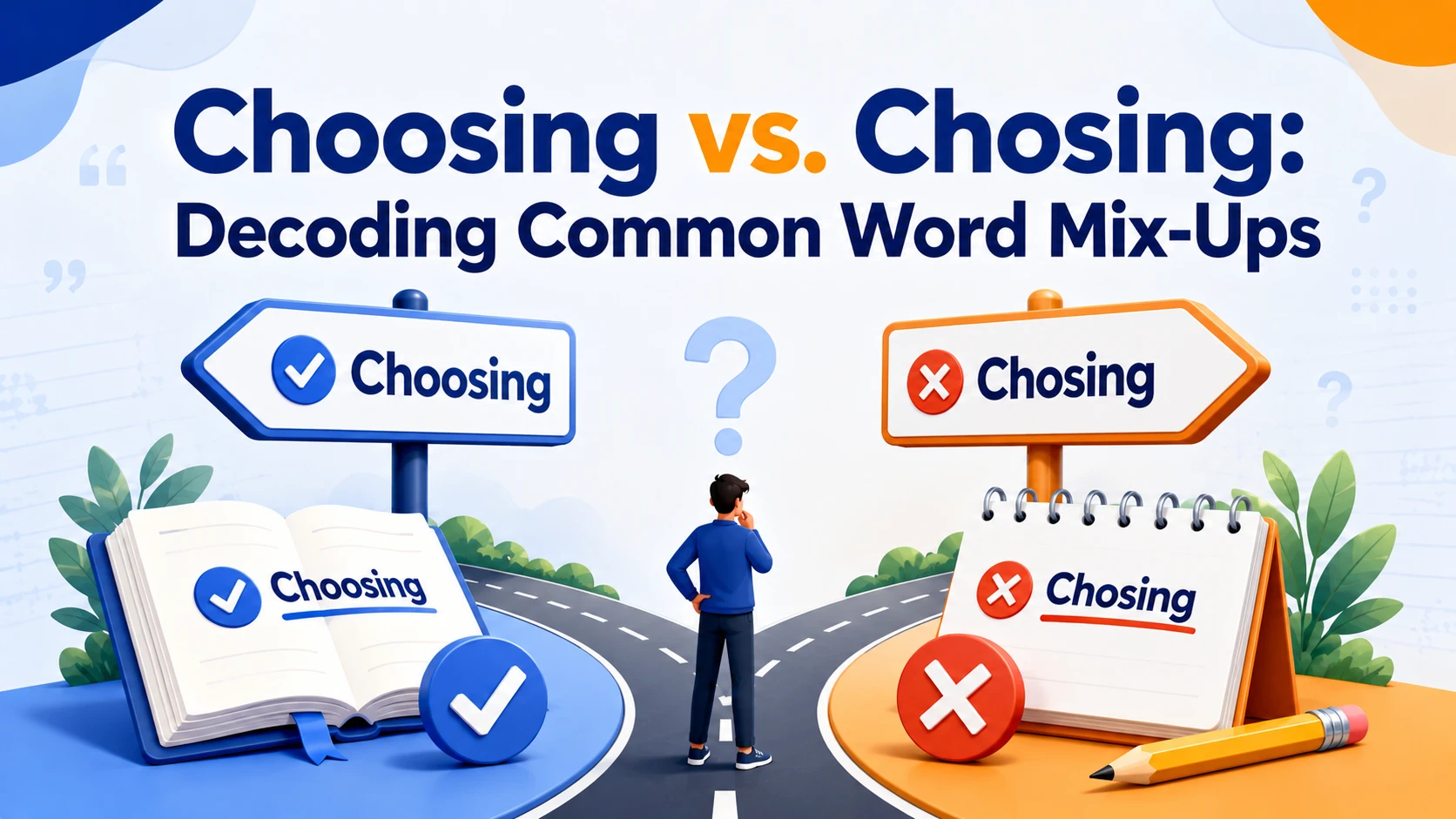
- Choosing is the correct spelling.
- Chosing is a misspelling and should not be used in modern English.
Whenever you need the present participle or gerund form of choose, always write choosing.
Quick rule: If you can replace the word with selecting or deciding, the correct spelling is almost certainly choosing.
Which Spelling Is Correct?
The accepted spelling in British English, American English, Canadian English, Australian English, and other major varieties of English is:
✅ Choosing
Examples:
- “She is choosing a university.”
- “We’re choosing new furniture.”
- “They are choosing the best candidate.”
The spelling chosing does not appear in standard dictionaries as an accepted modern word.
Is “Chosing” Ever a Real Word?
No.
Unlike some spelling variants that differ by region, chosing is simply considered a spelling error.
You may occasionally find it in:
- Typing mistakes
- Student writing
- Informal online posts
- Auto-correction failures
These examples reflect incorrect spelling rather than an accepted alternative.
The Simple Rule to Remember
Think of the base verb.
- Choose
- Choosing
The double “o” stays because it’s already part of the root word.
You remove only the silent “e” before adding -ing.
Choose → Choosing
Not:
Choose → Chosing ✖
What Does “Choosing” Mean?
Choosing is the present participle and gerund form of the verb choose.
It refers to the act of selecting, deciding, or picking one option from several possibilities.
Because people make choices every day, choosing appears frequently in spoken and written English.
Definition and Pronunciation
Definition
Choosing means selecting, deciding, or picking from two or more options.
Pronunciation
CHOO-zing
Notice that the long “oo” sound matches the spelling.
Why “Choosing” Is the Present Participle of “Choose”
English verbs often form their present participle by:
- Removing a final silent e
- Adding -ing
For example:
| Base Verb | Present Participle |
| Make | Making |
| Write | Writing |
| Smile | Smiling |
| Choose | Choosing |
The same spelling rule applies consistently.
Common Situations Where “Choosing” Is Used
You can use choosing whenever someone is in the process of making a decision.
Examples include:
- Choosing a college
- Choosing a career
- Choosing a restaurant
- Choosing a book
- Choosing a gift
- Choosing between two job offers
The word works equally well in everyday conversations and formal writing.
Is “Chosing” a Correct Word?
This is one of the most common spelling questions related to the verb choose.
The answer is straightforward:
No.
Modern English recognizes choosing as the only correct spelling.
If you write chosing, readers, teachers, editors, and grammar-checking software will almost certainly identify it as a mistake.
Why “Chosing” Is Considered a Misspelling
The error usually happens because people apply the wrong spelling pattern.
Some assume that removing the silent e also requires removing one o, but English spelling doesn’t work that way.
The root word already contains two o’s, and both remain after adding -ing.
Correct transformation:
- choose → choosing
Incorrect transformation:
- choose → chosing
How the Confusion Happens
Several factors contribute to this mistake:
- Fast typing
- Pronunciation that doesn’t strongly emphasize both o’s
- Unfamiliarity with English spelling rules
- Assuming words should become shorter when adding suffixes
Many learners also confuse choosing with the past tense chose, which contains only one o.
Compare:
- choose
- chose
- chosen
- choosing
Because these forms look different, spelling errors become more common.
Why Spell Checkers Flag “Chosing”
Most writing tools immediately underline chosing because it isn’t recognized as a correctly spelled English word.
Examples include:
- Microsoft Word
- Google Docs
- Grammarly
- LanguageTool
- Browser spell checkers
These programs recommend choosing because it matches modern dictionary standards.
Writing tip: If your spelling checker suggests choosing, accept the correction unless you’re reproducing someone else’s original typo for discussion.
Why “Choosing” Has Two O’s
Understanding the spelling rule makes the correct form much easier to remember than simple memorization.
The key is recognizing what changes—and what doesn’t—when adding -ing.
How the Verb “Choose” Changes When Adding -ing
The rule is simple:
- Remove the silent e
- Keep every other letter
- Add -ing
The process looks like this:
Choose
↓
Remove e
↓
Choos
↓
Add -ing
↓
Choosing
Notice that both o’s remain because they’re part of the original word.
English Spelling Rule Behind “Choosing”
Many English verbs ending in a silent e follow this exact pattern.
| Base Verb | Correct -ing Form |
| Hope | Hoping |
| Save | Saving |
| Write | Writing |
| Arrive | Arriving |
| Choose | Choosing |
The silent e disappears, but the remaining letters stay unchanged.
This is one of the most consistent spelling rules in English.
Similar Verbs That Follow the Same Pattern
Here are several verbs that behave just like choose.
| Base Verb | -ing Form |
| Move | Moving |
| Bake | Baking |
| Share | Sharing |
| Smile | Smiling |
| Believe | Believing |
| Choose | Choosing |
Learning this pattern helps you spell dozens of English verbs correctly.
Choosing vs. Chosing: Side-by-Side Comparison
The table below summarizes everything you need to know.
| Feature | Choosing | Chosing |
| Correct modern spelling | ✅ Yes | ❌ No |
| Found in dictionaries | ✅ Yes | ❌ No |
| Used in academic writing | ✅ Yes | ❌ No |
| Accepted in business writing | ✅ Yes | ❌ No |
| Recognized by spell checkers | ✅ Yes | ❌ Flagged as an error |
| Meaning | Selecting or deciding | Misspelling of choosing |
Differences at a Glance
| If you want to express… | Use |
| Selecting between options | Choosing |
| Making a decision | Choosing |
| Present participle of choose | Choosing |
| Correct spelling in modern English | Choosing |
Expert takeaway: The difference between choosing and chosing isn’t a matter of regional preference or writing style. Choosing is the only correct spelling because it follows the standard English rule for forming the -ing form of verbs ending in a silent e. Once you remember to remove only the final e—not one of the o’s—this common spelling mistake becomes easy to avoid.
When Should You Use “Choosing”?
Use choosing whenever you want to describe the ongoing act of selecting, deciding, or picking from two or more options. As the present participle and gerund form of choose, it fits naturally in continuous verb tenses and whenever the action itself functions as a noun.
Because it is the standard spelling, choosing is appropriate in every form of modern English, from casual conversations to academic research papers.
In Everyday Conversations
People make choices constantly, so choosing appears frequently in daily speech.
Examples include decisions about:
- Food
- Clothing
- Travel
- Entertainment
- Shopping
- Personal preferences
Examples:
- “I’m choosing a new laptop this weekend.”
- “She’s choosing a birthday gift for her brother.”
- “We’re still choosing where to eat tonight.”
- “He’s choosing the paint color for the living room.”
In each sentence, someone is actively making a decision.
In Academic and Professional Writing
The word choosing is common in essays, reports, presentations, and research because it clearly describes the process of decision-making.
Examples:
- “Researchers are choosing participants based on specific criteria.”
- “Students should spend time choosing reliable sources.”
- “The hiring committee is choosing the most qualified applicant.”
- “Consumers are increasingly choosing sustainable products.”
Using choosing makes your writing precise while keeping it natural.
Expert tip: When discussing a process rather than a completed decision, choosing is usually the correct verb form.
In Emails, Essays, and Reports
Whether you’re writing formally or informally, choosing helps explain decisions that are still being made.
Examples:
- “Thank you for choosing our company.”
- “We’re currently choosing the final design.”
- “Before choosing a supplier, compare several quotations.”
- “She spent weeks choosing the right university.”
Because the spelling is universally accepted, you never need to worry about regional variations.
In Questions and Continuous Verb Forms
Choosing frequently appears in questions and progressive tenses.
Examples:
Questions
- “Are you choosing the blue one?”
- “Why are they choosing a different approach?”
- “What are you choosing for dessert?”
Continuous forms
- “I am choosing carefully.”
- “They were choosing furniture all afternoon.”
- “We have been choosing candidates since Monday.”
These structures emphasize that the action is ongoing.
Choosing in Real-World Example Sentences
Seeing choosing used in different situations makes its meaning easier to understand and remember.
Everyday Examples
- She’s choosing fresh vegetables for dinner.
- We’re choosing a movie for family night.
- They’re choosing names for their new puppy.
- I’m choosing comfortable shoes for the trip.
- He enjoys choosing books at the library.
These examples reflect ordinary decisions people make every day.
Workplace Examples
Decision-making is an essential part of professional life, so choosing often appears in business communication.
Examples:
- The manager is choosing between two marketing strategies.
- We’re choosing a software provider for the project.
- The board is choosing a new chief executive.
- Customers are choosing faster delivery options.
- Our team is choosing the final product design.
These examples demonstrate how naturally the word fits in professional contexts.
Academic Examples
Students and educators frequently use choosing when discussing research, learning, and planning.
Examples:
- Students are choosing elective courses.
- Scientists are choosing the most suitable research methods.
- The professor discussed choosing credible references.
- Careful choosing of evidence strengthens an argument.
Notice that the word can function as both a verb and a gerund.
Conversation Examples
Here are examples you might hear in everyday English.
- Person A: “What are you choosing for lunch?”
- Person B: “I’m choosing the grilled chicken.”
- Person A: “Why are you taking so long?”
- Person B: “I’m choosing the best option.”
- Person A: “Have you decided yet?”
- Person B: “Not yet. I’m still choosing.”
These conversations illustrate how naturally the word appears in spoken English.
Common Mistakes Writers Make
Although choosing is straightforward once you know the spelling rule, several mistakes appear repeatedly in student writing, emails, and online posts.
Understanding why these errors happen makes them easier to avoid.
Dropping the Second O by Accident
This is the most common mistake.
❌ Chosing
✔ Choosing
Many writers remove both the silent e and one o, even though only the e should disappear.
Remember:
Choose → Choosing
not
Choose → Chosing
Confusing “Choosing” with “Chosen”
Both words come from the same verb but serve different grammatical purposes.
| Word | Function | Example |
| Choosing | Present participle / gerund | “She is choosing a dress.” |
| Chosen | Past participle | “She has chosen a dress.” |
A simple way to remember this difference is to focus on time:
- Choosing = the decision is happening now.
- Chosen = the decision has already been completed.
Mixing Up “Choose,” “Choosing,” and “Choice”
These related words have different grammatical roles.
| Word | Part of Speech | Example |
| Choose | Verb | “Please choose one.” |
| Choosing | Verb / Gerund | “She’s choosing carefully.” |
| Choice | Noun | “That was a wise choice.” |
Using the correct form makes sentences clearer and grammatically accurate.
Relying Too Heavily on Pronunciation
English spelling doesn’t always match pronunciation perfectly.
Some learners hear:
cho-zing
instead of
choo-zing
and mistakenly write chosing.
That’s why relying on sound alone can be misleading.
Instead, remember the spelling rule:
- Keep both o’s.
- Remove only the silent e.
A Quick Self-Editing Checklist
Before you finish writing, ask yourself these questions:
- ✔ Did I spell it choosing with two o’s?
- ✔ Am I describing an ongoing action or process?
- ✔ Would selecting fit naturally in the sentence?
- ✔ Did I accidentally confuse choosing with chosen?
- ✔ Did my spell checker approve the spelling?
If you answer yes to these questions, you’ve almost certainly used the correct word.
Best practice: Rather than memorizing the spelling in isolation, connect choosing to its base verb choose. Since the original word already contains two o’s, removing only the silent e becomes an easy habit. This understanding is far more reliable than depending on pronunciation or guesswork.
Choose vs. Choosing vs. Chosen
These three words all come from the same verb, but they serve different grammatical purposes. Knowing when to use each one will improve both your writing and your spoken English.
Understanding the Three Forms
- Choose is the base form of the verb.
- Choosing is the present participle and gerund.
- Chosen is the past participle.
Think of them as describing different stages of the same action.
| Word | Grammatical Role | When It’s Used | Example |
| Choose | Base verb | Present tense, commands, infinitives | “Please choose a seat.” |
| Choosing | Present participle / gerund | Ongoing action or activity | “She is choosing a laptop.” |
| Chosen | Past participle | Completed action with has, have, or had | “They have chosen a winner.” |
When to Use Each Correctly
Use choose when talking about making a decision in the present or giving instructions.
Examples:
- “You may choose either option.”
- “Choose carefully before signing.”
Use choosing when the action is still happening.
Examples:
- “We’re choosing a vacation destination.”
- “He’s choosing the final design.”
Use chosen after helping verbs such as has, have, or had.
Examples:
- “She has chosen a new career.”
- “They had chosen the wrong route.”
Expert tip: If you can naturally insert is, are, or was before the word, choosing is usually the correct form.
Related Words You Shouldn’t Confuse
Many spelling mistakes occur because similar words have related meanings but different grammatical functions.
Choose vs. Chose
This pair is one of the most common grammar questions.
| Word | Tense | Example |
| Choose | Present | “I choose healthy food.” |
| Chose | Past | “Yesterday I chose the blue shirt.” |
Notice that chose has only one o, while choose has two.
Chosen vs. Choosing
Although they look similar, they describe different points in time.
| Choosing | Chosen |
| Action is happening | Action is complete |
| Present participle | Past participle |
| “She is choosing.” | “She has chosen.” |
Understanding this difference prevents many grammar errors.
Choice vs. Choose
These words belong to different parts of speech.
- Choose is a verb.
- Choice is a noun.
Examples:
- “You must choose wisely.”
- “That was an excellent choice.”
A simple test is to ask yourself whether the sentence needs an action or a thing.
Choosing vs. Deciding
These words are similar but not always identical.
- Choosing emphasizes selecting from available options.
- Deciding focuses on reaching a conclusion, even when there are no obvious alternatives.
Compare:
- “She’s choosing a wedding dress.” ✔
- “She’s deciding whether to move abroad.” ✔
Sometimes either word works, but context determines which sounds more natural.
Simple Memory Trick to Spell “Choosing” Correctly
Instead of memorizing the spelling, remember the pattern behind it.
The “Keep the Root” Rule
Start with the base verb:
Choose
Now remove only the silent e.
Choos
Add -ing.
Choosing
The important point is that both o’s stay because they belong to the original word.
A Mnemonic That Actually Works
Remember this sentence:
“If you choose today, you’re choosing now.”
Because both words begin with choos-, the spelling naturally stays the same.
This mental connection is much easier to remember than trying to memorize the word letter by letter.
A Quick Spelling Self-Check
Whenever you’re unsure, ask yourself these questions:
- Does the original word have two o’s?
- Did I remove only the final silent e?
- Does the result become choosing?
If the answer is yes, your spelling is correct.
Quick Practice Quiz
Test your understanding before moving on to the FAQs.
Fill in the Blank
Choose the correct word.
- We are ______ a hotel for our vacation.
- She has ______ the most practical solution.
- Please ______ one answer.
- They are ______ new office furniture.
- Yesterday he ______ the red jacket.
Find the Spelling Mistake
Identify and correct the incorrect word.
- I’m chosing a birthday present.
- She enjoys chosing books online.
- We are chosing between two apartments.
Choose the Correct Sentence
Which sentence is correct?
A. We are chosing a new teacher.
B. We are choosing a new teacher.
A. She has choosing the blue dress.
B. She has chosen the blue dress.
A. Please choose your favorite option.
B. Please chosen your favorite option.
Answers and Explanations
Fill in the Blank
- choosing
- chosen
- choose
- choosing
- chose
Find the Spelling Mistake
Correct answers:
- I’m choosing a birthday present.
- She enjoys choosing books online.
- We are choosing between two apartments.
Choose the Correct Sentence
Correct answers:
- B. We are choosing a new teacher.
- B. She has chosen the blue dress.
- A. Please choose your favorite option.
Decision Guide: Which Word Should You Use?
Use this quick reference whenever you’re unsure.
| If you want to express… | Correct Word | Why |
| Making a decision now | Choosing | Ongoing action |
| Giving an instruction | Choose | Base verb |
| Talking about a completed decision | Chosen | Past participle |
| Referring to yesterday’s decision | Chose | Simple past tense |
| Talking about the decision itself | Choice | Noun |
| Writing the -ing form of choose | Choosing | Correct spelling |
Expert takeaway: Most mistakes happen because writers focus on pronunciation instead of spelling patterns. The safest approach is to remember the verb family: choose → choosing → chose → chosen. Once you understand how these forms relate to one another, you’ll not only avoid writing chosing, but you’ll also use every form of choose with confidence in everyday and professional English.
Conclusion
The difference between choosing and chosing is simpler than it first appears. Choosing is the only correct spelling in modern English because it follows the standard rule of dropping the final silent e before adding -ing. Chosing is simply a spelling mistake that often results from misunderstanding how English verbs change form. One final actionable tip is to connect every -ing form to its base verb before writing it. If you remember to choose → choosing, you’ll rarely make this error again. A common mistake to avoid is spelling the word based only on how it sounds instead of applying the correct spelling rule. By understanding the pattern rather than memorizing individual words, you’ll write more accurately, confidently, and professionally in every context.
Frequently Asked Questions
Q1. Is “chosing” ever a correct spelling?
No. In modern English, chosing is considered a misspelling of choosing. Standard dictionaries, grammar references, and spell-checking tools recognize only choosing as the correct present participle and gerund form of choose. Unless you’re quoting an original typo, always use choosing.
Q2. Why does “choose” become “choosing” instead of “chosing”?
English spelling rules require you to drop the final silent “e” before adding -ing, but you keep the rest of the root word unchanged. Since choose already contains two o’s, the correct transformation is choose → choosing, not chosing.
Q3. How can I remember the correct spelling of “choosing”?
A simple memory trick is to think: “Choose keeps its two o’s.” Remove only the silent e and add -ing. If the base word has two o’s, the -ing form keeps them as well. This method works much better than relying on pronunciation.
Q4. Is “choosing” a verb or an adjective?
Choosing is primarily a verb form—the present participle of choose. It can also function as a gerund, where it acts like a noun. For example, “Choosing the right software takes time.” Here, choosing names the activity rather than describing an action.
Q5. What is the difference between “choosing” and “chosen”?
Choosing describes an action that is happening now, while chosen refers to an action that has already been completed. For example, “They are choosing a winner” means the selection is in progress, whereas “They have chosen a winner” means the decision has already been made.
