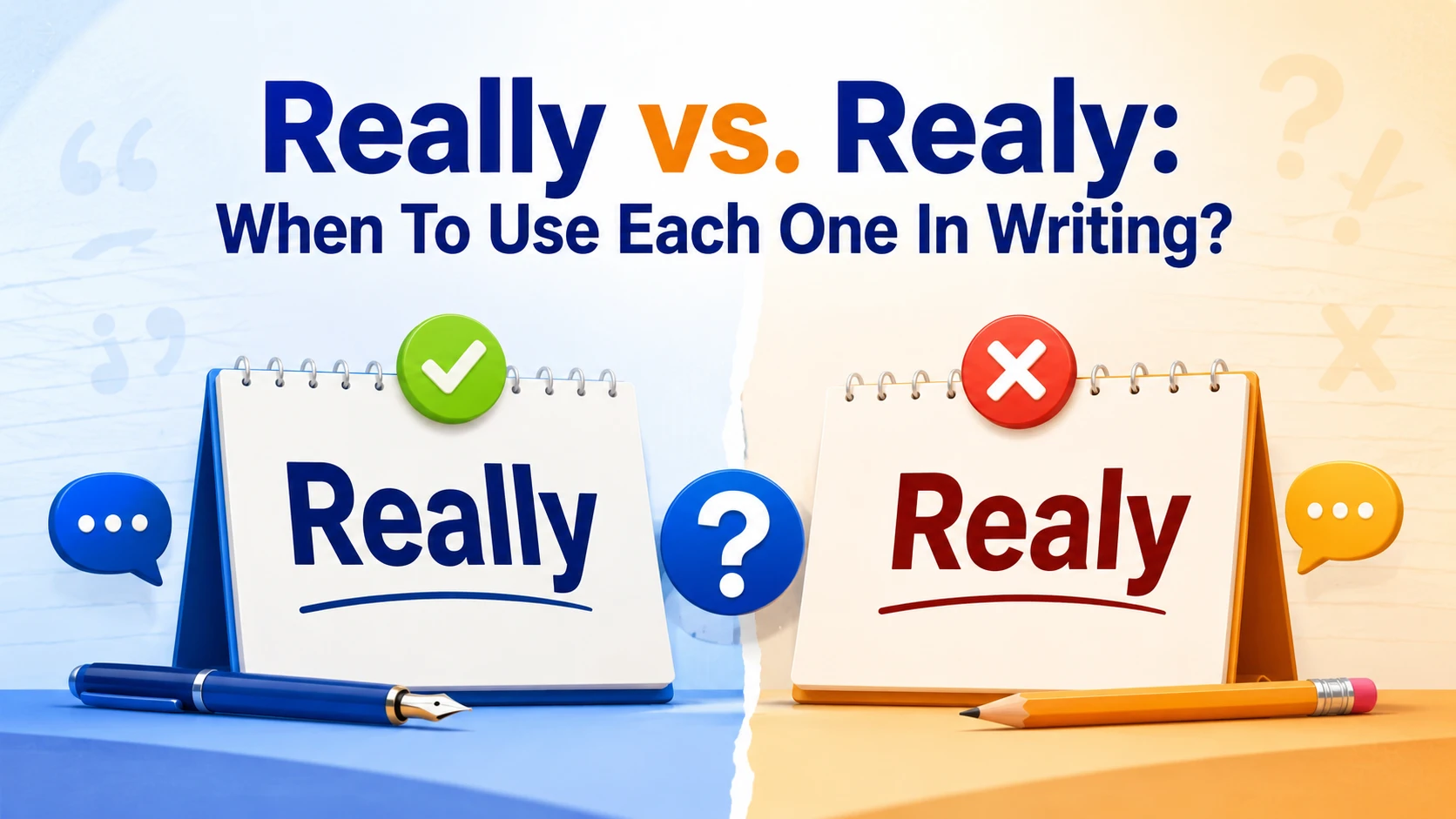
Really vs. realy is a spelling question that seems simple until you stop typing and wonder whether the word should have one l or two. Because really is one of the most frequently used adverbs in English, even experienced writers occasionally mistype it. The confusion is understandable: adding -ly to real looks like it should produce realy, but English spelling follows a different pattern. Knowing the correct form helps you write more confidently in emails, essays, reports, and everyday conversations.
The mistake often happens because people focus on pronunciation instead of spelling rules. Since really and realy sound nearly identical when spoken quickly, it’s easy to overlook the missing l while typing. Fortunately, this is one of the easiest spelling issues to fix once you understand why really keeps both l’s. Instead of memorizing the word, you’ll learn the spelling pattern behind it, making the correct form much easier to remember.
In this guide, you’ll discover why “really” is the only correct spelling, whether realy is ever acceptable, how the word functions in different contexts, and practical ways to avoid repeating the mistake. You’ll also see comparison tables, real-world examples, and memory tricks that make the rule stick. By the end, you’ll know exactly when to use really and why realy doesn’t belong in standard English writing.
Really vs. Realy: The Quick Answer
If you’re searching for the fastest answer, here it is:
- Really is the correct spelling.
- Realy is a misspelling and should not be used in standard English.
Whenever you want to emphasize a statement, express certainty, or modify another word, really is the form you should choose.
Quick rule: If you mean truly, actually, or very, write really with two l’s.
Which Spelling Is Correct?
Every major English dictionary recognizes only one standard spelling:
✅ Really
Examples:
- “I really enjoyed the presentation.”
- “Do you really believe that?”
- “She was really excited about the trip.”
The spelling realy is considered incorrect in modern English.
Is “Realy” Ever a Real English Word?
No.
Unlike some words that have American and British spelling variations, realy is not an accepted alternative.
You may encounter it in:
- Typing mistakes
- Informal text messages
- Social media posts
- Student writing
- Unedited online comments
These examples reflect spelling errors rather than legitimate English usage.
The One Rule You Should Remember
Think about the base word.
- Real
- Really
When -ly is added, the final l stays, creating a double l.
Correct:
Real + ly = Really
Incorrect:
Real + ly = Realy ✖
Once you remember this pattern, the correct spelling becomes much easier to recall.
What Does “Really” Mean?
Really is an adverb that modifies verbs, adjectives, other adverbs, or even entire sentences. Depending on the context, it can express emphasis, truth, certainty, surprise, or confirmation.
Because of its flexibility, really is one of the most common words in everyday English.
Definition and Pronunciation
Definition
Really means in truth, genuinely, actually, very, or to a great degree, depending on the sentence.
Pronunciation
REE-uh-lee or REEL-ee (depending on accent)
Although pronunciation varies slightly, the spelling always remains the same.
How “Really” Functions as an Adverb
An adverb modifies another word by providing additional meaning.
Really can modify:
- Verbs
- Adjectives
- Other adverbs
- Entire statements
Examples:
- “I really appreciate your help.” (modifies a verb)
- “The movie was really interesting.” (modifies an adjective)
- “She worked really quickly.” (modifies an adverb)
- “Really, I didn’t expect that.” (modifies the whole statement)
Understanding this flexibility explains why the word appears so frequently in spoken and written English.
Common Meanings of “Really” in Everyday English
Depending on context, really can express several different ideas.
| Meaning | Example |
| Emphasis | “That’s really important.” |
| Truth | “I really saw it happen.” |
| Surprise | “Really? I had no idea.” |
| Strong feeling | “I’m really happy.” |
| Confirmation | “Do you really agree?” |
The surrounding sentence determines which meaning readers understand.
Is “Realy” a Correct Word?
Many writers type realy by accident because it looks like a logical spelling. However, standard English does not recognize it.
Why “Realy” Is a Misspelling
The mistake happens when one l is accidentally removed.
English spelling rules do not simplify really to realy.
As a result:
- Teachers mark it as incorrect.
- Editors correct it.
- Dictionaries exclude it.
- Spell checkers flag it immediately.
How This Spelling Mistake Happens
Several factors contribute to the error.
Common causes include:
- Fast typing
- Skipping letters while proofreading
- Assuming one l is enough
- Confusing pronunciation with spelling
Since the spoken word doesn’t strongly emphasize both l’s, many people don’t notice the missing letter.
Why Dictionaries and Spell Checkers Reject “Realy”
Modern reference sources follow standardized spelling rules.
Programs such as:
- Microsoft Word
- Google Docs
- Grammarly
- LanguageTool
- Browser spell checkers
all identify realy as incorrect and recommend really instead.
Writing tip: If your spell checker highlights realy, don’t ignore it. The suggested correction is almost certainly really.
Why “Really” Has Double L
Instead of memorizing the spelling, it’s more useful to understand why the word looks the way it does.
The answer comes from how English forms adverbs.
The Spelling Rule Behind “Real” + “-ly”
The adjective real becomes the adverb really by adding the suffix -ly.
The final l remains part of the original word.
The transformation is:
Real
↓
Add -ly
↓
Really
Notice that nothing is removed from the root word.
Why the Second “L” Stays
The two l’s come from different parts of the word.
- The first l belongs to real.
- The second l begins the suffix -ly.
Together, they naturally create:
really
This is why spelling the word with only one l is incorrect.
Similar Adverbs That Follow the Same Pattern
Many adjectives ending in l form adverbs with a double l.
| Adjective | Adverb |
| Real | Really |
| Final | Finally |
| Full | Fully |
| Equal | Equally |
| Usual | Usually |
Recognizing this pattern helps you spell many common adverbs correctly.
Really vs. Realy: Side-by-Side Comparison
Here’s a quick comparison you can reference whenever you’re unsure.
| Feature | Really | Realy |
| Correct modern spelling | ✅ Yes | ❌ No |
| Found in dictionaries | ✅ Yes | ❌ No |
| Accepted in academic writing | ✅ Yes | ❌ No |
| Used in professional writing | ✅ Yes | ❌ No |
| Recognized by spell checkers | ✅ Yes | ❌ Flagged as an error |
| Meaning | Truly, actually, very | Misspelling of really |
Differences at a Glance
| If you want to express… | Correct Word |
| Strong emphasis | Really |
| Genuine truth | Really |
| Confirmation | Really |
| Standard English spelling | Really |
Expert takeaway: The difference between really and realy isn’t a matter of writing style or regional preference. Really is the only accepted spelling because it follows the standard English pattern for forming adverbs from adjectives ending in -al. Once you remember that real + -ly = really, you’ll avoid one of the most common spelling mistakes in everyday English.
When Should You Use “Really”?
Use really whenever you want to emphasize an idea, confirm that something is true, or increase the intensity of a verb, adjective, or another adverb. Because it is an adverb, really helps readers understand how true, how strong, or how certain something is.
It fits naturally in both formal and informal English, although professional writers sometimes replace it with more precise words when stronger vocabulary is appropriate.
To Emphasize a Statement
One of the most common uses of really is to add emphasis.
Instead of merely stating a fact, really highlights its importance or intensity.
Examples:
- “This guide is really helpful.”
- “She really enjoyed the concert.”
- “I really appreciate your support.”
- “That was really unexpected.”
Removing really often makes the sentence sound less expressive.
Compare:
- “The presentation was good.”
- “The presentation was really good.”
The second sentence communicates stronger enthusiasm.
To Express Truth or Certainty
Really can also mean truly, genuinely, or in fact.
Examples:
- “I really understand your concern.”
- “He really finished the project alone.”
- “They really deserve the award.”
In these examples, really reassures the reader that the statement is genuine rather than exaggerated.
To Ask for Confirmation
Sometimes it really turns a simple question into one that seeks verification.
Examples:
- “Do you really want to leave?”
- “Is she really moving abroad?”
- “Did they really cancel the event?”
Here, the speaker is checking whether something is actually true.
In Formal, Academic, and Professional Writing
Although really is grammatically correct, professional writers use it thoughtfully.
In reports, essays, and research papers, replacing really with a more precise word often creates stronger writing.
Compare these examples:
| Less Precise | More Precise |
| The results were really important. | The results were highly significant. |
| She is really skilled. | She is exceptionally skilled. |
| The system works really well. | The system works remarkably well. |
That doesn’t mean really is wrong. It simply means precision often improves formal writing.
Expert tip: If removing really doesn’t change the meaning, consider replacing it with a stronger adjective or adverb.
In Casual Conversations and Digital Communication
In everyday speech, really sounds completely natural.
Examples:
- “I’m really hungry.”
- “That movie was really funny.”
- “I really miss my friends.”
- “You’re really good at this.”
Because conversations are naturally expressive, really appears much more often than in formal documents.
Different Meanings of “Really” in Context
One reason really is so common is that its meaning changes slightly depending on how it’s used.
Understanding these different roles makes your writing more natural and helps you avoid unnecessary repetition.
Showing Emphasis
Here, really strengthens another word.
Examples:
- “The weather is really cold today.”
- “She sings really beautifully.”
- “That explanation was really clear.”
The emphasis adds emotional weight without changing the basic meaning.
Expressing Surprise
Sometimes really stands alone to show disbelief or interest.
Examples:
- “Really? I didn’t know that.”
- “Really? That’s incredible!”
- “Really? Tell me more.”
In conversation, tone of voice determines whether the speaker sounds surprised, skeptical, or excited.
Confirming Information
Really also signals that the speaker is verifying something.
Examples:
- “Did he really say that?”
- “Are you really serious?”
- “Is this really the final version?”
These questions ask whether something is genuinely true.
Softening or Strengthening Opinions
Writers often use really to make opinions sound warmer or more enthusiastic.
Examples:
- “I really like your idea.”
- “We really enjoyed working with your team.”
- “She’s really talented.”
However, overusing the word can weaken your writing because every sentence begins to sound similar.
Asking Genuine Questions
When placed before an adjective or verb, really often signals sincere curiosity.
Examples:
- “Do you really enjoy public speaking?”
- “Does this method really work?”
- “Can we really finish today?”
The speaker wants an honest answer rather than making a statement.
Real-World Examples of “Really” in Sentences
Seeing really in different situations helps you understand how flexible the word is.
Everyday Conversation Examples
- I really enjoyed dinner tonight.
- She really wants to learn Spanish.
- We really need more time.
- They’re really excited about the vacation.
- Do you really think it’ll rain?
These examples reflect natural spoken English.
Workplace and Business Examples
Professional communication often uses really, although moderation is important.
Examples:
- We really appreciate your continued partnership.
- The client was really satisfied with the results.
- Our team really benefited from your feedback.
- This solution really improves efficiency.
In formal reports, some of these sentences could be strengthened with more specific vocabulary.
Academic Writing Examples
Students frequently use really, but instructors often encourage more precise wording.
Examples:
- The experiment produced really interesting findings.
- The author presents a really persuasive argument.
- This theory is really useful for explaining the data.
Improved versions might replace really with:
- particularly
- highly
- exceptionally
- significantly
Choosing the right word depends on the context and tone.
Creative Writing Examples
In stories and novels, really helps express emotion and natural dialogue.
Examples:
- “I really thought you’d forgotten me,” she whispered.
- He was really afraid of opening the letter.
- “Do you really trust him?” she asked.
Because fictional dialogue imitates real speech, really often sounds authentic.
Common Mistakes Writers Make
Although really is easy to spell once you know the rule, writers still make several recurring mistakes.
Understanding these habits will help you produce cleaner, more professional writing.
Writing “Realy” Instead of “Really”
This is by far the most frequent error.
❌ Realy
✔ Really
The mistake usually happens while typing quickly or forgetting that the word contains two l’s.
Remember:
Real + ly = Really
Overusing “Really” as an Intensifier
Adding really to every sentence reduces its impact.
Example:
❌ “The meeting was really long, and everyone was really tired because it was really boring.”
A stronger revision:
✔ “The meeting was exceptionally long, and everyone was exhausted because it was monotonous.”
Using a wider vocabulary makes your writing more engaging.
Using “Really” Where a Stronger Word Works Better
Sometimes a single word communicates your meaning more effectively.
| Instead of… | Consider… |
| really good | excellent |
| really bad | terrible |
| really happy | delighted |
| really tired | exhausted |
| really important | essential |
This approach creates more vivid and precise writing.
Confusing “Really” with “Actually”
Although these words sometimes overlap, they aren’t identical.
Compare:
- “I really enjoyed the lecture.” (emphasis)
- “Actually, I missed the lecture.” (correction or contrast)
Choosing the wrong word can subtly change the meaning of your sentence.
A Quick Editing Checklist
Before publishing or submitting your writing, ask yourself:
- ✔ Did I spell really with two l’s?
- ✔ Am I using it to add meaningful emphasis?
- ✔ Could a more precise word improve this sentence?
- ✔ Have I avoided repeating really too many times in one paragraph?
- ✔ Does the sentence still sound natural if I remove really?
Best practice: Really is a perfectly correct and useful word, but it has the greatest impact when used intentionally. Spell it correctly, avoid relying on it for every sentence, and replace it with more specific vocabulary whenever greater precision will help your reader.
Can You Ever Use “Realy”?
In standard English, the answer is no. Whether you’re writing an email, school assignment, business report, blog post, or social media update, really is the only accepted spelling. However, there are a few situations where you might still come across realy. Understanding these exceptions helps you recognize why they don’t change the standard rule.
Intentional Misspellings in Text Messages or Memes
People sometimes misspell words deliberately for humor, emphasis, or to imitate casual online speech.
Examples:
- “I’m realy tired 😂”
- “That was realy funny lol.”
These spellings are stylistic choices rather than correct English. They may work in playful conversations between friends, but they should never appear in professional or academic writing.
Tip: Don’t confuse internet slang with accepted grammar. What works in a meme rarely belongs in formal communication.
Quoting Original Content with Spelling Errors
If you’re quoting someone exactly, you should preserve the original spelling—even if it’s incorrect.
Example:
The comment read, “I realy enjoyed this movie.”
Because you’re reproducing someone else’s words, the error remains unchanged. If needed, you can add [sic] after the mistake to indicate that it appeared in the original source.
Example:
“I realy [sic] enjoyed this movie.”
This tells readers that the misspelling belongs to the original writer, not to you.
Why It Should Still Be Avoided in Standard Writing
Whether you’re writing for school, work, publishing, or personal communication, using realy creates a poor impression.
It can make your writing appear:
- Careless
- Unproofread
- Less professional
- Less credible
Modern spell checkers catch this mistake instantly, so there’s little reason to let it remain in a finished document.
Related Words You Shouldn’t Confuse
Learning related words helps you understand how really fits into English grammar. Although these words share similar meanings, they aren’t always interchangeable.
Real vs. Really
The difference is grammatical.
- Real is an adjective.
- Really is an adverb.
| Word | Part of Speech | Example |
| Real | Adjective | “That’s a real diamond.” |
| Really | Adverb | “That’s really expensive.” |
If you’re describing a noun, use real. If you’re modifying a verb, adjective, or another adverb, use really.
Really vs. Actually
These words overlap in some contexts but serve different purposes.
Really adds emphasis.
Example:
- “I’m really excited.”
Actually introduces a correction, clarification, or unexpected fact.
Example:
- “Actually, the meeting starts tomorrow.”
Replacing one with the other can subtly change the meaning of a sentence.
Really vs. Truly
Both words express sincerity, but their tone differs.
| Really | Truly |
| More common in everyday speech | More formal or emotional |
| Often adds emphasis | Stresses genuineness or sincerity |
Compare:
- “I really appreciate your help.”
- “I truly appreciate your kindness.”
Both are correct, but truly often sounds more heartfelt.
Really vs. Very
These words both intensify meaning, but they aren’t identical.
- Very usually strengthens adjectives and adverbs.
- Really is more flexible and often sounds more conversational.
Examples:
- “She’s very intelligent.”
- “She’s really intelligent.”
Both are acceptable, although really often feels more natural in everyday speech.
Realistically vs. Really
These words have completely different meanings.
- Really emphasizes.
- Realistically expresses what is practical or likely.
Examples:
- “I really enjoyed the conference.”
- “Realistically, we’ll need another week.”
Using the wrong word changes the entire meaning of the sentence.
How to Spell “Really” Every Time
Instead of memorizing the spelling, learn the pattern. Once you understand why really is spelled the way it is, you’ll rarely make the mistake again.
A Simple Memory Trick
Remember this sentence:
“Real people really remember both l’s.”
Because real already ends with l, adding -ly naturally creates really.
This simple phrase helps many learners remember the spelling without hesitation.
The “Real + Ly” Spelling Rule
Think of the word in two parts.
Real
-ly
=
Really
The important point is that the original l stays, and the suffix contributes another l.
Visualizing the word this way makes the spelling feel logical rather than arbitrary.
A Quick Proofreading Habit
Before submitting any document, scan for common spelling errors.
Ask yourself:
- Did I type really with two l’s?
- Has spell check highlighted realy?
- Can I replace really with a more precise word in any sentence?
These simple questions improve both accuracy and writing quality.
Proofreading tip: Search your document for realy before publishing. If the search finds any matches, correct each one to really.
Quick Practice Quiz
Test what you’ve learned before moving on to the FAQs.
Fill in the Blank
Choose the correct word.
- I ______ enjoyed your presentation.
- Is she ______ moving to Canada?
- That was a ______ interesting documentary.
- We ______ appreciate your patience.
- He wasn’t ______ expecting the announcement.
Find the Spelling Mistake
Correct the misspelled word.
- I realy like this restaurant.
- She’s realy excited about graduation.
- We realy need to leave now.
- That movie was realy entertaining.
Choose the Better Sentence
Select the correct option.
1.
A. I realy enjoyed the workshop.
B. I really enjoyed the workshop.
2.
A. Are you really sure?
B. Are you realy sure?
3.
A. This is really helpful.
B. This is realy helpful.
Answers with Explanations
Fill in the Blank
- really
- really
- really
- really
- really
Every sentence requires the correctly spelled adverb really.
Find the Spelling Mistake
Correct answers:
- I really like this restaurant.
- She’s really excited about graduation.
- We really need to leave now.
- That movie was really entertaining.
Each sentence originally contained the common misspelling realy.
Choose the Better Sentence
Correct answers:
- B. I really enjoyed the workshop.
- A. Are you really sure?
- A. This is really helpful.
Decision Guide: Which Word Should You Use?
Use this table whenever you’re unsure whether really is appropriate or if another word fits your sentence better.
| If you want to express… | Best Word | Why It Fits |
| Strong emphasis | Really | Adds natural emphasis to a statement |
| Genuine truth | Really | Means truly or actually |
| Correction or contrast | Actually | Introduces new or corrective information |
| Strong sincerity | Truly | Sounds more formal and heartfelt |
| High degree of intensity | Very | Common intensifier for adjectives and adverbs |
| Practical likelihood | Realistically | Focuses on what is achievable or probable |
| Standard spelling | Really | The only accepted form in modern English |
Expert takeaway: The easiest way to avoid writing realy is to connect really with its root word, real, and remember that the -ly suffix creates a double l. At the same time, avoid relying on really as your default intensifier. Choosing more precise alternatives when appropriate will make your writing clearer, stronger, and more engaging.
Conclusion
Understanding the difference between really and realy is straightforward once you know the spelling rule. Really is the only correct spelling in standard English because it is formed from real + -ly, naturally producing two l’s. Realy is simply a spelling error, even though it occasionally appears in informal online communication. One final actionable tip is to pause for a quick proofreading check whenever you type commonly used words. Since really appears so often in everyday writing, correcting it before publishing will improve your credibility and professionalism. A common mistake to avoid is relying solely on pronunciation instead of spelling patterns. By understanding the rule rather than memorizing the word, you’ll write more accurately, confidently, and consistently in every situation.
Frequently Asked Questions
Q1. Is “realy” ever a correct English word?
No. Realy is not recognized as a correct English word by modern dictionaries or grammar guides. It is simply a misspelling of “really.” While you might see it in text messages, social media posts, or unedited content, it should never appear in formal, academic, or professional writing.
Q2. Why does “really” have two l’s?
The spelling comes from combining the adjective real with the adverb-forming suffix -ly. The l at the end of real remains, and the suffix begins with another l, producing really. Understanding this pattern makes the spelling much easier to remember.
Q3. Is it okay to use “really” in academic writing?
Yes, really is grammatically correct in academic writing. However, many style guides encourage using more precise language whenever possible. Words such as significantly, particularly, highly, or substantially often communicate your meaning more clearly in formal contexts.
Q4. Should I avoid using “really” in professional writing?
Not necessarily. Really is acceptable in business emails, reports, and workplace communication when it adds genuine emphasis. However, overusing it can weaken your writing. Replacing it with specific, descriptive vocabulary often creates a stronger and more professional impression.
Q5. What’s the difference between “really,” “very,” and “actually”?
Although these words sometimes overlap, they serve different purposes. Really usually adds emphasis or confirms truth, very increases the intensity of adjectives and adverbs, while actually introduces a correction, clarification, or unexpected fact. Choosing the right word depends on the context and the message you want to convey.
