
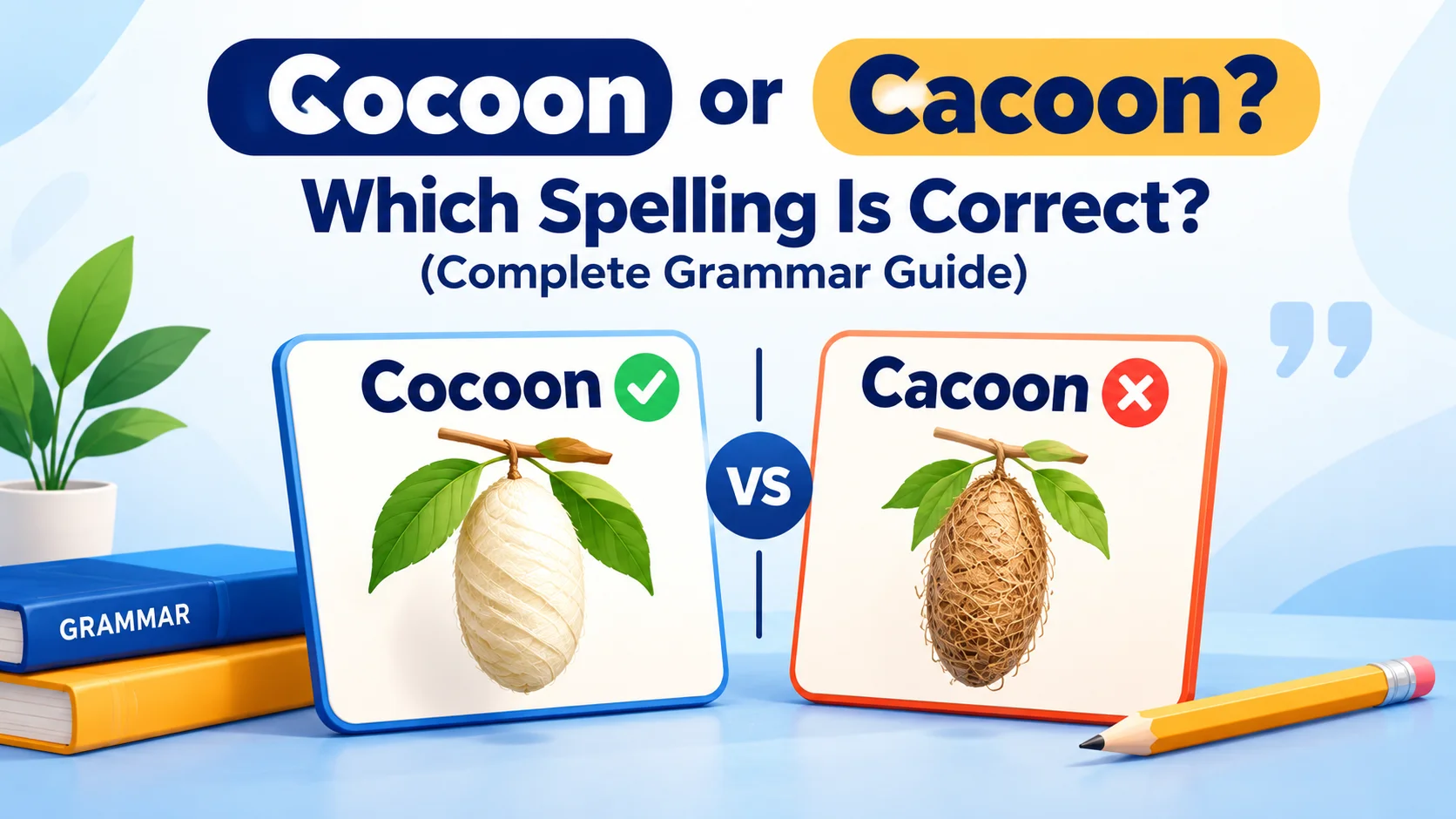
The correct spelling of cocoon or cacoon depends on what you are trying to say, but for the familiar English word describing an insect’s protective covering, cocoon is the correct choice. Although cacoon may look reasonable at first glance, it is not the standard spelling for this meaning. This small difference matters when you are writing a school assignment, preparing an article, describing an insect’s life cycle, or editing professional content. Learning the correct spelling helps you avoid a common mistake and use the word confidently in both scientific and everyday writing.
The confusion often begins when people remember a word by its sound rather than its written form. English contains many unusual spelling patterns, and familiar pronunciation does not always make the correct letters obvious. In the case of cocoon, the double o is part of the standard spelling, whether the word refers to an insect’s covering or a comfortable, sheltered environment. The word can also function as a verb, as in cocoon yourself in a blanket. Understanding these different uses makes the spelling easier to remember and helps you recognize incorrect examples when reading online.
This complete guide explains the meaning of cocoon, the difference between cocoon and cacoon, and the situations in which each form might appear. You will also learn how a cocoon differs from a pupa and a chrysalis, how to use the word naturally in sentences, and which related terms are appropriate in biological and figurative contexts. Practical examples, comparison tables, spelling tips, and a short quiz will help you apply what you learn. By the end, you will know not only which spelling to choose but also how to use the word accurately and effectively.
Cocoon or Cacoon: Which Spelling Is Correct?
Cocoon is the standard English spelling when referring to a protective covering made by certain insects. It is also the correct form when describing a person or place that feels sheltered from the outside world.
Cacoon is not the standard alternative spelling of cocoon. If you are writing about moths, insect development, comfort, privacy, or withdrawing from everyday activity, you should generally use cocoon.
Consider these examples:
- Correct: The moth larva spun a cocoon before entering the pupal stage.
- Incorrect: The moth larva spun a cacoon before entering the pupal stage.
- Correct: She wanted to cocoon herself in a quiet room.
- Incorrect: She wanted to cacoon herself in a quiet room.
The distinction is straightforward in ordinary English writing. However, an unfamiliar word or name should not automatically be corrected without checking its context. Specialized names may follow conventions that differ from the common word.
Cocoon vs. Cacoon: Quick Comparison
| Feature | Cocoon | Cacoon |
| Standard spelling for an insect’s protective covering | Correct | Incorrect |
| Used in biological writing about cocoons | Yes | Not for this meaning |
| Used figuratively to describe comfort or shelter | Yes | Not as the standard form |
| Used as a verb | Yes: cocoon, cocooned, cocooning | Not as the standard spelling of this verb |
| May appear in a specialized name or context | Yes | Possible; verify the specific term |
| Recommended in ordinary English writing | Yes | No, when intended to mean cocoon |
The table provides a useful rule for everyday writing: use cocoon unless you have verified that a different spelling belongs to a specific name or specialized term.
Is “Cacoon” Ever a Real Word?
You may encounter cacoon in references to a plant name, a regional expression, a proper name, or other specialized contexts. One example is the phrase cacoon bean, which appears in some botanical naming contexts.
That does not make cacoon a standard spelling variant of the English word cocoon. A specialized name needs to be checked separately, because changing its spelling without verification could alter the intended reference.
When you see the word, consider the surrounding sentence:
- If the writer means an insect’s protective covering, cocoon is the correct spelling.
- If the writer means a sheltered or comfortable environment, cocoon is also the standard form.
- If the word appears in a plant name or another specialized expression, check a reliable source for that exact term.
This distinction prevents two mistakes: treating a common misspelling as correct and automatically changing a legitimate specialized name.
What Does “Cocoon” Mean?
The word cocoon has both a literal and a figurative meaning. Its literal meaning relates to insect development, while its figurative meaning describes protection, comfort, or separation from the outside world.
Understanding both meanings helps explain why the word appears in scientific texts, everyday conversation, fiction, lifestyle writing, and descriptions of personal space.
The Literal Meaning of Cocoon
A cocoon is a protective covering made by certain insects, particularly the larvae of many moth species. The larva may construct the covering from silk before entering the pupal stage of development.
The cocoon provides a surrounding structure while the insect undergoes changes associated with becoming an adult. Depending on the species, a cocoon can differ in shape, color, thickness, and material. Some are made primarily from silk, while others incorporate material from the insect’s surroundings.
For example:
The moth larva spun a silk cocoon and remained inside while it developed.
In this sentence, cocoon refers to a physical structure. It does not name the insect itself or the developmental stage occurring inside the covering.
A useful point for students and science writers is that not every insect makes a cocoon. The term should be used when it accurately describes the structure produced by the species being discussed.
The Figurative Meaning of Cocoon
In everyday English, a cocoon can describe a comfortable or protected environment that separates someone from outside pressures. The meaning comes from the idea of an insect being enclosed within a covering.
For instance:
- “The warm blankets created a cocoon of comfort.”
- “After a demanding week, he wanted to cocoon himself at home.”
- “The small reading room became a cocoon of quiet.”
- “She worked in a cocoon of concentration, away from the busy office.”
The figurative meaning can be positive or negative.
A cocoon may represent welcome privacy, relaxation, and security. However, it can also suggest isolation when someone withdraws so completely that they avoid other people or responsibilities.
Compare these sentences:
- Positive: The cozy room felt like a cocoon of warmth on a cold evening.
- Negative: He had become cocooned in his routine and rarely interacted with anyone.
The word is effective because it creates a mental image rather than merely stating that someone feels comfortable or isolated.
What Does “To Cocoon” Mean?
Cocoon can also be used as a verb. It means to surround, shelter, or enclose someone or something. In figurative writing, it can mean withdrawing into a comfortable or protected environment.
The verb is commonly used when the writer wants to emphasize the feeling of being surrounded or sheltered.
Examples include:
- “The thick blanket cocooned the child in warmth.”
- “She cocooned herself in a quiet corner to finish her work.”
- “They decided to cocoon at home during the rainy weekend.”
- “The curtains cocooned the room in soft light.”
The verb has several forms:
| Verb Form | Example | Function |
| Cocoon | I cocoon myself in warm clothing. | Base form |
| Cocoons | The blanket cocoons him in warmth. | Present tense with a singular subject |
| Cocooned | She cocooned herself in a comfortable chair. | Past tense or past participle |
| Cocooning | They are cocooning at home this weekend. | Present participle or gerund |
Notice that the spelling remains consistent in all four forms. The word does not become cacoon, cacooned, or cacooning when used as a verb.
Why Do People Confuse Cocoon and Cacoon?
People may confuse these spellings because English spelling is not always predictable from pronunciation. A person may know exactly what a cocoon is but still type the wrong vowel when writing quickly.
The error can also occur when someone encounters the word infrequently or remembers it mainly from conversation rather than reading.
Similar Sounds and Uncertain Spelling Patterns
English includes many words whose spelling must be learned rather than reliably inferred from sound. When a word is unfamiliar, writers sometimes substitute a vowel that seems plausible.
That can explain why cacoon looks believable to some readers. However, a spelling that looks reasonable is not necessarily an accepted spelling.
The best approach is to remember the written form as a complete word: cocoon. Learning it alongside a familiar phrase, such as a moth’s cocoon, helps connect the spelling to its meaning.
Typing Errors and Autocorrect
Spelling mistakes often survive because writers depend entirely on spell-checking software. Although many tools identify common errors, their suggestions can vary according to language settings, dictionaries, and context.
Autocorrect may also behave differently when a word is part of a proper name or specialized expression. A spell-checker cannot always determine whether an unfamiliar term is a mistake or an intentional name.
For reliable proofreading:
- Run a spelling check on the finished document.
- Search specifically for cacoon.
- Review every result in context.
- Correct the word when it clearly means cocoon.
- Verify unfamiliar names before changing them.
This method is particularly useful for bloggers, editors, students, and anyone preparing long documents. A single spelling mistake can appear in multiple places if an incorrect form has been copied throughout a draft.
How to Remember the Correct Spelling of Cocoon
Use these simple techniques to make the correct form easier to recall.
1. Remember the opening letters. The standard word begins with co- and is spelled cocoon.
2. Picture the word. Visualize the double o in the middle of the word. Recalling the written shape can be more reliable than trying to reconstruct it from sound.
3. Connect the word with an image. Imagine a moth surrounded by its cocoon. The association reinforces both the spelling and the meaning.
4. Learn a complete phrase. Remember “a cocoon of comfort” or “a moth’s cocoon.” Words are often easier to recall when learned in meaningful combinations.
5. Use the word in your own sentence. Write something such as, “The moth spun a cocoon before becoming an adult.” Creating an original example helps you practice the word in context.
A practical memory sentence is:
The moth’s cocoon provides a protective covering.
It contains the correct spelling and connects it directly to the word’s literal meaning.
Cocoon, Pupa, and Chrysalis: What Is the Difference?
One of the most important distinctions in this topic is the difference between a cocoon, a pupa, and a chrysalis. These terms are connected to insect development, but they do not mean the same thing.
Using them accurately improves scientific explanations and prevents common misconceptions in educational writing.
What Is a Cocoon?
A cocoon is a structure or covering constructed by certain insects. Many moth larvae produce cocoons around themselves before or during the period associated with pupal development.
The cocoon may protect the developing insect, but the covering is not itself a developmental stage.
For example:
The moth pupa developed inside a protective cocoon.
This sentence distinguishes the insect’s developmental stage from the structure surrounding it.
What Is a Pupa?
A pupa is a developmental stage in insects that undergo complete metamorphosis. It follows the larval stage and precedes adulthood.
During the pupal stage, the insect undergoes substantial changes in body structure. In butterflies and moths, these changes help transform the larval body into the adult form.
A pupa may be protected by a cocoon, enclosed in another structure, or exposed, depending on the species. Therefore, it is inaccurate to use pupa as a direct synonym for cocoon.
What Is a Chrysalis?
A chrysalis is the pupal stage of a butterfly. Many butterflies form a chrysalis without producing a silk cocoon around it.
A chrysalis may be attached to a twig or another surface by silk. The exact form and attachment depend on the species.
In casual conversation, people sometimes call a butterfly’s chrysalis a cocoon. Readers may understand the intended meaning, but chrysalis is the more precise term in biological writing.
Cocoon vs. Pupa vs. Chrysalis: Comparison Table
| Term | What It Refers To | Typical Context | Example |
| Cocoon | A protective covering | Certain moths and other insects | The larva spun a cocoon. |
| Pupa | A developmental stage | Insects undergoing complete metamorphosis | The pupa developed inside the covering. |
| Chrysalis | The pupal stage of a butterfly | Butterfly development | The butterfly emerged from its chrysalis. |
The easiest way to remember the difference is:
- Cocoon: the covering.
- Pupa: the developmental stage.
- Chrysalis: the butterfly’s pupal stage.
These distinctions are more important than simply memorizing the vocabulary. They help you choose the right word when explaining what is happening in an insect’s life cycle.
Is Every Butterfly Covering a Cocoon?
No. Many butterflies develop inside a chrysalis rather than a silk cocoon. A chrysalis is the pupal stage itself, whereas a cocoon is an enclosing structure made by certain insects.
This distinction matters because the terms describe different features of development. Calling every butterfly’s chrysalis a cocoon may be understandable in informal conversation, but it is less precise.
When writing about a particular species, consult a reliable biological source instead of assuming that all butterflies and moths develop in the same way.
How a Cocoon Fits Into the Insect Life Cycle
Many familiar insects, including butterflies and moths, undergo complete metamorphosis. Their life cycle has four main stages: egg, larva, pupa, and adult.
A cocoon may be involved in the pupal stage, but not every insect constructs one.
Stage 1: Egg
The insect begins life as an egg. After the embryo develops, the young insect hatches.
The time required for hatching and the location where eggs are laid vary according to the species and its environment.
Stage 2: Larva
The larva is the feeding and growing stage. A caterpillar is the larval form of a butterfly or moth.
As the larva grows, it may shed its outer covering several times. Certain larvae eventually spin silk or use other materials to construct a protective structure.
Stage 3: Pupa
During the pupal stage, the insect undergoes major physical transformation. Structures associated with the adult insect develop as the insect changes from its larval form.
Many moth pupae develop inside cocoons, while butterflies commonly form chrysalises. The exact process depends on the species.
Stage 4: Adult
Once development is complete, the adult insect emerges. In butterflies and moths, the newly emerged adult usually needs time to expand and dry its wings before flying normally.
The adult stage allows the insect to carry out the activities associated with adult life, including reproduction.
Do All Caterpillars Make Cocoons?
No. Not all caterpillars spin cocoons. Many moth larvae do, but many butterflies form a chrysalis without constructing a silk cocoon.
The difference is an important reminder that general biological descriptions should leave room for variation. If you are describing a particular caterpillar, check the species’ life cycle before stating that it makes a cocoon.
Why Do Insects Make Cocoons?
For insects that construct them, cocoons serve as protective structures during a vulnerable stage of development. Their design depends on the species and the conditions in which the insect develops.
Protection During Development
A cocoon can help protect a developing insect from certain physical disturbances and environmental exposure. Depending on its structure and location, it may also make the insect less conspicuous or harder for some predators to reach.
However, a cocoon is not an impenetrable barrier. Its effectiveness depends on the materials used, the environment, and the threats present.
Silk and Other Materials
Many insects make cocoons using silk produced by their larvae. Some incorporate material from their surroundings, while others produce structures with distinctive textures or shapes.
This variation explains why a cocoon should not always be described as a perfectly round, white silk ball. Different species construct different structures.
How Moth Cocoons Differ From Butterfly Chrysalises
Many moth larvae spin cocoons that enclose their pupae. Many butterflies, on the other hand, form chrysalises without producing a comparable silk covering.
These are general patterns rather than rules that describe every species. If accuracy matters—for example, in a classroom resource or nature article—use species-specific information to support the description.
How to Use “Cocoon” Correctly in a Sentence
Examples are one of the easiest ways to understand how a word functions in different contexts. The following sentences demonstrate biological use, figurative meaning, verb forms, and common errors.
Biological Examples
- The moth larva spun a cocoon before entering the pupal stage.
- Researchers examined the cocoon to learn more about the insect’s development.
- A protective cocoon surrounded the developing pupa.
- The cocoon’s appearance varied from that of other specimens.
- The insect remained inside its cocoon during part of its development.
In each example, cocoon refers to a physical covering. If you mean the insect’s developmental stage, pupa may be the more accurate choice.
Figurative Examples
- The thick curtains created a cocoon of privacy in the bedroom.
- After a busy week, she wanted to cocoon herself at home.
- The reading nook felt like a cocoon of calm in a noisy house.
- He had become cocooned in his routine and rarely tried new activities.
- Soft lighting and warm blankets turned the room into a cocoon of comfort.
These examples demonstrate how the word can convey either welcome comfort or unwanted isolation.
Examples of Cocoon as a Verb
- “The blanket cocooned her against the evening chill.”
- “He cocooned himself in a quiet room to finish the report.”
- “They spent the rainy weekend cocooning at home.”
- “The curtains cocooned the room in soft light.”
The verb is especially useful when you want to emphasize the feeling of being enclosed or sheltered. If that image is unnecessary, a simpler verb such as rested, stayed, or withdrew may be clearer.
Common Phrases With Cocoon
A collocation is a combination of words that commonly appear together. Learning collocations helps you use vocabulary naturally.
Common phrases include:
- A silk cocoon
- A protective cocoon
- Inside a cocoon
- A cocoon of warmth
- A cocoon of comfort
- Cocoon oneself in a blanket
- Cocooned from distractions
- Cocooning at home
For example, “a cocoon of warmth” sounds natural in descriptive writing because it extends the image of being enclosed and protected.
Incorrect and Correct Examples
| Incorrect Sentence | Correct Sentence | Explanation |
| The moth spun a cacoon. | The moth spun a cocoon. | Cocoon is the standard spelling. |
| She wanted to cacoon herself in blankets. | She wanted to cocoon herself in blankets. | The verb uses the same standard spelling. |
| The butterfly’s cocoon was attached to a twig. | The butterfly’s chrysalis was attached to a twig. | Chrysalis is more precise for a butterfly’s pupal stage. |
| The pupa and cocoon are the same thing. | The pupa developed inside a cocoon. | A pupa is a life stage; a cocoon is a covering. |
Is “Cacoon” Related to the Cacoon Bean?
The phrase cacoon bean appears in some botanical or regional naming contexts. This is a separate issue from the spelling of cocoon, the standard English word for an insect’s protective covering.
Common plant names can vary across regions, and unfamiliar names should be checked against an appropriate reference. Do not assume that a name is wrong simply because its spelling resembles a familiar word written differently.
How Context Changes the Interpretation
When you encounter cacoon, consider the subject of the sentence before correcting it.
- Insect biology: Use cocoon for the protective covering.
- Everyday figurative writing: Use cocoon for a sheltered environment or the act of withdrawing into one.
- Botanical or specialized terminology: Check the exact name in a reliable source.
- A likely spelling mistake: Correct cacoon when the intended word is clearly cocoon.
This context-first approach is more reliable than treating every unfamiliar spelling as either automatically correct or automatically wrong.
The Origin and History of the Word “Cocoon”
The English word cocoon came through French cocon, a word associated with a shell or enclosing covering. Its history reflects the physical image behind the term: something that surrounds and protects an object or organism.
The word became established in English for the protective structures made by certain insects. Its meaning later extended into figurative language, where a sheltered room, comfortable environment, or private routine can be described as a cocoon.
This figurative extension is easy to understand. A cocoon in nature provides an enclosing structure, while a “cocoon of comfort” suggests a person surrounded by warmth or security.
The historical background helps explain why the word has both literal and figurative meanings. It does not change the modern spelling rule: cocoon is the standard spelling for the biological noun and its related verb.
Synonyms and Related Words for “Cocoon”
The best synonym depends on what you want to communicate. Some words describe an outer structure, others refer to insect development, and still others emphasize comfort or withdrawal.
Nouns Related to Cocoon
| Word | Meaning | Best Use |
| Covering | Something placed over or around another thing | General descriptions of protection |
| Case | An enclosing or protective structure | When the structure resembles a container |
| Shell | A hard or protective outer layer | When the object has a shell-like structure |
| Enclosure | Something that surrounds or contains | General descriptions of an enclosed space |
| Pupa | A developmental stage | Scientific explanations of insect development |
| Chrysalis | The pupal stage of a butterfly | Precise descriptions of butterfly development |
Important: Pupa and chrysalis are related terms, not direct synonyms for a cocoon. Replacing one with another can change the biological meaning of your sentence.
Alternatives to Cocoon as a Verb
Depending on the sentence, you may use:
- Shelter: to protect from danger or exposure.
- Envelop: to surround or cover something.
- Surround: to place or exist around something.
- Isolate: to separate from other people or influences.
- Withdraw: to move away from social contact or activity.
Compare these examples:
- “She sheltered herself from the cold.” This emphasizes protection.
- “She enveloped the gift in paper.” This emphasizes covering.
- “She cocooned herself in blankets.” This creates a stronger image of being surrounded by comfort.
- “She withdrew from the discussion.” This emphasizes moving away from interaction.
Choose the alternative that communicates the intended meaning most clearly. A synonym should improve the sentence, not merely replace a word.
Common Cocoon Spelling and Usage Mistakes
Mistake 1: Writing “Cacoon” for an Insect’s Covering
This is the main spelling error addressed by this guide. In ordinary English, write cocoon when referring to an insect’s protective covering.
How to avoid it: Remember “moth cocoon” and search your final draft for cacoon.
Mistake 2: Choosing the Spelling by Sound Alone
A word can sound familiar while its written form remains uncertain. Guessing from pronunciation may lead to errors, especially when you rarely write the word.
How to avoid it: Learn the spelling visually and check a reputable dictionary when unsure.
Mistake 3: Treating a Pupa as a Cocoon
A pupa is a developmental stage, whereas a cocoon is a protective structure. The two may occur together, but they do not name the same thing.
How to avoid it: Ask whether your sentence refers to the insect’s development or to the covering around it.
Mistake 4: Calling Every Butterfly Chrysalis a Cocoon
Many butterflies form a chrysalis without spinning a silk cocoon.
How to avoid it: Use chrysalis when you specifically mean the pupal stage of a butterfly.
Mistake 5: Assuming All Moths Make Identical Cocoons
Cocoons differ in appearance and construction. A description that applies to one species may not accurately describe another.
How to avoid it: Check reliable species-specific information before making detailed biological claims.
Mistake 6: Correcting a Specialized Name Without Checking It
An unfamiliar term may belong to a plant name, proper noun, or specialized expression. Changing it automatically could introduce a new error.
How to avoid it: Verify the exact term in context. Correct cacoon when it is clearly a misspelling of cocoon, but check specialized names first.
How to Choose the Right Word Every Time
When editing a sentence, use the following decision table to identify the most appropriate term.
| If You Mean… | Use… | Example |
| An insect’s protective covering | Cocoon | The moth spun a cocoon. |
| A developmental stage between larva and adult | Pupa | The pupa continued developing. |
| The pupal stage of a butterfly | Chrysalis | The butterfly emerged from its chrysalis. |
| A person seeking comfort or privacy | Cocoon as a noun or verb | He cocooned himself at home. |
| A verified specialized term spelled cacoon | Cacoon, if that exact form is confirmed | Check the original botanical reference. |
Before publishing, ask yourself three quick questions:
- Am I describing an insect’s covering? Write cocoon.
- Am I describing a developmental stage? Consider pupa or chrysalis.
- Is the spelling part of a specialized name? Verify it before changing it.
These checks are useful for students, teachers, bloggers, editors, and anyone who wants accurate writing. They also prevent the common problem of correcting spelling while accidentally changing meaning.
Quick Practice: Cocoon or Cacoon?
Use these questions to test your understanding of spelling, meaning, and biological terminology.
Question 1: Choose the Correct Spelling
“The moth larva spun a ___ before entering the next stage of development.”
- A. Cacoon
- B. Cocoon
Question 2: Complete the Sentence
“After a stressful week, she wanted to ___ at home and avoid distractions.”
Question 3: Choose the Biological Term
“Which word names the developmental stage between larva and adult?”
- A. Cocoon
- B. Pupa
- C. Covering
Question 4: True or False
“Every butterfly forms a silk cocoon.”
Question 5: Choose the Most Precise Word
“The butterfly’s ___ was attached to a twig.”
- A. Chrysalis
- B. Cacoon
- C. Larva
Answer Key and Explanations
- Question 1: B. Cocoon. This is the standard spelling for the insect’s protective covering.
- Question 2: Cocoon. The word is used figuratively as a verb meaning to withdraw into a sheltered setting.
- Question 3: B. Pupa. A pupa is a developmental stage, not a covering.
- Question 4: False. Many butterflies form a chrysalis rather than spinning a silk cocoon.
- Question 5: A. Chrysalis. This is the more precise term for the pupal stage of a butterfly.
If you missed any questions, review the distinction between the covering and the developmental stage. Understanding the meaning is more useful than memorizing the spelling alone.
Conclusion
When choosing between cocoon or cacoon, use cocoon for an insect’s protective covering and for figurative expressions about comfort, privacy, or withdrawal. Connecting the spelling to a familiar image, such as a moth inside its cocoon, makes the word easier to remember. Accuracy also means recognizing when a different biological term is needed: a pupa is a developmental stage, while a chrysalis is the pupal stage of a butterfly. These distinctions help you write clearly in everyday, educational, and scientific contexts. One final actionable tip: remember the phrase “moth cocoon” and search your finished draft for cacoon. A common mistake to avoid is treating every unfamiliar spelling as an error without checking whether it belongs to a specialized name. Good writing depends on spelling words correctly and using them in the right context.
Frequently Asked Questions
Q1. Is “cocoon” or “cacoon” the correct spelling?
Cocoon is the standard English spelling when referring to an insect’s protective covering or using the word figuratively. Cacoon is not an accepted ordinary spelling variant for this meaning. If it appears in a specialized name, check that source before deciding whether the spelling is an error.
Q2. Why do people spell cocoon as cacoon?
People may write cacoon because they have remembered the word incorrectly, typed quickly, or guessed its spelling from sound. The mistake does not make the alternative standard. Learning the written form cocoon and checking it during proofreading are reliable ways to avoid the error.
Q3. What is the difference between a cocoon and a chrysalis?
A cocoon is a protective covering made by certain insects, while a chrysalis is the pupal stage of a butterfly. Many moth pupae develop inside cocoons, whereas many butterflies form chrysalises without spinning silk coverings. The terms are related but not interchangeable in precise biological writing.
Q4. Can “cocoon” be used as a verb?
Yes. Cocoon can mean to surround or shelter someone or something, or to withdraw into a comfortable environment. For example, “He cocooned himself in a warm blanket while reading.” The verb forms include cocoons, cocooned, and cocooning, depending on the sentence.
Q5. Is “cacoon” a real word because of the cacoon bean?
The phrase cacoon bean appears in some botanical or regional naming contexts, but that does not make cacoon the standard spelling of the insect-related word. Check a reliable botanical reference for the exact name and meaning instead of assuming that every use follows ordinary spelling conventions.
