
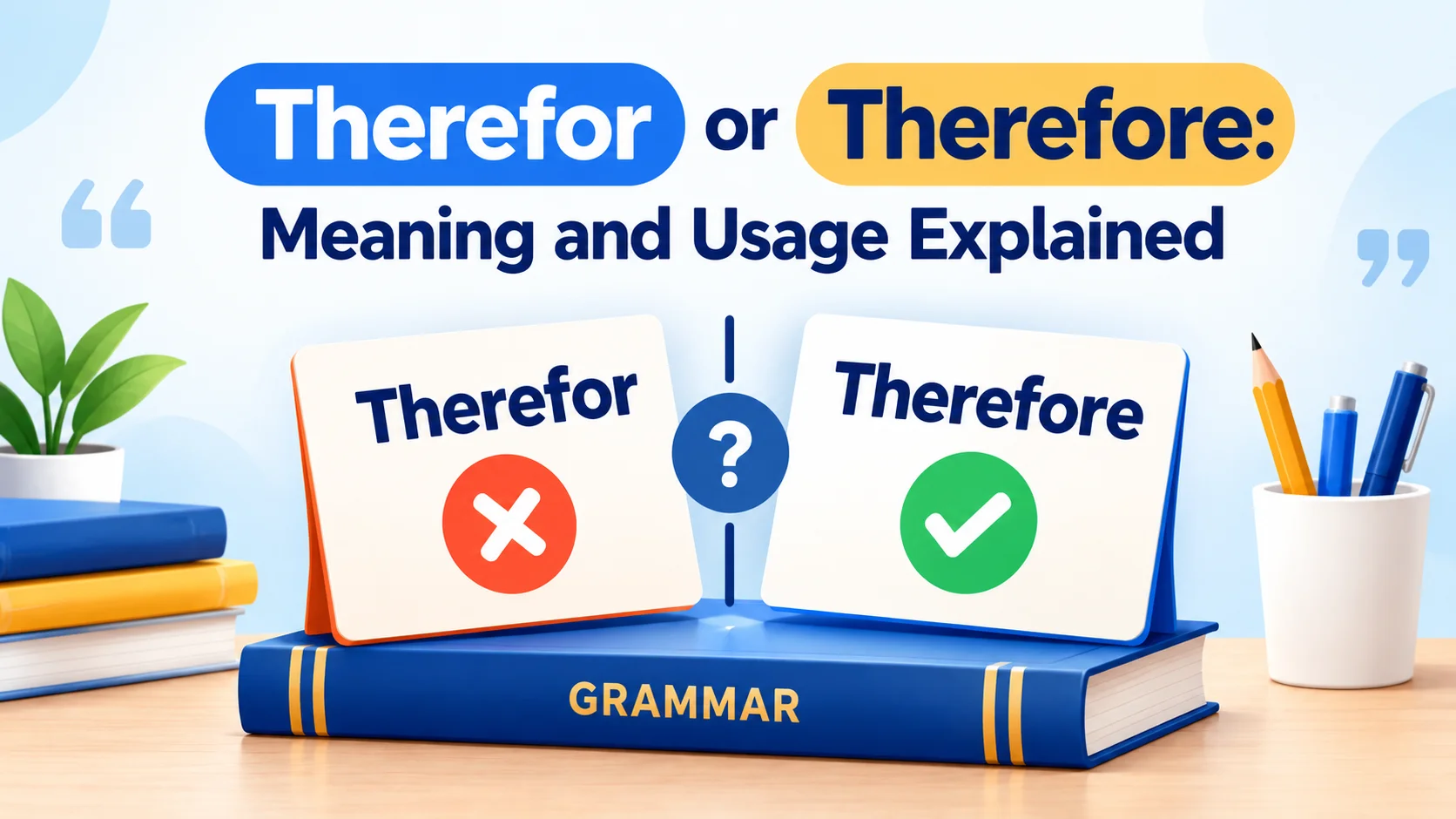
The difference between therefor or therefore comes down to meaning, not just spelling. Although the two words look almost identical, they serve different purposes in English. Therefore means “as a result” or “for that reason,” while therefor means “for that” or “for it” and appears mainly in formal, legal, and specialized writing. Choosing the wrong one can make a sentence confusing, even when a spellchecker accepts it. The good news is that a simple meaning-based test can help you choose correctly without memorizing complicated grammar rules.
The confusion often starts because therefore is common in everyday writing, academic essays, business communication, and logical arguments, whereas therefor is much less familiar to most readers. You might encounter the uncommon form in a contract, legal document, or sentence discussing something exchanged for payment. You may also see “there for” written as two words, which introduces a third possibility. Understanding these distinctions helps you avoid spelling errors, improve sentence clarity, and recognize when a seemingly unusual word is actually correct.
In this guide, you will learn the meaning of therefore and therefor, how to use each word in a sentence, and when to write the separate phrase there for. You will also discover how punctuation works with therefore, how it differs from thus, hence, and thereby, and how the word functions in academic writing and logic. Practical examples, comparison tables, common mistakes, and a short quiz will help you apply the rules confidently. By the end, you should be able to select the correct form based on what your sentence actually means.
Therefor vs. Therefore: What Is the Difference?
The most important distinction is straightforward: therefore expresses a conclusion or result, while therefor refers to something in exchange for it or for that purpose.
| Word or phrase | Meaning | Typical use | Example |
| Therefore | As a result; for that reason | Conclusions, explanations, formal writing | The road was closed; therefore, we took another route. |
| Therefor | For that; for it | Formal, legal, or specialized writing | The equipment was purchased, and payment was made therefor. |
| There for | Present in a place, available, or supporting someone | Everyday conversation and writing | I will be there for you. |
In ordinary writing, therefore is the word you are most likely to need when explaining a consequence. Therefor is a genuine English word, but it is uncommon and usually appears in contexts where the meaning of “for it” or “for that” makes sense.
The quickest way to choose the correct spelling
Ask yourself what you are trying to communicate.
- If you mean “as a result” or “for that reason,” use therefore.
- If you mean “for it” or “for that,” therefor may be appropriate.
- If you mean someone is present, available, or offering support, write there for as two words.
For example:
- The store was closed; therefore, we went home.
- The buyer paid the agreed amount therefor.
- She was there for her younger brother.
The substitution test is useful because it focuses on meaning instead of appearance. If replacing the word with “as a result” produces the intended meaning, therefore is probably correct. If “for it” fits naturally, consider therefor.
What Does “Therefore” Mean?
Therefore is an adverb meaning “as a result,” “consequently,” or “for that reason.” It signals that a statement follows logically from information presented earlier.
Consider this example:
The laboratory was closed for maintenance; therefore, the samples were tested the following day.
The closure explains the delay. Therefore connects the two facts by showing the relationship between them.
The word can introduce a conclusion, explain a decision, or show the consequence of a condition. It does not always describe a direct physical cause. Sometimes it indicates a conclusion drawn from evidence or reasoning.
How “therefore” functions in a sentence
In grammar, therefore is commonly described as a conjunctive adverb. It connects ideas by showing their logical relationship, but it does not function as a coordinating conjunction such as and, but, or so.
Compare these examples:
- Correct: The figures were inconsistent; therefore, the report needed revision.
- Correct: The figures were inconsistent. Therefore, the report needed revision.
- Incorrect in standard formal punctuation: The figures were inconsistent, therefore, the report needed revision.
The third sentence joins two independent clauses using only a comma. This is generally called a comma splice. A semicolon or a full stop is a better choice.
Examples of “therefore” in everyday and formal writing
The word works in several settings, provided the relationship between the statements is clear.
Everyday situations
- My phone battery was almost empty; therefore, I turned off the video.
- The restaurant had no available tables. Therefore, we chose another place.
Academic writing
- The second experiment produced similar results; therefore, the hypothesis received additional support.
- The sample size was limited. Therefore, the findings should be interpreted cautiously.
Business communication
- The supplier missed the delivery deadline; therefore, the installation has been rescheduled.
- The proposal exceeds the approved budget. Therefore, we recommend reviewing the costs before proceeding.
Logical reasoning
- All registered participants received an identification card. Sara was a registered participant; therefore, she received an identification card.
In each example, therefore introduces a result or conclusion. It should not be used merely because one sentence follows another. The connection needs to make sense.
What Does “Therefor” Mean?
Therefor means “for that” or “for it.” It is a legitimate English word, but it is much less common than therefore. It tends to appear in formal, legal, contractual, or specialized contexts where a writer refers back to something that has been paid, provided, exchanged, or otherwise given in return.
For example:
The buyer received the goods and paid the agreed price therefor.
Here, therefor means “for the goods.” It refers back to the item being purchased, rather than introducing a conclusion.
In contemporary everyday English, a writer would usually choose a more direct expression:
The buyer received the goods and paid the agreed price for them.
Both versions communicate the basic idea, but the second is clearer for a general audience.
Where “therefor” is commonly used
You are most likely to encounter therefor in writing that uses formal or specialized language.
- Contracts and legal documents: Referring to payment or consideration given for something.
- Formal commercial writing: Describing compensation, an exchange, or a payment made for a particular item.
- Older or traditional writing: Appearing in phrasing that is less common in modern everyday English.
Its appearance in a legal document does not make it inherently more accurate or professional. The word is appropriate when its meaning fits the sentence. In plain-language writing, “for it,” “for that,” or “in exchange for it” may communicate the same idea more clearly.
Examples of “therefor” in context
| Example sentence | Meaning of “therefor” |
| The buyer accepted the equipment and paid the agreed price therefor. | Paid the agreed price for the equipment. |
| The contract specifies the services and the compensation payable therefor. | Compensation payable for those services. |
| The materials were delivered, and the purchaser provided payment therefor. | Payment for the materials. |
These examples illustrate the word’s traditional meaning. In most modern business writing, the sentences can be simplified without changing their substance.
Is “therefor” incorrect or just uncommon?
It is correct when used with its intended meaning. The mistake is not writing therefor itself; the mistake is using it when the sentence needs therefore.
For instance:
- Incorrect: The deadline passed; therefor, the application was rejected.
- Correct: The deadline passed; therefore, the application was rejected.
The first sentence describes a consequence, so therefore is required.
Conversely, if a formal sentence means “payment for the goods,” therefor may be appropriate. Because this usage is uncommon, however, writers should consider whether a clearer alternative would help their readers.
When Should You Use “Therefor” or “Therefore”?
The best choice depends on the relationship you want to express. Think about the job the word performs rather than how familiar it looks.
Use “therefore” to show a result or conclusion
Use therefore when the second part of a sentence follows from the first.
Examples:
- The application was incomplete; therefore, it could not be processed.
- The team met every required condition. Therefore, the project was approved.
- The instructions were unclear; the technician therefore requested clarification.
The word is especially useful when you need to make reasoning explicit. In an essay, it can show how evidence supports a claim. In a report, it can explain why a recommendation follows from the findings.
However, do not use it to make a weak argument sound logical. If the evidence does not support the conclusion, inserting therefore will not fix the reasoning.
Use “therefor” when you mean “for it” or “for that”
Choose therefor when the sentence refers to something provided in exchange for another thing, particularly in formal or legal writing.
Example:
The agreement lists the services and the fees payable therefor.
In simpler English:
The agreement lists the services and the fees payable for them.
The plain-language version is usually easier to read. Keep therefor when it suits the document’s established terminology or when its precise meaning is clear to the intended audience.
Use “there for” when you mean presence, availability, or support
The phrase there for contains two words. It often describes someone being present at a place or available to help.
Examples:
- I will be there for the interview at nine.
- Her friends were there for her during a difficult period.
- The technician will be there for the installation.
- The documents are there for you to review.
A useful check is to see whether the sentence refers to a person or thing being present, available, or supportive. If it does, the two-word phrase may be correct.
A three-way comparison
| Intended meaning | Correct form | Example |
| A result or conclusion | Therefore | The system failed; therefore, work stopped. |
| In exchange for something | Therefor | The payment therefor was specified in the agreement. |
| Present or available to help | There for | We were there for our colleagues. |
| Available for a purpose | There for | The meeting room is there for staff to use. |
Practical tip: Read the sentence aloud and replace the disputed form with a short explanation. If you mean “as a result,” choose therefore, If you mean “for it,” consider therefor, If you mean “present or available,” write there for.
Correct and Incorrect Examples of Therefor and Therefore
The following examples address situations where the wrong form can slip into otherwise well-written sentences.
Examples where “therefore” is correct
1. Showing a consequence
- Incorrect: The train was delayed; therefor, I arrived late.
- Correct: The train was delayed; therefore, I arrived late.
The second clause explains the consequence of the delay.
2. Drawing a conclusion
- Incorrect: The records match; therefor, the transaction appears valid.
- Correct: The records match; therefore, the transaction appears valid.
Here, the writer is making an inference from the available evidence.
3. Explaining a business decision
- Incorrect: Demand declined; therefor, production was reduced.
- Correct: Demand declined; therefore, production was reduced.
The reduced demand is presented as the reason for reducing production.
Examples where “therefor” is correct
- The contract states the amount payable therefor.
- The purchaser received the goods and paid the agreed sum therefor.
In both sentences, therefor means “for it” or “for that.” It does not introduce a conclusion.
Examples where “there for” needs two words
- Incorrect: I will be therefor the appointment.
- Correct: I will be there for the appointment.
- Incorrect: He was always therefor his family.
- Correct: He was always there for his family.
- Incorrect: The files are therefor you to inspect.
- Correct: The files are there for you to inspect.
These sentences refer to availability, support, or purpose—not an exchange or a logical conclusion.
How to correct a confusing sentence
When proofreading, do not simply search for the word therefor. Ask what the sentence is trying to say.
For example:
The supplier failed to deliver the parts, therefor the repair was delayed.
A useful correction is:
The supplier failed to deliver the parts; therefore, the repair was delayed.
The revision fixes two problems: it replaces the incorrect word and corrects the comma splice by using a semicolon. This is more effective than correcting spelling alone.
Where Does the Comma Go With “Therefore”?
Punctuation depends on how therefore is placed in the sentence. The word does not automatically require a comma on both sides—or always require one after it.
“Therefore” at the beginning of a sentence
A comma commonly follows therefore when it introduces a sentence:
Therefore, we decided to postpone the launch.
The comma separates the introductory transition from the main statement. This pattern is common in formal writing, reports, and essays.
Another example:
The evidence was insufficient. Therefore, the committee requested further testing.
Starting a sentence with therefore is grammatically acceptable. What matters is that the relationship with the preceding discussion is clear.
“Therefore” between two independent clauses
When therefore connects two independent clauses, a common formal construction uses a semicolon before it and a comma after it.
The forecast predicted severe weather; therefore, the outdoor event was canceled.
Both sides could function as complete sentences. The semicolon joins them, while therefore explains the relationship.
You can also separate the clauses with a full stop:
The forecast predicted severe weather. Therefore, the outdoor event was canceled.
Avoid joining two complete sentences with only a comma:
The forecast predicted severe weather, therefore, the outdoor event was canceled.
That construction is generally considered a comma splice in standard formal English.
“Therefore” in the middle of a sentence
When therefore appears inside a clause, commas depend on the sentence’s structure and intended rhythm.
- The revised policy therefore takes effect in June.
- The revised policy will, therefore, take effect in June.
Both forms can be acceptable. The first integrates the word into the sentence smoothly; the second sets it off for emphasis or as a parenthetical transition. Follow the style conventions of your publication and avoid inserting commas mechanically.
Do you always need a comma after “therefore”?
No. A comma is common when therefore begins a sentence or follows a semicolon between independent clauses. It is not mandatory every time the word appears.
Compare:
- Therefore, the results require further review.
- The results therefore require further review.
In the first sentence, the word introduces the statement. In the second, it appears within the sentence and does not need to be separated by commas.
Best practice: Decide the sentence structure first, then punctuate it. Do not add a comma simply because you see the word therefore.
Therefore vs. Thus, Hence, Thereby, and Consequently
These transition words can overlap, but they do not all mean exactly the same thing. Choosing the most precise word improves clarity and avoids repetitive writing.
| Word | Main function | Example |
| Therefore | Introduces a result or conclusion | The evidence was incomplete; therefore, the claim remains unproven. |
| Thus | Indicates a conclusion or outcome, often concisely | The two lines are parallel; thus, they never intersect. |
| Hence | Introduces a consequence, inference, or explanation | The roads were icy, hence the delay. |
| Thereby | Means “by that means” or “as a result of that action” | She revised the instructions, thereby reducing confusion. |
| Consequently | Emphasizes an outcome or consequence | The supplier missed the deadline; consequently, delivery was delayed. |
Therefore vs. thus
Both words can introduce a conclusion. Therefore is widely used in general and formal writing, while thus often sounds more concise or technical.
- The measurements were inaccurate; therefore, the calculation was repeated.
- The measurements were inaccurate; thus, the calculation was repeated.
Both sentences work. Choose the one that best matches the tone of your writing.
Therefore vs. hence
Hence can introduce a conclusion or consequence, particularly in formal, academic, or technical contexts.
- The sample was contaminated; therefore, the test was repeated.
- The sample was contaminated; hence, the need to repeat the test.
Notice that the second example uses a noun phrase rather than a complete clause after hence. This construction is common and illustrates why the words are not always interchangeable without adjusting the sentence.
Therefore vs. thereby
This distinction is particularly important because the words are sometimes confused.
Therefore introduces a conclusion. Thereby describes the means through which an outcome occurs.
- The evidence was incomplete; therefore, the researcher withheld the conclusion.
- The researcher added more evidence, thereby strengthening the analysis.
In the first example, therefore connects a reason to a decision. In the second, thereby explains how an action produced an effect.
Therefore vs. consequently
These words often communicate a similar relationship. Consequently may place stronger emphasis on the resulting outcome, while therefore can signal a logical conclusion as well as a consequence.
Rather than replacing every occurrence of therefore with a synonym, select the word that expresses your intended relationship most accurately. Clarity matters more than variety for its own sake.
How “Therefore” Works in Logic, Mathematics, and Academic Writing
Outside everyday communication, therefore, is useful for showing how a conclusion follows from stated information. Its value depends on the quality of the reasoning behind it.
“Therefore” as a signal of logical conclusion
Consider this argument:
- Every employee who completes the required training receives a certificate.
- Amira completed the required training.
- Therefore, Amira receives a certificate.
The conclusion follows from the two premises, assuming both are true and the rule is applied as stated. The word therefore signals the move from the premises to the conclusion; it does not prove the premises are true.
This distinction is essential in persuasive writing. A sentence can contain therefore and still present an invalid inference if the evidence does not support the claim.
Understanding “A or B, not A, therefore B”
In formal logic, the pattern can be represented as:
- Either A or B is true.
- A is not true.
- Therefore, B is true.
For example:
- The file is stored either in Folder A or Folder B.
- It is not stored in Folder A.
- Therefore, it is stored in Folder B.
The conclusion follows if the first statement genuinely rules out other possibilities and at least one of A or B must be true. In everyday arguments, those assumptions are sometimes unstated, so check them before accepting a conclusion.
Using “therefore” in mathematical proofs
In mathematics, therefore can mark a result that follows from a calculation or established rule.
For example:
- (x + 3 = 8)
- (x = 5)
- Therefore, (x) equals 5.
The word is a signpost, not a substitute for showing the steps. In a formal proof, the reasoning should still be clear enough for a reader to verify.
Using “therefore” in essays and research papers
Academic writers often use therefore to connect evidence with an interpretation or recommendation.
For instance:
The survey included participants from only one region; therefore, the findings may not represent the wider population.
This is a careful conclusion because it acknowledges a limitation. The word should not make a claim sound more certain than the evidence allows.
Before using it in an essay or report, ask:
- Does the preceding information support the conclusion?
- Is there an assumption that needs to be stated?
- Would “as a result” or “for this reason” communicate the relationship more clearly?
- Have I used therefore so often that the prose feels repetitive?
A strong argument depends on sound reasoning, not on formal transition words.
Why Are “Therefor” and “Therefore” So Often Confused?
The two words differ by a single final letter, but their meanings are distinct. That small visual difference makes the error easy to overlook during typing and proofreading.
Their similar spellings hide different meanings
Because therefor resembles therefore, writers may treat the final -e as optional. It is not. The words are separate entries with different meanings, not alternative spellings of the same word.
A useful proofreading habit is to examine the sentence around the word. Looking at the whole idea makes it easier to notice whether the sentence expresses a conclusion or refers to an exchange.
Spellcheck may not catch the wrong word
A spellchecker may accept therefor because it is a real word. That does not mean it is correct in a particular sentence.
For example, “The office was closed; therefor, the meeting was moved” may pass a basic spelling check even though therefore is required.
Grammar and editing tools can help identify mistakes, but they may not understand the intended meaning. Proofread for meaning as well as spelling.
Why “therefor” appears in formal documents
Some legal and commercial writing preserves specialized vocabulary that is uncommon in everyday speech. Encountering therefor in a contract is not automatically evidence of a typo.
Still, formal language is not always the clearest language. If you are drafting a document for a general audience, consider replacing therefor with “for it,” “for that,” or another direct expression when doing so preserves the intended meaning.
Does “therefore” always mean cause and effect?
Not necessarily. It can signal a logical inference rather than a direct causal relationship.
For example:
All members must register before voting. Lina is a member; therefore, she must register before voting.
Lina’s membership does not physically cause the registration rule. Instead, the conclusion follows from the rule and the fact that she is a member.
Recognizing this difference helps writers use therefore accurately in explanations, essays, and arguments.
Common Mistakes to Avoid
1. Using “therefor” when you mean “therefore”
Incorrect: The figures did not match; therefor, the report was reviewed.
Correct: The figures did not match; therefore, the report was reviewed.
Why: The second clause describes a result, so therefore is needed.
2. Assuming “therefor” is never a real word
Incorrect assumption: Every use of therefor is a spelling error.
Correction: Therefor is valid when it means “for that” or “for it.” Its rarity does not make it incorrect.
3. Confusing “therefor” with “there for”
Incorrect: The nurse was therefor the patient.
Correct: The nurse was there for the patient.
Why: The sentence describes support, not payment or exchange.
4. Using “therefore” when you mean “thereby”
Incorrect: The editor corrected the instructions, therefore improving their clarity.
Better: The editor corrected the instructions, thereby improving their clarity.
Why: The second phrase explains how the improvement occurred. Thereby is the more precise choice.
5. Automatically adding a comma before “therefore”
Incorrect: The team completed the test, therefore, the equipment was approved.
Better: The team completed the test; therefore, the equipment was approved.
Why: The original construction joins two independent clauses with a comma. A semicolon followed by therefore and a comma is a standard solution.
6. Using “therefore” without a supported conclusion
Weak reasoning: The company redesigned its logo; therefore, its sales will increase.
The redesign alone does not establish that sales will rise. A more careful sentence would be:
The company redesigned its logo; whether sales increase will depend on customer response and other market factors.
Use therefore only when the connection is justified.
A Simple Method for Remembering the Difference
You do not need to memorize a long grammar rule. Use these three checks when editing.
The “as a result” test
Replace the word with “as a result” or “for that reason.”
The road was blocked; as a result, we took a detour.
The sentence makes sense, so therefore is appropriate:
The road was blocked; therefore, we took a detour.
The “for it” test
Try replacing the word with “for it” or “for that.”
The purchaser paid the agreed fee for it.
If the sentence refers to payment, compensation, or an exchange, therefor may fit a formal version of the same statement. If the result sounds unnatural, do not force the word.
The “there for” test
If you mean that someone is present or available, use two words.
My colleagues were there for me when I needed help.
You would not replace this phrase with therefore or therefor because neither single word expresses the intended meaning.
Quick decision checklist
| Ask yourself | If the answer is yes |
| Does the word introduce a result or conclusion? | Use therefore. |
| Does it mean “for it” or “for that,” especially in a formal exchange? | Consider therefor. |
| Does it mean present, available, or supportive? | Use there for. |
| Does the sentence still sound unclear? | Rewrite it in simpler language. |
Practice: Choose Therefor, Therefore, or There for
Choose the correct form for each sentence before checking the answers.
- The power went out; ______, the presentation stopped.
- Her family was always ______ her during difficult times.
- The contract lists the services and the fees payable ______.
- The evidence was incomplete; ______, the claim could not be verified.
- The technician will be ______ the inspection tomorrow.
- The buyer paid the agreed price ______ the equipment.
Answer key and explanations
- Therefore — It introduces the result of the power outage.
- There for — It describes emotional support.
- Therefor — It means “for the services,” although a plain-language rewrite would be clearer for many readers.
- Therefore — It introduces a conclusion based on incomplete evidence.
- There for — It means the technician will be present for the inspection.
- Therefor — It means “for the equipment.” In everyday writing, “paid the agreed price for the equipment” is more natural.
If you missed a question, identify the intended meaning first. That habit is more reliable than trying to remember which spelling looks right.
Conclusion
The difference between therefor or therefore becomes simple when you focus on what the sentence communicates. Use therefore to introduce a result, inference, or conclusion. Reserve therefor for the uncommon meaning “for it” or “for that,” particularly in formal or specialized writing. When describing someone who is present or available to help, choose the two-word phrase there for. One final actionable tip: before submitting an essay, email, or report, replace the disputed word with “as a result,” “for it,” or “present to help” and check which meaning fits. A common mistake to avoid is trusting spellcheck without reviewing context, because both single-word forms are legitimate. Accurate writing depends on meaning first, spelling second, and punctuation that makes your reasoning easy to follow.
Frequently Asked Questions
Q1. Is “therefor” a correct English word?
Yes. Therefor is a valid English word meaning “for that” or “for it.” It appears most often in formal, legal, or specialized writing. It is uncommon in everyday conversation, so readers sometimes mistake it for a misspelling of therefore.
Q2. What is the difference between “therefor” and “therefore” in American and British English?
The basic distinction is the same in both American and British English. Therefore introduces a conclusion or result, while therefor means “for that” or “for it.” This is a difference in meaning, not a regional spelling preference.
Q3. Can I use “therefore” in an email or text message?
Yes, but consider your audience and tone. Therefore works well in professional emails when you need to explain a decision or consequence. In casual messages, “so” or “that’s why” may sound more natural and less formal.
Q4. Is “therefore” too formal for everyday writing?
Not necessarily. Therefore is perfectly acceptable in everyday writing when the reasoning needs emphasis. However, it can sound stiff in a casual conversation. Choose it when it improves the connection between ideas, rather than using it simply to make a sentence sound sophisticated.
Q5. What should I use instead of “therefor” in plain English?
In most general-audience writing, replace therefor with a clearer phrase such as “for it,” “for that,” or “in exchange for it,” depending on the context. In a legal document, confirm that the alternative preserves the intended meaning before changing established wording.
