
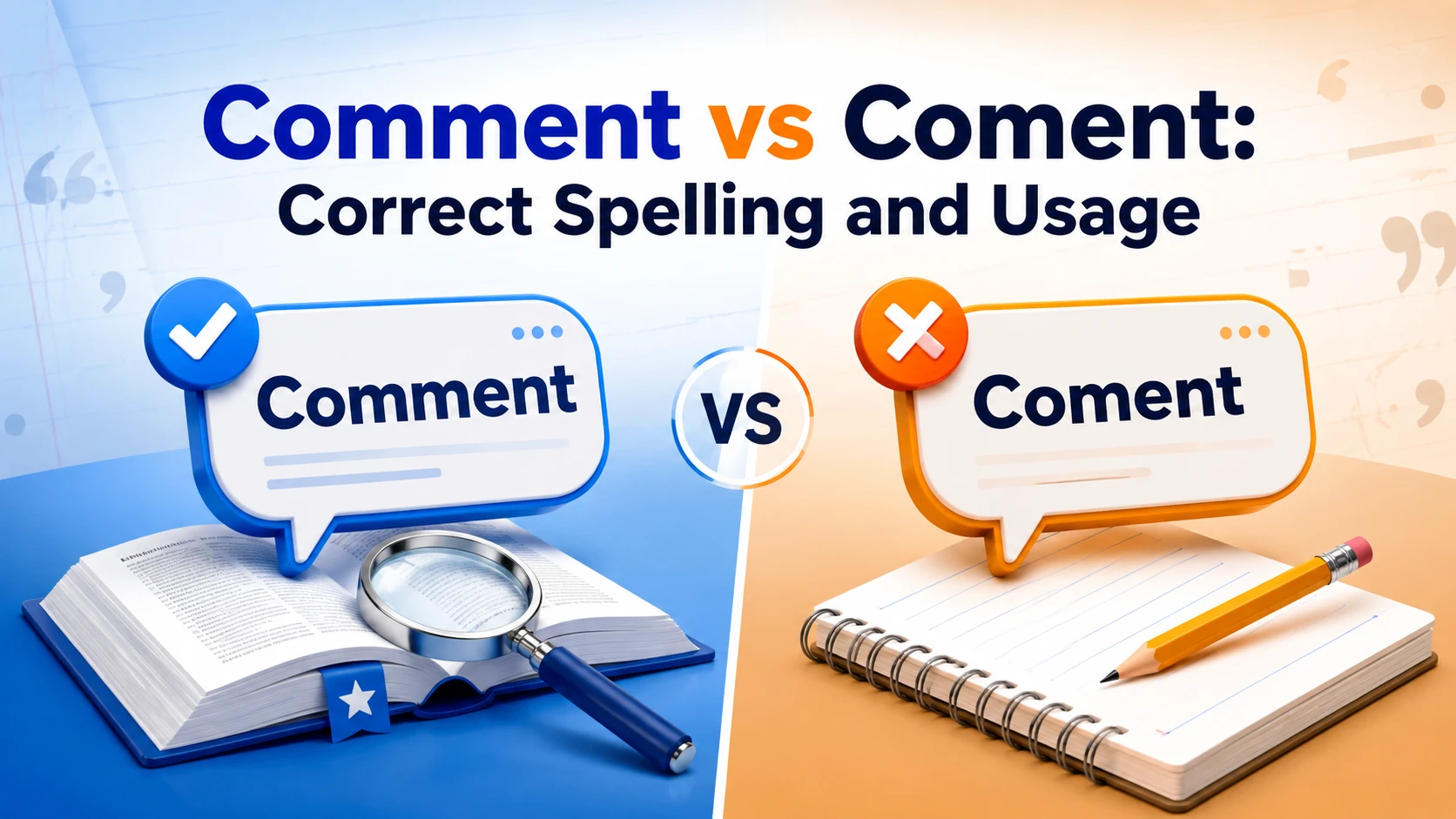
Comment vs coment is a comparison many English learners and even native speakers search for after seeing different spellings online. While both forms may appear in social media posts, emails, coding discussions, or search results, only one is considered standard English. Knowing the correct spelling is more than a matter of avoiding typos—it helps you communicate professionally, improves your writing credibility, and prevents confusion in academic, workplace, and digital settings. In this guide, you’ll learn which spelling is correct, why the mistake happens, and how to use the word confidently in different contexts.
English spelling isn’t always intuitive, especially when words contain double consonants. That’s one reason people mistakenly write coment instead of comment. The error often occurs because the second “m” is silent in pronunciation, making the misspelling look believable at first glance. Whether you’re writing a school assignment, posting on social media, drafting a business email, or learning programming, understanding the correct spelling and usage will help you write with greater accuracy, clarity, and confidence.
This article goes beyond simply telling you the right spelling. You’ll discover the meaning of comment, how it functions as both a noun and a verb, why coment is incorrect, and how the word is used in everyday English, online platforms, and computer programming. You’ll also find comparison tables, real-world examples, grammar tips, and practical advice that make remembering the correct spelling easier while helping you avoid one of the most common writing mistakes.
Quick Answer: Is It “Comment” or “Coment”?
The short answer is simple:
- ✅ Comment is the correct spelling.
- ❌ Coment is a misspelling and should be avoided in standard English writing.
Whether you’re writing an essay, replying to a social media post, leaving feedback on a blog, or documenting code, comment is the only accepted spelling recognized by standard English dictionaries.
Here’s a quick comparison.
| Spelling | Correct? | Meaning |
| Comment | ✅ Yes | A spoken or written opinion, observation, remark, or note; also an explanatory note in programming. |
| Coment | ❌ No | A spelling mistake with no accepted meaning in standard English. |
Unlike words that have legitimate spelling variations between British and American English, there is no regional variation here. The correct spelling is always comment.
Key takeaway: If you see coment, treat it as a typo or spelling error rather than an alternative English spelling.
The Correct Spelling at a Glance
The correct word is:
Comment
It contains:
- Two m letters
- One e
- Two n letters? No—just one n
- One t
A quick way to remember it is to break it into syllables:
com + ment
Although you pronounce it as two syllables, don’t let the pronunciation tempt you to remove one of the m letters.
Correct examples:
- Please leave a comment below.
- She made an interesting comment during the meeting.
- Would you like to comment on the proposal?
Incorrect examples:
- Please leave a coment below. ❌
- He wrote several coments on the article. ❌
- She comented on the issue yesterday. ❌
Every form built from the word keeps the double m:
- comment
- comments
- commented
- commenting
Is “Coment” Ever Correct?
For standard English, the answer is no.
You’ll occasionally encounter coment in:
- Typing mistakes
- Social media posts
- Informal text messages
- User-generated content
- Drafts that haven’t been proofread
However, these examples don’t make the spelling correct.
Major English dictionaries recognize comment but not coment as the standard word.
If you’re writing:
- school assignments
- academic papers
- business documents
- professional emails
- blog posts
- website content
always use comment.
There are rare cases where Coment appears as a surname, company name, username, or brand. Those are proper nouns, not examples of the English vocabulary word.
Why This Spelling Mistake Is So Common
Misspelling comment isn’t unusual.
Several factors contribute to the mistake.
Double-letter confusion
English contains many words with doubled consonants:
- comment
- address
- recommend
- accommodate
- committee
Many writers accidentally remove one of the repeated letters.
Pronunciation
When people say comment, they don’t strongly emphasize the second m.
As a result, some writers spell the word exactly as it sounds.
Fast typing
Quick typing often leads to omitted letters.
Examples:
- coment
- commet
- commment
- commnent
These are common keyboard errors rather than grammar mistakes.
Autocorrect isn’t perfect
Although most spelling tools recognize comment, some platforms may fail to catch errors immediately, especially in online forms or coding environments.
Writing Tip
If you’re unsure about a word containing double consonants, pause for a second and look for its base form or related words. In this case, comment, commented, and commenting all keep the double m, making the correct spelling easier to remember.
What Does “Comment” Mean?
A comment is a spoken or written statement that expresses an opinion, observation, reaction, or explanation about a person, event, idea, or piece of content.
The word is extremely versatile because it appears in everyday conversations, journalism, education, business communication, social media, and software development.
Depending on the sentence, comment can function as either a noun or a verb.
Definition in Everyday English
In general English, a comment is simply something someone says or writes in response to another topic.
Examples:
- The teacher made a helpful comment about my essay.
- I appreciated your comment on the presentation.
- His comment started an interesting discussion.
- Readers left hundreds of comments below the article.
In each example, the word refers to an opinion, observation, or response.
Comment as a Noun
When used as a noun, comment refers to the statement itself.
Examples:
- Her comment made everyone laugh.
- The editor added several comments to the manuscript.
- The judge declined to make any comment.
Common noun phrases include:
- public comment
- written comment
- thoughtful comment
- positive comment
- negative comment
- closing comment
- brief comment
Because comment is a countable noun, you can say:
- one comment
- two comments
- several comments
- many comments
Comment as a Verb
As a verb, comment means to express an opinion, offer feedback, or make a remark.
Examples:
- Please comment on the proposal by Friday.
- Journalists declined to comment until more facts became available.
- Would you like to comment before the meeting ends?
- Customers frequently comment on the company’s customer service.
Notice that the verb usually appears with the preposition on.
Examples:
- comment on the article
- comment on the decision
- comment on the results
- comment on the proposal
Although comment can occasionally appear without on, using the preposition is the most common and natural pattern in modern English.
Common Contexts Where “Comment” Is Used
One reason comment is such an important English word is that it appears across many different fields.
Some of the most common include:
Education
- Teacher comments
- Essay comments
- Report card comments
Business
- Client comments
- Performance review comments
- Customer comments
Journalism
- Official comments
- Media comments
- Public comments
Social Media
- Instagram comments
- Facebook comments
- YouTube comments
- LinkedIn comments
Programming
- Code comments
- Inline comments
- Multi-line comments
Although the meaning shifts slightly depending on the context, the central idea remains the same: a comment provides information, feedback, explanation, or opinion about something else.
Did You Know?
In everyday communication, a comment usually shares an opinion or reaction. In programming, however, a comment serves an entirely different purpose—it explains code for human readers while being ignored by the computer during execution. Understanding this distinction helps you use the word accurately across different contexts.
Comment vs Coment: Side-by-Side Comparison
Although comment and coment look similar, only one belongs in standard English. The extra “m” is not optional—it is part of the correct spelling. Understanding this difference helps you avoid mistakes in academic writing, professional communication, and everyday conversations.
The table below summarizes the key differences.
| Feature | Comment | Coment |
| Correct English spelling | ✅ Yes | ❌ No |
| Recognized by standard dictionaries | ✅ Yes | ❌ No |
| Used in formal writing | ✅ Yes | ❌ No |
| Used in academic writing | ✅ Yes | ❌ No |
| Accepted in business communication | ✅ Yes | ❌ No |
| Appropriate for exams and assignments | ✅ Yes | ❌ No |
| Meaning | A remark, opinion, response, or observation | No accepted meaning in standard English |
The conclusion is straightforward: comment is always the correct choice when you are referring to a remark, opinion, observation, or response.
Key Point
Unlike words with accepted spelling variations, comment has only one correct spelling in modern English. Writing coment is considered a spelling mistake.
Spelling Differences
The only difference between these words is one letter, but that single letter changes everything.
Correct spelling:
- comment
Incorrect spelling:
- coment
Many English words contain double consonants, and comment is one of them. Removing one “m” creates a misspelling rather than an alternative form.
Think of other correctly spelled words with double letters:
- common
- committee
- recommend
- address
The pattern is similar. The repeated letter is part of the standard spelling and should not be omitted.
Meaning Differences
The comparison is simple.
Comment has a clear meaning in English. It refers to:
- an opinion
- a remark
- an observation
- feedback
- a response to something
Examples:
- Her comment answered everyone’s question.
- The manager appreciated every constructive comment.
- Your comment helped improve the discussion.
Coment, however, has no accepted meaning in standard English.
If readers encounter coment, they usually assume the writer made a typing or spelling mistake.
Dictionary Status
Reliable English dictionaries recognize comment as both a noun and a verb.
By contrast, coment is not listed as a standard English vocabulary word.
This distinction matters because dictionaries establish accepted spellings used in:
- schools
- universities
- publishing
- journalism
- business communication
Using the standard spelling makes your writing more credible and easier for readers to trust.
Correct and Incorrect Examples
Let’s compare a few sentences.
| Correct Usage | Incorrect Usage |
| Please leave a comment below. | Please leave a coment below. |
| She made a thoughtful comment. | She made a thoughtful coment. |
| I forgot to comment on the proposal. | I forgot to coment on the proposal. |
| His comments improved the report. | His coments improved the report. |
| The teacher commented on my essay. | The teacher comented on my essay. |
Notice that every form of the word keeps the double m.
Quick Comparison Table
Use this table whenever you need a quick reminder.
| Question | Answer |
| Which spelling is correct? | Comment |
| Is coment acceptable? | No |
| Can comment be a noun? | Yes |
| Can comment be a verb? | Yes |
| Is there a British and American spelling difference? | No |
| Should I ever use coment in formal writing? | Never |
Why Do People Misspell “Comment” as “Coment”?
If coment is incorrect, why does it appear so often?
The answer lies in the way people read, pronounce, and type English words. Most spelling mistakes are predictable, and this one is no exception.
Understanding the cause makes the error much easier to avoid.
Double-Consonant Confusion
One of the biggest challenges in English spelling is remembering when letters are doubled.
Many writers instinctively remove one of the repeated letters because the word still looks reasonable.
For example, people often misspell words such as:
- committee
- recommend
- accommodate
- occurrence
Comment belongs to the same group.
The safest approach is to remember that the base word has two “m” letters, and every related form keeps them.
Pronunciation and Typing Habits
English pronunciation does not always reveal spelling.
When people say comment, both m letters blend into a single sound.
As a result, many writers spell the word exactly as they hear it.
Fast typing makes the problem even more common because repeated letters are easy to skip without noticing.
Autocorrect Isn’t Always Enough
Many people rely on spell-check tools, but they are not perfect.
A spelling checker may not immediately identify mistakes in every application, especially when writing quickly or using platforms with limited proofreading features.
That’s why developing your own spelling awareness remains valuable.
Reading your work once before publishing or sending it often catches simple errors like coment.
Common Spelling Patterns That Cause the Mistake
Certain habits increase the likelihood of writing coment.
Common causes include:
- typing too quickly
- relying only on pronunciation
- forgetting double letters
- skipping proofreading
- copying another person’s typo
Fortunately, these mistakes are easy to eliminate with consistent practice.
Expert Tip
Whenever you encounter a word containing double letters, pause for a moment before moving on. That brief review takes only a second but can prevent one of the most common spelling mistakes in English.
How to Use “Comment” Correctly in Writing
Knowing the correct spelling is only part of the process. You should also know how to use the word naturally in different types of writing.
Because comment functions as both a noun and a verb, its role changes depending on the sentence.
Using “Comment” as a Noun
As a noun, comment refers to a spoken or written remark.
Examples:
- Your comment was helpful.
- Every comment received careful consideration.
- The speaker welcomed questions and comments.
- Her final comment summarized the discussion perfectly.
This usage is common in conversations, reports, reviews, and articles.
Using “Comment” as a Verb
As a verb, comment means to express an opinion or make a remark.
Examples:
- Please comment on the proposal before Friday.
- Several experts commented during the discussion.
- Would you like to comment before we continue?
- Journalists refused to comment until additional information became available.
A common sentence pattern is:
- comment on an issue
- comment on a decision
- comment on a report
- comment on the results
Using on after the verb often sounds the most natural.
Formal vs Informal Usage
One advantage of comment is its flexibility.
It works equally well in formal and informal communication.
Formal examples
- The committee requested written comments before approving the proposal.
- The editor declined to comment until the investigation concluded.
Informal examples
- That’s an interesting comment.
- I wanted to comment on your idea.
- Everyone laughed at his funny comment.
The meaning stays consistent even though the tone changes.
Example Sentences for Everyday and Professional Writing
Below are examples from different situations.
Education
- The teacher wrote encouraging comments on each assignment.
- Students were invited to comment during the discussion.
Business
- Customer comments helped improve the service.
- Managers regularly comment on employee performance.
Meetings
- She made a useful comment that solved the problem.
- Everyone had an opportunity to comment before the final decision.
Writing
- The editor’s comments improved the article significantly.
- Authors often revise their work after receiving thoughtful comments.
These examples demonstrate how naturally comment fits into professional, academic, and everyday English.
Writing Advice
Before using comment, ask yourself whether you are referring to the remark itself (noun) or the act of giving a remark (verb). Making that distinction will help you choose the correct sentence structure and produce clearer writing.
What Does “Comment” Mean on Social Media?
On social media, a comment is a written response that users leave beneath someone else’s content. It allows people to share opinions, ask questions, provide feedback, or join a discussion without creating a separate post.
Whether you’re using a professional networking platform or a photo-sharing app, the basic purpose remains the same: a comment helps keep the conversation going.
Unlike private messages, comments are usually visible to other users, making them an important part of online engagement and community interaction.
Comments on Popular Social Platforms
Although every platform has its own features, the meaning of comment stays consistent.
People use comments to:
- Ask questions about a post.
- Share personal experiences.
- Offer compliments or constructive feedback.
- Add useful information.
- Participate in public discussions.
For businesses and content creators, comments also provide valuable insight into what audiences think, what they need, and which topics generate the most interest.
Difference Between a Comment, Reply, and Post
These three terms are closely related, but they are not interchangeable.
| Term | Meaning | When It’s Used |
| Comment | A response added beneath existing content | Reacting to a post, article, or video |
| Reply | A direct response to a specific comment or message | Continuing an existing conversation |
| Post | Original content shared with an audience | Starting a new discussion or sharing new information |
For example:
- Publishing a travel photo creates a post.
- Someone writes, “Beautiful view!” as a comment.
- Another person responds to that comment with, “I agree,” which becomes a reply.
Understanding these distinctions helps you use the correct terminology when discussing online communication.
Tips for Writing Effective Online Comments
Not every comment adds value. The most useful ones are thoughtful, relevant, and respectful.
Good commenting habits include:
- Read the original content carefully before responding.
- Stay on the topic.
- Support your opinion with a reason when appropriate.
- Keep your language respectful, even when you disagree.
- Check your spelling before posting.
Avoid comments that:
- Repeat what others have already said without adding value.
- Contain personal attacks.
- Spread inaccurate information.
- Ignore the original topic.
Best Practice
A valuable comment moves the conversation forward. Instead of writing only “Nice post,” explain why you found the content useful or ask a meaningful follow-up question.
What Does “Comment” Mean in Programming?
The word comment takes on a different meaning in programming than it does in everyday English.
Instead of expressing an opinion, a programming comment provides an explanation or note for people reading the code. Its purpose is to improve understanding, document important decisions, and make software easier to maintain over time.
Because comments are intended for human readers, they help developers understand what a section of code does, why it exists, or how it should be used.
Why Programmers Use Comments
Well-written comments improve collaboration and reduce confusion, especially on large projects involving multiple developers.
Common reasons for adding comments include:
- Explaining complex logic.
- Documenting important decisions.
- Describing the purpose of a section.
- Providing maintenance notes.
- Helping new team members understand the project.
Good comments save time because future readers don’t have to guess the author’s intent.
Single-Line Comments
A single-line comment explains one idea or one instruction.
These comments are commonly used to:
- Label a step.
- Clarify a calculation.
- Describe the purpose of a variable or function.
- Leave a short reminder.
They work best when the explanation is brief and directly related to the surrounding content.
Multi-Line Comments
Some explanations require more than one sentence.
Multi-line comments are useful for:
- Describing complicated processes.
- Explaining algorithms.
- Documenting important assumptions.
- Recording maintenance information.
- Providing detailed instructions for future developers.
Rather than scattering several unrelated notes throughout a project, one organized explanation is often easier to read.
Inline Comments
Inline comments appear beside a specific statement to clarify its purpose.
They are especially helpful when:
- A calculation isn’t immediately obvious.
- Business rules influence the logic.
- A particular value requires explanation.
However, excessive inline comments can make a document harder to read. They should clarify genuinely complex ideas rather than describe something already obvious.
Best Practices for Writing Useful Code Comments
Experienced developers follow a few simple principles.
A useful comment should:
- Explain why, not just what.
- Stay accurate as the project changes.
- Be concise.
- Use clear language.
- Add information that isn’t obvious from the surrounding work.
Avoid comments that simply repeat what readers can already understand.
For example, instead of describing an obvious action, explain the reason behind an important design choice or business requirement.
Developer Tip
The best comments answer questions future readers are likely to ask. If the explanation doesn’t provide new information, it may not need to be included.
Comment Out vs Uncomment
These two expressions are widely used by software developers, but they can confuse beginners because they don’t appear frequently outside programming.
Understanding the concepts makes technical discussions much easier to follow.
What “Comment Out” Means
To comment out something means to temporarily prevent part of a program from being used while keeping it available for later.
Developers commonly do this when they want to:
- Test different approaches.
- Isolate a problem.
- Disable a feature temporarily.
- Compare old and new solutions.
- Troubleshoot unexpected behavior.
Commenting something out is often safer than deleting it immediately because it can be restored later if needed.
What “Uncomment” Means
To uncomment means to restore previously disabled content so it becomes active again.
Developers may uncomment sections when they:
- Finish testing.
- Restore a feature.
- Reuse earlier work.
- Verify that a solution fixes a problem.
These two actions are opposites and are part of many everyday software development workflows.
Practical Situations Where These Terms Are Used
You might hear developers say:
- “Let’s comment out this section while we investigate the issue.”
- “Uncomment that feature after the update is complete.”
- “The problem disappeared after commenting out the old configuration.”
In each case, the discussion is about temporarily enabling or disabling part of a project during development, not about expressing opinions or leaving feedback.
Comment vs Related Words
Many English words seem similar to comment, but each has a distinct meaning.
Understanding these differences helps you choose the most precise word.
Comment vs Reply
A comment is a general observation or response to content.
A reply is a direct response to another person’s message or comment.
Example:
- Someone leaves a comment on an article.
- Another reader writes a reply to that comment.
A reply always continues an existing conversation.
Comment vs Feedback
Although feedback often includes comments, the two words are not identical.
| Comment | Feedback |
| May simply express an opinion | Usually aims to improve something |
| Can be positive, negative, or neutral | Often includes suggestions or evaluation |
| Doesn’t always require action | Usually encourages improvement |
For example:
- “Interesting idea.” is a comment.
- “Consider shortening the introduction to improve clarity.” is feedback.
Comment vs Remark
These words are close in meaning, but they differ slightly in tone.
A remark is often a brief spoken statement.
A comment may be spoken or written and is frequently more detailed.
Examples:
- She made a quick remark during the meeting.
- He wrote a thoughtful comment after reading the report.
Comment vs Commend
These words are frequently confused because they look and sound somewhat alike.
However, their meanings are completely different.
| Comment | Commend |
| To express an opinion or observation | To praise or formally recommend someone |
| Can be neutral | Usually expresses approval |
| Functions as a noun and a verb | Primarily used as a verb |
Examples:
- I want to comment on your proposal.
- I would like to commend your excellent work.
Replacing one with the other changes the meaning entirely.
Comment vs Review
A review is a detailed evaluation of a product, service, book, film, or experience.
A comment is usually shorter and focuses on a specific observation or reaction.
For example:
- A customer may leave a short comment beneath an article.
- The same customer might later write a detailed review describing their overall experience.
Expert Writing Tip
When choosing between similar words, think about your purpose. If you’re sharing a brief opinion, comment is usually the right choice. If you’re providing a detailed evaluation or recommendation, another word such as feedback or review may communicate your meaning more accurately.
Common Mistakes to Avoid
Even though comment is a common English word, writers still make mistakes with its spelling and usage. Avoiding the following errors will make your writing clearer and more professional.
Writing “Coment” Instead of “Comment”
The most frequent mistake is dropping one m.
Incorrect:
- I left a coment on the article.
- Please coment below.
Correct:
- I left a comment on the article.
- Please comment below.
Whenever you write the word, remember that it always contains two consecutive “m” letters.
Confusing “Comment” with “Commend”
Although these words look similar, they express different ideas.
- Comment means to make a remark or express an opinion.
- Commend means to praise or recommend.
Compare these sentences:
- I want to comment on your presentation. ✅
- I want to commend your presentation. ✅
Both are correct, but they communicate entirely different meanings.
Writing Unclear or Meaningless Comments
A comment should contribute something useful.
Weak comment:
- Good.
Improved comment:
- Your explanation made the topic much easier to understand because the examples were practical.
Specific comments are more valuable than vague ones because they provide context and encourage productive discussion.
Adding Too Many Comments in Technical Documents
In technical writing, more comments do not always mean better documentation.
Good comments:
- Explain difficult ideas.
- Clarify important decisions.
- Record useful background information.
Poor comments:
- Repeat obvious information.
- State what readers can already see.
- Make documents unnecessarily long.
Quality matters more than quantity.
Common Mistake to Avoid
Don’t assume every sentence needs a comment. Add one only when it improves understanding or provides information that readers cannot easily infer.
Grammar and Style Tips for “Comment”
Using the correct spelling is only the first step. Good grammar and style make your writing sound more natural and professional.
Is “Comment” Countable or Uncountable?
Comment is generally a countable noun.
Examples:
- I received one comment.
- She wrote three comments.
- There were several helpful comments during the meeting.
Because it is countable, you can use words such as:
- a
- an
- one
- two
- many
- several
- few
Common Collocations with “Comment”
Native speakers often combine comment with specific verbs and adjectives.
Common verb combinations:
- make a comment
- leave a comment
- write a comment
- post a comment
- read a comment
- respond to a comment
Common adjective combinations:
- helpful comment
- thoughtful comment
- constructive comment
- positive comment
- negative comment
- brief comment
- public comment
Learning these natural combinations improves both writing and speaking.
Frequently Used Phrases
Some expressions appear regularly in everyday English.
Examples include:
- no comment
- comment on
- opening comment
- closing comment
- public comment
- comment section
- reader comments
Recognizing these expressions helps you understand newspapers, books, websites, and professional communication more easily.
Punctuation and Capitalization Tips
The word comment follows standard English capitalization rules.
Use a capital letter only when:
- It begins a sentence.
- It appears in a title following title capitalization rules.
- It forms part of a proper noun.
Otherwise, write it in lowercase.
Correct punctuation also improves readability. If your comment contains multiple ideas, divide them into separate sentences instead of creating one long sentence.
Style Tip
A clear, concise comment is usually more effective than a long paragraph filled with unnecessary details.
Easy Memory Trick to Remember the Correct Spelling
Simple memory techniques make spelling easier to remember.
A Simple Mnemonic
Think of this sentence:
A good comment deserves double “M” for “More Meaning.”
The phrase More Meaning reminds you that comment always contains two “m” letters.
Visual Spelling Technique
Picture the word like this:
Com + Ment
Notice the two m letters standing together in the middle.
The next time you hesitate, visualize that double m before you write the word.
With repeated practice, the correct spelling quickly becomes automatic.
Practice Your Understanding
Choose the Correct Spelling
Select the correct word.
- Please leave a ______ below the article.
- A. Comment
- B. Coment
- She made an interesting ______ during the discussion.
- A. Comment
- B. Coment
- Everyone appreciated his thoughtful ______.
- A. Comment
- B. Coment
Answers
- A. Comment
- A. Comment
- A. Comment
Fill in the Blanks
Complete each sentence with the correct form of comment.
- The teacher wrote a helpful __________ on my assignment.
- Several readers left positive __________ after the article was published.
- Would you like to __________ on today’s presentation?
- Her final __________ summarized the discussion perfectly.
Answers
- comment
- comments
- comment
- comment
Correct the Spelling Mistakes
Rewrite these sentences correctly.
- Please leave a coment below.
- She comented on the proposal yesterday.
- His coments helped improve the report.
Correct Answers
- Please leave a comment below.
- She commented on the proposal yesterday.
- His comments helped improve the report.
Identify the Correct Meaning by Context
Choose the meaning of comment in each sentence.
- The editor added a comment to the manuscript.
- A. A question
- B. A written remark
- The audience commented on the speaker’s presentation.
- A. Expressed opinions
- B. Left the room
- Customers posted comments after purchasing the product.
- A. Shared feedback
- B. Requested refunds
Answers
- B. A written remark
- A. Expressed opinions
- A. Shared feedback
Answer Key with Explanations
If you answered comment in every spelling question, you are correct because coment is never the accepted spelling in standard English.
For the meaning questions:
- A comment can be spoken or written.
- As a noun, it refers to a remark or opinion.
- As a verb, it means to express an opinion or make a remark.
Understanding both functions will help you recognize the word correctly in different contexts.
Conclusion
Remembering the difference between comment and coment is straightforward once you know the rule: comment is the only correct spelling in standard English, while coment is simply a spelling mistake. Whether you’re writing an essay, participating in an online discussion, preparing a business document, or reading technical material, using the correct form improves your credibility, clarity, and professionalism. One final actionable tip: whenever you’re unsure about a word with double letters, pause and verify its spelling before publishing or sending your work. A common mistake to avoid is assuming that a frequently seen typo becomes acceptable through repeated use. Consistently choosing the correct spelling helps you build stronger writing habits and communicate with confidence.
Frequently Asked Questions
Q1. Is coment a real English word?
No. Coment is not recognized as a standard English word. It is simply a misspelling of “comment.” In formal, academic, and professional writing, you should always use comment, regardless of the context.
Q2. Why does comment have two “m” letters?
The spelling comes from the word’s historical development and has been standardized in modern English. Although the pronunciation doesn’t strongly emphasize both letters, the accepted spelling has always included a double “m”, making comment the only correct form.
Q3. Can comment be both a noun and a verb?
Yes. Comment functions as both a countable noun and a verb. As a noun, it means a remark or opinion. As a verb, it means to express an opinion or make a statement about something.
Q4. What is the difference between a comment and a reply?
A comment is a general response to content, while a reply responds directly to another person’s comment or message. Every reply continues an existing conversation, but not every comment is a reply.
Q5. Why are comments important in programming?
In programming, comments help people understand the purpose, logic, and structure of a project. They improve collaboration, simplify maintenance, and make complex sections easier to understand without affecting how the software operates.
