
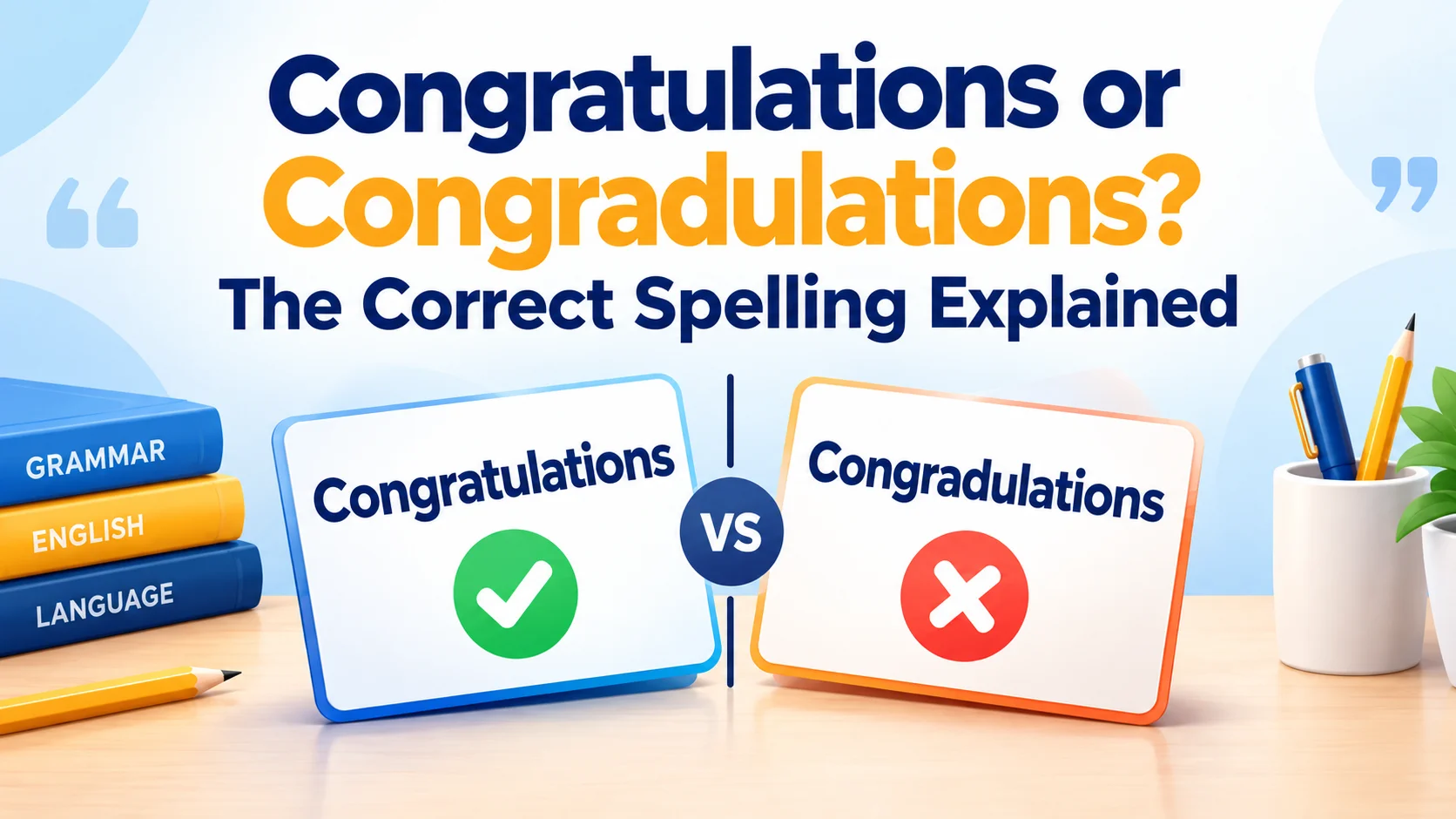
Have you ever typed “congradulations” instead of “congratulations” and wondered whether both spellings were acceptable? It is an easy mistake to make because the two versions look almost identical, and the difference is only one letter. However, there is an important distinction: congratulations is the correct standard English spelling, while congradulations is a misspelling. Whether you are writing a graduation message, congratulating a colleague, celebrating a wedding, or posting about someone’s success, choosing the correct spelling makes your message clearer and more professional.
The confusion often comes from pronunciation. When people say the word quickly, its middle syllables can sound less distinct, making it easy to remember the wrong consonant. Some writers consequently replace the t in congratulations with a d, producing the incorrect form congradulations. Although this mistake appears in informal messages and online writing, it is not recognized as a standard spelling in American, British, or other major varieties of English. Understanding the word’s structure is more reliable than simply memorizing how it sounds.
In this guide, you will discover why congratulations is correct, how the word developed from congratulate, and why congradulations is incorrect. You will also learn the difference between congratulation and congratulations, how to use on, to, and for naturally, and how to write appropriate congratulatory messages for personal and professional situations. Along the way, you will find practical examples, common spelling mistakes, memory techniques, and exercises. By the end, you will know how to spell and use the word confidently.
Congratulations or Congradulations: Which Spelling Is Correct?
The correct spelling is congratulations. The spelling congradulations is incorrect and should not be used in standard English writing.
The difference is the letter t. The correct word contains a t after the first part of the word, whereas the incorrect version replaces it with a d.
| Word or spelling | Status | Explanation |
| Congratulations | <text>Correct</text> | Standard plural noun and conventional expression of good wishes |
| Congradulations | <text>Incorrect</text> | Misspelling; the d should be a t |
| Congratulation | <text>Correct</text> | Singular noun referring to an expression or act of congratulating |
| Congratulate | <text>Correct</text> | Verb meaning to express pleasure about someone’s success |
| Congratulatory | <text>Correct</text> | Adjective describing something that expresses congratulations |
Consider these examples:
Correct: Congratulations on your graduation!
Incorrect: Congradulations on your graduation!
Correct: I want to congratulate you on your achievement.
Incorrect: I want to congradulate you on your achievement.
The distinction applies whether you are writing casually or formally. A text message to a friend, a university announcement, a business email, and a greeting card all require the standard spelling.
The easiest rule to remember: If you can spell congratulate, you can spell congratulations. Both contain the letter t.
Why Is Congratulations the Correct Spelling?
The spelling of congratulations becomes easier to understand when you examine its related word, congratulate.
Congratulate is the verb used when someone expresses happiness or approval about another person’s achievement. The noun congratulation is formed from this verb, and congratulations is its plural form.
The spelling retains the t throughout the word family:
- Congratulate
- Congratulated
- Congratulating
- Congratulation
- Congratulations
- Congratulatory
There is no standard spelling rule that changes the t into a d in these forms.
The Word’s Origin and Structure
The English word congratulate ultimately comes from Latin congratulari, meaning to wish someone joy or express shared happiness. Its history helps explain why the modern English spelling contains a t.
You do not need to study Latin to remember the spelling, but understanding that congratulations belongs to the congratulate word family is useful.
For everyday writing, think of the words as a connected group:
- You congratulate someone.
- You offer your congratulations.
- You send a congratulatory message.
This connection provides a practical spelling reminder.
Why Do People Write Congradulations?
The incorrect form usually develops from a combination of pronunciation, memory, and typing habits.
1. Confusing pronunciation with spelling
In natural speech, people often pronounce words quickly. Unstressed syllables and consonants may not sound as clear as they appear in writing. A listener may therefore remember the middle consonant incorrectly.
2. Remembering the wrong version
A person who has repeatedly seen congradulations in informal online writing may begin to recognize it as familiar. However, repeated exposure does not make an incorrect spelling standard.
3. Typing without checking
Long words are more likely to contain typing mistakes, especially when someone is writing quickly on a phone. The writer may know the correct word but accidentally enter the wrong letter.
4. Not recognizing the related word
Someone who remembers only the complete word may find it difficult to check its spelling. Recognizing congratulate makes the correct form easier to reconstruct.
Expert tip: Do not try to spell the word only by listening to its pronunciation. Use its related form, congratulate, as your reference.
What Does Congratulations Mean?
Congratulations is an expression used to communicate happiness, approval, admiration, or good wishes when someone achieves something positive.
It acknowledges that a person has reached a milestone, received an opportunity, completed something important, or experienced an event worth celebrating.
For example:
- Congratulations on passing your examination.
- Congratulations on your new job.
- Congratulations on your wedding.
- Congratulations to the entire team.
- Congratulations on launching your business.
The expression can be used in speech, writing, professional communication, greeting cards, and social media posts.
When Should You Say Congratulations?
You can use the expression in many situations. The important consideration is whether the event is something the recipient welcomes or considers an achievement.
| Situation | Example | Why it is appropriate |
| Graduation | Congratulations on your graduation! | Recognizes completing an educational milestone |
| New employment | Congratulations on your new job! | Acknowledges a career opportunity |
| Promotion | Congratulations on your promotion! | Recognizes professional progress |
| Wedding | Congratulations to both of you! | Celebrates a marriage |
| Competition | Congratulations on winning first place! | Recognizes a successful performance |
| New business | Congratulations on opening your business! | Celebrates an entrepreneurial milestone |
| New baby | Congratulations on the arrival of your baby! | Shares happiness about a family event |
| Personal achievement | Congratulations on reaching your goal! | Recognizes individual effort |
You do not have to reserve congratulations for major life events. It can also be used for smaller achievements, such as completing a challenging assignment or passing a difficult test.
Is Congratulations Formal or Informal?
It works in both formal and informal situations. The word itself is neutral and widely accepted. The rest of your sentence determines how formal the message sounds.
Compare:
- Casual: Congratulations! You finally did it!
- Friendly: Congratulations on your new job. I’m so happy for you.
- Professional: Please accept my congratulations on your appointment.
- Formal: We extend our sincere congratulations on this significant achievement.
This flexibility makes congratulations useful across different types of communication.
Can Congratulations Sound Insincere?
Yes. The expression is positive, but the way it is delivered matters.
For example, a short message such as “Congratulations” may be enough when replying to an announcement. However, if someone has worked hard toward an important goal, a more personal message can communicate genuine appreciation.
Compare:
“Congratulations.”
“Congratulations on completing your degree. I know how much time and effort you invested, and you deserve to celebrate this achievement.”
The second message recognizes the person’s effort rather than simply acknowledging the result.
Congratulation vs Congratulations: Understanding the Difference
Both congratulation and congratulations are grammatically correct. The difference is that one is singular and the other is plural.
However, English speakers generally use the plural form when expressing good wishes directly.
1. Congratulation: The Singular Form
Congratulation is a singular countable noun. It refers to one expression or act of congratulating someone.
For example:
- She received a congratulation from her manager.
- His congratulation came after the announcement.
- One congratulation was included in the official letter.
These sentences are grammatically possible, but the singular form is less common in ordinary conversation.
2. Congratulations: The Plural Form
Congratulations is the form conventionally used to express good wishes.
Examples:
- Congratulations on your success!
- My congratulations to everyone involved.
- Please accept our congratulations.
- Congratulations on completing your training.
The expression is established in English as a plural form, even when it functions as a short standalone message.
Comparison Table
| Feature | Congratulation | Congratulations |
| Grammatical number | Singular | Plural |
| Correct spelling | Yes | Yes |
| Common in everyday speech | Less common | Very common |
| Used as a standalone greeting | Unusual | Natural |
| Example | She offered a congratulation. | Congratulations on your success! |
Should You Say a Congratulation or Congratulations?
In ordinary conversation, congratulations is usually the better choice.
For example:
- Natural: Congratulations on your promotion.
- Less common: A congratulation on your promotion.
If you are writing a message, greeting card, or email, use congratulations unless the sentence specifically requires the singular noun.
How to Use Congratulations Correctly in Sentences
Correct spelling is important, but natural grammar matters too. The prepositions used with congratulations help explain who is being congratulated and what achievement is being celebrated.
The three prepositions worth understanding are on, to, and for.
Congratulations on: Mentioning an Achievement
Use on when you identify the event, achievement, or milestone.
Examples:
- Congratulations on your graduation.
- Congratulations on your promotion.
- Congratulations on passing the examination.
- Congratulations on completing the project.
- Congratulations on your successful presentation.
- Congratulations on starting your own company.
The structure is:
Congratulations on + noun or -ing form
Both of these are correct:
- Congratulations on your achievement.
- Congratulations on achieving your goal.
The first uses a noun; the second uses a gerund (-ing form).
Congratulations to: Mentioning the Recipient
Use to when identifying the person or group receiving the good wishes.
Examples:
- Congratulations to Sarah.
- Congratulations to the winning team.
- Congratulations to all the graduates.
- Congratulations to you and your family.
- Congratulations to everyone who participated.
You can combine to and on when you want to identify both the recipient and the achievement.
Congratulations to Sarah on her promotion.
Here, to Sarah identifies the recipient, while on her promotion identifies the reason.
Congratulations for: Giving a Reason for Praise
For can be used when explaining the action or behavior being praised, particularly when the emphasis is on someone’s effort or conduct.
Examples:
- Congratulations for speaking up when it mattered.
- Congratulations for helping the community.
- Congratulations for showing such determination.
However, when mentioning a specific achievement or milestone, on is often the more natural choice.
Compare:
- Congratulations on your graduation.
- Congratulations for your graduation.
The first is the conventional expression.
On, To, or For: Which Should You Choose?
| Preposition | Function | Example |
| On | Identifies the event or achievement | Congratulations on your success. |
| To | Identifies the recipient | Congratulations to James. |
| For | Explains the action or behavior being praised | Congratulations for helping others. |
A practical rule: Use on for the achievement, to for the person, and for when the sentence specifically focuses on an action or reason for praise.
30 Correct Examples of Congratulations in Different Situations
Examples are useful because the same expression appears in many contexts. The following sentences demonstrate how to use it naturally without repeating one sentence pattern.
Everyday Conversations
- Congratulations on your wonderful achievement!
- Congratulations! You worked hard for this.
- Congratulations on passing your driving test.
- Congratulations to you and your family.
- Congratulations on reaching your personal goal.
- Congratulations! I am genuinely happy for you.
Education and Graduation
- Congratulations on completing your degree.
- Congratulations to all the students who passed the examination.
- Congratulations on receiving your scholarship.
- Congratulations on earning such excellent results.
- We offer our congratulations to this year’s graduates.
- Congratulations on completing your professional qualification.
Career and Business
- Congratulations on your new position.
- Congratulations on getting the job you wanted.
- Please accept my congratulations on your promotion.
- Congratulations to the entire team on a successful launch.
- Congratulations on opening your first business.
- We extend our congratulations on your appointment as director.
Family and Personal Milestones
- Congratulations on your wedding!
- Congratulations to both of you on your engagement.
- Congratulations on welcoming your new baby.
- Congratulations on buying your first home.
- Congratulations on this exciting new chapter.
- Congratulations to your family on the wonderful news.
Awards and Competitions
- Congratulations on winning the competition.
- Congratulations to the finalists for their outstanding performances.
- Congratulations on receiving the award.
- Congratulations to the winning team.
- Congratulations on achieving first place.
- Congratulations to everyone who took part.
Notice that congratulations does not always have to appear at the beginning of a sentence. It can also appear later:
- I would like to offer my congratulations on your achievement.
- Everyone sent their congratulations after the announcement.
- Please share our congratulations with the team.
These variations make your writing sound less repetitive.
Common Misspellings of Congratulations
Because congratulations is a relatively long word, people sometimes rearrange letters, omit letters, or replace the wrong consonant.
Here are some forms you may encounter:
| Incorrect spelling | Correct spelling | Common problem |
| Congradulations | Congratulations | Replacing t with d |
| Congradulate | Congratulate | Incorrect consonant |
| Congratuations | Congratulations | Missing a letter |
| Congratualtions | Congratulations | Letters in the wrong order |
| Congratulaitons | Congratulations | Incorrect letter sequence |
| Congratulashions | Congratulations | Informal phonetic spelling |
These forms should not be treated as accepted alternatives. They are mistakes in standard English writing.
Why Is Congradulations Such a Common Mistake?
The word congradulations is especially confusing because it preserves most of the correct spelling. A reader can usually understand what the writer means, but that does not make the form correct.
It may also appear in usernames, jokes, deliberately misspelled captions, or brand names. In such cases, the spelling may be intentional. That is different from using it as the ordinary English word.
For example, a social media account might deliberately use a misspelled word as part of its name. You should preserve that exact spelling when referring to the account, but use congratulations when writing the standard expression.
How to Remember the Correct Spelling of Congratulations
You do not need a complicated spelling trick. The most reliable method is to connect the word to its base verb.
Method 1: Remember Congratulate
Think of this sentence:
I congratulate you, so congratulations!
Both words contain the letter t.
This is the simplest memory technique because it uses the relationship between the words rather than asking you to memorize a separate spelling.
Method 2: Break the Word Into Parts
You can practice the word in smaller sections:
CON-GRAT-U-LA-TIONS
Say each section slowly while writing the complete word. This can help you notice missing or misplaced letters.
The purpose is not to change the official spelling into separate words. It is simply a practice technique.
Method 3: Compare the Two Spellings
| Correct | Incorrect |
| Congratulations | Congradulations |
Focus on the middle consonant. The correct form contains a t.
Method 4: Write It in a Complete Sentence
Instead of repeating the word without context, practice using it naturally:
- Congratulations on your success.
- Congratulations on your graduation.
- Congratulations to the winners.
- Please accept my congratulations.
Writing complete sentences helps reinforce both spelling and usage.
Method 5: Use a Personal Proofreading Checklist
Before sending an important message, check:
- Is the word spelled congratulations?
- Did I use a t rather than a d?
- Is the correct preposition used?
- Have I named the achievement accurately?
- Does the message sound appropriate for the recipient?
This takes only a few seconds and can prevent avoidable mistakes.
Congratulations vs Congrats: Meaning, Tone, and Usage
Congrats is an informal shortened form of congratulations. It has the same general meaning, but the two expressions differ in tone and suitability.
When Should You Use Congratulations?
Use the complete word when you want a neutral, polished, or professional expression.
Examples:
- Congratulations on your appointment.
- Congratulations on completing your degree.
- Congratulations to the entire organization.
It is appropriate for:
- Business emails
- Formal announcements
- Graduation speeches
- Greeting cards
- Professional social media posts
- Personal messages
When Is Congrats Appropriate?
Congrats is suitable for relaxed communication with friends, family members, and colleagues with whom you have an informal relationship.
Examples:
- Congrats on the new job!
- Congrats! You did it!
- Big congrats to the whole team!
It is common in text messages and social media comments.
Comparison Table
| Feature | Congratulations | Congrats |
| Meaning | Expresses good wishes | Expresses good wishes |
| Tone | Neutral or formal | Informal |
| Length | Full expression | Shortened form |
| Professional email | Suitable | Depends on relationship |
| Text message | Suitable | Very suitable |
| Formal announcement | Preferred | Usually too casual |
Recommendation: When you are unsure whether a shortened expression is appropriate, choose congratulations. It is the safer option for both personal and professional writing.
How to Write Better Congratulations Messages
A congratulatory message should feel appropriate to the achievement and the relationship between the sender and recipient.
Simply writing “Congratulations” is not wrong. However, a thoughtful message can make the recipient feel that you genuinely recognize their effort.
1. Start With the Achievement
Mention what happened rather than sending a completely generic message.
For example:
“Congratulations on completing your master’s degree!”
This is more personal than simply writing “Congratulations.”
2. Recognize the Effort
If you know that the person worked hard, acknowledge it.
“Congratulations on passing your final examinations. Your dedication throughout the year has clearly paid off.”
This communicates more than a basic expression of happiness.
3. Keep the Tone Appropriate
A message to a close friend can be casual. A message to a senior colleague should usually be more polished.
4. Avoid Overdoing the Praise
A message does not need exaggerated language to feel sincere. Specific, genuine wording is often more effective.
5. Add a Personal Detail When Appropriate
If you know something about the person’s journey, mention it briefly.
For example:
“Congratulations on opening your new restaurant. I remember how long you worked toward this idea, and it is wonderful to see it become a reality.”
Ready-to-Use Message Examples
For a new job
“Congratulations on your new job! Wishing you confidence, success, and plenty of exciting opportunities in your new role.”
For graduation
“Congratulations on your graduation! Your hard work has brought you to this important milestone. I hope the next chapter brings you many opportunities.”
For a promotion
“Congratulations on your well-deserved promotion. Your dedication and contribution have made a real difference. Wishing you continued success.”
For a wedding
“Congratulations to both of you on your wedding. Wishing you a happy life together filled with love, patience, and wonderful memories.”
For a business launch
“Congratulations on launching your business! It takes commitment to turn an idea into reality. Wishing you a successful start and continued growth.”
For an award
“Congratulations on receiving this award. Your work and dedication deserve recognition, and I hope this achievement leads to even more opportunities.”
Formal and Informal Ways to Express Congratulations
Different situations call for different wording. The expression should reflect your relationship with the recipient and the importance of the occasion.
| Situation | Suggested wording | Tone |
| Close friend | Congratulations! You deserve it! | Friendly |
| Family member | Congratulations on your wonderful news! | Warm |
| Teacher or professor | Please accept my congratulations on your achievement. | Respectful |
| Colleague | Congratulations on your promotion. | Professional |
| Manager | Congratulations on your successful leadership. | Polite |
| Business partner | We extend our congratulations on this milestone. | Formal |
| Social media | Huge congratulations! | Casual |
Formal Alternatives to Congratulations
Sometimes you may want to vary your wording while keeping a professional tone.
Useful alternatives include:
- Please accept my sincere good wishes.
- I would like to recognize your achievement.
- Well done on this accomplishment.
- My sincere appreciation for your outstanding work.
- I am pleased to hear about your success.
These expressions are not exact replacements in every context, but they can help you avoid repeating the same wording in longer messages.
Capitalization, Apostrophes, and Punctuation
Correct spelling is not the only detail worth checking. Capitalization and punctuation also affect how your message reads.
Should Congratulations Be Capitalized?
Use a capital letter when the word begins a sentence or appears in a heading or title.
Correct:
- Congratulations on your achievement!
- I would like to offer my congratulations.
- The company sent congratulations to its employees.
Incorrect in ordinary sentence writing:
- I want to offer My Congratulations.
In the middle of a sentence, the word normally begins with a lowercase letter.
Does Congratulations Need an Apostrophe?
No. The word congratulations does not require an apostrophe when used as a plural noun or expression.
Incorrect: Congratulation’s on your new job!
Correct: Congratulations on your new job!
An apostrophe is not used simply because a word ends in s. Apostrophes generally indicate possession or omitted letters in contractions.
Should You Use an Exclamation Mark?
An exclamation mark is common because congratulations usually expresses excitement or happiness.
Examples:
- Congratulations!
- Congratulations on your wedding!
- Congratulations to everyone involved!
However, formal communication may call for a full stop instead:
“Please accept my sincere congratulations on your appointment.”
The choice depends on the tone of the message.
Is Congratulations Different in American and British English?
No. Congratulations is spelled the same way in American English and British English.
| English variety | Standard spelling |
| American English | Congratulations |
| British English | Congratulations |
| Canadian English | Congratulations |
| Australian English | Congratulations |
There is no accepted regional variation in which congradulations becomes correct.
This is useful for writers who publish content for an international audience. You do not need to change the spelling according to your target reader’s location.
Common Mistakes to Avoid When Using Congratulations
Even when someone knows the correct spelling, small grammatical and punctuation mistakes can make a message look less polished.
Here are some errors worth checking.
Mistake 1: Writing Congradulations
Incorrect: Congradulations on your success!
Correct: Congratulations on your success!
The correct form uses a t.
Mistake 2: Writing Congradulate
Incorrect: I want to congradulate you.
Correct: I want to congratulate you.
The verb also contains a t.
Mistake 3: Using the Wrong Preposition
Less natural: Congratulations for your graduation.
More natural: Congratulations on your graduation.
Use on for the achievement in ordinary congratulatory messages.
Mistake 4: Adding an Unnecessary Apostrophe
Incorrect: Congratulation’s!
Correct: Congratulations!
The expression does not need an apostrophe.
Mistake 5: Confusing the Verb and Noun
Incorrect: I congratulations you on your success.
Correct: I congratulate you on your success.
The verb is congratulate, not congratulations.
Mistake 6: Using an Overly Casual Expression in a Formal Message
A message such as “Congrats, boss!” may be fine in a friendly workplace. It may not be appropriate in a formal letter to a senior executive or a client.
Choose the expression according to the relationship and setting.
Practice Exercise: Test Your Understanding
Choose the correct answer for each question. These examples test spelling, grammar, and practical usage.
1. Which spelling is correct?
a) Congradulations
b) Congratulations
2. Complete the sentence: I want to ______ you on your achievement.
a) Congradulate
b) Congratulate
3. Which sentence is correct?
a) Congratulations on your graduation.
b) Congradulations on your graduation.
4. Choose the correct word: She sent a ______ message.
a) Congratulatory
b) Congradulatory
5. Which expression is more appropriate for a formal business email?
a) Congrats on your appointment.
b) Congratulations on your appointment.
6. Complete the sentence: Congratulations ______ the winning team.
a) to
b) at
7. Which spelling is correct?
a) Congratualtions
b) Congratulations
8. Choose the correct sentence.
a) I congratulate you on your promotion.
b) I congratulations you on your promotion.
9. Which form is commonly used to express good wishes?
a) Congratulations
b) Congradulations
10. Which sentence uses the preposition naturally?
a) Congratulations on your success.
b) Congratulations at your success.
Answer Key and Explanations
| Question | Answer | Explanation |
| 1 | b) Congratulations | The standard spelling contains a t. |
| 2 | b) Congratulate | The verb is spelled with a t. |
| 3 | a) Congratulations on your graduation. | Both the spelling and preposition are correct. |
| 4 | a) Congratulatory | This is the correct adjective. |
| 5 | b) Congratulations on your appointment. | The complete expression is more suitable for formal communication. |
| 6 | a) to | To identifies the people receiving the good wishes. |
| 7 | b) Congratulations | The letters are in the correct order. |
| 8 | a) I congratulate you on your promotion. | Congratulate is the correct verb. |
| 9 | a) Congratulations | This is the standard expression. |
| 10 | a) Congratulations on your success. | On is the natural preposition for an achievement. |
If you answered all ten correctly, you have a solid understanding of the spelling, related word forms, and common sentence patterns.
Conclusion
The correct spelling is congratulations, while congradulations is a common but incorrect alternative. The easiest way to remember the difference is to connect the word with congratulate, which also contains the letter t. Beyond spelling, understanding the distinction between congratulation and congratulations and choosing the right preposition will help you communicate more naturally. One final actionable tip: save the correct word in your spelling practice and use it in a few original sentences until it becomes familiar. A common mistake to avoid is trusting pronunciation alone when spelling a long word. Whether you are writing a friendly text or a formal announcement, accurate wording makes your congratulations clear, thoughtful, and professional.
Frequently Asked Questions
Q1. Is Congradulations Ever Correct in English?
No. Congradulations is not a recognized standard spelling of the expression. You might see it in a joke, username, brand name, or deliberately misspelled social media post, but those special uses do not make it a correct English alternative. In ordinary writing, always use congratulations.
Q2. Why Do People Confuse Congratulations With Congradulations?
The confusion usually comes from pronunciation and visual similarity. When spoken quickly, the middle consonants may not sound distinct to every listener. Since the two spellings differ by only one letter, the incorrect form can also escape a quick visual check. Remembering congratulate helps prevent this error.
Q3. Is Congratulations Singular or Plural?
Congratulations is grammatically plural, formed from the singular noun congratulation. However, English commonly uses the plural form as a standalone expression of good wishes. You can naturally say “Congratulations!” even when you are congratulating one person rather than a group.
Q4. Can I Write Congratulations in a Professional Email?
Yes. Congratulations is appropriate for professional emails, workplace announcements, client messages, and formal correspondence. You can make the message more polished by mentioning the specific achievement and adding a sincere sentence. For example, “Please accept my congratulations on your well-deserved appointment.”
Q5. What Is the Difference Between Congratulations, Congrats, and Congratulate?
Congratulations is the conventional expression of good wishes. Congrats is its informal shortened version, while congratulate is a verb describing the action. For example, you say “Congratulations!”, write “Congrats!” to a friend, or say “I congratulate you.”
