
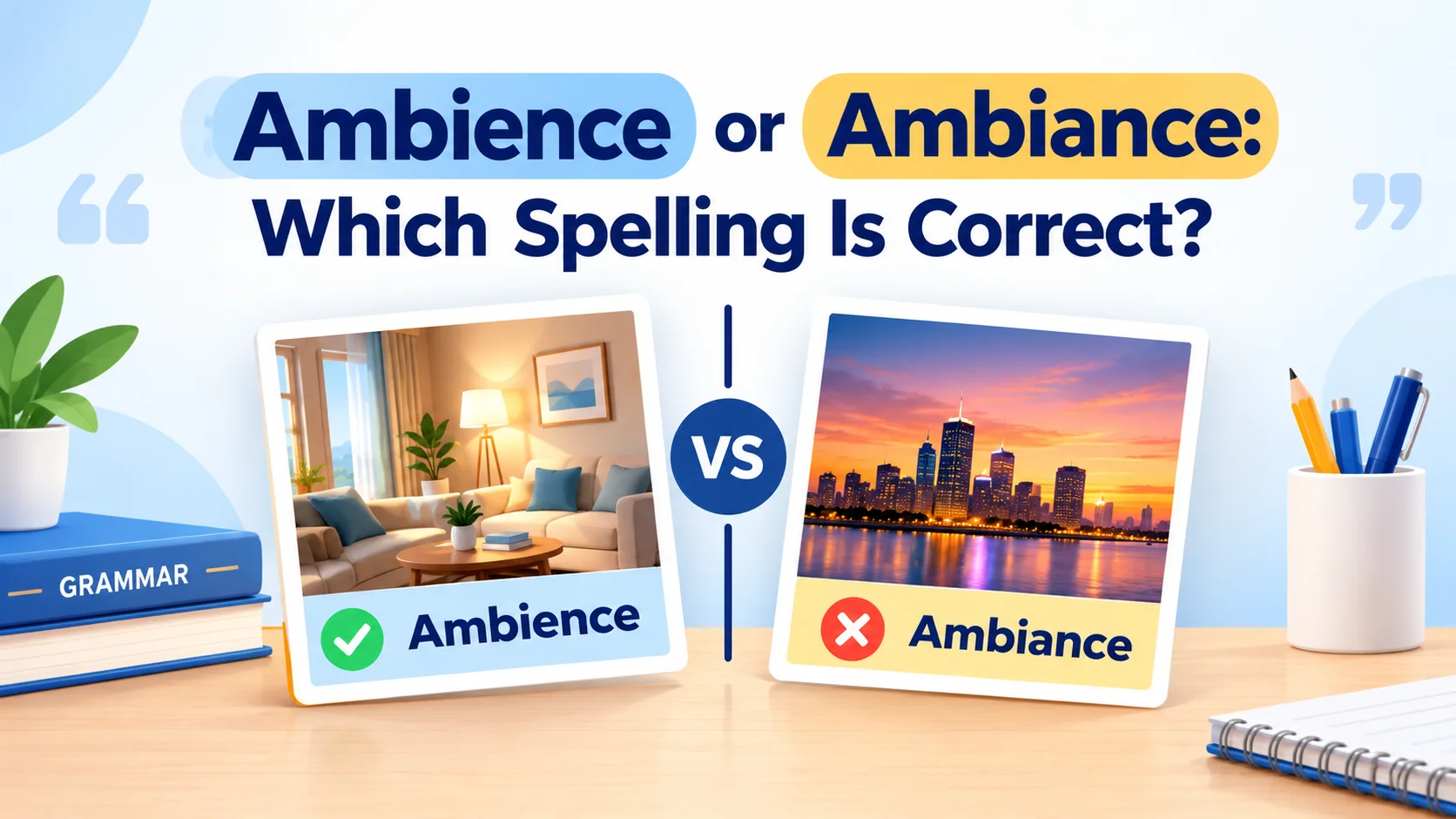
If you have ever wondered whether to write ambience or ambiance, you are not alone. Both spellings are correct, and both describe the atmosphere, mood, or overall character of a place or experience. The difference is not in their meaning but mainly in regional spelling preferences and editorial conventions. Ambiance is particularly common in American English, while ambience is widely preferred in British English. However, neither spelling belongs exclusively to one country. Understanding this distinction helps you choose the appropriate form without mistakenly treating a valid spelling as an error.
The word appears in all kinds of writing, from restaurant reviews and hotel descriptions to interior design articles, travel guides, and everyday conversations. A writer might describe a café’s relaxing ambience, a hotel’s luxurious ambiance, or the mysterious atmosphere of an old building. In each case, the two spellings communicate essentially the same idea. What matters is who will read your writing, which spelling convention your publication follows, and whether you maintain consistency throughout the document.
This guide explains the meaning of ambience and ambiance, their pronunciation, regional usage, and practical differences from related words such as atmosphere, mood, vibe, and environment. You will also see examples from real writing situations, learn how the word works in different contexts, and discover which spelling to choose for American, British, and international audiences. By the end, you will have a clear answer and a simple way to make the right spelling choice whenever you write about the character or feeling of a place.
Ambience or Ambiance: Which Spelling Is Correct?
The short answer is that both ambience and ambiance are correct English spellings. They have the same basic meaning: the atmosphere or overall character of a place, setting, or experience.
The difference is largely conventional. American writers often use ambiance, while British writers commonly prefer ambience. However, both forms are recognized and understood across English-speaking regions.
For example:
- The restaurant has a warm and welcoming ambience.
- The restaurant has a warm and welcoming ambiance.
Neither sentence is wrong. The spelling changes, but the meaning remains the same.
Ambience vs. Ambiance at a glance
| Feature | Ambience | Ambiance |
| Meaning | Atmosphere or character of a place | Atmosphere or character of a place |
| Part of speech | Noun | Noun |
| American English | Used and understood | Particularly common |
| British English | Commonly preferred | Also understood and used |
| Pronunciation | Generally the same | Generally the same |
| Correctness | Correct | Correct |
| Example | The hotel has a peaceful ambience. | The hotel has a peaceful ambiance. |
The most important point is that neither spelling is a different word with a different definition. Choose according to your audience or the style guide you are following.
Does the spelling change the meaning?
No. There is no standard distinction in which ambience describes physical surroundings while ambiance describes emotions, or vice versa.
Both can describe:
- The atmosphere of a restaurant.
- The character of a hotel or home.
- The mood created by lighting and music.
- The feeling associated with a public space.
- The atmosphere created in a film, story, or event.
If someone describes a room as having a peaceful ambience, another person can describe the same room as having a peaceful ambiance. The intended meaning is unchanged.
What Does “Ambience” Mean?
Ambience is a noun that describes the atmosphere, character, or overall feeling of a particular place or setting.
It refers to the combined impression created by different surroundings and sensory details. These may include lighting, colors, furniture, music, background noise, temperature, decoration, and even the behavior of people in the space.
Imagine entering a small café. Soft lighting, comfortable chairs, quiet background music, and the smell of freshly brewed coffee make the room feel welcoming. Together, these details contribute to the café’s ambience.
The word is useful because it describes the overall impression rather than just one individual feature.
How ambience is created
A place’s ambience rarely comes from a single element. It usually develops through several features working together.
| Element | How it influences ambience | Example |
| Lighting | Creates warmth, brightness, or intimacy | Soft lamps create a relaxed atmosphere. |
| Music | Influences energy and emotional tone | Gentle music makes a lounge feel peaceful. |
| Colors | Affect the visual character of a space | Neutral colors create a calm impression. |
| Furniture | Influences comfort and style | Wooden furniture gives a room a traditional feel. |
| Scent | Adds another sensory impression | Fresh flowers create a pleasant atmosphere. |
| Noise level | Changes how comfortable or lively a place feels | Quiet surroundings support concentration. |
| Layout | Shapes movement and interaction | Open seating makes a café feel social. |
This is why interior designers, restaurant owners, event planners, and hospitality professionals pay attention to ambience. A room may contain attractive furniture, but if the lighting is harsh and the music is too loud, the overall experience may still feel uncomfortable.
How “ambience” is used beyond physical places
Although the word is often associated with restaurants, hotels, and rooms, its use is broader.
In events:
The soft lighting and live instrumental music created a romantic ambience for the wedding reception.
In literature:
The author established an eerie ambience through descriptions of empty streets and distant footsteps.
In films and games:
The sound design gives the abandoned building a mysterious ambience.
In workplaces:
The company redesigned its office to create a more collaborative ambience.
In these examples, the word describes an overall experience or atmosphere rather than simply the appearance of a physical room.
What Does “Ambiance” Mean?
Ambiance has the same meaning as ambience. It describes the distinctive atmosphere, mood, or character of a place or experience.
The spelling is especially familiar in American English and appears frequently in restaurant descriptions, travel writing, lifestyle content, and discussions of interior design.
For example:
The small bookstore has a comfortable ambiance that encourages visitors to stay longer.
The sentence describes the feeling created by the bookstore’s surroundings. Replacing ambiance with ambience would not change the meaning.
Why “ambiance” is popular in American English
American English often favors the spelling ambiance. You may encounter it in:
- Restaurant and café reviews.
- Hotel and resort descriptions.
- American lifestyle magazines.
- Home decoration articles.
- Business and hospitality marketing.
- General American publications.
For example:
The hotel combines modern design with a relaxed ambiance.
An American publication may naturally prefer this spelling. That does not mean ambience is incorrect in the United States. It simply means ambiance is a familiar editorial choice.
Examples of “ambiance” in sentences
- The restaurant’s elegant ambiance makes it suitable for special occasions.
- Warm lighting gives the living room a comfortable ambiance.
- The hotel offers a peaceful ambiance away from the busy city.
- The gallery’s minimalist design creates a modern ambiance.
- Soft music and candlelight contribute to the romantic ambiance.
- The beach resort has a relaxed ambiance that attracts holidaymakers.
Each example could use ambience without changing its meaning.
Ambience vs. Ambiance: American, British, and International Usage
Regional spelling conventions are one of the main reasons writers search for this comparison. The two spellings are accepted, but their frequency and editorial preference can differ.
Which spelling is preferred in American English?
Ambiance is a particularly common choice in American English.
You will often see it in US restaurant descriptions, travel websites, home design publications, and general writing. However, ambience is also a valid spelling in American English.
For example, both of these are acceptable:
- The restaurant’s ambiance attracts visitors from across the city.
- The restaurant’s ambience attracts visitors from across the city.
If you are writing specifically for an American audience, ambiance is a sensible default unless your publisher or organization follows another convention.
Which spelling is preferred in British English?
Ambience is commonly preferred in British English.
It fits naturally alongside familiar British spelling conventions and is widely used in UK publications.
For example:
The hotel is known for its peaceful ambience and excellent service.
Nevertheless, ambiance is not automatically wrong in British writing. It is an accepted variant, even if ambience is often the more familiar choice.
What about Canadian, Australian, and other English varieties?
English spelling preferences do not always divide neatly into two categories.
In Canada, Australia, and other English-speaking regions, readers may encounter both spellings. A publication’s house style, editorial tradition, or intended audience can influence which form it chooses.
Rather than assuming that every country follows one strict rule, check the conventions of the publication you are writing for.
Which spelling should international writers choose?
If your content is intended for a broad international audience, either spelling is understandable. The more important decision is to use one form consistently.
For example, if your article begins with ambience, avoid switching to ambiance halfway through unless you are quoting a source or reproducing an official name.
Regional spelling decision table
| Audience or context | Practical spelling choice | Important note |
| United States | Ambiance | Ambience is also correct. |
| United Kingdom | Ambience | Ambiance is also understood. |
| Canada | Follow publication style | Both forms may be encountered. |
| Australia | Follow publication style | Consistency matters. |
| International audience | Either spelling | Choose one and maintain it. |
| Academic publication | Follow its style guide | Institutional preference takes priority. |
Editorial recommendation: Do not treat regional preference as an absolute grammar rule. When writing for a particular publication, its established style guide is more important than a general preference.
How to Choose Between Ambience and Ambiance in Your Writing
Choosing the spelling does not need to be complicated. Start with your audience, then check the writing conventions you need to follow.
Choose “ambiance” for American-focused content
If your readers are primarily in the United States, ambiance is a natural option.
It works well in:
- American restaurant reviews.
- Hotel and travel descriptions.
- Home improvement articles.
- Lifestyle blogs.
- Business websites targeting US customers.
Example:
This downtown café offers a relaxed ambiance, comfortable seating, and excellent coffee.
The spelling fits common American usage.
Choose “ambience” for British-focused content
For UK readers, ambience is a practical choice.
Example:
The country hotel combines traditional furnishings with a welcoming ambience.
It is also a sensible choice when your publication already uses British spelling conventions in other words.
Follow your publication’s style guide
Professional writers do not always choose spellings independently. Newspapers, publishers, universities, and businesses may maintain house styles to ensure consistency.
If you are editing an existing article, check:
- Which spelling appears in the title and opening paragraphs?
- Does the website consistently use American or British English?
- Does the organization have an editorial style guide?
- Are there official names or direct quotations that must retain their original spelling?
If a publication specifies ambience, use that form even if you personally prefer ambiance.
Avoid switching spellings within the same article
Consider this example:
The restaurant has a peaceful ambience. Its warm lighting and elegant ambiance make it popular with visitors.
The sentence is understandable, but switching between the two spellings looks unnecessary.
A consistent version is better:
The restaurant has a peaceful ambience. Its warm lighting and elegant ambience make it popular with visitors.
Or:
The restaurant has a peaceful ambiance. Its warm lighting and elegant ambiance make it popular with visitors.
Consistency makes the article look professionally edited.
How Do You Pronounce Ambience and Ambiance?
The two spellings generally have the same pronunciation in English. The spelling difference does not normally create a different spoken meaning.
Both are commonly pronounced with three syllables, with the stress on the first syllable.
IPA: /ˈæm.bi.əns/
Pronunciation can vary slightly by accent, but the two written forms are generally treated as pronunciation equivalents.
Syllables and word stress
The word has three syllables:
- Am
- Bi
- Ence or ance
The main stress falls on the first syllable. When speaking, avoid giving equal emphasis to every syllable.
Common pronunciation mistakes
Some learners try to pronounce the two spellings differently because they look different. This is usually unnecessary.
Other common problems include:
- Placing the main stress on the second syllable.
- Pronouncing the ending as a separate extra syllable.
- Assuming the final spelling difference changes the sound.
If you are unsure, consult a reputable learner’s dictionary with audio recordings. The Cambridge Dictionary and Oxford Learner’s Dictionaries are useful references for checking pronunciation and usage.
Ambience and Ambiance in Different Contexts
Understanding where the word appears helps you use it more naturally. The atmosphere of a restaurant is not created in exactly the same way as the atmosphere of a film or workplace.
Restaurants, cafés, and hotels
Hospitality businesses often use ambience or ambiance to describe the experience customers have when entering a place.
A restaurant’s atmosphere may depend on:
- Lighting and table arrangement.
- Music and background noise.
- Interior decoration.
- Staff behavior and service.
- The level of comfort and privacy.
Example:
The restaurant’s warm ambience, attentive service, and quiet dining area make it ideal for a relaxed evening.
In restaurant reviews, the word communicates more than whether the interior looks attractive. It describes the overall experience.
Homes and interior design
In interior design, ambience refers to the impression created by the way a room is arranged and decorated.
For example:
Natural light, soft furnishings, and neutral colors give the bedroom a peaceful ambience.
Designers may consider ambience when selecting:
- Wall colors.
- Furniture styles.
- Curtains and fabrics.
- Decorative lighting.
- Room layouts.
- Textures and materials.
A room designed for concentration may need a different ambience from one intended for relaxation or entertaining guests.
Events, weddings, and celebrations
Event planners often use the term when describing the feeling they want guests to experience.
Example:
Fairy lights, floral decorations, and gentle music created a charming ambience for the outdoor reception.
A formal corporate event might require a polished and professional atmosphere, while a birthday celebration may benefit from a lively and informal one.
Travel, tourism, and public spaces
Travel writers use the word to describe the distinctive character of destinations.
Examples:
- The historic streets give the town a charming ambience.
- The coastal village has a relaxed atmosphere that attracts visitors.
- The busy market creates a lively ambience throughout the afternoon.
The word can help readers imagine the experience of visiting a location rather than simply learning what it looks like.
Film, literature, and digital experiences
Ambience is not limited to physical surroundings. It can also describe an atmosphere created through artistic choices.
- In a film, lighting, sound effects, camera movement, and music may establish a tense or mysterious ambience.
- In literature, the writer may use weather, setting, dialogue, and descriptive language to create a particular feeling.
- In video games, background sounds, visual design, and environmental details can make a location feel peaceful, threatening, or unfamiliar.
- Example:
The game’s atmospheric soundtrack and dimly lit environments create an unsettling ambience.
Ambience vs. Atmosphere, Mood, Vibe, and Environment
These words are related, but they do not always communicate exactly the same idea. Choosing carefully can make descriptions more precise.
Ambience vs. atmosphere
Ambience and atmosphere often overlap. Both can describe the overall feeling or character of a place.
However, atmosphere is broader and can also refer to the general conditions surrounding an event or situation.
- The restaurant has a relaxed ambience.
- There was an atmosphere of uncertainty during the meeting.
The first sentence emphasizes the character of a place. The second describes the general feeling among people during an event.
Ambience vs. mood
Mood usually refers to an emotional state or the feeling created in a person or audience.
Ambience emphasizes the overall atmosphere of a setting.
For example:
- The room’s soft lighting creates a peaceful ambience.
- The peaceful ambience puts visitors in a relaxed mood.
The setting contributes to the feeling, but the two terms describe different aspects of the experience.
Ambience vs. vibe
Vibe is an informal word used to describe the general feeling or impression of a place, person, or situation.
- This café has a friendly vibe.
- This café has a welcoming ambience.
Both sentences are understandable. However, vibe is more conversational, while ambience often sounds more descriptive or polished.
Ambience vs. environment
Environment can refer to the physical surroundings, conditions, or broader setting in which something exists.
Ambience focuses more specifically on the atmosphere or character those surroundings create.
For example:
- The office environment includes its layout, equipment, and working conditions.
- The office ambience feels calm and welcoming.
The first describes the broader setting; the second describes the impression it creates.
Which word fits your sentence best?
| Word | Main emphasis | Typical tone | Example |
| Ambience | Overall character of a setting | Descriptive | The hotel has a relaxing ambience. |
| Atmosphere | General feeling or conditions | Neutral to descriptive | The atmosphere became tense. |
| Mood | Emotional state or feeling | General | The music improved my mood. |
| Vibe | General impression or energy | Informal | The café has a friendly vibe. |
| Environment | Surroundings or conditions | Neutral or technical | The office environment is comfortable. |
Use ambience when you want to describe the distinctive atmosphere of a place or experience. Choose another word when it expresses your intended meaning more accurately.
Word Origin and Related Word Forms
The history of the two spellings helps explain why both exist.
Where do ambience and ambiance come from?
Both forms are connected to the French word ambiance, which refers to atmosphere or surroundings. The English word developed through French influence, and the two spellings became established variants in English.
The difference between the spellings is therefore not evidence of two separate concepts. It reflects the development and adoption of different written forms.
For a detailed historical account, consult an established etymological dictionary rather than relying on assumptions based on the spelling alone.
Is ambience a noun or an adjective?
Both ambience and ambiance are nouns.
Examples:
- The ambience of the restaurant was welcoming.
- The ambiance of the hotel was elegant.
The related adjective is ambient.
Examples:
- Ambient lighting created a relaxing atmosphere.
- The room was filled with ambient music.
- The designer selected ambient lighting for the lounge.
Although the words are related, ambient has its own grammatical function. You would not normally use ambience as an adjective.
Common collocations with ambience and ambiance
A collocation is a combination of words that commonly appears together.
| Common expression | Example |
| Relaxing ambience | The spa has a relaxing ambience. |
| Romantic ambiance | Candlelight created a romantic ambiance. |
| Warm ambience | Wooden furniture gives the room a warm ambience. |
| Elegant ambiance | The hotel is known for its elegant ambiance. |
| Peaceful ambience | The garden offers a peaceful ambience. |
| Create an ambience | Soft music can create a welcoming ambience. |
| Improve the ambiance | Better lighting could improve the restaurant’s ambiance. |
| Ambient lighting | Ambient lighting makes the living room more comfortable. |
These expressions can help make descriptions sound natural. However, do not rely on adjectives alone. Specific details about lighting, sound, design, and comfort give readers a clearer picture.
Common Mistakes When Using Ambience or Ambiance
Even though the spelling choice is straightforward, writers sometimes misunderstand how the words work.
Mistake 1: Assuming one spelling is incorrect
Incorrect belief: Ambiance is a misspelling of ambience, or the other way around.
Correction: Both are accepted English spellings. The appropriate choice depends on regional preference and editorial style.
Mistake 2: Giving the two spellings different meanings
Incorrect belief: Ambience describes physical surroundings, while ambiance describes emotional atmosphere.
Correction: They share the same core meaning. Neither spelling has an exclusive definition.
Mistake 3: Treating ambience as a British-only word
Although ambience is commonly preferred in British English, it is not restricted to the UK. American readers also recognize and use it.
Mistake 4: Switching spellings randomly
Using both forms without a reason can make an article appear poorly edited.
Quick fix: Select a preferred spelling before writing, then use your word processor’s search function to check for accidental variation.
Mistake 5: Using ambience only for physical rooms
The word can also describe the atmosphere of an event, film, story, digital environment, or other experience.
Mistake 6: Confusing ambience with mood or environment
Related words are not always interchangeable. A setting can have a particular ambience that influences a person’s mood, but those terms describe different things.
Practical Tips for Using Ambience and Ambiance Correctly
A few simple editorial habits can prevent most spelling and usage problems.
Identify your target audience
Before choosing a spelling, decide who will read your content.
- For US-focused writing, ambiance is a natural default.
- For UK-focused writing, ambience is a natural default.
- For international content, either is acceptable if used consistently.
Check the relevant dictionary or style guide
A dictionary can confirm that a spelling is accepted. A publication’s style guide can tell you which accepted form its editors prefer.
For professional work, use the reference specified by your publisher, university, employer, or client.
Use one spelling consistently
Consistency is especially important in longer documents.
Before publishing, check:
- The headline.
- The introduction.
- Main headings.
- Body paragraphs.
- Captions and image descriptions.
- Frequently asked questions.
A single accidental variation may not affect comprehension, but consistent editing makes the finished work more polished.
Choose descriptive details rather than vague adjectives
Instead of writing:
The café has a beautiful ambience.
Consider:
Soft pendant lights, wooden tables, and quiet background music give the café a welcoming ambience.
The second sentence tells readers what actually creates the atmosphere. This is more informative and useful, particularly in reviews and descriptive articles.
Practice: Choose Ambience or Ambiance
The following questions test spelling preference and meaning. Remember that both forms are correct; the intended audience or style convention determines which one to select.
Complete the sentences
- The restaurant’s warm ______ makes it popular with couples.
- The hotel has a luxurious ______ that attracts international visitors.
- Soft lighting helped create a peaceful ______ in the bedroom.
- The café’s relaxed ______ makes it a comfortable place to study.
- The designer wanted to give the reception area a welcoming ______.
Check your answers
- Ambience or ambiance — Both are correct. Choose according to your style guide.
- Ambience or ambiance — Either spelling works.
- Ambience or ambiance — Both describe the peaceful atmosphere.
- Ambience or ambiance — The spelling depends on the audience.
- Ambience or ambiance — Both are acceptable in this context.
The exercise has no single universal spelling answer because the words have the same meaning. The important skill is recognizing that both are valid and applying one spelling consistently.
Conclusion
When deciding between ambience or ambiance, remember that you are choosing between two accepted spellings, not two different meanings. Both describe the atmosphere or character of a place, setting, or experience. Ambiance is particularly common in American English, while ambience is often preferred in British English, although both forms are understood internationally. One final actionable tip: identify your target audience and check your publication’s spelling conventions before choosing a form. A common mistake to avoid is switching between the spellings within the same article or assuming one is universally incorrect. Good writing is not about forcing a single spelling on every reader; it is about making thoughtful choices and applying them consistently. Choose the form that suits your audience, then let your descriptions bring the atmosphere to life.
Frequently Asked Questions
Q1. Is “ambience” or “ambiance” the correct spelling?
Both ambience and ambiance are correct English spellings. They share the same meaning and refer to the atmosphere or character of a place or experience. The choice usually depends on regional preference, publication style, or the audience you are writing for.
Q2. Is ambiance American or British English?
Ambiance is particularly common in American English, but it is not exclusive to the United States. British readers also understand it. British publications often prefer ambience, so follow the spelling convention of your intended audience or publisher.
Q3. Is ambience more British than ambiance?
Yes, ambience is commonly preferred in British English, while ambiance is especially familiar in American writing. However, this is a general usage preference rather than a strict grammatical restriction. Both spellings are accepted and understood in both regions.
Q4. Do ambience and ambiance have the same pronunciation?
Generally, yes. Both spellings are pronounced in essentially the same way in English, with the main stress on the first syllable. Accent differences may affect individual sounds, but the spelling variation does not normally indicate a different pronunciation.
Q5. What is the adjective form of ambience?
The related adjective is ambient. It describes something surrounding or present in the environment, as in ambient lighting or ambient sound. Remember that ambience and ambiance are nouns, whereas ambient performs an adjective’s role.
