
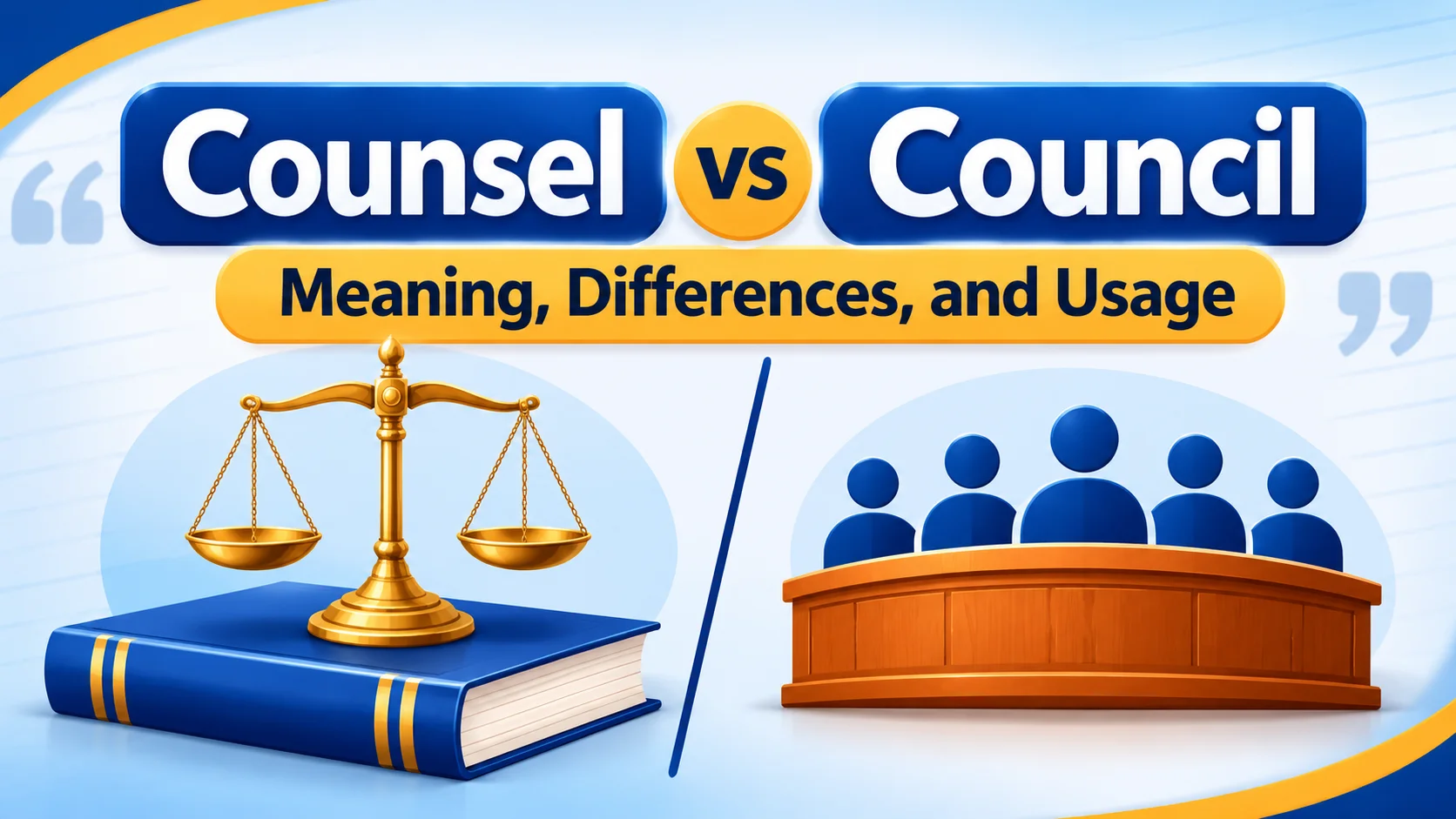
Counsel and council are two English words that sound exactly alike but communicate very different ideas. One relates to advice, guidance, and legal representation; the other describes an organized group responsible for discussing issues, providing recommendations, or making decisions. Because their pronunciation is identical, even confident English speakers sometimes choose the wrong spelling, particularly in professional emails, legal documents, and academic writing.
The distinction becomes especially important when the words appear in formal expressions such as legal counsel, city council, school council, and counsel for the defense. A single spelling change can alter the meaning of a sentence. Understanding their grammatical roles, common expressions, and real-world applications makes it much easier to select the correct word without relying on guesswork.
In this guide, you’ll learn the meaning of counsel and council, how each word functions as a noun or verb, and where their usage differs. We’ll also examine legal and professional terminology, explore common spelling mistakes, compare practical examples, and explain how to remember the distinction. By the end, you’ll be able to recognize which word belongs in a sentence, whether you’re writing about professional advice, an attorney, a government body, or an organizational committee.
Counsel vs Council: The Quick Answer
The main difference between counsel and council is their meaning and grammatical function.
- Counsel means advice, guidance, or legal representation. It can also function as a verb meaning to advise or guide someone.
- Council means an organized group of people who meet to discuss issues, provide advice, establish policies, or make decisions.
Both words are pronounced /ˈkaʊn.səl/ (KOWN-suhl). They are therefore homophones: words that share the same pronunciation but have different spellings and meanings.
Consider these examples:
- The company hired experienced legal counsel before signing the agreement.
- The city council approved the proposed housing development.
In the first sentence, counsel refers to legal assistance. In the second, council identifies a group of decision-makers.
Easy rule: If you’re talking about advice or a lawyer, use counsel. If you’re referring to a committee or governing group, use council.
Counsel vs Council: Key Differences at a Glance
The following table highlights the differences worth remembering.
| Feature | Counsel | Council |
| Meaning | Advice, guidance, or legal representation | An organized group of people |
| Part of speech | Noun and verb | Noun |
| Pronunciation | KOWN-suhl | KOWN-suhl |
| Refers to | Advice, a lawyer, or legal representatives | A committee, board, or governing body |
| Typical setting | Legal, personal, professional | Government, education, organizations |
| Common expressions | Legal counsel, seek counsel, offer counsel | City council, student council, council meeting |
| Verb form | Counsel someone | No standard verb form |
| Plural form | Counsels (in certain noun senses) | Councils |
| Example | She sought counsel before making the decision. | The council discussed the proposal. |
One important grammatical distinction deserves attention: counsel can be a noun or a verb, whereas council is a noun. This difference becomes useful when identifying the correct spelling in sentences where the surrounding words provide grammatical clues.
What Does Counsel Mean?
Counsel refers to advice, guidance, or assistance provided to someone who needs help making a decision. It can also describe a lawyer or legal representative who advises or represents a person, organization, or business.
The word is relatively formal compared with everyday alternatives such as advice or help. It frequently appears in legal documents, professional conversations, business communications, and situations involving important personal decisions.
For example:
- My manager advised me to seek professional counsel before accepting the offer.
- The defendant spoke with her counsel before entering the courtroom.
- His grandfather offered valuable counsel during a difficult period.
Although the examples involve different situations, the central idea remains the same: someone is receiving guidance or legal assistance.
Counsel as a Noun: Advice, Guidance, and Legal Representation
When used as a noun, counsel has two closely related but distinct meanings.
1. Advice or guidance
The word can describe recommendations intended to help someone understand a situation or make an informed decision.
For example:
- The student sought academic counsel before choosing a university.
- Her mentor offered practical counsel about managing workplace disagreements.
- The employee ignored the counsel provided by his supervisor.
In these examples, counsel refers to guidance rather than a particular person.
It is generally an uncountable noun when used in this sense. You would normally say some counsel, valuable counsel, or a piece of advice, rather than a counsel.
2. A lawyer or legal representative
In legal settings, counsel can refer to an attorney or a legal representative involved in a case.
For example:
- The defendant arrived at court with experienced counsel.
- The company consulted its legal counsel before responding to the lawsuit.
- Defense counsel questioned the witness.
Here, the word identifies a legal professional or legal representation, not simply a recommendation.
The surrounding context usually makes the intended meaning clear.
Counsel as a Verb: To Advise or Guide Someone
Counsel also works as a verb. It means to advise, guide, or recommend a particular course of action.
Its verb forms include:
- Counsel
- Counsels
- Counseled (American English)
- Counselled (British English)
- Counseling (American English)
- Counselling (British English)
Examples:
- The teacher counseled the student about improving her study habits.
- A financial adviser counsels clients on investment decisions.
- The organization provides professionals who counsel families experiencing difficult circumstances.
Notice the difference between the noun and verb:
| Usage | Example | Meaning |
| Noun | She requested counsel. | She requested advice. |
| Noun | The defendant spoke with counsel. | The defendant spoke with a lawyer. |
| Verb | The adviser counseled the client. | The adviser provided guidance. |
Practical tip: When someone is giving advice, counsel can describe the advice itself or the action of providing it.
Counsel in Legal and Professional Settings
Legal writing is one of the most important contexts in which the word counsel appears.
Lawyers often use it to describe legal representation, professional responsibilities, and the people involved in court proceedings.
Here are several common expressions:
| Expression | Meaning |
| Legal counsel | A lawyer or legal advisory service |
| Defense counsel | A lawyer representing the defendant |
| Prosecution counsel | A lawyer representing the prosecution |
| In-house counsel | A lawyer employed by an organization |
| Counsel for the plaintiff | The lawyer representing the plaintiff |
| Counsel of record | The lawyer formally recorded as representing a party |
| General counsel | A senior lawyer responsible for an organization’s legal affairs |
For example:
The company consulted its general counsel before announcing the acquisition.
This sentence means that the organization sought professional legal guidance from its senior legal adviser.
Another example:
Defense counsel challenged the reliability of the evidence.
Here, defense counsel refers to the lawyer or legal team representing the defendant.
An important distinction is that legal counsel does not automatically mean a group of lawyers. Depending on the context, it can refer to one attorney, several legal representatives, or legal advice as a service.
Common Expressions Containing Counsel
Understanding common word combinations makes the meaning easier to recognize.
| Expression | Example |
| Seek counsel | She sought counsel before resigning. |
| Offer counsel | His mentor offered counsel. |
| Give counsel | The adviser gave counsel to the family. |
| Take counsel | They took counsel from an experienced attorney. |
| Act on someone’s counsel | He acted on his lawyer’s counsel. |
| Keep one’s own counsel | She preferred to keep her own counsel. |
The expression keep one’s own counsel is particularly interesting. It means keeping one’s thoughts, plans, or opinions private rather than sharing them with others.
For example:
During the negotiations, the director kept his own counsel.
This means the director chose not to reveal his thoughts or intentions.
More Example Sentences Using Counsel
These examples demonstrate how the word works in different situations.
- The family sought professional counsel before making a major financial decision.
- Her lawyer provided counsel throughout the court proceedings.
- The principal counseled the student after the disagreement.
- Employees can request confidential counsel about workplace concerns.
- The defendant discussed the next legal steps with counsel.
- His father offered wise counsel when he was considering a career change.
- The organization hired outside counsel to review its contracts.
- Experienced managers often counsel new employees during their first months.
What Does Council Mean?
A council is an organized group of people brought together to discuss matters, provide recommendations, establish policies, or make decisions.
Unlike counsel, which can refer to advice or a lawyer, council always functions as a noun in standard contemporary English.
Councils exist in different environments, including:
- Local and national government
- Schools and universities
- Professional associations
- Businesses and corporations
- Charitable organizations
- Community groups
For example:
The city council voted to improve public transportation.
The sentence describes a group of representatives responsible for making decisions about local government.
Another example:
The student council organized a fundraising event.
Here, the council is a student organization representing learners and coordinating activities.
Council as a Noun: A Group That Makes Decisions
The defining characteristic of a council is that it brings people together for a shared organizational purpose.
However, not every council has the same authority.
Some councils make binding decisions, while others exist primarily to advise, represent members, or coordinate activities.
For example:
- A city council may approve local policies and budgets within its legal authority.
- A student council may represent students and organize school activities.
- An advisory council may provide recommendations without having final decision-making authority.
Council is a countable noun.
You can use it in singular and plural forms:
- One council
- Several councils
- A local council
- Two advisory councils
Example:
Three regional councils participated in the national consultation.
The plural form is councils, not counsels.
Different Types of Councils and Their Responsibilities
The word appears in many organizational settings. Understanding these variations helps explain why the same term can describe groups with very different responsibilities.
| Type of council | Main responsibility | Example |
| City council | Local government decisions | Approving municipal budgets |
| Town council | Managing local community matters | Discussing road maintenance |
| Student council | Representing students | Organizing school events |
| School council | Supporting school governance | Discussing educational policies |
| Advisory council | Providing expert recommendations | Reviewing a proposed strategy |
| Executive council | Overseeing organizational matters | Reviewing major decisions |
| Governing council | Providing institutional oversight | Establishing organizational policies |
| National council | Addressing national or sector-wide issues | Coordinating national initiatives |
The precise responsibilities depend on the laws, constitution, organizational rules, or terms of reference governing each council.
For instance, a student council may have permission to organize events but no authority to change school regulations. A local government council, by contrast, may have legally defined powers over certain public services.
Council in Government, Education, and Organizations
Government
City councils and municipal councils are responsible for various aspects of local administration.
Depending on the country and legal framework, their responsibilities may include:
- Approving local budgets.
- Discussing community development.
- Establishing certain local policies.
- Overseeing public services.
- Representing residents’ interests.
For example:
The council approved funding for a new public library.
Education
Educational institutions often establish councils to involve students, parents, teachers, or administrators in decision-making.
A student council may represent learners, while a school council may have a broader role in discussing educational policies and school management.
Example:
The student council proposed extending library opening hours during examination week.
Businesses and professional organizations
Organizations may establish advisory or executive councils to bring together people with specialized knowledge.
An advisory council, for instance, might review a company’s long-term plans and provide recommendations to senior management.
Example:
The technology advisory council reviewed the company’s proposed cybersecurity strategy.
The important point is that a council is defined by its organizational role, not simply by the fact that several people are meeting.
Common Expressions Containing Council
These expressions frequently appear in government documents, school communications, and professional writing.
| Expression | Meaning |
| City council | A local government decision-making body |
| Council member | A person belonging to a council |
| Council meeting | An official gathering of council members |
| Council decision | A decision made by a council |
| Council election | An election to select council representatives |
| Council chamber | A room where council meetings take place |
| Council resolution | A formal decision or statement |
| Council representative | Someone representing a council |
| Council authority | The powers or responsibilities of a council |
Examples:
- The council meeting begins at 9 a.m.
- Every council member received a copy of the proposal.
- The council resolution was published on the organization’s website.
- Residents attended the city council meeting to express their concerns.
More Example Sentences Using Council
- The city council approved the construction of a new community center.
- Our student council organized a cultural festival.
- The council members discussed the proposed changes.
- A national council was established to coordinate the initiative.
- The school council invited parents to share their opinions.
- The advisory council recommended improvements to the existing strategy.
- Several regional councils participated in the conference.
- The council postponed its decision until the next meeting.
Counsel vs Council: The Main Differences Explained
Although their pronunciation is identical, their meanings, grammatical roles, and applications are different.
Let’s examine the distinctions that matter most when writing.
Meaning: Advice or Guidance vs an Organized Group
This is the most important difference.
Counsel refers to advice, guidance, or legal representation. Council describes an organized body of people.
Compare:
- The employee requested counsel about a workplace dispute.
- The employee addressed the council about a workplace dispute.
In the first example, the employee wants guidance. In the second, the employee is speaking to an organized group.
The surrounding context may be similar, but the words communicate entirely different things.
Grammar: When Counsel Is a Noun or Verb
The grammatical role of a word can help you identify it.
| Sentence | Grammatical role | Explanation |
| She offered counsel. | Noun | Advice or guidance |
| He is legal counsel. | Noun | A lawyer or legal representative |
| The teacher counseled him. | Verb | Provided guidance |
| The council met yesterday. | Noun | An organized group |
| The council approved the plan. | Noun | The group made a decision |
A useful editing technique is to examine the action in the sentence.
If someone is counseling another person, the base word is counsel. If an organized group is meeting or voting, the appropriate word is council.
Legal Usage: Legal Counsel vs a Legal Council
This distinction is especially important because both expressions are grammatically possible, but they communicate different things.
Legal counsel refers to a lawyer, legal representative, or legal advice.
Example:
The business contacted legal counsel before responding to the complaint.
The business contacted a legal professional or legal service.
Legal council would refer to an actual organized group or committee concerned with legal matters, if an organization has established one under that name.
Example:
The university’s legal council reviewed its proposed governance policies.
In this hypothetical example, legal council identifies a committee rather than an individual attorney.
Remember the distinction
- Legal counsel = A lawyer or legal advice.
- Legal council = A group or committee dealing with legal matters.
In ordinary legal communication, legal counsel is the expression most people need.
Professional Usage: Seeking Counsel vs Joining a Council
The distinction also appears in business and workplace situations.
Consider these two sentences:
The employee sought counsel from an experienced manager.
This means the employee requested advice.
The employee joined the company’s advisory council.
This means the employee became a member of an organized group.
A useful way to think about the distinction is to ask whether the sentence describes receiving help or participating in an organization.
Singular and Plural Forms
The plural forms can create additional confusion, especially when people assume that the two words follow identical grammatical patterns.
| Word | Singular | Plural | Usage |
| Counsel | Counsel | Counsels (in certain senses) | Advice or legal representation |
| Council | Council | Councils | Organized groups |
When counsel means advice, it is generally uncountable.
You would normally write:
- She received valuable counsel.
- They requested professional counsel.
- His counsel was helpful.
You would not normally write three counsels to mean three pieces of advice.
However, counsels can be used in other contexts, including when referring to different advisers, legal representatives, or sets of advice.
For example:
The counsels for both parties presented their arguments.
By comparison, councils is the ordinary plural of council.
Example:
Several local councils introduced new community programs.
Why Are Counsel and Council So Easily Confused?
The confusion is not simply a spelling problem. It is connected to how English pronunciation and vocabulary work.
Identical Pronunciation and Different Spellings
Both words sound like KOWN-suhl.
Their pronunciation does not provide a reliable clue about their spelling, so writers must use context to determine the intended meaning.
This is why they are classified as homophones.
Other familiar examples of English homophones include:
- Their and there
- To, too, and two
- Right and write
- Principal and principle
- Stationary and stationery
In each case, pronunciation alone is insufficient to identify the correct written form.
Similar Word Origins and Historical Development
The two words have different historical backgrounds, despite their modern pronunciation.
Counsel entered English through Old French conseil, associated with advice, consultation, and deliberation. Its history can ultimately be traced to Latin consilium, meaning advice or deliberation.
Council also developed through Old French conseil, but its modern meaning became associated with an assembly or organized group that deliberates and makes decisions.
Their historical relationship helps explain their similar pronunciation, while their different modern meanings explain why their spelling matters.
The important lesson is that similar origins do not make two words interchangeable.
How Context Helps You Choose the Right Word
When pronunciation cannot help, examine the meaning of the entire sentence.
For example:
*The committee requested professional ___ before approving the contract.*
The sentence refers to advice, so the correct word is counsel.
Now consider:
*The local ___ approved the new transportation policy.*
The sentence refers to a governing group, so the correct word is council.
The same technique works in unfamiliar sentences: identify the person, action, or organization being described before choosing the spelling.
Counsel vs Council in Common Real-Life Situations
Some sentences are easier to understand when you see how the two words function in specific environments.
Legal Documents and Courtroom Communication
Legal writing frequently uses counsel because lawyers provide advice and represent clients.
Examples include:
- The defendant consulted legal counsel.
- Defense counsel questioned the witness.
- The plaintiff’s counsel submitted the documents.
- The organization appointed new legal counsel.
However, a legal organization may also establish a council.
For example:
The professional council reviewed proposed changes to its legal ethics guidelines.
Here, council refers to the organized body responsible for reviewing the proposals.
Local Government and Public Administration
Government communication commonly uses council to identify elected or appointed representatives.
Examples:
- The city council approved the annual budget.
- Council members discussed improvements to public transportation.
- The regional council announced a new housing initiative.
By contrast:
The mayor sought legal counsel before signing the agreement.
The mayor requested legal guidance.
Schools, Colleges, and Student Organizations
Educational settings provide straightforward examples of both words.
| Situation | Correct word | Example |
| Student representatives | Council | The student council organized the event. |
| School governance | Council | The school council reviewed the proposal. |
| Personal academic advice | Counsel | She sought academic counsel. |
| Professional guidance | Counsel | The adviser counseled the student. |
One additional distinction is worth remembering: a school counselor is a professional who supports students with academic, personal, or social concerns, depending on their role and qualifications.
A school council, however, is an organized group.
The words are related in sound but not in meaning.
Business and Workplace Communication
Businesses may use both words within the same department or discussion.
For example:
The executive council requested advice from the company’s legal counsel before approving the merger.
This sentence contains both words correctly:
- Executive council: The group responsible for reviewing or approving the matter.
- Legal counsel: The legal professional providing advice.
This is an especially useful example because it demonstrates that the two words can appear together without being interchangeable.
Common Counsel vs Council Mistakes (And How to Correct Them)
Even experienced writers can make homophone mistakes when typing quickly or relying on spell-checking software.
Here are some common errors and their corrections.
| Incorrect sentence | Correct sentence | Reason |
| She hired a council to represent her in court. | She hired counsel to represent her in court. | A lawyer or legal representative is intended. |
| The school counsel approved the proposal. | The school council approved the proposal. | An organized group is intended. |
| He requested legal council. | He requested legal counsel. | Legal advice or representation is intended. |
| The city counsel voted on the budget. | The city council voted on the budget. | A government body is intended. |
| Several counsel met to discuss local policies. | Several councils met to discuss local policies. | Multiple organized groups are intended. |
Confusing Legal Counsel With a Legal Committee
One mistake deserves particular attention: assuming that every reference to a group of lawyers requires the word council.
This is not correct.
A legal team can be described as legal counsel without being an official council.
For example:
The organization consulted external legal counsel.
The phrase can refer to a law firm or legal professionals providing services.
Use council only when you genuinely mean an organized body or committee.
Using the Wrong Word in Formal Emails and Documents
Professional writing requires extra care because the wrong word can create ambiguity.
Consider these examples:
Incorrect:
Please contact the company council for advice about your employment agreement.
Better:
Please contact the company’s legal counsel for advice about your employment agreement.
The second sentence identifies the intended source of legal guidance.
Another example:
Incorrect:
The legal counsel will hold its monthly meeting on Friday.
Better, if referring to a committee:
The legal council will hold its monthly meeting on Friday.
The second version is appropriate only if the organization actually has a body called a legal council.
Proofreading checklist:
Before submitting an important document, ask yourself:
- Am I referring to advice or a lawyer?
- Am I describing an organized group?
- Does the surrounding verb suggest a committee meeting or an advisory conversation?
- Have I used the correct plural form?
- Does the expression match the professional context?
A quick contextual review is more reliable than depending entirely on automatic spell-checking.
Easy Tricks to Remember the Difference Between Counsel and Council
You do not need to memorize complicated grammatical rules to distinguish these words. A few practical associations can make the difference stick.
Associate Counsel With Advice
Think of counselor.
A counselor is someone who provides guidance or support. The shared spelling connection makes counsel easier to associate with advice.
Remember these expressions:
- Legal counsel
- Professional counsel
- Seek counsel
- Offer counsel
Whenever the sentence concerns guidance, advice, or legal representation, consider counsel.
Associate Council With a Committee
Think of a familiar organization such as a city council or student council.
Both consist of people who come together to represent others, discuss matters, or make decisions.
Remember these expressions:
- Council meeting
- Council member
- City council
- Student council
If you can replace the word with committee or governing body without changing the basic meaning, council is probably the correct choice.
Use a Simple Context-Based Test
Here is a quick decision table you can use when writing.
| Ask yourself | If the answer is yes | Choose |
| Does the sentence refer to advice? | Someone is providing guidance. | Counsel |
| Does it refer to a lawyer? | Someone is receiving legal representation. | Counsel |
| Does it describe advising someone? | Someone is guiding another person. | Counsel |
| Does it refer to a committee? | An organized group is involved. | Council |
| Does it describe elected representatives? | A governing body is involved. | Council |
| Does it refer to a formal group meeting? | Members are gathering as an organization. | Council |
Quick memory trick: You seek counsel when you need guidance, but you join a council when you become part of a group.
Counsel vs Council: Synonyms and Related Words
Synonyms can help clarify meaning, but not every alternative works in every sentence. Some words describe similar concepts while carrying different levels of formality or specific professional meanings.
Synonyms of Counsel
When counsel refers to advice, possible alternatives include:
- Advice
- Guidance
- Recommendation
- Consultation
- Direction
- Support
For example:
She sought counsel from her supervisor.
Could become:
She sought advice from her supervisor.
When counsel refers to a lawyer, related terms include:
- Attorney
- Lawyer
- Legal representative
- Legal adviser
- Advocate (in jurisdictions where the term is used for legal professionals)
However, these terms are not always interchangeable. The precise professional title depends on the legal system and the person’s role.
Synonyms and Related Terms for Council
When council refers to an organized group, related words include:
- Committee
- Board
- Assembly
- Panel
- Governing body
- Advisory group
- Representative body
For example:
The advisory council reviewed the proposal.
Could become:
The advisory committee reviewed the proposal.
This substitution works if the organization uses those terms for bodies with comparable responsibilities.
A council and a board may have different legal powers, so avoid treating them as exact synonyms in formal documents.
Counsel vs Counselor vs Counsellor
These three related-looking words are often confused.
| Word | Meaning | Example |
| Counsel | Advice, legal representation, or to advise | She sought professional counsel. |
| Counselor | A person who provides guidance (American spelling) | The school counselor helped the student. |
| Counsellor | A person who provides guidance (British spelling) | The school counsellor met with the student. |
| Council | An organized group | The student council met yesterday. |
The main spelling difference between counselor and counsellor is regional:
- American English: Counselor
- British English: Counsellor
Both spellings are accepted in their respective varieties of English.
Be careful not to confuse a counselor with a council member. A counselor provides guidance; a council member belongs to an organized group.
Conclusion
Understanding counsel vs council comes down to recognizing whether you’re describing guidance or an organized group. Counsel relates to advice, professional guidance, and legal representation, while council identifies a body of people responsible for discussing issues or making decisions. Although their pronunciation is identical, their meanings and grammatical functions are distinct. One final actionable tip: Before using either spelling, replace it mentally with advice or committee. If advice fits, choose counsel; if committee fits, choose council. A common mistake to avoid is automatically writing council whenever several lawyers are involved. Legal counsel can refer to an entire legal team without describing a formal council. Pay attention to meaning, and you’ll make the correct choice confidently in everyday and professional writing.
Frequently Asked Questions
Q1. What is the main difference between counsel and council?
Counsel means advice, guidance, or legal representation. Council means an organized group of people who discuss issues, provide recommendations, or make decisions. Both words have identical pronunciation, but their meanings and grammatical functions are different.
Q2. Are counsel and council pronounced the same?
Yes. Both words are pronounced KOWN-suhl and are classified as homophones. Their identical pronunciation explains why people confuse them in conversation and writing. To choose correctly, consider the meaning of the sentence rather than how the word sounds.
Q3. Is it legal counsel or legal council?
Legal counsel is the standard expression when referring to a lawyer, legal representative, or legal advice. Legal council would describe an actual organized committee dealing with legal matters. Unless you mean such a group, use legal counsel in professional and legal communication.
Q4. Is counsel a person or advice?
It can mean both. As a noun, counsel can refer to advice or a lawyer representing someone in a legal matter. As a verb, it means to advise or guide another person. Its intended meaning depends on the sentence and surrounding context.
Q5. What is the plural of counsel and council?
The ordinary plural of council is councils. Counsel is generally uncountable when referring to advice, although counsels appears in certain contexts involving advisers, legal representatives, or different forms of guidance. The two plural forms are not interchangeable.
