
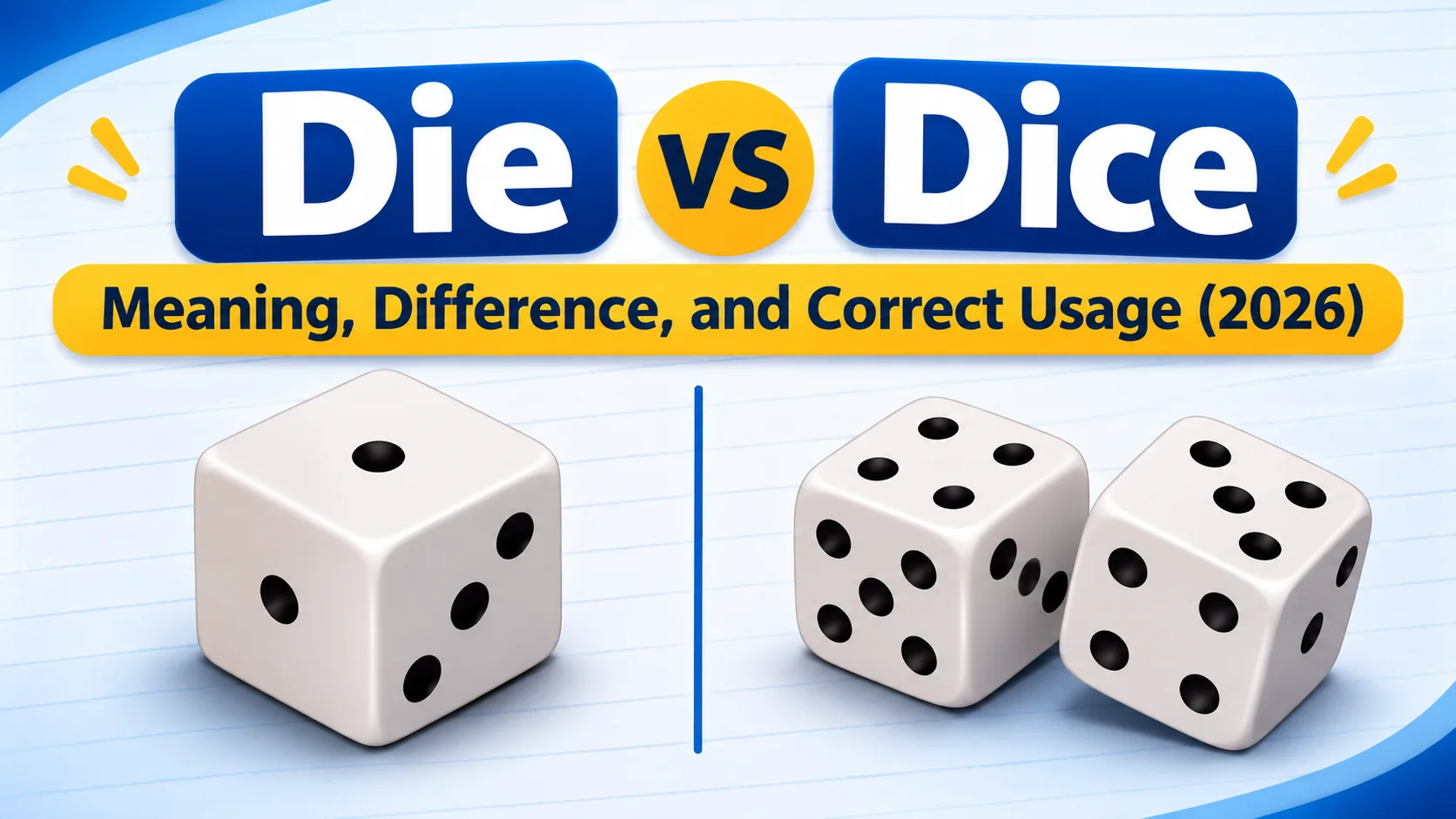
The difference between die vs dice seems simple at first: one refers to a single gaming cube, while the other traditionally refers to more than one. However, modern English makes the distinction slightly more interesting. You may hear someone say “roll a dice” when referring to just one object, even though traditional grammar recommends “roll a die.” Both forms appear in everyday communication, but their acceptability depends on context, writing style, and audience.
The confusion becomes greater because die and dice have meanings beyond board games. Die can describe a specialized manufacturing tool or function as a verb meaning to stop living. Meanwhile, dice can describe the action of cutting food into small cubes. These different grammatical roles can make it difficult to identify the correct word without considering the entire sentence.
This guide explains the meaning of die and dice, their singular and plural forms, and how modern usage differs from traditional grammar. You’ll also learn when “a dice” is acceptable, why “dies” is sometimes correct, how the words appear in probability and cooking, and which expressions use them naturally. By the end, you’ll have practical rules for choosing the right spelling in casual conversations, academic assignments, professional writing, and everyday situations.
Die vs Dice: The Quick Answer
Die is traditionally the singular form of the gaming object, while dice is its plural form.
- Die: One gaming cube.
- Dice: Two or more gaming cubes.
- Dice (modern singular): Also widely used to describe one gaming cube, particularly in informal English.
- Die (verb): To stop living.
- Dice (verb): To cut food or another material into small cubes.
Consider these examples:
- I rolled a die and got a six.
- She rolled two dice and got a total of nine.
- Please dice the carrots before adding them to the soup.
- Some plants die when they do not receive enough water.
The important distinction is that traditional grammar prefers a die for one gaming cube. However, using a dice is not automatically incorrect in contemporary English.
Quick rule: Use a die for one gaming cube and dice for multiple gaming cubes when following traditional grammar. Recognize that singular dice is also established in modern everyday usage.
Die vs Dice: Comparison Table
The following comparison shows how the two words differ in meaning, grammar, and practical usage.
| Feature | Die | Dice |
| Traditional number | Singular | Plural |
| Modern number | Singular | Singular or plural |
| Part of speech | Noun and verb | Noun and verb |
| Gaming meaning | One gaming cube | Multiple gaming cubes, or one in modern usage |
| Other meaning | To stop living; manufacturing tool | To cut into small cubes |
| Past tense | Died (verb meaning to stop living) | Diced (cut into cubes) |
| Present participle | Dying | Dicing |
| Common expression | The die is cast | Roll the dice |
| Example | Roll a die. | Roll the dice. |
One detail is especially important: the plural of a gaming die is dice, but the plural of a manufacturing die is dies. The correct plural therefore depends on which meaning of die you intend.
What Does Die Mean?
The word die has several meanings in English. Its meaning depends on whether it appears as a noun or a verb.
In gaming, a die is a small object used to generate random outcomes. Outside gaming, it can refer to a specialized manufacturing tool. As a verb, it describes the process of losing life or ceasing to exist.
Understanding these meanings prevents confusion when the same spelling appears in completely different situations.
Die as a Singular Noun: One Gaming Cube
In traditional English, a die is one small object used in games of chance. Most familiar dice are six-sided cubes, with each face displaying a number from one to six.
Players roll a die to produce a random result. That result may determine how many spaces a player moves, whether an action succeeds, or what happens next in a game.
For example:
- I need one more die to finish the board game.
- He rolled a die and landed on number four.
- The player picked up the die and rolled again.
- Each participant receives one die at the beginning of the activity.
The singular form is particularly useful in mathematics, probability lessons, traditional board-game instructions, and formal writing.
Why does the distinction matter?
Imagine writing instructions for a probability experiment:
Roll one die 20 times and record the results.
This is precise because the experiment uses one object. If you write roll one dice, readers will probably understand you, but one die follows the traditional singular form.
Other Meanings of Die as a Noun
A gaming cube is not the only object called a die.
In manufacturing, a die is a specialized tool used to cut, shape, stamp, press, or form materials into a particular shape.
These tools are common in industrial processes involving metal, plastic, paper, and other materials.
Examples include:
| Type of die | Purpose |
| Cutting die | Cuts material into a particular shape |
| Stamping die | Presses or forms designs into material |
| Forming die | Shapes material into a required structure |
| Extrusion die | Gives material a specific cross-sectional shape |
| Thread-cutting die | Creates external threads on a cylindrical object |
For example:
The manufacturer designed a new die for producing metal components.
Here, die refers to an industrial tool, not a gaming object.
An important grammatical exception applies to this meaning.
The plural of a manufacturing die is dies, not dice.
Example:
The factory replaced three worn-out dies during maintenance.
This distinction is important in technical writing because the plural changes according to the noun’s meaning.
Die as a Verb: To Stop Living
Die is also a common verb meaning to stop living or cease to exist.
It can describe people, animals, plants, and even things that gradually disappear or lose their effectiveness.
Its main grammatical forms are:
| Verb form | Example |
| Base form: die | Plants die without water. |
| Third-person singular: dies | A flower dies without proper care. |
| Past tense: died | The old tree died last winter. |
| Present participle: dying | The plant is dying. |
| Past participle: died | Several plants have died. |
Notice that dies is correct in this context.
For example:
The flower dies when it receives too much sunlight.
Here, dies is the third-person singular form of the verb die. It has nothing to do with the plural of a gaming cube.
Other examples:
- Some animals die naturally after reaching old age.
- The battery died before I could finish the call.
- The tradition may die out over time.
- The noise gradually died down.
Die in Figurative Expressions
The verb die also appears in expressions where it does not refer to literal death.
These expressions are common in everyday English.
| Expression | Meaning | Example |
| Die down | Become less intense | The argument eventually died down. |
| Die out | Disappear completely | The old tradition began to die out. |
| Die away | Gradually become quieter or weaker | The music slowly died away. |
| Never say die | Never give up | She maintained a never-say-die attitude. |
| Die-hard | Extremely committed or devoted | He is a die-hard cricket fan. |
| The die is cast | A decision has been made and cannot easily be reversed | The die is cast; we cannot change the plan now. |
These expressions should be understood according to their figurative meanings rather than their literal connection to death.
Example Sentences Using Die
Here are additional examples showing the different uses of the word.
- The player rolled a single die to determine the next move.
- We lost one die during the board game.
- The factory purchased a new metal die for its production line.
- The manufacturer replaced several damaged dies.
- Some flowers die quickly without sufficient sunlight.
- The old computer battery finally died.
- The excitement died down after the announcement.
- Many traditional customs gradually die out when younger generations stop practicing them.
What Does Dice Mean?
Dice traditionally refers to two or more gaming cubes used to generate random numbers or outcomes.
It is also used as a singular noun in contemporary English, especially in informal conversation and everyday gaming discussions.
In addition, dice functions as a verb meaning to cut food or another material into small cubes.
These meanings are separate, so the surrounding sentence determines which one is intended.
Dice as a Traditional Plural Noun
Traditionally, dice is the plural form of die.
If someone uses two, three, or more gaming cubes, the correct traditional noun is dice.
Examples:
- I bought a new set of dice for the game.
- The player rolled two dice at the same time.
- All the dice were placed in the center of the table.
- We need four dice for this activity.
The word appears frequently in:
- Board games
- Casino games
- Tabletop role-playing games
- Probability experiments
- Mathematics lessons
- Children’s games
For example:
The teacher gave each student two dice for a probability experiment.
This sentence clearly indicates that every student receives two gaming cubes.
Can Dice Be Singular in Modern English?
Yes. Dice is widely used as a singular noun in modern English, particularly in casual speech.
Although traditional grammar recommends a die for one gaming cube, many English speakers use a dice naturally.
Consider these examples:
- Traditional: I rolled a die.
- Modern informal: I rolled a dice.
- Plural: I rolled two dice.
The singular use of dice has become established enough to appear in ordinary dictionaries and contemporary English usage. It should not automatically be treated as a spelling mistake.
However, there is still a practical distinction between formal and informal writing.
| Situation | Recommended usage |
| Traditional grammar exercises | A die |
| Formal academic writing | A die |
| Mathematical probability problems | A die |
| Everyday conversation | A die or a dice |
| Informal gaming discussions | A die or a dice |
| Plural gaming objects | Dice |
Expert recommendation: If you are writing an educational article, formal assignment, textbook, or technical explanation, use a die for one gaming cube. If you are writing casual dialogue or reproducing natural conversational language, singular dice may be appropriate.
The goal is not to reject modern usage but to understand when traditional precision is useful.
Dice as a Verb: To Cut Food Into Small Cubes
The word dice also functions as a verb, particularly in cooking.
It means to cut food into small, approximately cube-shaped pieces.
This meaning is completely unrelated to rolling gaming cubes, even though the spelling is identical.
For example:
- Dice the onions before adding them to the pan.
- She diced the potatoes into small cubes.
- The chef is dicing fresh vegetables.
- Please dice the tomatoes evenly.
The verb has the following forms:
| Form | Example |
| Base form | Dice the carrots. |
| Third-person singular | He dices the vegetables. |
| Past tense | She diced the onions. |
| Present participle | They are dicing the potatoes. |
| Past participle | The vegetables have been diced. |
What Is the Difference Between Dicing and Chopping?
These cooking terms are related but do not describe exactly the same cutting technique.
- Dicing: Cutting ingredients into relatively uniform cube-shaped pieces.
- Chopping: Cutting ingredients into pieces that may vary in size and shape.
- Mincing: Cutting ingredients into very small pieces, often much smaller than diced pieces.
For example, a recipe asking you to dice an onion generally expects small, reasonably even cubes. A recipe asking you to chop an onion may allow more variation.
The exact size of a dice depends on the recipe. In professional kitchens, specific terms such as small dice, medium dice, and large dice may be used to communicate the intended dimensions.
Dice in Gaming, Probability, and Statistics
Dice are useful not only for entertainment but also for demonstrating basic probability.
A standard fair six-sided die has six possible outcomes:
1, 2, 3, 4, 5, and 6.
If the die is fair, each face has an equal probability of appearing on a single roll.
The probability of rolling a six is therefore:
[
P(6)=\frac{1}{6}
]
This is approximately 16.67%.
When two dice are rolled together, the number of possible ordered outcomes increases to 36.
For example, a total of seven can occur through six combinations:
- 1 + 6
- 2 + 5
- 3 + 4
- 4 + 3
- 5 + 2
- 6 + 1
Therefore:
[
P(\text{total of 7})=\frac{6}{36}=\frac{1}{6}
]
| Probability concept | One die | Two dice |
| Number of faces per die | 6 | 6 each |
| Possible ordered outcomes | 6 | 36 |
| Probability of a six on one specified die | 1/6 | 1/6 for each specified die |
| Probability of a total of seven | Not applicable | 6/36 |
| Probability of all dice showing six | 1/6 | 1/36 |
An important point: rolling two dice does not mean every total is equally likely. A total of seven has six possible combinations, while a total of two has only one.
This makes dice useful for teaching probability distributions and independent events.
Fair Dice vs Loaded Dice
A fair die is designed so that each face has an equal chance of appearing under the intended rolling conditions.
A loaded die has been deliberately altered or weighted to favor particular outcomes.
This distinction matters in probability experiments. If a die is biased, the simple assumption of a one-in-six probability for each face may no longer apply.
Common Expressions and Idioms With Dice
Dice appear in several familiar English expressions.
| Expression | Meaning | Example |
| Roll the dice | Take a risk | Starting a business can feel like rolling the dice. |
| No dice | No success or no agreement | I asked for an extension, but no dice. |
| Load the dice | Unfairly influence an outcome | The rules seemed designed to load the dice against beginners. |
| Dice with death | Take an extremely dangerous risk | Driving recklessly is like dicing with death. |
The expression roll the dice is especially common in business and everyday conversation. It describes making a decision when the outcome is uncertain.
For example:
Accepting the overseas position was a risk, but she decided to roll the dice.
The expression no dice is informal and generally means that an attempt has failed or a request has been rejected.
Die vs Dice: The Main Differences Explained
The most useful way to understand these words is to examine their grammatical number, meaning, and context separately.
Singular vs Plural: Is Die Singular and Dice Plural?
Under traditional English grammar:
- One gaming object = die.
- Two or more gaming objects = dice.
This is an irregular plural pattern, meaning the plural is not created by simply adding -s or -es.
The same general pattern appears in other English words:
- Mouse → Mice
- Louse → Lice
- Goose → Geese
- Die → Dice
However, modern English frequently uses dice as a singular noun.
For that reason, the traditional singular-plural rule is still useful, but it does not describe every way people use the word today.
Can You Say One Dice or a Dice?
Yes, particularly in informal contemporary English.
For example:
Can you pass me a dice?
This is understandable and used by English speakers. However, traditional edited English generally prefers:
Can you pass me a die?
The distinction is mainly one of convention and register rather than a simple division between correct and incorrect English.
If you are completing a grammar examination, writing a mathematics textbook, or preparing formal educational content, choose a die.
In casual conversation, a dice is generally acceptable.
Die vs Dice: Grammatical Differences
The following examples demonstrate how the words change according to their grammatical roles.
| Word | Part of speech | Function | Example |
| Die | Noun | One gaming cube | The die landed on six. |
| Dice | Noun | Multiple gaming cubes | The dice landed on six and two. |
| Dice | Noun | One gaming cube in modern usage | Pass me a dice. |
| Die | Verb | Stop living | Plants die without water. |
| Dice | Verb | Cut into cubes | Dice the potatoes. |
| Dies | Verb | Third-person singular of die | The plant dies in winter. |
| Diced | Verb | Past tense of dice | She diced the vegetables. |
One important writing principle is to avoid identifying a word solely by its spelling. English frequently uses the same written form for different grammatical functions.
Instead, examine the sentence structure and intended meaning.
Die vs Dice: Pronunciation Differences
Unlike some commonly confused English words, die and dice have different pronunciations.
- Die: /daɪ/
- Dice: /daɪs/
The main difference is the final /s/ sound in dice.
Both words begin with the same vowel sound, as in my or sky.
The distinction is useful when speaking, particularly when discussing board games or explaining instructions.
For example:
- Roll the die.
- Roll the dice.
The additional final consonant helps distinguish the plural noun when spoken.
The verb die and the gaming noun die have the same pronunciation. Likewise, the cooking verb dice and gaming noun dice sound identical.
Die vs Dice in American and British English
The traditional singular-plural distinction is recognized in both American and British English.
However, contemporary everyday usage in both varieties includes singular dice.
It is therefore misleading to claim that singular dice belongs exclusively to American English or that British speakers always use die.
The more useful distinction is between traditional edited usage and informal contemporary speech.
For example:
| Context | Preferred form |
| American academic writing | A die |
| British academic writing | A die |
| American casual conversation | A die or a dice |
| British casual conversation | A die or a dice |
| Formal probability explanations | A die |
| Everyday gaming discussion | Either, depending on the speaker |
If you are following a publication’s editorial policy, use its preferred convention consistently.
Die vs Dice vs Died vs Dies vs Diced
These forms can be confusing because they share related spellings but have different grammatical functions.
| Word | Meaning | Example |
| Die | One gaming cube or to stop living | Roll a die. |
| Dice | Plural gaming cubes or to cut into cubes | Roll the dice. |
| Dies | Plural of a manufacturing die or third-person verb form | The plant dies. |
| Died | Past tense of the verb die | The flower died. |
| Diced | Past tense of the cooking verb dice | He diced the carrots. |
| Dicing | Cutting into small cubes | She is dicing onions. |
| Dying | The process of losing life | The plant is dying. |
Notice that dies is not always wrong as a plural. It is wrong as the traditional plural of a gaming die, but correct for manufacturing tools.
Examples:
- The factory ordered several new dies.
- The plant dies without adequate water.
These sentences use the same spelling for entirely different grammatical reasons.
Die vs Dice: Which One Should You Use?
Choosing the correct form becomes easier when you consider the purpose of your writing.
When to Use Die
Use die when:
- Referring to one gaming cube in traditional English.
- Writing formal game instructions.
- Explaining probability involving a single six-sided object.
- Describing a specialized manufacturing tool.
- Using the verb meaning to stop living.
Examples:
- Roll one die and record the result.
- The die has six numbered faces.
- The factory installed a new cutting die.
- Some flowers die during extremely dry conditions.
When to Use Dice
Use dice when:
- Referring to multiple gaming cubes.
- Using the established informal singular form.
- Describing the cooking action of cutting ingredients into cubes.
- Using familiar expressions such as roll the dice.
Examples:
- The children rolled two dice.
- She bought a new set of dice.
- Please dice the potatoes.
- Starting a new career can feel like rolling the dice.
Choosing the Right Word in Different Contexts
This decision table offers a practical reference for common writing situations.
| Writing situation | Best choice | Reason |
| School grammar assignment | A die | Follows traditional grammar |
| Academic probability question | A die | Clear singular usage |
| Casual gaming conversation | A die or a dice | Both are used |
| Formal board-game instructions | A die | More precise traditional form |
| Multiple gaming objects | Dice | Conventional plural |
| Cooking recipe | Dice | Describes cutting into cubes |
| Industrial manufacturing | Die | Specialized tool |
| Multiple manufacturing tools | Dies | Correct technical plural |
Editorial recommendation: Do not force traditional grammar into every conversational situation. However, when clarity and formal precision matter, a die remains the safest choice for one gaming cube.
Common Mistakes to Avoid When Using Die and Dice
Even though the distinction is relatively straightforward, several errors occur regularly.
Using Dice as the Singular Form in Traditional Formal Writing
Incorrect in traditional formal usage:
Roll one dice and write down the result.
Preferred:
Roll one die and write down the result.
The first sentence reflects modern informal usage, but the second follows traditional grammar and is generally preferable in academic instructions.
Using Dies as the Plural of a Gaming Die
Incorrect:
The player rolled three dies.
Correct:
The player rolled three dice.
Remember that dies is the plural of a manufacturing die, not the conventional plural of a gaming die.
Confusing the Noun Die With the Verb Die
Consider:
The die is missing.
Here, die is a noun referring to a gaming object.
Now consider:
Some flowers die without sunlight.
Here, die is a verb describing what happens to the flowers.
The spelling is identical, but the grammatical roles differ.
Confusing Dice With Diced
Incorrect:
Please diced the vegetables before cooking.
Correct:
Please dice the vegetables before cooking.
The first sentence incorrectly uses the past-tense form after the instruction please. The base verb is required.
Another example:
She diced the potatoes yesterday.
Here, diced is correct because the action happened in the past.
Writing Dices as the Plural of Dice
Incorrect:
I bought three dices for the game.
Correct:
I bought three dice for the game.
However, dices can appear as a verb form in a sentence such as:
He dices the vegetables every morning.
The difference is grammatical, not simply a spelling preference.
Mixing Traditional and Modern Usage Without Considering the Audience
Inconsistent wording can make an article or set of instructions feel poorly edited.
For example:
- Roll one die.
- Roll two dices.
- Pick up another dice.
A more consistent version would be:
- Roll one die.
- Roll two dice.
- Pick up another die.
If the intended style uses singular dice, apply that choice consistently instead.
Die vs Dice in Real-Life Examples
Looking at real situations makes the distinction easier to apply.
Board Games and Tabletop Gaming
Board games often involve one or more gaming cubes.
Examples:
- Each player receives one die.
- Roll both dice before moving your game piece.
- The red die landed on five.
- Put all the dice back in the box after playing.
In gaming instructions, using die for one object can make the rules more precise, especially when players must roll a specific number of objects.
Probability and Mathematics
Probability exercises frequently use the singular die because they describe a specific experiment involving one object.
Example:
A fair six-sided die is rolled once. What is the probability of getting an even number?
The possible outcomes are 2, 4, and 6.
Therefore:
[
P(\text{even})=\frac{3}{6}=\frac{1}{2}
]
When two dice are used, the experiment has 36 possible ordered outcomes.
Example:
Two fair six-sided dice are rolled. What is the probability that both show the same number?
There are six matching combinations:
(1,1), (2,2), (3,3), (4,4), (5,5), and (6,6).
Therefore:
[
P(\text{matching numbers})=\frac{6}{36}=\frac{1}{6}
]
These examples show why precise singular and plural terminology is useful in mathematics.
Cooking and Food Preparation
The verb dice appears frequently in recipes.
For example:
Dice one onion and two tomatoes before preparing the sauce.
The instruction means that both ingredients should be cut into small pieces.
Other examples:
- Dice the potatoes into small cubes.
- The chef diced the carrots evenly.
- Dicing the vegetables helps distribute them throughout the dish.
A cooking recipe does not use dice because it involves gaming objects. It uses the verb meaning to cut something into cubes.
Manufacturing, Printing, and Engineering
Technical writing introduces another important distinction.
A manufacturing die is a specialized tool. Its plural is dies.
For example:
The engineer inspected five dies used in the metal-stamping process.
Here, writing five dice would be incorrect because the sentence is not referring to gaming cubes.
This is a good example of why meaning must come before memorizing a spelling rule.
A Simple Memory Trick for Die vs Dice
If you regularly confuse these words, use the following techniques.
Remember the Traditional Singular-Plural Rule
Think of the pattern:
One die, two dice.
You can connect it with other irregular English plurals:
- One mouse, two mice.
- One goose, two geese.
- One die, two dice.
This association makes the traditional pattern easier to remember.
Use the Sentence Replacement Test
When you are unsure which word to use, replace it with a simpler expression.
- If you mean one gaming cube, use one die.
- If you mean multiple gaming cubes, use several dice.
- If you mean cutting something into cubes, use the verb dice.
- If you mean a manufacturing tool, use die or dies, depending on the number.
For example:
The player rolled one ___.
Replacing the blank with one gaming cube shows that the traditional choice is die.
Remember the Modern Singular Exception
Do not assume that every use of a dice is an error.
Modern English allows singular dice in many informal situations. The traditional form remains more appropriate when grammatical precision is important.
The best approach is to understand both forms and select the one that suits your audience.
Conclusion
Understanding die vs dice requires more than memorizing a singular-plural rule. Traditional English uses die for one gaming cube and dice for multiple cubes, while modern conversation also accepts singular dice. Their other meanings make context equally important: die can describe a manufacturing tool or mean to stop living, whereas dice can describe cutting ingredients into cubes. One final actionable tip: Check whether you’re discussing a gaming object, an industrial tool, or an action before choosing the spelling. A common mistake to avoid is assuming that dies is always incorrect; it is the proper plural for manufacturing tools. Choose your wording according to meaning, audience, and formality, and these easily confused words become much simpler to use correctly.
Frequently Asked Questions
Q1. Is die singular and dice plural?
Yes. In traditional English, die is singular and dice is plural when referring to gaming cubes. However, modern English also uses dice as a singular noun, particularly in informal conversation. Both patterns exist, although formal writing generally favors the traditional distinction.
Q2. Is it correct to say a dice?
Yes. A dice is an established modern usage, especially in everyday speech and informal gaming conversations. However, traditional grammar recommends a die when referring to one gaming cube. For academic assignments, formal instructions, and carefully edited writing, the traditional form is preferable.
Q3. What is the plural of die?
The plural depends on the meaning. For a gaming cube, the traditional plural is dice. For a manufacturing tool used in cutting or shaping materials, the plural is dies. Understanding the context is essential because both plural forms are correct in their respective meanings.
Q4. Is dice singular or plural in American and British English?
Dice can be singular or plural in contemporary American and British English. Traditional grammar uses die for one gaming cube and dice for multiple objects. Informal speakers in both varieties may use a dice, so the distinction is not exclusively regional.
Q5. What is the difference between dice and diced?
Dice can be a noun referring to gaming cubes or a verb meaning to cut something into small cubes. Diced is the past tense and past participle of that cooking verb. For example, “Dice the onions” gives an instruction, while “She diced the onions” describes a completed action.
