Counselor and councilor are easy to confuse because they sound nearly identical, but they refer to very different things. One is connected with counsel, advice, and guidance, while the other describes a person who belongs to a council, particularly in local government. The distinction becomes especially important when writing about mental health, education, law, politics, or public administration.
The spelling becomes slightly more complicated because English has regional variants: counselor/counsellor and councilor/councillor. These pairs generally represent spelling differences rather than differences in meaning. Cambridge identifies counselor as the American spelling of counsellor and councilor as the American spelling of councillor.
Understanding the word behind the person is the simplest solution. A mental health or school counselor provides counseling or guidance; a city councilor serves on a council. In this guide, you’ll learn how the terms differ, why counsel and council cause confusion, how British and American spellings work, and how to choose the right word in real sentences.
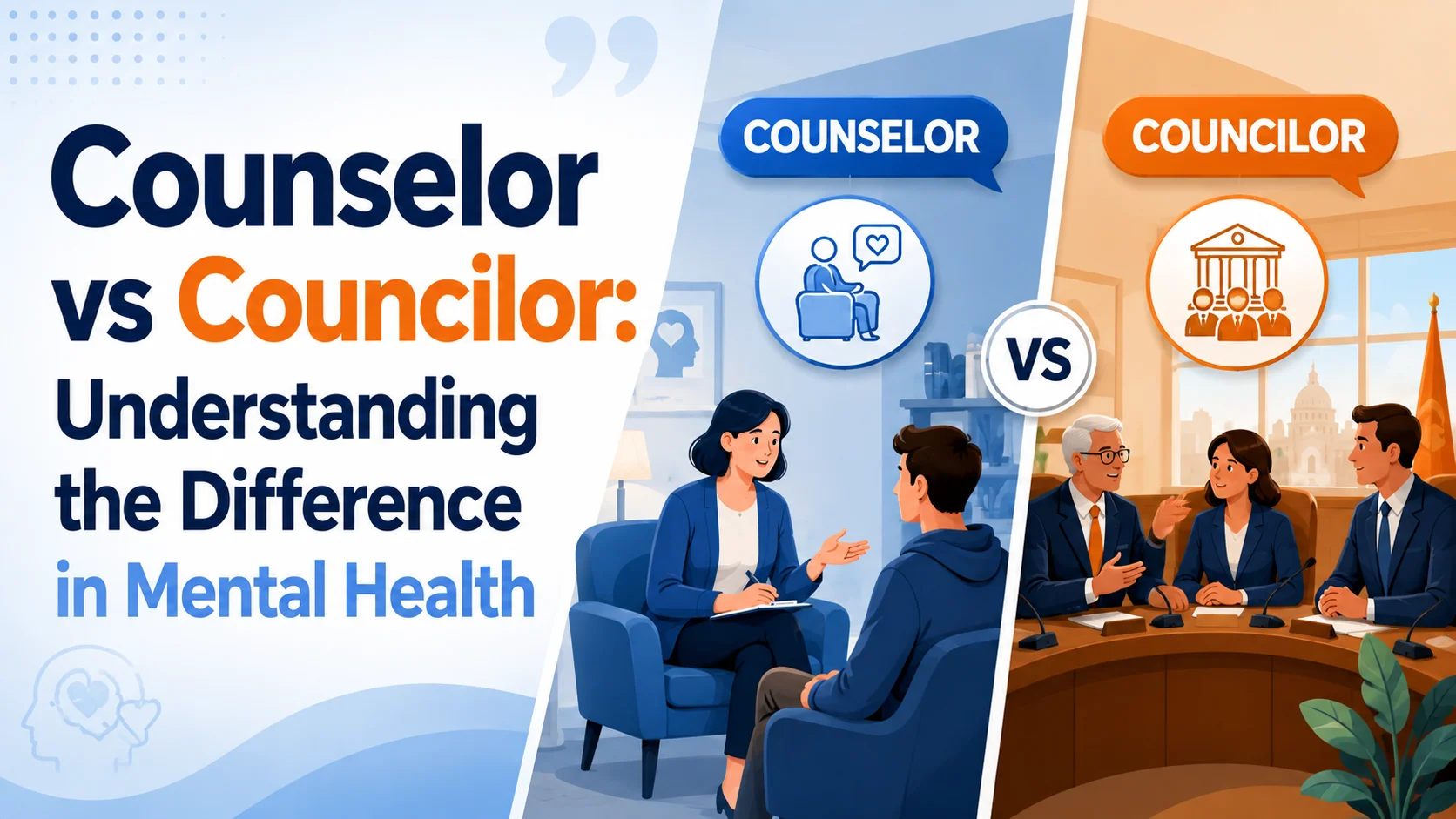
Counselor vs Councilor
The fastest way to remember the distinction is:
Counselor → counsel → advice, guidance, or counseling
Councilor → council → membership in a council
A counselor is generally someone whose role involves giving advice, guidance, assistance, or professional counseling. The term can refer to a mental health professional, school counselor, career counselor, camp counselor, or, in some contexts, a lawyer.
A councilor, by contrast, is a member of a council. In common usage, this especially means an elected member of local government, such as a city or town councilor.
Counselor vs Councilor at a Glance
| Feature | Counselor | Councilor |
| Related word | Counsel | Council |
| Basic meaning | Person who gives advice, guidance, or counseling | Member of a council |
| Common setting | Mental health, education, careers, law, advising | Local government and councils |
| Mental health use | Yes | No, not as a professional title |
| Government use | Sometimes, depending on role | Common |
| American spelling | Counselor | Councilor |
| Common British spelling | Counsellor | Councillor |
| Example | “She spoke with a school counselor.” | “The councilor attended the meeting.” |
The key is not the pronunciation. It is the meaning of the root word.
What Does Counselor Mean?
A counselor is someone whose work involves providing advice, guidance, support, or counseling. The exact meaning depends on the context.
In everyday English, the word can cover several occupations. Cambridge, for example, includes marriage and guidance counselors, camp counselors, and the use of counselor as a form of address for a lawyer.
Counselor as a Person Who Gives Advice or Guidance
The word comes from counsel, which is associated with advice or guidance.
That makes counselor a logical term for someone who helps another person work through a problem, make a decision, develop a plan, or address a particular need.
For example:
- “The career counselor helped Maya explore different fields.”
- “The school counselor spoke with the student.”
- “The counselor helped the family discuss their concerns.”
The word does not automatically mean mental health professional. Context determines what kind of counselor is being discussed.
Counselor in Mental Health
In mental health, a counselor may be a trained professional who provides counseling services for emotional, behavioral, relational, or other concerns.
Professional counseling can encompass individuals, couples, families, groups, and organizations. The American Counseling Association describes professional counseling as work that can address mental health and wellness as well as educational, career, and developmental goals.
Importantly, the precise title, training requirements, licensing rules, and permitted scope of practice can vary by jurisdiction.
That means it is better not to assume that every person using the word counselor has exactly the same qualifications or provides exactly the same services.
Expert tip: When choosing a mental health professional, look beyond the job title. Check the person’s credentials, license or registration where applicable, area of specialization, and scope of practice.
Counselor in Schools, Colleges, and Careers
Counselors also work outside clinical mental health settings.
A school counselor may help students with academic planning, educational decisions, personal concerns, or future goals. A career counselor may help someone evaluate career options, identify goals, or plan education and employment pathways.
Examples include:
- “Ask the school counselor about your course options.”
- “A career counselor can help you evaluate different career paths.”
- “The college counselor explained the application process.”
These uses all connect to counsel, not council.
Counselor in Law and Other Professional Contexts
The word counselor can also appear in legal contexts.
A lawyer may be addressed as counselor, particularly in American legal usage. Cambridge specifically lists counselor as a form of address for a lawyer.
This is why phrases such as legal counsel and counselor-at-law can appear in legal writing.
The important point is that a lawyer called counselor is still connected with counsel. The word does not imply membership in a government council.
What Does Councilor Mean?
A councilor is a person who serves on a council.
The term is commonly used for an elected member of local government. Cambridge defines councilor as an elected member of local government and notes councillor as the UK form.
For example:
“The councilor attended a meeting with local residents.”
Here, the person is not providing counseling. The person is serving as a member of a council.
What Does a Councilor Do?
The precise responsibilities depend on the government system, but a local councilor may participate in matters such as:
- local policies and regulations
- council meetings
- public services
- community concerns
- budgets and spending decisions
- planning and development
- committees
- representing constituents
A councilor’s job is therefore connected with governance and representation, not with the counseling profession.
Councilor vs Other Government Officials
A councilor should not automatically be treated as interchangeable with every other public official.
A mayor, for example, may have a distinct executive or ceremonial role. A council member is a broader descriptive term that can include a councilor, depending on the jurisdiction. A representative at another level of government may have different responsibilities altogether.
Government terminology varies between countries and political systems, so the exact powers of a councilor should always be understood within the relevant jurisdiction.
Counselor vs Councilor: Side-by-Side Comparison
The difference becomes particularly obvious when you put the two words next to each other.
| Situation | Correct term | Reason |
| Someone provides mental health counseling | Counselor | The role involves counseling |
| Someone advises students about education | Counselor | The person provides guidance |
| Someone helps with career decisions | Counselor | The role involves career counseling |
| A lawyer addressed in court | Counselor | Legal counsel is involved |
| An elected member of a city council | Councilor | The person belongs to a council |
| A local official voting at a council meeting | Councilor | The role is governmental |
| A member of a town council | Councilor | The word derives from council |
The One-Letter Difference That Changes the Meaning
The spelling difference is small, but the underlying words are not.
Counselor contains counsel.
Councilor contains council.
That distinction is more useful than trying to memorize the whole words separately.
If someone is giving counsel, think counselor.
If someone belongs to a council, think councilor.
Counselor, Counsellor, Councilor, and Councillor: Spelling Variations Explained
Four spellings often appear together:
- counselor
- counsellor
- councilor
- councillor
They look confusing because two different word pairs are involved.
Counselor vs Counsellor
- Counselor and counsellor generally have the same meaning.
Counselor is the standard American spelling, while counsellor is common in British English. Cambridge identifies counsellor as mainly UK and counselor as the US spelling.
So:
- American English: school counselor
- British English: school counsellor
Likewise:
- American English: mental health counselor
- British English: mental health counsellor
The extra l does not turn a counselor into a councilor.
Councilor vs Councillor
The second pair is:
- councilor
- councillor
Again, the difference is primarily regional spelling.
Councilor is the common American spelling, while councillor is the standard British form.
For example:
- American English: city councilor
- British English: city councillor
Both refer to a member of a council.
Why the Four Spellings Are Easy to Confuse
The problem becomes easier once you separate the pairs:
Counsel pair
counsel → counselor → counsellor
Council pair
council → councilor → councillor
The doubled l is a spelling convention. The much more important distinction is whether the underlying word is counsel or council.
Counsel vs Council
If you remember only one part of this article, remember this section.
What Does Counsel Mean?
Counsel relates to advice, guidance, or professional advice.
It can function as a noun:
“She sought counsel before making the decision.”
It can also function as a verb:
“The adviser counseled the student.”
That is why someone who provides this kind of guidance can be called a counselor.
What Does Council Mean?
A council is a group or governing body that meets to discuss, advise, administer, or make decisions.
For example:
“The city council approved the proposal.”
A member of that body is a councilor or, in British spelling, a councillor.
Counsel vs Council in Example Sentences
Compare these:
“The counselor helped the student plan her future.”
The person provides guidance.
“The councilor voted on the city’s new proposal.”
The person serves on a council.
One letter separates the spellings, but the root word explains the meaning.
How to Remember Counselor vs Councilor
A simple memory trick works better than memorizing dictionary definitions.
The “Counsel” Memory Trick
Think:
Counsel = advice
Therefore:
Counsel + or = counselor
If someone gives guidance, counseling, or professional advice, counselor is likely the word you need.
The “Council” Memory Trick
Think:
Council = group
Therefore:
Council + or = councilor
If someone is a member of a governing or advisory council, use councilor.
A Simple Two-Question Test
When you’re unsure, ask:
- Is this person giving counsel?
→ Counselor - Is this person serving on a council?
→ Councilor
This test is particularly useful when the two words sound similar in speech.
Counselor vs Councilor in Real-World Contexts
Mental Health Context
Correct:
“She scheduled an appointment with a mental health counselor.”
Incorrect:
“She scheduled an appointment with a mental health councilor.”
The first refers to a professional counseling role.
Professional counseling can involve mental health, wellness, development, assessment, treatment planning, and other services within the practitioner’s training and legal scope. The American Counseling Association’s professional materials emphasize that counselors should accurately represent their qualifications and credentials.
School and Career Context
Correct:
“The school counselor helped students consider their options.”
Here, the person is providing educational or personal guidance.
Government Context
Correct:
“The councilor represented residents at the meeting.”
Here, the individual belongs to a council.
Legal Context
Correct:
“The attorney was addressed as counselor.”
This is a legal use of counselor, not councilor. Cambridge specifically recognizes the legal use of counselor as a form of address for a lawyer.
Workplace and Advisory Context
A person who provides specialized advice may also be described as a counselor depending on the established job title.
For example:
“The employment counselor helped the applicant identify suitable career options.”
The common thread is guidance, not government.
Common Mistakes With Counselor and Councilor
Using Councilor for a Mental Health Professional
This is one of the clearest errors.
❌ “He spoke with a councilor about his anxiety.”
✅ “He spoke with a counselor about his anxiety.”
The mental health role is connected with counseling and counsel.
Using Counselor for an Elected Council Member
The reverse mistake is equally common.
❌ “The counselor voted on the city budget.”
✅ “The councilor voted on the city budget.”
The person is participating in a council, so councilor is appropriate.
Assuming Counselor Always Means Therapist
This is an important nuance.
A counselor may work in mental health, but the word itself is broader. School counselors, career counselors, camp counselors, and other professionals may use the title.
Even within mental health, professional titles and scopes of practice can differ by jurisdiction. The American Counseling Association recognizes multiple counseling specialties, including career, college, community, couple and family, mental health, and rehabilitation counseling.
Confusing British and American Spellings
Don’t treat these as four unrelated words.
| American English | British English | Meaning |
| counselor | counsellor | Person who provides counseling or advice |
| councilor | councillor | Member of a council |
The extra l does not change the underlying role.
Choosing the Word by Sound Alone
Pronunciation won’t reliably solve the problem because the words can sound extremely similar.
Instead, identify the noun hidden inside the word:
- counsel → counselor
- council → councilor
That approach is faster and more reliable.
Counselor vs Therapist
The terms overlap in some mental health contexts, but they should not automatically be treated as synonyms.
What a Counselor Does
A professional counselor may provide counseling for emotional, behavioral, developmental, relationship, educational, career, or mental health concerns, depending on their training and legal scope.
The American Counseling Association’s description of professional counseling encompasses mental health and wellness as well as social, career, and emotional development.
What a Therapist Does
Therapist is a broader professional term that can refer to different types of practitioners depending on the context.
For someone seeking mental health care, the important question is not simply whether the person is called a counselor or therapist. Their education, license, specialization, experience, and scope of practice matter more.
Can a Counselor Also Be a Therapist?
Sometimes, yes, depending on the professional’s qualifications and jurisdiction.
However, don’t assume that every counselor is a therapist or that every therapist has the same training. Titles can overlap, while professional requirements differ.
When Does Someone Need a Counselor?
People seek counseling for many different reasons, and there is no single situation that defines when counseling is appropriate.
Situations Where Counseling May Be Helpful
Depending on the counselor’s specialty, people may seek support with:
- stressful life changes
- relationship difficulties
- grief and adjustment
- academic concerns
- career decisions
- emotional difficulties
- behavioral concerns
- family issues
- personal development
- mental health concerns
For serious or urgent mental health concerns, the appropriate professional or service may differ. A counselor can help within their scope, while some situations may require another qualified healthcare professional or urgent support.
Choosing the Right Type of Counselor
Before making an appointment, consider:
- What problem do I want help with?
- Does this professional specialize in that area?
- What qualifications or license do they hold?
- What age groups or populations do they work with?
- What type of counseling do they provide?
- Is their practice within the relevant jurisdiction and professional rules?
This is more useful than choosing someone solely because their job title contains the word counselor.
How to Use Counselor and Councilor Correctly in a Sentence
Correct Examples With Counselor
- “The counselor helped the student choose courses.”
- “She spoke with a mental health counselor.”
- “The career counselor reviewed his options.”
- “The attorney was addressed as counselor.”
- “The camp counselor supervised the children.”
Correct Examples With Councilor
- “The councilor attended the public meeting.”
- “The city councilor responded to residents’ concerns.”
- “The councilor voted on the proposal.”
- “Several councilors joined the committee.”
- “The town councilor discussed the new policy.”
Incorrect vs Correct Sentences
| Incorrect | Correct | Why |
| “She visited a councilor for counseling.” | “She visited a counselor for counseling.” | Counseling relates to counsel. |
| “The counselor voted at the city council meeting.” | “The councilor voted at the city council meeting.” | A council member is a councilor. |
| “The school councillor helped him choose a career.” | “The school counsellor helped him choose a career.” | In British spelling, counselling uses counsellor. |
| “The city counsellor voted on the proposal.” | “The city councillor voted on the proposal.” | In British spelling, a council member is a councillor. |
Counselor vs Councilor Across American and British English
American English
American English generally uses:
- counselor
- councilor
Examples:
“She is a school counselor.”
“He was elected city councilor.”
British English
British English commonly uses:
- counsellor
- councillor
Examples:
“She is a school counsellor.”
“He was elected city councillor.”
Cambridge explicitly identifies counsellor as mainly UK and councillor as the UK equivalent of American councilor.
Canadian, Australian, and Other English Varieties
English spelling conventions can vary beyond the simple American-versus-British distinction. When writing for a particular country, follow the spelling standard used by that audience, institution, publication, or style guide.
The important thing is to preserve the semantic distinction:
counsel → counselor/counsellor
council → councilor/councillor
Quick Guide: Which Word Should You Use?
Use “Counselor” When…
Choose counselor when the person:
- provides counseling
- gives professional guidance
- helps students with educational decisions
- provides career guidance
- works in a counseling role
- is addressed as legal counsel in an appropriate context
Use “Councilor” When…
Choose councilor when the person:
- belongs to a council
- is an elected local-government member
- participates in council decisions
- represents constituents on a council
- serves on a city, town, or similar council
Use “Counsellor” or “Councillor” When…
Use the doubled-l forms when they match the spelling convention of the variety of English you’re writing.
The choice is therefore not:
“Which spelling looks better?”
It is:
“Am I talking about counsel or a council?”
Conclusion
The difference between counselor and councilor becomes simple once you stop focusing on how the words sound. A counselor is connected with counsel—advice, guidance, or counseling. A counsellor is connected with a council—a person who serves as a member of a governing or advisory body. The British spellings, counsellor and councillor, follow the same distinction. One final actionable tip: when proofreading, replace the confusing word mentally with its root: counsel or council. If the sentence is about advice or support, choose counselor; if it is about membership in a council, choose councilor. A common mistake to avoid is assuming that every counselor works in mental health or that spelling variations create different professions. The context, qualifications, and underlying root word tell you far more than pronunciation alone.
Frequently Asked Questions
Q1. What is the main difference between a counselor and a councilor?
A counselor provides advice, guidance, or counseling, while a counsellor is a member of a council, commonly a local-government body. The easiest memory aid is counsel → counselor and council → councilor. Their similar pronunciation is what makes the words easy to confuse.
Q2. Is a counselor the same as a therapist?
Not necessarily. Counselor and therapist can overlap in mental health settings, but they are not automatically interchangeable titles. A professional’s education, credentials, licensing requirements, specialty, and scope of practice provide more useful information than the title alone.
Q3. Is a councilor a government official?
Usually, councilor refers to someone who serves on a council, particularly an elected member of local government. Exact responsibilities vary by jurisdiction. A councilor may participate in meetings, committees, policy decisions, budgeting, and constituent representation.
Q4. Is a lawyer called a counselor or councilor?
A lawyer can be addressed as counselor in certain legal contexts, particularly in American English. Councilor is not the correct word simply because the person is a lawyer. The legal use comes from counsel, meaning legal advice or representation.
Q5. What is the difference between counselor and counsellor?
There is generally no difference in meaning between counselor and counsellor. Counselor is the usual American spelling, while counsellor is common in British English. The same regional pattern applies to councillors and councillors.
