
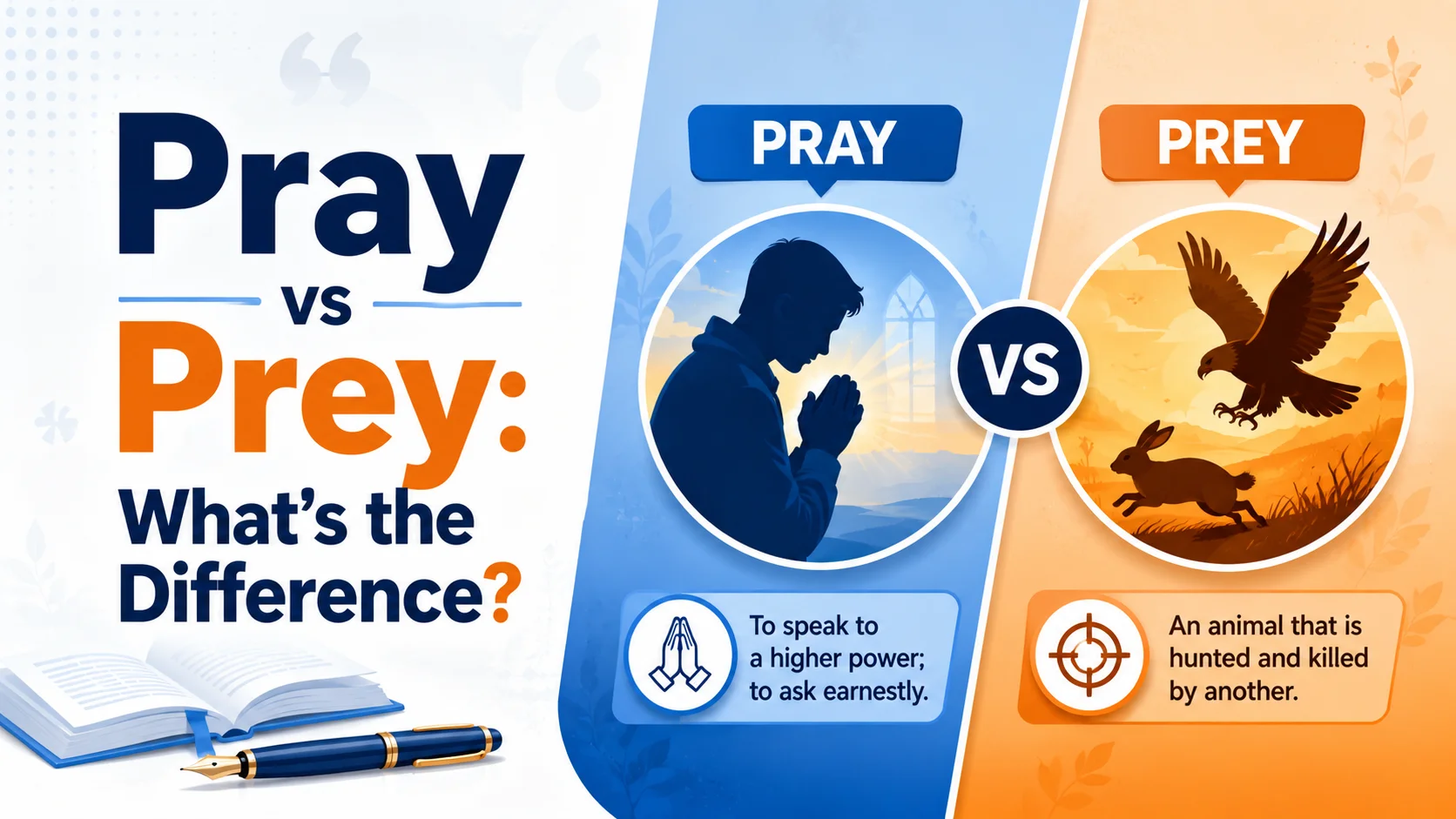
Pray vs. prey is a classic English word pair that can cause trouble because the two words are pronounced the same in standard English but have completely different meanings. Pray is connected with prayer, religious worship, earnest requests, and strong hopes, while prey refers to something hunted or targeted, or to the act of hunting or exploiting something or someone.
The confusion becomes especially noticeable in writing because both spellings are legitimate English words. A spell-checker may therefore accept a sentence even when the wrong word has been chosen. Understanding the meaning, grammar, and common word patterns is much more reliable than trying to distinguish the words by sound. This is particularly important with expressions such as pray for, pray to, prey on, and fall prey to.
By the end of this guide, you will know exactly when to use pray and when to use prey, how their verb forms work, why praying mantis is spelled with praying, and how to recognize the correct word from context. You will also see practical examples, common mistakes, useful memory tricks, and a quick decision rule you can apply whenever these homophones create doubt.
Pray vs. Prey at a Glance
The easiest way to separate these words is to focus on what each one is about.
| Word | Part of speech | Core meaning | Common patterns | Example |
| pray | Verb; also an old/formal adverbial use | To speak to God, make a religious appeal, or hope/ask earnestly | pray for, pray to, pray that | “They pray for peace.” |
| prey | Noun and verb | Something hunted or targeted; to hunt or exploit | prey on, prey upon, fall prey to | “The hawk caught its prey.” |
The one-line difference
Pray has to do with prayer, worship, earnest requests, or strong hope.
Prey has to do with hunting, predators, targets, victims, or exploitation.
A useful shortcut is:
Pray → prayer
Prey → predator
That association will solve most spelling questions immediately.
What Does Pray Mean?
Pray is primarily a verb. Its best-known meaning is to speak to God or another deity, either privately or as part of a religious practice. It can involve asking for something, expressing thanks, showing devotion, or seeking guidance. Cambridge gives the pronunciation as /preɪ/ and also recognizes a broader sense meaning to hope for something very strongly.
Pray as a religious verb
The most familiar use occurs in religious contexts.
- “They pray every morning.”
- “She prayed for her family.”
- “The congregation gathered to pray.”
- “He prayed to God for guidance.”
Notice that the word does not necessarily imply that a person is asking for something. Prayer can include thanks, praise, confession, worship, or requests.
Pray as an earnest request or hope
English also uses prayer more broadly to express a very strong hope.
- “I pray that everything works out.”
- “We are praying for good weather.”
- “She prayed that her brother would arrive safely.”
In everyday modern English, hope is often more natural when there is no religious context. Saying “I’m praying for good weather” can nevertheless communicate a particularly strong hope.
Pray in formal or old-fashioned expressions
You may encounter pray in older literature or deliberately formal language.
For example:
- “Pray tell me what happened.”
- “I pray you, reconsider.”
Here, pray can function as a formal or old-fashioned way of saying please or I ask you. Cambridge specifically labels this use as old or formal.
That distinction matters when editing modern writing: the construction can be grammatically correct while still sounding unusually literary.
Is pray a noun?
In contemporary standard English, pray is normally a verb, not the noun for an act or set of words directed to God. The noun you usually want is prayer.
- Verb: “They pray every evening.”
- Noun: “They said a prayer.”
This is a useful word-family distinction to remember.
What Does Prey Mean?
Prey works as both a noun and a verb, and its meanings are connected to hunting and targeting.
As a noun, prey traditionally refers to an animal hunted by another animal for food. It can also describe a person or group that is especially vulnerable to deception, harm, or exploitation.
Prey as a noun: an animal that is hunted
This is the classic meaning of wildlife.
- “The eagle spotted its prey.”
- “The spider waited for its prey.”
- “Small fish can become prey for larger fish.”
The word describes the target of predation, while predator describes the animal doing the hunting.
That gives you an especially useful semantic pair:
predator → hunts → prey
Prey as a noun
The word can also be used figuratively.
- “Scammers often look for easy prey.”
- “The dishonest seller saw inexperienced customers as potential prey.”
- “The company became prey to a much larger competitor.”
This sense is not limited to individuals. English can use prey for groups, organizations, or even companies that are vulnerable to stronger forces. Cambridge also records a business sense involving a company that another, larger company wants to buy or control.
Prey as a verb: to hunt
As a verb, prey means to hunt and feed on another creature.
- “Owls prey on small mammals.”
- “The spider preys on insects.”
- “Some birds prey upon fish.”
The construction prey on is especially common.
Prey as a verb: to exploit
The figurative meaning is equally important.
- “Fraudsters prey on people’s fears.”
- “Some advertisers prey on insecurity.”
- “Scammers may prey upon people who are unfamiliar with online fraud.”
In this construction, prey on means to take unfair advantage of someone or something, especially a weakness or vulnerability.
Pray vs. Prey
The main reason these words are easy to confuse is simple: they are homophones in standard varieties of English.
Both are generally pronounced /preɪ/. Cambridge lists that pronunciation for both pray and prey.
That means you cannot reliably choose the spelling by listening.
Consider:
“I ___ for your success.”
If you only hear the sentence, the missing word could sound like either spelling. Once you understand the meaning, however, the answer is obvious:
“I pray for your success.”
Compare:
“The eagle ___ on smaller birds.”
Now the context tells you that the word is:
“The eagle preys on smaller birds.”
This is why context is more useful than pronunciation when distinguishing these words in writing.
How to Use Pray in a Sentence
The surrounding grammar often gives you a strong clue.
Pray for someone or something
Pray for + noun/pronoun is one of the most common patterns.
- “Please pray for the affected families.”
- “They prayed for peace.”
- “We are praying for his safe return.”
The object after for is the person, situation, or outcome being prayed for.
Pray to someone or a deity
Use pray to when identifying the recipient of the prayer.
- “She prayed to God.”
- “He prayed to the deity in the temple.”
This is different from pray for:
- pray to God → identifies whom the prayer is addressed to.
- pray for peace → identifies what is being requested or hoped for.
Pray that + clause
You can use “pray” before a complete clause.
- “I pray that you are safe.”
- “They prayed that the storm would pass.”
- “She is praying that everything goes well.”
This construction can express either religious prayer or an extremely strong hope.
Pray tell
Pray tell is an established expression meaning something like “please tell me” or, depending on tone, “do tell me.”
- “Pray tell, what happened next?”
It is not normally the phrasing you would choose for a casual modern conversation. It can sound formal, theatrical, humorous, or deliberately old-fashioned.
How to Use Prey in a Sentence
The most useful thing to remember about prey is its relationship with on/upon.
Prey on an animal
- “The snake preys on mice.”
- “The hawk preys on smaller birds.”
- “These fish prey on insects.”
Here, prey describes a predator hunting another creature.
Prey on a person
The same construction can be figurative.
- “The scammer preyed on people’s fears.”
- “The organization was accused of preying on vulnerable customers.”
In these sentences, nobody is literally being hunted. The meaning is exploiting a weakness or vulnerability. Cambridge distinguishes this figurative sense from the literal hunting sense.
Prey upon
Prey upon means essentially the same thing as prey on.
- “The fox preys upon smaller animals.”
- “Fraudsters prey upon vulnerable people.”
Fall prey to
Another important expression is fall prey to.
- “Many inexperienced users fall prey to online scams.”
- “The business fell prey to poor management.”
- “The species may fall prey to larger predators.”
Here, the subject is the target or victim, rather than the one doing the hunting.
Pray vs. Prey
| Expression | Meaning | Example |
| pray for | Ask through prayer; strongly hope for | “We pray for peace.” |
| pray to | Address a deity in prayer | “She prayed to God.” |
| pray that | Strongly hope or ask that something happens | “I pray that you are safe.” |
| prey on | Hunt or exploit | “Wolves prey on deer.” |
| prey upon | Hunt or exploit | “Scammers prey upon vulnerable people.” |
| fall prey to | Become a victim or target | “He fell prey to a scam.” |
| easy prey | An easily targeted victim | “The weak animal became easy prey.” |
A particularly useful contrast
Compare these two sentences:
“They pray for vulnerable people.”
and
“They prey on vulnerable people.”
The difference is enormous.
In the first, the people are the subject of someone’s prayers.
In the second, the people are being exploited or targeted.
A single letter changes the meaning completely.
Praying vs. Preying
Adding -ing does not make the distinction disappear.
What does praying mean?
Praying is the present participle of prayer.
- “She is praying.”
- “They are praying for rain.”
- “He spent the morning praying.”
Cambridge identifies praying as the present participle of prayer.
What does preying mean?
Preying is the present participle of prey.
- “The hawk is preying on smaller birds.”
- “The insects were preying on the plants.”
- “The scammers were preying on vulnerable customers.”
The meaning remains tied to hunting or exploitation.
Praying vs. preying: the easiest test
Ask what the subject is doing.
- praying → engaging in prayer or expressing a strong hope/request.
- preying → hunting, targeting, or exploiting.
Compare:
“The family is praying for good news.”
with:
“The predator is preying on weaker animals.”
The different prepositions reinforce the difference, but the meanings themselves are what determine the spelling.
Is It “Praying Mantis” or “Preying Mantis”?
The standard common name is praying mantis, not praying mantis.
The spelling often confuses learners because a mantis is a predator and does, in fact, hunt other insects. However, the name praying mantis refers to the insect’s characteristic posture, in which its front legs can appear to be held in a prayer-like position.
So:
- praying mantis → the name of the insect
- preying on insects → describing its hunting behavior
These are two different uses of the two words.
This is an excellent example of why you cannot choose a word merely because its meaning seems logically related to the surrounding subject. A mantis may prey on other insects, but the insect’s name is praying mantis.
Common Mistakes With Pray and Prey
Mistake 1: “I pray that…”
Incorrect: “I pray that everything goes well.”
Correct: “I pray that everything goes well.”
The sentence expresses a strong hope or appeal, so pray is required.
Mistake 2: “The lion prays on…”
Incorrect: “The lion prays on smaller animals.”
Correct: “The lion preys on smaller animals.”
The lion is hunting, so prey is the correct word.
Mistake 3: “Preying mantis”
Incorrect: “I saw a praying mantis.”
Correct: “I saw a praying mantis.”
The insect’s established name uses praying.
Mistake 4: “Prey for” when you mean prayer
If you mean that someone is asking God for something, use pray for:
“Please pray for the families affected.”
Do not replace it with prey simply because the words sound identical.
Mistake 5: Trusting spell-check too much
This is one of the most important practical lessons.
A spell-checker may flag a misspelled word such as prayy, but it may not flag prey in a sentence where you intended to pray. Both are real words.
That means contextual proofreading matters:
Don’t ask only, “Is this word spelled correctly?”
Ask, “Does this word mean what I intend?”
Pray vs. Prey
| Feature | Pray | Prey |
| Main grammatical role | Verb | Noun and verb |
| Pronunciation | /preɪ/ | /preɪ/ |
| Main idea | Prayer, appeal, strong hope | Hunting, target, victim, exploitation |
| Common preposition | for, to | on, upon |
| Present participle | praying | preying |
| Past tense | prayed | preyed |
| Related noun | prayer | prey |
| Common association | religion, worship, hope | predator, hunting, vulnerability |
| Example | “They prayed for peace.” | “The hawk caught its prey.” |
Their word families are different
The family around pray includes:
- pray
- prayed
- praying
- prayer
The family around prey includes:
- prey
- preyed
- preying
- predator
- predation
These associations provide useful semantic clues when editing your writing.
Past Tense
Both words form their past tense by adding -ed, but the spelling remains distinct.
Pray → prayed
- “She prayed for her family.”
- “They prayed that the weather would improve.”
Prey → preyed
- “The hawk preyed on smaller birds.”
- “The scammers preyed on vulnerable customers.”
The forms prayed and preyed are also pronounced alike in ordinary English, so the same context-based approach is necessary when writing them.
Common Expressions With Pray
Here are the most useful combinations to recognize:
Pray for
To ask through prayer or express a strong hope.
“We pray for peace.”
Pray to
To address God or another deity.
“They prayed to God for guidance.”
Pray that
To express a strong hope or request.
“I pray that she is safe.”
Hope and pray
A common expression emphasizing a strong hope.
“We hope and pray that everything works out.”
Pray tell
A formal, literary, or sometimes humorous way of saying “please tell.”
“Pray tell, what happened?”
Cambridge recognizes both the religious meanings of prayer and its broader use for strong hope, as well as the old/formal pray tell construction.
Common Expressions With Prey
Prey on
To hunt or exploit.
“The owl preys on small animals.”
Prey upon
A variant of prey on.
“Some criminals prey upon vulnerable people.”
Fall prey to
To become a victim or target.
“Several businesses fell prey to the scheme.”
Easy prey
Someone or something considered easy to target.
“The isolated animal became easy prey.”
Bird of prey
A common term for a hunting bird, such as an eagle, hawk, or owl.
These expressions make prey especially recognizable in nature writing, journalism, business writing, and discussions of fraud or exploitation. Cambridge lists expressions including easy prey, fall prey to, and prey on/upon.
How to Remember the Difference Between Pray and Prey
If you regularly confuse these words, don’t memorize a complicated rule. Use associations.
1. Think “prayer” when you see pray
The spelling pray is closely connected to prayer.
pray → prayer → worship/request
2. Think “predator” when you see prey
A predator hunts prey.
predator → prey → hunting
3. Memorize the two strongest phrases
pray for
prey on
These two patterns cover a large proportion of everyday uses.
4. Use the five-second decision rule
Ask:
Is someone praying, worshipping, hoping, or making an earnest request?
→ Use pray.
Is something being hunted, targeted, harmed, or exploited?
→ Use prey.
This is more reliable than trying to remember how the words sound because their pronunciation does not distinguish them.
Pray vs. Prey in Real-World Contexts
Religious writing
“The community gathered to pray for the victims.”
The context is prayer, so pray is correct.
Wildlife writing
“The owl preys on rodents.”
The context is predation, so prey is correct.
News or social commentary
“Scammers often prey on people’s fears.”
Here, prey is figurative: the scammers exploit vulnerability.
Personal writing
“I pray that everything goes well.”
Here, prayer expresses a strong hope or appeal.
Literature
“Pray tell, what do you mean?”
Here, prayer is a formal or old-fashioned request for information.
The lesson is simple: the subject matter determines the spelling.
Quick Practice
Try these before checking the answers.
- We ___ for the safety of everyone involved.
- The eagle spotted its ___ from above.
- Some dishonest people ___ on vulnerable customers.
- She ___ that her family would remain safe.
- The lion ___ on weaker animals.
- The correct insect name is ___ mantis.
- They ___ to God for guidance.
- Many inexperienced users can fall ___ to online scams.
Answer key
- pray — the sentence refers to prayer.
- prey — the eagle has identified an animal it hunts.
- prey — prey on means exploit or take advantage of.
- prayed — the sentence describes a strong hope or prayer in the past.
- prey — the lion hunts other animals.
- praying — the established name is praying mantis.
- prayed — the subject is addressing God.
- prey — fall prey to become a victim or target.
The important skill is not memorizing eight answers. It is identifying the meaning and grammatical pattern that produced each answer.
A Simple Decision Checklist
When you’re proofreading, use this quick checklist:
- Religion or worship? → pray
- Strong hope or earnest request? → pray
- Speaking to God or a deity? → pray
- Hunting another animal? → prey
- A hunted animal? → prey
- Exploiting someone’s weakness? → prey
- “___ for” meaning religious appeal? → pray for
- “___ on/upon” meaning hunt or exploit? → prey on/upon
- Insect name? → praying mantis
- Past tense of pray? → prayed
- Past tense of prey? → preyed
Expert tip: If both spellings pass your spell-checker, stop looking at spelling and look at meaning. Context is the deciding factor.
Conclusion
The difference between pray and prey becomes much easier once you stop relying on pronunciation. They are generally pronounced alike, but their meanings point in completely different directions. Pray belongs to the world of prayer, worship, earnest requests, and strong hopes; prey belongs to hunting, targets, victims, and exploitation. Their common patterns make the distinction even clearer: pray for, pray to, and pray that contrast with prey on, prey upon, and fall prey to. One final actionable tip: when proofreading, replace the word mentally with its meaning. If you mean prayer, choose pray; if you mean a target or something hunted, choose prey. A common mistake to avoid is trusting spell-check alone, because both words are correctly spelled. When sound cannot help, context is your best spelling guide.
Frequently Asked Questions
Q1. What is the main difference between pray and prey?
Pray relates to prayer, worship, earnest requests, or strong hopes. Prey refers to an animal or person being targeted, hunted, or exploited, or to the act of hunting or exploiting. They are generally pronounced the same, so meaning and context determine the correct spelling.
Q2. Are pray and prey homophones?
Yes. Pray and prey are generally homophones because they share the same pronunciation, /preɪ/, while having different spellings and meanings. This is why listening alone cannot tell you which spelling belongs in a sentence. Written context is especially important when both words are possible.
Q3. Is it pray on or prey on?
The correct expression is prey on when you mean to hunt, target, or exploit. For example, “Wolves prey on deer” describes hunting, while “Scammers prey on vulnerable people” describes exploitation. Pray on is not the standard expression for these meanings.
Q4. Is it praying mantis or praying mantis?
The standard name is praying mantis. The spelling praying refers to the insect’s characteristic posture, which resembles a person holding their hands in prayer. Although a mantis is a predator and can prey on other insects, that fact does not change the established name.
Q5. What is the difference between praying and preying?
Praying is the present participle of prayer and refers to engaging in prayer or expressing a strong hope. Preying is the present participle of prey and refers to hunting or exploiting. For example, people may be praying for help, while predators are preying on other animals.
