
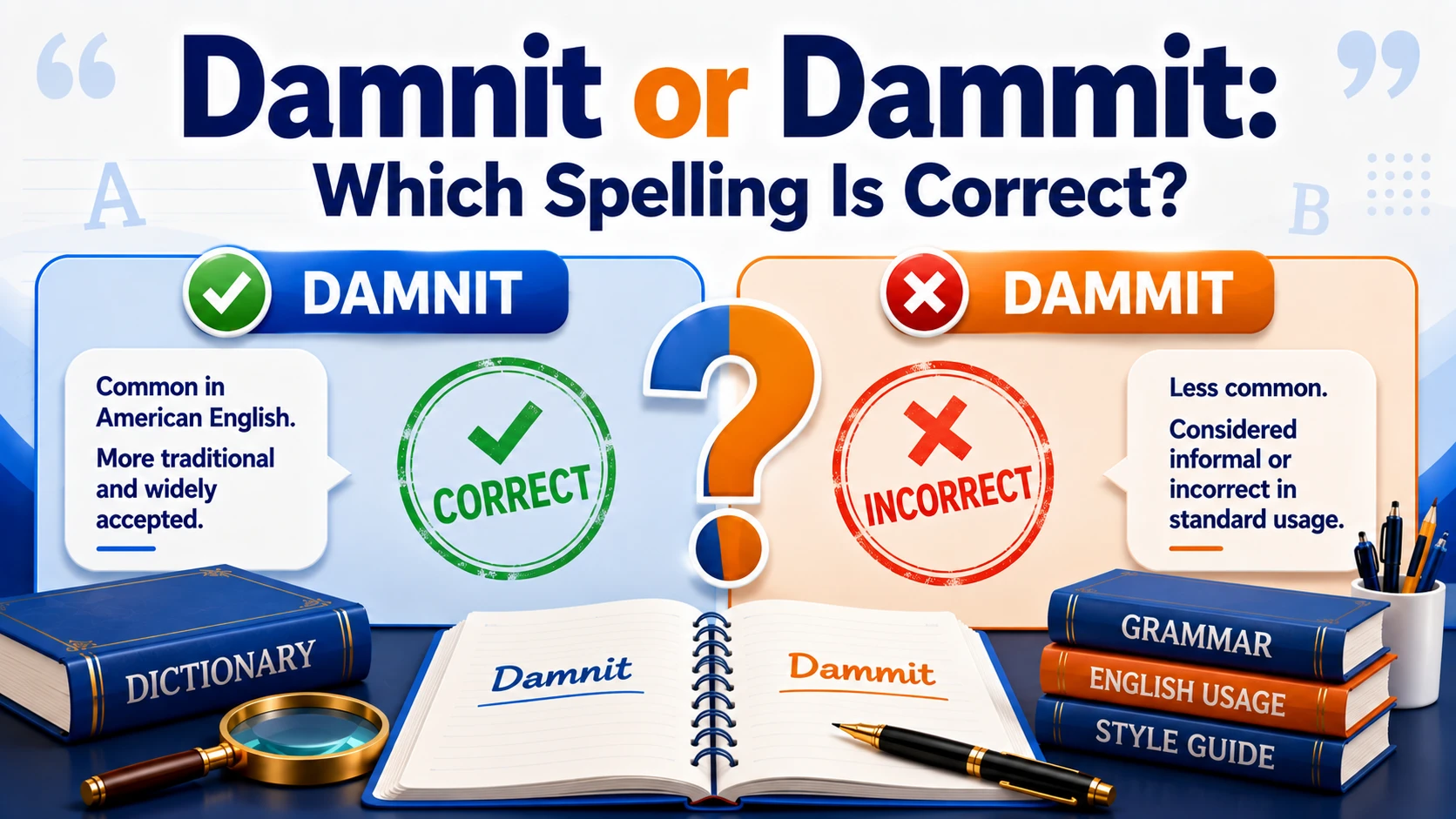
Damnit or dammit can look like a straightforward spelling choice, but both forms appear in informal English, which makes the answer less obvious than it first seems. The key point is that dammit is the dictionary headword for the one-word exclamation, while damnit is also recognized as a very informal variant. Cambridge lists dammit as an exclamation used to express anger or for emphasis and explicitly notes damnit as an alternative form. So if you’re choosing one spelling for careful writing, dammit is the safer conventional choice.
The confusion comes partly from pronunciation. Dammit is pronounced roughly “DAM-it,” so someone writing from sound may naturally produce damnit. There is also a third form to consider: damn it, written as two words. That form is not simply a misspelling of dammit. It is the original two-word expression and remains an established form in English. Cambridge treats damn it alongside dammit in its entry for damn. Understanding this distinction helps you choose the form that fits your sentence and your audience.
There’s another question beyond spelling: Should you use the word at all? Dammit is a very informal expression of anger, annoyance, frustration, or emphasis. Depending on the audience, it may be considered offensive or inappropriate, particularly in professional, academic, or formal settings. Cambridge labels dammit “very informal,” while its entry for damn notes that the expression may be considered offensive by some people. This guide explains the spelling, meaning, pronunciation, grammar, punctuation, register, common mistakes, and practical situations where each form works best.
Damnit or Dammit: Which Spelling Is Correct?
The short answer is dammit if you want the conventional one-word spelling.
However, saying that damnit is simply “wrong” would be too absolute. Cambridge lists damnit as a variant of dammit, so the form is recognizable and attested in informal English.
Here’s the practical distinction:
| Form | Status | Meaning | Best use |
| dammit | Established one-word form | Expression of anger, frustration, or emphasis | Informal writing and dialogue |
| damnit | Recognized very informal variant | Same basic meaning | Informal contexts |
| damn it | Established two-word form | Expression of anger, annoyance, or emphasis | Informal writing and speech |
| damn | Standalone exclamation | Anger, annoyance, surprise, or emphasis | Informal contexts |
If you’re writing an article, email, school assignment, business document, or other carefully edited text, dammit is the better one-word choice when the expression is appropriate at all.
Quick rule: Use dammit for the conventional one-word spelling, damn it for the two-word expression, and recognize damnit as a very informal variant rather than assuming it is a completely different word.
What Does “Dammit” Mean?
Dammit is an interjection used to express a strong emotional reaction. Most often, that reaction is anger, frustration, annoyance, or disappointment.
For example:
“Dammit! I forgot my wallet.”
The speaker isn’t making a statement about the wallet. The word simply communicates the speaker’s emotional response to the mistake.
It can also add emphasis:
“But dammit, I tried.”
Cambridge defines dammit as an exclamation used to express anger and also lists an emphatic use.
Dammit can express different shades of emotion
The precise emotion depends on context and delivery.
Frustration:
“Dammit, the printer stopped working again.”
Disappointment:
“Dammit. I really wanted that position.”
Anger:
“Dammit, leave me alone.”
Emphasis:
“I said I was going to finish it, dammit.”
The same spelling can therefore carry different emotional shades. Punctuation, surrounding words, and the situation tell the reader how strongly the speaker feels.
Is “Damnit” a Correct Spelling?
Damnit is a recognized informal variant of dammit. Cambridge explicitly gives damnit as an alternative form in its dammit entry.
That creates an important distinction between “recognized” and “best choice for careful writing.”
You may encounter:
“Damnit, I forgot the tickets.”
It is understandable and appears in informal English. But if you’re deliberately choosing the conventional dictionary headword, dammit is the better choice.
So these statements are not equally accurate:
- “Damnit is completely meaningless.” — Too strong.
- “Damnit is the preferred spelling everywhere.” — Too strong.
- “Dammit is the conventional one-word spelling, while damnit is a recognized informal variant.” — Accurate and useful.
That nuance matters because English spelling isn’t always divided neatly into “correct” and “incorrect.” Some forms are standard, some are informal variants, and some are simply mistakes.
Why Does “Damnit” Appear So Often?
There’s a simple reason: pronunciation encourages it.
Cambridge gives dammit the pronunciation /ˈdæm.ɪt/ in both British and American English. When people hear the word, they hear something close to dam-it.
That can make damnit seem logical.
A writer may unconsciously think:
damn + it → damnit
The problem is that spelling conventions don’t always follow the most obvious sound-based analysis.
The sound can hide the spelling
Compare:
“Dammit! I missed the bus.”
When spoken quickly, the word is heard as a compact unit. Someone who has never seen it written may reasonably guess damnit.
That is why this spelling appears in texts, comments, messages, and other informal writing.
Online writing reinforces variants
Digital communication is full of rapidly produced language. Text messages, comments, gaming chats, social media posts, and informal forums are rarely edited like published books.
When a variant is understandable, people keep using it.
That doesn’t necessarily mean it has become the preferred spelling. Frequency and editorial standard are not always the same thing.
Where Does “Dammit” Come From?
To understand dammit, start with damn it.
The word damn has several functions in English. As an exclamation, it can express anger or annoyance, and the phrase damn it is used in a similar way. Cambridge identifies damn it alongside dammit in its treatment of damn.
Over time, frequent spoken use can produce compact forms that function almost like single expressions.
That’s what you see with:
damn it → dammit
The one-word form represents the spoken expression as a conventionalized informal interjection.
Don’t interpret “dammit” as “damn + nit”
This is an important spelling point.
The -it portion relates to it. The spelling damnit can tempt readers to see the ending as -nit, but that is not the underlying structure.
The useful relationship is:
damn it → dammit
That connection makes the spelling easier to understand and remember.
Is “Dammit” a Bad Word?
It can be considered mild profanity or an offensive informal expression, depending on the speaker, audience, and cultural setting.
Cambridge labels dammit as very informal. Its entry for damn also notes that the word may be considered offensive by some people.
That means there isn’t one universal reaction.
One person may hear:
“Dammit, I forgot.”
as a mild expression of frustration.
Another person may consider it inappropriate language, especially in a religious, professional, educational, or family setting.
Context changes the impact
The word is more likely to be accepted in:
- Casual conversation
- Informal messages
- Fictional dialogue
- Personal writing
- Some entertainment contexts
It may be inappropriate in:
- Formal business correspondence
- Academic assignments
- Official reports
- Customer-facing communication
- Job applications
- Professional presentations
- Situations where profanity is discouraged
When in doubt, choose a neutral alternative.
Dammit vs. Damn It: Are They the Same?
They are closely related, but the spelling difference is meaningful.
“Damn it” is written as two words
In:
“Damn it, I forgot the keys.”
you have the familiar two-word expression.
Cambridge explicitly lists damn it as an alternative associated with the exclamation damn.
“Dammit” is the one-word form
In:
“Dammit, I forgot the keys.”
the expression is written as one word and functions naturally as an interjection.
The two forms communicate essentially the same emotional reaction.
| Form | Example | Main characteristic |
| damn it | “Damn it, I forgot.” | Two-word expression |
| dammit | “Dammit, I forgot.” | Conventional one-word interjection |
| damnit | “Damnit, I forgot.” | Recognized informal variant |
There is no need to invent a major difference in meaning where none exists. The main distinction is form and usage, not the emotion being expressed.
Is “Dammit” a Contraction?
It’s tempting to call dammit a contraction of damn it, but that description needs a little care.
Traditional contractions in English often use an apostrophe to show omitted letters:
- cannot → can’t
- do not → don’t
- I am → I’m
Dammit doesn’t follow that normal apostrophe pattern.
It is better understood as a fused informal form of the expression “damn it” that functions as an interjection.
That explains why the conventional spelling is:
dammit
not:
damn’it
and not:
damn-it
Why the distinction matters
If you call every shortened expression a contraction, you lose a useful difference between ordinary grammatical contractions and lexicalized informal expressions.
For everyday writing, however, you don’t need a complicated linguistic label. Just remember:
dammit is the established one-word form of the informal exclamation associated with damn it.
How to Use “Dammit” in a Sentence
Because dammit is an interjection, it can appear in several positions.
At the beginning of a sentence
Dammit, I left my phone at home.
The comma separates the introductory interjection from the rest of the sentence.
As a standalone exclamation
Dammit!
This is especially natural when the emotional reaction itself is the complete utterance.
In the middle of a sentence
I tried to warn you, dammit, but you wouldn’t listen.
Here, commas can set off the interjection.
At the end of a sentence
I told you not to touch it, dammit!
The placement adds emotional emphasis.
In dialogue
“Dammit, Sarah, I thought you had the keys.”
This can work naturally in fiction when the character’s emotional state calls for it.
The punctuation should reflect the sentence structure rather than treating dammit as if it requires a special punctuation rule every time.
When Should You Use “Dammit”?
The answer depends heavily on audience and register.
Use it in informal dialogue when the emotion matters
If a character is angry or frustrated, dammit can make dialogue sound more authentic.
“Dammit, we’re going to miss the flight!”
Removing the expression might make the character sound calmer than intended.
Use it in personal communication only when the relationship allows it
A close friend might receive:
“Dammit, I forgot your birthday.”
A professional client probably shouldn’t.
The issue isn’t grammar. It’s tone.
Use it deliberately in creative writing
Writers shouldn’t sprinkle profanity into every emotional sentence. The word works best when it reveals something about the character or raises the emotional temperature.
A normally restrained character saying:
“Dammit!”
may carry more weight than a character who swears constantly.
When Should You Avoid “Dammit”?
Avoid it when the setting calls for neutral, professional, or formal language.
For example, instead of:
“Dammit, the shipment is late again.”
a professional email could say:
“The shipment has been delayed again, and we need an updated delivery date.”
The second sentence communicates the problem without allowing the speaker’s frustration to become the main message.
Situations where a neutral alternative is safer
- Job applications
- Academic essays
- Formal reports
- Business proposals
- Customer support
- Government correspondence
- Professional complaints
- Public announcements
There may be exceptions. A literary analysis, for example, could quote a character saying dammit. A linguistics paper could discuss the word directly.
The important distinction is between using the expression and discussing the expression.
Dammit in Creative Writing
Creative writing has different priorities from formal business writing.
A novelist may intentionally choose dammit because the character is angry, frightened, exhausted, sarcastic, or under pressure.
Consider:
“Dammit, Maya. Just tell me what happened.”
That sentence tells the reader more than the fact that the speaker is annoyed. The word can contribute to characterization, pacing, tension, and voice.
But profanity should have a purpose
Ask:
- Does the word fit the character?
- Does it fit the setting?
- Does it reveal emotion?
- Does it make the dialogue more believable?
- Would removing it weaken the scene?
If the answer is no, leave it out.
A strong writer doesn’t use informal language simply because it exists. The language should serve the scene.
Common Mistakes With Damnit and Dammit
Mistake 1: Saying “damnit” is always wrong
That ignores actual dictionary evidence.
Cambridge lists damnit as an alternative form of dammit.
For careful writing, dammit is still the safer conventional choice, but calling damnit nonexistent is inaccurate.
Mistake 2: Saying “dammit” and “damn it” are unrelated
They are closely connected.
The one-word dammit represents the familiar informal expression associated with damn it.
Mistake 3: Treating “damn it” as a spelling mistake
It isn’t.
Damn it is an established two-word expression. Cambridge includes it with the exclamatory use of damn.
Mistake 4: Using “dammit” in formal writing simply because it is spelled correctly
Correct spelling doesn’t make a word appropriate for every register.
A perfectly spelled informal expression can still be unsuitable for a formal document.
Mistake 5: Assuming the word always expresses anger
Anger is common, but Cambridge also identifies emphasis as a use.
For example:
“It was difficult, but dammit, we finished.”
Here the speaker is emphasizing determination rather than simply shouting in anger.
Dammit vs. Similar Expressions
If your goal is to express frustration without using profanity, English gives you plenty of choices.
| Expression | Strength | Typical tone | Example |
| Oh no | Very mild | Neutral | “Oh no, I forgot the file.” |
| Oh, come on | Mild | Informal | “Oh, come on, that isn’t fair.” |
| Darn it | Mild | Informal | “Darn it, I missed the train.” |
| Dang it | Mild | Informal | “Dang it, the screen froze.” |
| For goodness’ sake | Mild | Informal/neutral | “For goodness’ sake, be careful.” |
| Damn it | Stronger | Very informal | “Damn it, I made a mistake.” |
| Dammit | Stronger | Very informal | “Dammit, I forgot again.” |
Darn it and dang it
These are common euphemistic alternatives. They soften the stronger expression while preserving the emotional function.
Oh, come on
This is useful when the emotion is irritation, disbelief, or disappointment rather than outright anger.
For goodness’ sake
This works better in settings where you want to show frustration without using profanity.
The best alternative depends on how strong you want the reaction to sound.
Damnit or Dammit: Which One Should You Choose?
Here’s a practical decision guide.
| Your situation | Best choice |
| You want the conventional one-word form | dammit |
| You’re writing informal dialogue | dammit or, depending on voice, damnit |
| You want the two-word expression | damn it |
| You’re writing a formal business email | Avoid both |
| You’re writing an academic essay | Usually avoid both unless relevant to the subject |
| You’re writing realistic fiction | Choose based on character and context |
| You’re unsure about the audience | Use a neutral alternative |
The safest rule for careful writing
If the sentence genuinely needs the one-word exclamation, use:
dammit
If you want the two-word form, use:
damn it
If you see damnit, understand that it is a recognized informal variant, but don’t assume it is the best choice for edited prose.
A Quick Reference Guide
Dammit
- Standard one-word form
- Very informal
- Expresses anger, frustration, annoyance, or emphasis
- Common in dialogue and casual writing
- Best conventional choice when the one-word form is appropriate
Damnit
- Recognized informal variant
- Same basic meaning
- Often influenced by pronunciation
- More likely to appear in casual, unedited writing
- Not the safest choice when you want the conventional spelling
Damn it
- Established two-word expression
- Closely related to dammit
- Useful when retaining the separate words matters
- Still informal and potentially offensive
Remember: spelling and register are separate questions. A word can be spelled correctly and still be inappropriate for your audience.
Conclusion
When choosing between damnit or dammit, the most practical answer is dammit. It is the established one-word spelling of the very informal exclamation, while damnit is recognized as an informal variant. Damn it is also legitimate when the expression is written as two words. The bigger lesson, though, is that spelling is only half the decision. Because dammit expresses anger, frustration, annoyance, or emphasis and is considered very informal, your audience and setting matter just as much as the letters on the page. One final actionable tip: if you need the one-word form in careful writing, choose dammit. A common mistake to avoid is treating damnit as either completely invalid or universally interchangeable with every context. In good writing, meaning, spelling, punctuation, and register should all work together.
Frequently Asked Questions
Q1. Is “dammit” or “damnit” correct?
Dammit is the conventional one-word spelling and is the dictionary headword in Cambridge. Damnit is also recognized there as a very informal variant. For careful or edited writing, dammit is the safer choice. Neither form belongs naturally in every formal setting.
Q2. Is “damnit” a real word?
Yes. Damnit is an attested informal variant of dammit, rather than simply a meaningless typo. Cambridge explicitly lists it as an alternative. However, if you want the more conventional one-word spelling, choose dammit.
Q3. Is “dammit” the same as “damn it”?
They express essentially the same emotional reaction, but they differ in form. Dammit is the conventional one-word interjection, while damn it is written as two words. Cambridge connects both forms with the exclamatory use of damn.
Q4. Is “dammit” considered profanity?
Dammit is very informal and may be considered offensive by some audiences. Its acceptability depends on culture, setting, and personal standards. It is generally safer to avoid it in formal professional or academic writing unless you are discussing or quoting the expression itself.
Q5. Why do people spell it “damnit”?
The spelling damnit is easy to produce because dammit is pronounced /ˈdæm.ɪt/, which can encourage people to spell the sound rather than remember the conventional form. Informal online writing also allows variants to circulate without editorial correction.
