
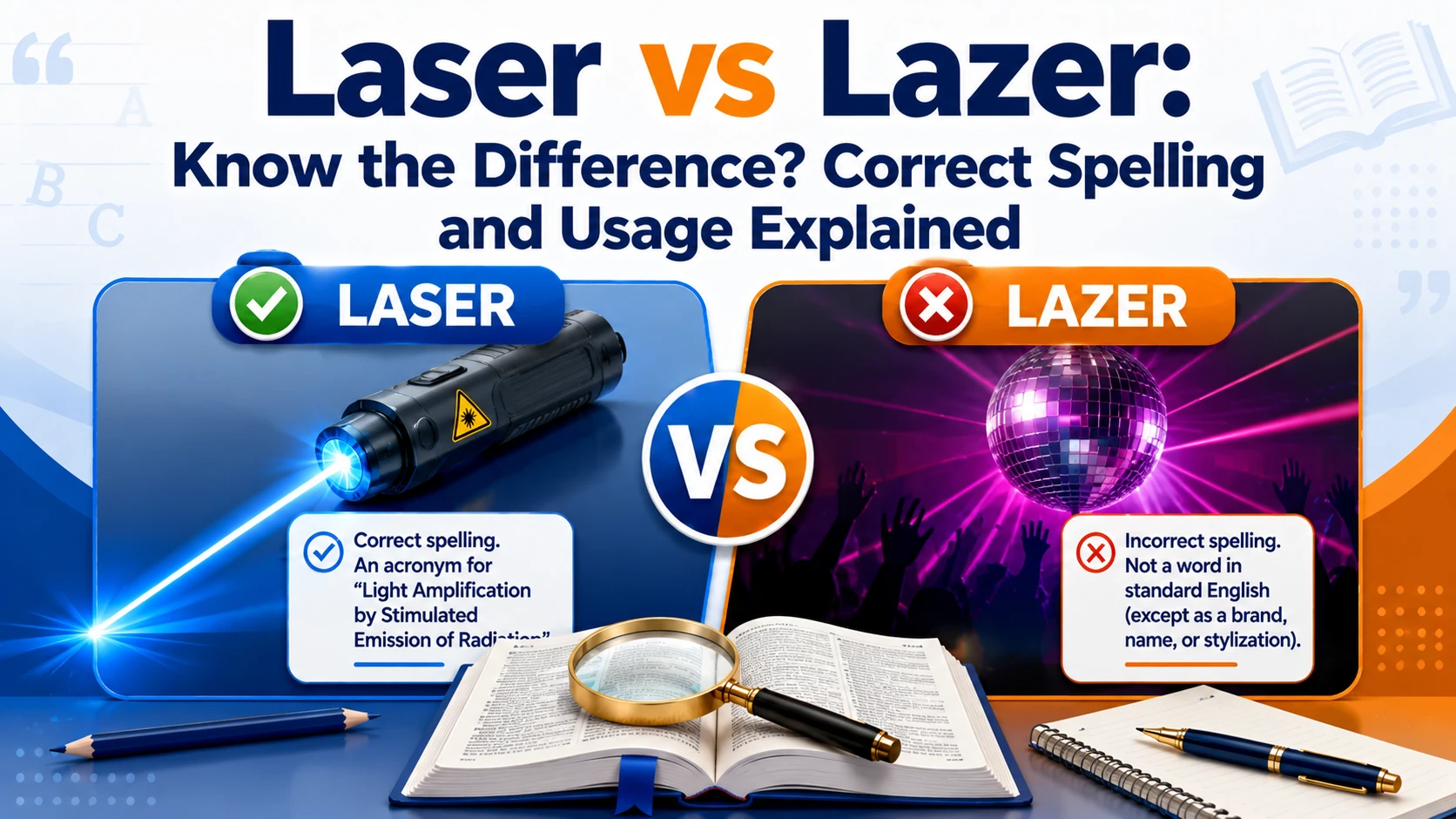
Laser vs Lazer is an easy spelling question to stumble over because both forms are pronounced almost the same. If you hear the word before seeing it written, the z sound can make lazer look perfectly reasonable. However, standard English has one established spelling for the technology: laser. The spelling lazer is generally incorrect when you mean the device, beam, or technology based on stimulated emission. The confusion becomes more interesting when you encounter Lazer in a company name, username, fictional title, or other proper name.
Knowing the distinction matters because laser appears in everything from science and medicine to manufacturing, communications, entertainment, and consumer electronics. A misspelling such as lazer surgery or lazer printer can make otherwise polished writing look careless. At the same time, automatically “correcting” a legitimate name from Lazer to Laser can create a different kind of error. This guide separates those situations clearly.
You’ll learn what laser means, where the spelling comes from, why the Z sound causes confusion, when Lazer can legitimately appear, and which form belongs in academic, professional, medical, and everyday writing. You’ll also see practical examples, comparison tables, common mistakes, and a quick decision rule you can use whenever you’re unsure. The short version is simple: use laser for the technology; preserve Lazer when it is intentionally part of a name.
Laser vs Lazer: Which Spelling Is Correct?
Laser is the standard English spelling for the technology that produces a concentrated, coherent beam of electromagnetic radiation.
Lazer is not the standard alternative spelling. In ordinary English, replacing the s in laser with z is a spelling mistake.
There is one important qualification. Lazer can be correct when it is a deliberate proper name or stylized spelling. A business, product, character, username, entertainment title, or other named entity may intentionally use Lazer. In that situation, you aren’t using lazer as an alternative spelling of the scientific term. You’re reproducing someone else’s chosen name.
| Question | Laser | Lazer |
| Standard spelling for the technology | Yes | No |
| Used in scientific writing | Yes | No |
| Used in medical terminology | Yes | No |
| Used in phrases such as “laser printer” | Yes | No |
| Standard US English spelling | Yes | No |
| Standard British English spelling | Yes | No |
| Can appear in a proper name? | Yes | Yes |
| Can be a creative or fictional spelling? | Yes | Yes |
| Pronounced with a Z sound? | Usually | Usually intended that way |
So if you’re writing about laser surgery, laser cutting, laser pointers, laser optics, or laser communication, choose laser.
What Does “Laser” Mean?
A laser is a device that generates and amplifies highly organized electromagnetic radiation, producing a beam with properties such as strong directionality and coherence. In everyday language, people often describe it simply as a powerful, tightly focused beam of light.
The word has a scientific origin. LASER is an acronym for Light Amplification by Stimulated Emission of Radiation. The acronym eventually became an ordinary noun, which is why people commonly write laser rather than treating it like a phrase that must always appear in capital letters. NIST likewise identifies laser as an acronym for this expression and explains that stimulated emission is central to how laser light is produced.
The technology is more specific than simply “bright light.” Laser light can be coherent, meaning its waves have a strong relationship in phase. It can also be highly directional and concentrated. Those characteristics explain why lasers are useful for tasks requiring precision.
What Does LASER Stand For?
LASER stands for:
Light Amplification by Stimulated Emission of Radiation.
The phrase describes the underlying physical process rather than merely naming a gadget.
At a basic level, energy is supplied to a suitable material or quantum system. Excited atoms, molecules, or other systems can release photons. Through stimulated emission, one photon can encourage the emission of another with closely related properties. A laser cavity helps build up this organized light before part of it exits as the useful beam. (NIST)
You don’t need to understand quantum mechanics to spell laser correctly, but knowing the word’s origin provides a useful memory anchor.
Is “Laser” an Acronym, a Word, or Both?
It started as an acronym, but modern English treats laser as an established word.
That distinction explains why you may see the word written in lowercase:
- laser beam
- laser printer
- laser surgery
- laser pointer
- laser cutting
In technical contexts, LASER may still be used when discussing the acronym explicitly. In ordinary prose, however, lowercase laser is entirely normal.
What Does “Lazer” Mean?
When lazer appears as an ordinary noun meaning the light-producing technology, it is generally a misspelling of laser.
For example:
- ❌ The technician used a lazer to measure the surface.
- ✅ The technician used a laser to measure the surface.
Likewise:
- ❌ She had lazer eye surgery.
- ✅ She had laser eye surgery.
The spelling lazer does not become a standard English variant simply because many people use it online. Search frequency and correctness are separate questions.
Is “Lazer” a Real Word?
The answer depends on what you mean by “real.”
If you’re asking whether lazer is an accepted alternative spelling of the scientific term, the answer is no in standard English.
If you’re asking whether the exact spelling Lazer can appear legitimately in English text, the answer is yes. Proper names don’t have to follow the spelling conventions of ordinary vocabulary. A company or fictional character can choose an unusual spelling for identity or branding.
That distinction is important:
A name can be spelled “Lazer” without making “lazer” the standard spelling of the technology.
For an editor, teacher, student, or professional writer, context is therefore essential.
Why Do People Spell Laser as “Lazer”?
The main reason is surprisingly simple: English spelling doesn’t always match pronunciation.
Laser is commonly pronounced approximately LAY-zər in American English. The middle consonant sounds like z, even though the word is spelled with s. Dictionary sources record this pronunciation and identify the scientific term as laser.
If someone is writing the word for the first time, it is natural to think:
“I hear a Z, so shouldn’t I write a Z?”
English frequently refuses to cooperate with that logic.
Laser Is Pronounced With a Z Sound
The pronunciation is one of the strongest reasons for the spelling error.
Compare:
- laser → pronounced with a z sound
- lazer → visually suggests exactly the sound people hear
The second spelling therefore looks phonetic. Unfortunately, it isn’t the conventional spelling.
This is a classic example of why pronunciation is not a reliable spelling guide in English.
The Letter S Can Represent a Z Sound
English uses s to represent different sounds depending on the word and surrounding letters.
For example:
- music contains an /z/ sound in many pronunciations.
- reason contains a /z/ sound.
- easy contains a /z/ sound.
- laser contains a /z/ sound.
The lesson isn’t that every /z/ sound should be spelled with s. Rather, English spelling preserves established word histories and conventions instead of following pronunciation mechanically.
Pop Culture and Brand Names Add to the Confusion
There is another wrinkle: businesses and creators deliberately alter familiar spellings.
A company might choose Lazer because it looks distinctive. A fictional character might have the name Lazer. A username may use the spelling because the conventional version is already taken.
Once readers encounter these forms repeatedly, they may assume lazer is simply another spelling of laser.
It isn’t.
Where Did the Word “Laser” Come From?
The history of laser helps explain why its spelling is so stable.
The underlying scientific concept goes back to stimulated emission, a process associated with Albert Einstein’s work in 1917. Later researchers developed devices based on related principles. The maser, which stands for “microwave amplification by stimulated emission of radiation,” was developed before the laser.
In 1958, Arthur Schawlow and Charles Townes published work describing an optical version of the maser concept. In May 1960, Theodore Maiman demonstrated the first working laser using a ruby crystal at Hughes Research Laboratories. NIST’s historical account notes that the term laser, associated with Gordon Gould, became standard in place of “optical maser.”
The spelling therefore isn’t an arbitrary modern choice. It comes directly from the established acronym:
light → L
amplification → A
stimulated → S
emission → E
radiation → R
That S is a useful way to remember the standard spelling.
How Does a Laser Work in Simple Terms?
You don’t need advanced physics to understand the basic idea.
A laser system contains a gain medium that can produce light through stimulated emission. Energy is supplied to the system, exciting particles into higher-energy states. Under the right conditions, photons stimulate additional emissions. Mirrors or another optical resonator help the light build up, while part of the resulting radiation exits as the laser beam.
Laser light is especially useful because it can be:
- Highly directional
- Coherent
- Concentrated
- Precisely controlled
- Produced at particular wavelengths or within narrow wavelength ranges
Different laser systems use different gain media and operating methods. Some use gases, some solid materials, and others semiconductor structures.
You don’t need to mention these technical details every time you write laser. But understanding them explains why the term appears across so many unrelated industries.
Laser Technology in Real Life
The word laser is not limited to science textbooks. It has become part of everyday vocabulary because laser technology is used in a remarkable range of applications.
NIST notes applications including construction, medicine, data storage, skin treatment, and other consumer and technical uses.
Medicine
Lasers can be used in carefully controlled medical procedures and treatments.
Examples include:
- laser eye procedures
- laser-based surgical techniques
- dermatological treatments
- tissue treatment and ablation
- certain diagnostic and therapeutic applications
The exact technology and safety requirements depend heavily on the procedure. That’s why laser is the correct spelling in medical terminology, where precision matters.
Manufacturing
Industrial lasers can deliver highly concentrated energy to materials.
Common applications include:
- laser cutting
- laser welding
- laser engraving
- precision marking
- material processing
In manufacturing, the ability to control where energy is delivered can be more important than simply producing a powerful beam.
Communications and Measurement
Lasers also play roles in optical communications, measurement science, spectroscopy, sensing, and precision instrumentation.
Modern research continues to develop smaller and more sophisticated laser systems. NIST, for example, reports ongoing work involving integrated laser technologies for applications including quantum sensing, optical clocks, and quantum computing.
Consumer Products
You may encounter lasers in:
- printers
- barcode scanners
- optical drives and data systems
- presentation pointers
- measuring equipment
- entertainment systems
The technology varies from product to product, but the spelling doesn’t: laser remains the standard word.
When Can “Lazer” Be Correct?
This is where many otherwise simple spelling guides become too rigid.
Lazer can be correct when it is intentionally part of a proper name.
Imagine that a fictional company officially calls itself Lazer Systems. If you’re writing about that company, changing its name to Laser Systems would be inaccurate.
The same principle applies to:
- company names
- trademarks
- product names
- usernames
- fictional characters
- entertainment titles
- creative projects
The important question is not:
“Does lazer look unusual?”
Instead ask:
“Is this person’s or organization’s chosen name actually spelled Lazer?”
If yes, preserve it.
Brand and Company Names
Businesses sometimes use altered spellings to create distinctive identities.
A modified spelling can:
- make a name easier to distinguish
- create a memorable visual identity
- help differentiate a business from competitors
- support trademark or branding strategies
- give a company a particular stylistic feel
That doesn’t change the dictionary spelling of the underlying technology.
Usernames, Titles, and Creative Names
Online names are even less constrained by standard spelling.
Someone can choose:
@LazerTech
instead of:
@LaserTech
The unusual spelling is intentional. You shouldn’t “correct” it unless you’re specifically editing the person’s name according to a style requirement.
Why You Shouldn’t Generalize a Brand Spelling
This mistake happens frequently:
- A reader sees Lazer in a company name.
- They assume it is a legitimate variant.
- They begin writing lazer printer or lazer beam.
- The spelling spreads through informal writing.
The chain starts with a legitimate proper name but ends with an incorrect common noun.
Keep those categories separate.
Laser vs Lazer in Different Types of Writing
| Writing context | Recommended form | Example |
| Academic paper | laser | The experiment used a laser source. |
| Medical article | laser | Laser treatment was discussed. |
| Science textbook | laser | A laser produces coherent light. |
| Business report | laser | The facility purchased a laser cutter. |
| Technical manual | laser | Align the laser beam carefully. |
| Everyday conversation | laser | He used a laser pointer. |
| Brand name | Use official spelling | Lazer may be correct if officially styled that way. |
| Username | Preserve chosen spelling | @LazerExample |
| Fiction | Preserve intended name | Captain Lazer |
| Creative title | Preserve official title | Use the published spelling. |
Academic and Scientific Writing
Use laser consistently.
A scientific paper has little room for phonetic experimentation. If you’re discussing laser physics, optics, spectroscopy, photonics, or engineering, lazer will normally be treated as a spelling error.
Medical Writing
Use phrases such as:
- laser surgery
- laser treatment
- laser therapy
- laser procedure
- laser-assisted treatment
A medical writer should be particularly careful because terminology must be precise. NIST’s own safety program discusses laser systems in the context of recognized safety requirements and standards.
Business and Professional Writing
The same rule applies to:
- proposals
- reports
- presentations
- product descriptions
- training documents
- emails
- technical documentation
A professional audience expects laser unless Lazer is part of an official name.
Common Laser vs Lazer Mistakes
“Lazer Surgery”
Incorrect: The patient underwent lazer surgery.
Correct: The patient underwent laser surgery.
The technology is a laser, so the ordinary noun keeps the standard spelling.
“Lazer Printer”
Incorrect: We bought a new lazer printer.
Correct: We bought a new laser printer.
“Lazer Beam”
Incorrect: The instrument emitted a narrow lazer beam.
Correct: The instrument emitted a narrow laser beam.
“Lazer Technology”
Incorrect: The company specializes in lazer technology.
Correct: The company specializes in laser technology.
Assuming Laser and Lazer Are Like Color and Colour
This is an especially important misconception.
Some English words genuinely have established regional spellings. Color/colour is a familiar example.
Laser/lazer is not one of those pairs.
Lazer is not the standard British spelling while laser is the American spelling. Laser is the standard form in both varieties of English.
Laser Is Not a British vs American English Difference
If you are wondering whether lazer belongs to British English, it doesn’t.
Standard English uses laser in both American and British contexts. Pronunciation can vary somewhat between accents, but that doesn’t create a spelling difference between laser and lazer.
This distinction is useful for editors working with international audiences. If your document switches from American to British English, you may need to change some spellings. Laser isn’t normally one of them.
Examples of “Laser” Used Correctly
Here are natural examples from different contexts:
Science and Technology
- The researcher adjusted the laser wavelength.
- The experiment used a low-power laser beam.
- The instrument relies on laser optics.
Medicine
- The clinic offers several laser treatments.
- The procedure uses a precisely controlled laser.
- The doctor explained how the laser therapy works.
Manufacturing
- The factory uses laser cutting for precision parts.
- The machine performs laser engraving.
- Engineers developed a new laser welding process.
Everyday Life
- Don’t point the laser pointer at anyone’s eyes.
- The office printer uses laser technology.
- The concert included a laser light show.
Notice that the word doesn’t change because the context changes. The same standard spelling works across all these fields.
Examples of “Lazer” in Context
The spelling Lazer can be appropriate when it belongs to an intentionally chosen name.
For example:
- Lazer is the surname of a fictional character.
- A company officially brands itself as Lazer Media.
- A musician chooses Lazer as a stage name.
- An online creator uses Lazer as a username.
These examples don’t establish lazer as an alternative spelling of the technology.
Consider the difference:
The technician repaired the laser.
versus:
Lazer Technologies released a new product.
The first uses the common noun. The second uses a proper name.
A Practical Decision Guide: Laser or Lazer?
When you’re unsure, use this quick test.
| What are you writing? | Choose |
| The light-producing technology | laser |
| A beam of concentrated light | laser |
| Medical treatment | laser |
| Laser printer | laser |
| Laser cutting machine | laser |
| Scientific research | laser |
| Engineering documentation | laser |
| A company’s official name | Check the official spelling |
| A person’s chosen name | Preserve the chosen spelling |
| A fictional character | Use the author’s spelling |
| A username | Preserve the username |
| A creative title | Follow the official title |
The Three-Second Rule
Ask yourself:
Am I describing the technology?
If the answer is yes, write laser.
Am I reproducing somebody’s official name?
If the answer is yes, check whether that name is actually spelled Lazer.
That’s usually all the decision-making you need.
How to Remember the Spelling of Laser
The easiest memory trick comes from the word’s origin.
Remember:
LASER = Light Amplification by Stimulated Emission of Radiation
The S comes from Stimulated.
You can also attach the spelling to familiar compounds:
- laser beam
- laser printer
- laser pointer
- laser surgery
- laser cutting
If laser is the word that fits all these familiar phrases, the spelling becomes much easier to recall.
Memory rule: If you mean the technology, use LASER with an S. The Z sound doesn’t change the spelling.
Myths About Laser vs Lazer
Myth: “Lazer” Is the American Spelling
False. Laser is the standard spelling in American English. Lazer is not the normal American alternative.
Myth: “Lazer” Is the British Spelling
Also false. British English uses laser as well.
Myth: The Z Sound Means the Word Should Be Spelled With Z
Not necessarily. English contains many words in which s represents a /z/ sound. Pronunciation can help you recognize a word, but it doesn’t always tell you how to spell it.
Myth: Seeing “Lazer” Online Proves It’s Correct
Internet usage is not a spelling authority by itself. A search result might represent a brand, username, nickname, fictional name, typo, or informal post.
Myth: Every Unusual Spelling Is an Error
That’s too broad. Proper names can intentionally break normal spelling conventions. The expert approach is to identify what role the word is playing in the sentence before changing it.
Conclusion
Laser is the correct standard spelling when you’re referring to the technology, its beam, or applications such as laser surgery, laser printers, laser cutting, and laser optics. The unusual part is pronunciation: the word contains a Z sound, but English spelling retains the S. Its acronymic origin—Light Amplification by Stimulated Emission of Radiation—helps explain why. One final actionable tip: before writing lazer, ask whether you’re describing the technology or copying an official name. If you’re describing the technology, choose laser. If you’re reproducing a company, character, username, or title, verify its intended spelling. A common mistake to avoid is treating laser and lazer as regional alternatives. They aren’t. Laser is the standard English form, while Lazer depends on context. Once you separate common vocabulary from proper names, this spelling choice becomes straightforward.
Frequently Asked Questions
Q1. Is laser or lazer the correct spelling?
Laser is the standard spelling when you mean the technology, device, beam, or related applications. Lazer is generally a misspelling in ordinary English. It can still be correct as part of a deliberately chosen proper name, brand, username, or fictional title.
Q2. Why is laser spelled with an S when it sounds like Z?
English spelling doesn’t always mirror pronunciation. In laser, the s represents a /z/ sound. More importantly, the spelling comes from the established acronym Light Amplification by Stimulated Emission of Radiation, which provides the S in the word.
Q3. Is lazer an accepted British spelling?
No. Laser is the standard spelling in both British and American English. The difference isn’t comparable to genuine regional pairs such as colour/color. If you’re writing for a British audience, you should still write laser when referring to the technology.
Q4. Can Lazer be a correct name?
Yes. Lazer can legitimately appear in a company name, username, fictional character name, stage name, product name, or other creative identity. In those cases, the spelling should be treated as a proper name, not as an alternative spelling of the common noun laser.
Q5. What is the easiest way to remember laser?
Connect the spelling to its origin: LASER = Light Amplification by Stimulated Emission of Radiation. The S comes from stimulated. For everyday writing, use one simple rule: technology means laser; an intentional name may use Lazer.
