
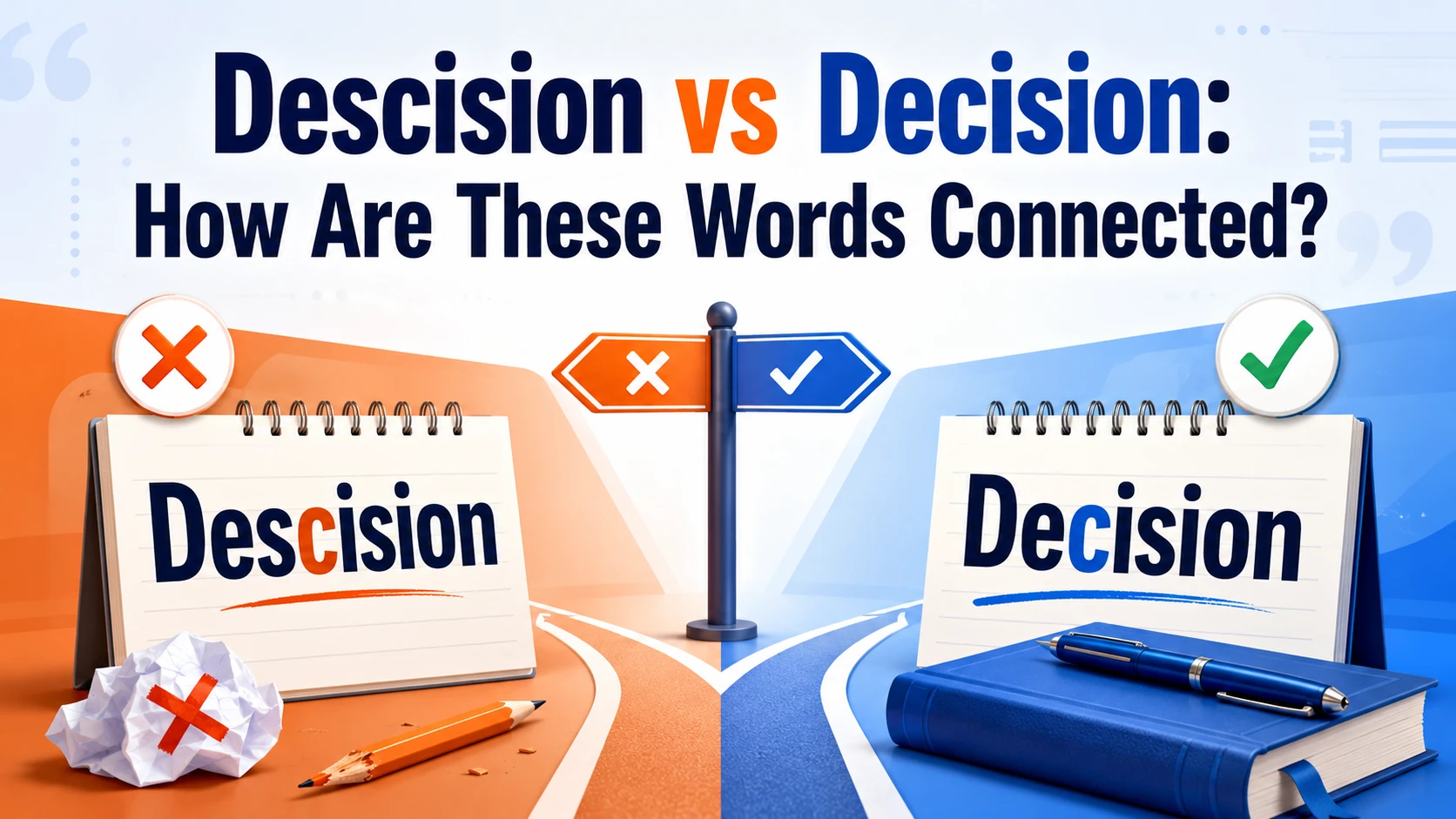
Descision vs decision is a common spelling question, but the answer is straightforward: decision is the only correct spelling in modern English. If you’ve written descision, you’ve made a spelling mistake—not used an alternative or regional variation. This error appears frequently because the pronunciation of decision doesn’t clearly reveal its spelling, causing many writers to insert an extra “s.”
Whether you’re writing an email, essay, business report, or social media post, using the correct spelling matters. A simple typo like descision can distract readers, reduce your credibility, and even affect automated spell-checking or searchability in digital documents. In this guide, you’ll learn why the mistake happens, how to remember the correct spelling, and how to use “decision” confidently in every context.
Unlike words that have legitimate spelling variants, decision has no accepted alternative spelling. Dictionaries, style guides, educational institutions, and professional editors consistently recognize only one form. Understanding this early will save you from confusion as you explore the word’s meaning, grammar, and real-world usage.
Which Spelling Is Correct?
The correct spelling is decision.
The spelling descision is incorrect and should be avoided in all forms of writing.
| Spelling | Correct? | Meaning |
| Decision | ✅ Yes | A choice or conclusion reached after consideration |
| Descision | ❌ No | A misspelling of decision |
If you’re unsure while writing, remember this simple rule:
If it comes from the verb “decide,” it becomes “decision”—never “descision.”
Is “Descision” Ever a Real English Word?
No.
Unlike some words that have accepted British and American spellings, descision has never been recognized as a standard English word.
You won’t find it listed as a correct entry in respected dictionaries because it isn’t an accepted variant. Instead, dictionaries typically identify it as a common misspelling of decision.
This distinction is important because some internet searches may suggest that both words exist. In reality:
- Decision is the correct noun.
- Descision is simply a spelling error.
That means you should avoid using descision in:
- Academic assignments
- Business communication
- Professional emails
- Legal documents
- Website content
- Job applications
Quick Comparison: Descision vs Decision
| Feature | Decision | Descision |
| Correct English spelling | ✅ Yes | ❌ No |
| Found in dictionaries | ✅ Yes | ❌ No |
| Suitable for formal writing | ✅ Yes | ❌ No |
| Used in professional communication | ✅ Yes | ❌ No |
| Common spelling mistake | ❌ No | ✅ Yes |
Key Takeaway: Whenever you’re deciding between descision and decision, always choose decision. The other spelling is simply a typo.
What Does “Decision” Mean?
A decision is a conclusion, judgment, or choice made after considering available information or alternatives. It represents the moment when uncertainty ends and a course of action begins.
People make decisions every day, often without realizing it. Some are small, such as choosing what to eat for breakfast, while others involve significant consequences, such as accepting a job offer, purchasing a home, or approving a business strategy.
Although the situations vary, the underlying idea remains the same: a decision is the result of choosing between options.
Definition and Grammatical Function
Decision is a noun.
It refers to:
- A choice made after thinking carefully.
- A formal judgment or ruling.
- A final conclusion reached after evaluating facts.
Examples:
- She made a difficult decision about her career.
- The judge announced the court’s decision.
- Buying the newer model proved to be the right decision.
Because decision is a noun, it often follows verbs such as:
- make
- reach
- announce
- reconsider
- reverse
- support
- question
For example:
- We need to make a decision today.
- The committee reached a decision after several meetings.
The Origin of the Word
Understanding where a word comes from often makes its spelling easier to remember.
Decision traces its roots through French and Latin:
- Latin decidere meaning “to decide” or “to settle.”
- Latin decisio, meaning “a cutting off” or “determination.”
- Old French later influenced the modern English spelling.
Notice something important:
The spelling has always centered around the root decid-, not descid-.
That historical pattern explains why decision contains only one s after the “ci.”
Common Meanings in Everyday English
The word appears in many different situations.
In personal life:
Choosing a college is an important decision.
In business:
Management announced its decision to expand internationally.
In sports:
The referee’s decision changed the outcome of the game.
In law:
The Supreme Court issued its final decision.
Despite these different contexts, the central meaning remains consistent: someone has evaluated options and reached a conclusion.
Common Word Partners (Collocations)
Certain words naturally appear alongside decision more often than others.
Examples include:
- make a decision
- reach a decision
- final decision
- informed decision
- difficult decision
- important decision
- executive decision
- unanimous decision
- legal decision
- strategic decision
- business decision
- financial decision
- personal decision
- quick decision
- thoughtful decision
Using these natural combinations makes your writing sound more fluent and professional.
Why “Decision” Is Easy to Mispronounce but Harder to Spell
English spelling doesn’t always match pronunciation perfectly.
When people pronounce decision, the middle sound resembles “zh”, making it difficult to hear whether the word contains:
- s
- sc
- ss
- or another letter combination.
As a result, many learners instinctively write:
- descision
- decission
- dicision
- descizion
All of these are incorrect.
The safest strategy is to connect the noun back to its verb:
Decide → Decision
That spelling relationship remains consistent and provides the easiest way to remember the correct form.
Descision vs Decision: The Short Answer
Descision vs decision is a common spelling confusion, but the correct answer is simple: decision is the only correct spelling in standard English. The word descision is not an accepted alternative spelling; it is a common misspelling caused by confusion about English spelling patterns.
Many people make this mistake because the pronunciation of decision does not clearly show how the word is written. The middle sound can make writers believe there should be an extra “s” after the “ci.” However, adding that extra letter changes a correct word into an incorrect spelling.
| Spelling | Correct or Incorrect | Meaning |
| Decision | ✅ Correct | A choice, judgment, or conclusion made after consideration |
| Descision | ❌ Incorrect | A misspelling of “decision” |
When writing professionally, academically, or publicly, always use decision. A single extra letter may seem minor, but spelling accuracy influences how readers perceive your attention to detail and credibility.
Quick rule: If you remember the connection decide → decision, you will almost always spell it correctly.
Is “Descision” a Real English Word?
No, descision is not a real standard English word.
Unlike words that have accepted variations between American and British English, such as “color” and “colour,” descision has no recognized usage in formal English. Dictionaries, grammar references, and professional writing standards list only decision as the correct form.
The confusion usually happens because English contains many words with similar endings:
- precision
- incision
- concision
- decision
Because several of these words contain “-cision,” writers sometimes assume that decision should also include an extra “s” before the “c.”
However, spelling depends on the history and structure of each word, not just appearance.
Why People Commonly Write “Descision”
Several factors contribute to this mistake:
- Pronunciation confusion: The sound in “decision” does not clearly reveal the spelling.
- Pattern guessing: Writers apply spelling patterns from other words incorrectly.
- Typing habits: Fast typing can create repeated letters or inserted letters.
- Memory errors: People may remember the sound but not the exact spelling.
For example:
❌ The manager made a descision about the project.
✅ The manager made a decision about the project.
The second sentence uses the accepted spelling and sounds natural to English readers.
What Does “Decision” Mean?
A decision is a choice or conclusion reached after thinking about different possibilities. It represents the point where someone selects one option, action, or direction from several alternatives.
A decision can be:
- Personal
- Professional
- Legal
- Financial
- Political
- Academic
- Strategic
The size of the decision does not matter. Choosing a restaurant and approving a major business investment are both decisions because they involve selecting an outcome.
Decision as a Noun
The word decision functions as a noun in English.
It names the result of deciding.
Examples:
- She made a difficult decision about her future.
- The company announced its final decision.
- The judge’s decision changed the outcome of the case.
The verb form is decide.
The relationship works like this:
| Verb | Noun |
| Decide | Decision |
Examples:
- I need to decide what to buy.
- I need to make a decision about what to buy.
This connection is one of the easiest ways to remember the spelling.
The Origin and History of the Word “Decision”
Understanding the origin of decision explains why the spelling does not contain “sc.”
The word comes from the Latin term decidere, which means “to cut off” or “to settle.” The idea behind the word was that making a decision means cutting away uncertainty and choosing one path.
Over time, the word moved through French before becoming part of English vocabulary.
The spelling developed around the root:
decide → decision
Not:
descide → descision
This historical connection is why the correct spelling contains one “s” in the standard form.
How to Use “Decision” Correctly in a Sentence
The word decision appears frequently in everyday communication. It can describe simple choices or major conclusions.
Everyday Examples of Decision
- My final decision is to accept the offer.
- Choosing a healthy lifestyle was one of the best decisions I ever made.
- I haven’t made a decision yet.
Professional Examples of Decision
In workplaces, decisions often involve planning, management, and problem-solving.
Examples:
- The board made a strategic decision to expand the company.
- The manager’s decision improved team productivity.
- Employees were informed about the company’s new decision.
Academic Examples of Decision
Students also use the word in essays, research papers, and presentations.
Examples:
- The study examines how people make financial decisions.
- The researcher explained the reasoning behind the final decision.
Legal Examples of Decision
In law, a decision often refers to an official judgment.
Examples:
- The court announced its final decision.
- The legal decision affected future cases.
Decision vs Choice: Understanding the Difference
Many people use decision and choice interchangeably, but they have slightly different meanings.
| Word | Meaning | Example |
| Choice | One option selected from alternatives | She chose the blue dress. |
| Decision | The process or conclusion after thinking | She made a decision about her career. |
A choice focuses on the option selected.
A decision focuses more on the thinking process and final judgment.
Compare:
Choosing between two phones is a choice.
Deciding which phone offers better value is a decision.
Both words can describe selection, but decision often suggests more consideration or responsibility.
Common Expressions Using “Decision”
Native English speakers commonly use decision in specific phrases.
Make a Decision
This is the most common expression.
Examples:
- I need time to make a decision.
- They made a quick decision.
Reach a Decision
This usually suggests discussion or careful consideration.
Examples:
- The committee reached a decision after several meetings.
- The team reached a final decision.
Final Decision
This refers to the last or official choice.
Examples:
- The final decision will be announced tomorrow.
- The customer has the final decision.
Difficult Decision
Used when a choice involves challenges or consequences.
Examples:
- Leaving the company was a difficult decision.
- It was one of the hardest decisions of her life.
Common Mistakes Writers Make With “Decision”
Although decision is a common English word, many writers still make mistakes with its spelling, meaning, or usage. Most errors happen because people rely on pronunciation instead of remembering the word structure.
Understanding these mistakes helps you write more accurately and avoid confusing your readers.
Adding Extra Letters to “Decision”
The most common mistake is writing:
❌ Descision
✅ Decision
The extra “s” does not belong in the word.
Incorrect:
The committee made a descision after reviewing the reports.
Correct:
The committee made a decision after reviewing the reports.
A useful way to avoid this error is to connect the noun with its verb form:
Decide → Decision
The spelling changes slightly, but the core decis- pattern remains.
Confusing “Decision” With “Decission”
Another frequent spelling mistake is adding a double s:
❌ Decission
✅ Decision
This happens because many English words contain double consonants, such as:
- address
- successful
- necessary
However, decision does not follow that pattern.
Remember:
- decision = one s
- discussion = double s
- permission = double s
Each word has its own spelling pattern.
Using “Decision” When Another Word Fits Better
Although decision is a useful word, it does not replace every word related to choosing or thinking.
Sometimes writers use it when another word communicates the idea more precisely.
| If you mean… | Better word |
| Selecting between options | Choice |
| A belief or opinion | Judgment |
| A final understanding | Conclusion |
| A strong commitment | Determination |
| A solution to a problem | Resolution |
Examples:
Less precise:
The meeting ended with a decision about the problem.
More precise:
The meeting ended with a resolution to the problem.
The word decision is correct, but resolution better explains that a problem was solved.
Decision vs Choice: When to Use Each Word
The words decision and choice are closely connected, but they highlight different parts of the process.
A choice focuses on the option selected.
A decision focuses on the process of thinking, evaluating, and selecting.
Examples of “Choice”
Use choice when talking about available options.
Examples:
- You have two choices for your payment method.
- She made a good choice when selecting that university.
- The menu offers many food choices.
The emphasis is on the alternatives.
Examples of “Decision”
Use decision when the act of choosing involves thought, judgment, or responsibility.
Examples:
- He made an important decision about his career.
- The company’s decision affected thousands of employees.
- She carefully considered her decision before accepting the offer.
The emphasis is on the reasoning behind the choice.
Decision vs Conclusion: Understanding the Difference
These words may appear similar because both can represent an ending point, but they describe different processes.
A decision involves choosing what action to take.
A conclusion involves forming an opinion based on evidence or information.
Compare:
After reviewing the evidence, the scientist reached a conclusion.
The scientist formed an understanding.
After reviewing the options, the manager made a decision.
The manager selected an action.
Simple Difference:
- Conclusion = What you believe after thinking
- Decision = What you choose after thinking
Examples:
Conclusion:
The investigation reached the conclusion that the system had failed.
Decision:
The company made the decision to replace the system.
Decision vs Determination: Are They the Same?
Many people confuse these two words because both involve commitment.
However, they have different meanings.
A decision is the act of choosing.
A determination is the commitment or persistence to achieve something.
Examples:
Decision:
She made the decision to learn a new language.
Determination:
Her determination helped her continue learning despite difficulties.
Someone can make a decision quickly, but determination usually develops over time.
Real-World Examples of “Decision” in Different Contexts
The meaning of decision stays the same, but its application changes depending on the situation.
Business and Workplace Decisions
Businesses make decisions constantly, from hiring employees to launching products.
Examples:
- The company’s decision to expand increased its market presence.
- Managers must make decisions based on available data.
- A financial decision can affect long-term growth.
Professional decisions often involve:
- Research
- Risk evaluation
- Planning
- Expert opinions
A good decision usually comes from understanding both opportunities and potential problems.
Academic and Educational Decisions
Students and educators also use the word frequently.
Examples:
- Choosing a major is an important decision for many students.
- The university made a decision regarding admission policies.
- Researchers must make careful decisions about their methods.
Academic decisions often require evaluating:
- Evidence
- Goals
- Long-term effects
Legal Decisions
In legal contexts, a decision often refers to an official ruling.
Examples:
- The court announced its decision.
- The judge’s decision was based on existing laws.
- The legal decision created a new precedent.
Here, the word carries a formal meaning because an authority has reached a judgment.
Personal Life Decisions
Many everyday situations involve decisions.
Examples:
- Moving to another city was a major decision.
- Choosing a healthy lifestyle was a positive decision.
- She made the decision to continue her education.
Personal decisions often involve:
- Values
- Goals
- Priorities
- Consequences
Easy Tricks to Remember the Correct Spelling of “Decision”
Remembering spelling becomes easier when you connect words with patterns.
Trick 1: Remember “Decide → Decision”
The easiest method:
Decide + ion = Decision
Examples:
- revise → revision
- divide → division
- decide → decision
The final “e” disappears, but the root spelling remains connected.
Trick 2: Think “Decision Has One S”
Many people accidentally add an extra s.
Use this reminder:
A decision is made once, so it has one “s.”
This simple visual trick helps prevent the common descision mistake.
Trick 3: Break the Word Into Parts
Instead of remembering the whole word, divide it:
De + cis + ion
The important middle part is:
cis
Not:
scis
Correct:
- decision
- decisive
- decisively
Incorrect:
- descision
- descisive
Practice Checklist: How to Check Your Writing
Before submitting important writing, check:
- ✅ Did I write decision, not descision?
- ✅ Does the word come from decide?
- ✅ Am I using decision when I mean a choice or conclusion?
- ✅ Does another word describe my meaning better?
- ✅ Have I checked spelling in professional documents?
A quick review can prevent a small spelling mistake from affecting otherwise strong writing.
Common Mistakes When Using “Descision” and “Decision”
Writing “Descision” Because of the Pronunciation
One of the most common reasons people write “descision” is that the word decision sounds like it contains an extra “s” sound. When we pronounce the word quickly, the middle syllables can feel unclear, which causes writers to insert an unnecessary letter.
However, the correct spelling is always decision.
The word follows the spelling pattern of related words such as:
- decide
- deciding
- decisive
- decisively
- decision
The root connection makes the correct spelling easier to remember. The word comes from the Latin root decidere, meaning “to cut off” or “to settle,” which developed into the modern English word decision.
Incorrect: The manager made a descision after reviewing the report.
Correct: The manager made a decision after reviewing the report.
Confusing “Decision” With Similar Words
Another mistake happens when writers use decision when another word would express the idea more accurately.
Although decision is related to choosing, it does not mean exactly the same thing as every similar word.
| Word | Meaning | Example |
| Decision | A choice made after thinking or considering options | She made a decision to change careers. |
| Choice | One option selected from several possibilities | You have a choice between two plans. |
| Determination | Strong commitment or firmness after deciding | His determination helped him finish the project. |
| Conclusion | A judgment reached after examining information | The researcher reached a conclusion. |
| Resolution | A firm decision, often about solving a problem | They reached a resolution during the meeting. |
For example:
Less accurate: His decision helped him complete the marathon.
Better: His determination helped him complete the marathon.
The first sentence suggests a choice, while the second emphasizes persistence and commitment.
Using “Decision” Without Considering Context
The word decision works in many situations, but the meaning changes depending on context.
A personal decision involves an individual’s choice:
I made the decision to learn a new language.
A business decision involves planning or strategy:
The company’s decision affected thousands of employees.
A legal decision involves an official judgment:
The court’s decision was announced on Monday.
A medical decision involves healthcare choices:
The patient discussed treatment decisions with the doctor.
Understanding context helps you use the word naturally instead of forcing it into every situation.
Ignoring Common Spelling Patterns
Many English spelling mistakes happen because writers remember how a word sounds instead of how it is structured.
The word decision follows a common pattern where the ending changes from the verb form:
- Decide → Decision
- Revise → Revision
- Divide → Division
- Confuse → Confusion
Notice that the final “e” disappears and the ending changes.
Remembering these patterns can prevent mistakes with many similar words, not just decision.
Quick spelling tip: If you can remember “decide” has one “s” sound and “decision” keeps that single “s,” you can avoid writing “descision.”
How to Choose Between Decision and Other Related Terms
When to Use “Decision”
Use decision when someone must choose between options, actions, or possible outcomes.
Common situations include:
- Personal choices
- Business strategies
- Government actions
- Academic judgments
- Everyday selections
Examples:
- The team made a decision after discussing all possible solutions.
- Her decision to move abroad changed her life.
- The company announced a major investment decision.
A decision usually involves a process of thinking, evaluating, and selecting.
When “Choice” Works Better Than “Decision”
Use choice when you want to emphasize the available options rather than the final action.
Examples:
- You have a choice between studying online and attending classes.
- Choosing a healthy meal was a good choice.
The word choice focuses on the alternatives, while decision focuses on the act of selecting.
When “Determination” Is More Accurate
Use determination when the focus is on dedication, effort, or persistence.
Examples:
- Her determination helped her overcome challenges.
- His determination to succeed inspired his team.
A decision starts an action, but determination helps someone continue it.
When “Conclusion” Is More Appropriate
Use conclusion when someone reaches an opinion after analyzing evidence.
Examples:
- Scientists reached a conclusion after reviewing the data.
- The investigation came to a conclusion after several months.
A conclusion is based on reasoning and evidence, while a decision usually involves selecting an action.
Real-Life Examples of Decision Used Correctly
Personal Life Examples
People make decisions every day, from small choices to major life changes.
Examples:
- I made the decision to save more money this year.
- Choosing a university was one of the biggest decisions of my life.
- She carefully considered her decision before accepting the offer.
Major decisions often involve comparing benefits, risks, and long-term effects.
Workplace Examples
In professional settings, decisions often involve leadership, management, and planning.
Examples:
- The manager’s decision improved team productivity.
- The company made a decision to expand into new markets.
- Hiring decisions should be based on skills and experience.
Business decisions usually require research, discussion, and careful evaluation.
Academic Examples
Students and researchers also use the word decision frequently.
Examples:
- The student made a decision about which subject to study.
- Researchers must make decisions about their methods.
- The university’s decision affected enrollment policies.
Legal and Government Examples
In legal contexts, decision often refers to an official judgment.
Examples:
- The judge’s decision changed the outcome of the case.
- The government announced a decision regarding the new policy.
- The committee reached a final decision after reviewing the evidence.
How to Remember the Correct Spelling of Decision
A simple memory trick can help you avoid writing descision.
Remember:
Decide → Decision
The noun keeps the same root but changes the ending.
You can also use this sentence:
“A decision is made after you decide.”
Both words share the same beginning, making the spelling connection easier.
Another useful trick:
❌ Descision = Extra “s”
✅ Decision = One “s”
The correct spelling looks cleaner because English does not usually add unnecessary letters in the middle of this word.
Is “Descision” Ever Correct?
Why “Descision” Is Not Standard English
The spelling descision is considered a misspelling in standard English. It does not appear as an accepted modern English word in major dictionaries.
You may see it occasionally in:
- Informal online writing
- Social media posts
- User-generated content
- Typing mistakes
However, it should not be used in:
- Professional documents
- Academic writing
- Business communication
- Published content
Using the incorrect spelling can make writing appear less polished and may distract readers from the message.
Practice Exercises: Test Your Understanding
Exercise 1: Choose the Correct Spelling
Select the correct option:
- The committee reached a final ______ after the meeting.
- A) descision
- B) decision
- She made an important ______ about her future career.
- A) decision
- B) descision
- The company’s ______ changed its entire strategy.
- A) decision
- B) descision
Answers:
- Decision
- Decision
- Decision
Exercise 2: Correct the Sentences
Fix the spelling mistakes:
- The manager’s descision surprised everyone.
- Making a descision requires careful thinking.
- The board announced their final descision.
Correct Answers:
- The manager’s decision surprised everyone.
- Making a decision requires careful thinking.
- The board announced their final decision.
Conclusion
Understanding descision vs decision is simple once you recognize that decision is the only correct spelling in standard English. The incorrect version usually appears because pronunciation creates confusion or writers add an unnecessary letter. A decision refers to a choice, judgment, or action selected after consideration, while similar words like choice, determination, and conclusion have their own specific meanings. Using the right word improves clarity in personal, academic, and professional writing. One final actionable tip: always connect “decision” with its root word “decide” to remember the spelling. A common mistake to avoid is trusting pronunciation over spelling patterns. Clear writing begins with accurate word choices.
Frequently Asked Questions
Q1. Is “Descision” a correct English word?
No, descision is not a correct English spelling. It is a common misspelling of decision caused by adding an unnecessary “s.” The correct form should always be used in professional, academic, and formal writing.
Q2. Why do people spell decision as descision?
People often write descision because the pronunciation can make the spelling confusing. The repeated “s” sound causes some writers to add an extra letter, even though the correct spelling only contains one “s.”
Q3. What is the difference between decision and choice?
A decision is the process or result of selecting an option after consideration. A choice refers more specifically to the option selected or the alternatives available. Both words overlap but emphasize different parts of the process.
Q4. Can decision be used as both a noun and a verb?
No, decision is only a noun. The related verb is decide. For example, “I need to make a decision” uses the noun, while “I need to decide” uses the verb form.
Q5. How can I remember the spelling of decision?
Remember the connection: decide becomes decision. When the verb changes into the noun form, the ending changes, but the root spelling remains connected. Avoid adding an extra “s” because descision is always incorrect.
