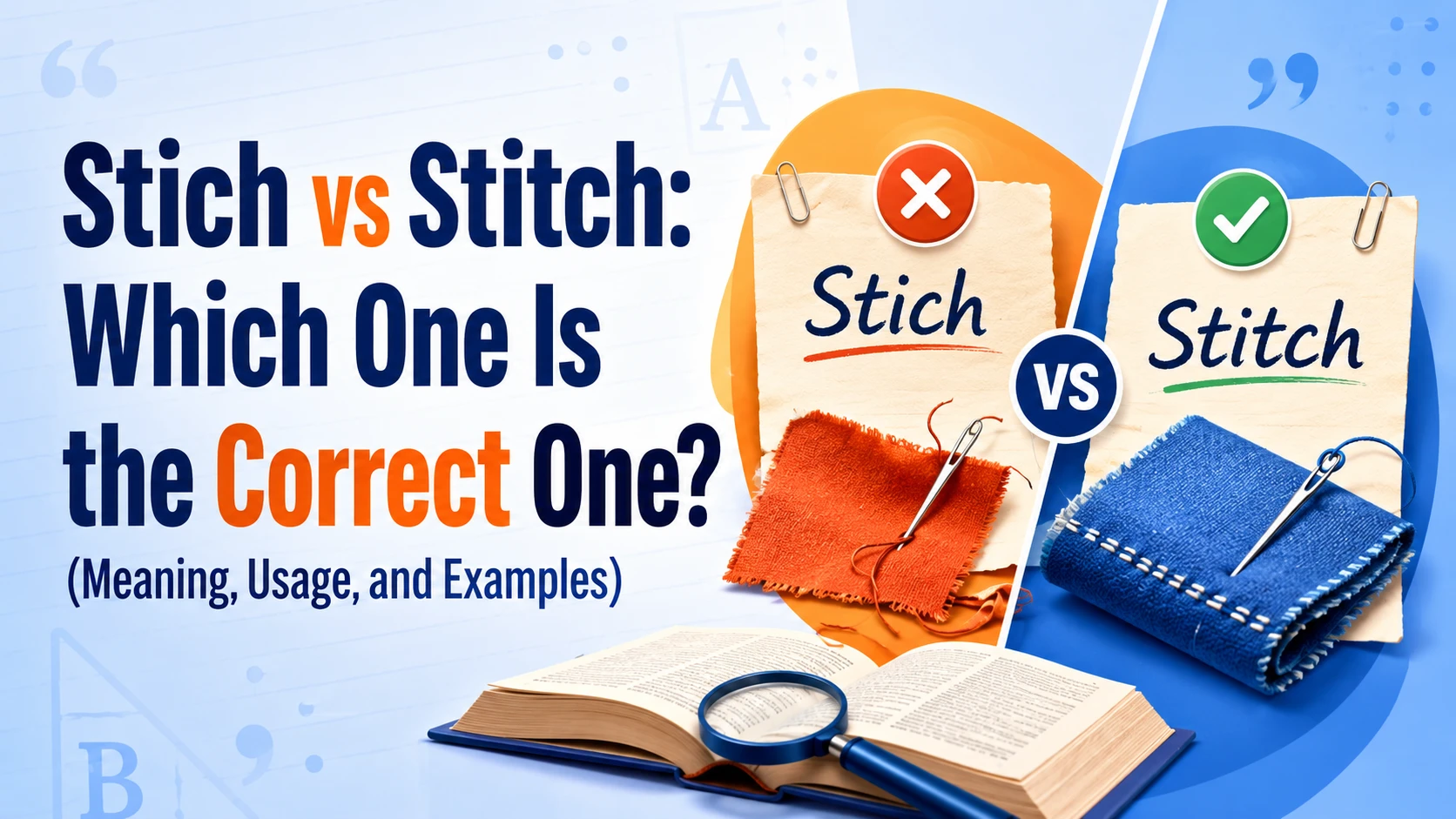
Stich vs Stitch is a common spelling question because the two words differ by just one letter, yet only one is correct in standard English for almost every situation. If you’ve ever hesitated before typing stitch, you’re not alone. Writers, students, English learners, and even native speakers often wonder whether stich is an accepted alternative or simply a misspelling. The confusion is understandable since English contains many word pairs where multiple spellings are valid. In this case, however, the rule is much simpler.
Whether you’re reading a sewing pattern, talking about medical stitches, following a knitting tutorial, or using the expression “a stitch in time saves nine,” choosing the correct spelling makes your writing more accurate and professional. You may also come across Stich as a surname or proper noun, which raises another question: Can “stich” ever be correct? Understanding the answer helps you avoid one of the most common spelling mistakes involving this word.
In this guide, you’ll learn the correct spelling, the meanings of each word, why people confuse them, how dictionaries treat stich and stitch, when each one is appropriate, common mistakes to avoid, useful memory tricks, and plenty of real-world examples. By the end, you’ll know exactly which spelling to use in every context.
Stich vs Stitch: The Quick Answer
If you only need the short answer, here it is:
- ✅ Stitch is the correct spelling in standard English.
- ❌ Stich is usually a misspelling of stitch.
- ✅ Stich may be correct only as a surname, proper noun, or brand name.
Which spelling should you use?
If you’re referring to:
- sewing
- knitting
- crochet
- embroidery
- repairing clothing
- medical wound closure
The correct word is always stitch.
| Word | Correct in Standard English? | Primary Use |
| Stitch | ✅ Yes | Sewing, medicine, knitting, idioms |
| Stich | ❌ Usually no | Proper names or surnames only |
Quick Tip: If you can replace the word with sew or suture, the correct spelling is stitch.
What Does Stitch Mean?
Stitch is both a noun and a verb with several related meanings. Although the exact definition depends on context, every meaning revolves around joining, fastening, or creating loops with thread or similar materials.
Stitch as a noun
As a noun, stitch commonly refers to:
- A single loop of thread made while sewing
- A medical suture used to close a wound
- One loop in knitting or crochet
- A sharp pain in the side during exercise
Examples
- She repaired the dress with a tiny stitch.
- The doctor removed the stitches after two weeks.
- Count every stitch before starting the next row.
- I got a painful stitch while running.
Stitch as a verb
As a verb, stitch means to sew or join materials together.
Examples
- My grandmother stitched a beautiful quilt.
- Please stitch the torn pocket before wearing the jacket.
- The tailor stitched the sleeves by hand.
This meaning appears frequently in sewing, tailoring, upholstery, leatherwork, embroidery, and textile manufacturing.
Common collocations with stitch
Native English speakers naturally combine stitch with many other words.
Some of the most common include:
- running stitch
- cross-stitch
- backstitch
- chain stitch
- slip stitch
- hand stitch
- decorative stitch
- surgical stitches
- remove stitches
- stitch together
- stitch pattern
- stitch count
Learning these combinations helps you sound more natural when writing or speaking.
What Does Stich Mean?
Unlike stitch, the word stich is not recognized as a standard English noun or verb in modern dictionaries.
Is “stich” a real English word?
In ordinary English, stich is almost always considered a spelling mistake.
If you mean:
- sewing
- mending clothing
- medical sutures
- knitting
- embroidery
The correct spelling is always stitch.
When is “Stich” actually correct?
There are a few exceptions.
Stich may be correct when it is:
- a person’s surname
- a company name
- a username
- another proper noun
In these cases, the spelling should never be changed because names keep their original spelling.
Why people misspell “stitch” as “stich”
Several factors contribute to this common error:
- accidentally omitting the second t
- typing too quickly
- relying on pronunciation rather than spelling
- unfamiliarity with English spelling patterns
Fortunately, once you recognize that stitch is the accepted dictionary spelling, the confusion becomes much easier to avoid.
Stich vs Stitch: What’s the Difference?
At first glance, stich and stitch seem almost identical. They differ by only one letter, yet that extra “t” determines whether the word is standard English or a spelling mistake. Understanding this distinction helps you write more accurately and avoid an error that dictionaries, editors, and teachers frequently correct.
The main difference in spelling
The difference is simple:
- Stitch ✅ is the accepted spelling in modern English.
- Stich ❌ is generally an incorrect spelling unless it is part of a proper noun or surname.
Because both words are pronounced similarly by many speakers, it’s easy to leave out the second t while typing. However, pronunciation does not change the correct spelling.
The difference in meaning
The meanings are even more important than the spelling.
Stitch has several established meanings. It can refer to:
- a loop of thread made while sewing
- the act of sewing fabric together
- a medical suture used to close a wound
- one loop in knitting or crochet
- a sharp pain in your side during exercise
By contrast, stich has no accepted meaning as a common English word. If you write stich intending any of the meanings above, readers will usually recognize it as a spelling mistake.
When each word is appropriate
Use stitch whenever you’re discussing:
- sewing clothing
- repairing fabric
- embroidery
- knitting or crochet
- surgical stitches
- clothing repairs
- common English idioms
Use Stich only when it is someone’s actual name or another proper noun.
For example:
- ✔ Sarah learned to stitch by hand.
- ✔ The doctor used several stitches to close the wound.
- ✔ Mr. Stich donated the artwork to the museum.
Notice that only the surname begins with the spelling Stich.
Side-by-side comparison
| Feature | Stitch | Stich |
| Standard dictionary word | ✅ Yes | ❌ No |
| Used in everyday writing | ✅ Frequently | Rarely |
| Refers to sewing | ✅ Yes | ❌ No |
| Refers to medical sutures | ✅ Yes | ❌ No |
| Used in knitting and crochet | ✅ Yes | ❌ No |
| Used as a surname | Rarely | ✅ Sometimes |
When Should You Use Stitch?
Since stitch has several meanings, knowing the context helps you choose the correct usage naturally.
Use “stitch” when talking about sewing
This is the most common meaning.
A stitch is the small loop of thread that joins fabric together.
Examples:
- She added another stitch to strengthen the seam.
- Every stitch was perfectly even.
- My grandmother taught me how to stitch by hand.
Whether you’re sewing clothes, making quilts, or repairing a backpack, stitch is always the correct spelling.
Use “stitch” in medical contexts
Doctors often use stitches to close cuts after injuries or surgery.
Although healthcare professionals may use the technical term sutures, patients almost always say stitches.
Examples:
- The emergency doctor placed eight stitches.
- Keep the stitches clean while the wound heals.
- The nurse removed the stitches after ten days.
This medical meaning is one of the most common uses of the word outside sewing.
Use “stitch” in knitting and crochet
Knitters and crocheters work with individual stitches rather than pieces of thread.
Patterns commonly include terms such as:
- knit stitch
- purl stitch
- chain stitch
- slip stitch
- double crochet stitch
Example:
- Count every stitch before beginning the next row.
Even though knitting doesn’t involve traditional sewing, stitch remains the correct term.
Use “stitch” in everyday expressions
Many familiar English expressions contain the word stitch.
Examples include:
- A stitch in time saves nine
- In stitches
- Without a stitch of clothing
- Stitch together a plan
- Stitch something back together
Because these idioms have existed for centuries, their spelling has long been standardized.
When Is Stich the Right Choice?
For most writers, the answer is simple: almost never.
Still, there are a few legitimate situations where Stich is the correct spelling.
As a surname
Some people have the family name Stich.
When referring to someone’s legal name, never change the spelling.
Examples:
- Anna Stich published the research.
- Professor Stich spoke at the conference.
Changing a surname to Stitch would be incorrect.
In brand names, usernames, and fictional names
Occasionally, businesses, online accounts, artists, or fictional characters intentionally use the spelling Stich.
For example, a designer may choose:
- Stich Studio
- Stich Designs
- @TheRealStich
Because these are chosen names, they should always be written exactly as intended.
Why “stich” is usually considered a typo
Outside proper nouns, stich almost always appears because someone accidentally omitted the second t.
Common reasons include:
- typing too quickly
- relying on pronunciation instead of spelling
- unfamiliarity with English spelling patterns
- autocorrect failing to detect the mistake
Professional editors routinely correct stich to stitch unless there is clear evidence that the word is meant to be a proper name.
Real-world examples
Correct:
- She stitched the torn sleeve yesterday.
- I needed three stitches after the accident.
- The embroidery stitch created a beautiful pattern.
- Mr. Stich donated the collection to the library.
Incorrect:
- Please stich my shirt.
- The doctor gave me six stiches.
- Learn cross-stich embroidery.
In every incorrect example above, stitch is the proper spelling.
Common Idioms and Expressions with Stitch
Learning common expressions is one of the easiest ways to remember the correct spelling. Every established English idiom uses stitch, never stich. If you encounter stich in these phrases, it’s almost certainly a typo.
A Stitch in Time Saves Nine
This classic proverb means that fixing a small problem early prevents it from becoming a much larger one later.
The saying comes from sewing. Repairing one loose stitch immediately is much easier than fixing a large tear after the seam comes apart.
Examples
- Spending five minutes backing up your files is a stitch in time saves nine.
- Replacing the worn tire early was a stitch in time that prevented a costly breakdown.
The phrase is now used in business, education, home maintenance, and everyday life—not just sewing.
In Stitches
When someone is in stitches, they are laughing so hard that they can barely control themselves.
Examples
- His joke had the entire audience in stitches.
- We were in stitches after hearing her travel story.
Although the expression contains the word stitch, it has nothing to do with sewing. Instead, it vividly describes uncontrollable laughter.
Without a Stitch of Clothing
This idiom means completely naked.
Examples
- The toddler ran through the yard without a stitch of clothing.
- The artist painted the figure without a stitch of clothing.
The phrase has been part of English for centuries and always uses the spelling stitch.
Stitch Together
The verb phrase stitch together often has both a literal and figurative meaning.
Literal meaning
- She stitched together two pieces of fabric.
- They stitched together the torn backpack.
Figurative meaning
- Investigators stitched together the timeline from several interviews.
- The documentary stitched together footage from different decades.
In figurative use, it means to combine separate parts into one complete whole.
Why These Expressions Never Use “Stich”
All standard English idioms use stitch because the word has been established in dictionaries for centuries.
Incorrect versions include:
- ❌ A stich in time saves nine
- ❌ We were in stiches
- ❌ Stitch together → never stich together
If you’re writing one of these expressions, remember that stitch is always the correct spelling.
Common Mistakes to Avoid
Most errors involving stitch happen because writers type quickly or assume the shorter spelling looks correct. Fortunately, these mistakes are easy to avoid once you know what to watch for.
Leaving Out the Second “T”
The most frequent mistake is simply dropping the second t.
Incorrect:
- Please stich my jacket.
- She learned cross-stich embroidery.
Correct:
- Please stitch my jacket.
- She learned cross-stitch embroidery.
Reading your work slowly before publishing often catches this error.
Confusing a Typo with an Accepted Spelling
Some English words have two accepted spellings, such as advisor/adviser or gray/grey.
That is not the case here.
Stitch is the accepted English word.
Stich is generally not accepted as an alternative spelling.
Assuming both forms are interchangeable is a common misconception.
Using “Stich” in Professional or Academic Writing
A single spelling mistake can reduce the credibility of otherwise polished writing.
If you’re preparing:
- academic assignments
- business reports
- blog articles
- resumes
- marketing materials
always proofread for stitch, especially if your topic involves sewing, fashion, medicine, or crafts.
Depending Entirely on Spell-Check
Spell-check tools are helpful, but they aren’t perfect.
If Stich is someone’s surname or appears in your custom dictionary, your software may not flag it as an error.
For example:
The doctor used several stich to close the wound.
Some writing tools may overlook the mistake because Stich exists as a proper noun.
Context—not software—should guide your final proofreading.
A Quick Proofreading Checklist
Before you publish or submit your writing, ask yourself:
- Am I talking about sewing or repairing fabric?
- Am I referring to medical wound closure?
- Is this about knitting or crochet?
- Is the word someone’s actual surname?
If the answer is yes to the first three questions, use stitch.
If it’s a person’s legal name, keep Stich unchanged.
Do British and American English Spell It Differently?
Many English spelling questions exist because British and American English prefer different forms. Think of colour/color, centre/center, or traveller/traveler.
Fortunately, stitch is not one of those words.
UK and US English Use the Same Spelling
Both British English and American English use stitch as the standard spelling.
You’ll see it in:
- dictionaries
- sewing books
- medical publications
- knitting patterns
- newspapers
- educational materials
There is no regional variation that changes stitch into stich.
Dictionary Recommendations
Major English dictionaries consistently recognize stitch as the correct word.
They define it as:
- a loop of thread
- the act of sewing
- a medical suture
- a sharp pain in the side
- a unit of knitting or crochet
By contrast, Stich generally appears only as a surname or proper noun.
Style Guide Recommendations
Professional editors and publishers follow the same rule:
- Use stitch for the common noun and verb.
- Preserve Stich only when it is someone’s official name.
Whether you’re writing in British English, American English, Canadian English, or Australian English, this recommendation remains the same.
How to Remember the Difference Between Stich and Stitch
A simple memory trick can prevent this spelling mistake for good.
Think of the Extra “T” as Thread
Imagine that the second t represents the thread passing through fabric.
No thread means no stitch.
No second t means the spelling is incomplete.
This visual association makes the correct spelling much easier to remember.
Use a Simple Mnemonic
Try this sentence:
A stitch needs Thread—both start with T.
The extra t reminds you that sewing always requires thread.
Connect the Word with Familiar Phrases
Think about expressions you’ve probably heard many times:
- A stitch in time saves nine
- Cross-stitch
- Running stitch
- Slip stitch
Seeing the correct spelling repeatedly helps build long-term memory.
A Quick Decision Guide
Use this simple rule whenever you’re unsure.
| If you’re writing about… | Correct Word |
| Sewing clothing | Stitch |
| Medical wound closure | Stitch |
| Knitting or crochet | Stitch |
| Embroidery | Stitch |
| A surname or proper noun | Stich (only if that’s the official spelling) |
Related Words People Often Confuse with Stitch
Several sewing and medical terms are closely related to stitch, but they aren’t interchangeable.
Stitch vs. Suture
A stitch is the everyday word most people use after receiving medical treatment.
A suture is the technical medical term healthcare professionals often prefer.
While related, suture usually refers to the material or procedure, whereas stitches are what patients commonly mention.
Stitch vs. Seam
A stitch is one individual loop of thread.
A seam is the line created by many stitches joining two pieces of fabric.
You create a seam by making multiple stitches.
Stitch vs. Sew
Sew is the action.
Stitch is either the action or the individual loop created during sewing.
For example:
- You sew a shirt.
- Each stitch holds the fabric together.
Stitch in Knitting vs. Stitch in Crochet
Both crafts use the word stitch, but the techniques differ.
Knitting creates stitches using two needles, while crochet forms stitches with a single hook.
Although the methods aren’t the same, the terminology remains consistent.
Practice Exercises
Test your understanding of stich and stitch with these exercises. They cover spelling, meaning, and real-world usage so you can apply what you’ve learned with confidence.
Exercise 1: Choose the Correct Word
Complete each sentence with stitch or Stich.
- The tailor added one more ________ before finishing the jacket.
- The doctor removed my ________ after ten days.
- Sarah learned cross-________ embroidery from her grandmother.
- Professor ________ delivered the keynote speech.
- One loose ________ caused the seam to come apart.
- The scarf needs another ________ to complete the pattern.
- Mr. ________ signed the agreement yesterday.
- Please ________ the torn pocket before washing the shirt.
Exercise 2: Fill in the Blanks
Choose the correct word to complete each sentence.
- A ________ in time saves nine.
- The audience was in ________ after hearing the comedian.
- The nurse checked each ________ carefully.
- She used a decorative ________ around the edge of the blanket.
- My grandmother taught me how to ________ by hand.
Exercise 3: Correct the Spelling Mistakes
Each sentence contains one spelling mistake. Rewrite it correctly.
- Please stich this button onto my coat.
- The patient received five stiches after the accident.
- She enjoys cross-stich embroidery.
- Every stich must be evenly spaced.
- The tailor will stich the sleeves tomorrow.
Exercise 4: Match the Word to Its Meaning
Match the description with the correct answer.
| Description | Answer |
| A loop of thread used in sewing | ________ |
| A person’s surname | ________ |
| To join fabric together | ________ |
| A medical suture | ________ |
| Usually a spelling mistake in standard English | ________ |
Options:
- Stitch
- Stich
Answer Key with Explanations
Exercise 1
- stitch ✔
- stitches ✔
- stitch ✔
- Stich ✔
- stitch ✔
- stitch ✔
- Stich ✔
- stitch ✔
Exercise 2
- stitch
- stitches
- stitch
- stitch
- stitch
Exercise 3
Correct answers:
- Please stitch this button onto my coat.
- The patient received five stitches after the accident.
- She enjoys cross-stitch embroidery.
- Every stitch must be evenly spaced.
- The tailor will stitch the sleeves tomorrow.
Exercise 4
| Description | Correct Answer |
| A loop of thread used in sewing | Stitch |
| A person’s surname | Stich |
| To join fabric together | Stitch |
| A medical suture | Stitch |
| Usually a spelling mistake in standard English | Stich |
Conclusion
The difference between stich and stitch is straightforward once you understand their usage. Stitch is the correct spelling in standard English whenever you’re referring to sewing, knitting, embroidery, medical wound closure, or common idioms. Stich, on the other hand, is generally used only as a surname or another proper noun and should not replace stitch in ordinary writing. Whenever you’re unsure, think about the context. If you’re describing a loop of thread, the act of sewing, or medical stitches, choose stitch every time. One final actionable tip: read your work slowly before publishing, as missing the second “t” is one of the easiest typing errors to overlook. A common mistake to avoid is assuming stich is an accepted alternative spelling—it isn’t. Using the correct form will make your writing clearer, more professional, and grammatically accurate.
Frequently Asked Questions
Q1. Is stich a real English word?
In standard English, stich is not recognized as the correct spelling for sewing, knitting, or medical contexts. It usually appears as a misspelling of “stitch” or as a surname or proper noun. Unless you’re referring to a person’s name, stitch is the correct choice.
Q2. Why is stitch spelled with -tch?
The spelling stitch developed through the historical evolution of English and has been standardized for centuries. Although the pronunciation may tempt some writers to omit the second t, dictionaries consistently recognize stitch as the only correct spelling for the common noun and verb.
Q3. Can stitch be both a noun and a verb?
Yes. Stitch functions as both a noun and a verb. As a noun, it refers to a loop of thread, a medical suture, or a knitting loop. As a verb, it means to sew or join materials together using thread or similar methods.
Q4. What’s the difference between a stitch and a suture?
A stitch is the everyday term most people use after an injury or surgery, while suture is the more technical medical term. In healthcare, a suture refers to the material or procedure, whereas patients commonly say they received stitches.
Q5. Why do so many people write stich instead of stitch?
The mistake usually happens because writers accidentally omit the second “t” while typing or rely on pronunciation instead of spelling. Since both forms look similar, the error is easy to make. Remembering that thread and stitch both include the letter “t” can help reinforce the correct spelling.
