
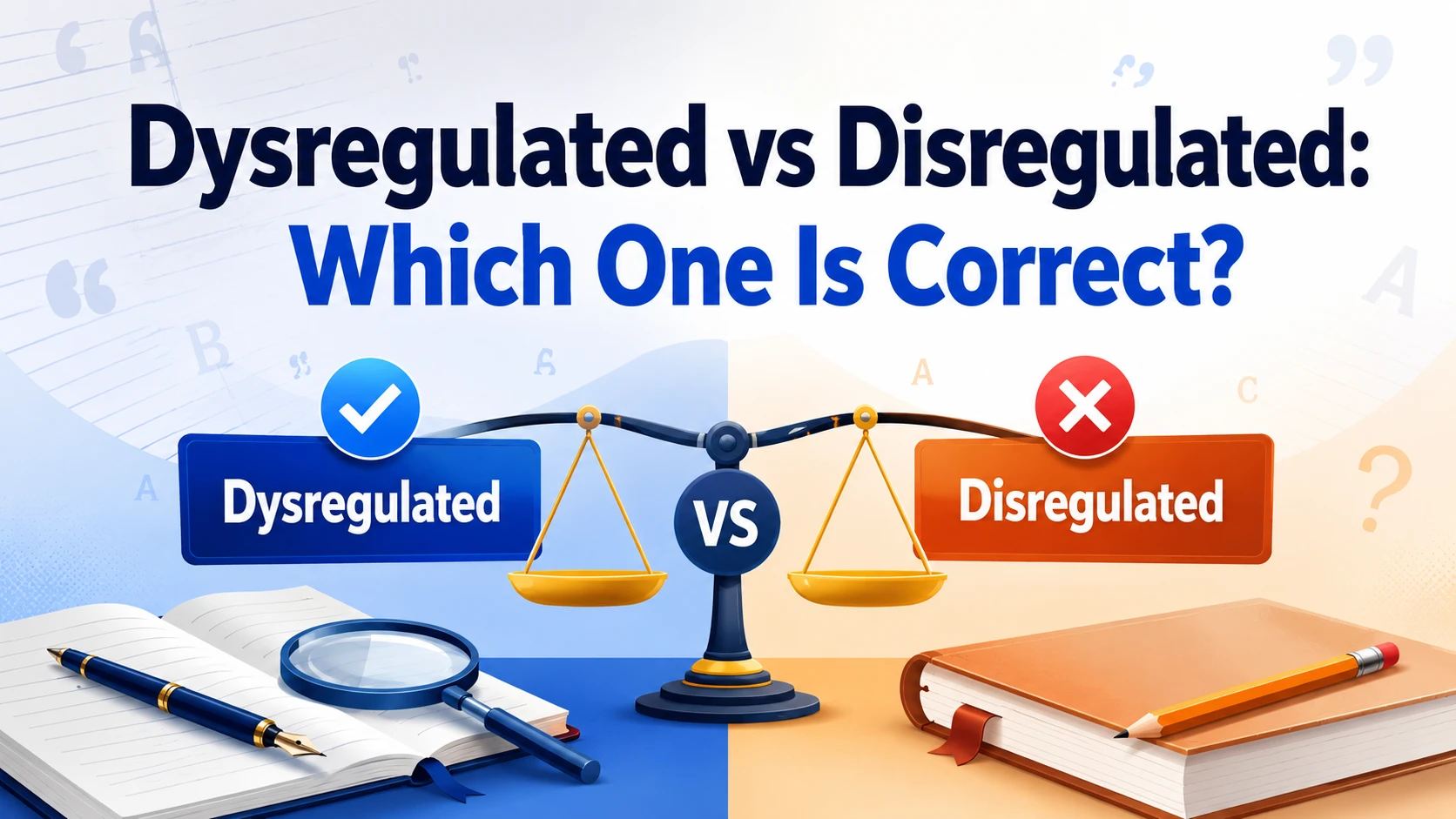
Dysregulated vs. disregulated can be confusing because both spellings look plausible, sound similar, and may appear in emails, essays, academic work, and professional writing. However, only dysregulated is the standard and correct spelling. Disregulated is generally considered a misspelling and should be avoided in formal or edited writing. Knowing the correct form helps you communicate clearly and maintain accuracy in your work.
The difference becomes easier to understand when you look at the word’s structure and meaning. Dysregulated is related to dysregulation, which refers to impaired, disrupted, or abnormal regulation of a process, system, or response. The prefix dys- often conveys difficulty, impairment, or abnormal functioning. Understanding this word pattern can help you remember the correct spelling instead of relying only on pronunciation.
This guide explains the correct spelling, meaning, usage, and common mistakes through simple explanations and practical examples. You will also learn how to use dysregulated correctly in sentences and how to avoid the common error disregulated. By the end, you should be able to recognize the standard form quickly and use it with greater confidence in everyday, academic, and professional communication.
Dysregulated vs Disregulated: Quick Answer
| Word | Correct? | Meaning or Status |
| Dysregulated | ✅ Yes | Functioning with impaired, disrupted, or abnormal regulation |
| Disregulated | ❌ No | Usually a misspelling or nonstandard form |
The simple rule
Use dysregulated when referring to something that is not being regulated normally or effectively.
Correct: Chronic stress may contribute to dysregulated emotional responses.
Incorrect: Chronic stress may contribute to disregulated emotional responses.
What Does Dysregulated Mean?
Dysregulated is the adjective form of dysregulate or dysregulation. It generally describes a process or system that is not functioning in a balanced, stable, or properly controlled way.
In simple terms:
A dysregulated system has difficulty maintaining normal or effective regulation.
The exact meaning depends on the subject being discussed. For example:
- Dysregulated emotions may be difficult to manage or return to a balanced state.
- A dysregulated stress response may react in an unusually intense or prolonged way.
- A dysregulated biological process may not function according to its normal regulatory pattern.
- Dysregulated gene expression refers to abnormal changes in how genes are activated or controlled.
The word does not always mean that regulation has disappeared completely. Instead, it usually suggests that the regulatory process is impaired, disrupted, altered, or functioning abnormally.
Why Is Dysregulated Spelled With “Dys-”?
The spelling becomes easier to understand when you look at the prefix dys-.
The prefix dys- comes from Greek and is commonly used in English to express ideas such as:
- impaired functioning
- abnormal functioning
- difficulty
- disorder
- dysfunction
You can see this pattern in words such as:
| Word | General Meaning |
| Dysfunction | Impaired or abnormal functioning |
| Dyslexia | A learning difference that affects reading and language processing |
| Dysphagia | Difficulty swallowing |
| Dyspepsia | Indigestion or impaired digestion |
| Dysregulation | Impaired or abnormal regulation |
Because dysregulated describes impaired or disrupted regulation, the prefix dys- is the established form.
A useful memory trick
Connect dysregulated with dysfunction.
Both words begin with dys- and describe a process that is not functioning normally.
Dysfunction → impaired function
Dysregulation → impaired regulation
Dysregulated → regulated abnormally or ineffectively
Why Do People Write “Disregulated”?
The misspelling disregulated is understandable because English contains many familiar words beginning with dis-, including:
- disconnect
- disagree
- disapprove
- disengage
- disorganize
- discontinue
When people hear dysregulated, they may assume that the first syllable is dis- because the two prefixes can sound similar in natural speech.
Several factors contribute to the confusion.
Similar pronunciation
In quick or casual speech, dys- may sound similar to dis-. As a result, some writers spell the word according to how they think it sounds rather than how it is conventionally written.
Familiar spelling patterns
The prefix dis- appears in many common English words. Your brain may automatically apply that familiar pattern to an unfamiliar technical term.
Online repetition
Misspellings can spread through social media posts, informal blogs, comments, and user-generated content. Seeing an incorrect form repeatedly may make it appear legitimate.
Autocorrect limitations
Spell-checking tools do not always identify every uncommon or technical spelling error. A word may remain uncorrected even when it is not the standard form.
Is “Disregulated” a Real Word?
In standard modern English, dysregulated is the established and preferred spelling. Disregulated may occasionally appear in informal writing, unedited content, or search results, but it is not the standard form used in most professional, academic, psychological, medical, or scientific contexts.
If you are writing an essay, article, report, research paper, professional document, or educational resource, use dysregulated.
How Is Dysregulated Used in Psychology?
In psychology, dysregulated often describes difficulty managing or adjusting emotional, behavioral, cognitive, or physiological responses.
One common phrase is emotional dysregulation. This term refers to difficulty responding to emotions in a flexible, manageable, or context-appropriate way.
Emotional dysregulation may involve:
- emotions that feel unusually intense
- difficulty calming down after stress
- reactions that last longer than expected
- difficulty adjusting emotional responses to a situation
- trouble managing strong feelings
However, experiencing anger, sadness, fear, stress, or frustration does not automatically mean that someone is emotionally dysregulated. Strong emotions are a normal part of human experience. The term is generally used when difficulties with emotional regulation are persistent, significant, or relevant to a particular psychological or clinical context.
Example
A person receives constructive feedback at work and feels disappointed or frustrated. Those emotions may be a normal response.
If the person repeatedly becomes overwhelmed, reacts intensely, struggles to regain emotional balance, or remains unable to focus for a prolonged period, a professional might examine whether emotional regulation difficulties are involved.
The word dysregulated describes the difficulty with regulation—not the fact that the person has emotions.
What Does a Dysregulated Nervous System Mean?
The phrase dysregulated nervous system is often used in psychology, trauma-informed discussions, and wellness content. It generally refers to difficulties in how the nervous system responds to stress, safety, or perceived threats.
People may use the phrase to describe responses such as:
- heightened alertness
- difficulty relaxing
- feeling overwhelmed
- increased stress reactivity
- emotional or physical shutdown
However, this phrase should not be used as a self-diagnosis. Symptoms such as fatigue, anxiety, sleep problems, irritability, difficulty concentrating, or digestive discomfort can have many possible causes. If symptoms are persistent, severe, or affecting daily life, professional evaluation may be appropriate.
Dysregulated Meaning in Biology and Medicine
The word dysregulated is not limited to psychology. Researchers also use it to describe abnormal or disrupted regulation in biological systems.
Common examples include:
Hormonal dysregulation
Hormones help regulate many body functions. Hormonal dysregulation refers broadly to disruptions or abnormalities in hormonal signaling or regulation.
Immune dysregulation
Immune dysregulation refers to abnormal functioning or control within the immune system. The meaning depends on the specific biological process or condition being discussed.
Dysregulated gene expression
Genes are activated and controlled through complex regulatory processes. Dysregulated gene expression describes abnormal changes in those processes that may affect how cells function.
Dysregulated cellular activity
Researchers may use the term when normal cellular controls are altered or disrupted.
In scientific writing, the exact meaning of dysregulated should always be understood from the surrounding context.
Dysregulated vs Unregulated vs Deregulated
These words are related to regulation, but they do not mean the same thing.
| Word | Meaning | Example |
| Dysregulated | Regulated abnormally, ineffectively, or in an impaired way | Dysregulated emotional responses |
| Unregulated | Not controlled or governed by regulation | An unregulated market |
| Deregulated | Previously existing rules or controls were officially removed or reduced | A deregulated industry |
The key difference
A dysregulated system still involves regulation, but the regulatory process is impaired or functioning abnormally.
An unregulated system lacks regulation or formal control.
A deregulated system has had rules, restrictions, or controls removed or reduced.
Dysregulated vs Disregulated: Usage Examples
Correct examples
- The report described dysregulated immune activity.
- Chronic stress may affect emotional regulation and contribute to dysregulated responses.
- The researchers examined dysregulated gene expression.
- The therapist discussed strategies for managing dysregulated emotional reactions.
- The condition was associated with changes in dysregulated biological processes.
Incorrect examples
- The report described disregulated immune activity.
- The patient experienced disregulated emotions.
- The researchers studied disregulated gene expression.
- The therapist discussed disregulated behavior.
In standard writing, replace disregulated with dysregulated.
Common Phrases That Use Dysregulated
You may encounter dysregulated in the following expressions:
- dysregulated emotions
- dysregulated behavior
- dysregulated stress response
- dysregulated nervous system
- dysregulated immune response
- dysregulated hormone levels
- dysregulated gene expression
- dysregulated cellular activity
- dysregulated inflammatory response
The surrounding noun determines the precise meaning.
For example, dysregulated emotions and dysregulated gene expression both involve impaired regulation, but they refer to very different systems.
How to Remember the Correct Spelling
Use this simple memory rule:
Dysregulated begins with dys-, just like dysfunction.
Both words describe impaired or abnormal functioning.
You can also remember:
Dys + regulated = regulation that is impaired or disrupted
Do not replace dys- with dis- simply because the two prefixes may sound similar.
Quick Practice
Fill in the blank
The researcher studied ________ gene expression.
Correct answer: dysregulated
Find the spelling mistake
Incorrect: The child became disregulated after the stressful event.
Correct: The child became dysregulated after the stressful event.
Choose the correct word
Which sentence uses the standard spelling?
A. The system became disregulated.
B. The system became dysregulated.
Correct answer: B
Key Takeaways
| Key Point | Answer |
| Correct spelling | Dysregulated |
| Incorrect or nonstandard form | Disregulated |
| General meaning | Regulated in an impaired, disrupted, or abnormal way |
| Common fields | Psychology, medicine, biology, neuroscience, and research |
| Main source of confusion | The similar sound of dys- and dis- |
| Memory tip | Connect dysregulated with dysfunction |
Conclusion
Understanding Dysregulated vs Disregulated: Which One Is Correct? is important for improving writing accuracy, language accuracy, and communication clarity. Although both words may look similar and share a similar sound, dysregulated is the correct spelling, accepted spelling, and standard usage in modern English. The form disregulated is generally considered an incorrect spelling and a common spelling mistake. Learning this distinction strengthens grammar awareness, word recognition, language proficiency, and vocabulary learning. Whether you are working on academic writing, professional writing, emails, or everyday communication, using dysregulated correctly helps create clearer, more professional, and more readable content.
FAQs
Q1. What is the correct spelling: Dysregulated or Disregulated?
The correct spelling is dysregulated. It is the accepted spelling used in psychology, medicine, academic writing, and professional communication. Disregulated is generally viewed as an incorrect spelling or misspelling.
Q2. What does dysregulated mean?
Dysregulated describes a system, process, or condition that is not functioning in a normal, balanced, or controlled way. It is often used when discussing emotional regulation, mental health, behavioral health, and other areas involving psychology and medicine.
Q3. Why do people confuse dysregulated and disregulated?
Many people become confused because the two words look very similar, have a similar pronunciation, and appear related in meaning. This creates spelling confusion, especially in emails, essays, formal writing, and everyday communication.
Q4. Is disregulated ever considered correct?
In most modern contexts, disregulated is not considered the preferred or standard form. Professional writers, medical professionals, researchers, and psychologists overwhelmingly use dysregulated as the correct and widely accepted term.
Q5. How can I remember the correct spelling of dysregulated?
A simple trick is to remember that many medical and psychological terms use the prefix “dys-” to indicate impaired or abnormal function. Since dysregulation and dysregulated follow this pattern, they are the correct forms. This memory aid can improve spelling accuracy, word recognition, and writing confidence.
