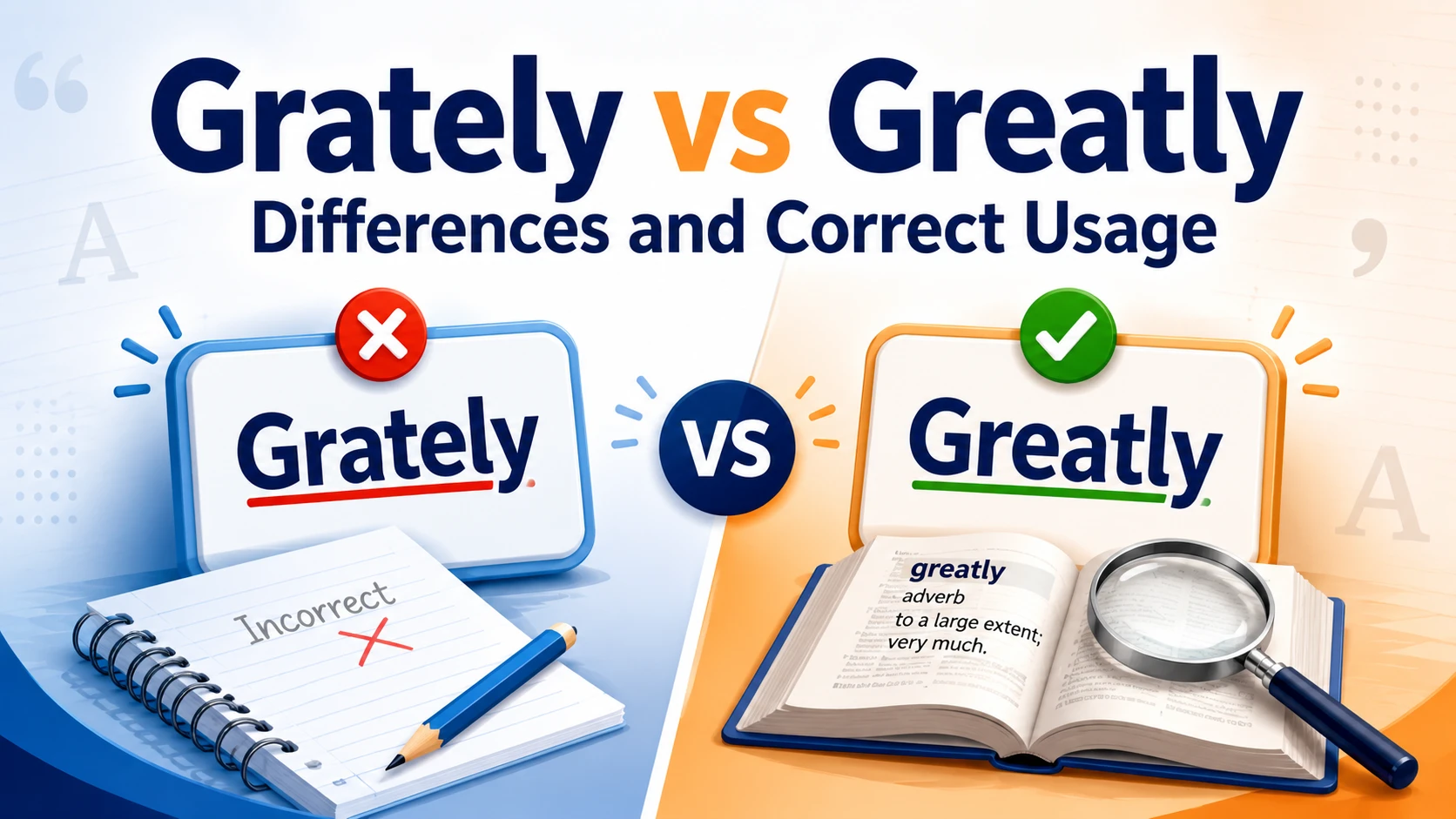
Most people who search for “grately vs greatly” are looking for one simple answer: Which spelling is correct? The short answer is that greatly is the correct English word, while grately is a spelling mistake. Although the error is common, especially in fast typing and informal online writing, using grately in emails, school assignments, business documents, or published content can make your writing appear careless. Knowing the difference helps you communicate more clearly and professionally.
English spelling can be deceptive because many words sound exactly the way we expect, while others contain silent letters or unusual patterns. The confusion between grately and greatly comes from pronunciation, the spelling of related words like grateful, and simple typing mistakes. Even fluent English speakers occasionally pause before writing words ending in -ly, particularly when the root word already ends with several letters that can be difficult to visualize. Understanding why this mistake happens is the first step toward avoiding it.
This guide goes beyond simply telling you which word is correct. You’ll learn what greatly means, why grately is incorrect, how to use greatly naturally in sentences, common phrases native speakers use, grammar rules, memory tricks, proofreading tips, and practical examples from everyday, academic, and professional writing. By the end, you’ll know exactly when and how to use greatly with confidence.
The Short Answer: Is It “Grately” or “Greatly”?
The correct spelling is greatly.
The spelling grately is not a recognized English word. It does not appear in standard dictionaries and should not be used in formal or informal writing.
| Word | Correct? | Meaning |
| Greatly | ✅ Yes | To a large, significant, or considerable extent |
| Grately | ❌ No | Misspelling of greatly |
Here are a few examples:
Correct
- Your support is greatly appreciated.
- The new software has greatly improved productivity.
- We were greatly surprised by the results.
Incorrect
- Your support is grately appreciated.
- The new software has grately improved productivity.
Quick Tip: If you’re ever unsure, remember that the base word is great, so adding -ly gives you greatly.
What Does “Greatly” Mean?
Greatly is an adverb that means to a large extent, very much, or significantly. It describes how much something happens or the degree to which an action, feeling, or condition exists.
Unlike adjectives, which describe nouns, adverbs modify verbs, adjectives, or even entire clauses. In everyday English, greatly is used to emphasize that something has a substantial effect or happens to a significant degree.
Common Meanings of “Greatly”
Depending on the context, greatly can mean:
- To a significant extent
- Very much
- Considerably
- Substantially
- To a high degree
For example:
- The weather has greatly changed since yesterday.
- Your advice greatly helped me.
- Technology has greatly transformed education.
In each sentence, greatly increases the strength of the statement by showing that the effect is substantial rather than minor.
Is “Grately” a Real Word?
No.
Grately is not an accepted English word. You won’t find it in reputable dictionaries because it has never been recognized as a standard spelling.
Many people mistakenly assume it is correct because English contains many words ending in -ly, and when spoken quickly, greatly can sound almost identical to grately.
This is a classic example of a spelling error rather than a new or alternative word.
Why Do People Write “Grately”?
Several factors contribute to this mistake:
- The pronunciation makes the missing letter difficult to notice.
- Writers confuse greatly with grateful, which has a different spelling pattern.
- Fast typing leads to omitted letters.
- People rely on memory instead of recognizing the base word great.
Fortunately, once you understand how the word is formed, the mistake becomes much easier to avoid.
Grately vs Greatly: What’s the Difference?
Although these words look similar, only one belongs in standard English.
| Feature | Greatly | Grately |
| Correct English spelling | ✅ Yes | ❌ No |
| Dictionary entry | Yes | No |
| Part of speech | Adverb | None |
| Appropriate in professional writing | Yes | No |
| Accepted in academic writing | Yes | No |
The difference is simple:
- Greatly expresses degree or extent.
- Grately is merely a misspelling that should always be corrected.
Because grately has no meaning, replacing it with greatly is always the right choice.
Why Do People Confuse “Grately” and “Greatly”?
The confusion isn’t random. It stems from how our brains process spoken and written language.
Pronunciation Hides the Extra Letter
When people speak naturally, the t and l sounds blend together. As a result, many writers don’t realize the word contains the full spelling great + ly.
Similar Words Create Confusion
Words like these often contribute to the mistake:
- grateful
- gratitude
- greatly
- greater
- greatest
Because these words share the same root, writers sometimes blend their spellings without realizing it.
Fast Typing Encourages Mistakes
Digital communication has increased spelling errors. Emails, text messages, and social media posts are often written quickly, making omitted letters more common than in carefully edited writing.
The Brain Prioritizes Sound Over Spelling
Research on reading and spelling consistently shows that people often remember how words sound more accurately than how they’re spelled. That’s why errors like grately appear surprisingly often, even among experienced writers.
How to Spell “Greatly” Correctly Every Time
One of the easiest ways to remember the correct spelling is to break the word into two parts:
Great + ly = Greatly
The adjective great keeps its complete spelling before adding the adverb suffix -ly.
Memory Trick
Think of this sentence:
“A great result happens greatly, not grately.”
Whenever you write the word, mentally identify the base adjective great first. Then simply add -ly.
This approach works because English frequently forms adverbs by adding -ly to adjectives without changing the original spelling.
Build a Better Proofreading Habit
Before submitting important writing:
- Read slowly instead of skimming.
- Look specifically for words ending in -ly.
- Double-check commonly confused spellings.
- Use spell-check as a second opinion rather than your only editor.
A few extra seconds of proofreading can prevent small spelling mistakes from reducing the professionalism of your writing.
How to Use “Greatly” Correctly in Sentences
Knowing that greatly is the correct spelling is only the first step. The next challenge is using it naturally. While greatly is a versatile adverb, it doesn’t fit every sentence. Native English speakers typically use it with verbs and adjectives that describe change, appreciation, influence, improvement, emotion, or degree.
Choosing the right context makes your writing sound more fluent and avoids awkward phrasing.
Use “Greatly” to Show Degree or Extent
The primary purpose of greatly is to emphasize that something happens to a large or significant extent.
Examples
- The new safety measures greatly reduced workplace accidents.
- Regular exercise can greatly improve your overall health.
- Their encouragement greatly boosted my confidence.
- Better planning greatly increased our chances of success.
- The renovation greatly enhanced the appearance of the house.
In each example, greatly strengthens the verb by showing that the effect is substantial rather than minor.
Use “Greatly” with Past Participles
One of the most common patterns in English is using greatly before a past participle.
Examples include:
- greatly appreciated
- greatly respected
- greatly admired
- greatly valued
- greatly improved
- greatly influenced
- greatly affected
- greatly missed
Examples in sentences
- Your patience is greatly appreciated.
- She is greatly respected by her colleagues.
- His contribution was greatly valued during the project.
- The community was greatly affected by the storm.
- Our old teacher is greatly missed by former students.
This structure appears frequently in professional emails, reports, academic writing, and formal conversations.
Use “Greatly” with Action Verbs
Many action verbs naturally pair with greatly.
| Verb | Example Sentence |
| Improve | The update greatly improved system performance. |
| Increase | Better marketing greatly increased sales. |
| Reduce | The medication greatly reduced the pain. |
| Benefit | Students greatly benefit from regular practice. |
| Help | Your advice greatly helped me understand the issue. |
| Influence | Social media has greatly influenced modern communication. |
| Enhance | Natural lighting greatly enhances the room’s appearance. |
| Simplify | Automation greatly simplifies repetitive tasks. |
Notice that greatly usually appears immediately before the main verb or past participle it modifies.
Common Phrases That Use “Greatly”
Some expressions with greatly are so common that native speakers instantly recognize them. Learning these collocations helps your writing sound more natural.
Greatly Appreciated
Perhaps the most common phrase of all.
Examples
- Your assistance is greatly appreciated.
- Your feedback would be greatly appreciated.
- Donations are greatly appreciated.
This phrase is widely used in:
- Business emails
- Customer service
- Professional letters
- Volunteer organizations
Greatly Missed
Used when talking about someone or something no longer present.
Examples
- She will be greatly missed after her retirement.
- The player was greatly missed during the tournament.
- His leadership is greatly missed.
Greatly Improved
Often used to describe progress or positive change.
Examples
- My pronunciation has greatly improved.
- Customer satisfaction has greatly improved this year.
- The software has greatly improved since its first release.
Greatly Reduced
Common in scientific, medical, and business writing.
Examples
- Energy consumption was greatly reduced.
- The new treatment greatly reduced symptoms.
- Manufacturing costs have been greatly reduced.
Greatly Increased
Used when discussing growth or expansion.
Examples
- Demand has greatly increased.
- Productivity has greatly increased.
- Internet access has greatly increased educational opportunities.
Greatly Influenced
Used when discussing ideas, people, history, or culture.
Examples
- The author was greatly influenced by classical literature.
- Technology has greatly influenced modern lifestyles.
- Her decision was greatly influenced by family advice.
Writing Tip: Instead of memorizing isolated words, learn these common word partnerships. Native speakers naturally use greatly appreciated, greatly improved, and greatly influenced, making your writing sound smoother and more authentic.
When “Greatly” Sounds Natural—and When It Doesn’t
Although greatly is grammatically correct, it isn’t always the best choice. Strong writing depends on selecting words that fit the context naturally.
Situations Where “Greatly” Works Well
Use greatly when discussing:
- Improvements
- Appreciation
- Changes
- Effects
- Influence
- Benefits
- Reductions
- Emotional impact
Natural examples
- The policy greatly benefited employees.
- Her confidence has greatly increased.
- We were greatly encouraged by the results.
- The discovery greatly advanced medical research.
Situations Where Another Word Works Better
Sometimes another adverb creates a more natural sentence.
Compare these examples:
| Less Natural | Better Choice |
| I greatly like pizza. | I really like pizza. |
| She greatly laughed. | She laughed loudly. |
| We greatly ran faster. | We ran much faster. |
| He greatly smiled. | He smiled warmly. |
This doesn’t mean greatly is incorrect in every situation. It simply means English has preferred expressions, known as collocations, that sound more natural to fluent speakers.
Words People Often Confuse with “Greatly”
The confusion doesn’t stop with grately. Several similar-looking words have different meanings and functions.
Greatly vs Grateful
These words share the same root but have completely different roles.
| Greatly | Grateful |
| Adverb | Adjective |
| Means “to a significant extent” | Means “thankful” |
Examples
- Your support greatly helped us.
- We are grateful for your support.
Greatly vs Gratefully
These words are related but not interchangeable.
Greatly describes the degree of an action.
Gratefully describes how someone feels or acts.
Compare:
- Your kindness is greatly appreciated.
- She gratefully accepted the gift.
Greatly vs Highly
Both express a high degree, but they are used differently.
Greatly often modifies actions or changes.
Highly commonly modifies opinions, recommendations, rankings, or qualities.
Examples:
- Sales greatly increased.
- This book is highly recommended.
- She is highly respected.
- The policy greatly benefited small businesses.
Understanding these subtle differences helps your writing sound more precise and natural, especially in professional and academic contexts.
Synonyms for “Greatly” and When to Use Them
Repeating greatly several times in the same piece of writing can make your sentences feel repetitive. Fortunately, English offers many alternatives. The best synonym depends on what you’re describing, how formal the writing is, and the degree of emphasis you want to convey.
The key is choosing a replacement that preserves your intended meaning instead of swapping words randomly.
Common Synonyms for “Greatly”
| Synonym | Best Used When | Example |
| Significantly | Statistics, research, formal writing | Profits significantly increased this year. |
| Considerably | Noticeable changes | Traffic has considerably decreased. |
| Substantially | Large measurable improvements | Costs were substantially reduced. |
| Markedly | Clear or obvious differences | Her condition markedly improved. |
| Extensively | Wide coverage or broad scope | The building was extensively renovated. |
| Severely | Negative effects | The crops were severely damaged. |
| Deeply | Feelings and emotions | He was deeply disappointed. |
| Highly | Recommendations, reputation, quality | The course is highly recommended. |
| Very much | Informal conversations | I very much enjoyed the concert. |
Choosing the Right Synonym
Although these words are similar, they are not always interchangeable.
For example:
- The new software greatly improved efficiency. ✅
- The new software significantly improved efficiency. ✅
- The new software deeply improved efficiency. ❌
Likewise:
- We are deeply grateful for your support. ✅
- We are greatly grateful for your support. ❌
Always consider the meaning and the natural word partnership, not just the dictionary definition.
Expert Tip: Read high-quality newspapers, books, or professional publications to see which adverbs naturally pair with different verbs. Native usage is often the best guide.
The Grammar Rule Behind “Greatly”
Understanding the grammar makes this spelling mistake much easier to avoid.
“Greatly” Is an Adverb
An adverb modifies:
- A verb
- An adjective
- Another adverb
- Occasionally an entire sentence
In this case, greatly tells us how much or to what extent something happens.
Examples:
- The decision greatly affected the company.
- Their support was greatly appreciated.
- Technology has greatly changed our daily lives.
How “Greatly” Is Formed
The word follows a common English pattern:
great (adjective) + -ly = greatly (adverb)
Many English adverbs are created this way.
| Adjective | Adverb |
| Great | Greatly |
| Quick | Quickly |
| Safe | Safely |
| Slow | Slowly |
| Happy | Happily |
| Easy | Easily |
| Careful | Carefully |
| Strong | Strongly |
Because great keeps its full spelling, removing the second “t” creates an incorrect word.
Exceptions to the “-ly” Pattern
Not every adverb ends in -ly.
Some common exceptions include:
- Fast
- Hard
- Late
- Well
For example:
- She runs fast.
- He works hard.
However, great is not one of these exceptions. The correct adverb remains greatly.
Common Mistakes Writers Make
Misspelling greatly is only one of several errors people make. Recognizing these patterns will help you avoid them in future writing.
Mistake 1: Writing “Grately”
This is the most common mistake.
❌ The changes were grately appreciated.
✅ The changes were greatly appreciated.
Always remember that the base word is great.
Mistake 2: Using “Greatly” Where Simpler Words Sound Better
Although greatly is correct, it can sometimes sound too formal.
Instead of:
- I greatly like this movie.
A more natural sentence is:
- I really like this movie.
- I really enjoyed this movie.
Choosing natural phrasing is just as important as correct spelling.
Mistake 3: Confusing Similar Words
Writers sometimes mix these words:
- greatly
- grateful
- gratefully
- greater
- greatest
Each has a different grammatical role.
| Word | Part of Speech | Meaning |
| Great | Adjective | Large or excellent |
| Greatly | Adverb | To a large extent |
| Grateful | Adjective | Thankful |
| Gratefully | Adverb | In a thankful way |
| Greatest | Adjective | Highest degree of greatness |
Learning each word’s function reduces confusion.
Mistake 4: Trusting Spell Check Completely
Modern spell-checkers are excellent, but they aren’t perfect.
For example:
- Some writing platforms don’t check every field.
- Text inside images isn’t checked.
- Proper nouns may confuse grammar software.
- Browser extensions occasionally miss errors.
Treat spell-check as your assistant, not your final editor.
Editing Tips to Catch This Error Before Publishing
Professional editors rarely rely on a single proofreading method. Instead, they use several techniques to catch mistakes that are easy to overlook.
Read Slowly
Reading too quickly causes your brain to “correct” mistakes automatically.
Slow reading forces you to see every letter.
Read Aloud
When you hear your own writing, awkward wording becomes much easier to notice.
Although grately and greatly sound similar, reading aloud often encourages slower reading, making spelling errors easier to spot.
Search for Commonly Misspelled Words
Before publishing an article or sending an important email, use your document’s search feature.
Search for:
- grately
- definately
- seperate
- recieve
Correcting these common mistakes takes only a few seconds.
Check Words Ending in “-ly”
During proofreading, quickly scan for adverbs ending in -ly.
Examples include:
- greatly
- carefully
- strongly
- quickly
- professionally
- completely
This targeted review often catches overlooked spelling mistakes.
Ask Someone Else to Review Your Writing
Fresh eyes notice mistakes that writers often miss.
If your document is important—a report, proposal, resume, or article—having another person review it can improve both accuracy and clarity.
Proofreading Checklist
- ✓ Confirm every instance of greatly is spelled correctly.
- ✓ Make sure grately does not appear anywhere.
- ✓ Check that greatly fits naturally in the sentence.
- ✓ Replace it with a better synonym when appropriate.
- ✓ Run a final spell-check before publishing.
Mini Quiz: Test Your Understanding
See if you’ve mastered the difference between grately and greatly.
Choose the Correct Word
1. Your help is ______ appreciated.
A. Grately
B. Greatly
Answer: B. Greatly
2. The new policy has ______ improved employee satisfaction.
A. Greatly
B. Grately
Answer: A. Greatly
3. Which spelling is recognized in standard English?
A. Grately
B. Greatly
Answer: B. Greatly
Fill in the Blank
Choose the correct word.
- Technology has ______ changed the way we communicate.
- Answer: greatly
- We were ______ surprised by the announcement.
- Answer: greatly
- Your feedback is ______ appreciated.
- Answer: greatly
Correct the Sentence
Can you spot the mistake?
Incorrect: Your advice was grately appreciated.
Correct: Your advice was greatly appreciated.
Incorrect: Sales grately increased after the campaign.
Correct: Sales greatly increased after the campaign.
If you answered every question correctly, you’ve already overcome one of the most common spelling mistakes involving this word.
Conclusion
The difference between grately and greatly is straightforward once you understand the word’s structure. Greatly is the only correct spelling and functions as an adverb meaning to a large or significant extent, while grately is simply a misspelling that should never appear in polished writing. By recognizing common collocations, understanding the grammar behind the word, and proofreading carefully, you’ll avoid an error that can undermine your credibility. One final actionable tip: whenever you write greatly, pause for a moment and check that it begins with the complete adjective great before adding -ly. This simple habit prevents one of the most common spelling mistakes. A common mistake to avoid is relying entirely on pronunciation or spell-check software. Instead, build a consistent proofreading routine and pay attention to common word pairings such as greatly appreciated, greatly improved, and greatly influenced.
Frequently Asked Questions
Q1. Is “grately” ever correct in English?
No. Grately is not a recognized English word and does not appear in standard dictionaries. If you use it in academic papers, professional emails, or published content, it will be treated as a spelling mistake. The correct spelling is always greatly, which means to a large or significant extent.
Q2. Why do so many people write “grately” instead of “greatly”?
The mistake usually happens because greatly and grately sound almost identical when spoken quickly. Some writers also confuse greatly with words like grateful or type too fast without proofreading. Remembering that the word comes from great + -ly makes the correct spelling much easier to recall.
Q3. Is “greatly appreciated” grammatically correct?
Yes, “greatly appreciated” is a grammatically correct and widely accepted English expression. It is commonly used in business emails, customer service, academic communication, and thank-you messages to express sincere gratitude. For example, you might write, “Your cooperation is greatly appreciated,” or “Any assistance would be greatly appreciated.”
Q4. Can I use “greatly” in formal and academic writing?
Absolutely. Greatly is appropriate in professional reports, research papers, business correspondence, and formal presentations. However, choose it only when it naturally expresses a significant degree. In some contexts, alternatives such as significantly, considerably, or substantially may communicate the idea more precisely.
Q5. What’s the easiest way to remember the correct spelling?
Start with the adjective great and simply add the suffix -ly to form the adverb greatly. If you can clearly identify the base word great, you’ll avoid dropping the second “t” and accidentally writing grately.
