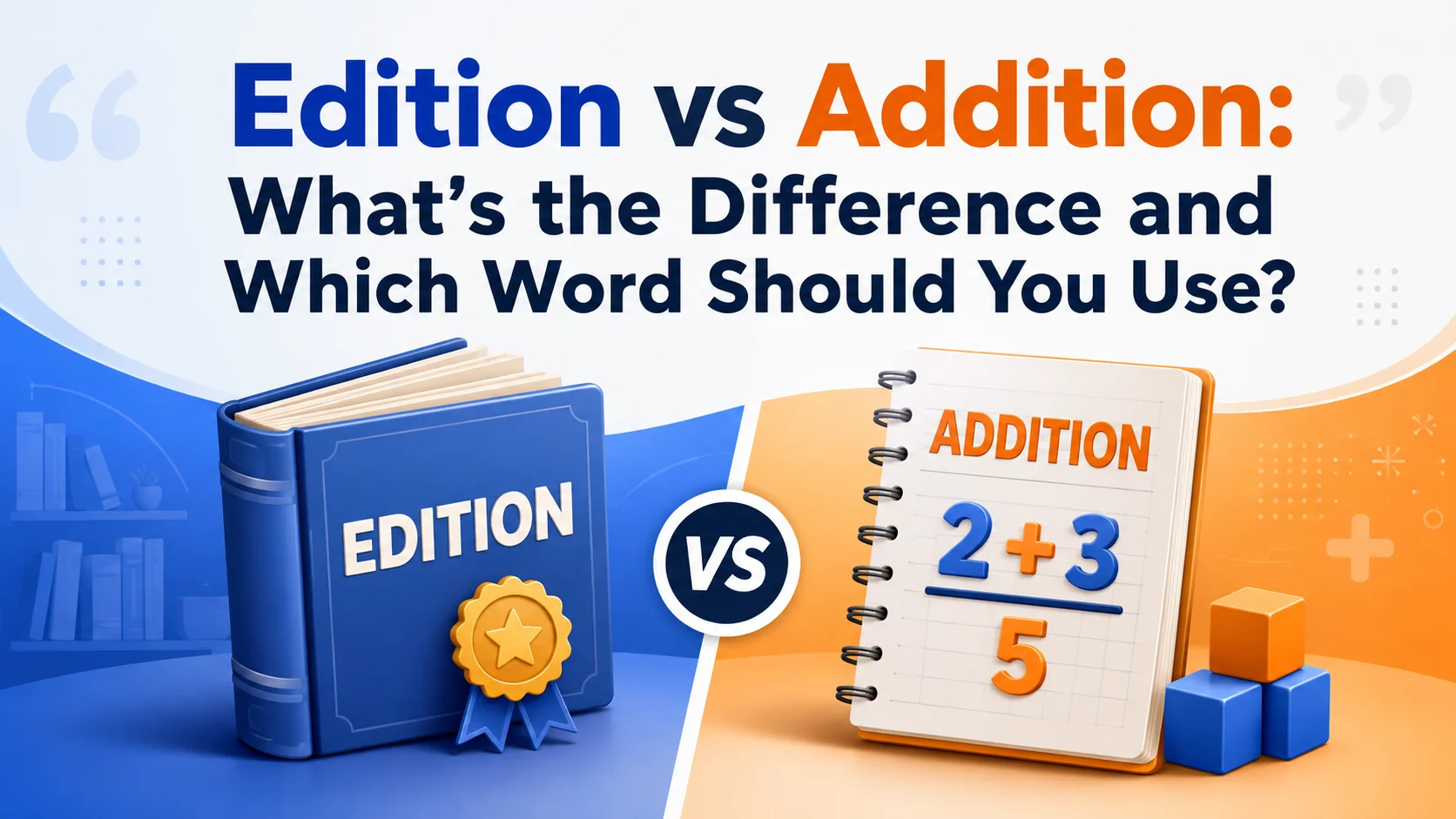
Edition vs addition can be confusing because the two words look and sound remarkably similar, but they describe completely different ideas. Addition is about adding something, while edition usually refers to a particular version of a book, publication, product, or recurring program.
The confusion becomes especially common in the phrase “in addition to.” If you have ever wondered whether to write “in edition to” or “in addition to,” the answer is straightforward: “in addition to” is the standard expression when you mean “as well as” or “besides.”
Once you connect each word to its core idea, the distinction becomes much easier. Think addition → add something and edition → a particular version. This guide explains both meanings, shows how they work in real sentences, examines common mistakes, and gives you practical tests for choosing the right word quickly.
Edition vs Addition: The Quick Answer
The simplest distinction is:
- Addition means something that is added, the act of adding, or the mathematical process of combining numbers.
- Edition means a particular version or form of a published work, such as a book, newspaper, or magazine.
- In addition it means “as well as” or “besides.”
- In addition to is generally not the expression you want when making this kind of sentence.
Consider these examples:
In addition to her regular classes, Maya takes an evening course.
Here, addition expresses the idea that one activity is being added to another.
Now compare:
I bought the latest edition of the textbook.
Here, the edition identifies a particular published version of the book.
The words are therefore not interchangeable. Cambridge defines addition in several senses, including something added and the process of adding numbers, while edition refers to a particular form in which a book, magazine, or newspaper is published, among other related uses.
Addition and Edition Mean Different Things
What Does “Addition” Mean?
Addition is a noun connected with the idea of putting something together with something else.
It has three especially useful meanings.
First, it can describe something that has been added:
The new playground is a welcome addition to the neighborhood.
Second, it can describe the act or process of adding:
The addition of extra examples made the lesson easier to understand.
Third, in mathematics, addition means combining numbers to find a total:
Addition is one of the basic arithmetic operations.
Cambridge also gives addition the meaning of a new person joining a group, as in “the newest addition to the team.”
So the central idea remains consistent: something is being added or combined.
What Does “Edition” Mean?
Edition usually identifies a particular version of something that has been published or released.
For example:
I need the third edition of the textbook.
She bought the paperback edition instead of the hardback.
The newspaper’s regional edition contains local stories.
The word is especially common with books, newspapers, magazines, and other publications. It can also refer to a particular broadcast of a continuing radio or television program. In American English, edition can additionally describe one occurrence in a series of repeated events.
The important idea is version or particular release, not simply “something added.”
Why “Edition” Cannot Usually Replace “Addition”
Imagine that your teacher gives you a textbook and later includes three new chapters.
If you are talking about the new chapters themselves, you could call them an addition:
The three new chapters are a useful addition to the textbook.
If the publisher releases a new version of the entire textbook containing those chapters, that published version may be a new edition:
The publisher released a revised edition of the textbook.
The two concepts can therefore appear in the same situation without meaning the same thing.
The addition of three chapters led to a new edition of the textbook.
That sentence demonstrates the distinction perfectly: addition describes what was added; edition describes the resulting version.
“In Addition To” Is the Correct Phrase
One of the most important things to remember is that the familiar phrase is in addition to, not in edition to.
Cambridge defines in addition to as meaning “as well as,” while in addition can introduce another point in a sentence.
What “In Addition To” Means
Use in addition to when you want to say that something is included alongside something else.
For example:
In addition to English, she studies French.
This means she studies English and French.
Another example:
In addition to his salary, he receives a transportation allowance.
The transportation allowance exists alongside his salary.
The phrase works in everyday conversation, professional writing, academic prose, and formal documents.
How to Use “In Addition To” in a Sentence
A useful pattern is:
in addition to + noun
In addition to the report, we submitted the supporting documents.
You can also use a pronoun:
In addition to her, two other students volunteered.
And you can use a gerund:
In addition to working full-time, he studies at night.
That last structure is particularly important. After a preposition such as to in in addition to, a following verb normally appears in its -ing form, not the base form.
So:
✅ In addition to working late, she answered emails.
Not:
❌ In addition to work late, she answered emails.
“In Edition To” vs “In Addition To”
If your intended meaning is “as well as” or “besides,” use “in addition to.”
| If you mean… | Use… | Example |
| as well as | in addition to | In addition to math, he studies science. |
| besides | in addition to | In addition to the fee, there is a service charge. |
| another point | in addition | In addition, the results were unexpected. |
| a particular publication/version | edition | I bought the latest edition. |
A simple substitution test works well: if “as well as” fits your sentence, in addition to is probably the expression you need.
Addition vs Edition at a Glance
| Feature | Addition | Edition |
| Basic idea | Something added | A particular version |
| Part of speech | Noun | Noun |
| Common context | Adding things, people, information, mathematics | Books, newspapers, magazines, broadcasts, releases |
| Common phrase | in addition to | latest edition |
| Example | The new employee is a valuable addition. | I bought the latest edition. |
| Related word | add | edit |
| Main question | “What was added?” | “Which version?” |
The table gives you a useful mental shortcut, but context matters. Edition has several specialized uses, and addition is not limited to physical objects.
How to Use “Addition” Correctly
Addition Meaning “Something Added”
When a new person, feature, item, or piece of information becomes part of an existing whole, addition is often the natural choice.
The new employee is a valuable addition to the team.
The photographs are a useful addition to the report.
The balcony is a beautiful addition to the house.
Notice the common structure:
a/an + addition + to + noun
Examples:
- an addition to the collection
- a useful addition to the website
- a new addition to the family
- an important addition to the project
This construction is different from in addition to.
Compare:
The new chapter is an addition to the book.
versus:
In addition to the new chapter, the author added several illustrations.
The first identifies something that was added. The second means “besides.”
Addition in Mathematics
In mathematics, addition has a specific technical meaning: combining numbers or quantities to obtain a total. Cambridge lists this as one of the standard meanings of the noun.
For example:
8 + 7 = 15
You could say:
The students are learning addition and subtraction.
This mathematical meaning makes addition particularly easy to connect with the verb add.
Common Expressions With “Addition”
Several expressions deserve special attention.
In addition
The hotel is affordable. In addition, it is close to the station.
In addition to
In addition to the hotel, we considered several apartments.
An addition to
The new café is a welcome addition to the neighborhood.
These structures are related but grammatically different.
A useful distinction is:
- in addition = additionally
- in addition to + noun/gerund = as well as
- an addition to + noun = something added to something else
How to Use “Edition” Correctly
Book and Publication Editions
The word edition is especially common when a work is published in different forms or at different stages.
You might see:
- first edition
- second edition
- revised edition
- new edition
- paperback edition
- hardback edition
- abridged edition
- special edition
For example:
The revised edition includes three new chapters.
I prefer the paperback edition because it is lighter.
The library has a rare first edition of the novel.
Cambridge specifically defines editions in relation to particular forms of books, magazines, and newspapers.
Product and Special Editions
Edition can also identify a distinct release or form of a product.
For example:
The company released a special edition of the device.
The collector bought the limited edition.
The key point is that the product has been presented as a particular version or release. Calling it an edition does not simply mean that something has been added.
Edition in Newspapers, Magazines, and Media
Newspapers provide especially clear examples:
Did you read today’s edition of the newspaper?
The regional edition contains additional local coverage.
An edition can also refer to a particular broadcast in a series:
Tonight’s edition of the program begins at eight.
These uses are established dictionary meanings rather than informal extensions.
The Most Common “Addition vs Edition” Mistakes
Mistake 1: Writing “In Edition To”
This is the most direct error behind the phrase “in edition (addition) to.”
Incorrect:
❌ In edition to my classes, I work part-time.
Correct:
✅ In addition to my classes, I work part-time.
The reason is semantic. The sentence means “besides my classes,” so addition is the appropriate word.
Mistake 2: Confusing “An Addition” With “An Edition”
Consider:
The newest addition to the series is a bonus chapter.
Here, something has been added.
Now:
The newest edition of the book contains a bonus chapter.
Here, the sentence identifies a particular version of the book.
Both words can describe the same general situation, but they focus on different things.
Mistake 3: Using “Edition” When You Mean “Added”
Incorrect:
❌ The new employee is the latest edition to our team.
Correct:
✅ The new employee is the latest addition to our team.
A person joining a team is an addition, not an edition.
Mistake 4: Using “Addition” When You Mean “Version”
Incorrect:
❌ I bought the newest addition of the textbook.
Correct:
✅ I bought the newest edition of the textbook.
The reader is asking for a particular published version, so edition is the appropriate noun.
Mistake 5: Confusing “In Addition” and “In Addition To”
These two expressions are closely related but should not be treated as identical.
In addition, the company provides free training.
Here, in addition, introduces another statement.
In addition to free training, the company provides mentoring.
Here, in addition to is followed by a noun phrase.
This distinction becomes especially useful in formal writing because it helps you build cleaner sentence structures.
Addition vs Edition in Real-World Contexts
At School and University
Students encounter both words frequently.
Use addition when talking about:
- adding numbers
- adding information
- adding examples
- adding a person to a group
The final paragraph is a useful addition to the essay.
Use edition when referring to a textbook or published source:
Please use the fourth edition of the textbook.
At Work
Professional writing often uses addition when discussing people, features, costs, or information:
The new analyst is a valuable addition to the team.
In addition to the presentation, we need a written summary.
Edition is more likely to appear when discussing publications or particular releases:
Please check the latest edition of the industry report.
In Everyday Conversation
The distinction becomes intuitive when you focus on the object of the sentence.
The puppy is the newest addition to the family.
I bought the newest edition of the cookbook.
The puppy was added to the family. The cookbook is a particular version of a publication.
In Formal and Academic Writing
In addition, it is especially useful when you want to connect related information without creating another sentence.
For example:
In addition to analyzing the survey results, the researchers interviewed participants.
The phrase lets the writer add a second activity while keeping the relationship between the two actions clear.
“In Addition,” “In Addition To,” and “Addition To” — What’s the Difference?
| Expression | Function | What follows it? | Example |
| in addition | Adds another statement | Usually a clause | In addition, the report includes photographs. |
| in addition to | Means “as well as” | Noun, pronoun, or -ing form | In addition to photographs, the report includes charts. |
| an addition to | Names something that was added | Noun | The chart is an addition to the report. |
In Addition
Use in addition when you want to introduce another point.
The course is inexpensive. In addition, it is available online.
In Addition To
Use in addition to when one thing exists alongside another.
In addition to the online course, students receive printed materials.
An Addition To
Use an addition to when referring to the actual thing that has been added.
The new chapter is an addition to the revised textbook.
This three-way distinction prevents a surprising number of mistakes.
Edition, Version, Issue, and Addition: Choosing the Right Word
Several related words can overlap, but they are not interchangeable.
| Word | Core idea | Example |
| Addition | Something added | The new chapter is an addition. |
| Edition | A particular published/released form | I bought the second edition. |
| Version | A particular form or variation | Install the latest version. |
| Issue | A particular publication or instance | I read the June issue. |
| Supplement | Material added to provide extra information | The magazine included a travel supplement. |
Edition vs Version
Version is broader. You can talk about a version of software, a plan, a document, an argument, or a product.
Edition is strongly associated with publications and particular releases or forms.
the latest version of the software
the latest edition of the textbook
Sometimes a product may use edition as a marketing or release label, but the two words still carry different conventional associations.
Edition vs Issue
For periodicals, issue often refers to one particular publication in a series:
the June issue of the magazine
Edition can refer to a particular form or regional/daily publication:
the evening edition of the newspaper
The exact terminology depends on the publication and its conventions.
Addition vs Supplement
A supplement is specifically extra material provided alongside a main publication or resource.
An addition is much broader. It can be any person, thing, feature, or information added to something else.
British English vs American English: Is There Any Difference?
The core distinction between addition and edition does not change between British and American English.
Both varieties use:
- addition for something added
- edition for a particular version or publication
- in addition to for “as well as”
There can be differences in specialized publication terminology, but they do not turn in addition to into in edition to.
One useful regional distinction is that Cambridge notes an American use of edition for one of a series of repeated events, while its main British dictionary entry emphasizes books, newspapers, broadcasts, and similar contexts.
For ordinary writing, however, you do not need to memorize a British-versus-American rule. The basic meanings remain stable.
Pronunciation and Spelling: Why Do “Addition” and “Edition” Get Confused?
The two words share the ending -dition, which makes them visually similar.
Their initial sounds are different:
- addition: /əˈdɪʃ.ən/
- edition: /ɪˈdɪʃ.ən/
Cambridge gives these pronunciations for both words.
For learners, spelling can be easier to remember through the words they connect to:
addition → add → adding
edition → edit → edited version
That is not a complete etymological explanation of edition, but it is a useful practical memory aid.
A Simple Spelling and Meaning Memory Trick
Ask yourself:
Am I adding something, or am I naming a version?
If you are adding, choose addition.
If you are talking about a version, choose edition.
And if your sentence means “as well as,” the phrase is almost certainly:
in addition to
This test is faster and more reliable than trying to remember which spelling “looks right.”
How to Decide Between “Addition” and “Edition” in Seconds
Use this four-question decision process.
1. Does the sentence mean “something was added”?
Choose addition.
The new feature is a useful addition to the app.
2. Does the sentence mean “a particular version”?
Choose edition.
The publisher released a revised edition.
3. Does the sentence mean “as well as” or “besides”?
Choose in addition to.
In addition to English, she speaks Spanish.
4. Are you talking about a mathematical operation?
Choose addition.
The lesson covers addition and subtraction.
A compact decision rule is:
Added thing = addition. Particular version = edition. “As well as” = in addition to.
Correct the Sentence: Addition or Edition?
Here are some realistic examples that show how the distinction works.
| Incorrect | Correct | Why |
| In edition to my studies, I work. | In addition to my studies, I work. | Means “as well as.” |
| The newest addition of the textbook is useful. | The newest edition of the textbook is useful. | Refers to a version. |
| She is the latest edition to the team. | She is the latest addition to the team. | A person has joined the team. |
| The new chapter is an edition to the book. | The new chapter is an addition to the book. | A chapter was added. |
| Read the revised addition of the manual. | Read the revised edition of the manual. | The manual has a particular version. |
Why Each Correction Is Correct
The easiest way to correct these sentences is not to look at spelling first. Look at the intended meaning.
If the writer means besides, use in addition to.
If the writer means a new thing that has been included, use addition.
If the writer means a particular published form, use edition.
This meaning-first approach is more dependable than memorizing isolated sentences.
Common Misconceptions About Edition and Addition
“Edition” Means Anything That Has Been Edited
Not necessarily.
An edition can be a particular published form, but the word is not simply a synonym for edited material. A book’s edition identifies a particular form or publication, often distinguished from earlier editions by revisions, format, or publication details.
“Addition” Only Belongs to Mathematics
No.
Mathematics has one important meaning, but addition also refers to something added, a new member of a group, or the act of adding something to something else.
“In Addition To” Is Too Informal for Professional Writing
It is not.
In addition to is a standard English expression used in formal, academic, business, and everyday contexts. Cambridge explicitly defines it as meaning “as well as.”
“Edition” and “Version” Always Mean Exactly the Same Thing
They can overlap, but they are not universally interchangeable.
Version is broader, while edition is strongly associated with particular published forms and certain types of releases.
Practical Editing Checklist
Before submitting an essay, email, report, or article, run through this quick check:
- Do I mean something added? Use addition.
- Do I mean a particular published version? Use edition.
- Do I mean as well as/besides? Use in addition to.
- Am I talking about a textbook’s release? Consider the edition.
- Am I talking about a new person joining a group? Use addition.
- Am I talking about a mathematical operation? Use addition.
- Have I accidentally written “in addition to” when I mean “as well as”?
- If I wrote “new edition,” am I actually talking about a new version rather than merely something added?
Expert tip: When proofreading, replace addition or edition temporarily with a plain-English phrase such as “something added” or “a particular version.” If
Conclusion
The difference between addition and edition becomes simple once you stop focusing on their similar spelling and focus on their meanings. Addition is connected with adding: a new person, object, feature, piece of information, or the mathematical process of combining numbers. Edition, by contrast, identifies a particular version or form, especially of a book, newspaper, magazine, broadcast, or similar publication. One final actionable tip: when you are unsure, ask whether you mean “something added” or “a particular version.” That quick question will solve most cases immediately. A common mistake to avoid is writing “in addition to” when you mean “as well as.” In that situation, the correct phrase is “in addition to.” Once these three ideas—addition, edition, and in addition to—are separated in your mind, choosing the right word becomes almost automatic.
the sentence still makes sense, you have probably chosen the right word.
Frequently Asked Questions
Q1. Is “in edition to” correct English?
Usually, no. If you mean “as well as” or “besides,” the standard phrase is “in addition to.” For example, “In addition to English, she studies Spanish.” Edition is normally used for a particular version or form of a publication, such as a revised edition of a book.
Q2. What is the easiest way to remember addition vs edition?
Connect each noun with a related idea: addition → add something, while edition → a particular version or publication. If your sentence means “as well as,” remember the fixed expression in addition to. This meaning-based approach is more useful than relying only on spelling.
Q3. Is it “the newest addition” or “the newest edition”?
Both can be correct, but they mean different things. The newest addition is something newly added to a group or collection. The newest edition is the latest version of a publication or similar work. Compare “newest addition to the team” with “newest edition of the textbook.”
Q4. Is “edition” a noun or a verb?
Edition is a noun. It names a particular form, publication, or release. The related verb is edit, as in “The editor edited the manuscript.” Addition is also a noun, while its related verb is add. Knowing these word families can make the distinction easier to remember.
Q5. What is the difference between “in addition” and “in addition to”?
In addition, I can introduce another statement: “In addition, the report includes photographs.” In addition, it means “as well as” and is followed by a noun, pronoun, or appropriate -ing form: “In addition to photographs, the report includes charts.”
