
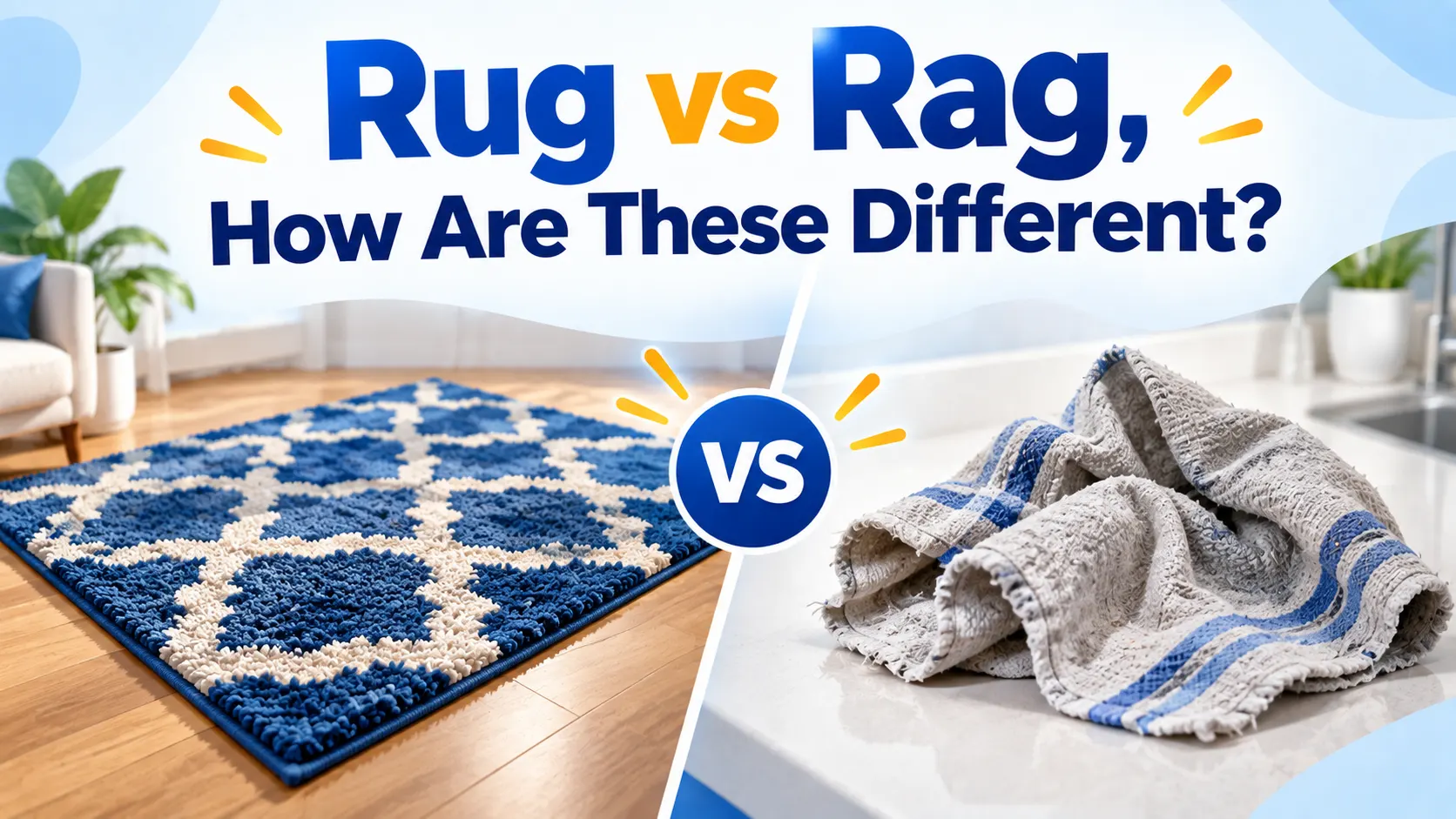
Rug vs rag, how are these different? The answer seems simple, but the two words can become confusing because both can involve fabric. A rug is generally a finished piece used to cover or decorate part of a floor, while a rag is typically an old or torn piece of cloth used for cleaning or other practical purposes. The distinction becomes especially interesting when you meet the phrase rag rug, because a rag can be the material used to make a rug. Understanding that relationship makes the vocabulary much easier to use accurately in everyday English.
The difference matters because English does not classify these objects by material alone. A piece of cotton can be a rag, a cloth, or part of a rug, depending on what it is and how it is being used. Oxford describes a rug as a piece of thick material used to cover or decorate part of a floor, while a rag is a piece of old, often torn cloth used especially for cleaning. Once you focus on purpose, construction, and context, the choice between rug and rag becomes much more predictable.
This guide explains rug vs rag from the ground up, then moves into the areas that commonly cause trouble: pronunciation, sentence usage, rag rugs, carpets and mats, regional English, related vocabulary, and common mistakes. You will also see practical examples showing why “I wiped the table with a rag” works but “I wiped the table with a rug” changes the meaning completely. By the end, you should be able to identify the right word quickly without relying on memorized rules. The key is not simply what an object is made of, but what role the object serves.
Rug vs Rag: The Difference in One Minute
The quickest way to separate these words is to think about what the object is for.
A rug is normally a finished floor covering. It covers or decorates part of a floor and is usually deliberately made in a particular shape, size, and design. Cambridge similarly defines a rug as a piece of thick or heavy cloth smaller than a carpet that is used for covering the floor or for decoration.
A rag, on the other hand, is generally a piece of old, torn, or unwanted cloth, especially one used for cleaning. Cambridge gives the example of keeping rags for cleaning a car, while Oxford describes a rag as old, often torn cloth used especially for cleaning things.
Rug vs Rag Quick Comparison
| Feature | Rug | Rag |
| Basic meaning | A floor covering | A piece of cloth |
| Main purpose | Covering or decorating part of a floor | Cleaning, wiping, polishing, or practical reuse |
| Typical condition | Usually finished and intentionally made | Often old, worn, torn, or unwanted |
| Shape | Usually deliberately shaped | Often irregular or simply cut from fabric |
| Common location | On a floor | In the hand or used on a surface |
| Can be made from fabric? | Yes | Yes |
| Can they be connected? | Yes, as in rag rug | Yes, rags can provide material for a rug |
The Simple Rule to Remember
Think:
Rug = something designed to cover part of a floor.
Rag = a piece of cloth, especially one used for cleaning or practical work.
There is one important qualification: a rag can be used to make a rug. That is why rag rug is perfectly normal English rather than a contradiction.
What Does “Rug” Mean?
In its most common everyday sense, rug refers to a piece of material used to cover or decorate part of a floor.
Oxford defines it as a piece of thick material like a small carpet used for covering or decorating part of a floor.
For example:
- We bought a new rug for the living room.
- The dog is sleeping on the rug.
- She placed a small rug beside the bed.
- The Persian rug added color to the room.
- Please roll up the rug before moving the furniture.
The word does not require a particular material. A rug may be made from wool, cotton, synthetic fibers, natural fibers, or combinations of materials.
Rug as a Floor Covering
The defining idea is function.
If a finished textile is intended to lie on a floor and cover or decorate part of that floor, rug is usually the natural word.
A rug can be:
- decorative
- practical
- soft and comfortable
- used for warmth
- used to define an area within a larger room
- placed indoors or outdoors, depending on the type
This is why material alone cannot determine the word.
A wool object could be a rug. A cotton object could be a rug. A synthetic object could be a rug.
The important question is: What is the finished object intended to do?
What Else Can “Rug” Mean?
The floor-covering meaning is the one most learners need, but rug has other senses.
Cambridge also records a rug as a soft cover that keeps someone warm or comfortable.
British English can therefore use rug in contexts involving a warm covering, such as a travel rug. Oxford also records an informal humorous use of rug meaning a toupee.
These meanings are context-dependent, so they should not distract you from the central distinction in this article.
What Does “Rag” Mean?
A rag is usually a piece of old or torn cloth, particularly one used for cleaning, wiping, polishing, or handling messy materials.
For example:
- I cleaned the window with a rag.
- He used an old rag to wipe the oil from his hands.
- Keep a few rags in the garage.
- She polished the table with a soft rag.
- The mechanic grabbed a rag to clean the tools.
Cambridge defines the cloth-related noun as a torn piece of old cloth and also uses rags for old or torn clothing.
Rag as an Old or Worn Piece of Clothing
The word can also describe clothing that is old, torn, or in poor condition.
For example:
- The clothes were little more than rags.
- The old jacket had become a rag.
This gives us expressions such as in rags, meaning dressed in very old or torn clothes.
Notice that rag does not necessarily mean “something used for cleaning” in every context. The broader idea is a piece of cloth, especially one that is old, torn, or being treated as a low-value material.
Other Meanings of “Rag”
Rag has several unrelated or extended meanings.
For example, informal English can use rag for a newspaper considered poor quality. British English also uses rag for certain student charity events.
There is also a verb rag, meaning to tease or make fun of someone in some varieties of informal English; Oxford labels this use old-fashioned.
These meanings show why context matters. When someone says, “I need a rag,” the cloth meaning is usually obvious from the situation. When rag appears in another context, it may mean something entirely different.
Rug vs Rag: The Core Difference
The biggest difference is function.
A rug is normally a finished object intended for use on a floor. A rag is normally a piece of cloth being used or kept for a practical purpose such as wiping or cleaning.
Purpose Is the Biggest Difference
Compare these two sentences:
We put a rug in front of the sofa.
We wiped the spill with a rag.
The materials could theoretically overlap. Both objects might contain cotton, Both might be woven, Both might be soft.
Their roles, however, are different.
The first object belongs to the category of floor coverings. The second belongs to the category of cleaning cloths.
Structure and Construction
A rug is usually a deliberately finished object.
It normally has:
- a defined shape
- a planned size
- an intended location
- a finished surface
- a specific purpose
A rag may simply be a piece cut or torn from an old shirt, towel, sheet, or other fabric.
That does not mean every rag is literally torn. A cleaning cloth can be neatly cut and still be called a rag. Likewise, an old rug does not automatically become a rag just because it is worn.
Size Does Not Decide the Word
A common misconception is that rugs must be large and rags must be small.
That is not a reliable rule.
A tiny decorative rug can still be a rug.
A relatively large piece of old cloth can still be a rag if it is being used as one.
The object’s purpose and conventional category matter more than its dimensions.
Condition Matters, But It Is Not Everything
Rags are commonly associated with old, worn, or torn fabric. Dictionaries explicitly include that idea.
But a rug can also become dirty, damaged, faded, or worn.
You would still normally call it a rug if it remains a floor covering.
So:
- old rug → still potentially a rug
- dirty rug → still a rug
- torn piece of cloth used for cleaning → rag
- new cleaning cloth → may be called a cloth rather than a rag
This is one reason simple definitions are more useful than rigid physical rules.
Rug vs Rag in Everyday Sentences
Seeing the words in realistic sentences is one of the fastest ways to understand the distinction.
Examples With “Rug”
- The children were playing on the rug.
- We placed a colorful rug under the coffee table.
- The cat scratched the rug.
- She bought a wool rug for the bedroom.
- Please move the rug before painting the floor.
In each sentence, the object has a relationship with the floor.
Examples With “Rag”
- He wiped the counter with a rag.
- Use a clean rag to polish the glass.
- She kept old T-shirts to use as rags.
- The mechanic wiped his hands on an oily rag.
- I need a rag to clean this paintbrush.
Here the fabric is being used as a practical tool.
Side-by-Side Examples
| Rug | Rag |
| The rug is under the dining table. | The rag is beside the sink. |
| She vacuumed the rug. | She washed the rag. |
| The rug has a floral pattern. | The rag is covered in paint. |
| We bought a new rug. | We used an old shirt as a rag. |
| The dog is sleeping on the rug. | The worker wiped the machine with a rag. |
A Useful Context Test
When you are unsure, ask:
Is this object functioning as a floor covering?
If yes, rug is probably right.
Is it a piece of cloth being used to wipe, clean, polish, or handle something?
If yes, rag is probably right.
This test is more dependable than asking whether the material is cotton, wool, or another type of fabric.
Why “Rug” and “Rag” Are Sometimes Confused
The words are visually similar:
- rug
- rag
They are both short, one-syllable nouns beginning with r and ending in g. The main difference is the vowel sound.
That small spelling difference can be easy to miss when reading quickly.
There is another source of confusion: both words can involve cloth.
A learner may reason:
“A rug is made of cloth, and a rag is cloth, so perhaps they mean the same thing.”
They do not.
English often has several words for objects made from similar materials because those words describe different functions or categories.
For example, wood can become a chair, table, shelf, or door. The material does not determine the object’s name.
The same principle applies here.
What Is a Rag Rug?
Rag rug is the phrase that causes the most confusion.
Oxford defines a rag rug as a rug made from small pieces of cloth.
That gives us a simple grammatical relationship:
- rag describes the material or fabric pieces
- rug describes the finished object
So a rag rug is a rug made from rags or pieces of cloth.
How a Rag Becomes a Rug
Old fabric can be reused to create a finished floor covering through methods such as:
- weaving
- braiding
- crocheting
- knotting
- stitching pieces together
Once those pieces have been deliberately constructed into a floor covering, the resulting object can be called a rag rug.
The important point is that the two words are describing different aspects of the same object.
Why “Rag Rug” Is Not a Contradiction
Consider:
We made a rag rug from old clothes.
There is no contradiction.
The finished item is a rug.
The material came from rags or pieces of old cloth.
This is similar to compounds in English where one word identifies the material, source, or type and the other identifies the finished object.
rag + rug = a rug made from cloth pieces
That distinction is especially useful for English learners because it explains why rag and rug are not interchangeable even though they appear together in the compound.
Rug vs Carpet vs Mat: How Are They Different?
These words belong to the same general vocabulary area, but they are not interchangeable in every context.
Rug vs Carpet
A rug usually covers part of a floor and is often movable.
A carpet can also cover a floor, but the word is commonly associated with a larger floor covering and, depending on the context, a covering that extends across most or all of a room.
Oxford specifically describes a rug as something like a small carpet used to cover or decorate part of a floor.
Compare:
- We put a rug beneath the coffee table.
- The bedroom has wall-to-wall carpet.
The boundary is not an absolute measurement. Everyday speakers may use the terms somewhat differently depending on the type of floor covering and regional vocabulary.
Rug vs Mat
A mat is often smaller and more specifically functional.
Examples include:
- doormat
- bath mat
- kitchen mat
- exercise mat
A rug can also be functional, but rug often carries a stronger association with floor decoration or a substantial textile floor covering.
For example:
There is a mat outside the door.
sounds more natural than:
There is a rug outside the door.
But:
There is a rug in the living room.
is completely ordinary.
Quick Vocabulary Comparison
| Word | Typical meaning | Example |
| Rug | A floor covering that usually covers part of a floor | A patterned rug in the living room |
| Carpet | A larger floor covering, often covering much more of a room | Carpet covering the bedroom floor |
| Mat | A usually smaller floor covering with a particular practical purpose | A bath mat |
| Rag | A piece of cloth, often old or torn, used especially for cleaning | A rag for wiping the table |
| Cloth | A general term for material or a piece of fabric | A soft cleaning cloth |
Related Words You Should Know
Understanding nearby vocabulary prevents you from forcing rug or rag into situations where another word is more natural.
Rug, Carpet, Mat, and Runner
A runner is a long, narrow floor covering commonly used in hallways, stairs, or narrow spaces.
So you might hear:
- hallway runner
- area rug
- Persian rug
- bath mat
- wall-to-wall carpet
These terms describe different types or uses of floor coverings.
Rag, Cloth, Towel, Wipe, and Cleaning Cloth
A cloth is broader than rag.
You can have:
- a cleaning cloth
- a polishing cloth
- a dishcloth
- a microfiber cloth
- an old rag
Calling something a rag can suggest that it is old, worn, disposable, or being used for a messy job.
A towel has a more specific function, usually involving drying.
A wipe often refers to a disposable or specially manufactured piece used for cleaning.
Fabric vs Rag
Fabric usually describes the material itself.
Rag describes a piece of cloth, especially one that is old, torn, discarded, or being used practically.
For example:
The dress is made from cotton fabric.
He used a cotton rag to clean the machine.
The material can be similar, but the nouns serve different purposes.
Common Mistakes With Rug and Rag
Mistake 1: Using “Rag” for Any Floor Covering
Incorrect:
I bought a new rag for my bedroom floor.
If you mean a decorative floor covering, the natural word is rug.
Correct:
I bought a new rug for my bedroom.
Mistake 2: Assuming Every Old Cloth Is a Rug
An old piece of fabric sitting in a garage is not automatically a rug.
If it is being used to wipe oil from a machine, rag is the natural word.
Correct:
He grabbed an old rag to clean the engine.
Mistake 3: Thinking “Rag Rug” Is Wrong
Some learners see rag rug and assume the two words contradict each other.
They do not.
A rag rug is specifically a rug made from pieces of cloth. Oxford explicitly lists the term and defines it in this way.
Mistake 4: Thinking Size Determines the Word
A small rug is still a rug.
A large piece of old cloth can still be a rag.
There is no universal size threshold that changes one word into the other.
Mistake 5: Choosing the Word Based Only on Material
This is perhaps the most useful lesson.
Do not ask only:
“What is it made of?”
Ask:
“What is this object being used as?”
That question usually points you toward the correct word.
How to Choose Between Rug and Rag in Real Situations
Use this practical decision guide.
| Situation | Most natural word | Why |
| Decorative covering under a coffee table | Rug | It is a finished floor covering |
| Cloth used to wipe a spill | Rag | It is being used for cleaning |
| Old shirt cut into cleaning pieces | Rag | The fabric has been repurposed |
| Handwoven floor covering made from fabric scraps | Rag rug | The finished item is a rug made from cloth pieces |
| Small covering beside a bathtub | Usually mat | Its function is specific and the term is conventional |
| Large textile covering most of a room | Usually carpet | It is a larger floor covering |
| Patterned textile placed under a dining table | Rug | It covers and decorates part of the floor |
If It Covers the Floor
Choose rug when the object is intentionally serving as a floor covering.
The rug is underneath the dining table.
If It Wipes Something
Choose rag when the object is a piece of cloth being used for cleaning or wiping.
Use a rag to clean the spilled paint.
If It Is Made From Old Fabric and Covers the Floor
Choose rag rug.
She made a rag rug from strips of old fabric.
If Another Term Is More Specific
Sometimes neither word is the best choice.
For example, if you mean a specially designed object for drying your feet after a shower, bath mat is more precise than either rug or rag.
Good vocabulary is not only about avoiding wrong words. It is also about choosing the most natural and specific word for the situation.
Pronunciation: Rug vs Rag
The pronunciation difference is small but useful.
How to Pronounce “Rug”
Rug is pronounced /rʌɡ/. Cambridge gives this pronunciation in both British and American English.
The vowel is the same general sound heard in words such as:
- cup
- luck
- sun
- much
How to Pronounce “Rag”
Rag is pronounced /ræɡ/. Cambridge gives /ræɡ/ for both British and American English.
The vowel is the sound heard in words such as:
- cat
- bag
- map
- black
A Simple Pronunciation Practice
Say these pairs slowly:
- rug — rag
- bug — bag
- hug — hag
- tug — tag
The final consonants remain similar while the vowel changes.
For English learners, hearing the vowel distinction can make the spelling distinction easier to remember.
Are Rug and Rag Different in British and American English?
The core distinction is shared across British and American English.
Cambridge lists rug with /rʌɡ/ in both varieties and rag with /ræɡ/ in both varieties.
So this is not a case like:
- colour vs color
- centre vs center
There is no British-versus-American spelling choice where one country prefers rug and another prefers rag.
The words have different meanings, regardless of the variety of English.
There can be regional differences in related vocabulary. For example, terms for particular types of floor coverings may vary in frequency or preference. But that does not turn rug and rag into regional alternatives for the same object.
The Word Origins of Rug and Rag
The history of these words provides an interesting explanation for their apparent similarity.
Oxford traces rug to the mid-16th century, originally referring to a type of coarse woollen cloth, with a probable Scandinavian connection. Oxford notes that the “small carpet” sense developed later, in the early 19th century.
For rag, Oxford gives a different historical development for the cloth-related noun, tracing it to Middle English and suggesting a back-formation from ragged or raggy.
There is therefore a historical connection worth noticing: the words have both been associated with cloth or rough material, but they developed into distinct modern vocabulary items.
This is a useful reminder that similar-looking words are not necessarily synonyms.
Idioms and Expressions With “Rug” and “Rag”
Although the main purpose of this article is the physical meanings, both words occur in established expressions.
Expressions With “Rug”
Pull the rug out from under someone’s feet means to suddenly take away someone’s support or advantage. Oxford labels this informal.
Example:
The sudden policy change pulled the rug out from under the small business.
Another expression is:
Sweep something under the rug
This means trying to prevent people from discovering something embarrassing, wrong, or problematic. Oxford notes that North American English commonly uses sweep something under the rug, while sweep something under the carpet is also used.
Expressions With “Rag”
In rags means wearing very old or torn clothes.
Rags to riches describes a movement from extreme poverty to great wealth.
British informal English also has lose your rag, meaning to become angry.
These expressions are worth learning separately because their meanings cannot always be understood simply by combining the literal meanings of the individual words.
A Practical Proofreading Test
If you are writing and hesitate between rug and rag, use this three-step check.
Step 1: Identify the Object
Ask what you are actually describing.
Is it:
- a finished floor covering?
- a piece of cloth?
- a cleaning material?
- a mat?
- a carpet?
Step 2: Identify the Function
Ask what the object does.
Covers part of a floor → rug
Wipes or cleans something → rag
Covers a floor and is made from cloth scraps → rag rug
Step 3: Read the Sentence Naturally
Try replacing the noun mentally.
She wiped the window with a rug.
This sounds wrong because the intended object is a cleaning cloth.
She wiped the window with a rag.
That is natural.
Now:
The rag is underneath the sofa.
That sounds unusual if you mean a decorative floor covering.
The rug is underneath the sofa.
That works immediately.
This final context check is especially helpful because spell-checkers cannot always solve vocabulary mistakes. Both rug and rag are legitimate English words, so software may not flag the wrong one.
Expert tip: When two valid words look similar, do not rely on spelling correction alone. Check whether the meaning fits the sentence.
Rug vs Rag: A Quick Memory Trick
If you need a simple mental shortcut, remember:
Rug → rests on the floor.
Rag → used as a piece of cloth.
Then add the exception:
Rag rug → a rug made from pieces of cloth.
The memory trick is not a complete dictionary definition, but it is useful for everyday writing and conversation because it points you toward the correct semantic category.
Conclusion
Rug vs rag becomes straightforward once you stop focusing on the fact that both can involve fabric. A rug is normally a finished floor covering, while a rag is generally a piece of cloth used for cleaning, wiping, or practical reuse. The most useful distinction is therefore function rather than material or size. The phrase rag rug makes perfect sense because rag identifies the fabric source while rug identifies the finished floor covering. One final actionable tip: when choosing between the words, ask whether the object is covering a floor or being used as a piece of cloth. A common mistake to avoid is treating rag and rug as interchangeable simply because both can be made from fabric. In precise English, context tells you which noun belongs.
Frequently Asked Questions
Q1. Is a rag the same as a rug?
No. A rag is generally a piece of old, torn, or unwanted cloth, often used for cleaning, while a rug is a finished floor covering. The materials can overlap, but the words describe different objects based largely on purpose and use.
Q2. Why is it called a rag rug?
A rag rug is called that because the finished floor covering is made from small pieces of cloth or rags. Oxford defines a rag rug as a rug made from small pieces of cloth. Thus, rag describes the material and rug describes the finished object.
Q3. Can a rug be made from rags?
Yes. Old clothing or fabric pieces can be reused to create a rag rug through techniques such as weaving, braiding, crocheting, or stitching. However, once the material has been made into a finished floor covering, calling the completed object a rug is appropriate.
Q4. Is a small rug called a rag?
No. Size alone does not determine the word. A small decorative floor covering can still be a rug. A relatively large piece of old cloth can still be a rag if it is being used as a cleaning or utility cloth. Function and context are more useful clues.
Q5. What is the difference between a rug, carpet, and mat?
A rug generally covers part of a floor, while a carpet can cover a much larger area or an entire room. A mat is usually smaller and often has a specific practical function, such as a bath mat, doormat, or exercise mat. Exact usage can vary by context.
