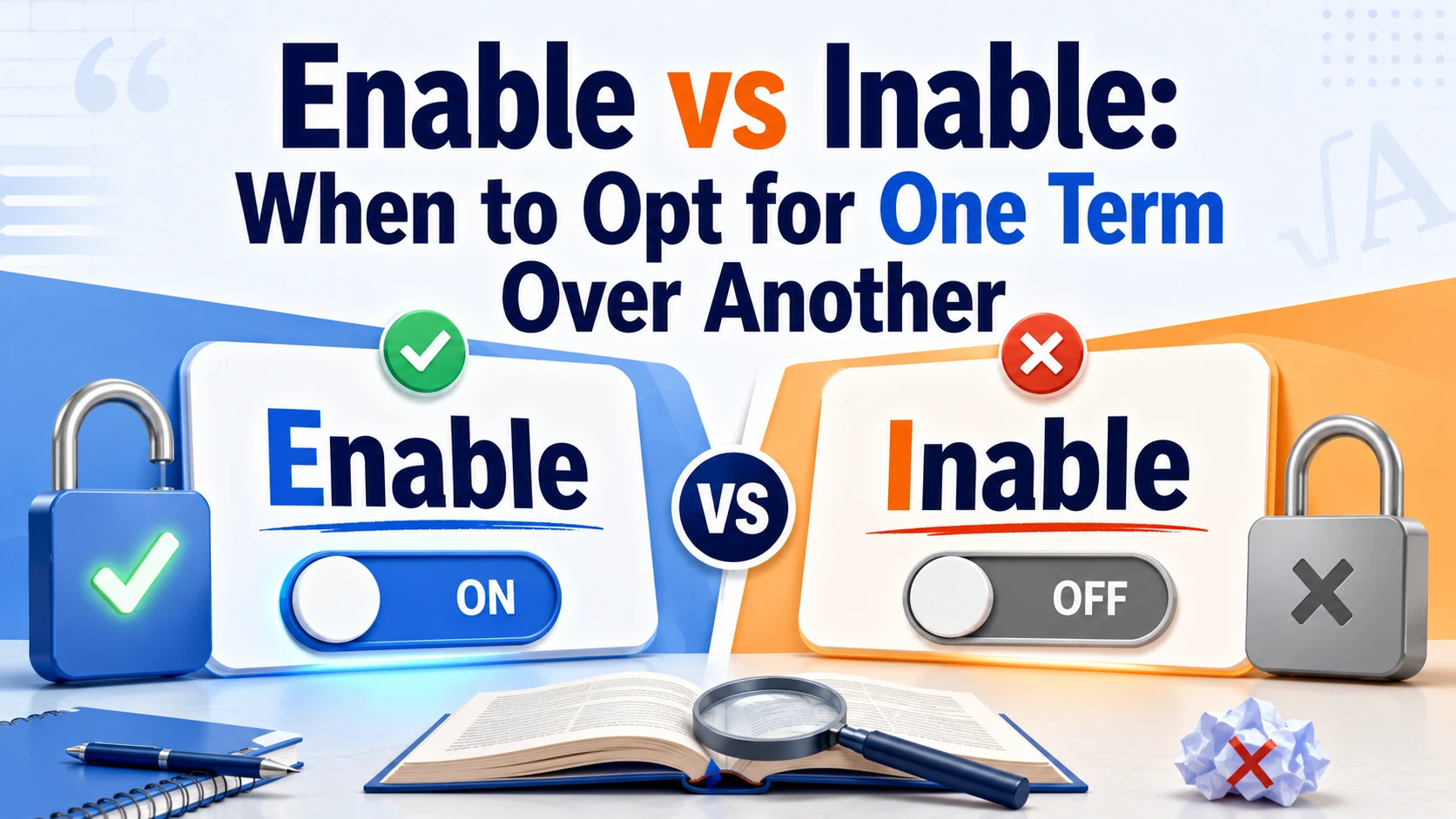
Enable vs Inable is a common word confusion that appears when writers try to understand how English prefixes change word meanings. At first glance, these two words seem like opposites, but modern English does not use them that way. Enable is a widely accepted and frequently used word, while inable is a rare historical form that most modern writers avoid. Understanding the difference helps you communicate more clearly in professional writing, academic work, technology discussions, and everyday conversations.
The confusion becomes stronger because many people assume that adding “in-” before “able” should create the opposite meaning of “enable.” However, English words do not always follow simple prefix rules. The correct negative form of able is unable, not inable. Meanwhile, enable means giving someone or something the ability, tools, permission, or conditions needed to complete an action.
In this article, you’ll learn exactly how enable and inable differ, why inable is rarely used today, how to use enable correctly in sentences, and how to avoid common mistakes. You’ll also see practical examples, comparisons, and writing tips that will help you choose the right word confidently.
Enable vs Inable: Quick Difference at a Glance
| Word | Meaning | Modern Usage | Example |
| Enable | To make something possible or give ability | Common and correct | The software enables users to edit documents. |
| Inable | A rare historical form meaning to make able | Almost never used today | The old text used “inable” instead of “enable.” |
| Unable | Not having the ability to do something | Common and correct | She was unable to complete the task. |
The easiest way to remember the difference:
- Enable = create ability
- Unable = lack ability
- Inable = outdated/rare form that should usually be avoided
What Does Enable Mean?
Definition of Enable
Enable is a verb that means to make something possible, provide the ability to do something, or give someone the resources needed to complete an action.
When you enable something, you are creating the conditions for success. You might provide knowledge, access, permission, technology, support, or tools.
For example:
- A teacher enables students to understand complex ideas.
- A smartphone feature enables users to communicate faster.
- Training enables employees to perform their jobs effectively.
The important idea behind enable is that something becomes possible because a person, system, or situation provides what is needed.
How Enable Is Used in Different Contexts
Enable in Everyday English
In daily conversations, enable often describes helping someone achieve a goal.
Examples:
- “The flexible schedule enabled me to spend more time with my family.”
- “The instructions enabled beginners to complete the project.”
- “The additional practice enabled her to improve her skills.”
In these examples, enable means more than simply helping. It suggests that something provided the ability or opportunity to accomplish an action.
Enable in Technology and Software
One of the most common modern uses of enable appears in technology.
You regularly see phrases like:
- Enable notifications
- Enable Bluetooth
- Enable cookies
- Enable location services
- Enable two-factor authentication
In technical situations, enable usually means activate or turn on a feature.
Example:
“You need to enable notifications if you want to receive updates from the application.”
The feature already exists, but enabling it makes it available for use.
Enable in Business and Professional Writing
Professionals often use enable when describing systems, improvements, and strategies.
Examples:
- “Automation enables businesses to reduce repetitive work.”
- “The new platform enables employees to collaborate remotely.”
- “Better training enables workers to make informed decisions.”
In professional communication, enable is often preferred because it sounds more precise than general words like “help” or “allow.”
What Does Inable Mean?
Definition of Inable
Inable is an uncommon and mostly obsolete word that historically meant to make able or to enable.
Although it appears in some older English writings, it is not considered normal modern usage. Most readers today will likely think “inable” is a spelling mistake.
For example:
Older style:
“The invention inabled people to communicate more easily.”
Modern English:
“The invention enabled people to communicate more easily.”
The second sentence is clearer and follows current English standards.
Why Is Inable Rare in Modern English?
The main reason inable disappeared from everyday use is language standardization.
Over time, English speakers and writers naturally selected enable as the preferred form because it was:
- More familiar
- Easier to understand
- More widely accepted
- More common in dictionaries and professional writing
Modern writers, editors, teachers, and businesses almost always choose enable instead of inable.
Is Inable the Opposite of Enable?
No. This is one of the most common misunderstandings.
Many people assume:
- Enable = make able
- Inable = make unable
But this is incorrect.
The correct relationship is:
| Meaning | Correct Word |
| To give ability | Enable |
| To remove ability | Disable |
| To lack ability | Unable |
Examples:
Enable:
“The administrator enabled the account.”
Meaning: The account was activated.
Disable:
“The administrator disabled the account.”
Meaning: The account was turned off.
Unable:
“The user was unable to access the account.”
Meaning: The user could not access it.
Enable vs Inable vs Unable: Understanding the Difference
Enable Means Creating Ability
When something enables a person or system, it provides the ability to do something.
Examples:
- “The scholarship enabled him to continue his education.”
- “The new software enabled faster data analysis.”
- “The training enabled employees to manage customer requests.”
The action becomes possible because something new has been provided.
Unable Means Having No Ability
Unable describes a situation where someone or something cannot perform an action.
Examples:
- “She was unable to attend the conference.”
- “The computer was unable to connect to the network.”
- “The team was unable to finish the project on time.”
Unlike enable, unable does not create a possibility. It describes a limitation.
Enable vs Unable: Comparison Table
| Feature | Enable | Unable |
| Word type | Verb | Adjective |
| Meaning | Make possible | Not capable |
| Purpose | Shows improvement or capability | Shows limitation |
| Example | The tool enables faster communication. | The tool was unable to connect. |
| Similar words | Allow, empower, activate | Incapable, powerless, unable |
How to Use Enable Correctly in a Sentence
Enable + Object + To + Verb
The most common structure is:
Enable + person/thing + to + action
Examples:
- “The course enabled students to improve their grammar.”
- “The app enables users to track expenses.”
- “The technology enabled doctors to diagnose problems faster.”
This structure clearly shows who gains the ability and what action becomes possible.
Enable + Noun
Sometimes enable is followed directly by a noun.
Examples:
- “Technology enables innovation.”
- “The system enables communication between teams.”
- “The policy enables greater flexibility.”
This style is common in business, academic, and technical writing.
Enable in Passive Voice
Enable is also frequently used in passive sentences.
Examples:
- “The feature was enabled automatically.”
- “Your account has been enabled.”
- “Cookies must be enabled to access this website.”
In these examples, the focus is on the feature or system rather than the person performing the action.
Why You Should Usually Avoid Using Inable
Although inable has existed historically, it is not a practical choice for modern communication. Using uncommon words can create unnecessary confusion, especially when a simpler and widely accepted alternative already exists.
Modern English values clarity and familiarity. When readers encounter a word they rarely see, they may stop to question whether the spelling is correct rather than focusing on the message itself.
For most situations, replace inable with one of these words:
| Intended Meaning | Better Word Choice | Example |
| Giving someone ability | Enable | The program enables users to manage their accounts. |
| Lacking ability | Unable | The employee was unable to complete the task. |
| Preventing something | Disable / Prevent | The settings disabled automatic updates. |
Using the correct modern term makes your writing smoother and easier to understand.
Common Mistakes When Choosing Between Enable and Inable
Mistake 1: Using Inable When You Mean Unable
This is the most frequent error.
Many writers see the word able and assume that adding “in-” creates the opposite meaning. However, English does not form the negative version of every word by simply adding prefixes.
Incorrect:
“I am inable to attend the meeting.”
Correct:
“I am unable to attend the meeting.”
The word unable already exists and is the standard way to express a lack of ability.
Why People Make This Mistake
The confusion happens because English contains many words where in- creates a negative meaning.
Examples:
- Accurate → Inaccurate
- Complete → Incomplete
- Visible → Invisible
Because of these examples, writers sometimes assume:
- Able → Inable
However, language develops through usage, not only through logical patterns. Some words follow these rules, while others do not.
Mistake 2: Confusing Enable With Allow
Many people use enable and allow as if they have exactly the same meaning. Although they can overlap, there is an important difference.
Allow means giving permission.
Enable means providing the ability or conditions needed.
Compare:
“The manager allowed employees to work from home.”
Meaning: The manager gave permission.
“The technology enabled employees to work from home.”
Meaning: The technology made remote work possible.
A person can allow something without enabling it.
For example:
- A company may allow remote work.
- But without proper software, communication tools, and systems, employees may not be enabled to work efficiently.
Mistake 3: Using Enable When Disable Is More Accurate
Because enable means activating or making possible, its opposite is often disable.
Incorrect:
“The update enabled the feature from working.”
Correct:
“The update disabled the feature.”
Examples:
- Enable notifications → Turn notifications on.
- Disable notifications → Turn notifications off.
Understanding this pair helps avoid unnecessary confusion.
Real-Life Examples of Enable Used Correctly
Examples of Enable in Technology
Technology is one of the areas where enable appears most frequently.
Examples:
- “Users must enable two-factor authentication for better account security.”
- “The settings allow you to enable automatic updates.”
- “The developer enabled a new payment option.”
In these cases, enable means activating a function or making a capability available.
Examples of Enable in Education
Education often focuses on creating opportunities, which makes enable a natural choice.
Examples:
- “Quality education enables students to develop critical thinking skills.”
- “The online course enabled learners to study at their own pace.”
- “Practical exercises enable students to apply theoretical knowledge.”
Here, education provides the ability to achieve a result.
Examples of Enable in Business
Businesses frequently use enable when discussing growth, productivity, and systems.
Examples:
- “The new software enables faster customer support.”
- “Employee training enables teams to solve problems independently.”
- “Data analysis enables companies to make better decisions.”
The word highlights how a tool, process, or resource creates capability.
Examples of Enable in Everyday Life
Enable is not limited to formal writing.
Examples:
- “The extra money enabled me to repair my car.”
- “Her advice enabled me to make a better decision.”
- “The map enabled us to find the location easily.”
Each sentence shows something providing the ability to complete an action.
Examples Showing Why Inable Sounds Incorrect Today
Because inable is unfamiliar to most modern readers, it often makes sentences sound unnatural.
Incorrect Examples
❌ “The machine was inable to complete the operation.”
Better:
✅ “The machine was unable to complete the operation.”
❌ “The new system inabled employees to work faster.”
Better:
✅ “The new system enabled employees to work faster.”
❌ “She was inable to understand the instructions.”
Better:
✅ “She was unable to understand the instructions.”
When Might You See Inable?
Although you should generally avoid using inable, there are a few situations where you may encounter it.
Historical Texts and Older Literature
Some older English writings used inable before enable became the dominant form.
If you are reading:
- Historical documents
- Old manuscripts
- Literature from earlier periods
you may find unusual spellings and vocabulary choices that are no longer common today.
Linguistic Research
Researchers studying the history of English may mention inable when discussing how words developed over time.
For example, a linguist might analyze how:
- Old word forms changed
- Prefixes evolved
- Modern spellings became standardized
In this context, the word is being studied rather than used in everyday writing.
Enable vs Inable in Professional Writing
Professional communication requires words that readers immediately understand.
Whether you are writing:
- A business report
- A website article
- A resume
- A research paper
- Technical documentation
- An email
enable and unable are the appropriate choices.
Using inable can create several problems:
| Problem | Why It Matters |
| Readers may think it is a typo | It reduces credibility |
| The meaning may be unclear | Communication becomes weaker |
| It sounds outdated | Modern writing usually avoids it |
A professional writer does not only choose grammatically possible words. They choose words that communicate effectively.
How to Remember the Difference Between Enable and Unable
A simple memory technique can prevent most mistakes.
Remember: Enable = Empower
Both words describe giving someone power, ability, or opportunity.
Examples:
- “The training enabled employees to succeed.”
- “The tools empowered employees to succeed.”
Both ideas are positive.
Remember: Unable = Cannot
If you can replace the word with cannot, use unable.
Examples:
“She was unable to finish the assignment.”
You can rewrite it:
“She could not finish the assignment.”
The meaning stays the same.
Quick Decision Guide: Which Word Should You Choose?
| Question to Ask | Correct Word | Example |
| Am I giving ability or making something possible? | Enable | This feature enables faster payments. |
| Am I saying someone cannot do something? | Unable | He was unable to join the call. |
| Am I turning a feature off? | Disable | The administrator disabled the account. |
| Am I writing modern English? | Avoid Inable | Use enable or unable instead. |
Enable vs Inable: Common Questions Writers Ask
Is Inable Technically a Word?
Yes, inable appears in some historical dictionaries and older writings, but it is not considered standard modern vocabulary. Most contemporary readers and editors prefer enable when expressing the idea of making something possible.
Can I Use Inable in Formal Writing?
You generally should not use inable in formal writing. Even if someone understands the intended meaning, the word may appear incorrect or outdated. Use enable or unable depending on the meaning you want to express.
What Is the Opposite of Enable?
The opposite depends on the context. If you mean stopping a feature, use disable, If you mean preventing an action, use prevent. If you mean someone lacks ability, use unable.
More Examples of Enable and Unable Used in Sentences
Understanding definitions is helpful, but seeing enable and unable in real sentences makes the difference much clearer. Since inable is rarely used in modern English, most examples focus on the words people actually use today.
The best way to identify the correct word is to look at the relationship between the subject and the action:
- If something creates the ability to do something, use enable.
- If someone or something cannot do something, use unable.
Examples of Using Enable in a Sentence
Enable Meaning “Make Something Possible”
When enable means making an action possible, it often describes a tool, opportunity, resource, or person that creates a new ability.
Examples:
- “The new software enables employees to complete reports faster.”
- “The scholarship enabled Maria to continue her education.”
- “The improved internet connection enables students to attend online classes.”
- “The training program enabled workers to develop new skills.”
- “The extra funding enabled the company to expand its services.”
In each sentence, something provides the ability or opportunity to achieve a result.
Enable in Technology Examples
Technology is one of the most common areas where people use enable.
Examples:
- “Please enable notifications to receive important updates.”
- “You need to enable Bluetooth before connecting your headphones.”
- “The administrator enabled access to the company database.”
- “The latest update enables users to customize their privacy settings.”
- “The security feature enables safer online transactions.”
In technical contexts, enable often means activate, switch on, or make available.
Enable in Business and Workplace Examples
In professional environments, enable often describes systems and strategies that improve performance.
Examples:
- “The new communication platform enables teams to collaborate from different locations.”
- “Automation enables businesses to reduce repetitive tasks.”
- “Better planning enables managers to make informed decisions.”
- “The company’s resources enable employees to solve problems independently.”
Here, enable emphasizes that a process or resource creates better capability.
Enable in Education Examples
Education is another area where enable is commonly used because learning creates new abilities.
Examples:
- “Good teachers enable students to think critically.”
- “Practical exercises enable learners to apply their knowledge.”
- “Technology enables students to access information more easily.”
- “The course enabled beginners to understand complex grammar rules.”
The focus is not simply on teaching information but on creating the ability to use that information.
Examples of Using Unable in a Sentence
Unable Meaning “Not Capable of Doing Something”
Unable describes a limitation, difficulty, or lack of ability.
Examples:
- “She was unable to attend the event because of a scheduling conflict.”
- “The computer was unable to complete the installation.”
- “He was unable to answer the question correctly.”
- “The team was unable to meet the deadline.”
- “The machine was unable to process the damaged file.”
In these sentences, no new ability is created. Instead, something prevents the action from happening.
Enable vs Unable: Sentence Comparison
| Situation | Correct Sentence | Meaning |
| Creating ability | The app enables users to manage their accounts. | The app gives users the ability. |
| Lack of ability | The app was unable to load the account information. | The app could not complete the action. |
| Providing opportunity | The program enabled students to learn online. | The program made learning possible. |
| Facing limitation | The student was unable to access the online class. | The student could not access it. |
Common Sentence Patterns With Enable
Learning common structures can help you use enable naturally.
Enable Someone to Do Something
This is the most common pattern.
Structure:
Enable + person/thing + to + verb
Examples:
- “The guide enabled travelers to explore the city safely.”
- “The new tools enable designers to create better graphics.”
- “The instructions enabled customers to complete the setup process.”
This structure clearly shows who receives the ability and what they can do.
Enable Something to Happen
Sometimes enable describes a condition or situation that allows an event to occur.
Examples:
- “The agreement enabled the two companies to work together.”
- “The technology enabled faster communication between teams.”
- “The discovery enabled further research in the field.”
This usage is common in academic and professional writing.
Common Sentence Patterns With Unable
Unable + To + Verb
The most common structure for unable is:
Unable + to + verb
Examples:
- “I was unable to open the document.”
- “They were unable to find the correct address.”
- “The device was unable to connect to the network.”
This pattern directly shows an inability to complete an action.
Unable Due to a Reason
Writers often add a reason after unable.
Examples:
- “She was unable to attend due to illness.”
- “The company was unable to continue because of financial problems.”
- “The machine was unable to operate because of a damaged component.”
This gives extra information about why the action could not happen.
Real-World Scenarios: Choosing Between Enable and Unable
Scenario 1: Workplace Software
A company introduces a new project management tool.
Correct:
“The software enables employees to organize tasks more efficiently.”
Why?
The software creates a new capability.
Incorrect:
“The software inables employees to organize tasks.”
Why?
Inable is not the accepted modern form.
Scenario 2: Customer Support
A customer cannot access an account.
Correct:
“The customer was unable to log in.”
Why?
The customer lacks the ability to complete the action.
Incorrect:
“The customer was inable to log in.”
Why?
The correct word is unable.
Scenario 3: Education
A teacher introduces a new learning method.
Correct:
“The teaching method enabled students to understand difficult concepts.”
Why?
The method helped create understanding and ability.
Practical Tips for Using Enable Correctly
Focus on the Direction of Meaning
Ask yourself:
Is something giving ability?
Use:
Enable
Example:
“The new equipment enables workers to complete tasks faster.”
Is something lacking ability?
Use:
Unable
Example:
“The old equipment was unable to complete the task.”
Avoid Creating New Words With Prefixes
English has many exceptions. A word that looks logical may not be accepted by modern speakers.
For example:
- Possible → Impossible ✅
- Regular → Irregular ✅
- Able → Unable ✅
- Able → Inable ❌ (in modern usage)
Always check whether a word is commonly accepted before using it in formal writing.
Professional Recommendation: Which Word Should You Choose?
For modern English writing, the safest choices are:
- Use enable when you mean make possible, activate, or provide ability.
- Use unable when you mean not capable or cannot do something.
- Avoid inable unless you are discussing historical language or studying word origins.
Clear communication is not only about choosing words that exist. It is about choosing words your readers immediately understand.
Conclusion
Understanding enable vs inable becomes much easier once you focus on the meaning rather than the spelling. Enable is the correct modern word when you want to describe creating ability, activating a feature, or making something possible. Unable is the right choice when someone or something cannot perform an action. Although inable exists as an older and rare word form, it is not suitable for most modern writing. A strong writer does not simply choose words that look grammatically possible. They choose words that communicate clearly and match how people actually use language. Before writing, consider whether you are describing a new ability or a missing ability. One final actionable tip: replace “inable” with either enable or unable after checking the meaning of your sentence.
Frequently Asked Questions
Q1. Is inable a correct English word?
Inable is technically a word, but it is extremely uncommon in modern English. It appears mainly in historical texts and older forms of writing. Today, most readers expect enable when referring to creating ability and unable when referring to a lack of ability. In professional and everyday writing, avoiding inable is the clearest choice.
Q2. What is the difference between enable and unable?
The difference is based on whether ability is created or missing. Enable means to provide the ability, opportunity, or resources needed to do something. Unable means someone or something does not have the ability to complete an action. For example, technology enables communication, while a connection problem may make a device unable to communicate.
Q3. Can I use inable instead of unable?
No, you should not use inable as a replacement for unable. Although the spelling may look logical, it is not the standard negative form of able in modern English. The correct word is unable, as in “She was unable to finish the assignment.” Using inable may confuse readers or make your writing appear incorrect.
Q4. Is enable the opposite of disable?
Yes, enable and disable are commonly used as opposites, especially in technology. Enable means to activate or turn something on, while disable means to deactivate or turn something off. For example, you can enable notifications when you want alerts and disable notifications when you no longer want them.
Q5. What are some alternatives to the word enable?
Depending on the context, alternatives for enable include allow, permit, empower, facilitate, support, activate, and make possible. However, these words are not always identical. For example, allow focuses on permission, while enable focuses on providing the ability or resources needed to complete an action.
